
Chapter 27—Risk Management and Financial Engineering
MULTIPLE CHOICE
1. Ryan believes the exchange rate between U.S. dollars and Swiss Francs will be $r1/SF three months
from now. The current spot rate is $r2/SF, and the three-month forward rate is $r3/SF. Ryan’s company
produces goods in the U.S., sells in the Swiss market, denominates prices in Swiss francs, and is
negotiating a contract to deliver SF c worth of goods in three months (with payment upon delivery). If
Ryan chooses not to hedge, he is __________. If the exchange rate three months from now is actually
$r4/SF and Ryan’s company does not hedge, the firm will experience a profit of __________ versus
hedging in the forward market.
a.
insuring against appreciation of the Swiss franc; $ans
b.
insuring against adverse price risk without forfeiting the right to upside gain; $w1
c.
speculating on changes in foreign interest rates; $w2
d.
speculating on the movement of the Swiss franc; $w1
e.
speculating on changes in the exchange rate; -$ans
2. Your company plans to borrow $b0 million for 92 days, starting in 182 days, at LIBOR plus bp basis
points. Concerned that LIBOR will increase before then, your firm has entered into a six-month FRA.
Terms of the contract are: notional principal $b0 million; six months from now, if the three-month
LIBOR exceeds the forward rate of r1%, your firm will receive funds; your firm must pay if LIBOR is
less than r1%. If, six months from now, the three-month LIBOR is r2%:
a.
your firm will receive $cf
b.
your firm will receive $w1
c.
your firm will receive $w2
d.
your firm must pay $w1
e.
your firm must pay $w3
3. The default risk of a futures contract is lower than a forward contract because:
a.
daily cash settlement of all contracts is required
b.
traders need not worry about the creditworthiness of the party they trade with, but rather
only the creditworthiness of the exchange itself
c.
cash flows between origination and termination of the contract are eliminated
d.
a and b
e.
b and c
4. Fungibility refers to the ability to __________ and is made possible __________.

a.
close out a position by taking an offsetting position; if enough open interest exists and the
closing price is used to settle all contracts at the end of each day’s trading
b.
close out a position by taking an offsetting position; because futures contracts are settled
daily and the clearinghouse is the counterparty in a futures contract
c.
close out a position by taking an offsetting position; because buyers and sellers must take
delivery of the underlying asset in futures contracts and are obligated to settle contracts
each day
d.
purchase or sell a contract quickly and with low cost; when open interest is high and a
clearinghouse acts as counterparty to all contracts
e.
purchase or sell a contract quickly and with low cost; because futures are exchange-traded
contracts and are settled daily
5. Your firm plans to hedge against interest rate changes using an interest rate collar. Typically a collar is
used in place of a cap because:
a.
the cost of selling an interest rate cap may be used to at least partially offset the cost of
buying a floor.
b.
when you purchase both a cap and a floor, there are substantial economies of scale.
c.
the cost of selling an interest rate floor may be used to at least partially offset the cost of
buying a cap.
d.
when you sell both a cap and a floor, there are substantial economies of scale.
e.
None of the above.
6. A U.S. company and a Swiss company have agreed on a swap contract with a fixed exchange rate of
$er/SF. The U.S. company issues $ui0 million in 10-year bonds while the Swiss company issues SF si0
million in 10-year bonds. The coupon rates on both the U.S. and Swiss bonds are r percent. Principal
amounts will be exchanged at contract origination and again to terminate the contract. At the end of
the first six-month period, what amount will the U.S. company pay?
a.
$w1
b.
$w2
c.
SF ans
d.
SF w3
e.
SF w4
7. In which of the following contracts is the creditworthiness of the trading parties a major concern?
a.
futures
b.
forwards
c.
swaps
d.
a and b
e.
b and c
8. Which of the following trends is likely to continue with regards to financial engineering?

a.
The development of risk-management products with extremely short maturities.
b.
The development of securities that hedge multiple interest rate, currency and input/output
pricing risks in a less complicated manner.
c.
The development of new options to hedge against political risks in stable, developed
countries.
d.
The development of new techniques for hedging pricing and underwriting risk in the
issuance of new securities.
e.
The development of methods which allow institutional investors simple, standardized
tools to offset underlying risk exposure.
9. What is the single most common concern among managers engaged in risk management?
a.
transaction exposure
b.
interest rate risk
c.
economic exposure
d.
interest rate caps
e.
fungibility
10. Empirical studies on the relation between hedging activities and ownership structure have found
evidence that:
a.
there is no relation between hedging activities and managerial ownership
b.
hedging occurs only if futures contracts are available on the underlying asset
c.
managers with more diversified portfolios employ hedging techniques more frequently
d.
hedging activities of firms decrease as the level of intra-firm diversification declines
e.
hedging activities of firms increase with increased share ownership by managers
11. What does a firm need to consider in choosing a hedging strategy?
a.
transactions costs
b.
effectiveness and accuracy of alternative strategies
c.
liquidity risks
d.
default risks
e.
all of the above
12. __________ arises from the possibility of unanticipated changes in the difference between the spot and
futures price of some asset.
a.
Cross-hedging
b.
Tailing the hedge
c.
Basis risk
d.
Transaction exposure
e.
All of above
13. One common strategy, called an __________, allows a firm to change the nature of its capital structure
without changing its securities outstanding.
a.
interest rate cap
b.
interest rate floor
c.
interest rate collar

d.
interest rate swap
e.
interest differential
14. Transaction exposure involves:
a.
the risk that a business partner will not complete a contracted transaction
b.
the risk that a change in prices will negatively affect the value of a specific transaction or
series of transactions
c.
the risk that a check for a transaction with a foreign firm and drawn on a foreign bank will
not be cleared by the firm’s local bank
d.
the risk that one transaction with a firm in a high risk country will lead to other firms
seeking to do business with our firm creating additional risk
e.
the risk that a change in prices will negatively impact the value of all cash flows of a firm.
15. Interest rate caps:
a.
specify the maximum amount of interest a company can hedge
b.
will have a positive payoff to the buyer when interest rates decrease
c.
establishes a maximum interest charge by selling a put option on interest rates and buying
a call option on interest rates
d.
are call options on interest rates
e.
are special types of swaps that establish a maximum rate for one party to pay.
16. The most common risk management concern is
a.
Interest-rate risk
b.
Transaction risk
c.
Economic risk
d.
Currency risk
17. Motivations for edging include
a.
Reducing the likelihood of financial distress
b.
Reducing tax liability
c.
Increasing evaluation ability of managers by outsiders
d.
All of the above
18. Motivations for edging include
a.
Reducing tax liability
b.
Diversifying firm assets
c.
Reducing need for cash safety stocks
d.
Increasing financial distress
19. A long forward position can be synthetically created by holding
a.
A long call and a long put
b.
A long call and a short put
c.
A short call and a long put
d.
A short call and a short put
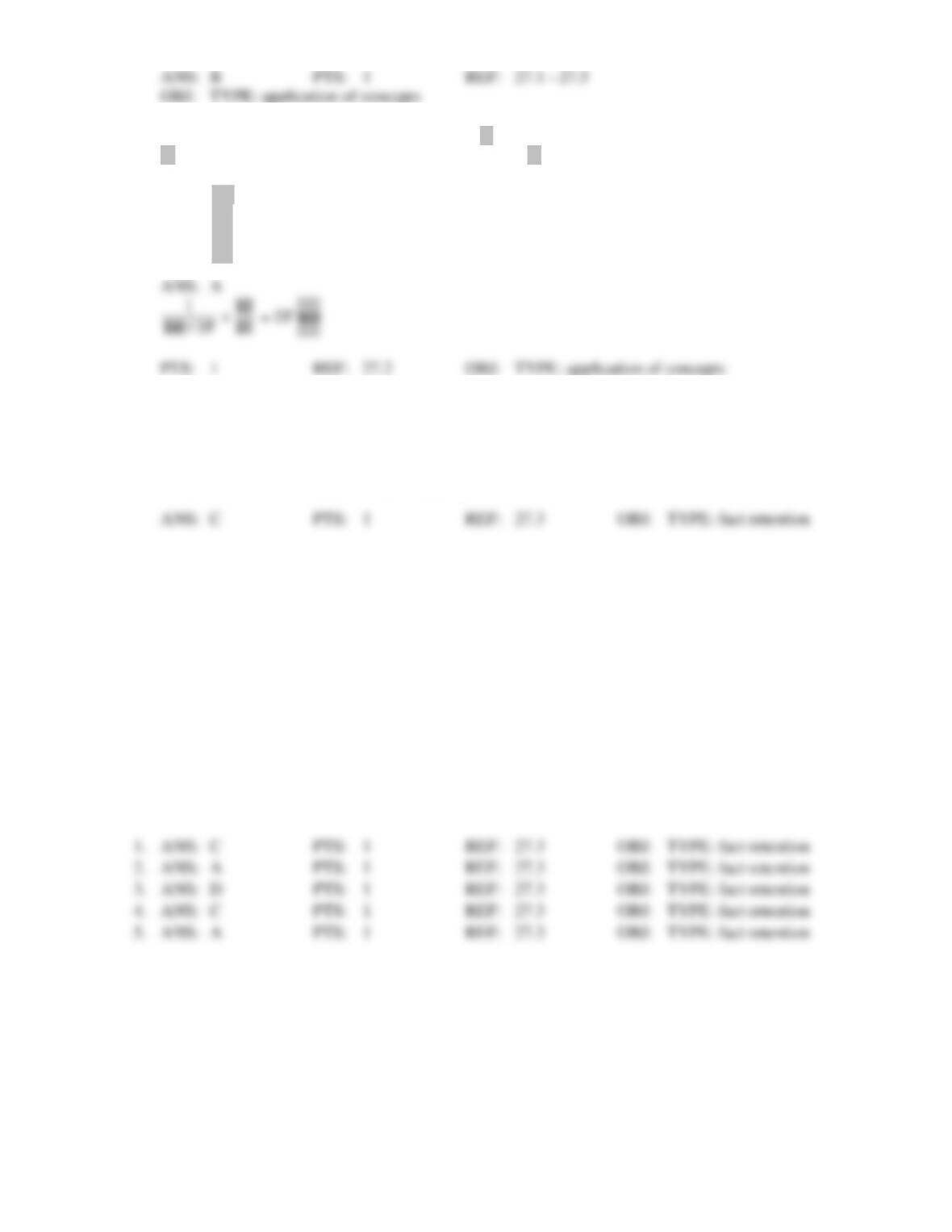
20. If the current spot exchange rate on the SF is $er/SF, and the effective risk-free rate in US dollars is
r1% and the effective risk-free rate in Swiss francs is r2%, what is the 1-year forward rate on the Swiss
franc?
a.
SF ans
b.
SF w1
c.
SF w2
d.
SF w3
21. Which of the following is not correct regarding holders of futures contracts?
a.
Holders are only concerned about the creditworthiness of the exchange
b.
Holder must deposit an initial margin when buying the contract
c.
Holders never take delivery of the underlying asset
d.
Holders are marked-to-market every day
MATCHING
Match the following contracts with the appropriate exchange:
a.
Chicago Mercantile Exchange
b.
New York Cotton Exchange
c.
Chicago Board of Trade
d.
New York Mercantile Exchange
1. corn
2. pork bellies
3. crude oil
4. Treasury bonds
5. LIBOR
Match the following terms with the appropriate measure:
a.
wheat
b.
silver
c.
cocoa
d.
oil
e.
copper
6. lbs
7. metric tons
8. bushels
9. troy oz
10. bbls
Match the appropriate description to the topic:
a.
Basis Risk
b.
Cross-hedging
c.
Tailing the Hedge
d.
Fungibility
e.
Marking-to-Market
11. utilizing underlying securities in the futures contract which differ from the assets being hedged
12. purchasing enough futures contracts to hedge the risk exposure but not so many that you overhedge
13. the possibility of unanticipated changes in the difference between the futures price and the spot price
14. daily cash settlement of contracts
15. the ability to close out a position by taking an offsetting position
SHORT ANSWER
1. What has caused global firms to have increasing exposure to foreign exchange risk?
2. Why do value-maximizing firms hedge?
3. Why are small firms less likely to hedge than larger firms?
4. What is a forward rate agreement (FRA)?
5. What are the differences in the characteristics of forward and futures contracts?
6. Why is it so important for buyers and sellers to close out their positions in futures contracts?
7. Identify the advantage and disadvantage of using options to hedge against risks.
8. If the market is in equilibrium and the risk-free rate is equal to r%, what is the forward price in one
year on an asset with a current spot price of $sp?
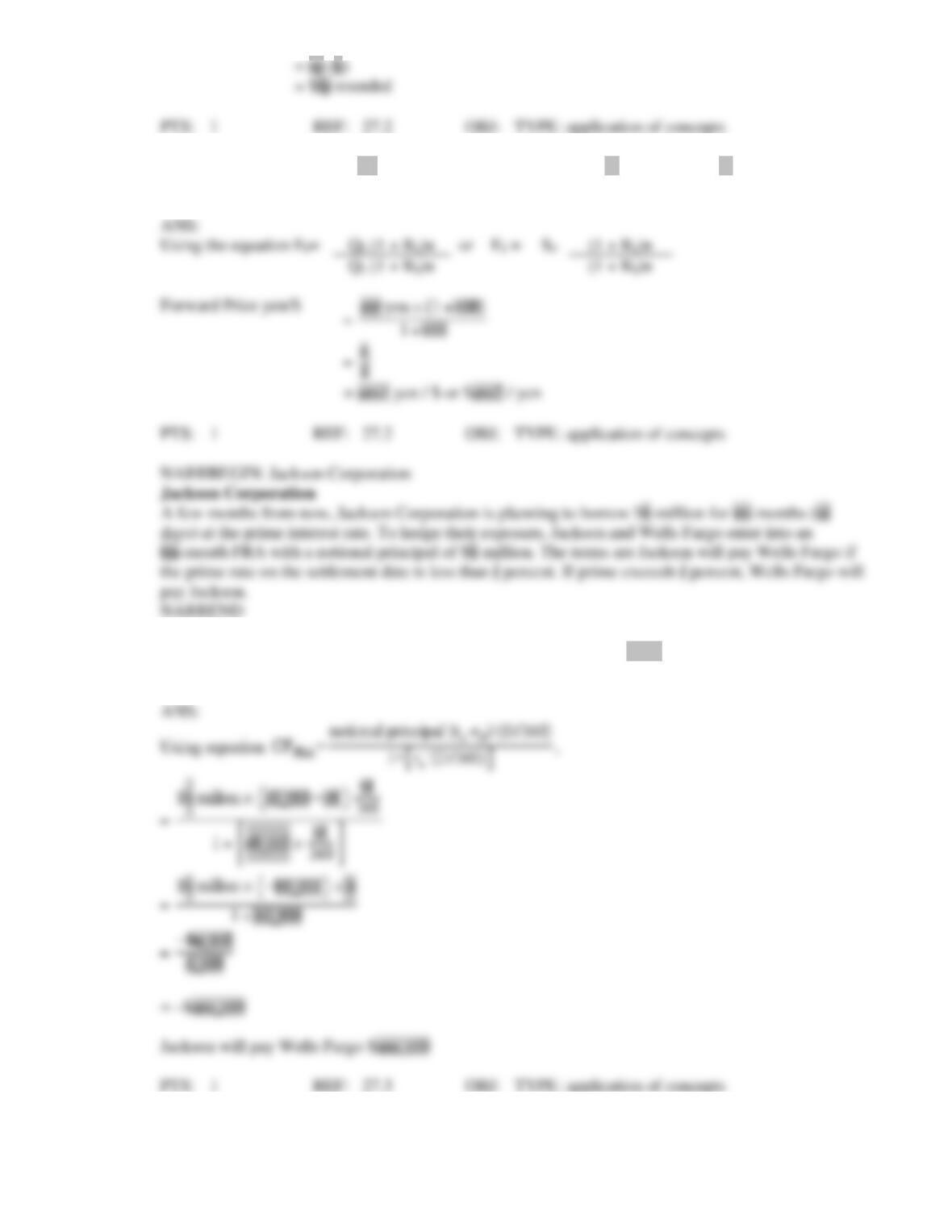
9. If the spot exchange rate is ¥ser / $, the one-year risk-free rate is r1% in U.S. and r2% in Japan, what is
the one-year forward exchange rate on the yen in yen / $ and $ / yen?
10. Refer to Jackson Corporation. What will happen if the prime rate is r_t10 percent on the settlement
date?
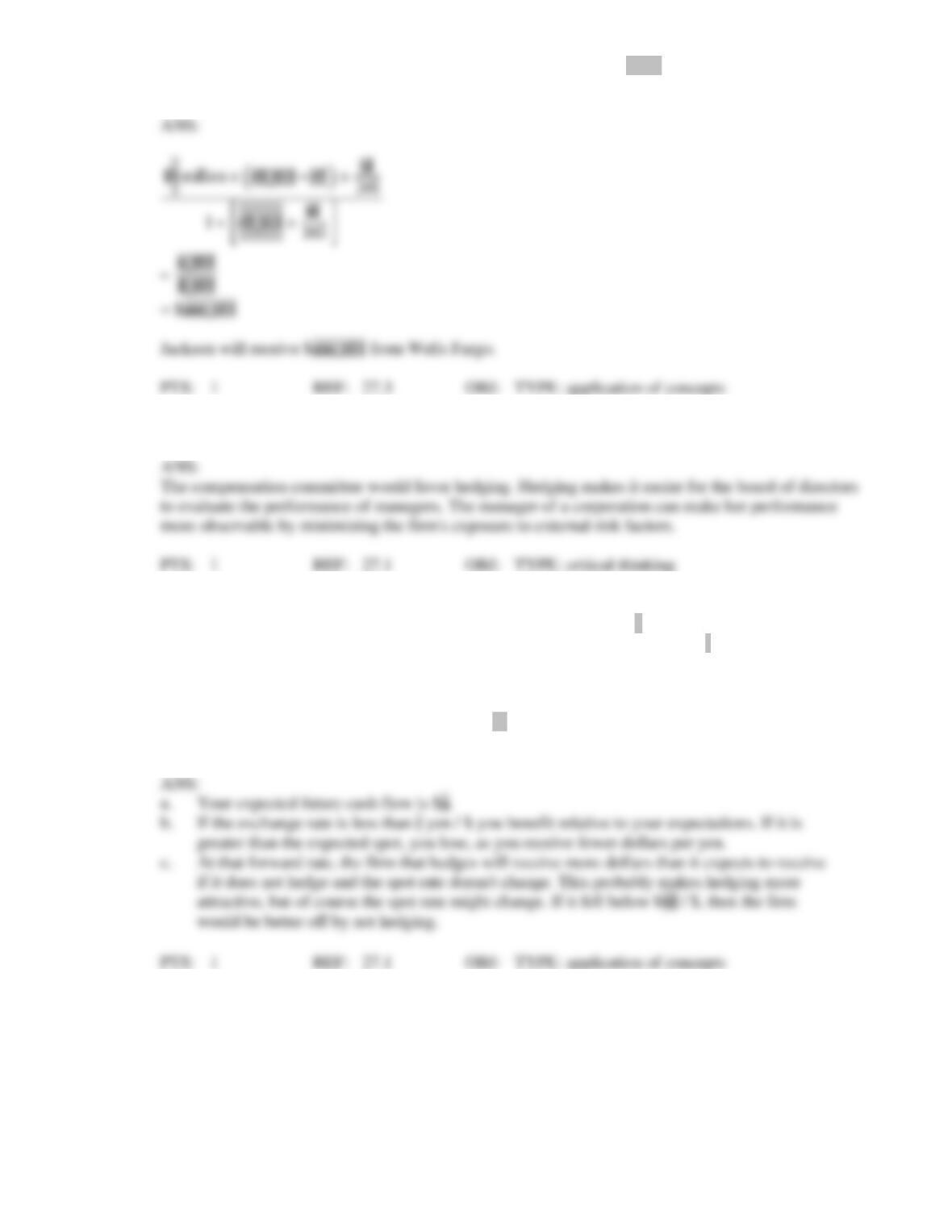
11. Refer to Jackson Corporation. What will happen if the prime rate is r_t11 percent on the settlement
date?
12. How would the compensation committee of a firm’s board of directors feel about hedging?
13. Your firm manufactures electrical circuitry used by a Japanese electronics firm. At the end of the
upcoming six-month manufacturing cycle, your firm expects to have c yen worth of components to sell
to your Japanese customers. You expect the spot rate in six months time to be ¥r / $.
a.
Assuming the spot exchange rate doesn’t change, what is your expected future dollar cash
flow in six months?
b.
Explain the transaction exposure that you face if exchange rates are not as you expect.
c.
If the six-month forward exchange rate is ¥rd / $, does that make hedging seem more or less
attractive?
a.
Your expected future cash flow is $a.
b.
If the exchange rate is less than r yen / $ you benefit relative to your expectations. If it is
greater than the expected spot, you lose, as you receive fewer dollars per yen.
would be better off by not hedging.
14. Suppose Few Tears Inc expects future earnings to be very good. As underlying cash flows increase,
Few Tears finds that its tax liability increases at an increasing rate.
a.
Explain how a hedging strategy might be helpful to Few Tears.
b.
If Few Tears had other means of managing income over time, based on accounting discretion
how would this affect your answer to part a. above?
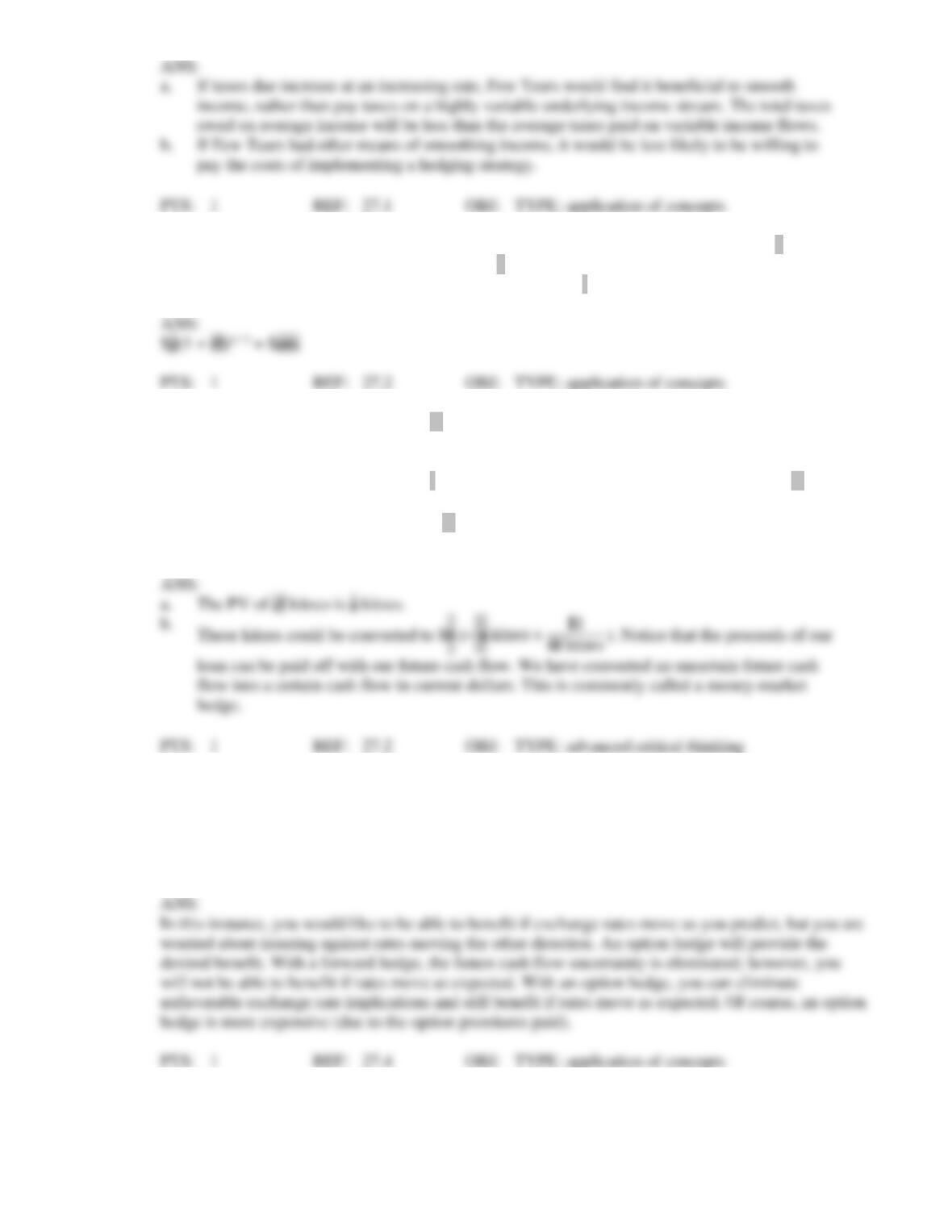
15. Sally plans to purchase 2-month Treasury Bills in four months with a total face value of $d million.
The current price for 6-month Treasury-Bills is $p per $1 million of face value. Suppose that Treasury
bills at all maturities are priced at an effective interest rate of r percent. What is the future price?
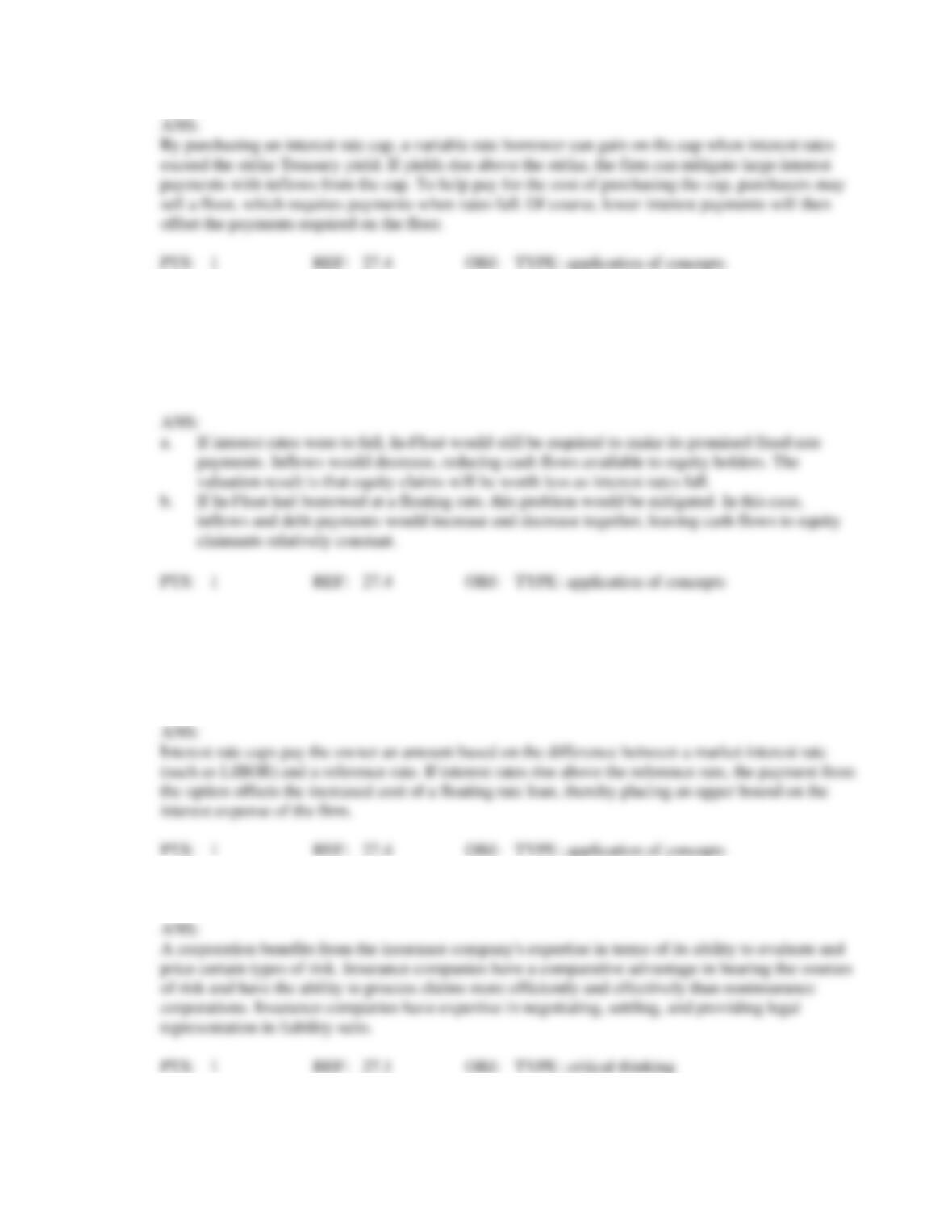
16. Your firm is guaranteed a cash flow of cf kitzes in one year. Your boss is concerned that the exchange
rate between dollars and kitzes will fluctuate between now and then. Unfortunately, there is no forward
market between dollars and kitzes.
a.
The current riskless rate in kitz is r percent. If you were to borrow the present value of cf
kitzes, how much would you receive now?
b.
The spot rate is currently $1 equals er kitzes. If you convert your answer from part a. to dollars
at the spot rate, explain what your transactions would have accomplished?
The PV of cf kitzes is a kitzes.
flow into a certain cash flow in current dollars. This is commonly called a money-market
hedge.
17. You are exposed to a large transaction exposure due to a foreign currency inflow in six months time.
You believe that currencies will likely move in your favor. This will make the future cash flow even
more valuable at expected future spot rates. Unfortunately, given the magnitude of this transaction,
you do not believe you can leave the transaction unhedged. Explain why you might favor an option
hedge rather than a forward hedge.
pay the costs of implementing a hedging strategy.
18. Discuss why a variable rate borrower might purchase an interest rate cap. If the cost of the cap was
very large, discuss why a variable rate borrower might also sell a floor.
19. In-Float has borrowed with ten-year debt at a fixed rate of 8 percent. Cash inflows for In-Float are
closely related to market rates. When rates increase or decrease, cash flows to In-Float increase and
decrease substantively.
a.
Describe what will happen to In-Float if market interest rates fall.
b.
If In-Float had borrowed at a floating interest, describe how these risks could be mitigated.
claimants relatively constant.
ESSAY
1. In a well-written essay describe interest rate caps. Explain how these derivative contracts are
structured and how they are used to manage interest rate risk.
2. What are the motivations for a corporation to utilize an insurance company to reduce risk?

3. Hedging marketwide sources of risk does not seem to provide any real service other than reduced
volatility. This risk reduction is costly in terms of the resources required to implement an effective
risk-management program. Discuss this statement and why firms may choose a hedging strategy.
4. A 6-month T-bill with face value $fv is currently selling for $cs. The effective annual risk-free rate
over the next two months is rfr0%. The forward price quoted to you for a four month T-bill with the
forward contract settled in two months is $tm. Demonstrate through calculations how you would
determine whether an arbitrage opportunity existed. Describe the necessary actions to gain the
arbitrage profit.
5. The current spot exchange rate on the British pound is $er1 / £. The 1-year risk-free rate for borrowing
in dollars is r1%, and the rate for borrowing in pounds is r2%. What should be the 1-year forward
exchange rate on the British pound?
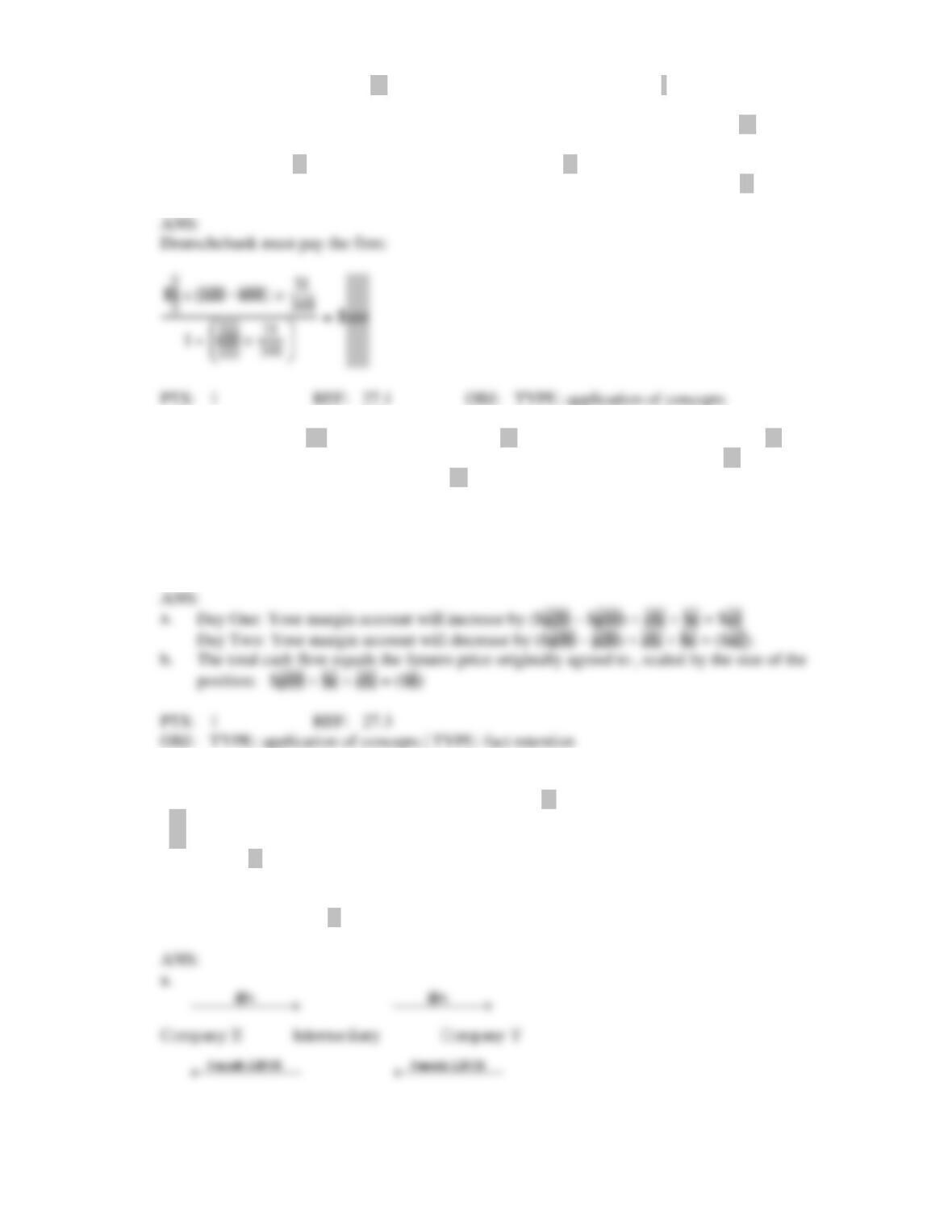
6. A firm is planning to borrow $b0 million in three months at LIBOR plus l basis points and is
concerned that LIBOR will increase before the company borrows. To hedge this exposure, the firm
and Deutsche bank enter into a forward rate agreement with a notional principal of $b0 million. The
terms of the contract are such that the firm will pay Deutschebank if the one-month LIBOR is less than
the forward rate of r1%. If the one-month LIBOR exceeds r1%, Deutschebank must pay the firm.
What transaction will take place if the one-month LIBOR three months from now is r2%?
7. Assume you go long cfc corn futures contracts at p1 cents per bushel. Each contract has bc bushels of
corn in it. On the first day after you enter the long position, the settlement price is p2 cents per bushel.
On the second day, the settlement price is p3 cents per bushel.
a.
Demonstrate marking-to-market with this information.
b.
If delivery were on day two, what would be your cash flow (total of out of
pocket and transfers out of your margin account) then? Assume that you did
not withdraw any money from your margin account so far.
Day One: Your margin account will increase by ($p20 – $p10) cfc bc = $a1
Day Two: Your margin account will decrease by ($p30 – p20) cfc bc = ($a2).
position: –$p10 bc cfc = ($b)
8. An intermediary has arranged an interest rate swap and is acting as the counterparty to both contracts.
The swap calls for Company X to pay the intermediary r1% per year based on a notional principal of
$p0 million. In return, the intermediary will pay Company X the 6-month LIBOR applied to the same
$p0 million notional principal. At the same time, the intermediary enters into an agreement to pay
Company Y r2% in exchange for the 6-month LIBOR. All the contracts call for semi-annual payments.
a.
Diagram the structure of this fixed-for-floating interest rate swap.
b.
What amount will the intermediary always receive?
c.
Assume LIBOR is rc% at the end of the first 6-month period. What cash flows will occur?
9. A U.S. company issues $i10 million in 5-year bonds with a coupon rate of r1%. A British firm issues
an equivalent principal amount of £i20 million in 5-year bonds that have a coupon rate of LIBOR + dr
basis points. The two companies agree on a semiannual fixed-for-floating currency swap. What
exchanges of cash will occur with this agreement at the start and, assuming at the end of the first six
months the LIBOR is r1%, what exchange will take place?