278)
What is the relationship between the Sherman Antitrust Act and the Clayton Act?
278)
A)
The Sherman Antitrust Act encouraged competition among firms in the U.S. while the
Clayton Act encouraged competition among foreign firms.
B)
The Clayton Act strengthened the Sherman Antitrust Act by limiting some very specific
business practices.
C)
The Clayton Act was the first act passed and the Sherman Antitrust Act was the second.
D)
Both Acts deal with issues of setting price and quantity for regulated industries.
279)
The U.S. Justice Department prosecuted Microsoft under the terms of
279)
A)
the Kefauver amendment.
B)
the 1933 amendment to the Federal Trade Commission Act.
C)
the Sherman Act.
D)
none of the above.
C
280)
The federal regulatory agency whose mission is to regulate workplace health and safety is the
280)
A)
OSHA.
B)
FTC.
C)
SEC.
D)
AFL–CIO.
A
281)
Commonwealth Edison is the only provider of electricity to many households in the Chicago area.
Commonwealth Edison is regulated by the government. This type of regulation is known as
281)
A)
the Federal Register.
B)
social regulation.
C)
the market share test.
D)
economic regulation.
D
B
282)
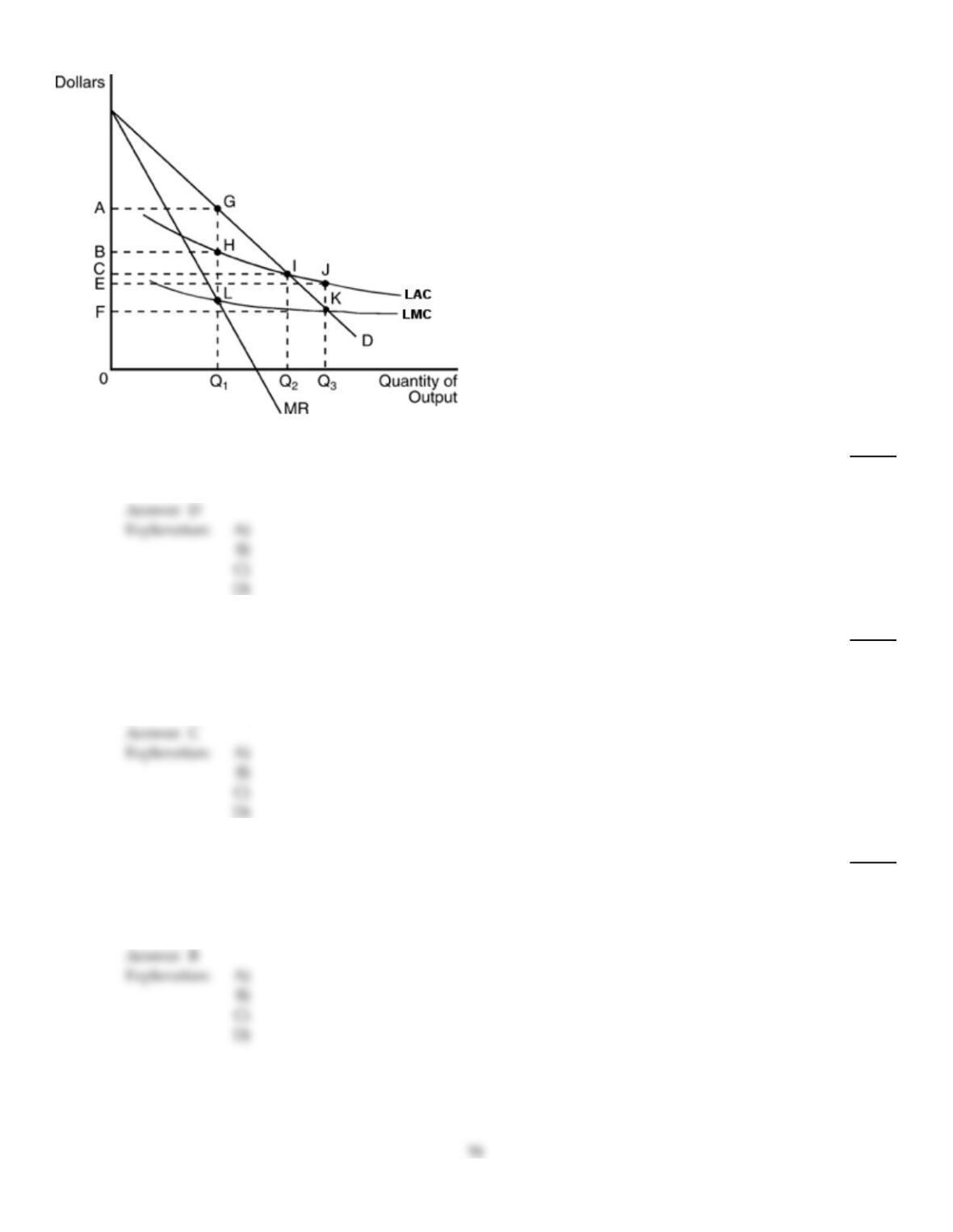
In the above figure, if this natural monopolist were forced to use marginal cost pricing, it would
sell the product at the price
282)
A)
A.
B)
C.
C)
E.
D)
F.
283)
Which of the following is illegal according to the antitrust laws?
283)
A)
price discrimination based on cost differences
B)
the use of coupons
C)
price fixing
D)
vertical mergers
284)
With average cost pricing, the monopolist
284)
A)
produces where P = MC.
B)
earns a normal rate of return for its shareholders.
C)
does not cover opportunity costs.
D)
earns no accounting profit.
285)
Which of the following statements regarding economic regulation is TRUE?
285)
A)
Economic regulation deals mainly with prices firms charge, but firms can alter their return by
altering quality of service, effectively raising the price per constant–quality–unit.
B)
Economic regulation has failed by insisting that firms must be allowed to earn a normal rate
of return.
C)
Rate–of–return regulation has been much more effective than cost–of–service regulation.
D)
Economic regulation deals only with rates of return, and not with prices.
286)
If regulators disallow price increases requested by a natural monopoly that is currently earning an
economic loss, quality of service will
286)
A)
remain unchanged.
B)
increase rapidly.
C)
likely fall.
D)
none of the above.
C
287)
The Sherman Antitrust Act was passed to
287)
A)
control the growth of monopolies in the U.S.
B)
prevent market price from equaling marginal cost.
C)
protect the monopoly profits of firms.
D)
protect companies from foreign competition.
A
288)
The act of Congress which prohibited “unfair or deceptive acts or practices in commerce” is called
288)
A)
the Federal Trade Commission Act of 1914.
B)
the Clayton Act.
C)
the Robinson–Patman Act.
D)
the Chain Store Act.
A
A
289)
The problem of excess pollution mainly occurs because of
289)
A)
a positive externality.
B)
a monopoly.
C)
asymmetric information.
D)
a negative externality.
290)
“As compared to the benefits of economic and social regulation, the costs are minimal.” Do you agree or
disagree? Why?
291)
How does social regulation differ from economic regulation?
292)
“Regulations do not always have the intended result.” Do you agree or disagree? Why?
293)
What is the difference between product versioning and product bundling? Which of these two business
practices have antitrust authorities been more likely to regard to be the form of price discrimination called tie–in
sales? Why?
294)
Explain the share–the–gains, share–the–pains theory. How does it differ from the capture hypothesis?
295)
Explain the capture hypothesis.
296)
What is the difference between holding a monopoly and monopolization? Which is illegal? Explain.
297)
Distinguish between cost–of–service regulation and rate–of return regulation. What problem is inherent in both
types of regulation?
298)
What are the major rationales for consumer protection in nonmonopolistic industries?
299)
What is the lemons problem? How do firms try to address this problem?
300)
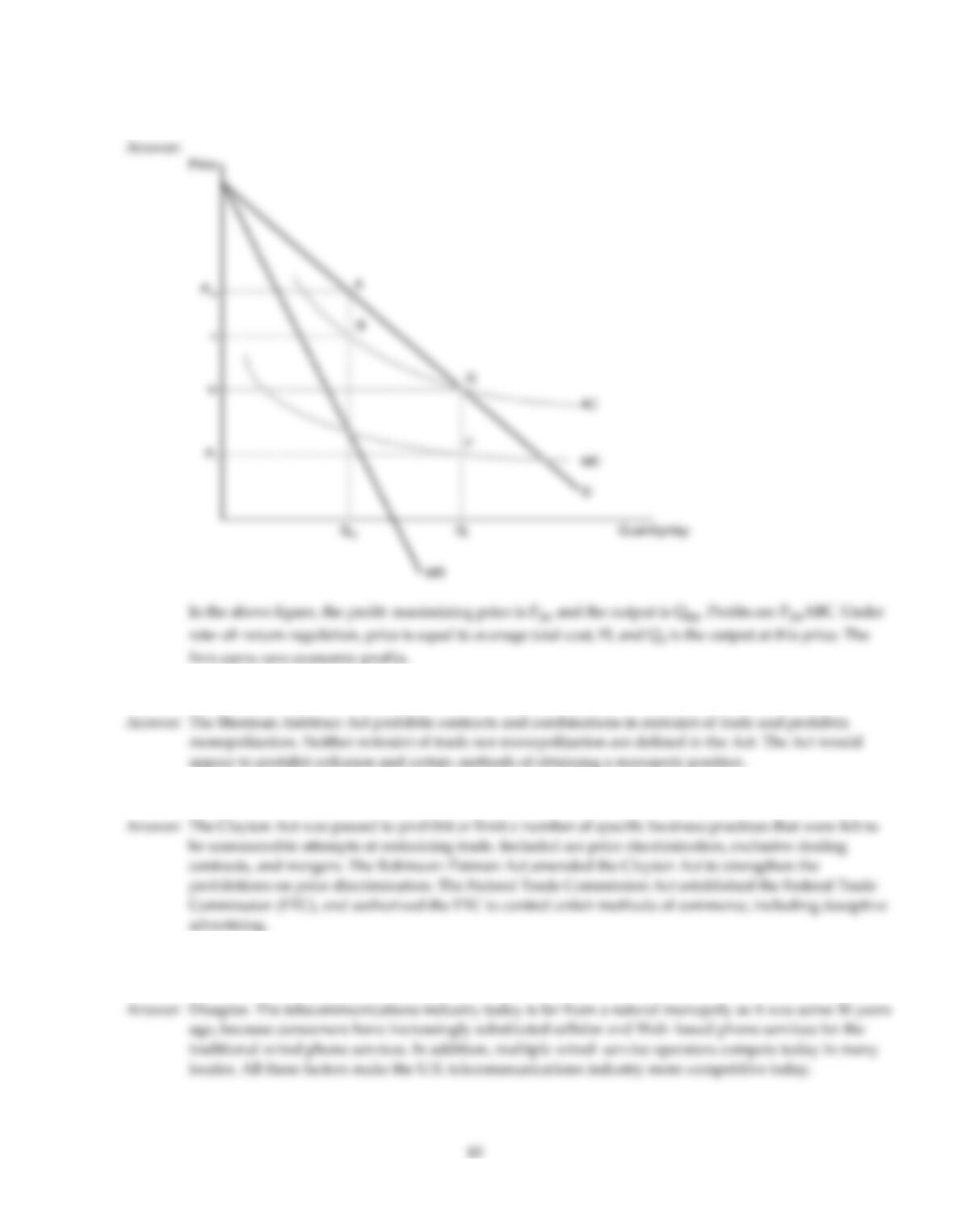
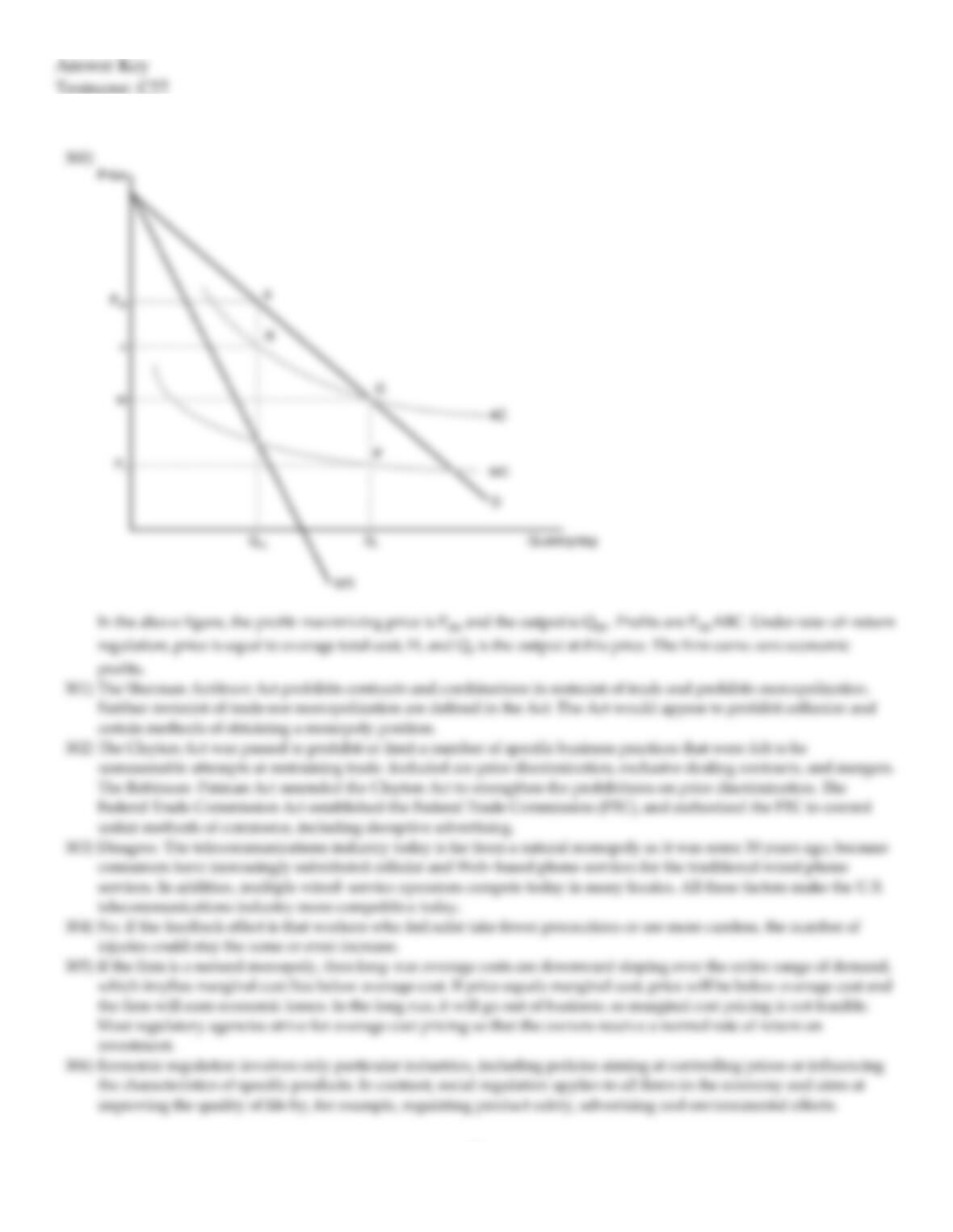
Using a graph, show the price–output combination of a natural monopoly without regulation and the
price–output combination if the government requires the monopoly to earn a normal rate of return. What are
economic profits in each situation?
301)
Discuss the important provisions of the Sherman Antitrust Act of 1890.
302)
Discuss the Clayton Act and the Federal Trade Commission Act, and relevant amendments to them.
303)
“Today the U.S. telecommunications industry remains heavily regulated by the government as it was some 30
years ago.” Do you agree or disagree? Why?
304)
Suppose OSHA requires a factory to install specific safety equipment to reduce the number of injuries in the
factory. Would the number of accidents necessarily decline? Why or why not?
305)
What is the problem with marginal cost pricing in the natural monopoly situation? How do regulatory agencies
in the United States usually handle the problem?
306)
What is the main difference between economic regulation and social regulation?
307)
A common feature of regulated industries is cross–subsidization, which is a situation when one group of
customers pays prices above costs while another group of customers pays prices below costs. The one group is
subsidizing the other group. Is this practice more consistent with the capture hypothesis or the share–the–gains,
share–the–pains theory? Explain.
308)
Why do government regulators not enforce marginal cost pricing for natural monopolies? What are the
common regulatory solutions?
91
92
93