149)
The Interstate Commerce Commission (ICC) regulates railroads, barges and trucks. Suppose
technical change lowers the costs of railroads. As a result, the ICC permits railroads to lower prices
some but also alters the rates of barges and trucks so they get additional business. The ICC would
be acting consistently with
149)
A)
the capture theory of regulation.
B)
the share–the–gains, share–the–pains theory of regulation.
C)
the public interest theory of regulation.
D)
None of the theories presented in the text since economic regulation is specific to a single
industry and not to agencies that cover more than one industry. That is the province of social
regulation.
150)
Regulation of monopolies that allows prices to reflect only the actual cost of production and no
monopoly profits is referred to as
150)
A)
natural regulation.
B)
cost–of–service regulation.
C)
rate–of–return regulation.
D)
service–opportunity regulation.
Explanation:
151)
The notion that regulated industry members themselves, sooner or later, are able to control
regulatory bodies is referred to as
151)
A)
consumerism.
B)
the capture theory.
C)
the control theory.
D)
cartelization.
Explanation:
Explanation:
152)
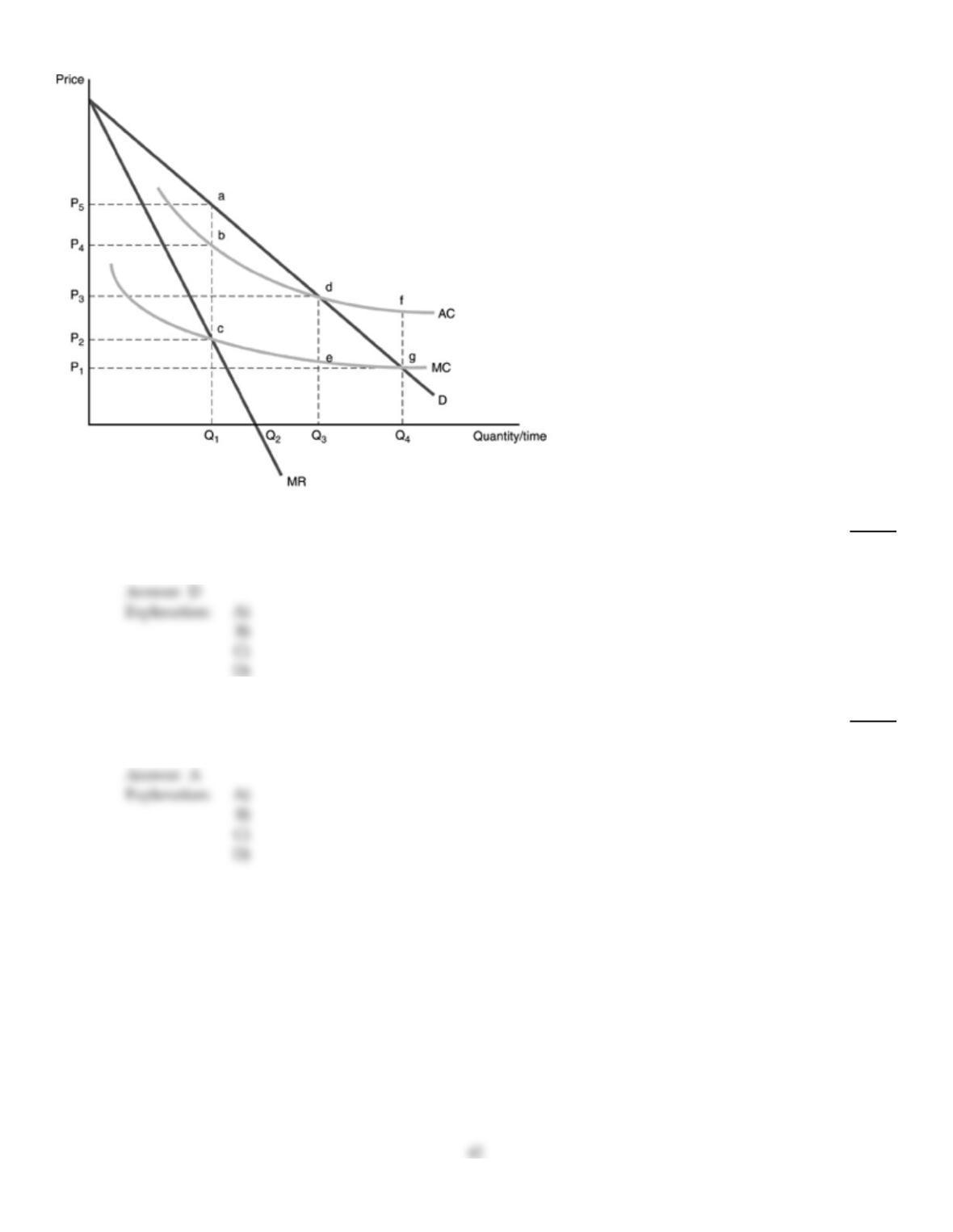
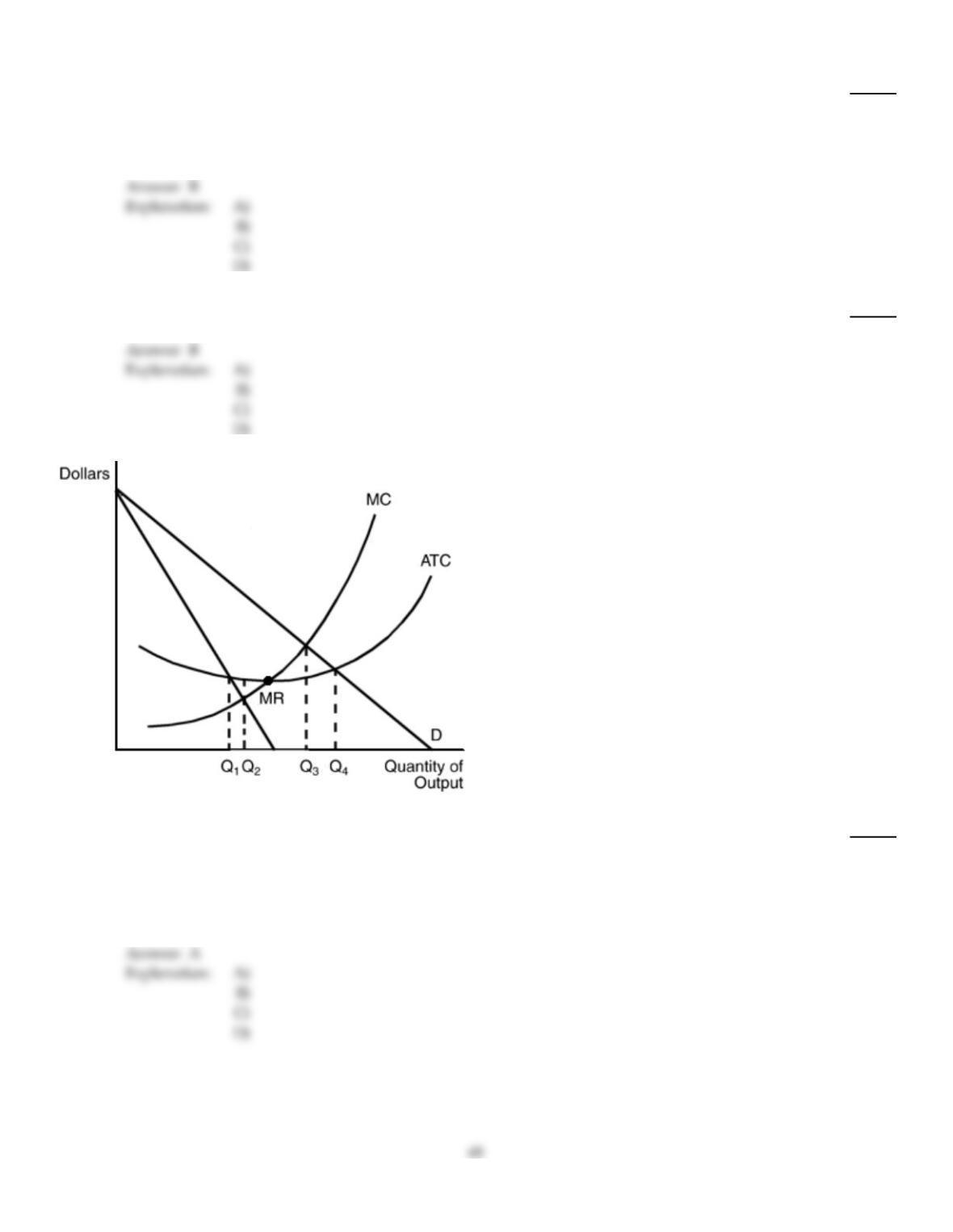
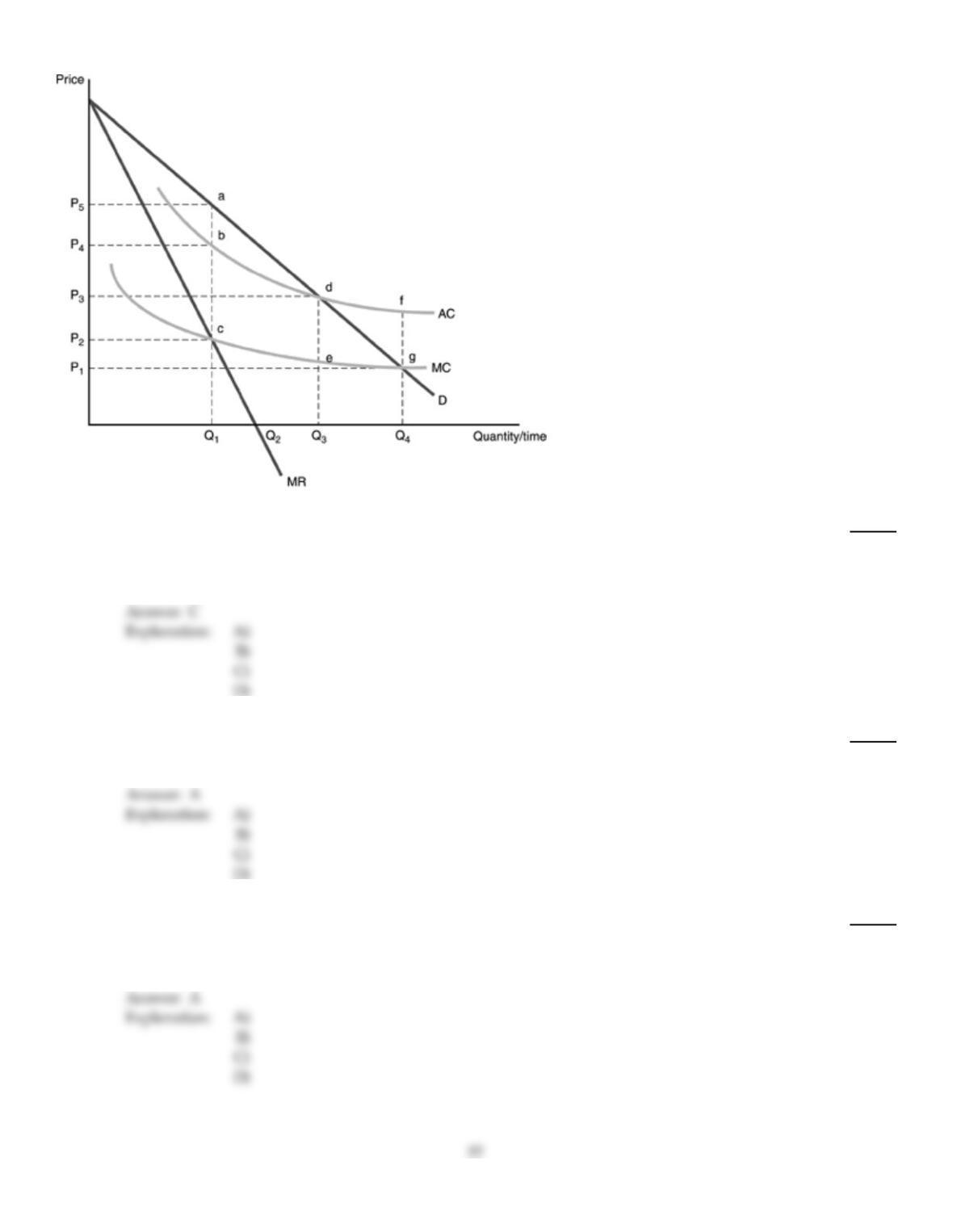
Refer to the above figure. An unregulated natural monopolist would choose
152)
A)
output rate of Q1 and price P2.
B)
output rate Q3 and price P3.
C)
output rate Q4 and price P1.
D)
output rate Q1 and price P5.
153)
The Food and Drug Administration (FDA) is an agency that would enforce
153)
A)
social regulation.
B)
antitrust laws.
C)
economic regulation.
D)
price discrimination.
154)
When regulating a natural monopoly, average cost pricing is usually used rather than marginal
cost pricing because
154)
A)
average cost pricing is more economically efficient than marginal cost pricing.
B)
average cost pricing allows the firm to earn a normal rate of return on investment, while
marginal cost pricing leads to economic losses.
C)
average cost pricing leads to lower profits than marginal cost pricing.
D)
average cost pricing leads to a lower market price than marginal cost pricing.
155)
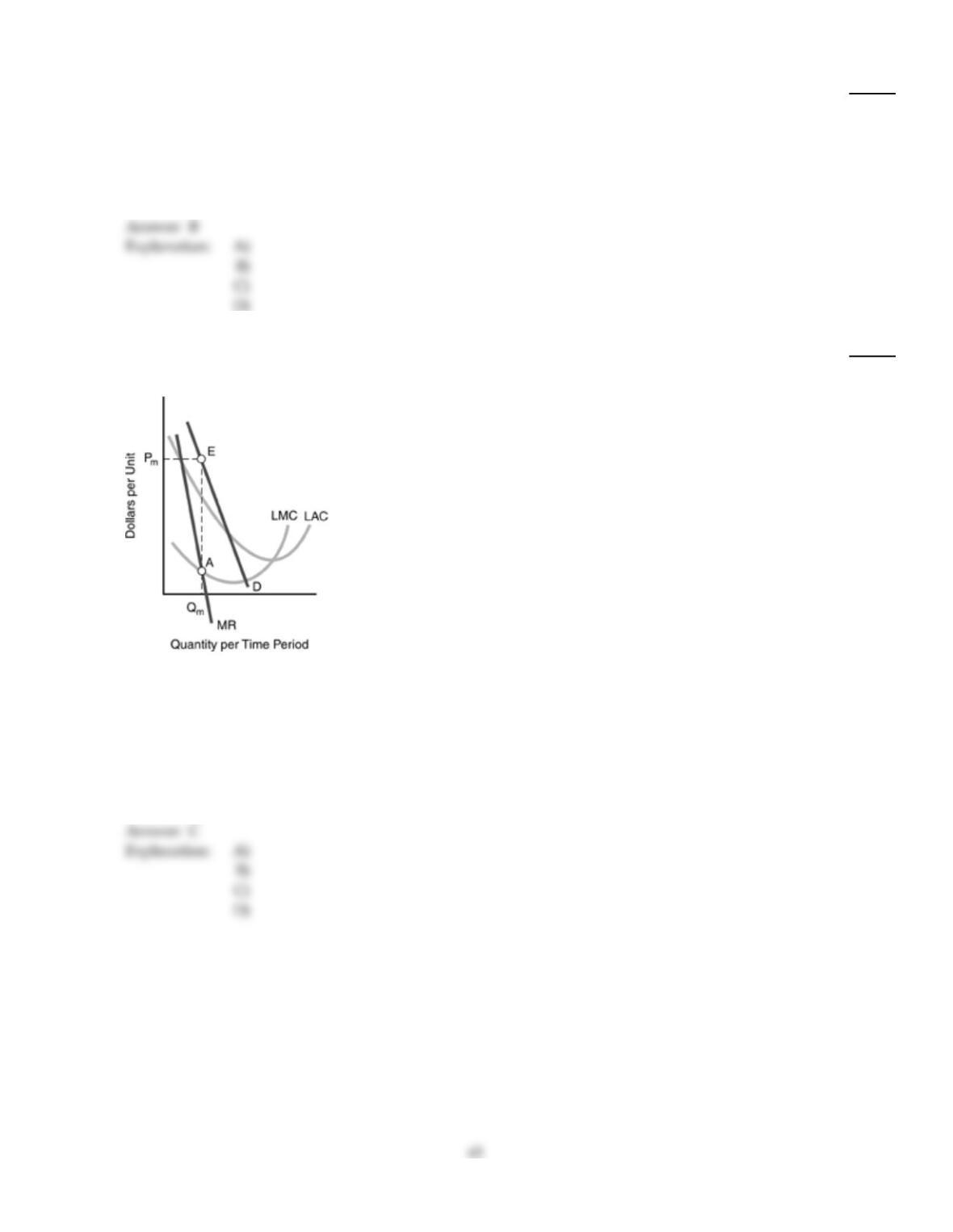
Using the figure as a guide, which of the following is FALSE with respect to profit maximization
and the monopolist?
155)
A)
A monopolist (like any other firm) will select an output rate at which marginal revenue is
equal to marginal cost, at the intersection of the marginal revenue curve and the marginal cost
curve.
B)
Profits are the positive difference between total revenues and total costs.
C)
When compared to a competitive situation, consumers pay a higher price to the monopolist,
and consequently are forced to purchase more of a product as price varies directly with
quantity demanded.
D)
The monopolist will produce quantity Qm and charge a price of Pm.
156)
If antitrust legislation is successful, then
156)
A)
the price of each item will equal its marginal social opportunity costs.
B)
most firms will be earning a positive economic profit.
C)
firms will produce the quantity at which marginal cost equals marginal revenue.
D)
natural monopoly will be eliminated.
157)
The first antitrust law in the United States was the
157)
A)
Sherman Act.
B)
Clayton Act.
C)
Glass–Steagall Act.
D)
Robinson–Patman Act.
158)
Financial markets are regulated by
158)
A)
the Stock and Exchange Commission.
B)
the Stock and Bond Exchange Commission.
C)
the Securities and Exchange Commission.
D)
the Security and Protection Commission.
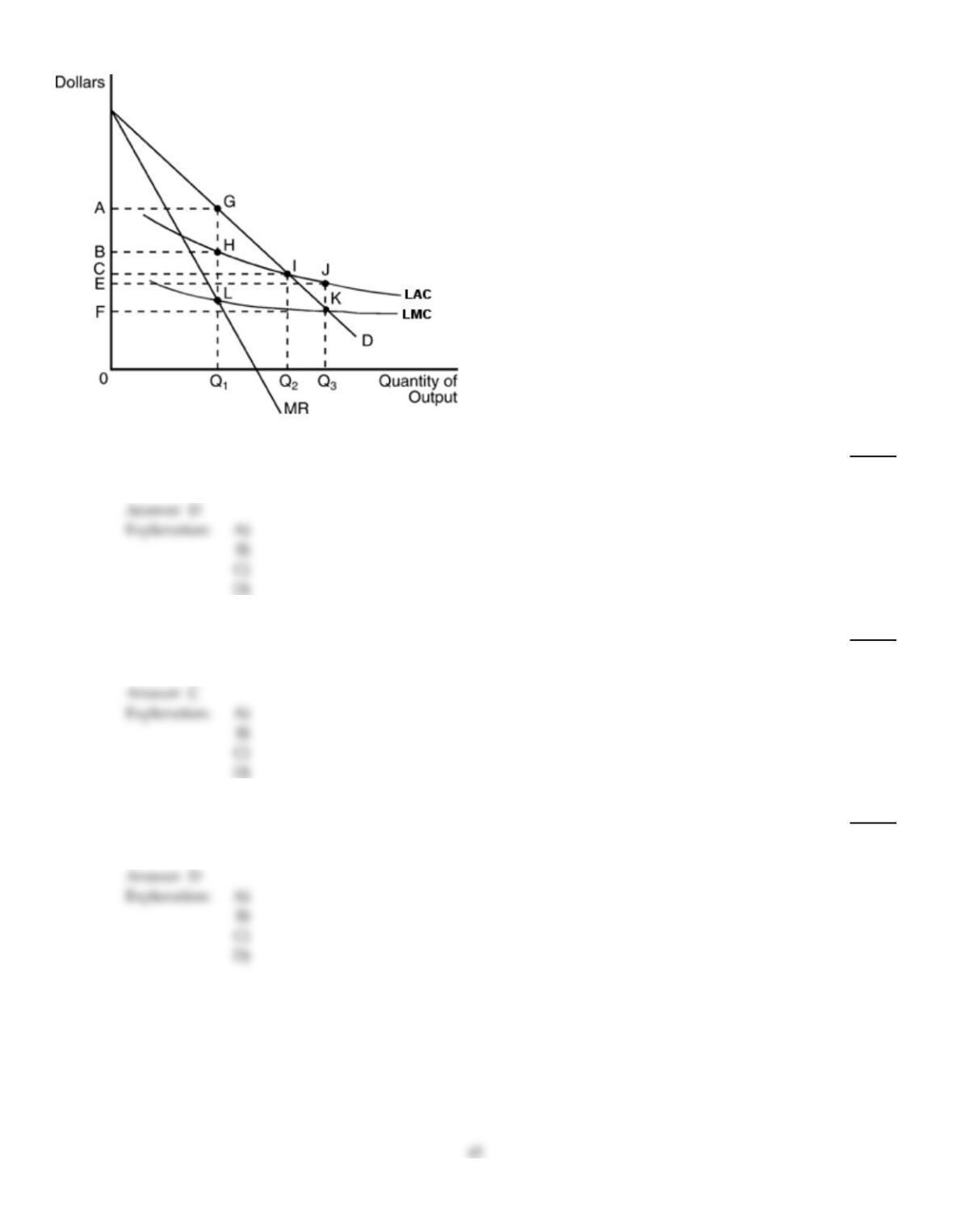
159)
In the above figure, if this natural monopolist were unregulated, the profit maximizing firm would
sell the product at the price
159)
A)
B.
B)
C.
C)
F.
D)
A.
160)
Which of the following is exempt from antitrust laws?
160)
A)
professional basketball
B)
automobile companies
C)
suppliers of military equipment
D)
telephone companies
161)
Which of the following would most likely promote competitive pricing of products?
161)
A)
Wheeler–Lea Act
B)
Federal Trade Commission Act
C)
Robinson–Patman Act
D)
Clayton Act
162)
Enforcement of antitrust policy is the responsibility of
162)
A)
the Trust Division of Congress and the World Trade Organization.
B)
the World Trade Organization and the FDA.
C)
the Federal Trade Commission and the Antitrust Division of the Department of Justice.
D)
the Food and Drug Administration and Congress.
163)
Which of the following is NOT exempt from antitrust laws?
163)
A)
public transit systems
B)
professional baseball
C)
labor unions
D)
airlines
164)
One key purpose of economic regulation is
164)
A)
to focus on the impact of production on the environment and society, the working conditions
under which goods and services are produced, and sometimes the physical attributes of
goods.
B)
to control the price that regulated enterprises are allowed to charge.
C)
to force a firm to produce at the point at which marginal cost equals marginal revenue.
D)
to control the quality of service provided by a monopolist.
165)
For a firm to be economically efficient from society’s point of view, it should produce to the point at
which
165)
A)
marginal cost equals marginal revenue.
B)
marginal cost equals average total cost.
C)
average total cost equals price.
D)
marginal cost equals price.
166)
All of the following are exempt from antitrust lawsuits EXCEPT
166)
A)
software developers.
B)
public transportation.
C)
professional baseball.
D)
labor unions.
167)
Which of the following is NOT a government response to asymmetric information?
167)
A)
liability laws
B)
manufacturer’s warranties
C)
social regulation
D)
government licensing
168)
The “primary motive” of regulators, according to the share–the–gains, share–the–pains theory, is to
168)
A)
keep their jobs.
B)
ensure that all customers share the benefits of regulation, and not just the wealthiest
consumers.
C)
maximize their income through accepting monetary payoffs from groups.
D)
ensure that every group gets what it wants.
169)
U.S. securities firms recently agreed to pay a record amount of $1.4 billion in settlement charges
brought by government regulators. Regulators claimed that firms had abused investors during the
market boom of the 1990s. Abuses included analysts tailoring their research reports and ratings on
the stocks they covered in order to win more business for their firm. If this settlement causes Wall
Street firms to comply with the letter of the law but they violate the spirit of the law, the firms are
engaging in
169)
A)
elimination of conflicts of interest.
B)
the capture hypothesis.
C)
creative response.
D)
deregulation.
170)
The Sherman Antitrust Act of 1890 prohibited
170)
A)
interstate commerce.
B)
attempts to restrain trade.
C)
export tariffs.
D)
all existing monopolies.
171)
According to the Justice Department and the Federal Trade Commission, a merger would likely be
challenged if
171)
A)
the number of firms in the post–merger industry is very large.
B)
the firms’ markets are very large.
C)
the post–merger industry has an HHI above 1,500 and the HHI rises by more than 100.
D)
the post–merger industry has an HHI above 500 and the HHI rises by more than 50.
172)
Regulation of a natural monopoly that forces it to price and produce as if it were a competitive firm
results in
172)
A)
higher profits for the monopoly.
B)
the market being instantly competitive.
C)
a highly unstable marketplace.
D)
economic losses for the monopoly.
D
173)
When promoting average cost pricing, regulators
173)
A)
inflate costs so much that price ends up as large as would prevail under unregulated
monopoly.
B)
fail to consider a return to investors, so regulated firms often have a hard time raising
investment funds.
C)
encourage firms to produce at the output level where price equals marginal cost.
D)
include what they consider to be a normal rate of return on investment.
D
174)
The Federal Trade Commission regulates which of the following?
174)
A)
unfair trade practices by businesses
B)
the banking industry
C)
financial markets
D)
trade with third world countries
A
C
175)
One problem that might occur as a result of economic regulation is
175)
A)
the demand for the good may be greater than the supply.
B)
the quality of service might be lowered.
C)
the firm may be earning more than a normal rate of return on investment.
D)
that social regulation may follow.
176)
The act of offering two or more products for sale as a set is called
176)
A)
tie–in sales.
B)
bundling.
C)
branding.
D)
versioning.
177)
In the above figure, which of the following statements is FALSE if the firm is operating at output
level Q2?
177)
A)
The price is lower than at an equivalent firm forced by regulators to charge ATC pricing.
B)
The output is equivalent to an unregulated monopolist.
C)
Average costs would be lowered by expanding output.
D)
Economic profits are positive.
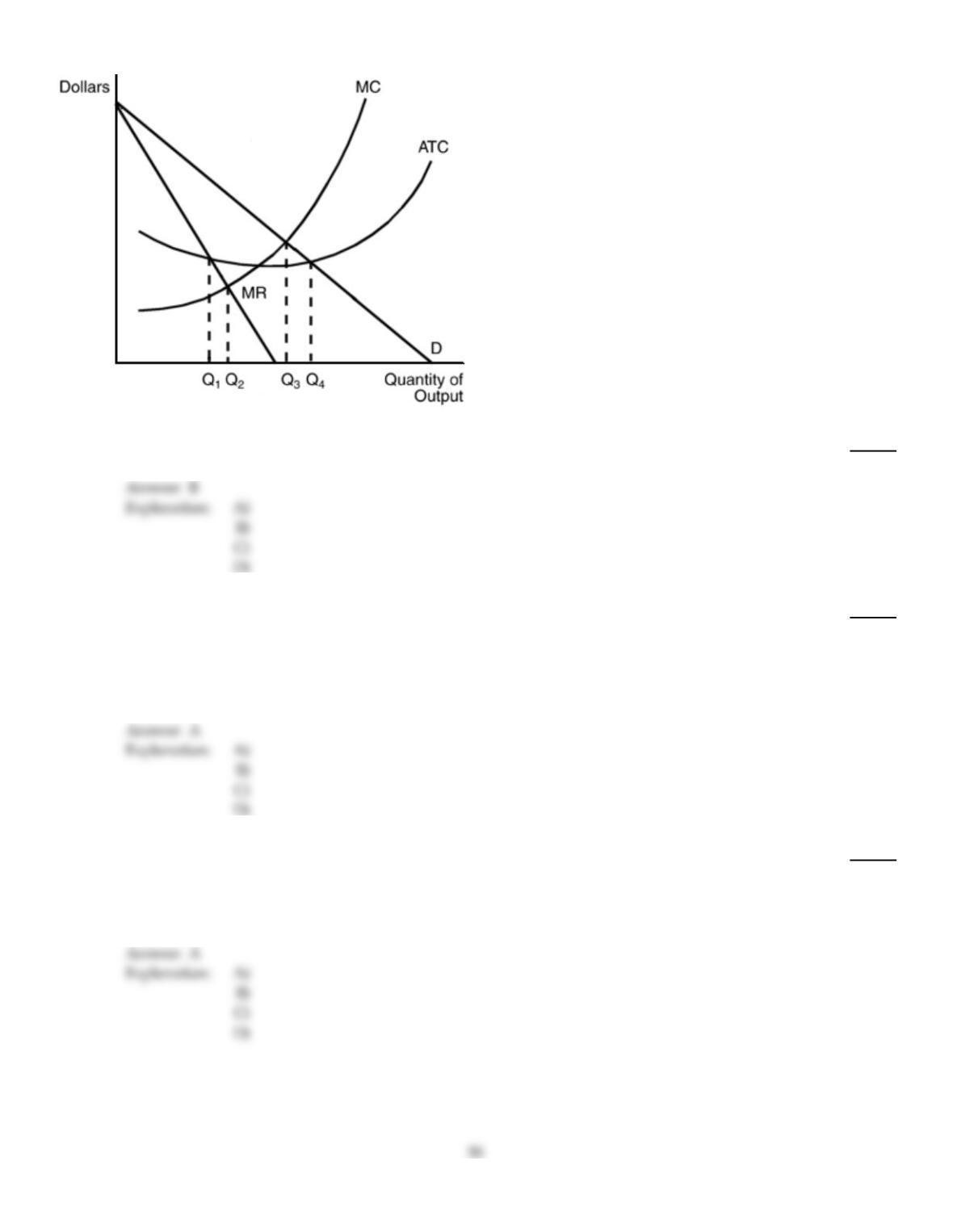
178)
In the above figure, an unregulated natural monopolist will produce output level
178)
A)
Q1.
B)
Q2.
C)
Q3.
D)
Q4.
179)
Ajax Corporation has just started advertising that there are 16 ounces in every package. In reality
the packages contain only 14 ounces. This misleading advertising
179)
A)
could be subject to an investigation by the Federal Trade Commission.
B)
could be subject to an investigation by the Sherman Commission.
C)
is exempt from the antitrust laws.
D)
is in violation of the Robinson–Patman Act.
180)
The Supreme Court has defined the offense of monopolization to
180)
A)
include the possession of monopoly power and the willful maintenance of that power.
B)
be when only one firm exists in an industry.
C)
be unfair acts in the practice of commerce.
D)
occur when asymmetric information exists.
181)
The act of selling an item in slightly altered forms at different prices and to different groups of
consumers is known as
181)
A)
lemons marketing.
B)
versioning.
C)
tie–in sales.
D)
bundling.
182)
Which of the following is NOT a reason for the government to regulate a nonmonopolistic
industry?
182)
A)
market failures
B)
to protect consumer interests
C)
to allow firms to achieve the profit maximizing output
D)
asymmetric information
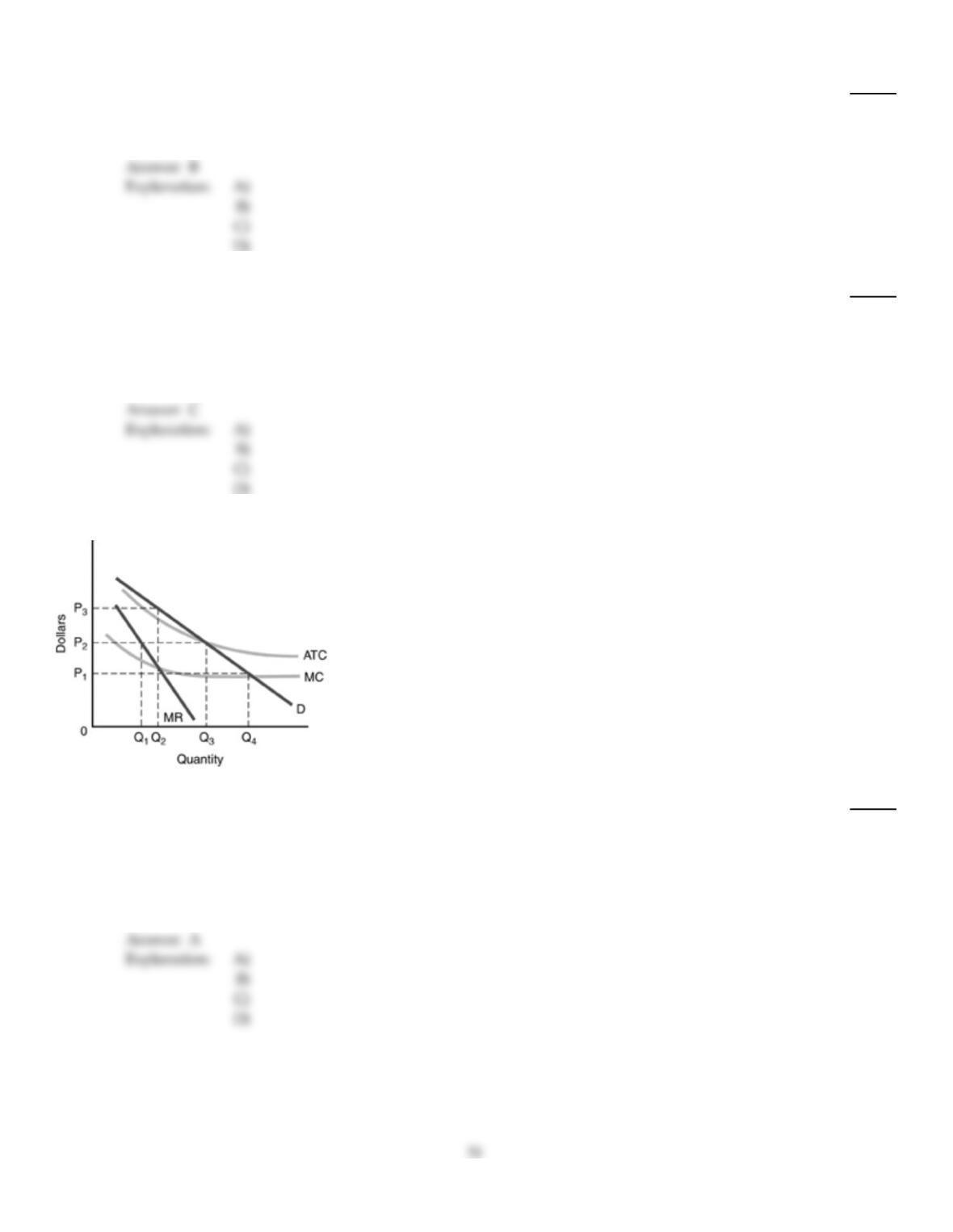
183)
Use the above figure. A regulatory commission sets the maximum price this monopolist can charge
at P1. If this monopolist were to produce, it
183)
A)
would produce Q4 output and generate losses.
B)
would produce Q2 output and generate losses.
C)
would produce Q4 output and generate profits.
D)
would produce Q2 output and generate profits.
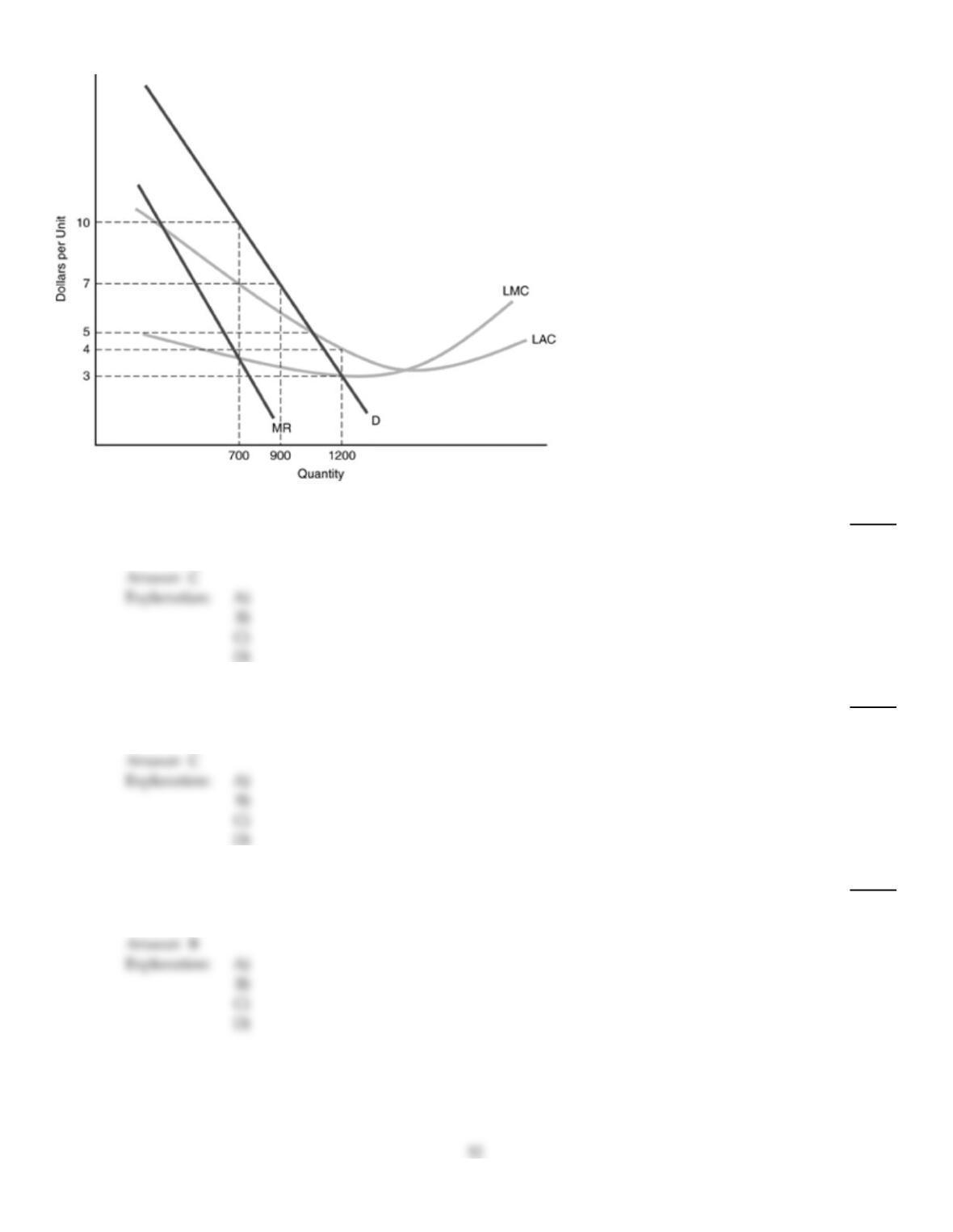
184)
In the above figure, if the monopolist engages in marginal cost pricing, what are its output and
price?
184)
A)
900, $7
B)
700, $7
C)
1,200, $3
D)
700, $10
185)
Regulation that is based upon the cost of providing the good or service is known as
185)
A)
rate–of–return regulation.
B)
social regulation.
C)
cost–of–service regulation.
D)
deregulation.
186)
U.S. government regulation of social and economic activity
186)
A)
is confined to antitrust law.
B)
has increased steadily since 1970.
C)
costs less now than it did in the 1980s.
D)
only began after World War II.
187)
Which of the following organizations is exempt from prosecution under the Sherman Antitrust Act
(1890)?
187)
A)
labor unions
B)
television stations
C)
book publishers
D)
retailers
188)
The Sherman Antitrust Act was enforced in 1906 by a ruling of the Supreme Court regarding the
monopolization of the oil industry by
188)
A)
Texaco Oil of Texas.
B)
Gulf Oil of Pennsylvania.
C)
Standard Oil of New Jersey.
D)
Getty Oil of Oklahoma.
189)
A regulated natural monopolist allowed to earn a “fair” rate of return would produce to the point at
which
189)
A)
the marginal revenue curve meets the long–run marginal cost curve.
B)
the marginal revenue curve meets the long–run average cost curve.
C)
the price per unit equals the long–run average cost.
D)
the price per unit equals its marginal revenue.
190)
According to the capture hypothesis, it appears that regulators eventually end up
190)
A)
adopting policies that benefit the firms being regulated.
B)
adopting policies that benefit consumers at the expense of the regulated firms.
C)
satisfying neither producers nor consumers, but striving to control as much as possible.
D)
adopting policies that benefit no one.
191)
Natural monopolies
191)
A)
have long–run average costs equal to zero.
B)
have one lowest–cost producer in an industry.
C)
are not regulated.
D)
do not experience economies of scale.
192)
According to the ________ theory of regulation, regulators must take into account the preferences
of legislators, consumers, and producers.
192)
A)
general interest
B)
share–the–gains, share–the–pains
C)
public interest
D)
capture
193)
The benefits of social regulation usually are
193)
A)
small.
B)
less than the costs of social regulation, reducing overall welfare.
C)
difficult to measure.
D)
obvious to people while the costs are hidden.
194)
A possible market solution that a reputable firm can engage in when faced with the lemons
problem is
194)
A)
to engage in externalities.
B)
to offer a warranty.
C)
to create asymmetric information.
D)
to use average cost pricing.
195)
The primary purpose of economic regulation of an industry is to
195)
A)
reduce output.
B)
control the prices charged by the regulated industry.
C)
increase taxes across the board.
D)
control hiring and firing within the industry.
196)
Suppose that smart phone producers meet secretly and agree to issue the smart phones of their
most successful models sequentially and at the same price that maximizes their profits. After
hearing about the secret meeting the U.S. Justice Department is most likely to file charges under the
196)
A)
FTC Act.
B)
Wheeler–Lea Act.
C)
Robinson–Patman Act.
D)
Sherman Act.
197)
Section 1 of the Sherman Antitrust Act makes it illegal to
197)
A)
restrain trade.
B)
price discriminate.
C)
have an oligopoly.
D)
form a monopolistically competitive firm.
198)
The possession of monopoly power and the willful acquisition of that power is
198)
A)
not the definition of monopolization.
B)
not defined as monopolization until a statement about profits is included.
C)
defined in the Sherman Antitrust Act as monopolization.
D)
defined by the Supreme Court as monopolization.
199)
The hypothesis that regulators eventually adopt policies that benefit the producers in the industry
is known as the
199)
A)
producers’ hypothesis.
B)
it’s–a–rip–off hypothesis.
C)
share–the–gains, share–the–pains hypothesis.
D)
capture hypothesis.
200)
In a natural monopoly situation
200)
A)
producers try to differentiate their product with advertising.
B)
the firm has an upward sloping average cost curve.
C)
there are large economies of scale relative to demand.
D)
there is no need for government regulation.
201)
Refer to the above figure. Regulators cannot force natural monopolies to operate in the long run at a
loss. Therefore, they usually require the firms to charge a price equal to
201)
A)
marginal cost, which is P2.
B)
average cost, which is P4.
C)
average cost, which is P3.
D)
marginal cost, which is P1.
202)
The agency that deals with issues of “unfair and deceptive acts or practices in commerce” is the
202)
A)
Federal Trade Commission.
B)
Federal Products Commission.
C)
Federal Advertising Commission.
D)
Federal Consumer Protection Agency.
203)
The potential for a decline in product quality due to asymmetric information is commonly referred
to as
203)
A)
the lemons problem.
B)
planned obsolescence.
C)
the externality problem.
D)
diminishing marginal product.
204)
During the production process Ajax Corporation releases pollution into the air. Ajax Corporation
operates in a monopolistic competitive industry. Which of the following statements addresses the
pollution situation?
204)
A)
This is known as the lemons problem.
B)
Ajax is taking advantage of asymmetric information.
C)
This is an example of a market failure and is a reason for the government to regulate the
industry.
D)
The quality of the product could be improved if the amount of pollution can be reduced.
205)
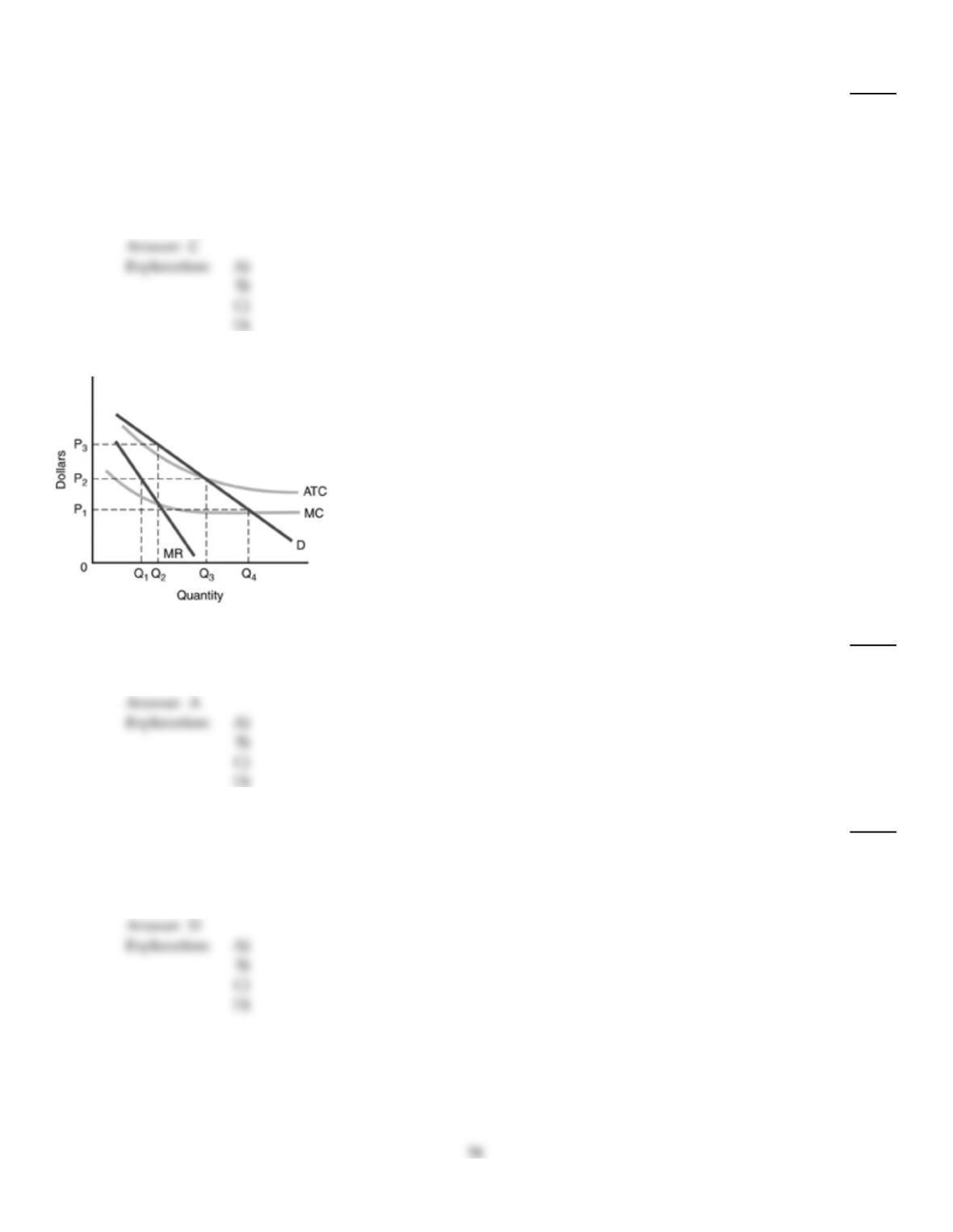
Use the above figure. If a commission regulates the above monopoly using fair–return (average cost
pricing), then the industry’s output will be ________ and the product’s price will be ________.
205)
A)
Q3; P2
B)
Q2; P3
C)
Q1; P1
D)
Q4; P1
A
206)
Which of the following refers to the capture hypothesis of regulation?
206)
A)
horizontal mergers
B)
consumer cost savings captured through regulation
C)
the ability of the government to capture monopoly profits
D)
the control of regulatory agencies by firms in an industry
D
C
207)
The hypothesis that regulators eventually are controlled by the regulated firms and their special
interests is the
207)
A)
public interest theory.
B)
capture hypothesis.
C)
share–the–gains, share–the–pains hypothesis.
D)
control–group hypothesis.
208)
When a regulator is concerned about pleasing different groups in order to keep employed, this is
known as the
208)
A)
creative theory.
B)
regulatory hypothesis.
C)
capture hypothesis.
D)
share–the–gains, share–the–pains theory.
209)
The main rationale for government regulatory functions is
209)
A)
to make sure that firms are maximizing profits.
B)
to protect consumer interests.
C)
to regulate for–profit institutions.
D)
to expand the scope of the government.
210)
Which of the following will NOT be true if the antitrust laws are successful?
210)
A)
Producers will earn zero economic profits in the long–run.
B)
Firms will produce the quantity at which marginal cost equals marginal revenue and charge a
price that is greater than marginal cost.
C)
Firms will produce the competitive output.
D)
Firms will not restrict output.
211)
A measure of monopoly power used by the government is the
211)
A)
price charged by the firm for goods and services.
B)
profit of the firm compared to other firms in the industry.
C)
percentage share of the relevant market or market share test.
D)
percentage difference between price and marginal cost.
212)
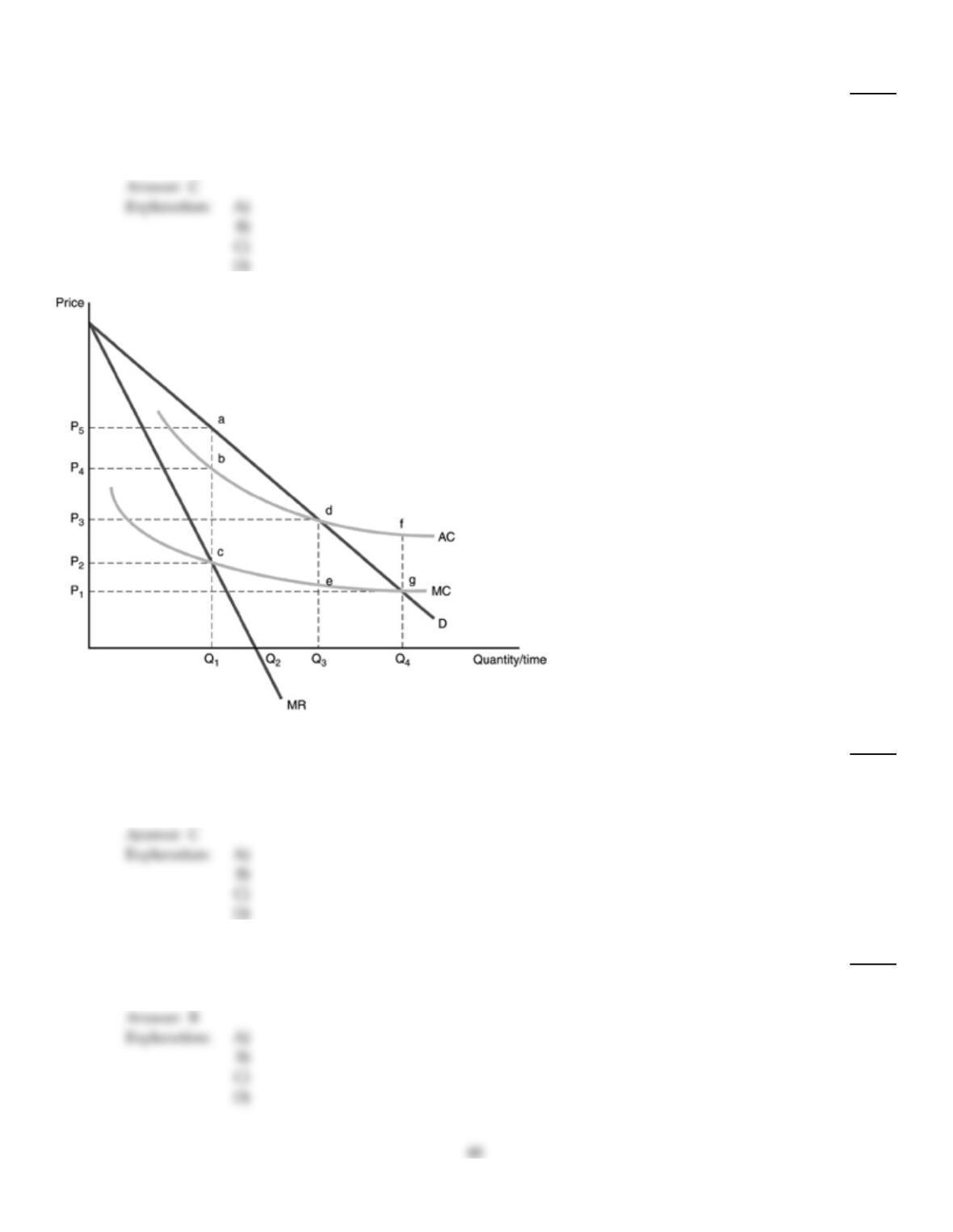
Refer to the above figure. Suppose the government requires the natural monopolist to charge the
efficient price. Then profits for the firm will be
212)
A)
profits equal to Q1 times distance a–b.
B)
zero.
C)
losses equal to Q4 times distance f–g.
D)
losses equal to Q3 times distance d–e.
213)
The first antitrust law in the United States was the
213)
A)
the Federal Trade Commission Act.
B)
Sherman Antitrust Act.
C)
Clayton Act.
D)
Contestable Markets Act.