67)
Social regulation is focused on all of the following EXCEPT
67)
A)
ensuring costs are minimized and benefits are maximized.
B)
a better quality of life through a less polluted environment.
C)
the impact of production on the environment and society.
D)
better working conditions, and safer and better products.
68)
The two basic types of government regulation are
68)
A)
social regulation and financial regulation.
B)
social regulation and health and safety regulation.
C)
economic and social regulation.
D)
economic regulation and monopoly regulation.
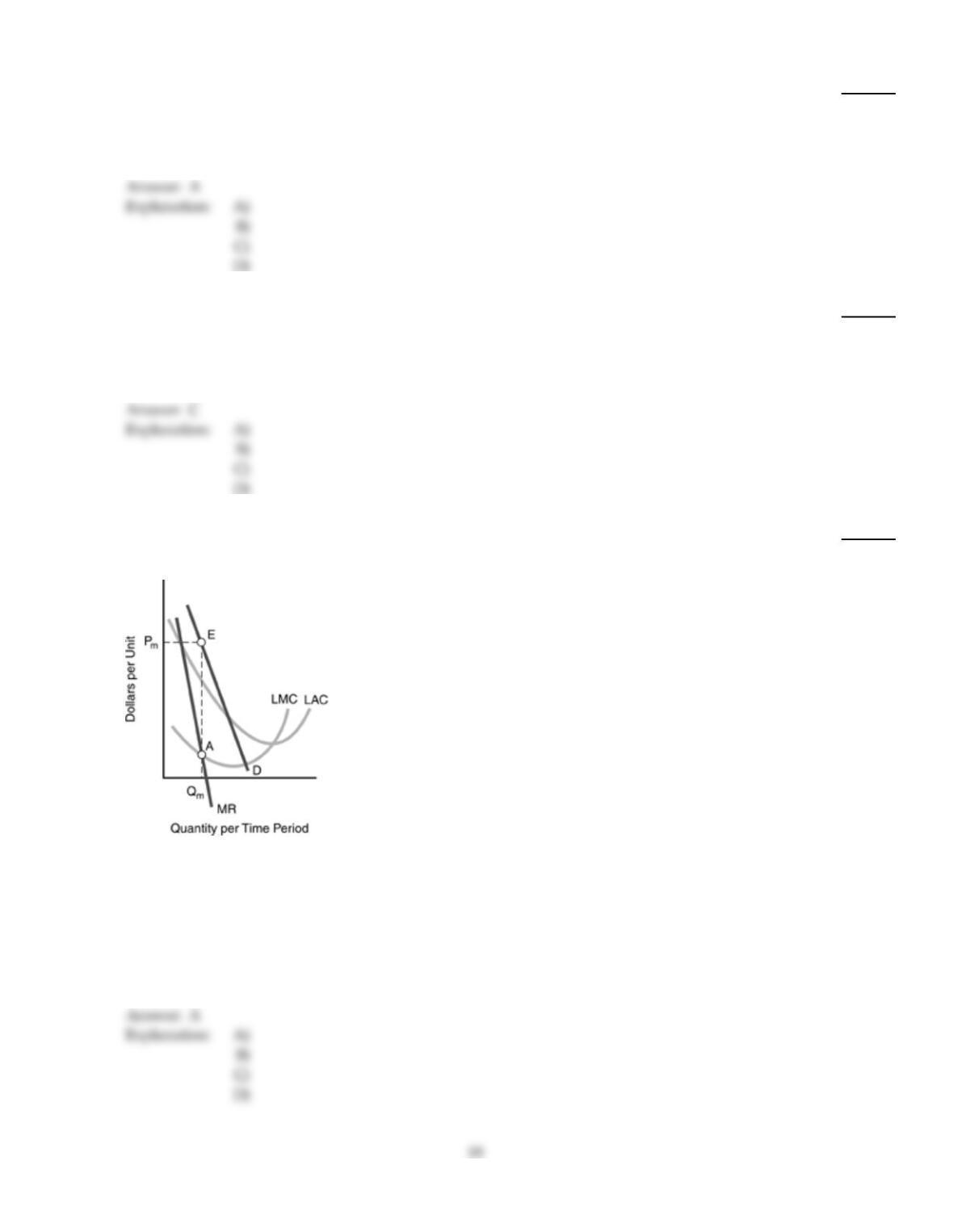
69)
Using the figure as a guide, which of the following is FALSE with respect to profit maximization
and the monopolist?
69)
A)
When compared to a competitive situation, consumers pay a higher price to the monopolist,
and consequently are forced to purchase more of a product as price varies directly with
quantity demanded.
B)
A monopolist (like any other firm) will select an output rate at which marginal revenue is
equal to marginal cost, at the intersection of the marginal revenue curve and the marginal cost
curve.
C)
The monopolist will produce quantity Qm and charge a price of Pm.
D)
Profits are the positive difference between total revenues and total costs.
70)
The act of selling an item in slightly altered forms at different prices and to different groups of
consumers is known as
70)
A)
lemons marketing.
B)
tie–in sales.
C)
versioning.
D)
bundling.
71)
Which of the following is NOT an antitrust law?
71)
A)
The FTC Act
B)
The Sherman Act
C)
The Smoot–Hawley Act
D)
The Robinson–Patman Act
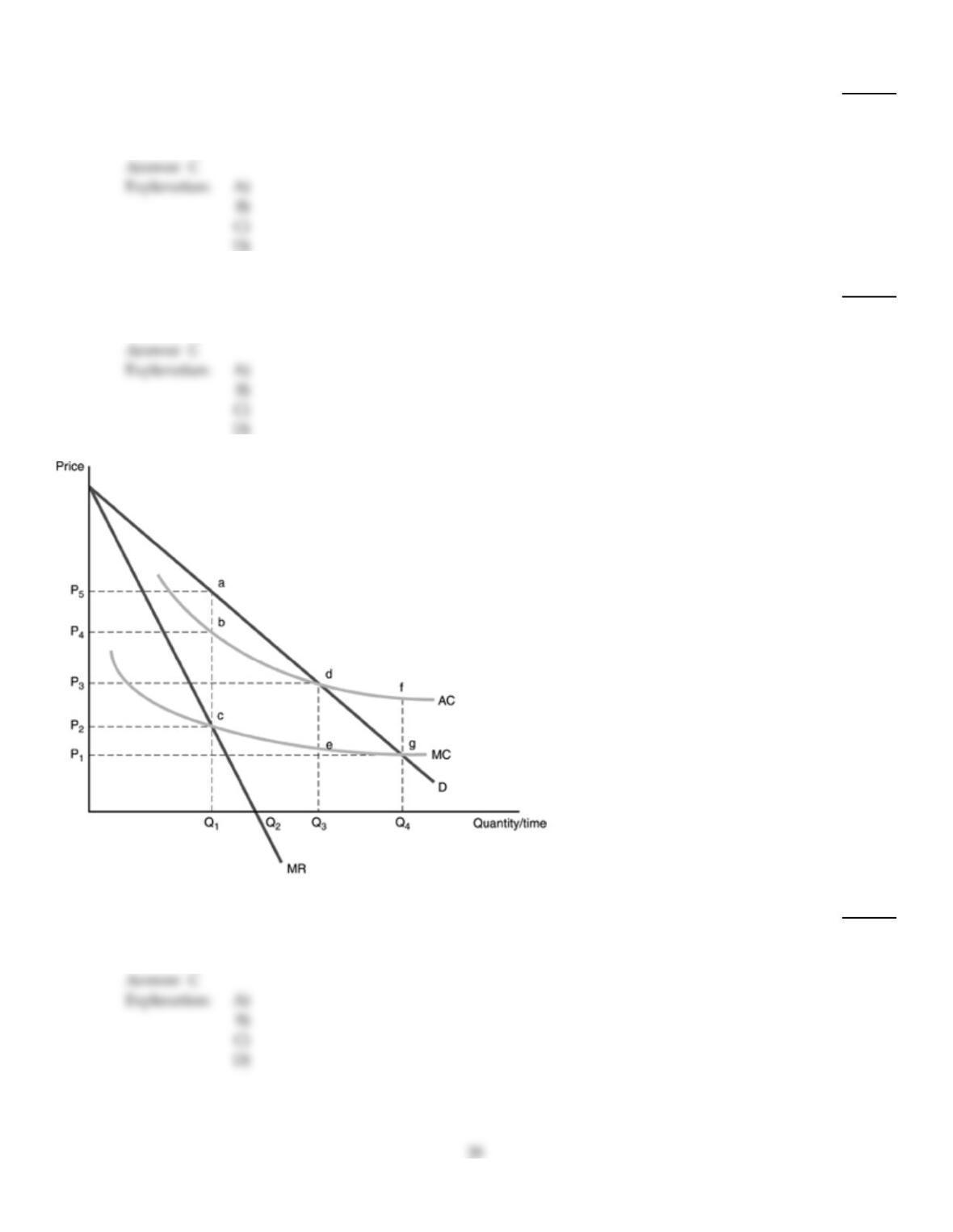
72)
Refer to the above figure. An unregulated natural monopolist would choose
72)
A)
output rate Q3 and price P3.
B)
output rate of Q1 and price P2.
C)
output rate Q1 and price P5.
D)
output rate Q4 and price P1.
73)
In a court decision in June 2001, the Federal District Count of Appeals in Washington, D.C. found
that Microsoft had violated the
73)
A)
Celler–Kefauver Act.
B)
Robinson–Patman Act.
C)
Sherman Act.
D)
Clayton Act.
74)
The reason an unregulated natural monopolist will produce at an economically inefficient quantity
is
74)
A)
that the price does not equal the true marginal cost of producing the good.
B)
due to the fact that the monopolist will equate average total cost with price to determine the
output level.
C)
that the monopolist will produce a quantity greater than the minimum of the average total
cost curve.
D)
due to the fact that the monopolist will equate marginal cost with price to determine the
output level.
Explanation:
75)
The goals of rate regulation have included the prevention of
75)
A)
average cost pricing.
B)
monopoly profits.
C)
oligopolistic pricing.
D)
marginal cost pricing.
Explanation:
76)
Regulation of monopolies that allows prices to reflect only the actual cost of production and no
monopoly profits is referred to as
76)
A)
service–opportunity regulation.
B)
cost–of–service regulation.
C)
rate–of–return regulation.
D)
natural regulation.
Explanation:
Explanation:
77)
The hypothesis that regulators eventually adopt policies that benefit the producers in the industry
is known as the
77)
A)
producers’ hypothesis.
B)
share–the–gains, share–the–pains hypothesis.
C)
it’s–a–rip–off hypothesis.
D)
capture hypothesis.
78)
The hypothesis that regulators eventually are controlled by the regulated firms and their special
interests is the
78)
A)
capture hypothesis.
B)
public interest theory.
C)
share–the–gains, share–the–pains hypothesis.
D)
control–group hypothesis.
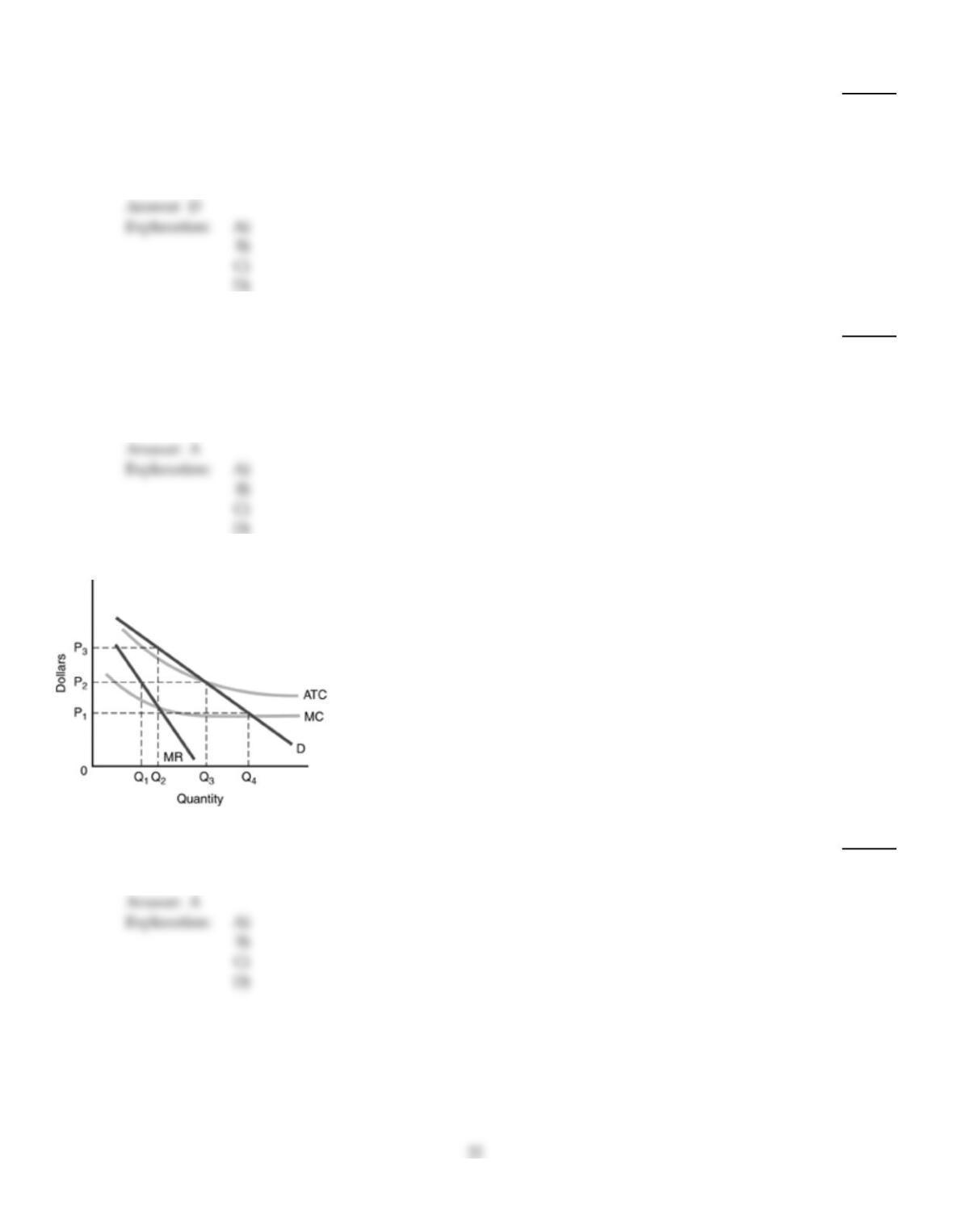
79)
Use the above figure. If this monopolist was not regulated, the profit–maximizing quantity and
price would be
79)
A)
Q2 and P3.
B)
Q4 and P1.
C)
Q2 and P1.
D)
Q3 and P2.
80)
A creative response to regulations can be described as
80)
A)
totally conforming to the law.
B)
completely ignoring the law.
C)
conforming to the letter of the law but undermining its spirit.
D)
none of the above.
81)
This agency is responsible for regulating the quality and safety of foods, health and medical
products, pharmaceuticals, cosmetics, and animal feed.
81)
A)
Equal Employment Opportunity Commission
B)
Food and Drug Administration
C)
Environmental Protection Agency
D)
Federal Trade Commission
B
82)
Which of the following is illegal according to the antitrust laws?
82)
A)
vertical mergers
B)
the use of coupons
C)
price fixing
D)
price discrimination based on cost differences
C
83)
An unregulated natural monopolist would produce to the point at which
83)
A)
MR = MC.
B)
P = AC.
C)
MR = AC.
D)
P = MR.
A
84)
Regulation that is based upon the cost of providing the good or service is known as
84)
A)
social regulation.
B)
deregulation.
C)
rate–of–return regulation.
D)
cost–of–service regulation.
D
C
85)
A potential benefit that comes from social regulations would be
85)
A)
a cleaner environment.
B)
higher costs.
C)
more layoffs.
D)
higher tax collections.
86)
Which of the following defines monopoly?
86)
A)
Federal Trade Commission Act
B)
Sherman Act
C)
Clayton Act
D)
none of the above
87)
If government regulators make the natural monopolist set price equal to marginal cost
87)
A)
the natural monopolist will make losses and go out of business.
B)
the natural monopolist will make zero economic profits.
C)
the natural monopolist will make positive economic profits larger than if it wasn’t regulated
at all.
D)
the natural monopolist will make normal profits.
88)
For a firm to be economically efficient from society’s point of view, it should produce to the point at
which
88)
A)
marginal cost equals marginal revenue.
B)
average total cost equals price.
C)
marginal cost equals price.
D)
marginal cost equals average total cost.
89)
A firm that responds to a regulatory rule in a way that permits technical compliance while allowing
the firm to violate the spirit of the regulation has.
89)
A)
become a captured regulator.
B)
reduced the scope of the lemons problem.
C)
shared the gains and pains of regulation.
D)
engaged in a creative response to regulation.
90)
Which of the following is NOT an objective of economic regulation?
90)
A)
to prevent monopoly profits
B)
to keep rates of return in an industry at a competitive level
C)
to fix prices so that they are never allowed to rise
D)
to regulate the prices enterprises are allowed to charge
91)
Which of the following is FALSE with respect to regulation?
91)
A)
Recent regulations have generated feedback effects that undermined the key aim of the rules.
B)
Firms engage in creative responses which conform to the letter of the law but undermine its
spirit.
C)
Regulated firms commonly try to avoid the effects of regulation whenever they can.
D)
Regulation has resulted in state laws that have made creative response illegal in many states.
92)
Which of the following is concerned with social regulation?
92)
A)
Board of Education
B)
Sherman Commission
C)
Federal Reserve Board
D)
Food and Drug Administration
93)
This agency develops and enforces environmental standards for air, water, toxic waste, and noise.
93)
A)
Consumer Product Safety Commission
B)
Equal Employment Opportunity Commission
C)
Occupational Safety and Health Administration
D)
Environmental Protection Agency
94)
Which of the following will NOT be true if the antitrust laws are successful?
94)
A)
Firms will produce the quantity at which marginal cost equals marginal revenue and charge a
price that is greater than marginal cost.
B)
Firms will not restrict output.
C)
Firms will produce the competitive output.
D)
Producers will earn zero economic profits in the long–run.
95)
One problem that might occur as a result of economic regulation is
95)
A)
the demand for the good may be greater than the supply.
B)
the quality of service might be lowered.
C)
that social regulation may follow.
D)
the firm may be earning more than a normal rate of return on investment.
96)
Which type of regulation applies to all firms in the economy, as opposed to only covering specific
industries?
96)
A)
Rate regulation
B)
Economic regulation
C)
Social regulation
D)
Statutory regulation
97)
This agency is responsible for preventing businesses from engaging in misleading advertising,
unfair trade practices, and monopolistic actions, as well as for protecting consumer rights.
97)
A)
Environmental Protection Agency
B)
Equal Employment Opportunity Commission
C)
Food and Drug Administration
D)
Federal Trade Commission
98)
The notion that regulated industry members themselves, sooner or later, are able to control
regulatory bodies is referred to as
98)
A)
cartelization.
B)
consumerism.
C)
the capture theory.
D)
the control theory.
99)
The Sherman Antitrust Act was enforced in 1906 by a ruling of the Supreme Court regarding the
monopolization of the oil industry by
99)
A)
Gulf Oil of Pennsylvania.
B)
Standard Oil of New Jersey.
C)
Texaco Oil of Texas.
D)
Getty Oil of Oklahoma.
100)
A theory of regulatory behavior, which states that regulators must take into account the preferences
of legislators, producers, and consumers, is the
100)
A)
capture theory.
B)
general interests theory.
C)
share–the–gains, share–the–pains theory.
D)
public interest theory.
SHORT ANSWER. Write the word or phrase that best completes each statement or answers the question.
101)
What is the problem with marginal cost pricing in the natural monopoly situation? How
do regulatory agencies in the United States usually handle the problem?
101)
102)
“Regulations do not always have the intended result.” Do you agree or disagree? Why?
102)
103)
How does social regulation differ from economic regulation?
103)
104)
What is the difference between product versioning and product bundling? Which of these
two business practices have antitrust authorities been more likely to regard to be the form
of price discrimination called tie–in sales? Why?
104)
105)
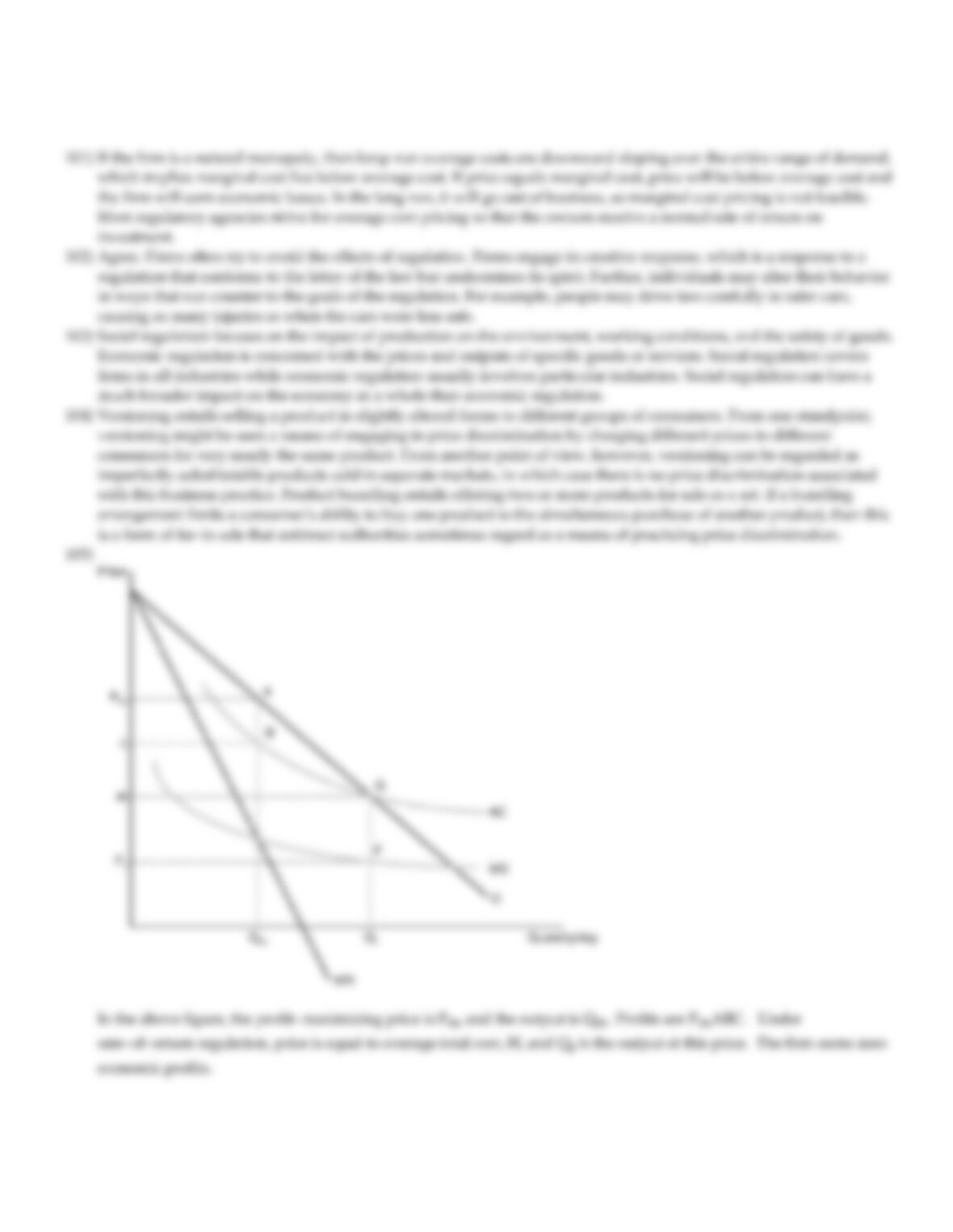
Using a graph, show the price–output combination of a natural monopoly without
regulation and the price–output combination if the government requires the monopoly to
earn a normal rate of return. What are economic profits in each situation?
105)
106)
Discuss the Clayton Act and the Federal Trade Commission Act, and relevant amendments
to them.
106)
107)
What is the main difference between economic regulation and social regulation?
107)
108)
Explain the capture hypothesis.
108)
109)
Explain the share–the–gains, share–the–pains theory. How does it differ from the capture
hypothesis?
109)
110)
“As compared to the benefits of economic and social regulation, the costs are minimal.” Do
you agree or disagree? Why?
110)
111)
What are the major rationales for consumer protection in nonmonopolistic industries?
111)
112)
A common feature of regulated industries is cross–subsidization, which is a situation when
one group of customers pays prices above costs while another group of customers pays
prices below costs. The one group is subsidizing the other group. Is this practice more
consistent with the capture hypothesis or the share–the–gains, share–the–pains theory?
Explain.
112)
113)
What is the lemons problem? How do firms try to address this problem?
113)
114)
Suppose OSHA requires a factory to install specific safety equipment to reduce the number
of injuries in the factory. Would the number of accidents necessarily decline? Why or why
not?
114)
115)
Why do government regulators not enforce marginal cost pricing for natural monopolies?
What are the common regulatory solutions?
115)
116)
“Today the U.S. telecommunications industry remains heavily regulated by the
government as it was some 30 years ago.” Do you agree or disagree? Why?
116)
Answer Key
Testname: C27
Answer Key
Testname: C27
Answer Key
Testname: C27
34
Answer Key
Testname: C27
35