80)
Regulation focused on the impact of production on the environment and society, the working
conditions under which production occurs, or the physical attributes of goods, is known as
80)
A)
cost–of–service regulation.
B)
social regulation.
C)
rate–of–return regulation.
D)
monopoly regulation.
81)
Acme Inc. found a tricky way to conform to the letter of the law with respect to new EPA
regulations, even though they violated the spirit of the law. This is called
81)
A)
the capture theory.
B)
creative response.
C)
collusive response.
D)
share–the–gains, share–the–pains theory.
82)
The first step in enforcing any antitrust policy is to
82)
A)
win the support of the public.
B)
win the approval of the state senators from the state where the company is headquartered.
C)
win congressional approval.
D)
define the market.
83)
This agency develops and enforces environmental standards for air, water, toxic waste, and noise.
83)
A)
Environmental Protection Agency
B)
Consumer Product Safety Commission
C)
Equal Employment Opportunity Commission
D)
Occupational Safety and Health Administration
84)
A firm that responds to a regulatory rule in a way that permits technical compliance while allowing
the firm to violate the spirit of the regulation has.
84)
A)
engaged in a creative response to regulation.
B)
shared the gains and pains of regulation.
C)
reduced the scope of the lemons problem.
D)
become a captured regulator.
85)
The lemons problem is a situation of
85)
A)
a natural monopoly.
B)
asymmetric information.
C)
perfect competition.
D)
creative response.
B
86)
When regulators identify with the special interests of the industry they regulate, this behavior
conforms with the
86)
A)
share–the–gains, share–the–pains hypothesis.
B)
capture hypothesis.
C)
lemon market hypothesis.
D)
rate–of–return hypothesis.
B
87)
Under the U.S. system of regulation, most regulars are selected from
87)
A)
the industry that is to be regulated.
B)
university professors who understand the nature of the industry and who understand the true
interests of consumers.
C)
politicians and their friends.
D)
consumer advocacy groups.
A
A
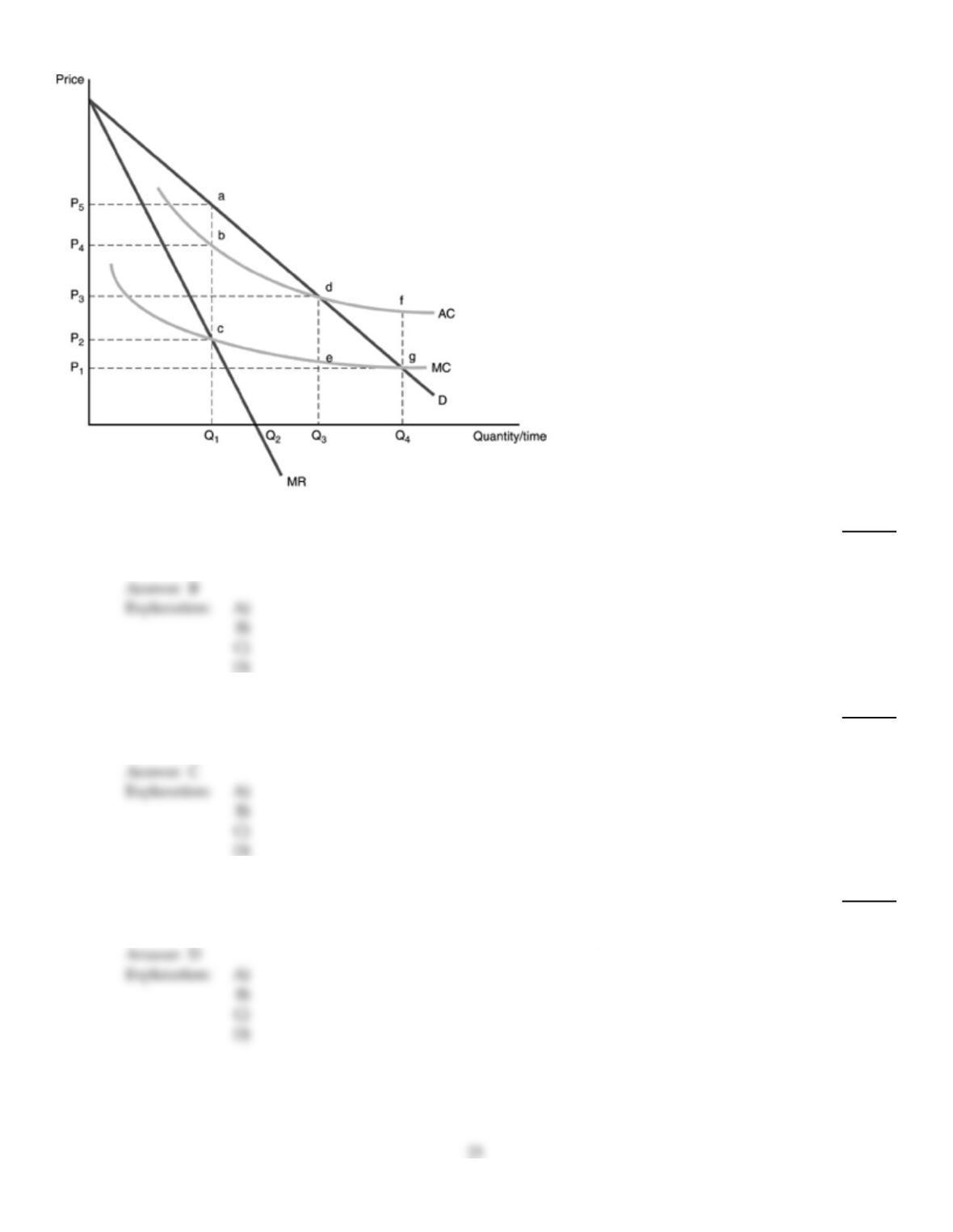
88)
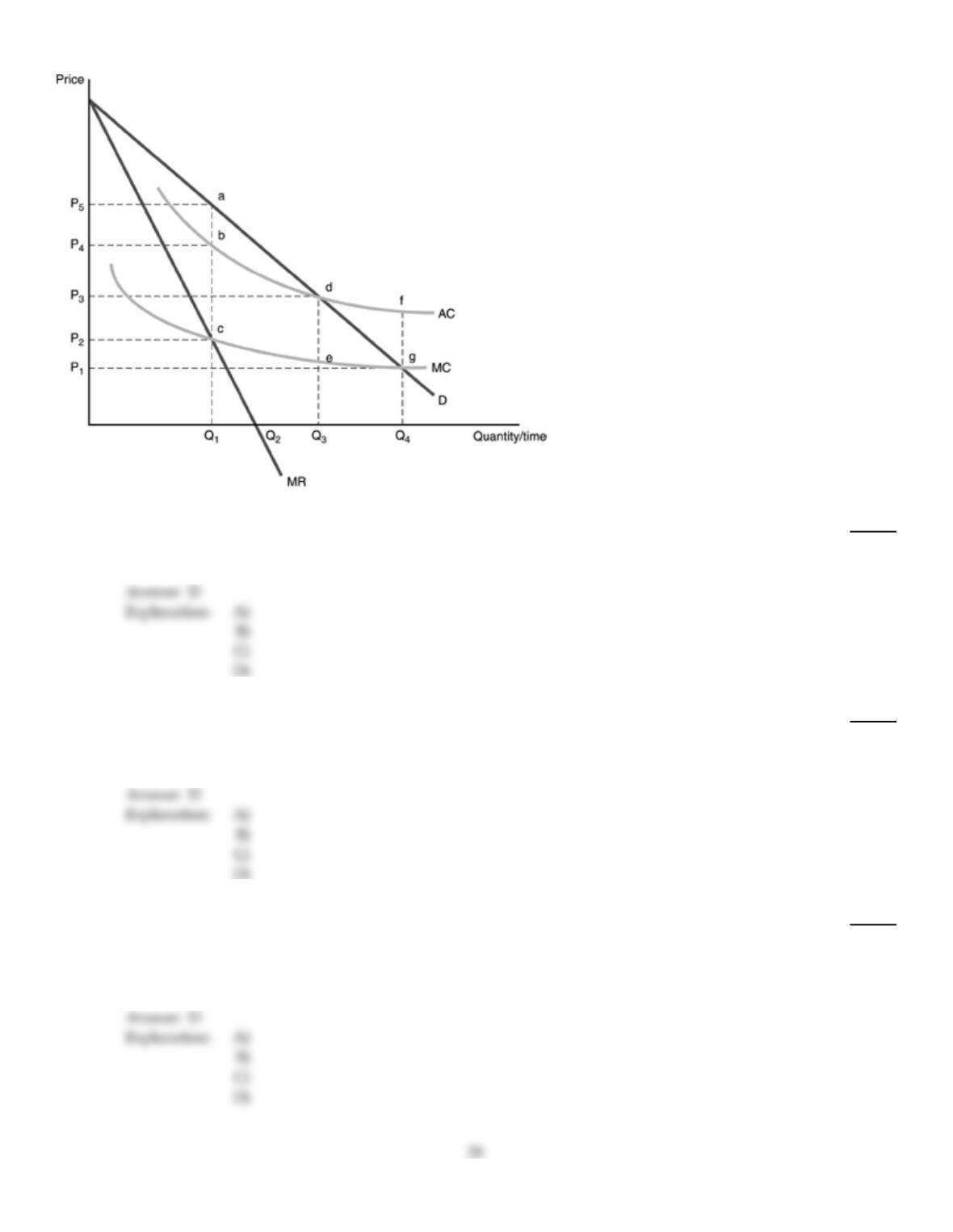
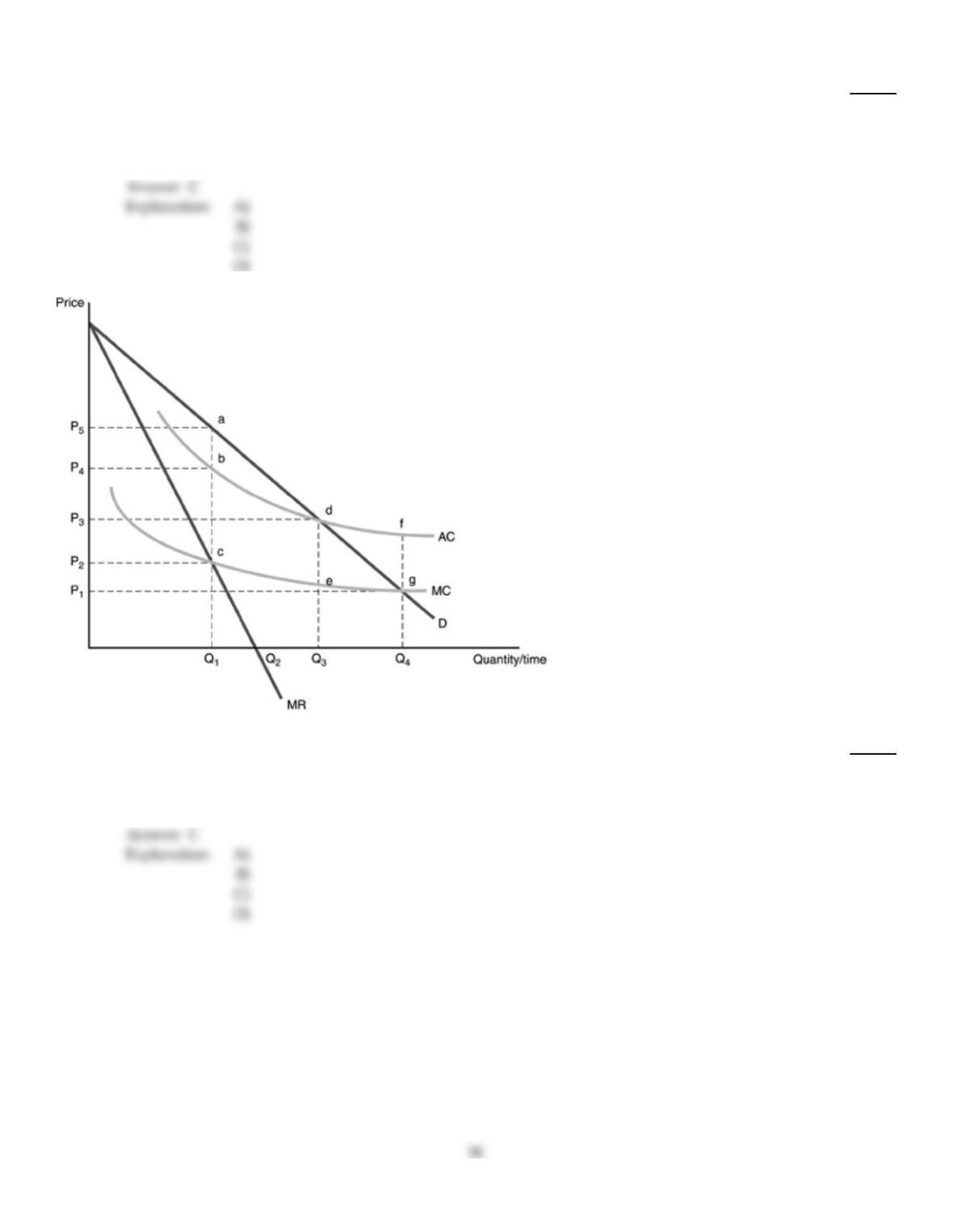
Refer to the above figure. What are the price and quantity if this monopolist is required to use
average cost pricing?
88)
A)
P1, Q4
B)
P3, Q3
C)
P2, Q1
D)
P5, Q1
89)
Which of the following is a government response to asymmetric information?
89)
A)
product guarantees
B)
manufacturer’s warranties
C)
government licensing
D)
external product certification
C
90)
The regulation of the prices charged by insurance companies is known as
90)
A)
the Federal Register.
B)
social regulation.
C)
the market share test.
D)
economic regulation.
D
B
91)
Asymmetric information is
91)
A)
when the producer has information on the product that the consumer lacks.
B)
the regulatory price for a natural monopoly.
C)
an externality.
D)
when a market failure occurs.
92)
While economic regulation applies to ________ industries, social regulation applies to ________
firms.
92)
A)
particular; all
B)
all; individual
C)
utility; healthcare
D)
particular; individual
93)
According to the text, the federal government spends the most taxpayer–provided funds regulating
which area of the economy?
93)
A)
finance and banking
B)
consumer safety and health
C)
transportation
D)
the environment
94)
One type of economic regulation often used in the United States by various public utility
commissions allows prices to reflect only the actual cost of production and no monopoly profits.
This type of economic regulation is known as
94)
A)
cost–of–service regulation.
B)
creative response regulation.
C)
price per constant–quality–unit regulation.
D)
rate–of–return regulation.
95)
The costs of regulation
95)
A)
include increased taxes and increased prices of the products being regulated.
B)
are relatively small.
C)
are more than covered by the benefits gained from the regulation.
D)
are paid entirely by the regulated industries.
96)
Under rate–of–return regulation, average cost pricing
96)
A)
includes a cost for capital that generates an above normal rate of return.
B)
includes what they consider to be a fair rate of return on investment.
C)
includes variable costs but not a cost for capital.
D)
is inflated so the firm can make economic profits.
97)
The two basic types of government regulation are
97)
A)
regulation of natural monopolies and regulation of cartels.
B)
economic regulation and industry regulation.
C)
social regulation and economic regulation.
D)
social regulation and labor law.
98)
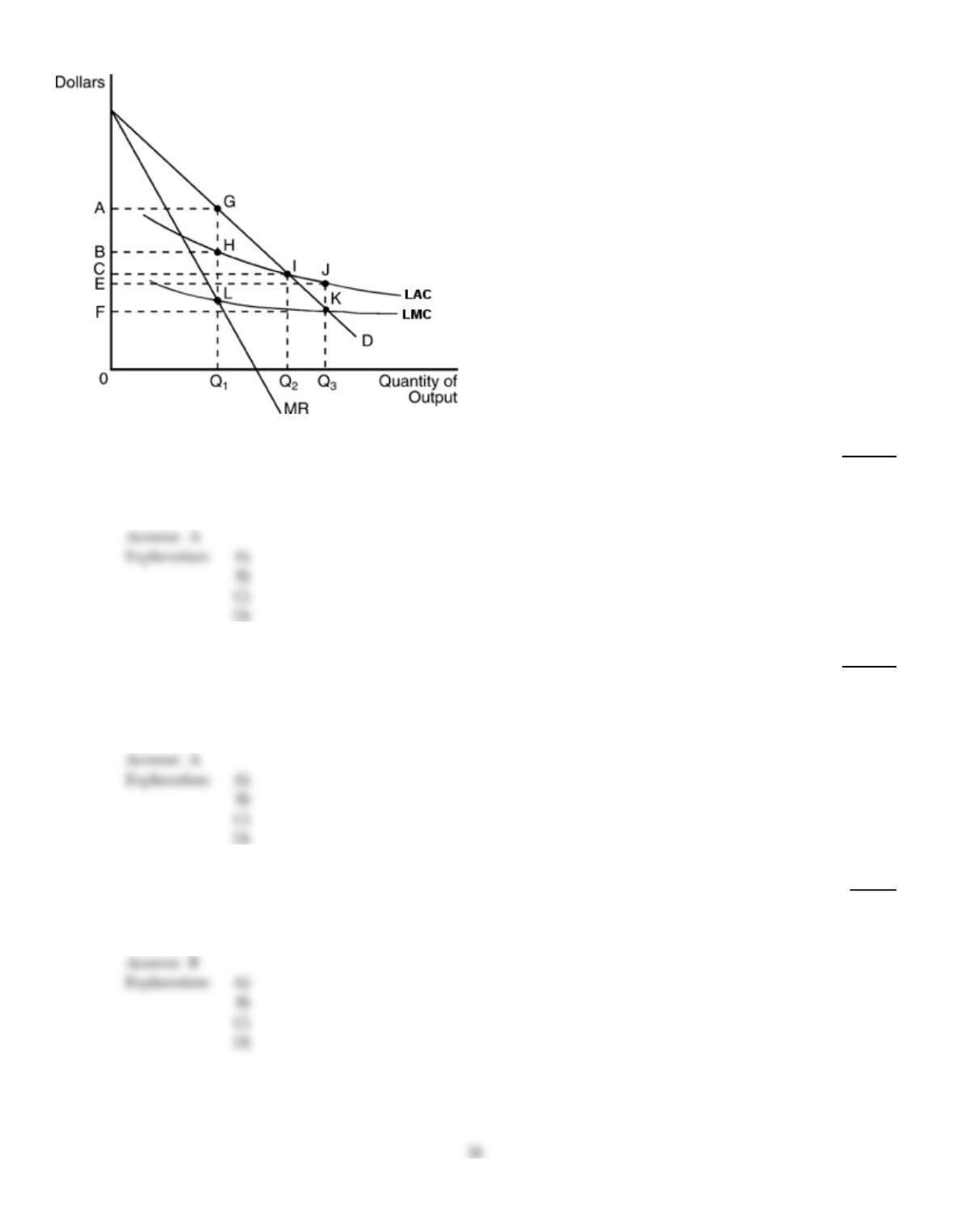
In the above figure, if this natural monopolist were unregulated, the profit maximizing firm would
produce
98)
A)
at Q1 output rate.
B)
past the Q3 output rate.
C)
at Q2 output rate.
D)
at Q3 output rate.
99)
The benefits of social regulation are
99)
A)
often difficult to measure.
B)
greater than the costs of social regulation in every example in the country today.
C)
obvious to almost everyone, but the costs are usually hidden.
D)
easy to measure by the marginal value method.
100)
In a court decision in June 2001, the Federal District Count of Appeals in Washington, D.C. found
that Microsoft had violated the
100)
A)
Clayton Act.
B)
Sherman Act.
C)
Robinson–Patman Act.
D)
Celler–Kefauver Act.
101)
If a natural monopolist is unregulated, then
101)
A)
the monopoly will produce inefficiently from society’s point of view.
B)
the monopoly will produce efficiently from society’s point of view.
C)
the monopolist will determine the profit maximizing quantity by equating marginal cost to
the demand curve.
D)
the monopolist will be earning just a normal rate of return on investment.
102)
Which of the following is NOT an antitrust law?
102)
A)
the FTC Act
B)
the Robinson–Patman Act
C)
the Smoot–Hawley Act
D)
the Sherman Act
103)
If regulators force a natural monopoly to price as a perfectly competitive firm would, the natural
monopolist
103)
A)
will experience a rise in long–term average costs.
B)
will earn higher economic profits.
C)
will earn an economic loss.
D)
will expand its output.
104)
For a natural monopoly, long–run average costs
104)
A)
rise as output increases.
B)
fall as output increases.
C)
rise as output falls.
D)
fall as output falls.
105)
Under rate–of–return regulation, the price is set so that
105)
A)
the firm earns a normal rate of return on investment.
B)
the firm earns a monopoly profit.
C)
the firm earns a positive economic profit.
D)
price equals the marginal cost of production.
106)
In some cases, social regulation may alter individuals’ behavior. For example, there is evidence to
indicate that as more automobile safety regulations have been introduced, more individuals have
begun to drive recklessly. This phenomenon is known as
106)
A)
the share–the–pains effect.
B)
the feedback effect.
C)
the share–the–gains effect.
D)
the capture effect.
Explanation:
107)
A major shortcoming of the Sherman Act was that
107)
A)
violators of the Act were forced out of business.
B)
it failed to explicitly state which specific activities were illegal.
C)
it was not enforced by the courts.
D)
when it was passed, there were no violations, so the Supreme Court ruled it unnecessary.
Explanation:
Explanation:
108)
Refer to the above figure. An unregulated natural monopolist’s profits will be
108)
A)
profits equal to Q1 times distance a–c.
B)
losses equal to Q3 times distance d–e.
C)
losses equal to Q4 times distance f–g.
D)
profits equal to Q1 times distance a–b.
109)
Behavior on the part of the firm that allows it to comply with the letter of the law but violate the
spirit reducing the law’s effect is
109)
A)
asymmetric information.
B)
only a problem in a monopoly.
C)
the lemons problem.
D)
creative response.
110)
Regulation imposed by such organizations as the Food and Drug Administration or the
Environmental Protection Agency seeking to protect the welfare of people in our nation is referred
to as
110)
A)
natural regulation.
B)
moral regulation.
C)
rate–of–return regulation.
D)
social regulation.
111)
Which of the following acts outlawed selling products at “unreasonably low prices” with the intent
of reducing competition?
111)
A)
Sherman Act
B)
Robinson–Patman Act
C)
FTC Act
D)
Wheeler–Lea Act
112)
The Federal Trade Commission was established in 1914 to
112)
A)
regulate trade of public goods.
B)
investigate unfair competitive practices.
C)
prevent non–price competition.
D)
promote competition in interstate commerce.
113)
Regulators often adopt policies that benefit
113)
A)
consumers and injure producers.
B)
no one.
C)
the firms regulated rather than consumers.
D)
only the government.
114)
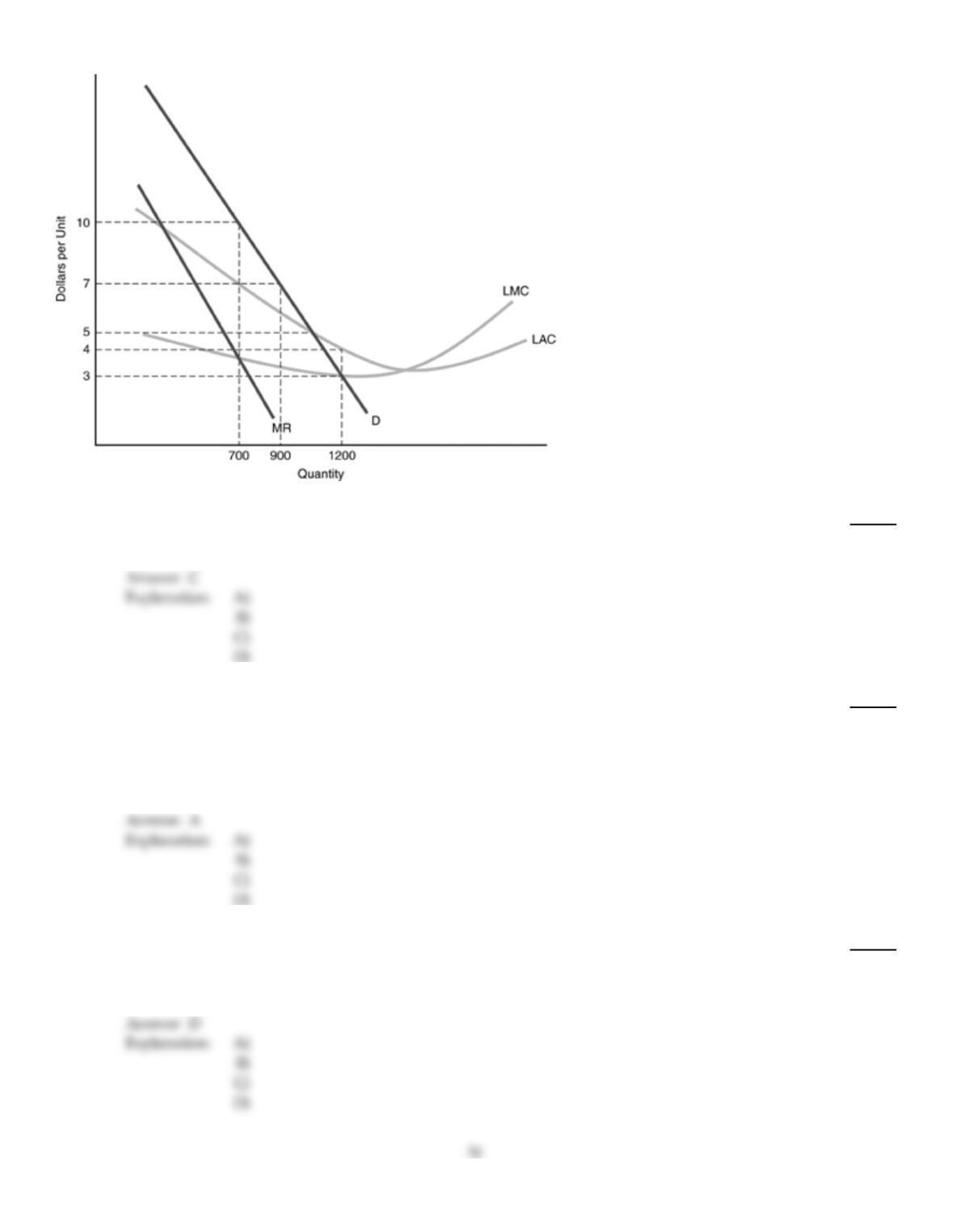
In the above figure, what would be the profit or loss at the marginal cost pricing point for this
natural monopolist?
114)
A)
–$300
B)
$2,700
C)
–$1,200
D)
$2,100
115)
If government regulators make the natural monopolist set price equal to marginal cost
115)
A)
the natural monopolist will make losses and go out of business.
B)
the natural monopolist will make positive economic profits larger than if it wasn’t regulated
at all.
C)
the natural monopolist will make zero economic profits.
D)
the natural monopolist will make normal profits.
116)
The problem of asymmetric information that brings about a general decline in product quality in an
industry is
116)
A)
the result of government regulation.
B)
a market failure.
C)
creative response.
D)
the lemons problem.
117)
The first major law created to control the growth of monopoly power was the
117)
A)
Robinson–Patman Act.
B)
Sherman Act.
C)
Clayton Act.
D)
FTC Act.
118)
Which of the following is an example of an agency concerned with social regulation?
118)
A)
Securities and Exchange Commission
B)
Federal Communications Commission
C)
Consumer Product Safety Commission
D)
Federal Energy Regulatory Commission
119)
Which of the following is exempt from antitrust laws?
119)
A)
petroleum companies
B)
airlines
C)
hospitals
D)
professional football
120)
Suppose that a regulatory agency has imposed marginal cost pricing on a natural monopolist. We
expect that
120)
A)
the firm will earn only a normal profit.
B)
the firm will eventually go out of business.
C)
the firm will earn economic profits.
D)
the firm’s average total cost of production is rising over the relevant range of production.
121)
Which of the following statements can correctly be made about social regulation?
I. Extensive social regulation may have an anticompetitive effect.
II. The benefits of social regulation are easier to measure than are the costs of social regulation.
121)
A)
I only
B)
II only
C)
both I and II
D)
neither I nor II
122)
In marginal cost pricing, the natural monopoly would have to set price equal to
122)
A)
AVC.
B)
AFC.
C)
MC.
D)
ATC.
123)
The following table depicts the cost and demand structure a natural monopoly faces. Provided that
the firm operates as a monopolist, what is the price charged and quantity produced in order to
maximize profits?
Total Marginal Total Marginal
Quantity Price ($) Revenue Revenue Cost Cost
0 1,000 0 0 0 0
1 900 900 900 800 800
2 800 1,600 700 1,400 600
3 700 2,100 500 1,900 500
4 600 2,400 300 2,400 500
5 500 2,500 100 2,800 400
6 400 2,400 100 3,200 400
123)
A)
price charged of $700 and quantity produced of 3
B)
price charged of $600 and quantity produced of 4
C)
price charged of $800 and quantity produced of 2
D)
price charged of $900 and quantity produced of 1
124)
When Microsoft put together a set of products with the Windows operating system, it was
practicing
124)
A)
versioning.
B)
bundling.
C)
compacting.
D)
tie–in sales.
125)
An unregulated natural monopolist will produce the quantity at which
125)
A)
average total costs are minimized.
B)
marginal cost equals marginal revenue.
C)
the long–run average cost curve intersects the demand curve.
D)
marginal cost equals the long run average cost curve.
126)
The total cost of federal regulation includes
126)
A)
the funding of government agencies overseeing compliance, the compliance cost for the
regulated firms, and the opportunity cost of regulation for the firms.
B)
only the funding of the regulatory agencies.
C)
only the cost of compliance by the regulated firms.
D)
the funding of government agencies overseeing compliance less the compliance cost for the
regulated firms and the opportunity cost of regulation for the firms.
127)
If antitrust legislation is successful, then the monopolistic firm will
127)
A)
decrease output and charge a higher price than before.
B)
increase output and charge a higher price than before.
C)
decrease output and charge a lower price than before.
D)
increase output and charge a lower price than before.
Explanation:
128)
One goal of rate–of–return regulation is the prevention of
128)
A)
poor quality service.
B)
positive economic profits.
C)
free market entry.
D)
environmental degradation.
Explanation:
Explanation:
129)
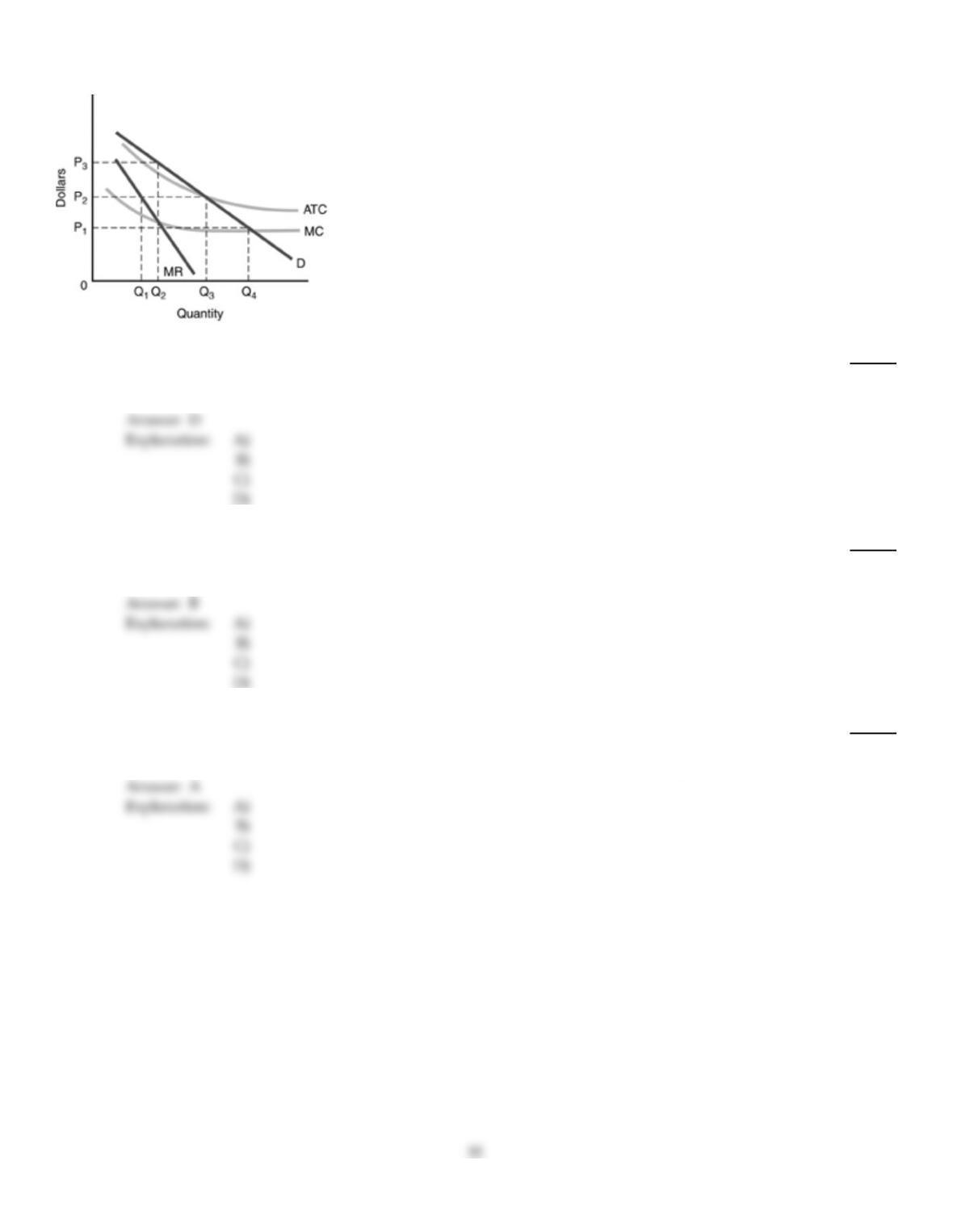
Use the above figure. If this monopolist was not regulated, the profit–maximizing quantity and
price would be
129)
A)
Q3 and P2.
B)
Q2 and P1.
C)
Q4 and P1.
D)
Q2 and P3.
130)
The first antitrust law in the United States was the
130)
A)
Clayton Act.
B)
Sherman Act.
C)
Robinson–Patman Act.
D)
FTC Act.
131)
One of the agencies responsible for enforcement of antitrust policy is
131)
A)
the Federal Trade Commission.
B)
the Food and Drug Administration.
C)
the World Trade Organization.
D)
the Trust Division of Congress.
132)
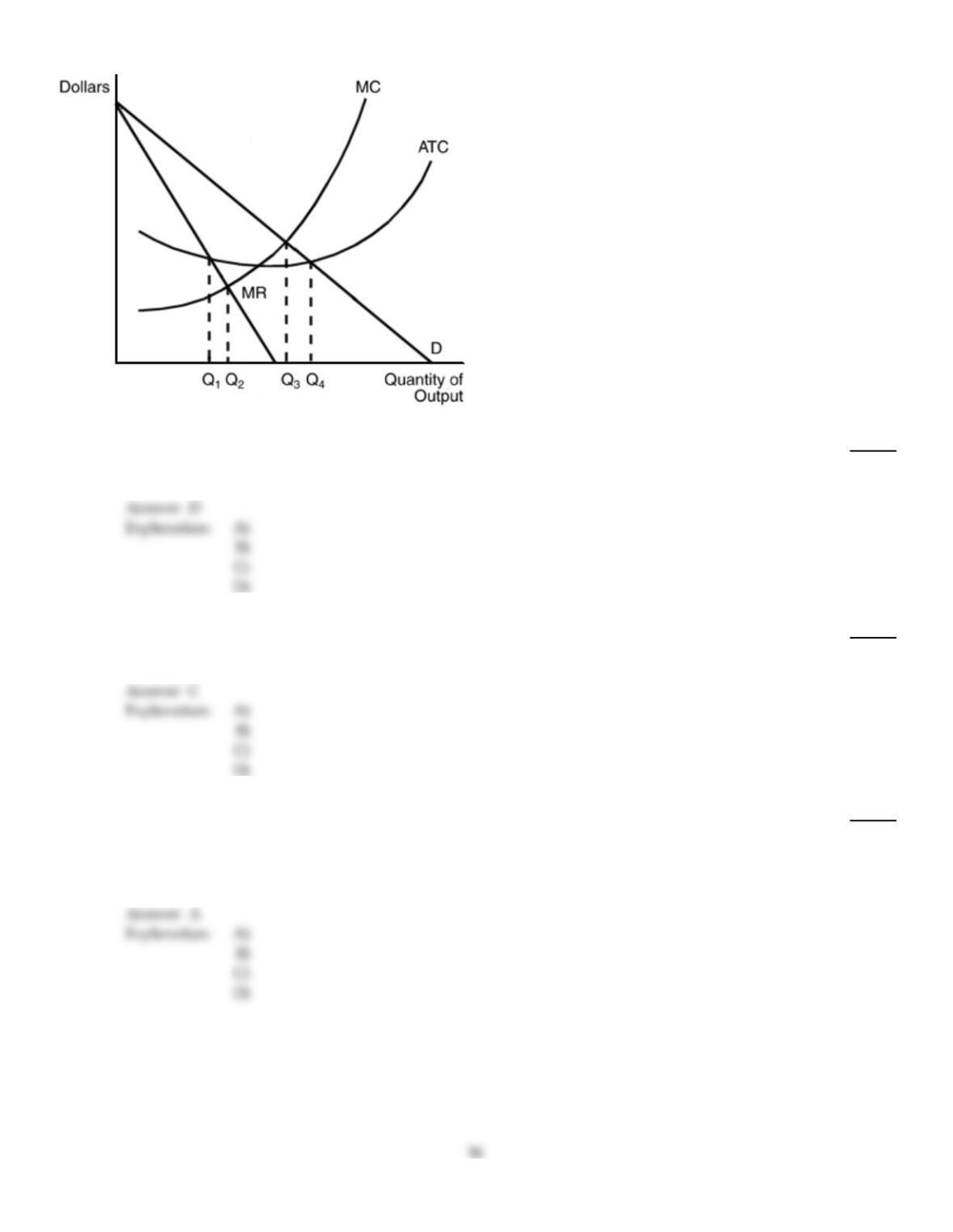
In the above figure, a regulation requiring average cost pricing would force the firm to produce at
output level
132)
A)
Q1.
B)
Q2.
C)
Q3.
D)
Q4.
133)
Which of the following are exempt from the antitrust laws?
133)
A)
all professional athletes
B)
deregulated industries
C)
labor unions
D)
colleges and universities
C
134)
The Federal Register
134)
A)
publishes all the new federal regulatory rules.
B)
has decreased in size.
C)
is used to track immigration.
D)
itemizes state and local government spending.
A
D
135)
According to U.S. antitrust enforcement guidelines, a merger is likely to be challenged if
135)
A)
the HHI decreases after the merger.
B)
the industry after the merger has an HHI above 1,000 and the HHI rises by more than 10.
C)
the industry after the merger has an HHI above 1,800 and the HHI rises by more than 100.
D)
the industry after the merger has an HHI above 1,800 and the HHI falls by more than 100.
136)
Why is antitrust legislation necessary?
136)
A)
Monopolies tend to misallocate resources.
B)
Monopolies tend to allocate resources in a socially optimal manner.
C)
Monopolies will always make a profit in the long run.
D)
All monopolies are unlawful in the United States.
137)
The goals of rate regulation have included the prevention of
137)
A)
marginal cost pricing.
B)
oligopolistic pricing.
C)
average cost pricing.
D)
monopoly profits.
138)
This agency is responsible for investigating complaints of discrimination based on race, religion,
sex or age in hiring, promotion, firing, wages, testing, and all other conditions of employment.
138)
A)
Equal Employment Opportunity Commission
B)
Federal Trade Commission
C)
Food and Drug Administration
D)
Environmental Protection Agency
139)
All of the following are forms of social regulation EXCEPT
139)
A)
the Food and Drug Administration regulating the quality of drugs.
B)
the Environmental Protection Association regulating automobile emissions.
C)
the Public Utility Commission regulating the price of telephone service.
D)
the Occupational Safety and Health Administration regulating workplace safety.
140)
Refer to the above figure. If the government uses rate–of–return regulation for the natural
monopolist, the firm will charge price
140)
A)
P2 and sell Q1 units.
B)
P5 and sell Q1 units.
C)
P3 and sell Q3 units.
D)
P1 and sell Q4 units.
141)
The main goal of antitrust policy is to
141)
A)
regulate natural monopolies.
B)
prevent the nationalization of industries.
C)
encourage firms to produce at the MR = demand level.
D)
prevent the monopolization of industries.
142)
Antitrust laws in the United States
142)
A)
are not necessary in the twenty–first century.
B)
have not been used in the past twenty–five years.
C)
are the same as the laws in the European Union.
D)
are an attempt to foster competition.
D
143)
The argument that suggests that regulators balance the interests of firms, consumers, and
legislators is called
143)
A)
the theory of optimal regulation.
B)
the share–the–gains, share–the–pains theory.
C)
the creative response theory.
D)
the capture hypothesis.
B
144)
Defining the “relevant market” involves looking at two components. They are
144)
A)
the goods market and the services market.
B)
the geographic market and the product market.
C)
the local market and the national market.
D)
the competitive market and the dominant market.
B
D
145)
Which of the following is most subject to the lemons problem?
145)
A)
homogeneous goods
B)
credence goods
C)
search goods
D)
inferior goods
146)
The key issue in determining the relevant product market is
146)
A)
the production processes used to produce the goods.
B)
the specific geographic area in which competing products overlap.
C)
the market share test.
D)
the degree of interchangeability between products.
D
147)
Which of the following federal agencies is engaged in social regulation?
147)
A)
Federal Deposit Insurance Corporation
B)
the Securities and Exchange Commission
C)
Equal Employment Opportunity Commission
D)
Office of the Comptroller of the Currency
C
148)
All of the following are exempt from antitrust laws EXCEPT
148)
A)
labor unions.
B)
professional baseball.
C)
public utilities.
D)
oil companies.
D
B