
45) A spaceship is moving away from an asteroid with a speed of 0.80c relative to the asteroid.
The spaceship then fires a missile with a speed of 0.50c relative to the spaceship. What is the
speed of the missile measured by astronauts on the asteroid if the missile is fired toward the
asteroid?
A) 0.30c
B) 0.50c
C) 0.93c
D) 1.3c
E) 0.65c
46) A spaceship leaves Earth at a steady forward speed of 70% the speed of light. How fast
relative to the ship must the spaceship launch a shuttlecraft in the forward direction so that it will
be moving away from Earth at 98.7% the speed of light?
A) 0.91c
B) 0.97c
C) 0.93c
D) 0.99c
E) 0.84c
47) A spaceship traveling at 0.50c away from Earth launches a secondary rocket in the forward
direction at 0.50c relative to the spaceship. As measured by Earthlings, how fast is the secondary
rocket moving away from Earth?
A) 0.90c
B) 0.50c
C) 0.80c
D) 0.70c
E) c
48) A star is moving toward Earth at 90% the speed of light. The star emits light, which moves
away from the star at the speed of light. What do Earth-based astronomers measure for the speed
of this light?
A) c
B) 1.9c
C) 1.2c
D) 0.98c
E) 0.95c

49) A spaceship, traveling at 0.560c towards a stationary space platform, launches a secondary
towards the station with a speed of 0.100c relative to the spaceship. What is the speed of the
secondary rocket relative to the space platform?
A) 0.460c
B) 0.575c
C) 0.600c
D) 0.625c
E) 0.660c
50) A spaceship, traveling at 0.100c away from a stationary space platform, launches a
secondary rocket towards the station, with a speed of 0.560c relative to the spaceship. What is
the speed of the secondary rocket relative to the space platform?
A) 0.460c
B) 0.487c
C) 0.492c
D) 0.660c
51) Two spaceships approach Earth from the same direction. One has a speed of 0.21c and the
other a speed of 0.34c, both relative to Earth. What is the speed of one spaceship relative to the
other?
A) 0.13c
B) 0.14c
C) 0.15c
D) 0.16c
E) 0.18c
52) Two spaceships approach Earth from opposite directions. One has a speed of 0.21c and the
other a speed of 0.34c, both relative to Earth. What is the speed of one spaceship relative to the
other?
A) 0.51c
B) 0.55c
C) 0.58c
D) 0.61c
E) 0.64c
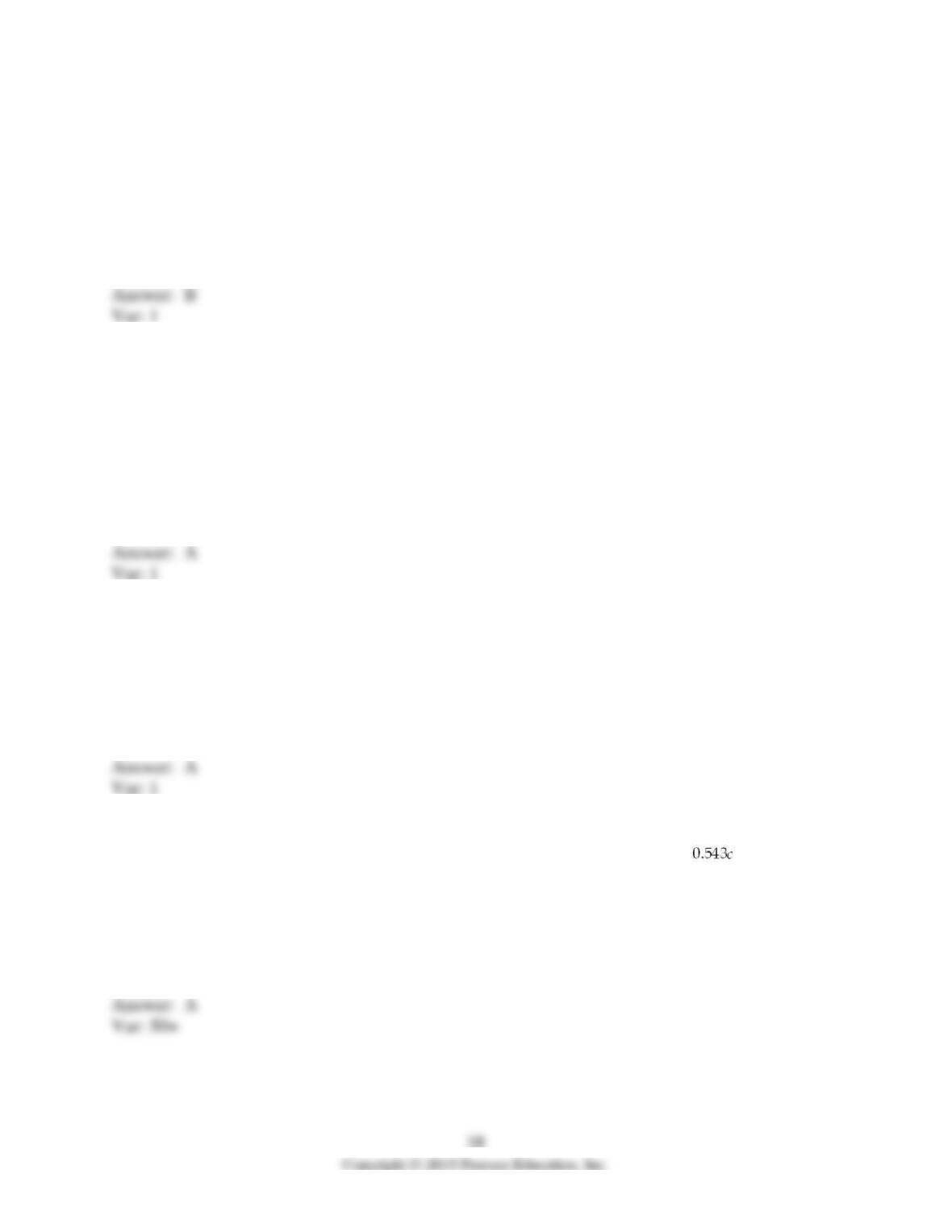
53) Two spaceships, each 100 m long in its own rest frame, approach Earth from opposite
directions, each with a speed 0.50c relative to Earth. As measured by a passenger in one of the
spaceships, how long is the other spaceship?
A) 50 m
B) 60 m
C) 70 m
D) 80 m
E) 90 m
54) Two spaceships, each 100 m long in its own rest frame, approach Earth from opposite
directions, with equal speeds relative to Earth. As measured by a passenger in one of the
spaceships, the other spaceship is 96 m long. What is the speed of the spaceships relative to
Earth?
A) c/7
B) c/6
C) c/5
D) c/4
E) c/3
55) A spaceship approaching an asteroid at a speed of 0.60c launches a scout rocket with speed
0.40c relative to the spaceship. At what speed is the scout rocket approaching the asteroid?
A) 0.81c
B) 1.0c
C) 0.76c
D) 0.64c
E) 0.96c
56) In an “atom smasher,” two particles collide head on at relativistic speeds. If the velocity of
the first particle is 0.741c to the left, and the velocity of the second particle is to the right
(both as measured in the lab rest frame), how fast are the particles moving with respect to each
other?
A) 0.916c
B) 1.284c
C) 0.934c
D) 0.834c
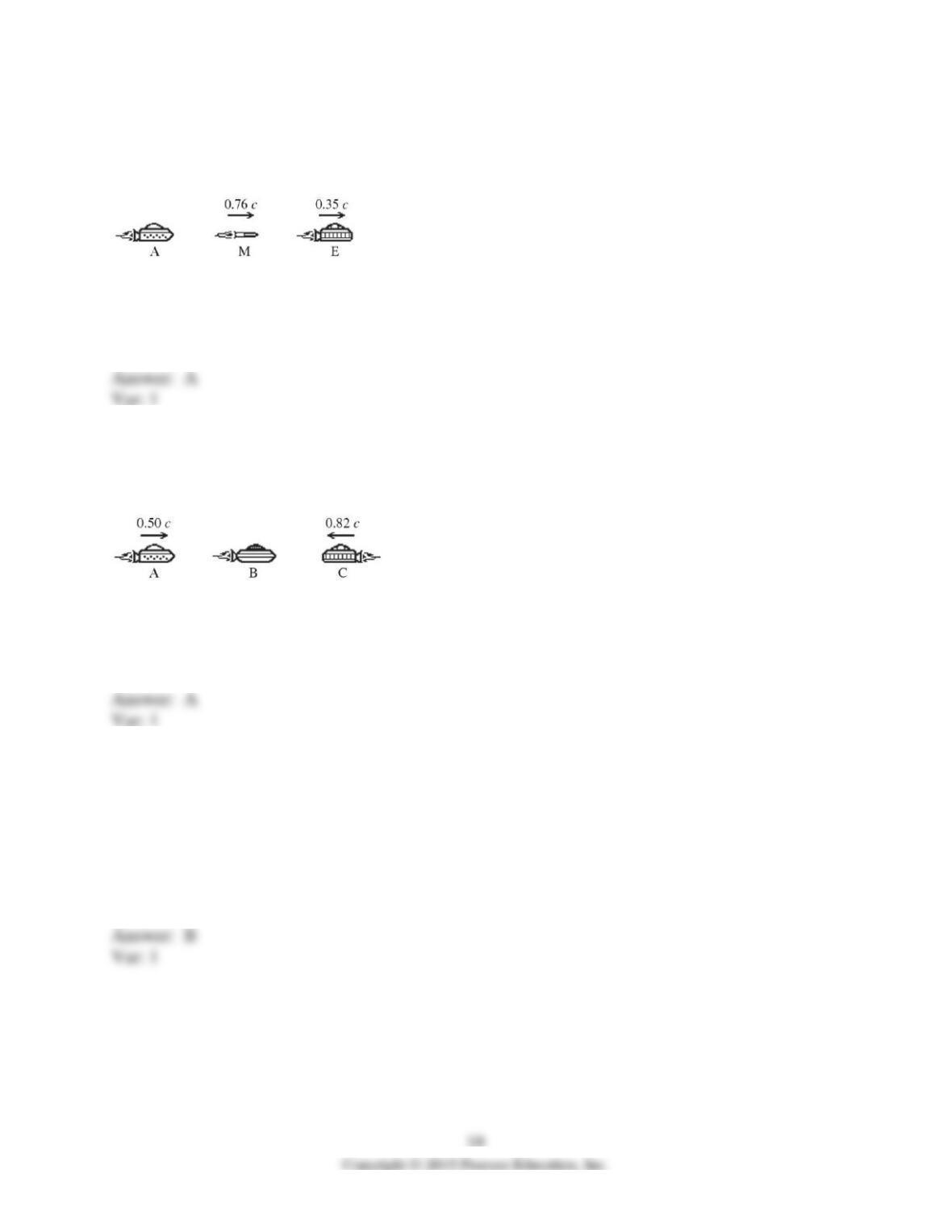
57) As shown in the figure, the captain of spaceship A observes spaceship E escaping with a
relative velocity of 0.35c. A missile M is fired from ship A directly toward ship E, with a
velocity of 0.76c relative to ship A. What does the captain of ship E measure for the velocity of
the missile M?
A) 0.56c
B) 0.41c
C) 0.52c
D) 0.48c
E) 0.45c
58) Three spaceships A, B, and C are in motion as shown in the figure. The commander on ship
B observes ship C approaching with a relative velocity of 0.82c. The commander also observes
ship A, advancing in the rear, with a relative velocity of 0.50c. What is the speed of ship C as
measured by the captain of ship A?
A) 0.94c
B) 0.23c
C) 2.2c
D) 0.54c
E) 1.3c
59) Consider three galaxies, Alpha, Beta and Gamma. An astronomer in Beta sees each of the
other two galaxies moving away from her in opposite directions at 0.70c. At what speed would
an observer in Alpha see the galaxy Beta moving?
A) 0.82c
B) 0.70c
C) 0.94c
D) 0.35c
E) 0.57c
60) Consider three galaxies, Alpha, Beta and Gamma. An astronomer in Beta sees each of the
other two galaxies moving away from him in opposite directions at 0.70c. At what speed would
an observer in Alpha see the galaxy Gamma moving?
A) 0.70c
B) 1.4c
C) 0.82c
D) 0.94c
E) 0.98c
61) As an electron slows down from 0.9980c to 0.5000c, how much momentum does it lose? (c
= 3.0 × 10⁸ m/s, melectron = 9.11 × 10⁻³¹ kg)
62) Calculate the speed at which a 0.723-kg object has the same momentum as a 1.30-kg object
that is moving 0.515c.
A) 0.734c
B) 0.712c
C) 0.981c
D) 0.592c
63) What is the momentum of a proton when it is moving with a speed of 0.60c? (mproton = 1.67
× 10-27 kg)
A) 1.2 × 10⁻¹⁹ kg∙ m/s
B) 1.5 × 10⁻¹⁹ kg ∙ m/s
C) 3.0 × 10⁻¹⁹ kg ∙ m/s
D) 3.8 × 10⁻¹⁹ kg ∙ m/s
64) A particle is moving at 0.86c. By what magnitude percentage is the Newtonian expression
for momentum in error? (The percentage error is the difference between the erroneous and
correct expressions, relative the correct one).
A) 49%
B) 40%
C) 55%
D) 62%
65) An object with a rest mass of 0.456-kg is moving at 1.20 × 10⁸ m/s. What is the magnitude
of its momentum? (c = 3.00 × 10⁸ m/s)
A) 5.47 × 10⁷ kg ∙ m/s
B) 5.57 × 10⁷ kg ∙ m/s
C) 5.67 × 10⁷ kg ∙ m/s
D) 5.87 × 10⁷ kg ∙ m/s
E) 5.97 × 10⁷ kg ∙ m/s
66) A satellite, initially at rest in deep space, separates into two pieces, which move away from
each other. One piece has a rest mass of 190 kg and moves away with a speed 0.280c, and the
second piece moves in the opposite direction with a speed 0.600c. What is the rest mass of the
second piece?
A) 88.7 kg
B) 79.6 kg
C) 73.9 kg
D) 68.8 kg
E) 52.7 kg
67) A satellite, initially at rest in deep space, separates into two pieces, which move away from
each other. One piece has a rest mass of 190 kg and moves away with a speed 0.500c, and the
second piece has a rest mass of 250 kg and moves in the opposite direction. What is the speed of
the second piece?
A) 0.212c
B) 0.380c
C) 0.402c
D) 0.473c
E) 0.500c
68) Two satellites with equal rest masses of 100 kg are traveling toward each other in deep
space. They have identical speeds of 0.600c. The satellites collide and somehow manage to stick
together. What is the rest mass of the combined object after the collision?
A) 200 kg
B) 225 kg
C) 250 kg
D) 275 kg
E) 300 kg
69) A satellite with a rest mass of 200 kg and a speed of 0.800c and a second satellite with a rest
mass of 100 kg and a speed of 0.600c are traveling toward each other in deep space. The
satellites collide and somehow manage to stick together. What is the rest mass of the combined
object after the collision?
A) 300 kg
B) 389 kg
C) 416 kg
D) 457 kg
E) 587 kg
70) A satellite with a rest mass of 200 kg and a speed of 0.800c and a second satellite with a rest
mass of 100 kg and a speed of 0.600c are traveling toward each other in deep space. The
satellites collide and somehow manage to stick together. What is the speed of the combined
object after the collision?
A) 0.333c
B) 0.374c
C) 0.397c
D) 0.418c
E) 0.432c
71) Two satellites with equal rest masses are traveling toward each other in deep space. One is
traveling at 0.550c and the other at 0.750c. The satellites collide and somehow manage to stick
together. What is the speed of the combined object after the collision?
A) 0.100c
B) 0.113c
C) 0.150c
D) 0.175c
E) 0.311c
72) Two satellites with equal rest masses of 100 kg are traveling toward each other in deep
space. One is traveling at 0.650c and the other at 0.850c. The satellites collide and somehow
manage to stick together. What is the rest mass of the combined object after the collision?
A) 100 kg
B) 200 kg
C) 277 kg
D) 378 kg
E) 312 kg
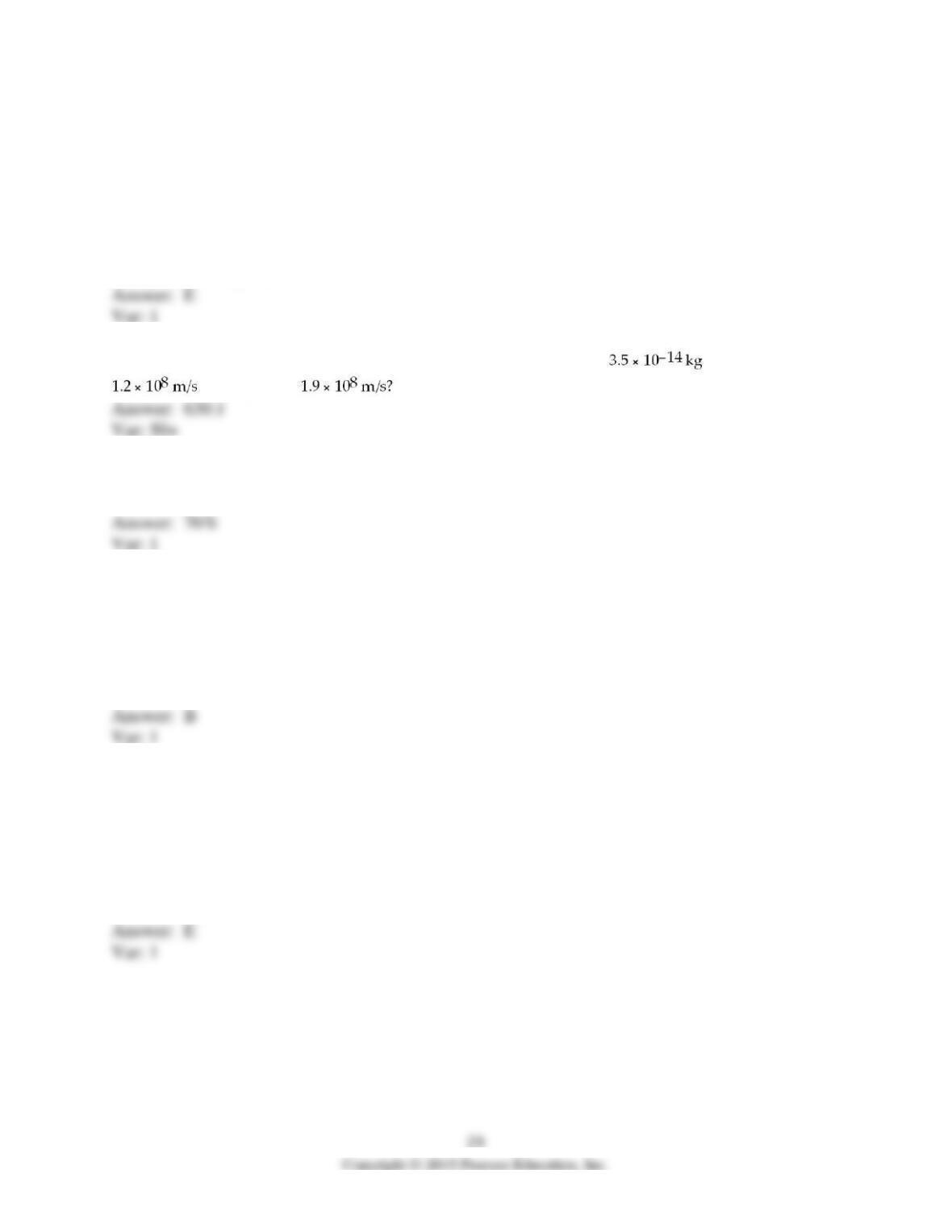
73) A proton, which has a mass of 1.67 × 10⁻²⁷, is moving at 0.80c relative to the laboratory.
What does a physicist in that lab measure for its momentum? (c = 3.0 × 10⁸ m/s)
A) 4.0 × 10⁻¹⁹ kg ∙ m/s
B) 4.4 × 10⁻¹⁹ kg ∙ m/s
C) 5.0 × 10⁻¹⁹ kg ∙ m/s
D) 5.8 × 10⁻¹⁹ kg ∙ m/s
E) 6.7 × 10⁻¹⁹ kg ∙ m/s
74) How much work must be done to accelerate a particle of mass from a speed of
to a speed of (c = 3.0 × 10⁸ m/s)
75) An electron has a relativistic momentum of 1.1 × 10⁻²¹ kg ∙ m/s. What percent of its total
energy is its kinetic energy? (melectron = 9.11 ×10⁻³¹ kg, c = 3.0 × 10⁸ m/s)
76) When a proton is traveling at 0.80c, what is the ratio of its kinetic energy to its rest energy?
A) 0.60
B) 0.67
C) 0.80
D) 1.2
E) 1.7
77) If an electron in the lab has a kinetic energy equal to twice its rest energy, what is its speed in
the lab?
A) 0.84c
B) 0.87c
C) 0.89c
D) 0.91c
E) 0.94c

78) Calculate the amount of energy needed to accelerate an electron from to
Express your answer in The rest mass energy of an electron is 0.511 MeV.
A) 2.71 MeV
B) 1.90 MeV
C) 4.61 MeV
D) 5.69 MeV
79) If the kinetic energy of a proton is 80% of its total energy, what is the speed of the proton?
A) 0.02c
B) 0.87c
C) 0.98c
D) 1.0c
80) What is the total energy of an electron moving with a speed of 0.950c? (c = 3.0 × 10⁸ m/s,
mel = 9.11 × 10⁻³¹ kg)
A) 2.6 × 10⁻¹³ J
B) 8.2 × 10⁻¹⁴ J
C) 1.1 × 10⁻¹³ J
D) 1.2 × 10⁻¹⁴ J
81) How many joules of energy are required to accelerate a 1.0-kg rock from rest to a speed of
0.866c? (c = 3.0 × 10⁸ m/s)
A) 1.8 × 10¹⁷ J
B) 9.0 × 10¹⁶ J
C) 3.0 × 10³ J
D) 3.3 × 10¹⁶ J
82) If, instead of the correct formula for kinetic energy, we carelessly use the classical
expression for kinetic energy for a particle moving at half the speed of light, by what magnitude
percent will our calculation be in error? (c = 3.0 × 10⁸ m/s)
A) 24%
B) 19%
C) 27%
D) 7%
E) 1%

83) How much energy would be required to accelerate a 77-kg professor from rest to 90% the
speed of light? (c = 3.0 × 10⁸ m/s)
A) 1.6 × 10¹⁹ J
B) 2.1 × 10¹⁹ J
C) 9.0 × 10¹⁹ J
D) 2.8 × 10¹⁹ J
E) 3.5 × 10¹⁹ J
84) If the kinetic energy of a particle is 3.00 times its rest energy, the speed of the particle is
closest to which of the following values?
A) 0.950c
B) 0.968c
C) 0.976c
D) 0.984c
E) 0.990c
85) A space barge pushes on a spaceship with a rest mass of 15,000 kg and accelerates it from a
speed of 0.600c to a speed of 0.700c. How much work does the barge have to do to accomplish
this? (c = 3.00 × 10⁸ m/s)
A) 1.35 × 10²⁰ J
B) 2.03 × 10²⁰ J
C) 2.70 × 10²⁰ J
D) 5.42 × 10²⁰ J
E) 8.78 × 10¹⁹ J
86) An electron has a speed of 0.783c. Through what potential difference would the electron
need to be accelerated from rest in order to reach this speed? The rest mass energy of an electron
is 0.511 MeV.
A) 310 kV
B) 260 kV
C) 360 kV
D) 400 kV
87) Consider a student whose mass is 70 kg. If all his mass were converted to electrical energy,
for how many years could he keep a 100-W light bulb burning? (c = 3.0 × 10⁸ m/s)
88) An electron-volt is the energy gained by an electron if it is accelerated through a potential
difference of one volt. What is the equivalent to an electron-volt in kilograms? (c = 3.00 × 10⁸
m/s, e = 1.60 × 10⁻¹⁹ C)
89) One of the first atomic bombs released energy equivalent to that of 20,000 tons of TNT
explosive. How much mass was converted to energy by this explosion, given that 1000 tons of
TNT produce 4.3 × 10¹² J of energy. Incidentally, modern H-bombs have energy yields 1000
times as much! (c = 3.0 × 10⁸ m/s)
90) An alpha particle has a mass of 6.64 × 10⁻²⁷ kg and a charge of 3.20 × 10⁻¹⁹ C, and it is
traveling at 0.9650c. (c = 3.00 × 10⁸ m/s), 1 eV = 1.60 × 10⁻¹⁹ J)
(a) What is its rest energy (in GeV)?
(b) What is its total energy (in GeV)?
(c) What is its kinetic energy (in GeV)?
91) A person with an initial mass of 70 kg climbs a stairway and thereby rises 6.0 m in elevation.
By how much does his mass increase by virtue of his increased potential energy? (c = 3.0 × 10⁸
m/s)
92) If the mass of a 1.0-kg book could be entirely converted into electrical energy, how many
kW ∙ h of energy would that generate? (c = 3.0 × 10⁸ m/s)
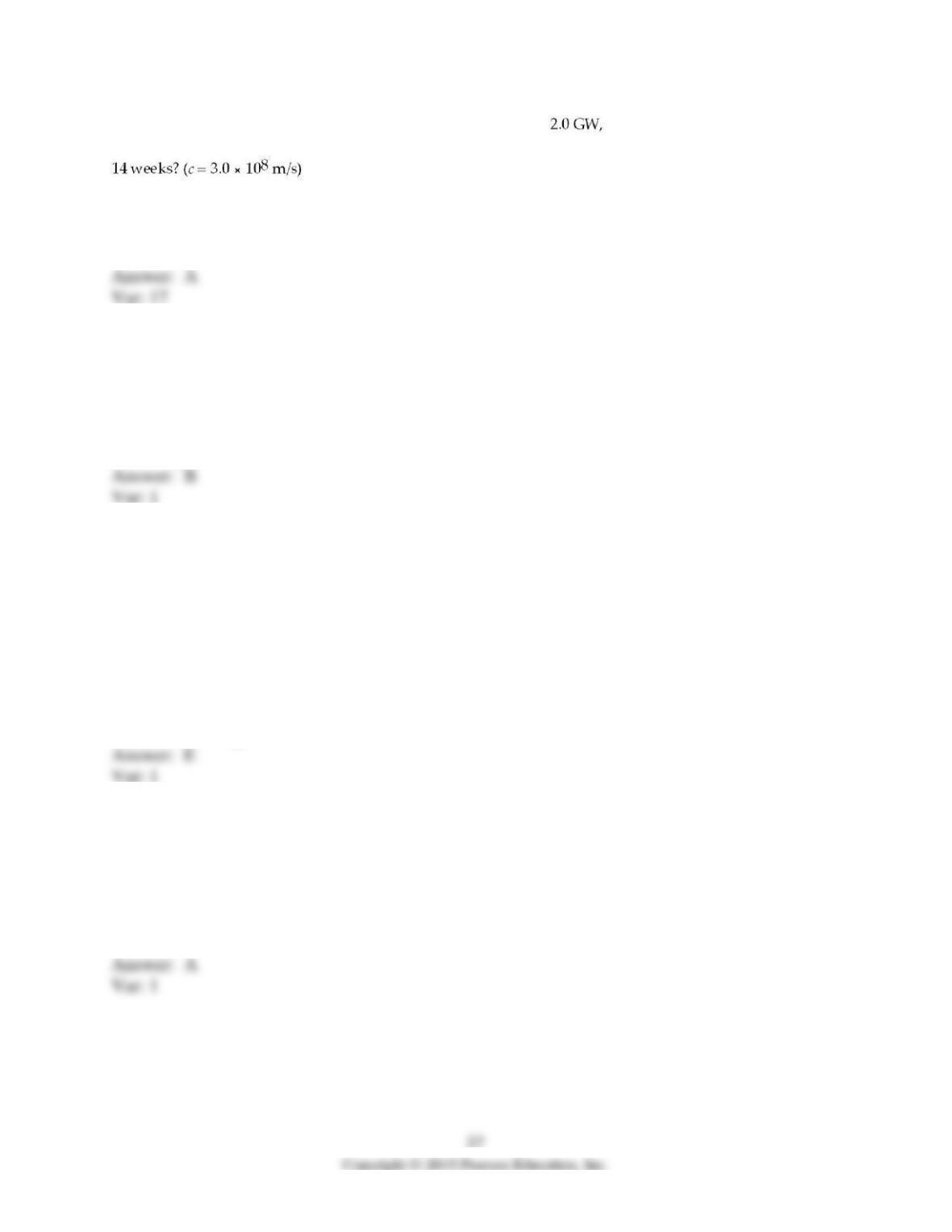
93) If a typical city consumes electrical energy at a rate of how many kilograms of matter
would have to be converted entirely into electrical energy in order to keep this city running for
A) 0.19 kg
B) 0.21 kg
C) 0.27 kg
D) 0.32 kg
94) In a nuclear plant, 1017 J of energy is available from mass conversion. How much mass of
fuel was lost to produce this energy? (c = 3.0 × 10⁸ m/s)
A) 0.1 kg
B) 1 kg
C) 10 kg
D) 100 kg
95) In a certain chemical reaction, 8.1 × 10⁻¹⁹ J of energy is released per molecule formed. What
is the difference in mass per molecule between the sum of the masses of the molecules of the
reagents before the reaction and the mass of the molecules produced by the reaction? (c = 3.0 ×
108 m/s)
A) 8.1 × 10⁻²⁸ kg
B) 2.7 × 10⁻²⁷ kg
C) 3.2 × 10⁻²⁷ kg
D) 5.4 × 10⁻³² kg
E) 9.0 × 10-36 kg
96) During a reaction, a reactant loses 4.8 × 10⁻²⁸ kg of mass. How many joules of energy are
released? (c = 3.0 × 10⁸ m/s)
A) 4.3 × 10⁻¹¹ J
B) 1.4 × 10⁻¹⁹ J
C) 1.6 × 10-36 J
D) 5.3 × 10-45 J
97) During a reaction, 170 µJ of energy is released. What change of mass would accompany this
release? (c = 3.0 × 10⁸ m/s)
A) 5.1 × 10⁻⁴ kg
B) 1.5 × 10⁻¹³ kg
C) 4.8 × 10⁻¹⁸ kg
D) 1.9 × 10⁻²¹ kg
98) How many MeV of energy is released during a reaction in which 1.67 × 10⁻²⁵ kg of material
is converted to energy? (c = 3.0 × 10⁸ m/s, 1 eV = 1.67 × 10⁻¹⁹ J)
A) 5.0 × 10⁻¹⁴ MeV
B) 4.1 × 10⁻⁷ MeV
C) 3.1 × 10⁻⁴ MeV
D) 9.4 × 10⁴ MeV
99) How much mass is lost during a reaction in which 1.7 × 10⁸ MeV of energy is released? (c =
3.0 × 10⁸ m/s, 1 eV = 1.6 × 10⁻¹⁹ J)
A) 1.8 × 10⁻⁸ kg
B) 5.7 × 10⁻⁹ kg
C) 1.9 × 10⁻¹⁷ kg
D) 3.0 × 10⁻²² kg
100) How much energy would be released if 2.0 kg of material was lost during a reaction? (c =
3.0 × 10⁸ m/s)
A) 1.8 × 10¹⁷ J
B) 1.5 × 10¹⁶ J
C) 6.0 × 10⁸ J
D) 4.7 × 10⁻⁸ J
101) The energy released by a certain reaction is enough to totally evaporate 125 kg of water at
its boiling point. How much mass was lost during this reaction? (LF = 334,000 J/kg for water, c
= 3.00 × 10⁸ m/s)
102) One of the first atomic explosion released approximately 1.0 × 10¹⁴ J of energy. How much
matter had to be changed into energy to produce this yield? (c = 3.0 × 10⁸ m/s)
A) 1.1 g
B) 23 g
C) 13 g
D) 0.45 kg
E) 1.1 kg
103) A 1.00-kg gold ingot is carried from the bottom of the Eiffel tower to the top, 300 m above
ground level. By what amount does its mass change? (c = 3.00 × 10⁸ m/s)
A) Its mass does not change.
B) Its mass increases by 3.27 × 10⁻¹⁴ kg
C) Its mass decreases by 3.27 × 10⁻¹⁴ kg
D) Its mass increases by 1.64 × 10⁻¹⁴ kg
E) Its mass decreases by 1.64 × 10⁻¹⁴ kg
104) A 1.0-kg aluminum ingot is heated from 0°C to 100°C. By what amount does its mass
change? The specific heat of aluminum is 900 J/kg ∙ K. (c = 3.0 × 10⁸ m/s)
A) Its mass does not change.
B) Its mass increases by 0.50 × 10⁻¹² kg
C) Its mass decreases by 0.50 × 10⁻¹² kg
D) Its mass increases by 1.0 × 10⁻¹² kg
E) Its mass decreases by 1.0 × 10⁻¹² kg
105) If a particle has a total energy that is 5.00 times its rest energy, the speed of the particle is
closest to which one of the following values?
A) 0.980c
B) 0.985c
C) 0.950c
D) 0.990c
E) 0.998c
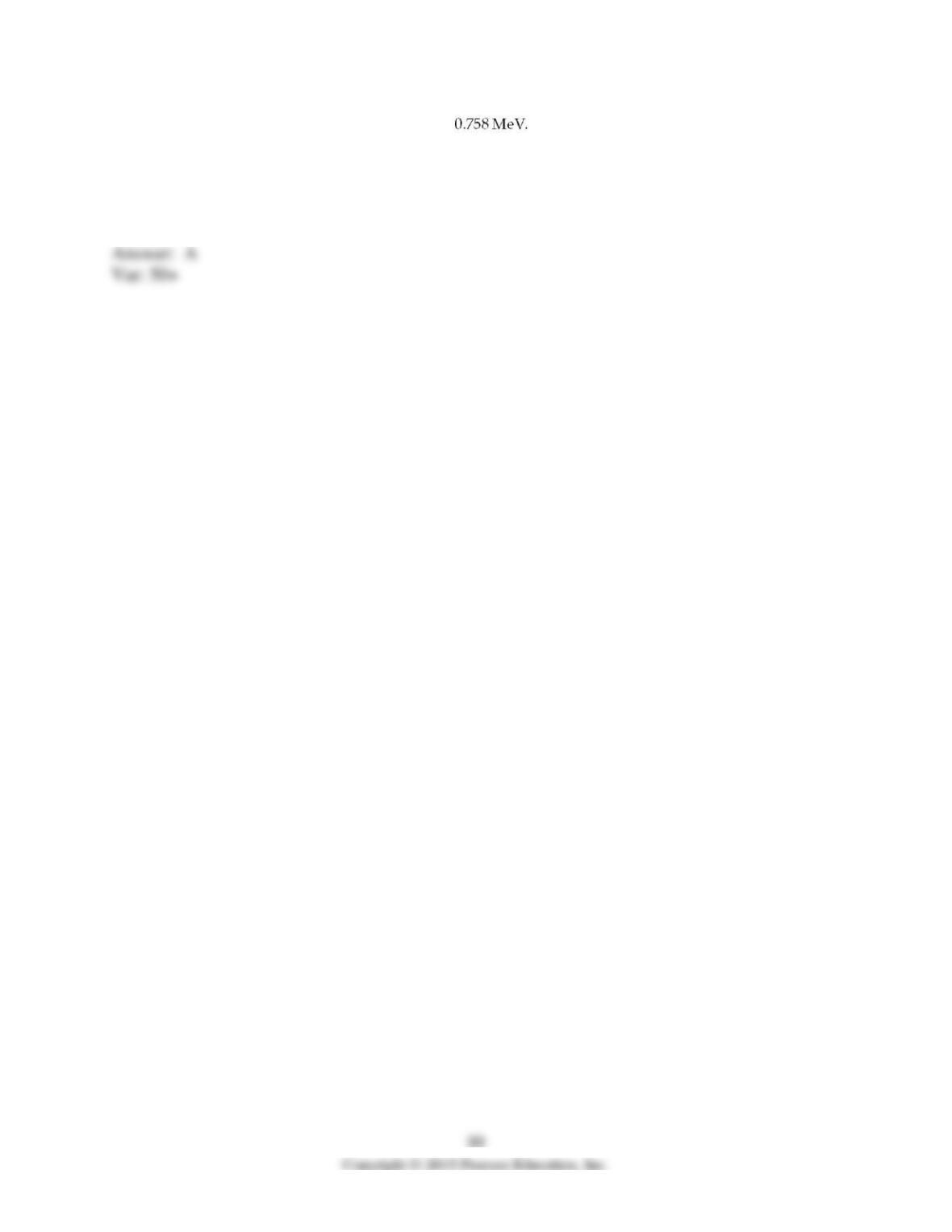
106) The total energy of a moving electron is What is the speed of the electron in
terms of c? The rest mass energy of an electron is 0.511 MeV.
A) 0.739 c
B) 0.794 c
C) 0.306 c
D) 0.933 c