Exam
Name___________________________________
MULTIPLE CHOICE. Choose the one alternative that best completes the statement or answers the question.
1)
Which of the following statements is false?
1)
A)
When following a conservative financing policy, a firm would use long–term sources of funds
to finance its fixed assets, permanent working capital, and some of its seasonal needs.
B)
To implement a conservative financing policy effectively, there will necessarily be periods
when excess cash is available—those periods when the firm requires little or no investment in
temporary working capital.
C)
A firm could finance its short–term needs with long–term debt, a practice known as a
conservative financing policy.
D)
An aggressive financing policy also increases the possibility that managers of the firm will
use this excess cash nonproductively—for example, on perquisites for themselves.
2)
Which of the following statements is false?
2)
A)
The first step in short–term financial planning is to forecast the company’s future net working
capital.
B)
If a company anticipates an ongoing surplus of cash, it may choose to increase its dividend
payout.
C)
Deficits resulting from investments in long–term projects are often financed using long–term
sources of capital, such as equity or long–term bonds.
D)
Seasonal sales can create large short–term cash flow deficits and surpluses.
The first step in short–term financial planning is to forecast the company’s future
3)
Which of the following statements is false?
3)
A)
With a trust receipts loan or floor planning, all inventory items are held in a trust as security
for the loan.
B)
In a warehouse arrangement, the inventory that serves as collateral for the loan is stored in a
warehouse.
C)
If the factoring agreement is without recourse, the borrowing firm must receive credit
approval for a customer from the factor prior to shipping the goods. If the factor gives its
approval, the firm ships the goods and the customer is directed to make payment directly to
the lender.
D)
In a pledging of accounts receivable agreement, the lender reviews the invoices that represent
the credit sales of the borrowing firm and decides which credit accounts it will accept as
collateral for the loan, based on its own credit standards.
4)
Luther Industries is offered a $1 million dollar loan for four months at an APR of 9%. If this loan
has an origination fee of 1%, then the effective annual rate (EAR) for this loan is closest to:
4)
A)
12.6%
B)
4.1%
C)
13.8%
D)
12.0%
5)
Which of the following statements is false?
5)
A)
The value of short–term debt is less sensitive to the firm’s credit quality than long–term debt;
therefore, its value will be less affected by management‘s actions or information.
B)
Financing part or all of the permanent working capital with short–term debt is known as an
aggressive financing policy.
C)
Permanent working capital is the amount that a firm must keep invested in its short–term
assets to support its continuing operations.
D)
When the yield curve is downward sloping, the interest rate on short–term debt is lower than
the rate on long–term debt. In that case, short–term debt may appear cheaper than long–term
debt.
6)
Which of the following statements is false?
6)
A)
Following the matching principle should, in the long run, help minimize a firm’s transaction
costs.
B)
A portion of a firm’s investment in its accounts receivable and inventory is temporary and
results from seasonal fluctuations in the firm’s business or unanticipated shocks.
C)
In a perfect capital market, the choice of financing is irrelevant; thus how the firm chooses to
finance its short–term cash needs cannot affect value.
D)
The matching principle indicates that the firm should finance permanent working capital
with short–term sources of funds.
7)
Which of the following statements regarding commercial paper is false?
7)
A)
With dealer paper, the spread increases the proceeds that the issuing firm receives, thereby
decreasing the effective cost of the paper.
B)
With direct paper, the firm sells the security directly to investors.
C)
With dealer paper, dealers sell the commercial paper to investors in exchange for a spread (or
fee) for their services.
D)
The minimum face value is $25,000, and most commercial paper has a face value of at least
$100,000.
8)
Which of the following statements is false?
8)
A)
Extending the maturity of commercial paper beyond 270 days triggers a registration
requirement with the Securities and Exchange Commission (SEC), which increases issue costs
and creates a time delay in the sale of the issue.
B)
Commercial paperis short–term, unsecured debt used by large corporations that is usually a
cheaper source of funds than a short–term bank loan.
C)
The interest on commercial paper is typically paid by selling it at an initial discount.
D)
Unlike long–term debt, because of its short maturity, commercial paper is not rated by credit
rating agencies.
9)
Inventory can be used as collateral for a loan in all of the following ways except
9)
A)
a trust receipt.
B)
a warehouse arrangement.
C)
a floating lien.
D)
a factoring arrangement.
10)
A firm issued three–month commercial paper with a $2,000,000 face value and received $1,964,000.
The effective annual rate that this firm is paying is closest to:
10)
A)
7.3%
B)
7.5%
C)
1.8%
D)
8.0%
11)
A short–term bank loan that is often used until a firm can arrange for long–term financing is called
11)
A)
a bridge loan.
B)
a committed line of credit.
C)
a short–term mortgage loan.
D)
a single, end–of–period–payment loan.
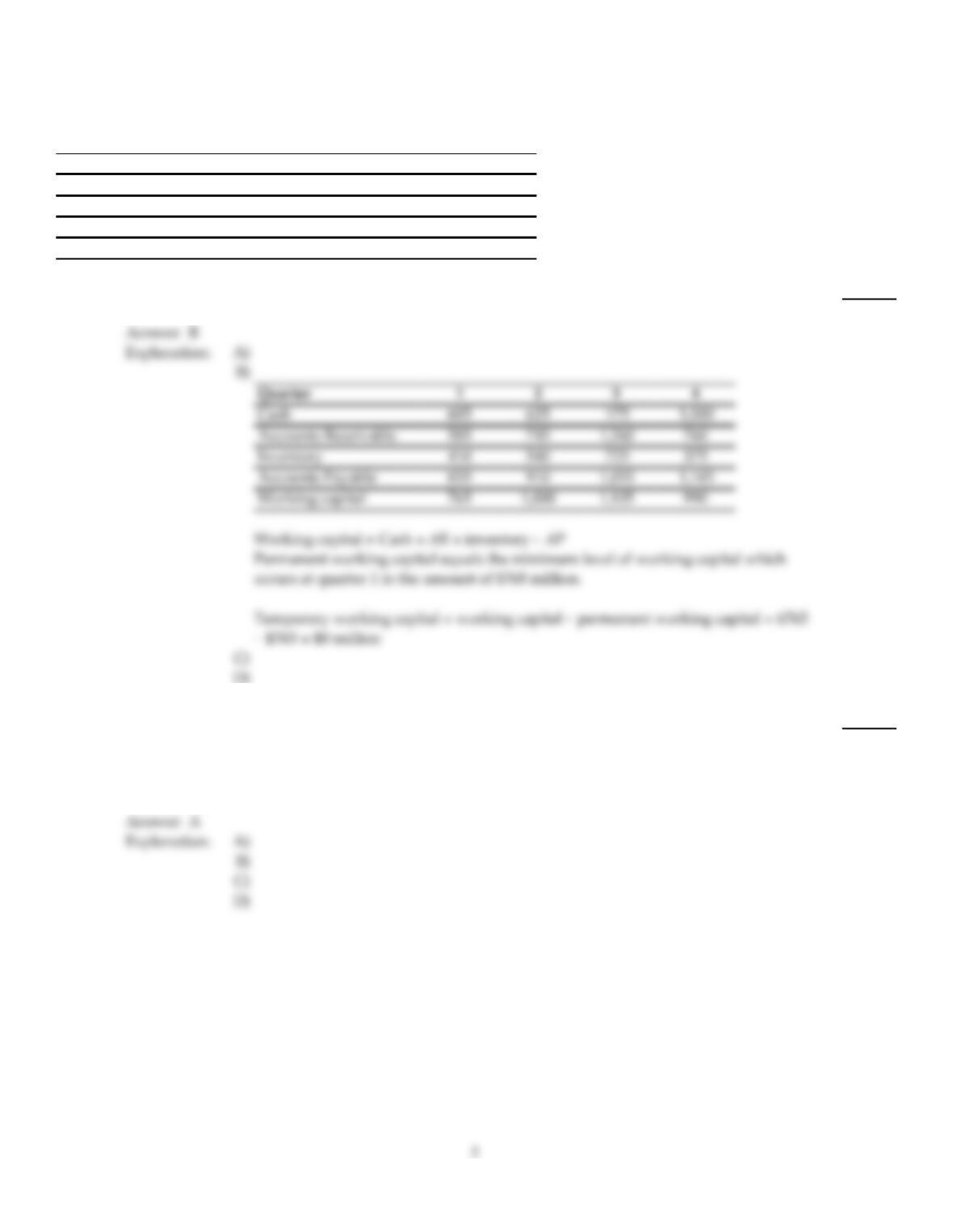
Use the table for the question(s) below.
The quarterly working capital levels for Hasbeen Toys are presented in the following table (in $ millions):
Quarter 1 2 3 4
Cash 605 625 175 1,000
Accounts Receivable 585 745 1,260 760
Inventory 410 540 725 375
Accounts Payable 835 910 1,055 1,145
12)
The temporary working capital needs for Hasbeen Toys in quarter 1 is closest to:
12)
A)
$770 million
B)
$0 million
C)
$845 million
D)
$340 million
13)
A a written, legally binding agreement that obligates the bank to lend a firm any amount up to a
stated maximum, regardless of the financial condition of the firm (unless the firm is bankrupt) as
long as the firm satisfies any restrictions in the agreement is called
13)
A)
a committed line of credit.
B)
a short–term mortgage loan.
C)
a bridge loan.
D)
a single, end–of–period–payment loan.
14)
Which of the following statements is false?
14)
A)
On the other hand, by relying on short–term debt the firm exposes itself to funding risk,
which is the risk of incurring financial distress costs should the firm not be able to refinance
its debt in a timely manner or at a reasonable rate.
B)
With a conservative financing policy, the firm would use short–term debt very sparingly to
meet its peak seasonal needs.
C)
Short–term debt can have lower agency and lemons costs than long–term debt, and an
aggressive financing policy can benefit shareholders.
D)
An ultra–conservative policy would involve financing even some of the plant, property, and
equipment with short–term sources of funds.
15)
Which of the following statements is false?
15)
A)
Regardless of the loan structure, the bank may include a compensating balance requirement
in the loan agreement that reduces the usable loan proceeds.
B)
Firms frequently use lines of credit to finance seasonal needs.
C)
The commitment fee associated with a committed line of credit is designed to decreases the
effective cost of the loan to the firm.
D)
Another common type of fee is a loan origination fee, which a bank charges to cover credit
checks and legal fees.
16)
Which of the following statements is false?
16)
A)
With a discount loan, the borrower is required to pay the interest at the endof the loan
period.
B)
A bridge loan is another type of short–term bank loan that is often used to “bridge the gap”
until a firm can arrange for long–term financing.
C)
Bridge loans are often quoted as discount loans with fixed interest rates.
D)
After a natural disaster, lenders may provide businesses with short–term loans to serve as
bridges until they receive insurance payments or long–term disaster relief.
An ultra–aggressive policy would involve financing even some of the plant,
17)
When a company analyzes its short–term financing needs, it typically examines cash flows at
17)
A)
quarterly intervals.
B)
monthly intervals.
C)
weekly intervals.
D)
yearly intervals.
18)
Which of the following statements is false?
18)
A)
If a firm sells its goods on terms of net 30, then the factor will pay the firm the face value of its
receivables, less a factor’s fee, at the end of 30 days.
B)
The factoring arrangement may be without recourse, in which case the lender bears the risk of
bad–debt losses.
C)
Commercial banks, finance companies, and factors, which are firms that purchase the
receivables of other companies, are the most common sources for secured short–term loans.
D)
In a floating lien, general lien, or blanket lien arrangement, specific inventory is used to
secure the loan.
In a floating lien, general lien, or blanket lien arrangement, all of the inventory is
19)
Which of the following statements is false?
19)
A)
With a variable interest rate, the terms of the loan may indicate that the rate will vary with
some spread relative to a benchmark rate, such as the yield on one–year Treasury securities or
the prime rate.
B)
A common benchmark rate is the London Inter–Bank Offered Rate, or LIBOR, which is the
rate of interest at which banks borrow funds from each other in the London inter bank
market.
C)
With a discount loan, the borrower is required to pay the interest at the beginning of the loan
period.
D)
The prime rate is the rate banks charge other banks.
The prime rate is the rate banks charge their most creditworthy customers.
20)
Which of the following is not a specific financing option for temporary working capital?
20)
A)
Bank loans
B)
Secured financing
C)
Commercial paper
D)
Repurchase agreements
21)
Which of the following statements is false?
21)
A)
A public warehouse is a business that exists for the sole purpose of storing and tracking the
inflow and outflow of the inventory.
B)
A warehouse arrangement is the riskiest collateral arrangement from the standpoint of the
lender.
C)
A field warehouse is operated by a third party, but is set up on the borrower’s premises in a
separate area so that the inventory collateralizing the loan is kept apart from the borrower’s
main plant.
D)
Because the warehouser is a professional at inventory control, there is likely to be little loss
due to damaged goods or theft, which in turn lowers insurance costs.
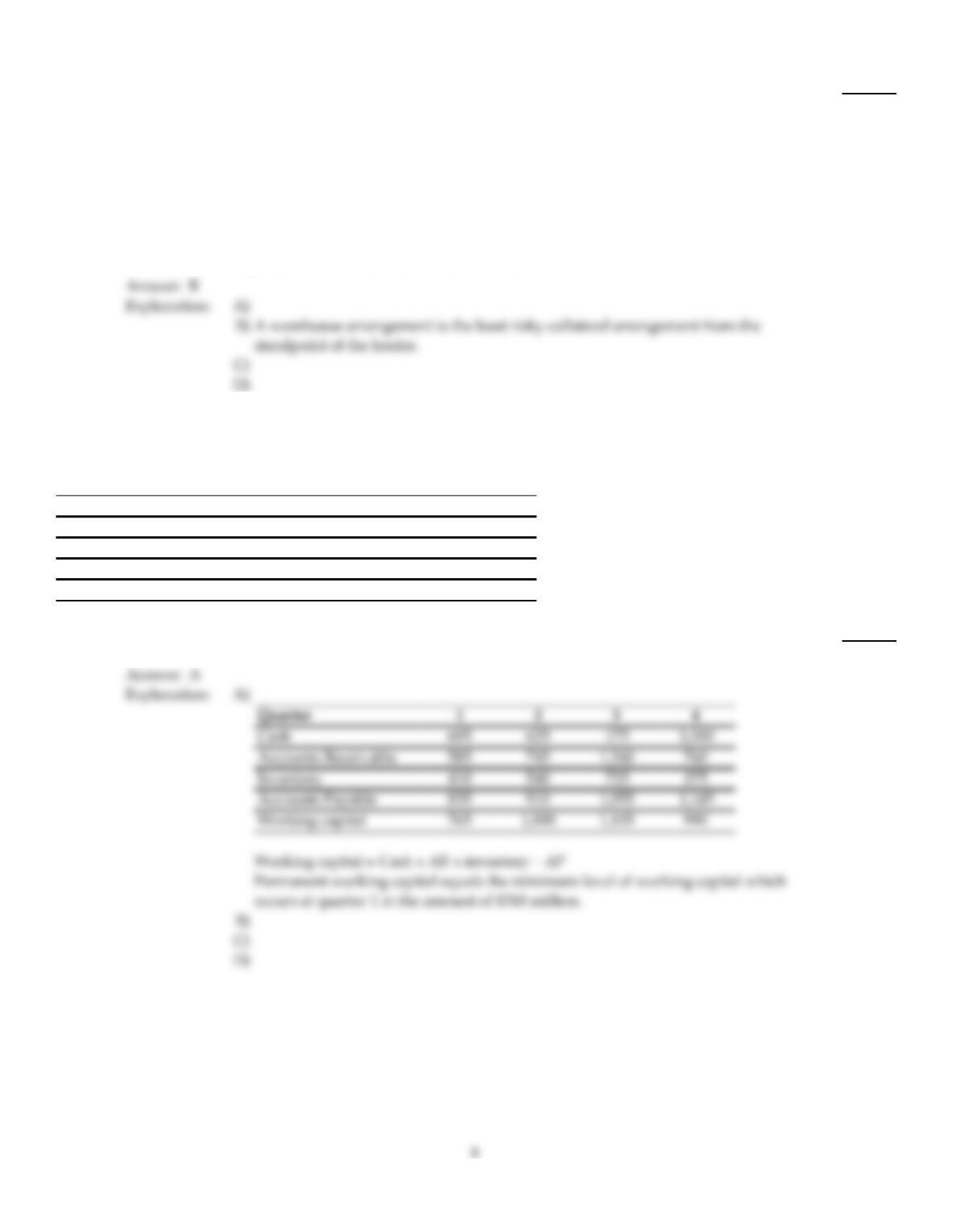
Use the table for the question(s) below.
The quarterly working capital levels for Hasbeen Toys are presented in the following table (in $ millions):
Quarter 1 2 3 4
Cash 605 625 175 1,000
Accounts Receivable 585 745 1,260 760
Inventory 410 540 725 375
Accounts Payable 835 910 1,055 1,145
22)
The permanent working capital needs for Hasbeen Toys is closest to:
22)
A)
$770 million
B)
$1,100 million
C)
$1,275 million
D)
$2,435 million
A
B
23)
Which of the following firms is likely to have the highest short–term financing needs?
23)
A)
An electric utility
B)
A toy store
C)
A pharmaceutical manufacturer
D)
A grocery store
24)
Occasionally, a company will encounter circumstances in which cash flows are temporarily
negative for an unexpected reason. We refer to such a situation as a
24)
A)
a cash crunch.
B)
a liquidity shock.
C)
a negative liquidity shock.
D)
negative cash flow shock.
D
25)
Which of the following statements is false?
25)
A)
Because investment in permanent working capital is required so long as the firm remains in
business, it constitutes a long–term investment.
B)
Temporary working capital is the difference between the lowest level of investment in
short–term assets and the permanent working capital investment.
C)
Because temporary working capital represents a short–term need, the firm should finance this
portion of its investment with short–term financing.
D)
The matching principle states that short–term needs should be financed with short–term debt
and long–term needs should be financed with long–term sources of funds.
B
26)
A loan agreement requires that the firm pay interest on the loan and pay back the principal in one
lump sum at the end of the loan is called
26)
A)
a line of credit.
B)
a short–term mortgage loan.
C)
a bridge loan.
D)
a single, end–of–period–payment loan.
D
B
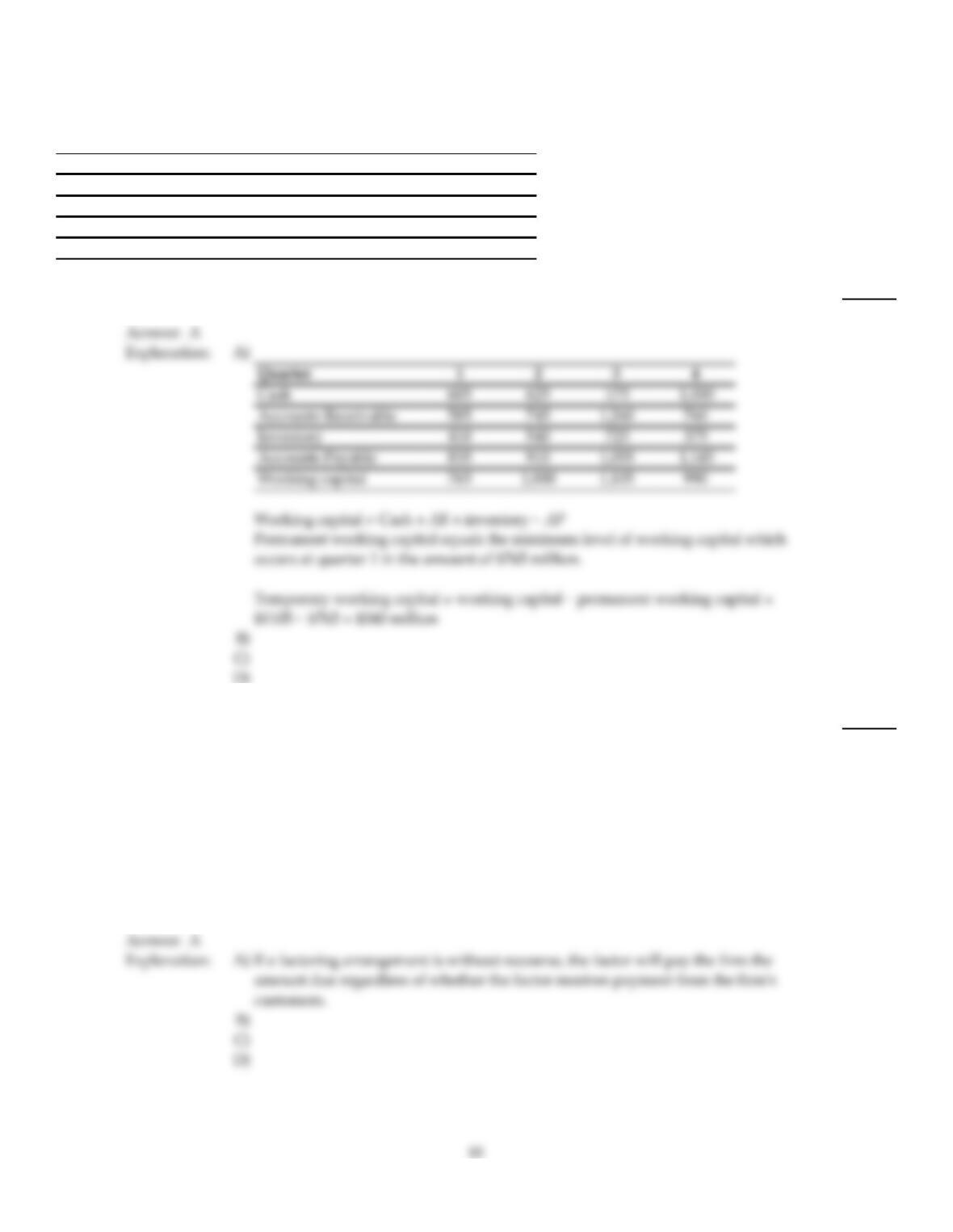
Use the table for the question(s) below.
The quarterly working capital levels for Hasbeen Toys are presented in the following table (in $ millions):
Quarter 1 2 3 4
Cash 605 625 175 1,000
Accounts Receivable 585 745 1,260 760
Inventory 410 540 725 375
Accounts Payable 835 910 1,055 1,145
27)
The temporary working capital needs for Hasbeen Toys in quarter 3 is closest to:
27)
A)
$ 340 million
B)
$770 million
C)
$845 million
D)
$0 million
28)
Which of the following statements is false?
28)
A)
If a factoring arrangement is with recourse, the factor will pay the firm the amount due
regardless of whether the factor receives payment from the firm’s customers.
B)
Both the interest rate and the factor’s fee vary depending on such issues as the size of the
borrowing firm and the dollar volume of its receivables.
C)
In a factoring of accounts receivable arrangement, the firm sells receivables to the lender (i.e.,
the factor), and the lender agrees to pay the firm the amount due from its customers at the
end of the firm’s payment period.
D)
Businesses can also obtain short–term financing by using secured loans, which are loans
collateralized with short–term assets—most typically the firm’s accounts receivables or
inventory.
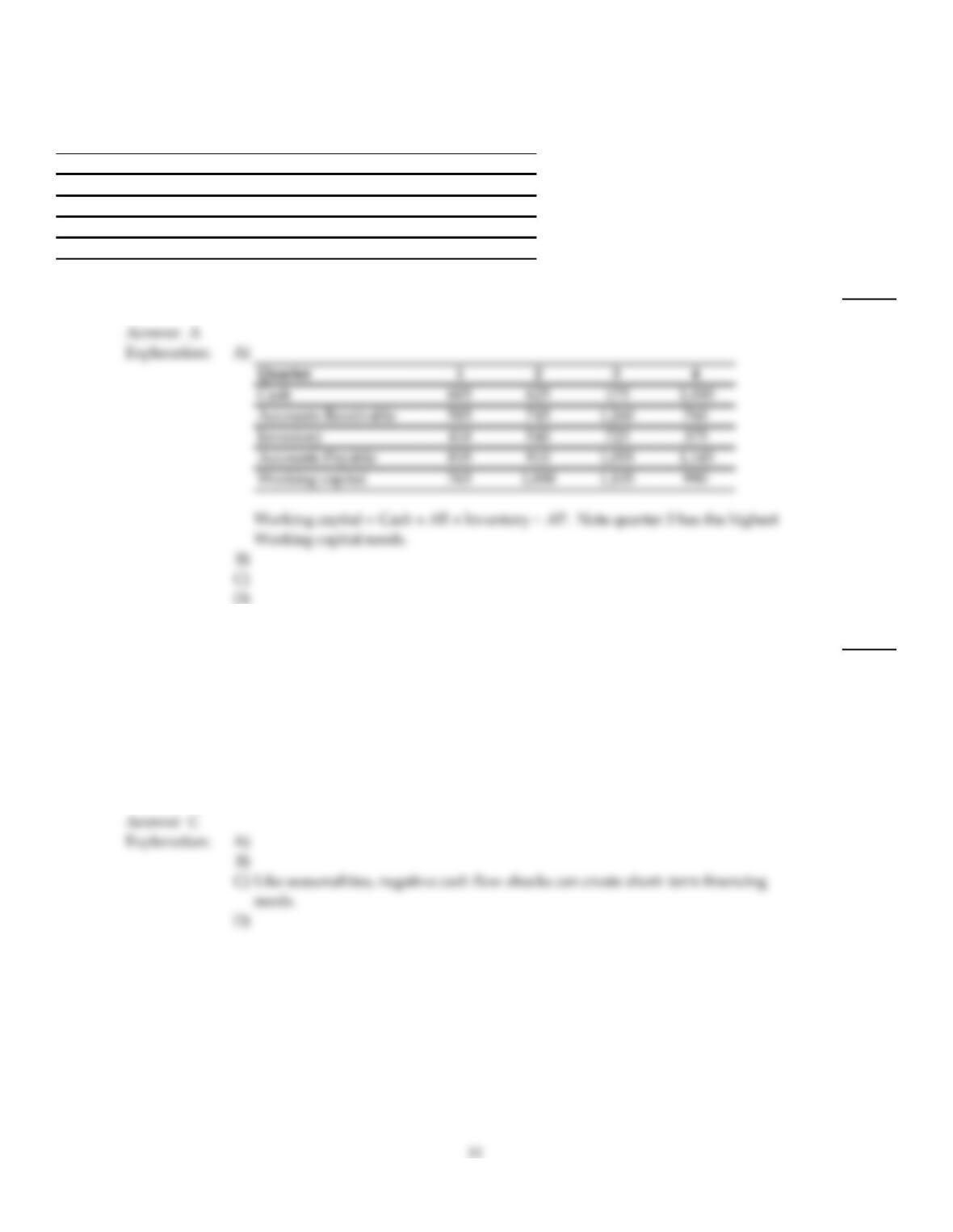
Use the table for the question(s) below.
The quarterly working capital levels for Hasbeen Toys are presented in the following table (in $ millions):
Quarter 1 2 3 4
Cash 605 625 175 1,000
Accounts Receivable 585 745 1,260 760
Inventory 410 540 725 375
Accounts Payable 835 910 1,055 1,145
29)
In which quarter are Hasbeen’s seasonal working capital needs the greatest?
29)
A)
3
B)
2
C)
4
D)
1
30)
Which of the following statements is false?
30)
A)
A company forecasts its cash flows to determine whether it will have surplus cash or a cash
deficit for each period.
B)
When sales are concentrated during a few months, sources and uses of cash are also likely to
be seasonal.
C)
Like seasonalities, positive cash flow shocks can create short–term financing needs.
D)
Firms with seasonal cash flows may find themselves with a surplus of cash during some
months that is sufficient to compensate for a shortfall during other months. However, because
of timing differences, such firms often have short–term financing needs.
31)
Which of the following statements is false?
31)
A)
The most straightforward type of bank loan is a single, end–of–period–payment loan.
B)
One of the primary sources of short–term financing, especially for small businesses, is the
investment bank.
C)
Bank loans are typically initiated with a promissory note, which is a written statement that
indicates the amount of the loan, the date payment is due, and the interest rate.
D)
With a fixed interest rate, the specific rate that the bank will charge is stipulated at the time
the loan is made.
32)
Which of the following statements regarding lines of credit is false?
32)
A)
The line of credit agreement may also stipulate that at some point in time the outstanding
balance must be zero. This policy ensures that the firm does not use the short–term financing
to finance its long–term obligations.
B)
A revolving line of credit with no fixed maturity is called evergreen credit.
C)
A revolving line of credit is an uncommitted line of credit that involves an informal
agreement from the bank for a longer period of time, typically two to three years.
D)
The line of credit may be uncommitted, meaning it is an informal agreement that does not
legally bind the bank to provide the funds.
33)
Luther Industries is offered a $1 million dollar loan for four months at an APR of 9%. If Luther’s
bank requires that the firm maintain a compensating balance equal to 10% of the loan amount in a
non–interest bearing account, then the effective annual rate EAR for this loan is closest to:
33)
A)
71.5%
B)
14.4%
C)
50.0%
D)
12.6%
ESSAY. Write your answer in the space provided or on a separate sheet of paper.
34)
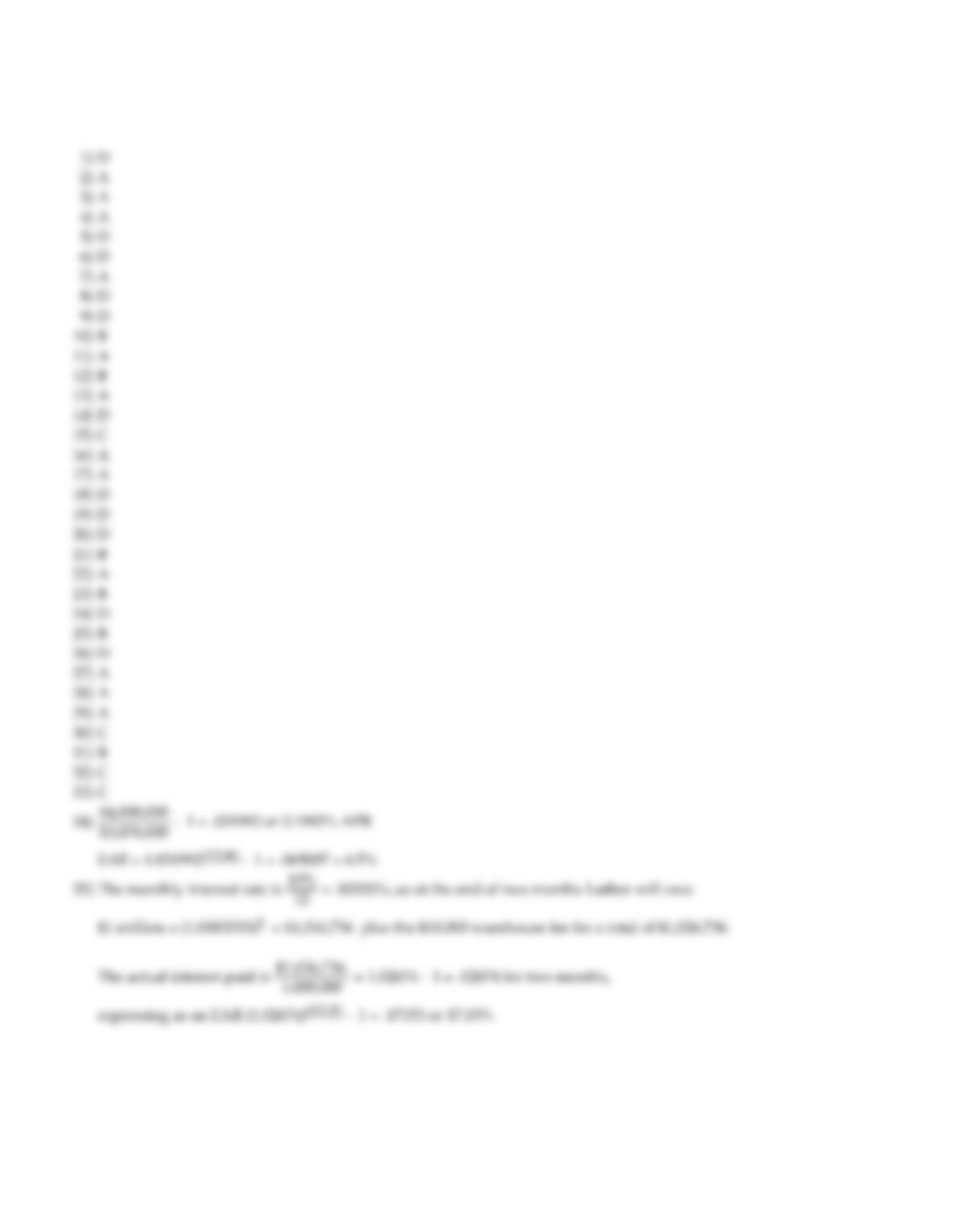
Kinston Industries issued $4,000,000 in commercial paper which matures in six months and received $3,876,000.
Calculate the effective annual rate that Kinston is paying.
35)
The Luther Industries wants to borrow $1 million for two months. Using its inventory as collateral, it can obtain
a 10% (APR) loan (compounded monthly). The lender requires that a warehouse arrangement be used. The
warehouse fee is $10,000, payable at the end of the two months. Calculate the effective annual rate of this loan
for Row Cannery.
36)
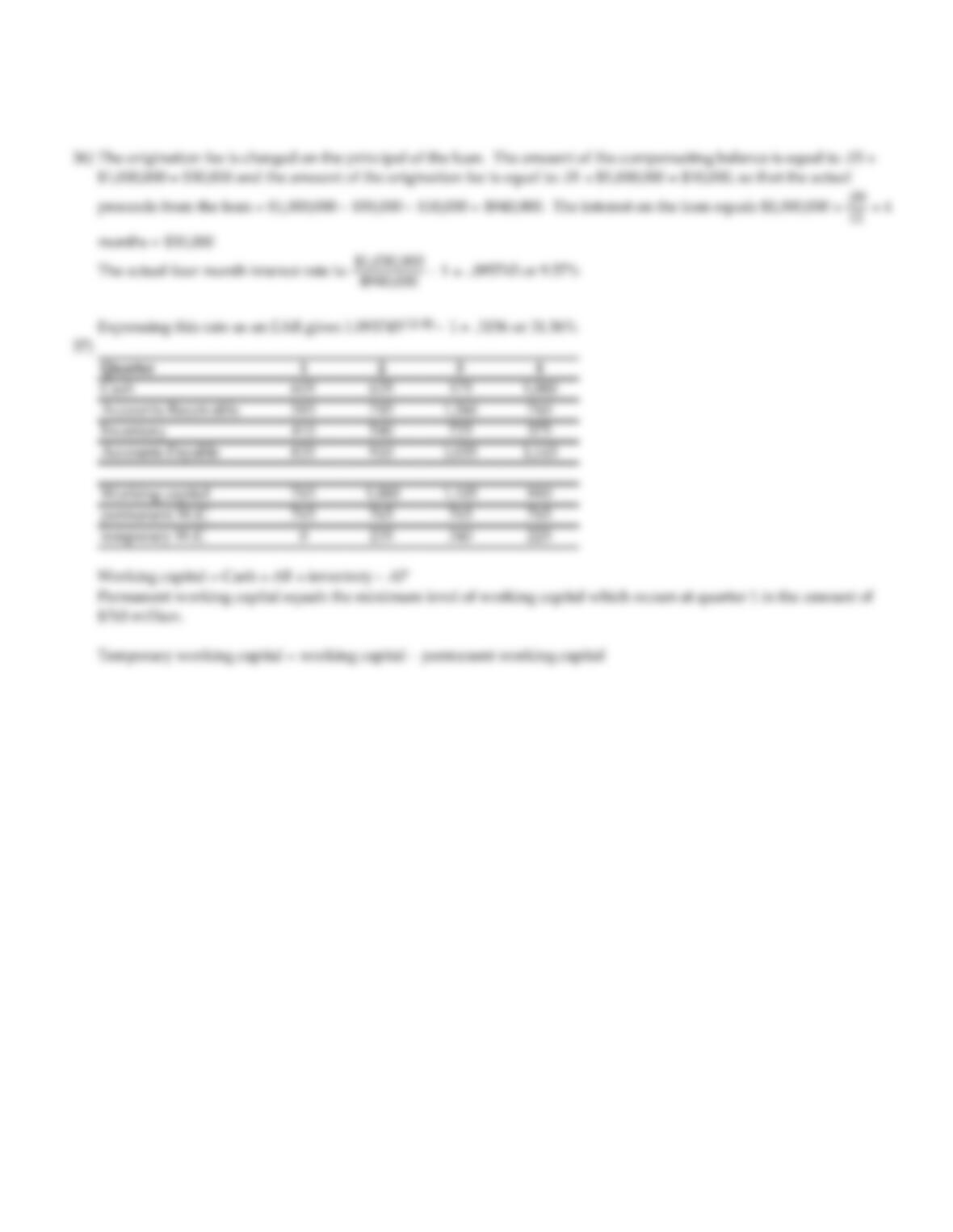
Luther Industries is offered a $1 million dollar loan for four months at an APR of 9%. Luther’s bank requires
that the firm maintain a compensating balance equal to 5% of the loan amount in a non–interest bearing account
and the bank charges a 1% origination fee. Calculate the the effective annual rate EAR for this loan.
Use the table for the question(s) below.
The quarterly working capital levels for Hasbeen Toys are presented in the following table (in $ millions):
Quarter 1 2 3 4
Cash 605 625 175 1,000
Accounts Receivable 585 745 1,260 760
Inventory 410 540 725 375
Accounts Payable 835 910 1,055 1,145
37)
Calculate the temporary working capital needs for each of the four quarters for Hasbeen Toys.
Answer Key
Testname: C27
15
Answer Key
Testname: C27
16