Exam
Name___________________________________
MULTIPLE CHOICE. Choose the one alternative that best completes the statement or answers the question.
1)
If a regulator forced a natural monopolist to set P = MC
1)
A)
the monopolist would break even.
B)
the monopolist would earn monopolistic profits.
C)
the monopolist would suffer economic losses.
D)
the monopolist would earn economic profits.
2)
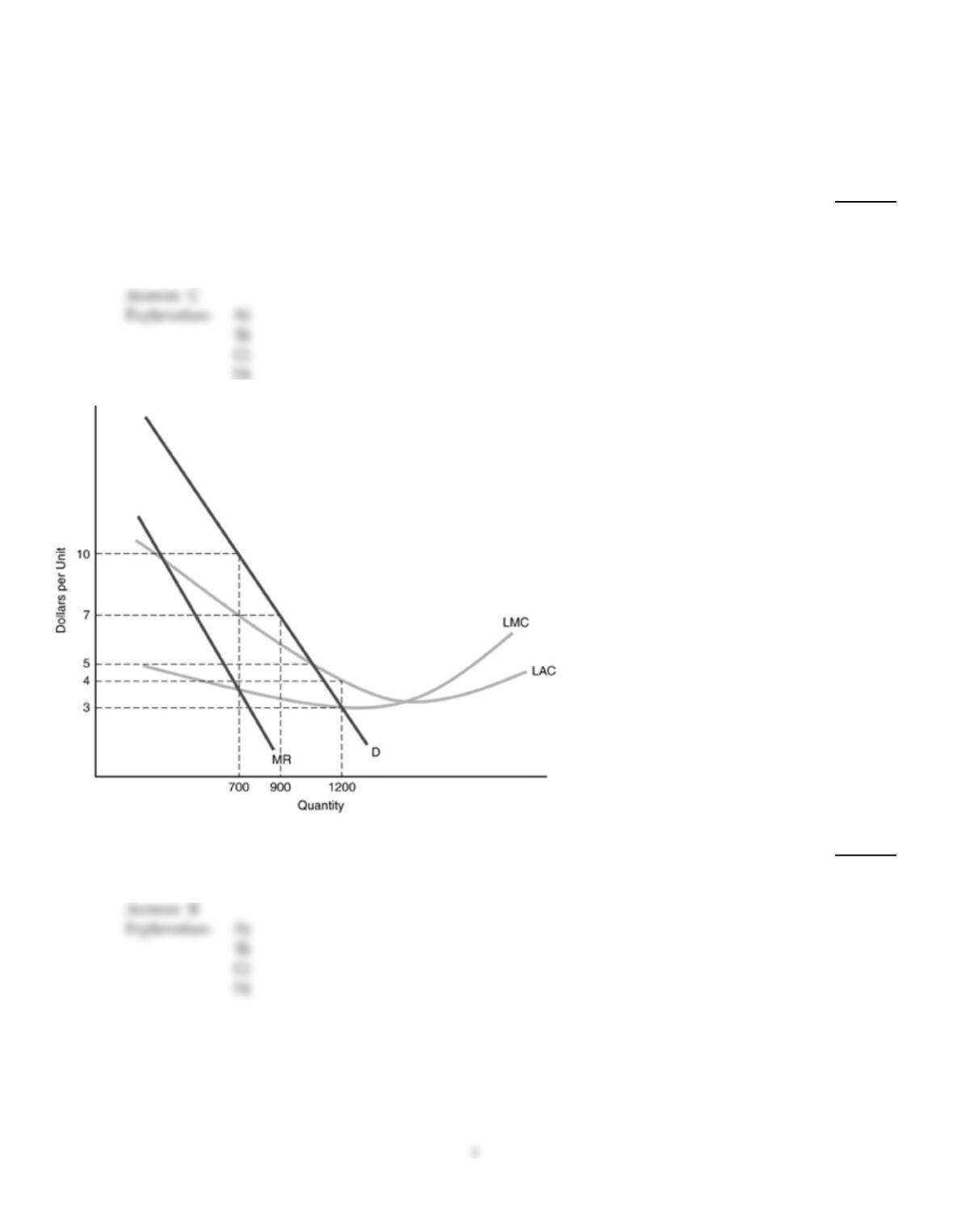
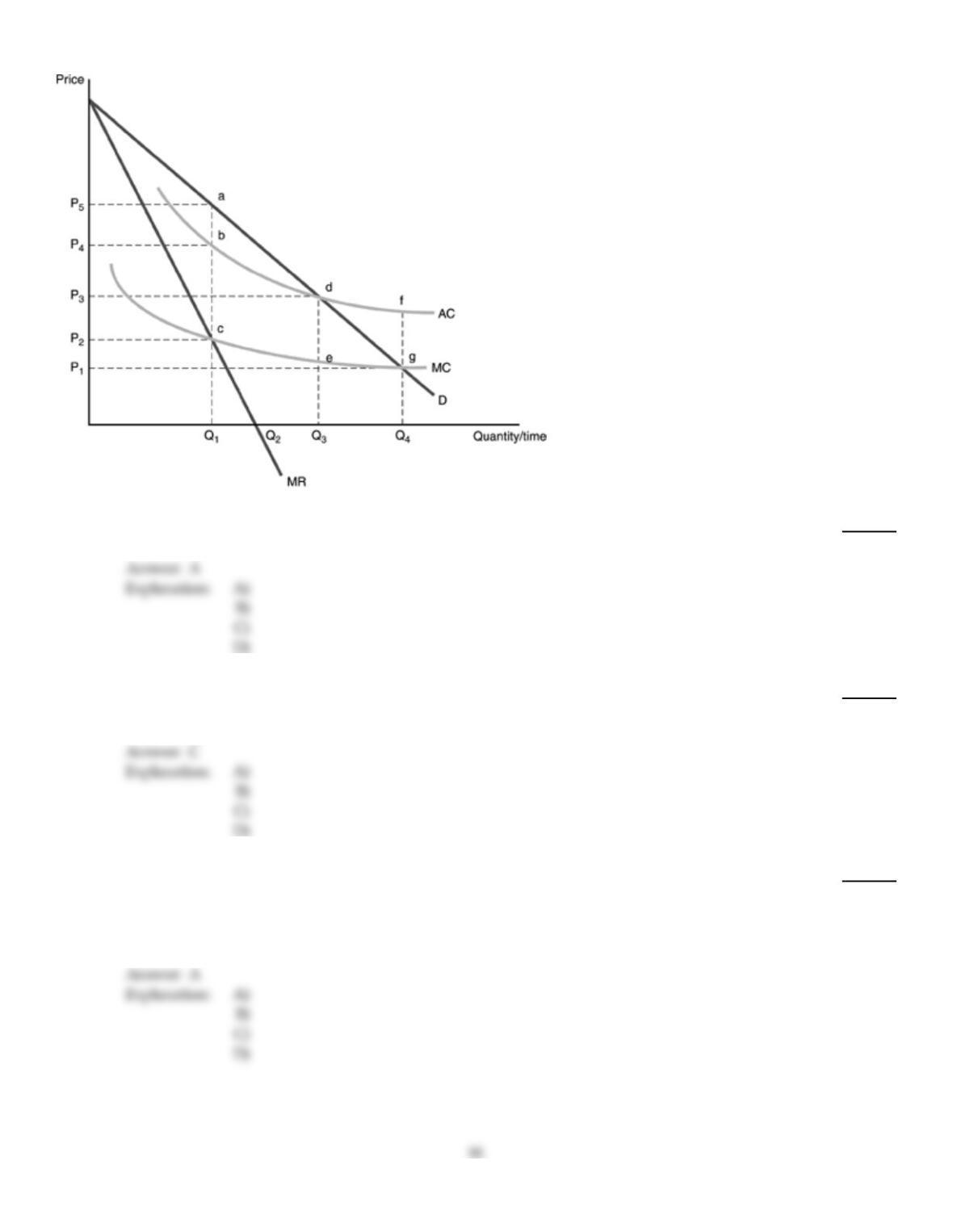
In the above figure, what will be the output level produced if average cost pricing is used?
2)
A)
900
B)
somewhere between 900 and 1,200
C)
1,200
D)
700
3)
Economists who think the capture theory explains regulatory behavior will support their claims by
noting that
3)
A)
Congress ensured that consumers have more influence on the decisions of regulators by
setting up the agencies in ways that insulated the regulators from the regulated firms.
B)
consumers actually dominate regulatory hearings through the influence of consumer
advocacy groups.
C)
regulation as carried out in this country generates larger profits for the firms and does not
generate lower prices for consumers.
D)
the firms that are regulated have greater incentive to try to influence regulators than do
consumers.
4)
When companies sell slightly different forms of a product to different groups of customers, this is
known as
4)
A)
editions.
B)
adaptations.
C)
versioning.
D)
market testing.
5)
Credence goods are particularly susceptible to the lemons problem because
5)
A)
creative responses among producers create volatility in market supply.
B)
they have qualities that are difficult for producers to fully assess.
C)
they have qualities that are difficult for consumers to fully assess.
D)
creative responses among consumers create volatility in market demand.
6)
Which of the following is FALSE with respect to regulation?
6)
A)
Regulated firms commonly try to avoid the effects of regulation whenever they can.
B)
Recent regulations have generated feedback effects that undermined the key aim of the rules.
C)
Firms engage in creative responses which conform to the letter of the law but undermine its
spirit.
D)
Regulation has resulted in state laws that have made creative response illegal in many states.
7)
Which of the following defines monopolization?
7)
A)
Federal Trade Commission Act
B)
U.S. Supreme Court
C)
the Federal Reserve
D)
the Securities and Exchange Commission
8)
A difference between economic regulation and social regulation is that
8)
A)
the former tends to be specific to an industry and the latter tends to affect firms in all
industries.
B)
the former tends to affect the profits of firms and the latter does not.
C)
the former tends to be done at the state level and the latter at the federal level.
D)
the former tends to affect the prices at which products are sold and the latter does not.
A
9)
One of the elements of monopolization is
9)
A)
the possession of monopoly power in the relevant market.
B)
having a superior product or having a superior business acumen..
C)
when only one firm exists in an industry.
D)
having a significant pricing power due to an accident in the relevant market.
A
10)
The feedback effect can be thought of as a type of
10)
A)
creative response, which reduces the law’s effectiveness.
B)
economic regulation.
C)
social regulation.
D)
regulatory lag.
A
B
11)
The Federal Trade Commission Act, as amended, prohibits
11)
A)
price discrimination.
B)
unfair competitive practices and deceptive acts.
C)
horizontal mergers.
D)
price–fixing agreements.
12)
The antitrust legislation that forbids a company from selling goods on the condition that the
purchaser must deal exclusively with that company is the
12)
A)
Clayton Act.
B)
Fair Trade Commission Act.
C)
Robinson–Patman Act.
D)
Sherman Act.
13)
Which of the following federal agencies is NOT engaged in social regulation?
13)
A)
Federal Deposit Insurance Corporation
B)
Food and Drug Administration
C)
Environmental Protection Agency
D)
Federal Trade Commission
14)
Which of the following is the BEST example of a natural monopoly?
14)
A)
airline
B)
electric utility
C)
tobacco products company
D)
book publisher
15)
An unregulated natural monopolist would produce to the point at which
15)
A)
P = AC.
B)
MR = AC.
C)
P = MR.
D)
MR = MC.
16)
The behavior of regulators when trying to win approval for their actions from their entire
constituency is best described by the
16)
A)
capture hypothesis.
B)
share–the–gains, share–the–pains hypothesis.
C)
marginal benefit pricing hypothesis.
D)
law of increasing social well–being.
17)
Which of the following protects people from incompetent or unscrupulous producers?
17)
A)
the Federal Register
B)
social regulation
C)
the market share test
D)
economic regulation
18)
The total costs of federal regulation
18)
A)
encompasses only opportunity costs of satisfying regulatory demands.
B)
encompasses only explicit costs of satisfying regulatory demands.
C)
also includes the explicit costs associated with regulations issued by 50 different state
governments.
D)
encompasses both explicit and opportunity costs of satisfying regulatory demands..
19)
Suppose technical change makes it cheaper for cable television suppliers to supply their service.
The capture theory would predict that the regulators would
19)
A)
force the firms to pass some of the savings on to consumers and permit them to keep some of
the savings for themselves.
B)
force the firms to pass the savings on to consumers in the form of better service.
C)
allow the firms to capture the savings and would lower price only if the firms asked them to.
D)
force the firms to pass the savings on to consumers in the form of lower prices.
20)
When consumers have less information about a product than do sellers, then this is the situation of
20)
A)
caveat emptor.
B)
a market failure.
C)
symmetric information.
D)
asymmetric information.
21)
The major goal of social regulation is
21)
A)
to make sure that firms are not earning monopoly profits.
B)
to make sure that prices are kept low enough so that every person can purchase the good.
C)
a better quality of life through a less polluted environment, better working conditions, and
safer and better products.
D)
to make sure that the firm produces at the socially optimal point of production.
C
22)
Government policy that attempts to prevent collusion among the sellers of a product and attempts
to prevent restraint of trade is known as
22)
A)
inherent policy.
B)
social policy.
C)
goodwill policy.
D)
antitrust policy.
D
23)
If a public service commission requires a natural monopoly to set its price equal to the long–run
marginal cost, this will result in
23)
A)
either economic profits or losses, depending on the efficiency of the monopoly.
B)
excessive economic profits to the monopoly.
C)
losses to the monopoly.
D)
normal economic profits to the monopoly.
C
D
24)
Which of the following federal agencies is engaged in economic regulation?
24)
A)
Occupational Safety and Health Administration
B)
Consumer Product Safety Commission
C)
Food and Drug Administration
D)
Federal Motor Carrier Safety Administration
25)
Which of the statements best describes the difference between economic regulation and social
regulation?
25)
A)
Economic regulation focuses on output and price; social regulation focuses on improving the
quality of life.
B)
There are no significant differences between economic and social regulation, social regulation
is a more modern way of regulating an economy.
C)
Social regulation targets industries like transportation, while economic regulation targets
utilities.
D)
Social regulation focuses on output and price; economic regulation focuses on quality of life
issues.
26)
The Sudsy Soda Company will not sell its soft drinks to a restaurant unless that business also buys
paper cups from Sudsy. This requirement is an example of
26)
A)
product versioning.
B)
price differentiation.
C)
complementary pricing.
D)
tie–in sales.
27)
According to the capture hypothesis
27)
A)
regulators eventually support the views of either the firms or the consumers, but at the
expense of the taxpayers, regardless of the reasons why the regulatory agency was
established.
B)
regulators support the view of the regulated firms all along because that is the reason the
regulatory agency was established.
C)
regulators eventually support the views of consumers instead of the firms or the taxpayers,
regardless of the reasons why the regulatory agency was established.
D)
regulators eventually support the views of the regulated firms instead of the consumers or
taxpayers, regardless of why the regulatory agency was established.
28)
An automobile manufacturer voluntarily recalls certain models to fix a defective part at no cost to
the owners. This action has the effect of
28)
A)
the lemon problem.
B)
a market failure.
C)
a manufacturer’s warranty.
D)
none of the above
29)
The U.S. antitrust enforcers determine whether a merger violates antitrust laws by examining
29)
A)
only the resulting change in the HHI but not the level of HHI after the merger.
B)
both the size of the market after the merger and the profits of the mergers.
C)
whether the mergers are monopolies before they merge.
D)
both the resulting change in the HHI and the level of post–merger HHI.
30)
Regulators usually encourage natural monopolists to engage in
30)
A)
average cost pricing.
B)
marginal cost pricing.
C)
marginal cost pricing, with subsidies from the government offsetting the losses.
D)
inefficient pricing.
31)
Which antitrust law is sometimes called the “Chain Store Act”?
31)
A)
Clayton Act
B)
Sherman Act
C)
Robinson–Patman Act
D)
Federal Trade Act
32)
The Federal Trade Commission (FTC) is a regulatory agency that is responsible for preventing
firms from engaging in misleading advertising. This type of regulation is known as
32)
A)
the Federal Register.
B)
social regulation.
C)
the market share test.
D)
economic regulation.
33)
This agency regulates workplace safety and health conditions.
33)
A)
Environmental Protection Agency
B)
Consumer Product Safety Commission
C)
Equal Employment Opportunity Commission
D)
Occupational Safety and Health Administration
34)
The “Chain Store Act” is a name given to the
34)
A)
Robinson–Patman Act.
B)
Sherman Antitrust Act.
C)
Clayton Act.
D)
Federal Trade Commission Act.
35)
One organization in the United States today that is exempt from antitrust laws is
35)
A)
the automobile industry.
B)
the oil industry.
C)
professional baseball.
D)
the steel industry.
36)
Regulators employ average cost pricing instead of marginal cost pricing because
36)
A)
price must be high enough to cover all opportunity costs if the firm is to stay in business.
B)
average cost pricing is simpler to compute than marginal cost pricing.
C)
the price is lower with average cost pricing.
D)
average cost pricing is more efficient than marginal cost pricing.
37)
A potential benefit that comes from social regulations would be
37)
A)
a cleaner environment.
B)
more layoffs.
C)
higher tax collections.
D)
higher costs.
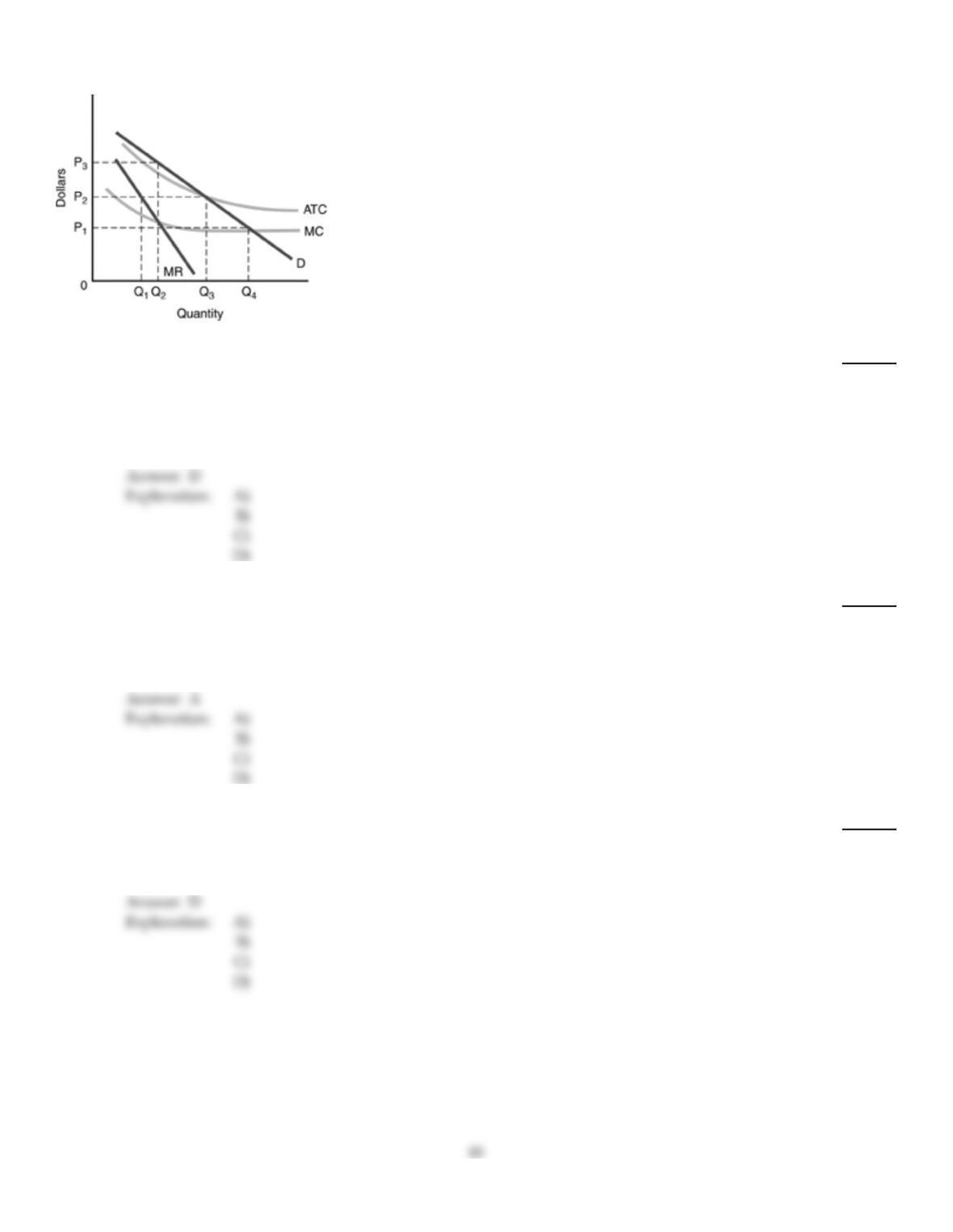
38)
Use the above figure. Suppose that a regulatory agency requires this natural monopolist to engage
in marginal cost pricing. This would lead to
38)
A)
losses, which would encourage the monopolist to lower costs in the long run.
B)
profits, but new firms cannot enter the industry in the long run due to high barriers to entry.
C)
profits, which would encourage new producers to enter the industry in the long run.
D)
losses, which would drive the monopolist out of business in the long run.
39)
According to the text, critics point out that the costs incurred by firms due to regulations
39)
A)
increase production costs.
B)
reduce taxes too far.
C)
lower production costs to the shutdown point.
D)
none of the above.
A
Explanation:
40)
The type of regulation that attempts to keep prices and the rate of return in an industry at a
competitive level is referred to as
40)
A)
cost–of–service regulation.
B)
natural regulation.
C)
service–opportunity regulation.
D)
rate–of–return regulation.
D
Explanation:
D
Explanation:
41)
A natural monopoly exists when
41)
A)
economies of large–scale production are substantial, leading to a single–firm industry.
B)
increasing marginal returns and the ability to obtain quantity discounts from suppliers leads
to a single–firm industry.
C)
the government restricts entry that leads to a single–firm industry.
D)
control of a key input leads to a single–firm industry.
42)
In average cost pricing, the natural monopoly would have to set price equal to
42)
A)
ATC.
B)
MC.
C)
AFC.
D)
AVC.
43)
All of the following are exempt from antitrust enforcement EXCEPT
43)
A)
hospitals.
B)
television and radio stations.
C)
professional baseball.
D)
labor unions.
44)
The Supreme Court’s decision in the Standard Oil of New Jersey case was
44)
A)
to force the company to pay $10 billion in fines.
B)
to increase the fine imposed by a lower court.
C)
to force the company to send refund checks to customers.
D)
to break up the company.
45)
This agency is responsible for protecting consumers from products posing fire, electrical, chemical,
or mechanical hazards or dangers to children.
45)
A)
Environmental Protection Agency
B)
Consumer Product Safety Commission
C)
Equal Employment Opportunity Commission
D)
Occupational Safety and Health Administration
46)
The purpose of social regulation is
46)
A)
to control the quality of service provided by a monopolist.
B)
to focus on the impact of production on the environment and society, the working conditions
under which goods and services are produced, and sometimes the physical attributes of
goods.
C)
to control the price that regulated enterprises are allowed to charge.
D)
to force a firm to produce at the point where marginal cost equals marginal revenue.
47)
The total costs of regulation
47)
A)
are paid entirely by the consumers of regulated industries.
B)
are paid entirely by the regulated industries.
C)
are much higher than just the explicit government outlays to fund the administration of
various regulations.
D)
include increased taxes and increased prices of the products being regulated.
48)
This agency is responsible for preventing businesses from engaging in misleading advertising,
unfair trade practices, and monopolistic actions, as well as for protecting consumer rights.
48)
A)
Federal Trade Commission
B)
Food and Drug Administration
C)
Environmental Protection Agency
D)
Equal Employment Opportunity Commission
49)
One of the basic differences between social and economic regulations is that
49)
A)
economic regulations only apply to financial institutions while social regulations apply to a
greater variety of institutions.
B)
social regulations only apply to non–profit organizations while economic regulations apply
only to for–profit organizations.
C)
economic regulations focus on the banking industry while social regulations focus on
monopolies.
D)
economic regulations cover only particular industries while social regulations apply to all
firms in the economy.
50)
A firm that has taken advantage of economies of scale and expanded to become the only producer
in the market is
50)
A)
a natural monopoly.
B)
a cartel.
C)
an oligopolist.
D)
a monopolistic competitor.
51)
The theory of regulatory behavior that suggests that regulators must consider the demands of
legislators, consumers, and members of the regulated agency is called
51)
A)
share–the–gains, share–the–pains theory.
B)
the natural theory.
C)
the creative theory.
D)
the capture theory.
52)
A natural monopoly owes its existence to
52)
A)
persistently declining long–run average costs as scale increases.
B)
patents.
C)
control of a key input.
D)
increasing marginal returns and the ability to obtain quantity discounts from suppliers.
53)
Clarke’s gas station in Podunk only sells gasoline if customers also purchase oil.
53)
A)
This is called a tie–in sale and is in violation of antitrust laws.
B)
This is in violation of the Robinson–Patman Act.
C)
This is not in violation of antitrust laws, as cars need both oil and gas.
D)
This is not in violation of antitrust laws, as consumers get the oil below market prices.
54)
According to OSHA standards, the air in the building that John works in is unsafe. The type of
regulation that OSHA engages in is known as
54)
A)
the Federal Register.
B)
social regulation.
C)
the market share test.
D)
economic regulation.
55)
Cost–of–service regulation allows regulated companies to charge prices that
55)
A)
reflect the actual average cost of providing the services to the customer.
B)
reflect the cost of regulating the industry, plus the marginal cost of the product.
C)
are determined by competition in other geographic markets.
D)
allow monopoly profits to the producer.
56)
The capture hypothesis suggests that
56)
A)
regulation will lead to over–entry and eventual losses for firms in the industry.
B)
marginal cost regulation is superior to average cost regulation.
C)
the firms being regulated will unduly influence the regulators.
D)
the well–focused interests of consumers will lead to the over–regulation of most industries.
57)
Which type of regulation applies to all firms in the economy, as opposed to only covering specific
industries?
57)
A)
statutory regulation
B)
rate regulation
C)
economic regulation
D)
social regulation
58)
Social regulation is focused on all of the following EXCEPT
58)
A)
ensuring costs are minimized and benefits are maximized.
B)
the impact of production on the environment and society.
C)
a better quality of life through a less polluted environment.
D)
better working conditions, and safer and better products.
59)
The type of mergers that the Federal Trade Commission will most likely challenge are
59)
A)
mergers of firms within a relevant market.
B)
mergers of firms that will generate economies of scale.
C)
mergers of firms in different markets.
D)
mergers of firms in different geographical locations.
60)
Suppose that a regulated industry experiences an increase in the price of inputs used to produce
the good. According to the capture theory, we would expect
60)
A)
there will be some increase in price but not immediately.
B)
prices to increase by a little immediately and profits to decrease by a lot.
C)
no increase in price.
D)
a quick increase in price maintains profits in the industry.
61)
As a result of a conviction under the Sherman Antitrust Act, Standard Oil of New Jersey
61)
A)
went bankrupt and no longer is in existence.
B)
was fined for its extensive price discriminating activity.
C)
was broken up into many smaller companies.
D)
was restrained from oil exploration for twenty–five years, which enabled other oil firms to
assume leadership in the industry.
62)
Refer to the above figure. From the standpoint of society, the optimal price is
62)
A)
P1
B)
P2
C)
P3
D)
P5
63)
Offering two or more products for sale as a set is known as
63)
A)
monopolizing.
B)
versioning.
C)
bundling.
D)
product sharing.
64)
Regarding the costs of regulation, which is a FALSE statement?
64)
A)
Regulatory spending by federal agencies has decreased since 1970.
B)
Airline safety standards have increased the price of air travel.
C)
Automobile safety standards raise the price of cars.
D)
Pharmaceutical manufacturing safety standards raise the price of drugs.
65)
The first antitrust law that the U.S. Congress enacted was
65)
A)
the Federal Trade Commission Act.
B)
the Robinson–Patman Act.
C)
the Clayton Antitrust Act.
D)
the Sherman Antitrust Act.
66)
Suppose technical change permits cable television companies to provide their services at lower
rates. The share–the–gains, share–the–pains theory would predict that the regulators would
66)
A)
force the firms to pass the savings on to consumers in the form of better service.
B)
force the firms to pass some of the savings on to consumers and to permit the firms to keep
some of the savings themselves.
C)
permit the firms to keep the savings and would lower prices only if the firms were pressured
to do so.
D)
force the firms to pass all the savings on to consumers in the form of lower prices.
67)
All of the following are exempted from antitrust laws EXCEPT
67)
A)
Microsoft Windows.
B)
professional baseball.
C)
hospitals.
D)
labor unions.
68)
This agency is responsible for regulating the quality and safety of foods, health and medical
products, pharmaceuticals, cosmetics, and animal feed.
68)
A)
Federal Trade Commission
B)
Environmental Protection Agency
C)
Food and Drug Administration
D)
Equal Employment Opportunity Commission
69)
Cab drivers operating from JFK Airport to the City of New York legally must charge a specific fare.
This is an example of
69)
A)
economic regulation.
B)
the market share test.
C)
the rate of return test.
D)
social regulation.
70)
The regulatory agency most concerned with false advertising is the
70)
A)
Antitrust Division of the Justice Department.
B)
National Labor Relations Board.
C)
Federal Trade Commission.
D)
Federal Deposit Insurance Corp.
71)
“Unfair or deceptive acts or practices in commerce” were prohibited by the
71)
A)
Federal Trade Commission Act.
B)
1938 amendment to the Federal Trade Commission Act.
C)
Clayton Act as amended by the Robinson–Patman Act.
D)
Clayton Act.
72)
There are many exemptions from antitrust laws. Which of the following is NOT one of them?
72)
A)
hospitals
B)
labor unions
C)
publishers
D)
public utilities
73)
Which of the following mergers would most likely be challenged by the Federal Trade
Commission?
73)
A)
an automaker and an insurance company
B)
one oil refinery in the U.S. and another oil refinery in Canada
C)
two restaurants in a large metro area
D)
two largest wireless service providers in the U.S. wireless communication industry
74)
A retail store cuts the prices of the products it sells to force its competitor to leave the market. This
is prohibited by the
74)
A)
Aldrich Act.
B)
Robinson–Patman Act.
C)
FTC Act.
D)
Sherman Act.
75)
When production is characterized by persistently declining long–run average costs as output
increases
75)
A)
the costs of production are greater when competition exists than when a single firm produces
a good.
B)
it is impossible for two firms to compete in the market.
C)
there is no need for the government to limit competition by licensing requirements.
D)
the costs are lower if a single firm exists, and even if the firm is unregulated, price will still be
lower with a single firm.
76)
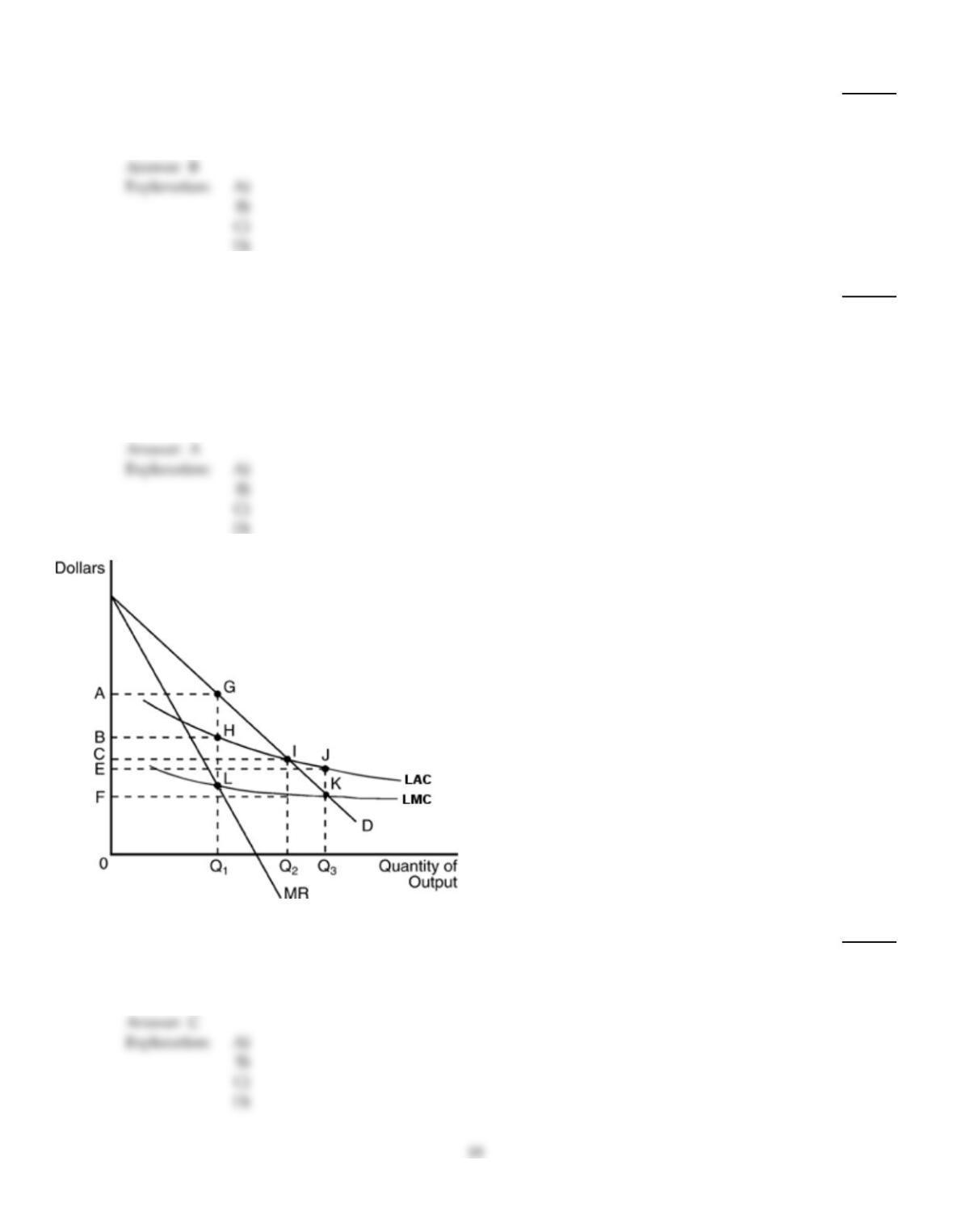
In the above figure, if this natural monopolist were forced to use marginal cost pricing, it would
produce
76)
A)
past the Q3 output rate.
B)
at Q2 output rate.
C)
at Q3 output rate.
D)
at Q1 output rate.
77)
Under rate–of–return regulation, natural monopolies must use
77)
A)
average cost pricing.
B)
marginal cost pricing.
C)
monopoly pricing.
D)
efficient pricing.
78)
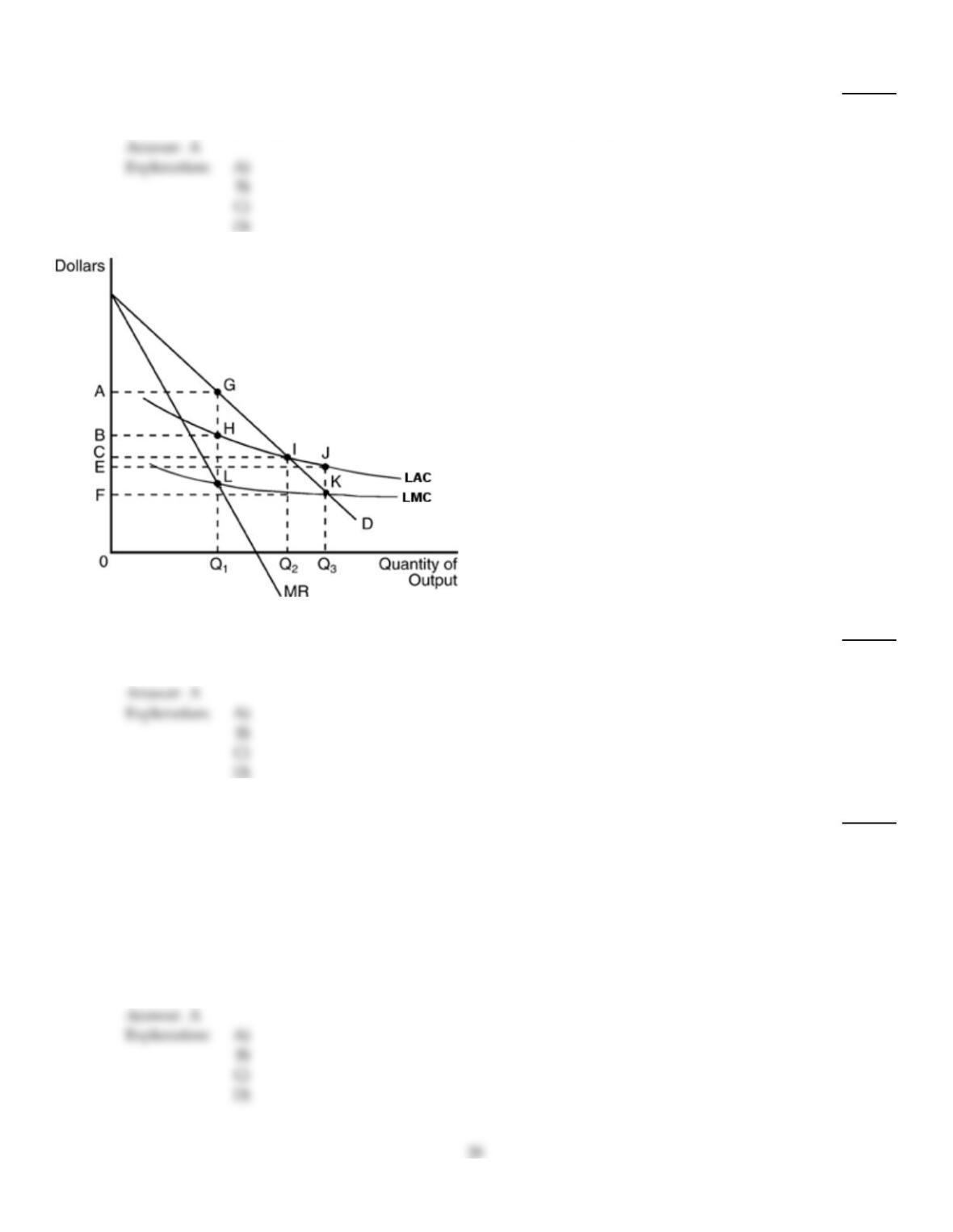
In the above figure, if this natural monopolist were regulated and allowed to earn a “fair” rate of
return, it would sell the product at the price
78)
A)
C.
B)
F.
C)
B.
D)
A.
79)
Which of the following best describes the difference between cost–of–service regulation and
rate–of–return regulation?
79)
A)
Costs determine prices in cost–of–service regulation and prices are set in rate–of–return
regulation so the firm can make a normal rate of return.
B)
Regulators determine prices in cost–of–service regulation and market forces determine prices
in rate–of–return regulation.
C)
Variable costs determine prices in cost–of–service regulation and prices are set in
rate–of–return regulation so the firm can make an economic profit.
D)
Costs determine prices in cost–of–service regulation and prices determine costs in
rate–of–return regulation.