Exam
Name___________________________________
MULTIPLE CHOICE. Choose the one alternative that best completes the statement or answers the question.
1)
The federal regulatory agency whose mission is to regulate workplace health and safety is the
1)
A)
SEC.
B)
AFL–CIO.
C)
FTC.
D)
OSHA.
2)
Credence goods are particularly susceptible to the lemons problem because
2)
A)
creative responses among producers create volatility in market supply.
B)
they have qualities that are difficult for consumers to fully assess.
C)
creative responses among consumers create volatility in market demand.
D)
they have qualities that are difficult for producers to fully assess.
3)
According to the capture hypothesis,
3)
A)
regulators eventually support the views of either the firms or the consumers, but at the
expense of the taxpayers, regardless of the reasons why the regulatory agency was
established.
B)
regulators eventually support the views of consumers instead of the firms or the taxpayers,
regardless of the reasons why the regulatory agency was established.
C)
regulators support the view of the regulated firms all along because that is the reason the
regulatory agency was established.
D)
regulators eventually support the views of the regulated firms instead of the consumers or
taxpayers, regardless of why the regulatory agency was established.
4)
The costs of regulation
4)
A)
are relatively small.
B)
are paid entirely by the regulated industries.
C)
include increased taxes and increased prices of the products being regulated.
D)
are more than covered by the benefits gained from the regulation.
5)
As a general rule of thumb, a firm is considered to have monopoly power if
5)
A)
its total revenues are greater than $50 million per year.
B)
the product it manufactures has less than five close substitutes.
C)
it has fewer than 10 competitors nationwide.
D)
its share of the relevant market is 70 percent or more.
6)
All of the following are regulatory agencies EXCEPT
6)
A)
the Food and Drug Administration.
B)
the National Rifle Association.
C)
the Occupational Safety and Health Administration.
D)
the Environmental Protection Agency.
7)
One of the agencies responsible for enforcement of antitrust policy is
7)
A)
the Federal Trade Commission.
B)
the World Trade Organization.
C)
the Food and Drug Administration.
D)
the Trust Division of Congress.
8)
With average cost pricing, the monopolist
8)
A)
earns no accounting profit.
B)
produces where P = MC.
C)
does not cover opportunity costs.
D)
earns a normal rate of return for its shareholders.
9)
Regulators employ average cost pricing instead of marginal cost pricing because
9)
A)
the price is lower with average cost pricing.
B)
average cost pricing is simpler to compute than marginal cost pricing.
C)
price must be high enough to cover all opportunity costs if the firm is to stay in business.
D)
average cost pricing is more efficient than marginal cost pricing.
10)
The lemons problem occurs mainly because of
10)
A)
negative externality.
B)
a monopoly.
C)
asymmetric information.
D)
a market failure.
11)
The problem of excess pollution mainly occurs because of
11)
A)
asymmetric information.
B)
a negative externality.
C)
a monopoly.
D)
a positive externality.
12)
Regulation imposed by such organizations as the Food and Drug Administration or the
Environmental Protection Agency seeking to protect the welfare of people in our nation is referred
to as
12)
A)
social regulation.
B)
natural regulation.
C)
rate–of–return regulation.
D)
moral regulation.
13)
Suppose that a regulated industry experiences an increase in the price of inputs used to produce
the good. According to the share–the–gains, share–the–pain theory, we would expect
13)
A)
there will be some increase in price but not immediately.
B)
no increase in price.
C)
a quick increase in price maintains profits in the industry.
D)
prices to increase by a little immediately and profits to decrease by a lot.
14)
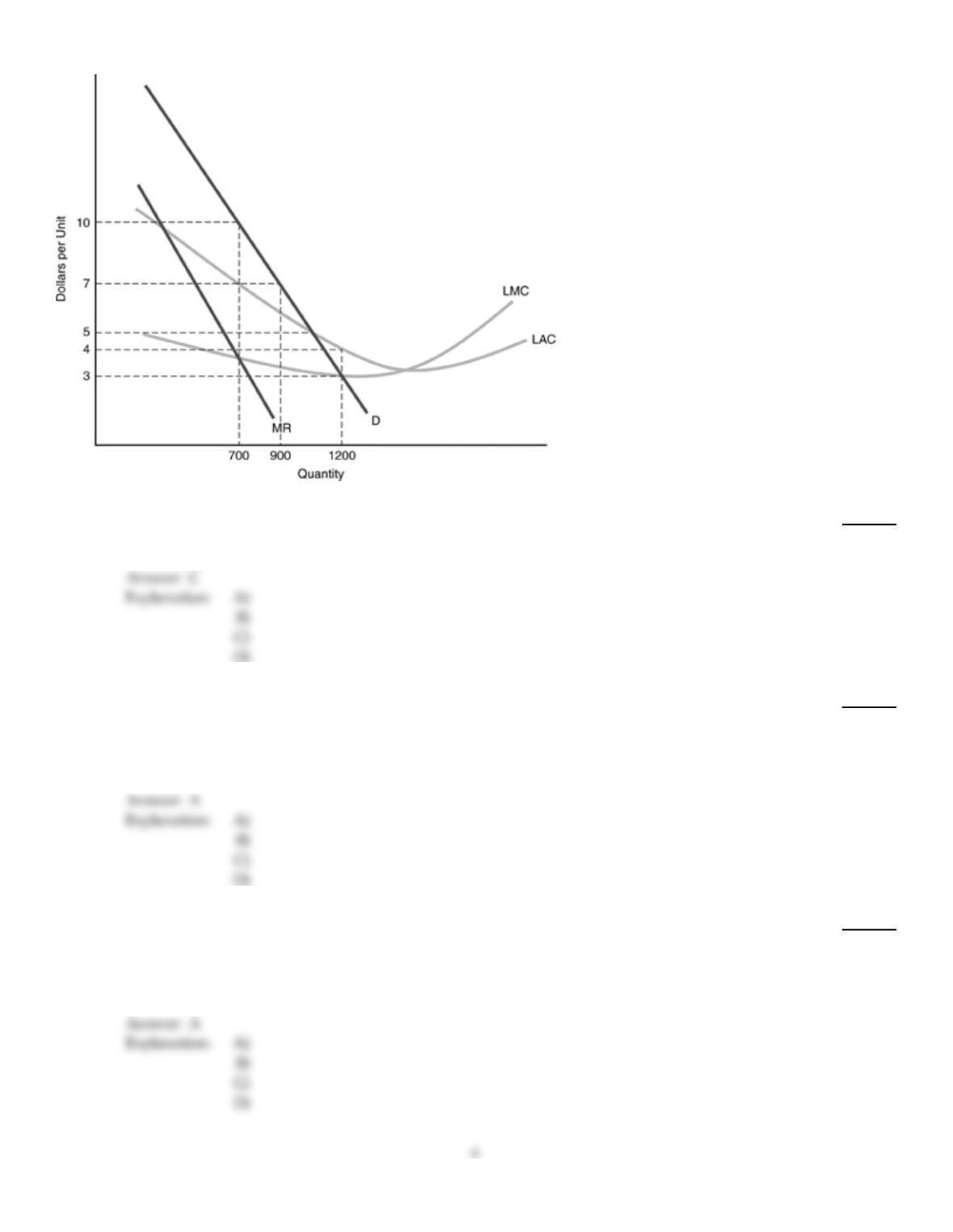
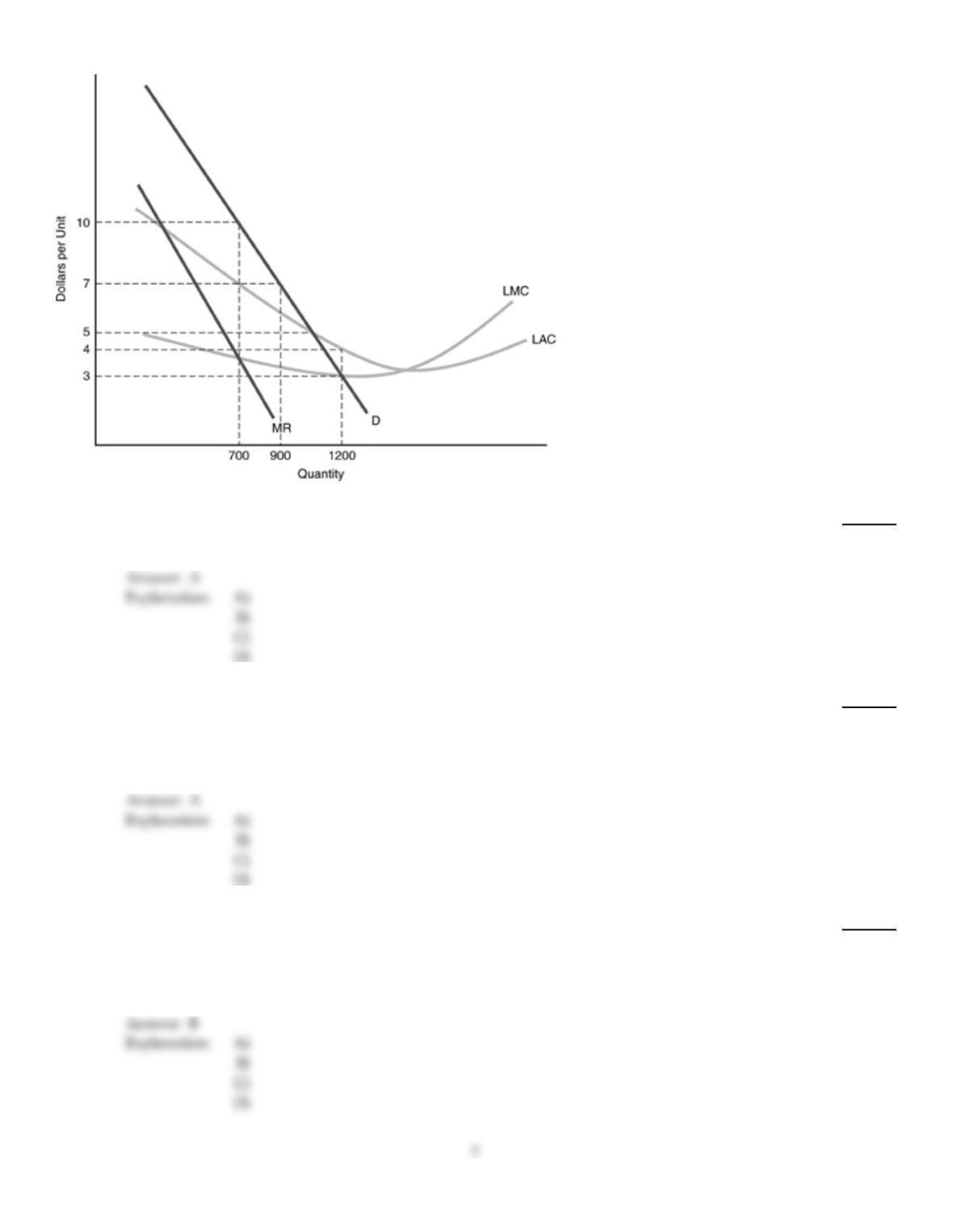
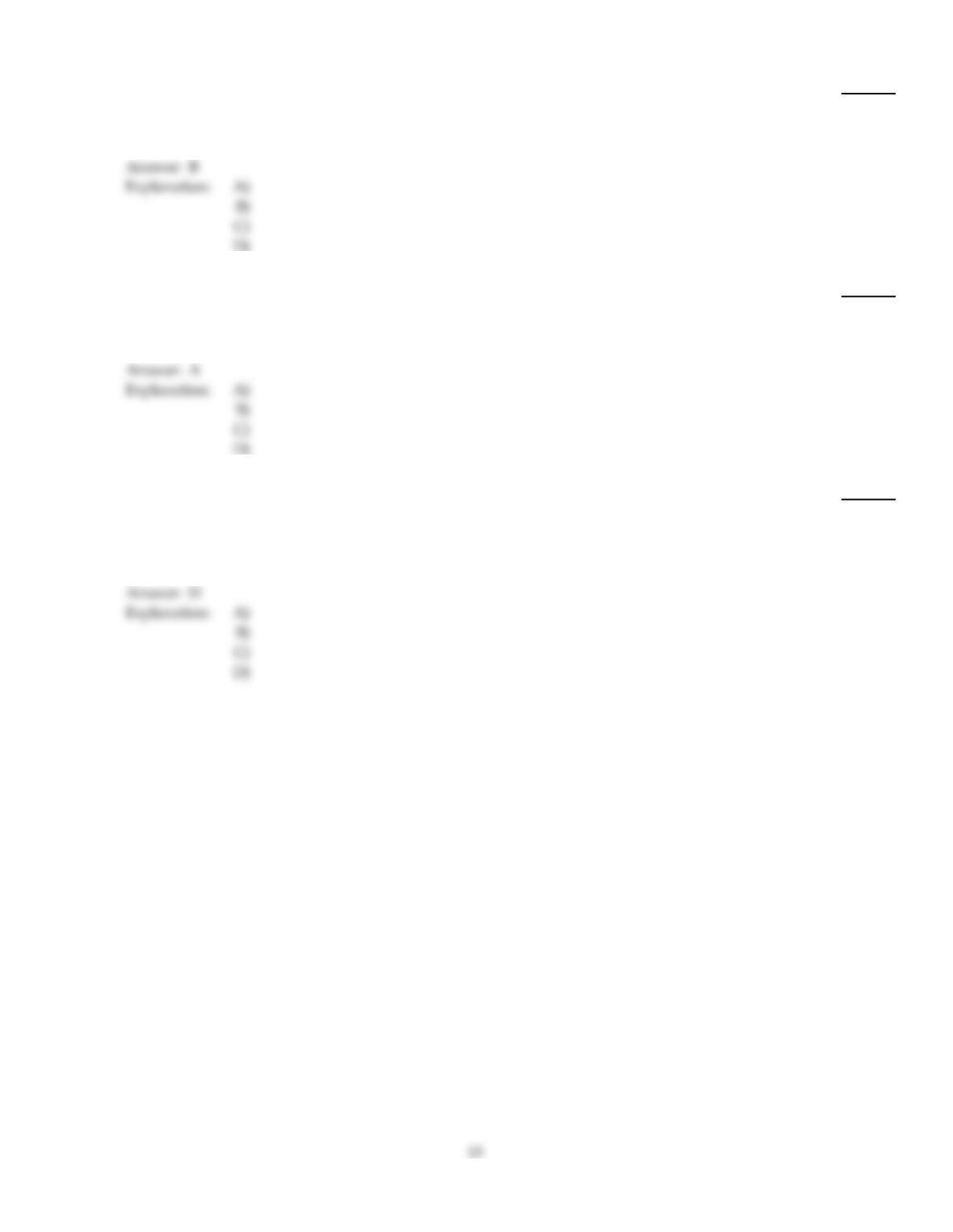
In the above figure, what would be the profit–maximizing output and price for this natural
monopolist?
14)
A)
900; $7
B)
700; $7
C)
700; $10
D)
1,200; $3
15)
The feedback effect can be thought of as a type of
15)
A)
creative response, which reduces the law’s effectiveness.
B)
economic regulation.
C)
regulatory lag.
D)
social regulation.
A
16)
Clarke’s gas station in Podunk only sells gasoline if customers also purchase oil.
16)
A)
This is called a tie–in sale and is in violation of antitrust laws.
B)
This is not in violation of antitrust laws, as consumers get the oil below market prices.
C)
This is in violation of the Robinson–Patman Act.
D)
This is not in violation of antitrust laws, as cars need both oil and gas.
A
C
17)
The price charged by a monopolist is socially inefficient because the price
17)
A)
is too low.
B)
is less than the opportunity cost of the resources used.
C)
puts the monopolist into a higher tax bracket.
D)
exceeds the true marginal cost of the resources used.
18)
The Federal Register
18)
A)
has decreased in size.
B)
publishes all the new federal regulatory rules.
C)
itemizes state and local government spending.
D)
is used to track immigration.
B
Explanation:
19)
The Supreme Court’s decision in the Standard Oil of New Jersey case was
19)
A)
to force the company to send refund checks to customers.
B)
to break up the company.
C)
to force the company to pay $10 billion in fines.
D)
to increase the fine imposed by a lower court.
B
Explanation:
20)
Behavior on the part of the firm that allows it to comply with the letter of the law but violate the
spirit reducing the law’s effect is
20)
A)
only a problem in a monopoly.
B)
asymmetric information.
C)
creative response.
D)
the lemons problem.
C
Explanation:
21)
The primary measure of monopoly power is
21)
A)
the market share test.
B)
the Sherman test.
C)
the capture hypothesis.
D)
creative response.
A
Explanation:
D
Explanation:
22)
One organization in the United States today that is exempt from antitrust laws is
22)
A)
the oil industry.
B)
professional baseball.
C)
the automobile industry.
D)
the steel industry.
23)
According to the ________ theory of regulation, regulators must take into account the preferences
of legislators, consumers, and producers.
23)
A)
capture
B)
share–the–gains, share–the–pains
C)
general interest
D)
public interest
24)
The FTC is
24)
A)
the commission that investigates unfair competitive practices such as misleading advertising.
B)
an agency which has been set up to regulate the federal government.
C)
the act that prevents producers from driving out smaller competitors by means of selected
discriminatory price cuts.
D)
the agency set up to regulate hospitals.
25)
In the above figure, if the monopolist engages in marginal cost pricing, what are its output and
price?
25)
A)
1,200, $3
B)
700, $7
C)
700, $10
D)
900, $7
26)
One weakness of the Sherman Act is that
26)
A)
it fails to clearly define restraint of trade.
B)
it applies only to the steel and railroad industries.
C)
it applies only to foreign monopolies.
D)
none of the above
A
27)
According to the text, critics point out that the costs incurred by firms due to regulations
27)
A)
reduce taxes too far.
B)
increase production costs.
C)
lower production costs to the shutdown point.
D)
none of the above.
B
A
28)
The Sherman Antitrust Act was passed to
28)
A)
protect the monopoly profits of firms.
B)
prevent market price from equaling marginal cost.
C)
control the growth of monopolies in the U.S.
D)
protect companies from foreign competition.
29)
Ajax Corporation has just started advertising that there are 16 ounces in every package. In reality
the packages contain only 14 ounces. This misleading advertising
29)
A)
is exempt from the antitrust laws.
B)
could be subject to an investigation by the Sherman Commission.
C)
could be subject to an investigation by the Federal Trade Commission.
D)
is in violation of the Robinson–Patman Act.
30)
The potential for a decline in product quality due to asymmetric information is commonly referred
to as
30)
A)
planned obsolescence.
B)
the externality problem.
C)
diminishing marginal product.
D)
the lemons problem.
31)
If antitrust legislation is successful, then
31)
A)
most firms will be earning a positive economic profit.
B)
firms will produce the quantity at which marginal cost equals marginal revenue.
C)
the price of each item will equal its marginal social opportunity costs.
D)
natural monopoly will be eliminated.
32)
Cost–of–service–regulation sets prices by considering
32)
A)
the actual variable cost of providing the service to the customer.
B)
the actual marginal cost of providing the service to the customer.
C)
the actual average cost of providing the service to the customer.
D)
the actual total cost of providing the service to the customer.
33)
The law passed by Congress in 1914 that was designed to sharpen or define further the vagueness
of the Sherman Act is called
33)
A)
the Clayton Act.
B)
the Wheeler–Lea Act.
C)
the Federal Trade Commission Act.
D)
the Robinson–Patman Act.
A
34)
A natural monopoly owes its existence to
34)
A)
patents.
B)
increasing marginal returns and the ability to obtain quantity discounts from suppliers.
C)
control of a key input.
D)
persistently declining long–run average costs as scale increases.
D
35)
The total costs of regulation
35)
A)
include increased taxes and increased prices of the products being regulated.
B)
much higher than just the explicit government outlays to fund the administration of various
regulations.
C)
are paid entirely by the regulated industries.
D)
are paid entirely by the consumers of regulated industries.
B
C
36)
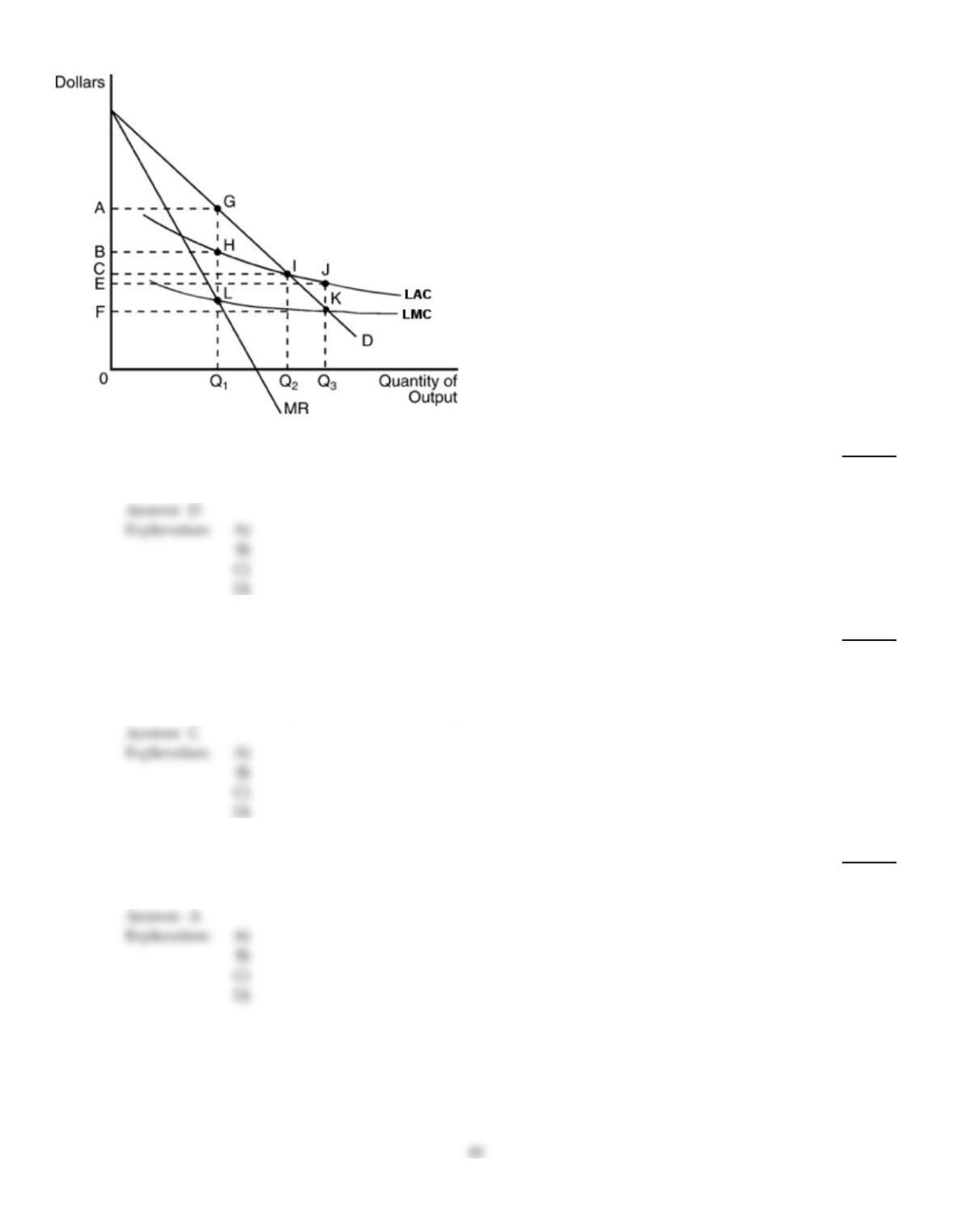
In the above figure, if this natural monopolist were forced to use marginal cost pricing, it would
sell the product at the price ________.
36)
A)
A
B)
C
C)
E
D)
F
37)
A natural monopoly that is not regulated will choose to produce at the
37)
A)
point at which the demand curve intersects the long–run average cost curve.
B)
minimum point of the long–run average cost curve.
C)
point at which marginal revenue equals marginal cost.
D)
point at which marginal cost is above average total cost.
C
38)
When consumers have less information about a product than do sellers, then this is the situation of
38)
A)
asymmetric information.
B)
a market failure.
C)
symmetric information.
D)
caveat emptor.
A
D
39)
One of the elements of monopolization is
39)
A)
monopoly pricing.
B)
the willful acquisition of monopoly power.
C)
having a monopoly.
D)
wanting to be a monopoly and wanting to earn monopoly profits.
40)
If a natural monopolist is unregulated, then
40)
A)
the monopoly will produce inefficiently from society’s point of view.
B)
the monopoly will produce efficiently from society’s point of view.
C)
the monopolist will determine the profit maximizing quantity by equating marginal cost to
the demand curve.
D)
the monopolist will be earning just a normal rate of return on investment.
A
41)
Which of the following federal agencies is engaged in social regulation?
41)
A)
Equal Employment Opportunity Commission
B)
Federal Deposit Insurance Corporation
C)
Office of the Comptroller of the Currency
D)
The Securities and Exchange Commission
A
42)
Which of the following statements regarding economic regulation is TRUE?
42)
A)
Economic regulation deals mainly with prices firms charge, but firms can alter their return by
altering quality of service, effectively raising the price per constant–quality–unit.
B)
Economic regulation deals only with rates of return, and not with prices.
C)
Economic regulation has failed by insisting that firms must be allowed to earn a normal rate
of return.
D)
Rate–of–return regulation has been much more effective than cost–of–service regulation.
A
B
43)
If a regulator forced a natural monopolist to set P = MC,
43)
A)
the monopolist would earn economic profits.
B)
the monopolist would earn monopolistic profits.
C)
the monopolist would break even.
D)
the monopolist would suffer economic losses.
44)
Suppose that a regulated industry experiences an increase in the price of inputs used to produce
the good. Which of the following statements is true?
44)
A)
An increase in price will occur quicker in the capture theory than the share–the–gains,
share–the–pain theory.
B)
Under both the capture theory and the share–the–gains, share–the–pain theory profits will
decrease.
C)
In the capture theory there will be an increase in price but not in the share–the–gains,
share–the–pain theory.
D)
An increase in price will occur quicker in the share–the gains, share–the–pain theory than the
capture theory.
45)
What is the relationship between the Sherman Antitrust Act and the Clayton Act?
45)
A)
Both Acts deal with issues of setting price and quantity for regulated industries.
B)
The Clayton Act strengthened the Sherman Antitrust Act by limiting some very specific
business practices.
C)
The Clayton Act was the first act passed and the Sherman Antitrust Act was the second.
D)
The Sherman Antitrust Act encouraged competition among firms in the U.S. while the
Clayton Act encouraged competition among foreign firms.
46)
Regulation of a natural monopoly that forces it to price and produce as if it were a competitive firm
results in
46)
A)
economic losses for the monopoly.
B)
a highly unstable marketplace.
C)
the market being instantly competitive.
D)
higher profits for the monopoly.
47)
It is illegal to price discriminate except in cases in which the price differences are due to actual cost
differences. This situation is due to which antitrust act?
47)
A)
Contestable Market Act
B)
Clayton Act
C)
Sherman Antitrust Act
D)
Federal Trade Commission Act
48)
Which of the following acts outlawed selling products at “unreasonably low prices” with the intent
of reducing competition?
48)
A)
Robinson–Patman Act
B)
Wheeler–Lea Act
C)
FTC Act
D)
Sherman Act
49)
Natural monopolies
49)
A)
do not experience economies of scale.
B)
are not regulated.
C)
have long–run average costs equal to zero.
D)
have one lowest–cost producer in an industry.
50)
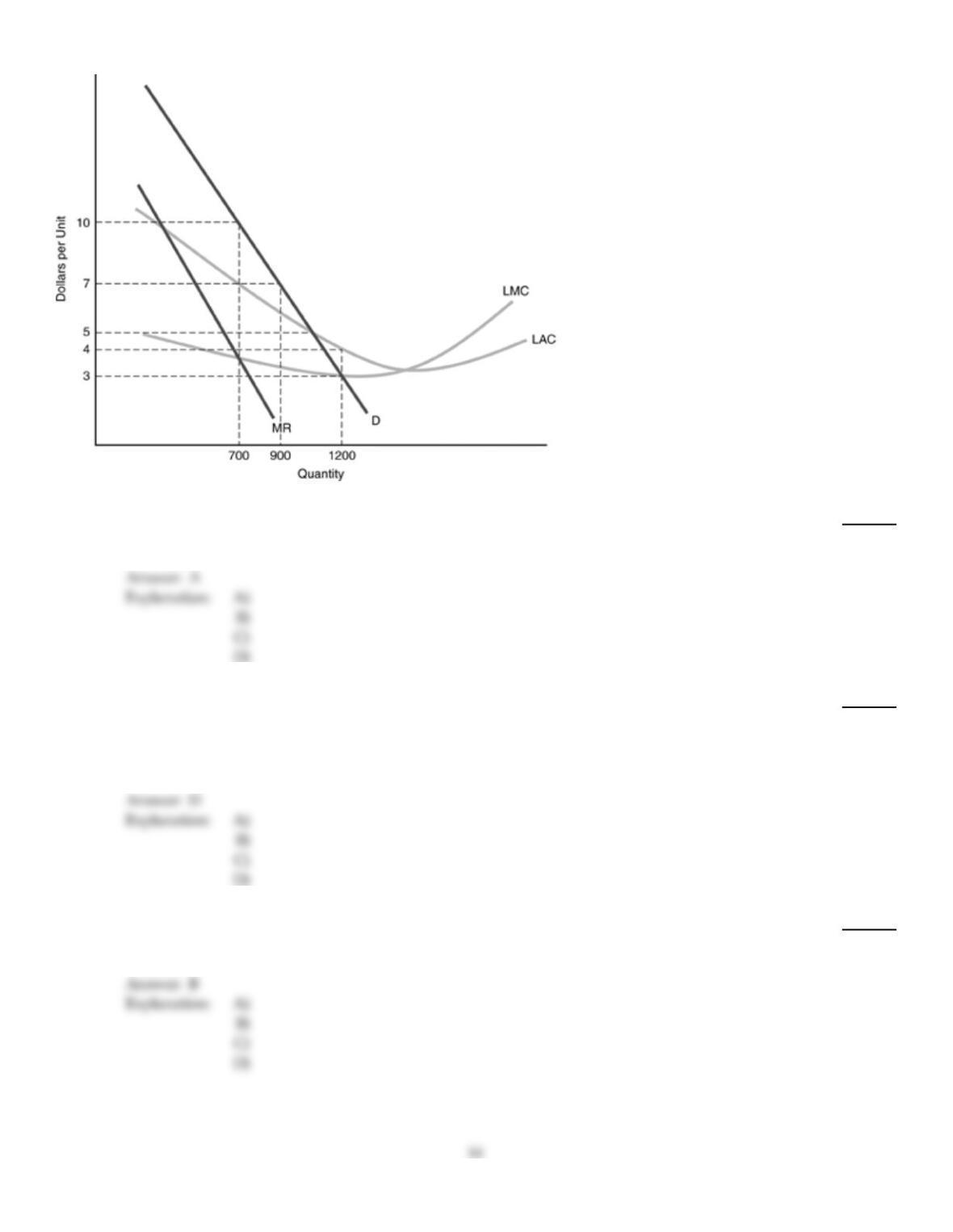
In the above figure, what would be the profit or loss at the marginal cost pricing point for this
natural monopolist?
50)
A)
–$1,200
B)
$2,100
C)
$2,700
D)
–$300
51)
The benefits of social regulation usually are
51)
A)
small.
B)
less than the costs of social regulation, reducing overall welfare.
C)
obvious to people while the costs are hidden.
D)
difficult to measure.
52)
Offering two or more products for sale as a set is known as
52)
A)
monopolizing.
B)
bundling.
C)
versioning.
D)
product sharing.
53)
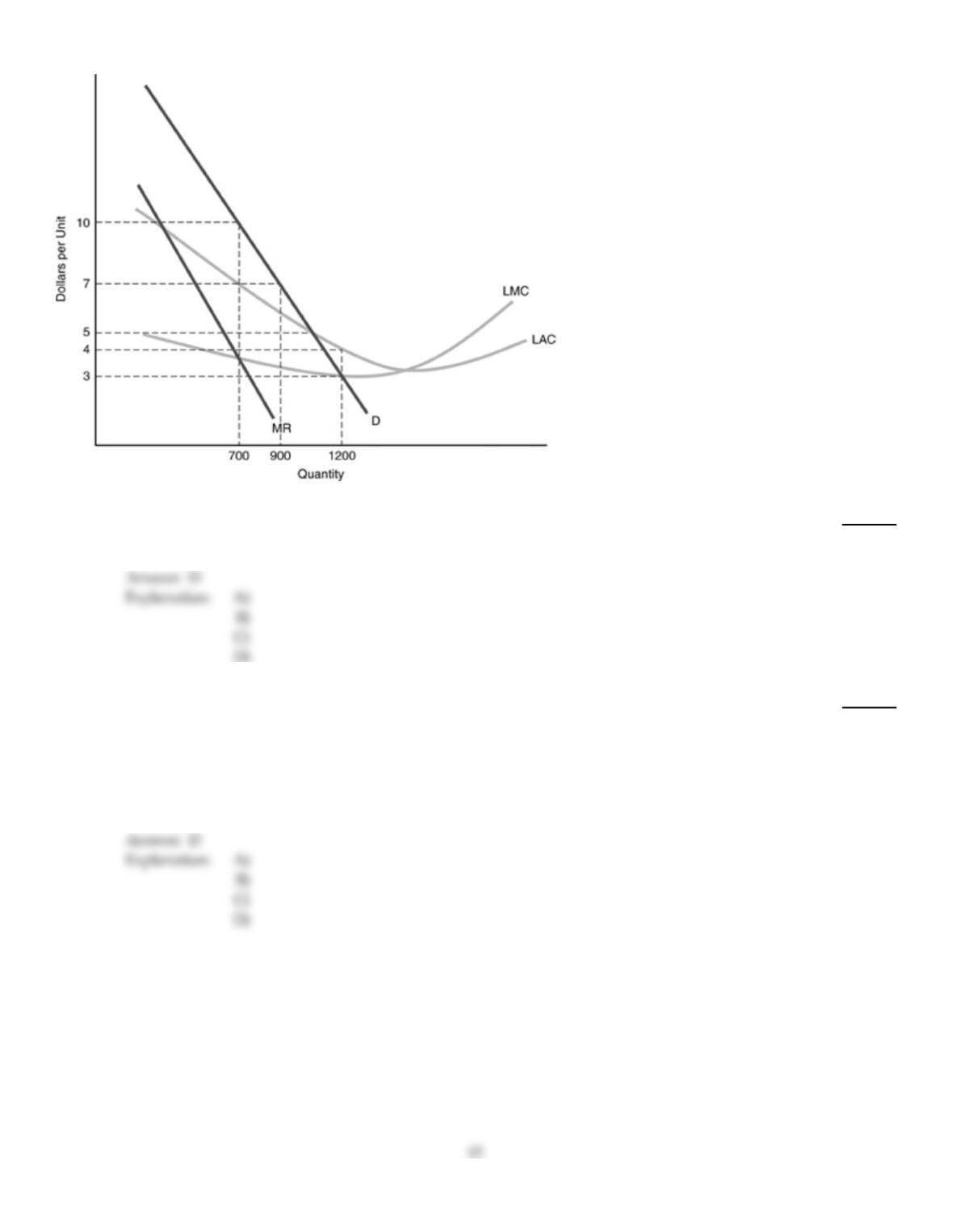
In the above figure, what would be the profit or loss at the profit–maximizing output for this
natural monopolist?
53)
A)
–$300
B)
–$1,200
C)
$2,700
D)
$2,100
54)
Suppose technical change makes it cheaper for cable television suppliers to supply their service.
The capture theory would predict that the regulators would
54)
A)
force the firms to pass the savings on to consumers in the form of better service.
B)
force the firms to pass the savings on to consumers in the form of lower prices.
C)
force the firms to pass some of the savings on to consumers and permit them to keep some of
the savings for themselves.
D)
allow the firms to capture the savings and would lower price only if the firms asked them to.
55)
The Federal Trade Commission Act, as amended, prohibits
55)
A)
price–fixing agreements.
B)
horizontal mergers.
C)
unfair competitive practices and deceptive acts.
D)
price discrimination.
56)
Which antitrust act was passed to protect independent retailers from “unfair discrimination” by
chain stores?
56)
A)
Robinson–Patman Act
B)
Wheeler–Lea Act
C)
Federal Trade Commission Act
D)
Sherman Act
57)
Which of the following best describes the difference between cost–of–service regulation and
rate–of–return regulation?
57)
A)
Regulators determine prices in cost–of–service regulation and market forces determine prices
in rate–of–return regulation.
B)
Costs determine prices in cost–of–service regulation and prices are set in rate–of–return
regulation so the firm can make a normal rate of return.
C)
Variable costs determine prices in cost–of–service regulation and prices are set in
rate–of–return regulation so the firm can make an economic profit.
D)
Costs determine prices in cost–of–service regulation and prices determine costs in
rate–of–return regulation.
58)
An automobile manufacturer voluntarily recalls certain models to fix a defective part at no cost to
the owners. This action has the effect of
58)
A)
a manufacturer’s warranty.
B)
a market failure.
C)
the lemon problem.
D)
none of the above
59)
This agency regulates workplace safety and health conditions.
59)
A)
Environmental Protection Agency
B)
Equal Employment Opportunity Commission
C)
Consumer Product Safety Commission
D)
Occupational Safety and Health Administration
60)
In average cost pricing, the natural monopoly would have to set price equal to
60)
A)
ATC.
B)
AVC.
C)
MC.
D)
AFC.
A
61)
If regulators disallow price increases requested by a natural monopoly that is currently earning an
economic loss, quality of service will
61)
A)
likely fall.
B)
increase rapidly.
C)
remain unchanged.
D)
none of the above.
A
62)
The two most important rationales for government intervention in non–monopolistic markets are
62)
A)
market failure and asymmetric information.
B)
job creation and income maintenance.
C)
substandard products and job creation for public employees.
D)
unfair pricing and usury.
A
D
63)
Suppose technical change permits cable television companies to provide their services at lower
rates. The share–the–gains, share–the–pains theory would predict that the regulators would
63)
A)
force the firms to pass some of the savings on to consumers and to permit the firms to keep
some of the savings themselves.
B)
permit the firms to keep the savings and would lower prices only if the firms were pressured
to do so.
C)
force the firms to pass all the savings on to consumers in the form of lower prices.
D)
force the firms to pass the savings on to consumers in the form of better service.
64)
The theory of regulatory behavior that suggests that regulators must consider the demands of
legislators, consumers, and members of the regulated agency is called
64)
A)
the capture theory.
B)
the natural theory.
C)
share–the–gains, share–the–pains theory.
D)
the creative theory.
65)
Under rate–of–return regulation, average cost pricing
65)
A)
includes variable costs but not a cost for capital.
B)
is inflated so the firm can make economic profits.
C)
includes a cost for capital that generates an above normal rate of return.
D)
includes what they consider to be a fair rate of return on investment.
66)
U.S. securities firms recently agreed to pay a record amount of $1.4 billion in settlement charges
brought by government regulators. Regulators claimed that firms had abused investors during the
market boom of the 1990s. Abuses included analysts tailoring their research reports and ratings on
the stocks they covered in order to win more business for their firm. If this settlement causes Wall
Street firms to comply with the letter of the law but they violate the spirit of the law, the firms are
engaging in
66)
A)
creative response.
B)
the capture hypothesis.
C)
elimination of conflicts of interest.
D)
deregulation.