College Physics: A Strategic Approach, 3e (Knight)
Chapter 27 Relativity
27.1 Conceptual Questions
1) Which of the following are basic postulates of special relativity? (There could be more than
one correct choice.)
A) Nothing can travel faster than the speed of light.
B) No material object can be accelerated to the speed of light.
C) The speed of light is the same for all observers.
D) The laws of physics are the same in all reference frames.
E) The laws of physics are the same in all inertial reference frames.
2) If you were in a spaceship traveling close to the speed of light with respect to Earth, you
would notice that
A) some of your physical dimensions were smaller than normal.
B) your mass was less than normal.
C) your mass was greater than normal.
D) your pulse rate was greater than normal.
E) none of the above effects occur.
3) You are riding in a spaceship that has no windows, radios, or other means for you to observe
or measure what is outside. You wish to determine if the ship is stopped or moving at constant
velocity. How can you do this?
A) You can determine if the ship is moving by determining the apparent velocity of light in the
spaceship.
B) You can determine if the ship is moving by checking your precision time piece. If it’s running
slow, the ship is moving.
C) You can determine if the ship is moving by lying down and measuring your height. If you are
shorter than usual, the ship is moving.
D) You should give up because you have taken on an impossible task!
4) One of Einstein’s postulates in formulating the special theory of relativity was that the laws of
physics are the same in reference frames that
A) accelerate.
B) move at constant velocity with respect to an inertial frame.
C) oscillate.
D) are stationary, but not in moving frames.

5) You are a passenger on a spaceship. As the speed of the spaceship increases, you will observe
A) your watch slowing down.
B) your watch speeding up.
C) your watch losing time.
D) your watch gaining time.
E) nothing unusual about the behavior of your watch.
6) A spaceship traveling at constant velocity passes by Earth and later passes by Mars. In which
frame of reference is the amount of time separating these two events the proper time?
A) the Earth frame of reference
B) the Mars frame of reference
C) the spaceship frame of reference
D) any inertial frame of reference
E) any frame of reference, inertial or not
7) Observer A sees a pendulum oscillating back and forth in a relativistic rocket and measures its
period to be TA. Observer B moves along with the rocket and measures the period of the
pendulum to be TB. What is true about these two time measurements?
A) TA > TB
B) TA = TB
C) TA < TB
D) TA could be greater or smaller than TB depending on the direction of the motion.
8) A 30-year-old astronaut goes off on a long-term mission in a spacecraft that travels at speeds
close to that of light. The mission lasts exactly 20 years as measured on Earth. Biologically
speaking, at the end of the mission, the astronaut’s age would be
A) more than 50 years.
B) exactly 50 years.
C) less than 50 years.
D) exactly 30 years.
E) exactly 25 years.

9) Suppose one twin takes a ride in a spaceship traveling at a very high speed to a distant star and
then back again, while the other twin remains on Earth. Compared to the twin who remained on
Earth, the astronaut twin is
A) younger than the Earth-twin.
B) the same age as the Earth-twin.
C) older than the Earth-twin.
D) The ages cannot be determined from the information provided.
10) You are a passenger on a spaceship. As the speed of the spaceship increases, you will
observe
A) the length of your spaceship getting shorter.
B) the length of your spaceship getting longer.
C) the length of your spaceship is zero.
D) no change in the length of your spaceship.
11) Observer A sees a ruler moving by in a relativistic rocket and measures its length to be LA.
Observer B moves along with the rocket and measures the length of the ruler to be LB. What is
true about these two length measurements?
A) LA > LB
B) LA = LB
C) LA < LB
D) LA could be greater or smaller than LB depending on the direction of the motion.
12) An astronaut is resting on a bed inclined at an angle above the floor of a spaceship, as shown
in the figure. From the point of view of an observer who sees the spaceship moving near the
speed of light parallel to the floor, the angle the bed makes with the floor
A) is greater than the angle observed by the astronaut.
B) is the same as the angle observed by the astronaut.
C) is smaller than the angle observed by the astronaut.
D) could be greater or smaller than the angle observed by the astronaut depending on whether the
rocket is moving to the right or to the left.

13) When an object moves close to the speed of light relative to Earth, what happens to its
dimensions compared to what they were before it began moving, as measured by an Earth-based
observer?
A) Only lengths parallel to the direction of travel are decreased.
B) Only lengths perpendicular to the direction of travel are decreased.
C) All lengths are decreased.
D) No lengths are affected.
14) A really high-speed train moves in a direction parallel to its length with a speed that
approaches the speed of light. The height of the train, as measured by a stationary observer on
the ground,
A) approaches infinity.
B) approaches zero.
C) increases slightly.
D) decreases slightly.
E) does not change due to the motion.
15) A really high-speed train moves in a direction parallel to its length with a speed that
approaches the speed of light. The length of the train, as measured by a stationary observer on
the ground,
A) approaches infinity.
B) increases due to the motion.
C) decreases due to the motion.
D) is not affected by the motion.
16) A spaceship is moving in a straight line away from Earth at 0.80c, measured relative to
Earth. It launches a missile that moves away from the spaceship in the forward direction at 0.60c,
relative to the ship. Relative to Earth, what is the speed of this missile?
A) greater than 0.80c but less than c
B) 1.4 c
C) c
D) greater than c but less than 1.4c

17) You are moving at a speed 2/3 c toward Randy when shines a light toward you. At what
speed do you see the light approaching you?
A) 1/3 c
B) 2/3 c
C) 4/3 c
D) c
18) The special theory of relativity predicts that there is an upper limit to the speed of an object.
It therefore follows that there is also an upper limit on which of the following properties of the
object? (There could be more than one correct choice.)
A) The kinetic energy of the object.
B) The total energy of the object.
C) The linear momentum of the object.
D) None of the above.
19) The relativistic kinetic energy formula is valid
A) only for speeds near the speed of light.
B) at all speeds.
C) only for subatomic particles, such as electrons and protons.
20) According to the equation E = mc2, an object turns into energy when it reaches the speed of
light.
A) True
B) False
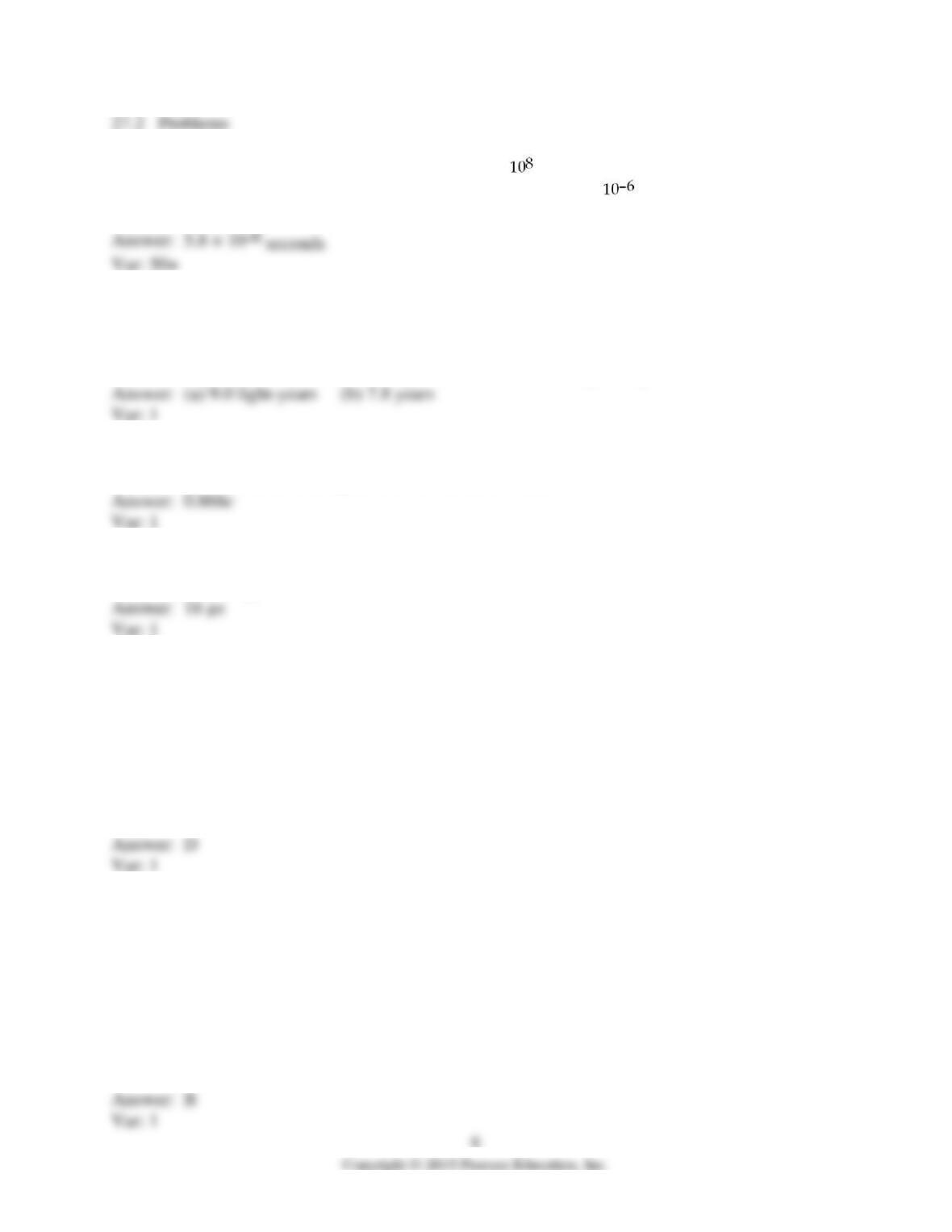
1) An unstable particle is moving at a speed of 1.6 × m/s relative to a laboratory. Its lifetime
is measured by a stationary observer in the laboratory to be 6.8 × s. What is the lifetime of
the particle as measured in the rest frame of the particle? (c = 3.0 × 10⁸ m/s)
2) A spaceship visits a star that is 4.5 light-years from Earth, and the spaceship travels at one-
half the speed of light for the entire trip.
(a) How long did the trip take according to an observer on Earth?
(b) How long did the trip take according to an observer on the spaceship?
3) How fast (in terms of the speed of light) should a moving clock travel if it is to be observed by
a stationary observer as running at one-half its normal rate?
4) A muon at rest decays in 2.2 μs. Moving at 99.00% the speed of light, it would be seen to
“live” for how long?
5) A spaceship carrying a light clock moves at a speed of 0.960c relative to an observer on Earth.
If the clock on the ship advances by 1.00 s as measured by the space travelers aboard the ship,
how long did that advance take as measured by the observer on Earth?
A) 0.96 s
B) 1.2 s
C) 2.6 s
D) 3.6 s
E) 5.8 s
6) Astronaut Rob leaves Earth in a spaceship at a speed of 0.960c relative to an observer on
Earth. Rob’s destination is a star system 14.4 light-years away (one light-year is the distance light
travels in one year). Relative to a frame of reference that is fixed with respect to Earth, how long
does it take Rob to complete the trip?
A) 14.4 years
B) 15.0 years
C) 10.8 years
D) 4.20 years
E) 22.7 years

7) Astronaut Rachel leaves Earth in a spaceship at a speed of 0.960c relative to an observer on
Earth. Rachel’s destination is a star system 14.4 light-years away (one light-year is the distance
light travels in one year). According to Rachel, how long does the trip take?
A) 14 years
B) 15 years
C) 11 years
D) 4.2 years
E) 23 years
8) At age 21, you set out for a star that is 50 light-years from Earth. How fast would your
spaceship have to travel in order to reach that star when you are 61 years old? One light-year is
the distance light travels in one year.
A) 0.58c
B) 0.68c
C) 0.78c
D) 0.88c
E) 0.96c
9) A spaceship approaches Earth with a speed 0.50c. A passenger in the spaceship measures his
heartbeat as 70 beats per minute. What is his heartbeat rate according to an observer that is at rest
relative to Earth?
A) 61 beats per minute
B) 65 beats per minute
C) 69 beats per minute
D) 73 beats per minute
E) 75 beats per minute
10) A spaceship enters the solar system moving toward the Sun at a constant speed relative to the
Sun. By its own clock, the time elapsed between the time it crosses the orbit of Jupiter and the
time it crosses the orbit of Mars is 50.0 minutes. How fast is the spaceship traveling towards the
Sun? The radius of the orbit of Jupiter is 778 × 109 m, and that of the orbit of Mars is 228 × 109
m.
A) 0.319c
B) 0.438c
C) 0.522c
D) 0.671c
E) 0.982c

11) A spaceship enters the solar system moving toward the sun at a constant speed relative to the
sun. By its own clock, the time elapsed between the time it crosses the orbit of Jupiter and the
time it crosses the orbit of Mars is 50.0 minutes. As measured in the coordinate system of the
sun, how long did it take for the spaceship to travel that distance? The radius of the orbit of
Jupiter is 778 × 109 m, and that of the orbit of Mars is 228 × 109 m.
A) 30.0 minutes
B) 43.6 minutes
C) 58.6 minutes
D) 69.8 minutes
E) 95.8 minutes
12) A pion is an unstable particle that has a mean lifetime of 2.55 × 10⁻⁸ s. This is the time
interval between its creation in a nuclear process and its extinction into decay products, as
measured in a frame of reference at rest with respect to the pion. An average pion is traveling at
0.230c relative to Earth. How far does it travel in its lifetime, relative to Earth?
A) 2.07 m
B) 1.81 m
C) 2.23 m
D) 3.22 m
E) 3.50 m
13) A certain unstable particle has a mean lifetime of 1.52 × 10⁻⁶ s. This is the time interval
between its creation in a nuclear process and its extinction into decay products, as measured in a
frame of reference at rest with respect to the particle. An average such particle is observed by a
scientist on Earth to travel 342 m in its lifetime. What is the speed of the particle relative to
Earth? (c = 3.00 × 10⁸ m/s)
A) 0.821c
B) 0.681c
C) 0.600c
D) 0.551c
E) 0.335c

14) A particle physicist observes cosmic rays creating a new particle high in the atmosphere, and
the speed of this particle is measured at 99.7% the speed of light. It is unstable, and is observed
to decay in an average 37.0 μs. If this particle were at rest in the laboratory, what would be its
average lifetime?
A) 2.9 µs
B) 18 µs
C) 5.3 µs
D) 12 µs
E) 4.3 µs
15) You are moving past the Earth at 0.990c and notice your heart beating 88 beats per minute.
(a) If a doctor on Earth measures your heart rate as you zip past, what will the measured rate be?
(b) If you had been moving 99.99% the speed of light, what rate would you have observed your
heart beats?
16) As measured in Earth’s rest frame, a spaceship traveling at 0.9640c takes to travel
between two planets that are not moving relative to each other. How long does the trip take as
measured by someone on the spaceship?
A) 2.79 y
B) 6.83 y
C) 39.5 y
D) 28.8 y
17) An astronaut on a spaceship moving at 0.927c says that the trip between two stationary stars
took How long does this journey appear to take to someone in the rest frame of the two
stars?
A) 11.4 y
B) 1.60 y
C) 2.30 y
D) 12.6 y

18) Someone in Earth’s rest frame says that a spaceship’s trip between two planets took 10.0 y,
while an astronaut on the space ship says that the trip took What is the speed of the
spaceship, assuming the planets are at essentially at rest?
A) 0.816 c
B) 0.735 c
C) 0.975 c
D) 0.384 c
19) A spaceship with a constant speed of 0.800c relative to Earth travels to a star that is 4.30
light-years from Earth. How much time for this trip would elapse on a clock on board the
spaceship?
A) 3.23 y
B) 4.40 y
C) 5.15 y
D) 5.38 y
20) A spaceship with a constant speed of 0.800c relative to Earth travels to a star that is 4.30
light-years from Earth. How much time for this trip would elapse on a clock on Earth?
A) 3.23 y
B) 4.40 y
C) 5.15 y
D) 5.38 y
21) A set of twins, Andrea and Courtney, are initially 10 years old. While Courtney remains on
Earth, Andrea rides on a spaceship that travels away from Earth at a speed of 0.60c for 10 years
(as measured by Courtney). At the end of the trip, Courtney is 20 years old. How old is Andrea?
A) 10 years
B) 12 years
C) 18 years
D) 20 years

22) One 20-year-old twin brother takes a space trip with a speed of 0.80c for 30 years according
to a clock on his spaceship. At the end of this trip, what are (a) his own age and (b) the age of
his Earth-based twin brother?
A) (a) 20 y (b) 30 y
B) (a) 30 y (b) 50 y
C) (a) 50 y (b) 70 y
D) (a) 70 y (b) 90 y
23) How fast would a rocket ship have to move past Earth to contract to half of its proper length
as observed by an Earth-based physicist?
24) A spacecraft is measured by a scientist on the ground to have a length of 81 m as it flies
overhead with a speed The spacecraft then lands and its length is again measured by
the scientist at rest on the ground. What result does he now get for the length of the spacecraft?
(c = 3.0 × 10⁸ m/s)
25) A stretch of land is 12.5 km long on a map.
(a) What would be its length to an observer moving by, parallel to the stretch, at
(b) Which is the proper length for this stretch of land?
(c) How fast relative to Earth would the observer have to move for the land to appear 6.50 km
long? Express your answer in terms of the speed of light.
26) A starship is constructed to be 100 m long in the factory. It is launched and as it coasts by
Earth, it is measured to be shortened to 5.48 m long.
(a) How fast, in terms of the speed of light, is it moving past Earth?
(b) What length does the ship’s crew measure for the ship?
27) Two stars are at rest relative to each other. In their common rest frame, these stars are 90.0
light-years apart. If they are measured to be apart by the navigator of a spaceship
traveling between them, how fast is the spaceship moving relative to these stars?
A) 0.646c
B) 0.604c
C) 0.558c
D) 0.505c

28) A particle in a 799=m-long linear particle accelerator is moving at How long does the
particle accelerator appear to the particle?
A) 387 m
B) 1039 m
C) 184 m
D) 1651 m
29) Two stars are at rest relative to each other. A spaceship is moving between these two stars at
0.932c relative to each star. To someone in the ship, the distance between the two stars appears
to be What is the distance between the stars in their own rest frame?
A) 72.8 light-years
B) 9.57 light-years
C) 21.1 light-years
D) 55.4 light-years
30) Astronaut Jill leaves Earth in a spaceship and is now traveling at a speed of 0.280c relative to
an observer on Earth. When Jill left Earth, the spaceship was equipped with all kinds of scientific
instruments, including a meter stick. Now that Jill is underway, how long does she measure the
meter stick to be?
A) 1.00 m
B) 0.960 m
C) 1.04 m
D) 0.280 m
E) 1.28 m
31) How fast must a meter stick move, relative to the frame of the observer making the
measurement, so its length will be measured to be 0.60 m?
A) 0.40c
B) 0.60c
C) 0.70c
D) 0.80c
E) 0.90c
32) Astronaut Sarah leaves Earth in a spaceship at a speed of 0.280c relative to Earth. Sarah’s
destination is a star system 12.5 light-years away (one light-year is the distance light travels in
one year). According to Sarah, how far did she travel during the trip?
A) 13.0 light-years
B) 12.5 light-years
C) 12.0 light-years
D) 11.5 light-years
E) 11.0 light-years
33) Astronaut Hans leaves Earth in a spaceship traveling at a speed of 0.280c relative to the
observer Brian at rest on Earth. Hans is holding a pencil at an angle of 30° with the direction of
travel, as seen by Hans. What angle does the pencil make with the direction of travel, as seen by
Brian on Earth?
A) 29°
B) 30°
C) 31°
D) 33°
E) 90°
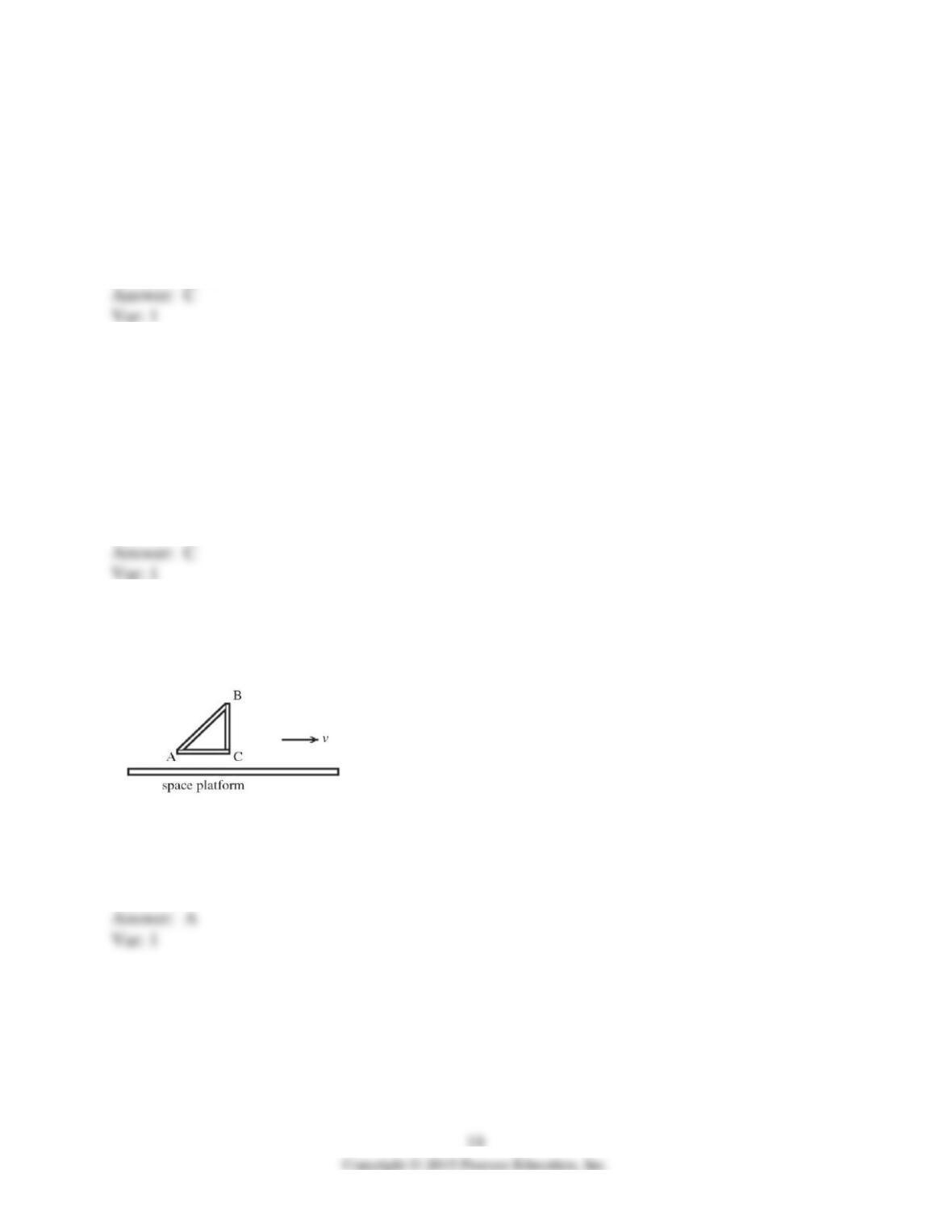
34) The figure shows a right-angled construction frame ABC. When measured at rest, it has
dimensions as follows: AB = 18.9 m, AC = 10.0 m, and BC = 16.0 m. This frame is now given a
new velocity of 0.420c, relative to Earth, in a direction parallel to AC. How long is part BC of
this frame with the new velocity as measured by Earth-based engineers?
A) 16.0 m
B) 14.0 m
C) 12.0 m
D) 10.0 m
E) 18.0 m
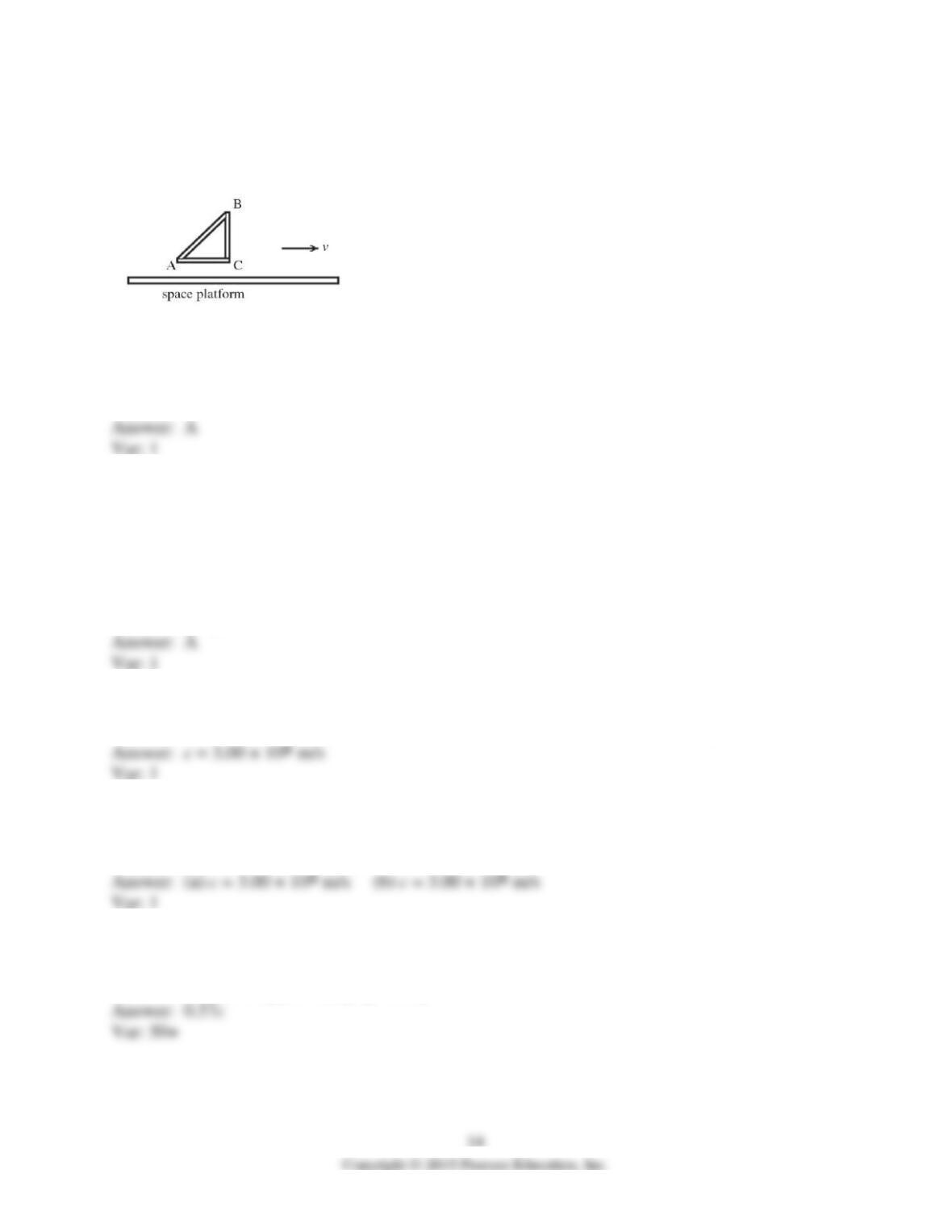
35) The figure shows a right-angled construction frame ABC. When measured at rest, it has
dimensions as follows: AB = 26.0 m, AC = 10.0 m, and BC = 24.0 m. This frame is now given a
new velocity of 0.760c, relative to Earth, in a direction parallel to AC. How long is part AC of
this frame with the new velocity as measured by Earth-based engineers?
A) 6.50 m
B) 25.4 m
C) 24.3 m
D) 23.7 m
E) 24.9 m
36) A spaceship with a constant velocity of 0.800c relative to Earth travels to the star that is 4.30
light-years from Earth. What distance does the space ship travel as measured by a passenger on
the ship?
A) 2.58 light-years
B) 3.52 light-years
C) 4.12 light-years
D) 4.30 light-years
37) A person in a rocket ship traveling past the earth at a speed of 0.500c fires a laser gun in the
forward direction. With what speed does an observer on Earth measure for the light pulse?
38) A rocket is traveling away from Earth at 90% the speed of light. The captain turns on a laser
light. What is the speed of the light as measured by an Earth-based astronomer if the captain
aims the laser (a) directly forward or (b) directly backward?
39) Two spaceships are approaching one another, each at a speed of 0.31c relative to a stationary
observer on Earth. What speed, in terms of the speed of light, does an observer on one spaceship
record for the other approaching spaceship?

40) From the Earth, the Earthlings see the Enterprise approaching from the west at 0.800c and
the Klingons approaching from the east at 0.900c. What speed, in terms of the speed of light,
does the crew of the Enterprise measure for the Klingon ship?
41) Two spaceships are traveling through space at speeds of 0.600c and 0.900c, respectively,
with respect to Earth. If they are headed directly toward each other, what is their approach speed
(in terms of the speed of light) as measured by the captain of either ship?
42) Two spaceships approach each other along a straight line at a constant relative velocity of
0.9880c as measured by the captain of one of the ships. An observer on Earth is able to measure
the speed of only one of the ships as 0.9000c. From the point of view of the observer on Earth,
what is the speed of the other ship in terms of the speed of light?
43) A tracking station on Earth observes a rocket move away at 0.370c. This rocket is designed
to launch a projectile at 0.505c relative to the rocket. What speed (in terms of the speed of light)
does the tracking station measure for the projectile if it is fired (a) straight ahead of the rocket or
(b) backward from the rocket?
44) A spaceship is moving away from an asteroid with a speed of 0.80c relative to the asteroid.
The spaceship then fires a missile with a speed of 0.50c relative to the spaceship. What is the
speed of the missile measured by astronauts on the asteroid if the missile is fired away from the
asteroid?
A) 0.30c
B) 0.50c
C) 0.93c
D) 1.3c
E) 0.65c