Elements of Ecology, 9e (Smith)
Chapter 26 Large-Scale Patterns of Biological Diversity
26.1 Short Answer Questions
1) Over the past 600 million years, the overall trend in the number of species has been ________.
2) A mass extinction of large mammals occurred during the ________ epoch.
3) As latitude increases, the number of terrestrial species ________.
4) As latitude increases, the number of marine species ________.
5) As structural diversity within plant communities increases, the number of animal species
________.
6) As elevation increases, the number of terrestrial species ________.
7) As latitude increases, marine productivity ________.
8) Patterns of species diversity for pelagic and benthic organisms appear to be influenced by the
________ of primary production rather than by the total productivity.
9) Total species diversity, or species richness, of individual communities is referred to as
________ diversity.
10) Total species diversity, or species richness, across all communities within a geographic area
is referred to as ________ diversity.
26.2 Multiple-Choice Questions
1) The number of species of living organisms on the planet is probably closest to
A) 100,000.
B) 1,000,000.
C) 10,000,000.
D) 100,000,000.
2) Which taxa contain the largest number of known species?
A) coleoptera
B) plants (embryophytes)
C) fungi
D) crustaceans
3) Which time period has the greatest richness of fossilized invertebrates?
A) Cambrian
B) Carboniferous
C) Cretaceous
D) Cenozoic
4) Which group of plants emerged first?
A) angiosperms
B) gymnosperms
C) pteridophytes
D) conifers
5) Angiosperms emerged
A) 100 million years ago.
B) 200 million years ago.
C) 300 million years ago.
D) 400 million years ago.
6) Which time period has the greatest richness of fossilized invertebrates?
A) Cambrian
B) Carboniferous
C) Cretaceous
D) Cenozoic
7) When was the largest extinction in Earth’s history?
A) the current time
B) Cretaceous
C) Permian
D) Cambrian
8) During what period did one of the greatest extinctions of mammals occur?
A) Cretaceous
B) Permian
C) Pleistocene
D) Carboniferous
9) Which of the following is the correct order of plant evolutionary appearance (geologically
oldest to present date)?
A) angiosperms, gymnosperms, psilopsids, pteriodophytes
B) gymnosperms, angiosperms, psilopsids, pteriodophytes
C) psilopsids, pteriodophytes, gymnosperms, angiosperms
D) pteriodophytes, gymnosperms, angiosperms, psilopsids
10) The end of the Permian period was characterized by a mass extinction of
A) shallow-water marine invertebrates.
B) dinosaurs and other large reptiles.
C) small mammals.
D) large mammals.
11) The dinosaurs and many other animals became extinct at the end of the
A) Cambrian period.
B) Permian period.
C) Cretaceous period.
D) Pleistocene epoch.
12) The end of the Pleistocene epoch was marked by a mass extinction of
A) shallow-water marine invertebrates.
B) dinosaurs and other large reptiles.
C) small mammals.
D) large mammals.
13) Which of the following shows the correct chronological order (geologically oldest to most
recent) of near or total extinctions for the organisms listed?
A) dinosaurs, psilopsids, marine invertebrates, large mammals
B) psilopsids, marine invertebrates, dinosaurs, large mammals
C) large mammals, marine invertebrates, dinosaurs, psilopsids
D) marine invertebrates, dinosaurs, psilopsids, large mammals

14) Which of the following patterns occurs with respect to geographic distribution of species
diversity?
A) Diversity increases with increasing latitudes.
B) Diversity increases with increasing longitudes.
C) Diversity increases with decreasing latitudes.
D) Diversity increases with decreasing longitudes.
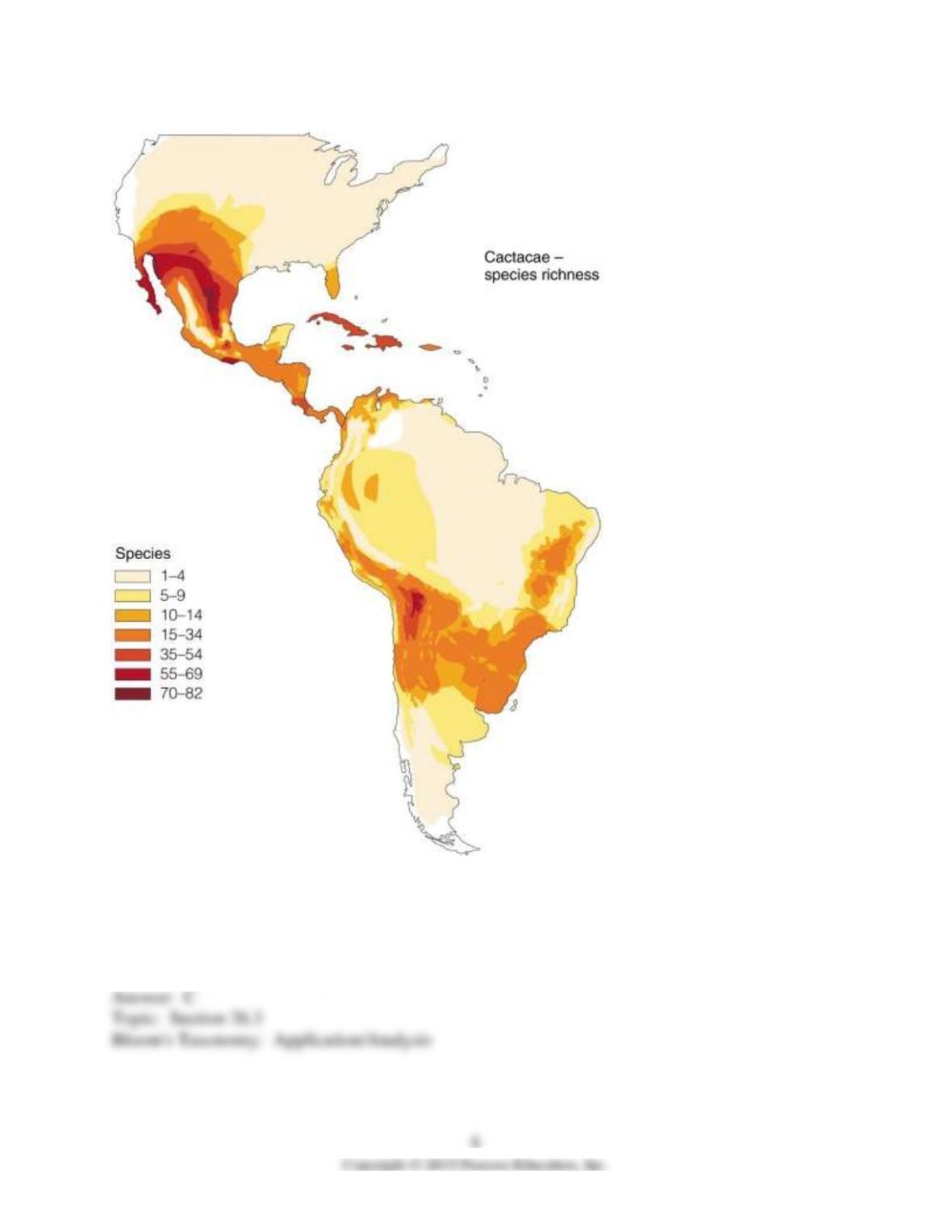
15)
What does the figure suggest about patterns of biodiversity for particular groups of organisms?
A) Species diversity is highest at the equator.
B) Species diversity is highest at the poles.
C) Climatic influences are most important in determining areas of higher diversity.
D) Diversity patterns are unpredictable.
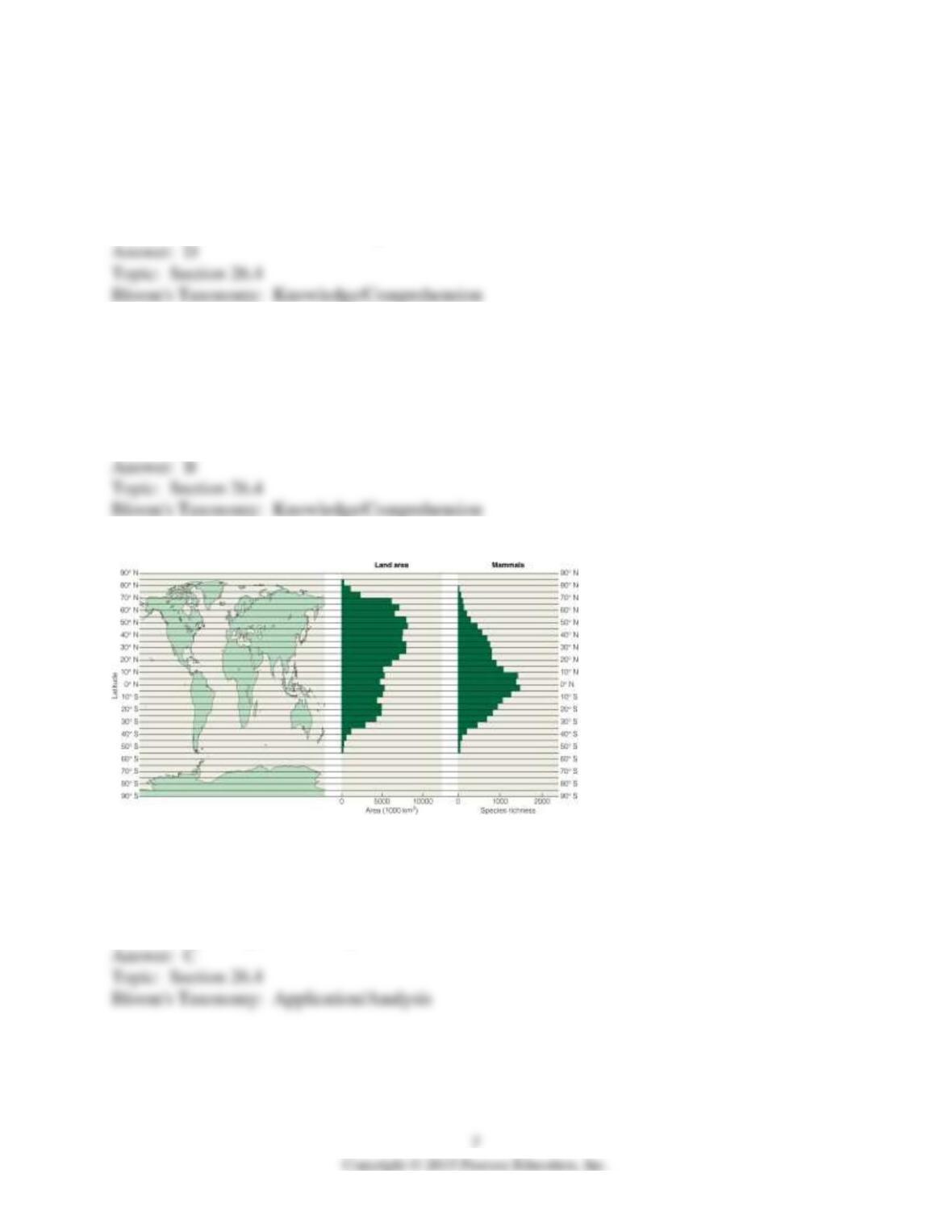
16) What is the evidence that exists to support the idea that the greater area of the tropics is the
reason for higher diversity?
A) The land mass is greater at the equator than elsewhere on Earth.
B) The area of the Atlantic Ocean is greater at the equator.
C) There are more mountainous areas in the tropics, creating more surface area.
D) The area between 0° and 10° is greater than between 60° and 70° latitude.
17) In relation to the stability hypothesis of diversity, which area provides the best evidence that
glaciation reduced temperate tree diversity?
A) North America
B) Europe
C) Asia
D) Russia
18)
What does this figure suggest?
A) Greater land area is strongly associated with mammalian diversity.
B) Mammalian diversity is highest at the northern latitudes.
C) Mammalian diversity is highest at the equator.
D) Land area is highest at the equator.
19) Species richness of terrestrial plants and animals increases with
A) latitude.
B) the structural diversity of plant communities.
C) elevation.
D) flatter terrain.
20) Variation in species richness of terrestrial species in North America correlates most strongly
with estimates of
A) actual or potential evapotranspiration.
B) annual temperature.
C) solar radiation.
D) precipitation.
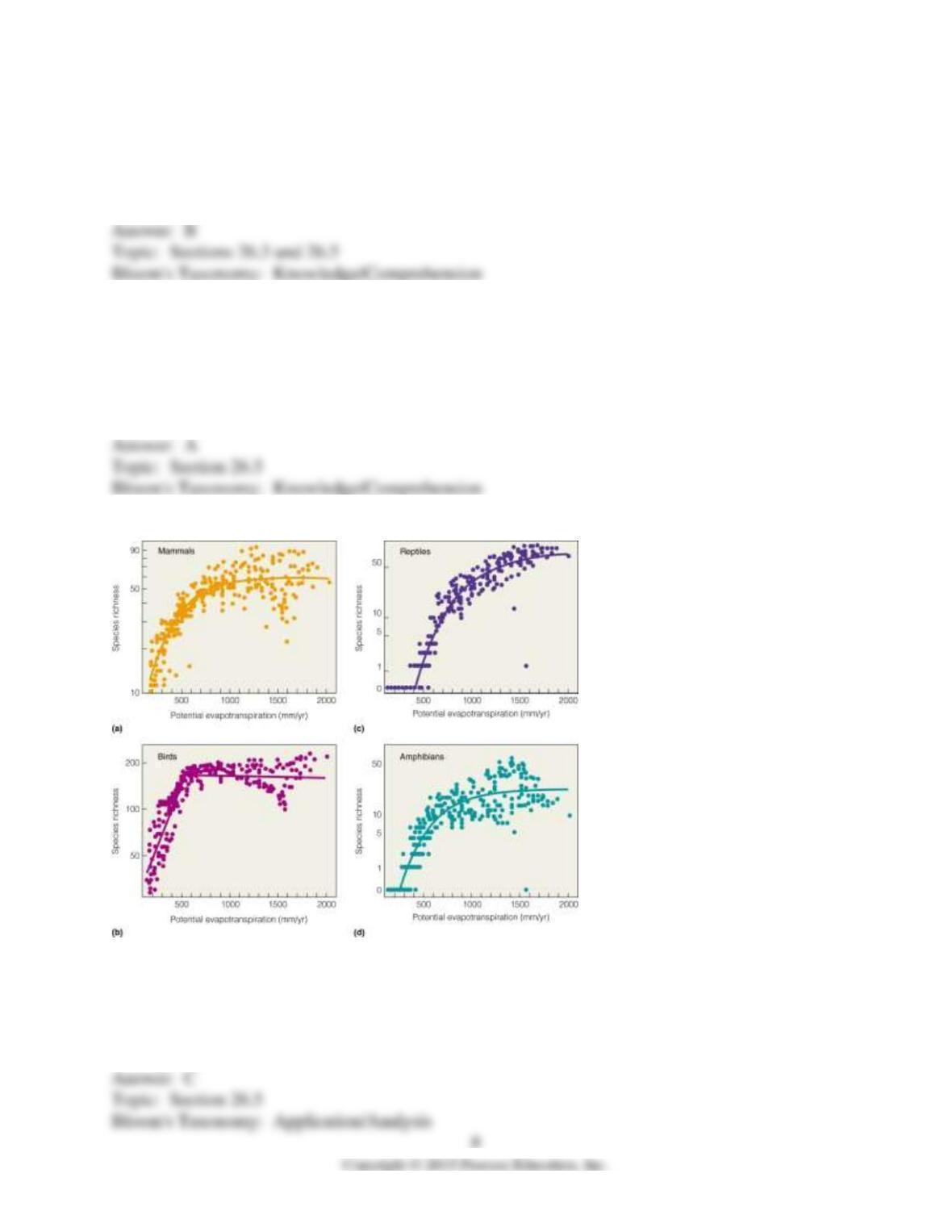
21)
Which of the following taxa have greater richness at lower PET?
A) mammals
B) reptiles
C) birds
D) amphibians
22) What is PET?
A) probability of evaporation
B) potential evapotranspiration
C) probable evapotranspiration
D) positive evaporative transport
23) Which of the following was seen as a significant predictor of diversity in the oceans?
A) NPP
B) PET
C) SST
D) IUCN
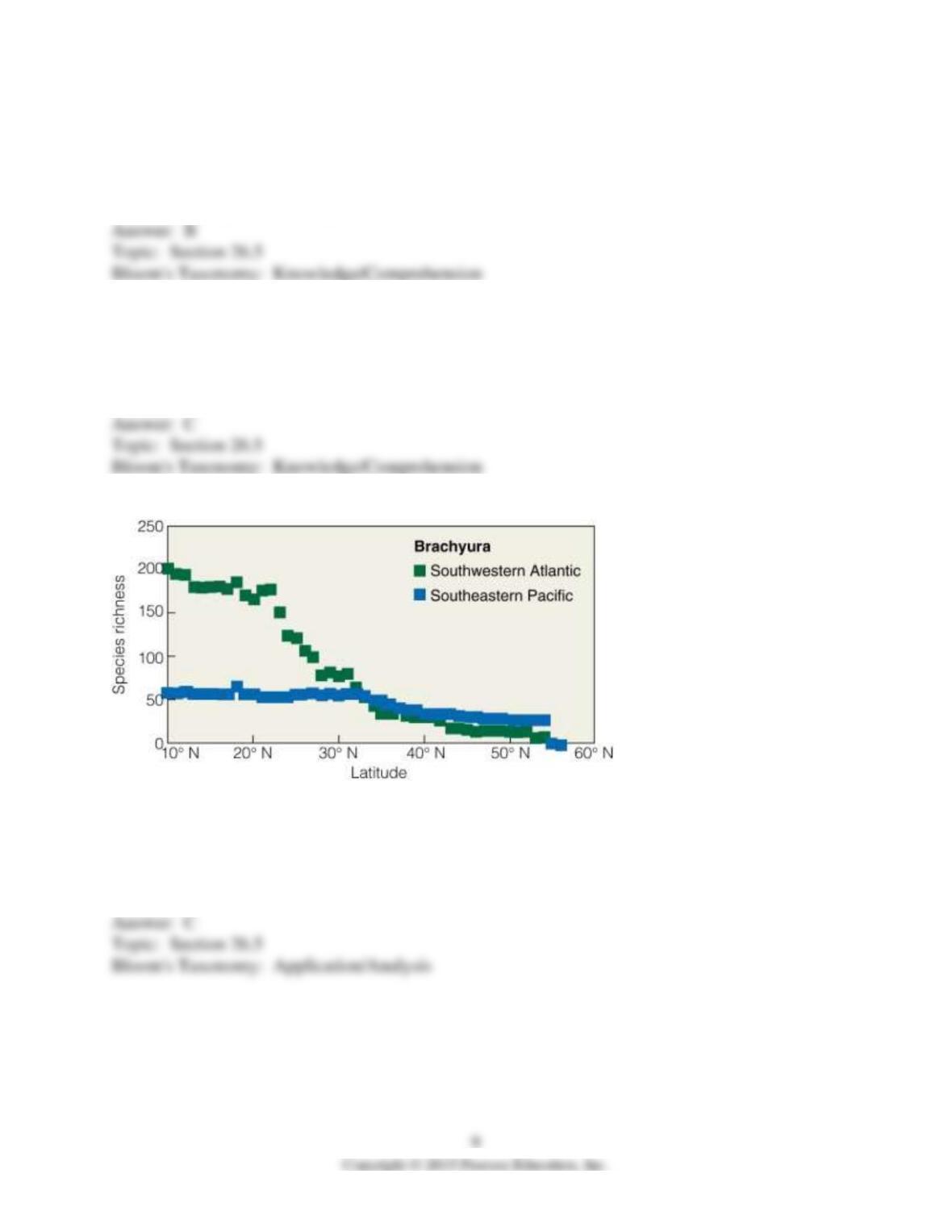
24)
Which of the following is true for Brachyura marine crabs?
A) Species richness decreases with increasing sea surface temperatures.
B) Species richness decreases with NPP.
C) Species richness decreases with latitude.
D) Species richness decreases with time.
25) Compare two environments at 45° N latitude: environment A’s altitude is 50 meters and
environment B’s altitude is 3000 meters. Which environment will support the greater level of
species richness for mammals and birds?
A) Environment A will have the greater level of species richness.
B) Environment B will have the greater level of species richness.
C) Environments A and B will have the same species richness.
26) Which of the following is seen as a significant predictor of increased diversity in trees?
A) primary productivity
B) wind patterns
C) decreased temperatures
D) decreased precipitation
27) Which of the following is strongly associated with net primary productivity?
A) sea surface temperatures
B) actual evapotranspiration
C) ocean biodiversity
D) increased altitude
28) In marine environments,
A) both species richness and productivity increase with latitude.
B) species richness increases and productivity decreases with latitude.
C) species richness decreases and productivity increases with latitude.
D) both species richness and productivity decrease with latitude.
29) As temperatures increase during seasonal fluctuations in marine environments,
A) both species richness and species dominance increase.
B) species richness increases and species dominance decreases.
C) species richness decreases and species dominance increases.
D) both species richness and species dominance decrease.
30) Terrestrial vertebrate richness is most strongly tied to
A) primary productivity.
B) potential evapotranspiration.
C) sea surface temperatures.
D) altitude.
31) Which of the following is increased amphibian diversity correlated with?
A) sea surface temperature
B) net primary productivity
C) altitude
D) distribution of land area across the globe
32) A measure of diversity between sites is called
A) alpha diversity.
B) beta diversity.
C) gamma diversity.
D) zeta diversity.
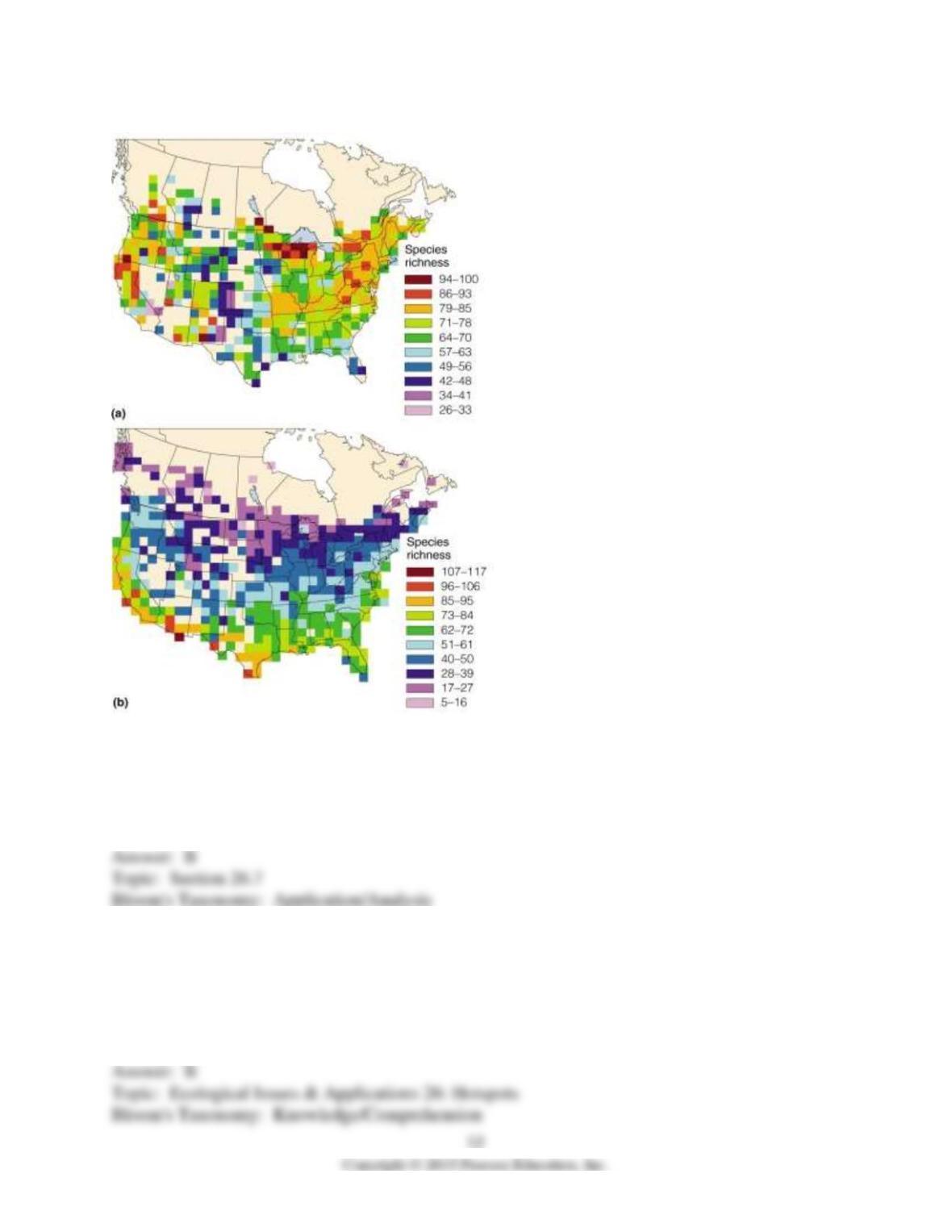
33)
The figure suggests
A) primary productivity dictates diversity.
B) diversity changes seasonally.
C) a high gamma diversity.
D) birds are more diverse at northern latitudes.
34) Hotspot regions make up only 2 percent of the total land mass but contain what percentage of
the world’s endemic plant species?
A) 2 percent
B) 50 percent
C) 75 percent
D) 90 percent
35) Which state is most likely to be a hotspot for biodiversity?
A) California
B) South Dakota
C) North Carolina
D) West Virginia
36) In 2004, the IUCN declared how many hotspot regions?
A) 10
B) 25
C) 35
D) 86
26.3 True/False Questions
1) All living species of organisms have now been described by scientists.
2) Over the past 100 million years, species richness has declined for gymnosperms and has
increased for angiosperms.
3) Humans are responsible for more than 75 percent of all present-day extinctions since A.D.
1600.
4) Species richness in both terrestrial and marine environments generally declines with latitude.
5) The 1.4 million species identified are equally distributed across the Earth’s surface.
6) In terrestrial habitats, species richness is negatively correlated with primary productivity.
7) As the structural diversity of plant communities increases, the species richness of animals also
increases.
8) The species richness of terrestrial plants and animals generally increases with elevation.
9) Primary productivity in the oceans is lower in tropical latitudes than in temperate latitudes,
primarily due to a permanent thermocline in tropical latitudes.
10) Seasonal variation in surface temperatures of the ocean functions to increase primary
productivity.
11) The diverse topography of mountainous regions generally supports more species of plants
and animals than the consistent terrain of flatlands.
12) Patterns of species migrations, such as birds that nest in North America during the spring and
in South America during the winter, do not alter seasonal patterns of regional diversity for a wide
range of taxonomic groups.
13) On a geological timescale, changes in climate do not influence overall regional patterns of
species diversity.

26.4 Essay Questions
1) Discuss three mass extinction events in Earth’s history, including the time when they occurred
and the groups of organisms that were most affected.
2) Choose one of several mass extinction events of the past or present and discuss its possible
cause(s).
3) Discuss the relationship between actual evapotranspiration (AET) and mammalian or avian
species richness in North America.
4) Discuss the major geographical trends in diversity and productivity in marine environments.
Give one possible explanation for these patterns.
5) Describe several reasons why species diversity changes with increasing altitude.
6) What single environmental factor is most likely to shift the geographic ranges of many
species, thus altering regional patterns of diversity? Give reasons for your answer.