Biology: A Guide to the Natural World, 5e (Krogh)
Chapter 26 Body Support and Movement: The Integumentary, Skeletal, and Muscular
Systems
1) The discipline dealing with the study of how parts of the body work is:
A) physiology.
B) anatomy.
C) endocrinology.
D) mechanics.
2) Which of the following is the study of the body’s structure?
A) physiology
B) anatomy
C) zoology
D) endocrinology
E) homeostasis
3) Which of the following is true concerning homeostasis?
A) Homeostasis is the maintenance of a rigid internal environment with no variation.
B) The maintenance of homeostasis relies mainly on positive feedback.
C) Homeostasis allows for major fluctuations in body conditions.
D) Homeostasis is the maintenance of a relatively stable internal environment.
4) A stimulus producing a response that reduces the stimulus describes:
A) all stimulus-response chains.
B) positive feedback.
C) negative feedback.
D) breakdown of homeostasis.
5) In oxygen homeostasis, the kidney that releases EPO, prompting increased red blood cell
production is the:
A) stimulus.
B) response.
C) product.
D) reactant.
6) In humans, the heart and lungs are found in the:
A) spinal cavity.
B) abdominopelvic cavity.
C) cranial cavity.
D) thoracic cavity.
7) The spinal cavity and cranial cavity are the two parts of the:
A) dorsal cavity.
B) ventral cavity.
C) abdominopelvic cavity.
D) skeletal system.
8) The thoracic and abdominopelvic cavities are separated by the:
A) lungs.
B) vertebral column.
C) diaphragm.
D) rib cage.
9) Groups of cells with a common function make up a/an:
A) tissue.
B) limb.
C) organ.
D) gland.
E) organ system.
10) Groups of tissues that perform a specific body function make up:
A) a tissue.
B) an organ.
C) the integument.
D) a gland.
E) an organ system.
11) The four types of body tissues are:
A) epithelial, glandular, muscle, and nervous.
B) epithelial, hormonal, cellular, and bone.
C) connective, cardiac, nervous, and adipose.
D) connective, epithelial, nervous, and muscle.
E) connective, neuronal, muscle, and epithelial.
12) Which of the following statements best describes epithelial tissue?
A) It is found only in the skin.
B) It is always at least several layers thick.
C) It covers internal and external surfaces.
D) It produces blood cells.
E) It only covers surfaces exposed to the internal environment.
4
13) Groups of cells that secrete substances are called:
A) glands.
B) organ systems.
C) tissues.
D) hormones.
14) Bone, cartilage, adipose tissue, and blood are all examples of:
A) epithelial tissue.
B) connective tissue.
C) muscle tissue.
D) nervous tissue.
E) small organ systems.
15) What unusual feature do you find in connective tissues?
A) glandular secretions
B) conductive cells
C) cells with the ability to contract
D) extracellular material called the ground substance
16) The function of epithelial tissue is to:
A) allow for movement of the body.
B) protect and cover the body.
C) support the body.
D) form the immune system.
17) A function of connective tissue is to:
A) move the muscles of the body.
B) protect and cover the body.
C) stabilize and support the body.
D) form glands.
18) Muscle tissue has a specialized ability to:
A) protect the body.
B) support the body.
C) shorten or contract.
D) provide an internal framework for the body.
E) form the glands.
19) Connective tissue is different from epithelial tissue in that connective tissue:
A) has a structure called basement membrane.
B) has cells that are usually separated and scattered in an extracellular material.
C) is not made up of cells.
D) is found only in joints.
20) A prescription medication lists a rare side effect of impairing the movement of smooth
muscle. This medication could potentially affect the:
A) heart.
B) walls of the small intestine.
C) muscles that move your arms and legs.
D) muscles that move the eyeballs.
21) The type of muscle tissue that can be under our conscious control is:
A) skeletal.
B) cardiac.
C) smooth.
D) skeletal and smooth.
E) smooth and cardiac.
22) Which of the following is characteristic of cardiac muscle?
A) It is found only in the heart and blood vessels.
B) It is most similar in appearance to smooth muscle.
C) It is not striated.
D) It contracts under the control of its pacemaker cells.
23) Glial cells are cells found in which type of tissue?
A) muscle
B) nervous
C) connective
D) epithelial
24) In the textbook, the stomach was given as an example of an organ. Which of the following is
a valid description of the work of one of its tissues?
A) Its connective tissue helps drain the stomach contents.
B) Its muscle tissue forces secretions out of glands and into the stomach.
C) Its epithelial tissue secretes substances that help with digestion.
D) Its nervous tissue communicates directly with the intestines to coordinate digestion.
25) Which of the two systems listed work together to bring oxygen into your body and deliver it
to your cells?
A) lymphatic and endocrine
B) respiratory and cardiovascular
C) respiratory and digestive
D) urinary and cardiovascular
26) Which of the following systems are involved in coordination and regulation?
A) nervous and endocrine
B) digestive and cardiovascular
C) urinary and cardiovascular
D) lymphatic and respiratory
27) Which of the following systems are involved in bringing nutrients into the body and to its
cells?
A) respiratory and cardiovascular
B) digestive and cardiovascular
C) urinary and cardiovascular
D) lymphatic and respiratory
28) Which human body system would be best described as playing roles in both waste disposal
and conservation?
A) cardiovascular
B) nervous
C) urinary
D) lymphatic
E) respiratory
29) Which human body system includes lymphatic organs of the lymphatic network, such as the
tonsils and lymph notes?
A) nervous
B) cardiovascular
C) urinary
D) endocrine
E) immune
30) Structures such as hair and nails are part of the:
A) skeletal system.
B) integumentary system.
C) endocrine system.
D) muscular system.
E) lymphatic system.
31) Acne is caused by problems with the:
A) sweat glands.
B) endocrine glands.
C) sebaceous glands.
D) hair follicles.
32) Keratinized cells near the surface of the epidermis are:
A) found in a single layer.
B) mostly dead and water resistant.
C) about one month old.
D) derived from nervous tissue.
33) The inner layer of the skin, the dermis, is mostly:
A) epithelial tissue.
B) muscle tissue.
C) connective tissue.
D) keratin.
E) nervous tissue.
9
34) A paper cut that draws blood must have cut down into at least which layer of the skin?
A) subcutaneous layer
B) dermis
C) adipose layer
D) epidermis
35) Hair color (or lack of it) is mostly due to:
A) activity of melanocytes.
B) a colored version of keratin.
C) sebaceous gland pigments.
D) sweat gland pigments.
36) Glands found primarily in the groin and armpit areas are the:
A) sebaceous glands.
B) merocrine sweat glands.
C) apocrine glands.
D) endocrine glands.
37) Structures of the skeletal system include all of the following except:
A) bone.
B) cartilage.
C) nails.
D) ligaments.
38) Which of the following typically connects a bone to another bone?
A) cartilage
B) ligaments
C) tendons
D) marrow
39) Which of the following is part of the axial skeleton?
A) thoracic cage bones such as the ribs
B) pelvic girdle bones such as the os coxa
C) arm bones such as the humerus
D) leg bones such as the femur
40) Which of the following best describes “spongy bone”?
A) soft bone tissue
B) very similar to compact bone but more flexible
C) bone tissue found only in the skull
D) contains blood-cell-producing red marrow
41) Blood vessels and nerves are found in which part of compact bone?
A) only in the marrow cavity
B) only on the outside surface
C) in central canals
D) in osteoblasts
42) The two main divisions of the skeletal system are:
A) cranial and axial.
B) appendicular and cranial.
C) axial and articular.
D) appendicular and axial.
E) vertebral and appendicular.
43) In a muscle cell, sarcomeres are the:
A) myofibrils that run the length of the cell.
B) fundamental units of muscle contraction.
C) thin filaments.
D) thick filaments.
44) The protein actin is found in the:
A) nucleus.
B) thick filaments.
C) thin filaments.
D) membrane.
45) Which part of the muscle cell actually does the work of contraction by attaching, pivoting,
and pulling?
A) myosin heads
B) actin filaments
C) calcium ions
D) neurotransmitter molecules
46) The brain is responsible for essentially all homeostasis.
47) The heart is in the thoracic cavity.
48) Homeostasis is maintained mostly by positive feedback.
49) The abdominopelvic cavity is part of the larger ventral body cavity.
50) In the levels of organization, the tissue level is between the cellular and organ levels.
51) Because they form linings or coverings, epithelial tissues always face an open area or an
exterior environment.
52) Smooth muscle may be moved by either voluntary or involuntary control depending on
location in the body.
53) Subcutaneous fat tissue in humans is located mainly in the dermis.
54) The dermis is mostly made up of connective tissue.
55) Keratin in the skin is produced mainly by the cells in the epidermis.
56) A sweat gland is a type of exocrine gland.

Match the following.
A) Connective tissue
B) Muscle Tissue
C) Nervous tissue
D) Epithelial tissue
57) May have “ground substance”
Topic: Section 26.4
Skill: Application/Analysis
58) “Smooth” is one type
Topic: Section 26.4
Skill: Application/Analysis
59) Includes glial cells
Topic: Section 26.4
Skill: Application/Analysis
60) Covers surfaces and forms linings
Topic: Section 26.4
Skill: Application/Analysis
Match the following.
A) joints and cartilage
B) hair, nails, and some glands
C) water conservation and waste processing
D) communication using hormones
E) larynx, trachea, and bronchi
F) Connective tissue
61) Bone and cartilage
Topic: Section 26.4
Skill: Application/Analysis
62) Urinary system
Topic: Section 26.5
Skill: Application/Analysis
63) Endocrine system
Topic: Section 26.5
Skill: Application/Analysis
64) Respiratory system
Topic: Section 26.5
Skill: Application/Analysis
65) Skeletal system
Topic: Section 26.5
Skill: Application/Analysis
66) Integumentary system
Topic: Section 26.5
Skill: Application/Analysis
67) In the most general terms, studying the structure of the passages that air takes into the lungs
would be considered ________; studying the mechanism for how gases are exchanged between
the lungs and the blood would be ________.
15
68) The brain is in the ________ cavity, which is part of the larger ________ cavity.
69) Glands are part of the ________ tissue category.
70) Bone and cartilage are examples of ________ tissues.
71) The endocrine system sends signals using chemical messengers called ________.
72) The two organ systems that are involved in removing wastes from the cells and eliminating
them from the body are the ________ system and ________ system.
73) A 25-year-old friend tells you her mom was diagnosed with advanced osteoporosis. Your
friend seems dispirited, feeling resigned to the same fate. Using the material you learned about
the skeletal system, what supportive advice can you give your friend for ways she can guard
against her risk of osteoporosis?
74) An older friend of yours who has been a dedicated jogger for many years has been having
mild knee pain recently when jogging longer distances. He tells you his doctor recommended
better-cushioned running shoes. He wonders why better shoes on his feet will help his knees.
Using the material you learned about the skeletal system, what can you say to help your friend
understand his doctor’s recommendation?
75) An auto mechanic friend expresses interest in changing his career to nursing. He sees that
anatomy and physiology is one of the courses he needs to take. He asks you what such a course
would be like. You decide to explain it to him by comparing the human body to a car. How
would you explain the course to him?
76) What is the evolutionary significance of tissues, organs, and organ systems in animals?
77) A biology classmate seems confused by something he read at the professor’s website about
calcium imbalances and neurotoxins interfering with proper functioning of the muscular system–
even to the point of causing death by suffocation. He states the professor probably goofed up and
meant the skeletal, nervous, and respiratory systems were adversely affected. Defend your
professor’s statements.
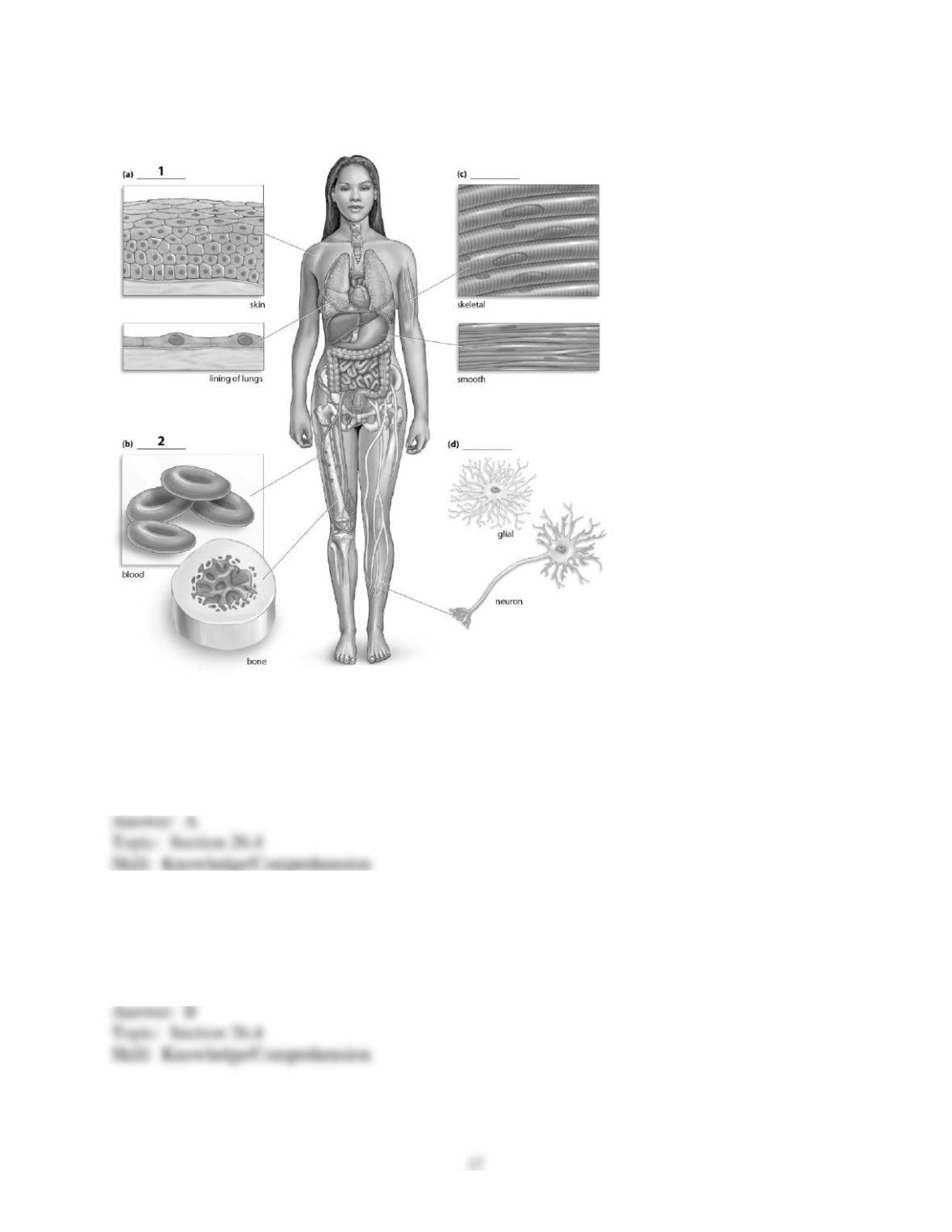
Refer to the figure below, and then answer the following question(s).
78) The missing label indicated with a “1” corresponds to which tissue type?
A) epithelial
B) connective
C) muscle
D) nervous
79) The missing label indicated with a “2” corresponds to which tissue type?
A) epithelial
B) connective
C) muscle
D) nervous