Chapter 26 – The Origin and Diversity of Life
Chapter 26
The Origin and Diversity of Life
Multiple Choice Questions
1. The age of the Earth according to modern estimations is aboutrev:
02_12_2014_QC_45114
2. The oldest microfossils are of
3. Life apparently originated on Earth about
Chapter 26 – The Origin and Diversity of Life
4. The early Earth’s reducing atmosphere probably contained all of the following except
5. An experimental test of the hypothesis to explain the origin of the first organic compounds
on Earth might include all of the following sequential steps except
6. Which of the following was produced in experiments on primitive Earth conditions
conducted by Miller-Urey and others?
Chapter 26 – The Origin and Diversity of Life
7. All of the following were produced in experiments on primitive Earth conditions
conducted by Miller-Urey and others, except for
8. It has been discovered that enzyme-like catalysis can be carried out not only by enzymes
but also by
9. The oldest fossils of eukaryotes have been estimated to be
Chapter 26 – The Origin and Diversity of Life
10. Imagine that NASA discovered a new planet with an atmosphere rich in hydrogen gas,
hydrogen sulfide, ammonia and methane. We would call this a(n)
Clarify Question
•
What is the key concept addressed by the question?
•
What type of thinking is required?
Gather Content
•
What do you already know about the reducing atmosphere of the early earth?
Choose Answer
•
Given what you now know, what information and/or problem solving approach is most
likely to produce the correct answer?
Reflect on Process
•
Did your problem-solving process lead you to the correct answer? If not, where did the
process break down or lead you astray? How can you revise your approach to produce a
more desirable result?
Chapter 26 – The Origin and Diversity of Life
11. Which of the following was demonstrated by the Miller-Urey experiment?
12. Eukaryotic cells acquired mitochondria and chloroplasts by
Chapter 26 – The Origin and Diversity of Life
13. Two principal organelles in eukaryotes that were apparently derived from different types
of bacteria are the
14. The group that probably gave rise to chloroplasts is the
15. True multicellularity is a major characteristic of
Chapter 26 – The Origin and Diversity of Life
16. A scientist is studying endosymbiosis in cells. This means she is investigating
17. In the original experiments by Stanley Miller and Harold Urey to synthesize organic
molecules in an abiotic environment, which one of the following would you NOT expect to
find in the collection flask?
Chapter 26 – The Origin and Diversity of Life
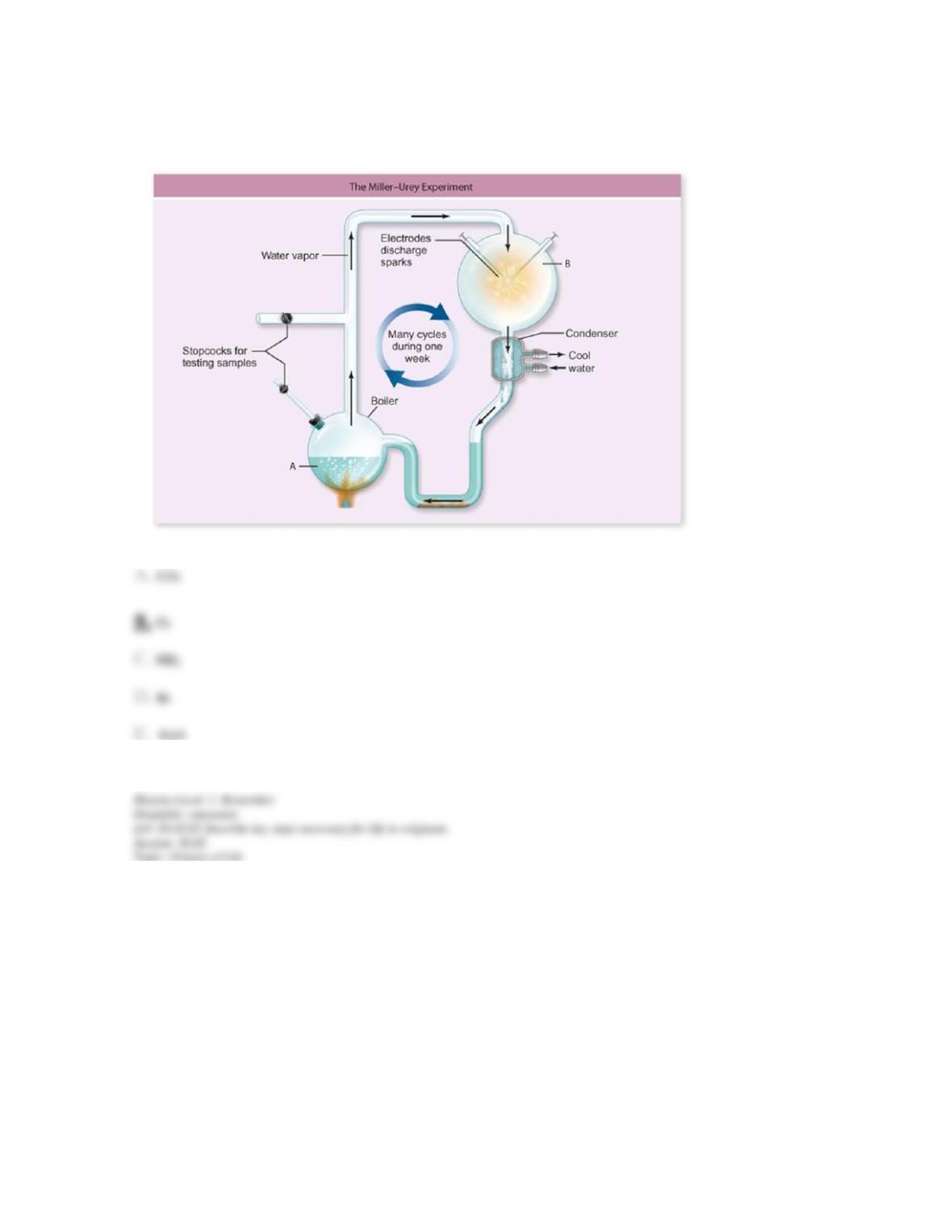
18. The apparatus in the figure was used by Stanley Miller and Harold Urey to study the
origin of life on Earth. What compound was excluded from the apparatus so that it would
form a reducing atmosphere?
Chapter 26 – The Origin and Diversity of Life
19. Which one of the following statements about endosymbiosis and the origin of the
eukaryotic cell is FALSE?
True / False Questions
20. Homo sapiens have existed on earth for 2% of the earth’s history.
Multiple Choice Questions
21. Vascular plants appeared about 450 million year ago. Vascular plants have existed on
earth for ______.
Chapter 26 – The Origin and Diversity of Life
Clarify Question
•
What is the key concept addressed by the question?
•
What type of thinking is required?
Gather Content
•
What do you already know about the age of the earth?
Choose Answer
•
Given what you now know, what information and/or problem solving approach is most
likely to produce the correct answer?
Reflect on Process
•
Did your problem-solving process lead you to the correct answer? If not, where did the
process break down or lead you astray? How can you revise your approach to produce a
more desirable result?
True / False Questions
Chapter 26 – The Origin and Diversity of Life
22. Prokaryotic organisms were the only life-forms present on earth for almost 2 billion
years. Multicellular eukaryotes have only been around for about 25% of earth’s history
Multiple Choice Questions
23. Why is there free oxygen in the air?
24. Why is a reducing atmosphere conducive to the origin of life?