292)
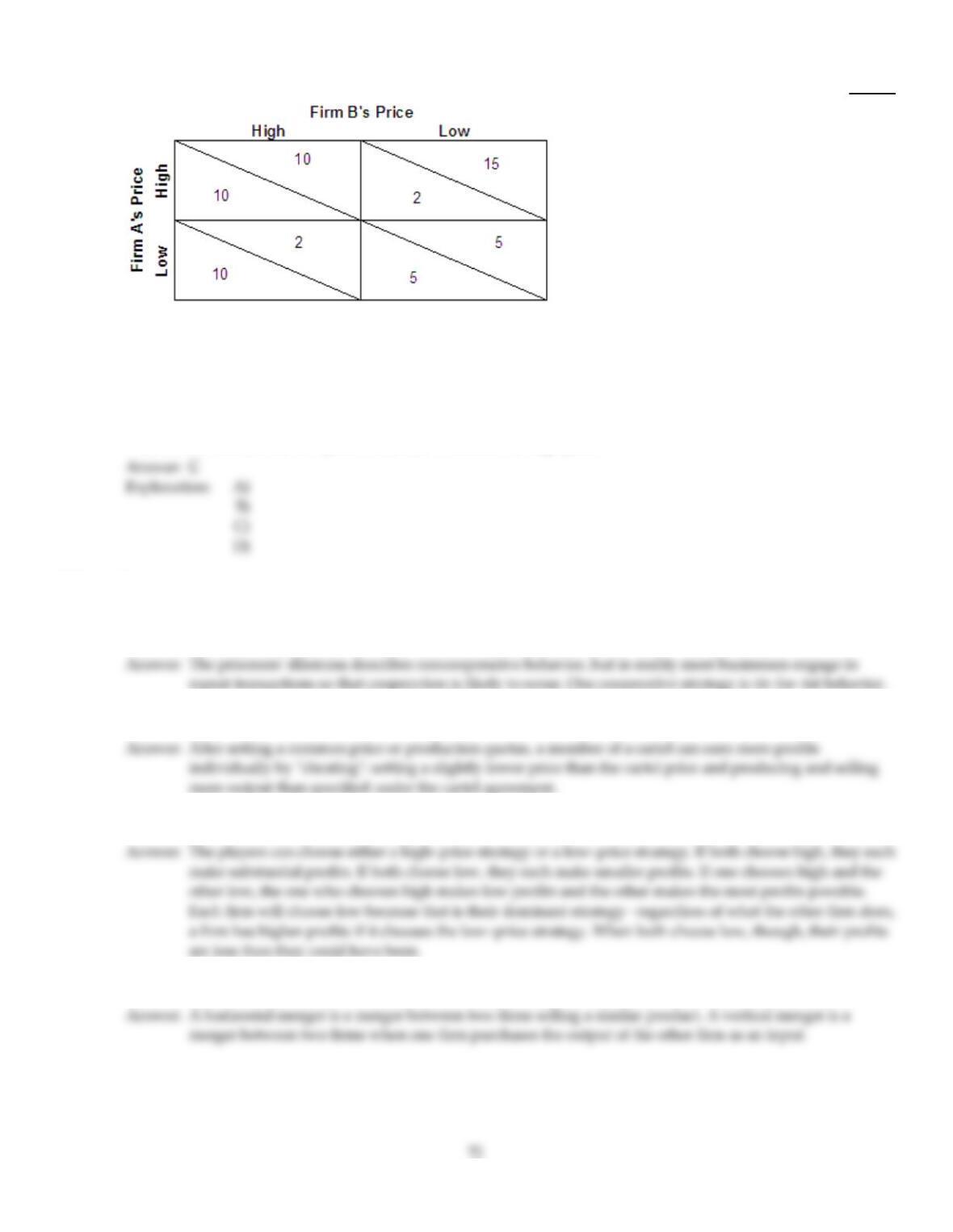
Refer to the above payoff matrix for the profits (in $ millions) of two firms (A and B) and two
pricing strategies (high and low). Which of the following is the outcome of the dominant strategy
without cooperation?
292)
A)
Both firm A and firm B choose the high price.
B)
Firm A chooses the high price while firm B chooses the low price.
C)
Both firm A and firm B choose the low price.
D)
Firm A chooses the low price while firm B chooses the high price.
ESSAY. Write your answer in the space provided or on a separate sheet of paper.
293)
Firms faced with prisoners’ dilemma can always make more profits by engaging in opportunistic behavior.
Why is this type of behavior NOT commonly found even in oligopolistic markets?
294)
Why would a member of a cartel cheat?
295)
Explain how the prisoners’ dilemma can be used to examine pricing strategies in an oligopoly.
296)
Distinguish between a horizontal merger and a vertical merger.
297)
Using the information in the table, develop the four–firm concentration ratio. Would you classify this industry
as an oligopoly? Explain your answer.
Annual Sales
Firm ($ millions)
1 350
2 200
3 150
4 100
5 40
6 through 20 20
860
298)
What are the main characteristics that make it more likely for a cartel to enforce agreements among
participating members?
299)
Why do firms form a cartel? How do cartels achieve their goals?
300)
“Oligopoly is the only market structure in which rivalry among firms takes place.” Do you agree or disagree?
Why?
301)
What is meant by the concentration of an industry? How is concentration measured? What are likely causes of
high concentration?
302)
How does the presence of network effects in a two–sided market affects the pricing behavior in the market?
303)
What is a cartel? Can cartels generate long–term profits without the existence of barriers to entry?
304)
Why do cartels often break down?
305)
What is oligopoly? How does oligopoly differ from the other kinds of market structure?
306)
Explain the basic operations of an economic game.
307)
How can network effects lead an industry to become an oligopoly?
Answer Key
Testname: C26
Answer Key
Testname: C26
Answer Key
Testname: C26
Answer Key
Testname: C26
Answer Key
Testname: C26
Answer Key
Testname: C26
80
Answer Key
Testname: C26
81