154. A project has estimated annual cash flows of $90,000 for three years and is estimated to cost $250,000.
Assume a minimum acceptable rate of return of 10%. Using the following tables determine the (a) net present
value of the project and (b) the present value index, rounded to two decimal places.
Below is a table for the present value of $1 at compound interest.
Year
6%
10%
12%
1
.943
.909
.893
2
.890
.826
.797
3
.840
.751
.712
4
.792
.683
.636
5
.747
.621
.567
Below is a table for the present value of an annuity of $1 at compound interest.
Year
6%
10%
12%
1
.943
.909
.893
2
1.833
1.736
1.690
3
2.673
2.487
2.402
4
3.465
3.170
3.037
5
4.212
3.791
3.605
155. A project is estimated to cost $273,840 and provide annual cash flows of $60,000 for seven years.
Determine the internal rate of return for this project, using the following table.
Year
6%
10%
12%
1
.943
.909
.893
2
1.833
1.736
1.690
3
2.673
2.487
2.402
4
3.465
3.170
3.037
5
4.212
3.791
3.605
6
4.917
4.355
4.111
7
5.582
4.868
4.564
8
6.210
5.335
4.968
9
6.802
5.759
5.328
10
7.360
6.145
5.650
156. A project is estimated to cost $248,400 and provide annual cash flows of $50,000 for eight years.
Determine the internal rate of return for this project, using the following table.
Year
6%
10%
12%
1
.943
.909
.893
2
1.833
1.736
1.690
3
2.673
2.487
2.402
4
3.465
3.170
3.037
5
4.212
3.791
3.605
6
4.917
4.355
4.111
7
5.582
4.868
4.564
8
6.210
5.335
4.968
9
6.802
5.759
5.328
10
7.360
6.145
5.650
157. Project A requires an original investment of $65,000. The project will yield cash flows of $15,000 per year
for seven years. Project B has a calculated net present value of $5,500 over a five year life. Project A could be
sold at the end of five years for a price of $30,000. (a) Using the proper table below determine the net present
value of Project A over a five-year life with salvage value assuming a minimum rate of return of 12%. (b)
Which project provides the greatest net present value?
Below is a table for the present value of $1 at compound interest.
Year
6%
10%
12%
1
.943
.909
.893
2
.890
.826
.797
3
.840
.751
.712
4
.792
.683
.636
5
.747
.621
.567
Below is a table for the present value of an annuity of $1 at compound interest.
Year
6%
10%
12%
1
.943
.909
.893
2
1.833
1.736
1.690
3
2.673
2.487
2.402
4
3.465
3.170
3.037
5
4.212
3.791
3.605
Present value of a $15,000 five year annuity at 12%:
$54,075 *
Present value of a $30,000 amount, five years at 12%
17,010**
Total present value of Project A:
$71,085
Total cost of Project A:
65,000
Net present value of Project A
$6,085
158. Project A requires an original investment of $50,000. The project will yield cash flows of $15,000 per year
for seven years. Project B has a calculated net present value of $13,500 over a four year life. Project A could be
sold at the end of four years for a price of $25,000. (a) Using the proper table below determine the net present
value of Project A over a four-year life with salvage value assuming a minimum rate of return of 12%. (b)
Which project provides the greatest net present value?
Below is a table for the present value of $1 at compound interest.
Year
6%
10%
12%
1
.943
.909
.893
2
.890
.826
.797
3
.840
.751
.712
4
.792
.683
.636
5
.747
.621
.567
Below is a table for the present value of an annuity of $1 at compound interest.
Year
6%
10%
12%
1
.943
.909
.893
2
1.833
1.736
1.690
3
2.673
2.487
2.402
4
3.465
3.170
3.037
5
4.212
3.791
3.605
Present value of a $15,000 four year annuity at 12%:
$45,555 *
Present value of a $25,000 amount, four years at 12%
15,900**
Total present value of Project A:
$61,455
Total cost of Project A:
50,000
Net present value of Project A
$11,455
159. What is the present value of $8,000 to be received at the end of six years, if the required rate of return is
15%?
Below is a table for the present value of $1 at compound interest.
Year
15%
Year
15%
1
0.87
6
0.432
2
0.756
7
0.376
3
0.658
8
0.327
4
0.572
9
0.284
5
0.497
10
0.247
Below is a table for the present value of an annuity of $1 at compound interest.
Year
15%
Year
15%
1
0.87
6
3.785
2
1.626
7
4.16
3
2.283
8
4.487
4
2.855
9
4.772
5
3.353
10
5.019
160. Norton Company is considering a project that will require an initial investment of $750,000 and will return
$200,000 each year for five years.
Required:
If taxes are ignored and the required rate of return is 9%, what is the project’s net present value? Based on this
analysis, should Norton Company proceed with the project?
Below is a table for the present value of $1 at compound interest.
Year
9%
Year
9%
1
0.917
6
0.596
2
0.842
7
0.547
3
0.772
8
0.502
4
0.708
9
0.460
5
0.650
10
0.422
Below is a table for the present value of an annuity of $1 at compound interest.
Year
9%
Year
9%
1
0.917
6
4.486
2
1.759
7
5.033
3
2.531
8
5.535
4
3.240
9
5.995
5
3.890
10
6.418
161. An investment of $185,575 is expected to generate returns of $65,000 per year for each of the next four
years. What is the investment’s internal rate of return?
Below is a table for the present value of $1 at compound interest.
Year
6%
10%
12%
15%
1
0.943
0.909
0.893
0.87
2
0.89
0.826
0.797
0.756
3
0.84
0.751
0.712
0.658
4
0.792
0.683
0.636
0.572
5
0.747
0.621
0.567
0.497
Below is a table for the present value of an annuity of $1 at compound interest.
Year
6%
10%
12%
15%
1
0.943
0.909
0.893
0.87
2
1.833
1.736
1.69
1.626
3
2.673
2.487
2.402
2.283
4
3.465
3.17
3.037
2.855
5
4.212
3.791
3.605
3.353
162. Dickerson Co. is evaluating a project requiring a capital expenditure of $810,000. The project has an
estimated life of four years and no salvage value. The estimated net income and net cash flow from the project
are as follows:
Year
Net Income
Net Cash Flow
1
$ 75,000
$285,000
2
100,000
290,000
3
109,000
190,000
4
36,000
125,000
$320,000
$890,000
The company’s minimum desired rate of return is 12%. The present value of $1 at compound interest of 12% for 1, 2, 3, and 4 years is .893, .797,
.712, and .636, respectively.
Required:
Determine the average rate of return on investment, including the effect of depreciation on the investment.
163. Dickerson Co. is evaluating a project requiring a capital expenditure of $810,000. The project has an
estimated life of four years and no salvage value. The estimated net income and net cash flow from the project
are as follows:
Year
Net Income
Net Cash Flow
1
$ 75,000
$280,000
2
100,000
300,000
3
109,000
200,000
4
36,000
120,000
$320,000
$900,000
The company’s minimum desired rate of return is 12%. The present value of $1 at compound interest of 12% for 1, 2, 3, and 4 years is .893, .797,
.712, and .636, respectively.
Required:
Determine the net present value.
1
.893
$280,000
$250,040
2
.797
300,000
239,100
3
.712
200,000
142,400
4
.636
120,000
76,320
Total
$900,000
$707,860
Amount to be invested
810,000
Net present value
$(102,140)
164. Match each of the following terms with the best definition given below.
1. Average income as a percentage of average
Time value of money
2. Initial cost divided by Annual net cash inflow of an
Net present value
3. Recognizes that a dollar today is worth more than a
Capital investment
5. The investment analysis method that is most often
Cash payback
165. Match the term with the correct definition.
1. The length of time it will take to recover through cash
accounting rate
2. A formal means of analyzing long-range investment
net present
3. The rate of return that makes the net present value of a
capital
5. The decision model that computes the expected net
monetary gain or loss from a project by discounting all
expected future cash inflows and outflows to their present
internal rate of
6. A measure of profitability computed by dividing the
average operating income that an asset generates by the
payback
166. Jimmy Co. is considering a 12-year project that is estimated to cost $1,050,000 and has no residual value.
Jimmy Co. seeks to earn an average rate of return of 18% on all capital projects. Determine the necessary
average annual income (using straight-line depreciation) that must be achieved on this project for this project to
be acceptable to Jimmy Co.
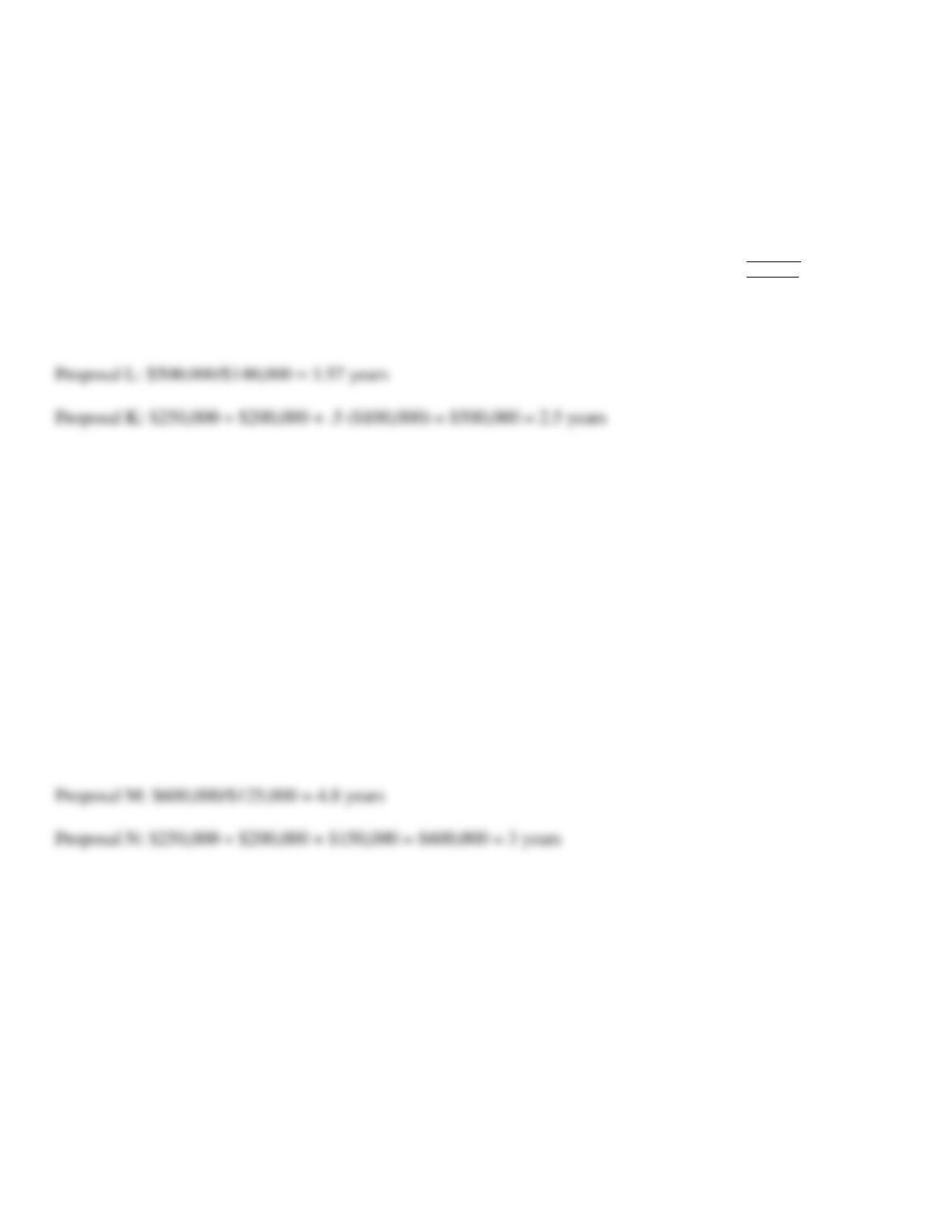
167. Proposals L and K each cost $500,000, have 6-year lives, and have expected total cash flows of $720,000.
Proposal L is expected to provide equal annual net cash flows of $140,000, while the net cash flows for
Proposal K are as follows:
Year 1
$250,000
Year 2
200,000
Year 3
100,000
Year 4
90,000
Year 5
60,000
Year 6
20,000
$720,000
Determine the cash payback period for each proposal. Round your answers to two decimal places.
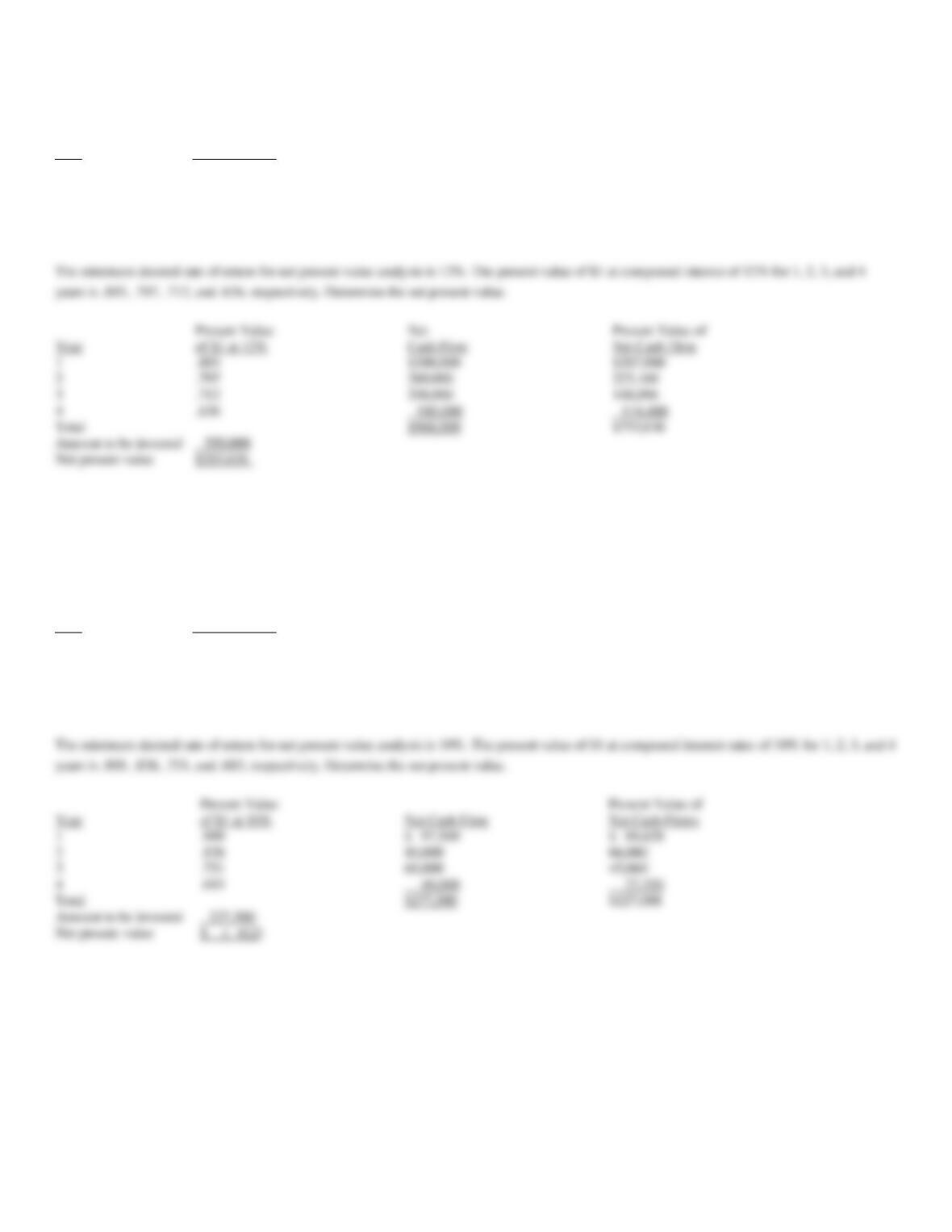
168. Proposals M and N each cost $600,000, have 6-year lives, and have expected total cash flows of $750,000.
Proposal M is expected to provide equal annual net cash flows of $125,000, while the net cash flows for
Proposal N are as follows:
Year 1
$250,000
Year 2
$200,000
Year 3
$150,000
Year 4
$ 75,000
Year 5
$ 50,000
Year 6
$ 25,000
Determine the cash payback period for each proposal.
169. A $550,000 capital investment proposal has an estimated life of four years and no residual value. The
estimated net cash flows are as follows:
Year
Net Cash Flow
1
$300,000
2
280,000
3
208,000
4
180,000
170. Sunrise Inc. is considering a capital investment proposal that costs $227,500 and has an estimated life of
four years and no residual value. The estimated net cash flows are as follows:
Year
Net Cash Flow
1
$97,500
2
$80,000
3
$60,000
4
$40,000
1
.909
$ 97,500
$ 88,628
2
.826
80,000
66,080
3
.751
60,000
45,060
4
.683
40,000
27,320
Total
$277,500
$227,088
Amount to be invested
227,500
Net present value
$ ( 412)
1
.893
$300,000
$267,900
2
.797
280,000
223,160
3
.712
208,000
148,096
4
.636
180,000
114,480
Total
$968,000
$753,636
Amount to be invested
550,000
Net present value
$203,636
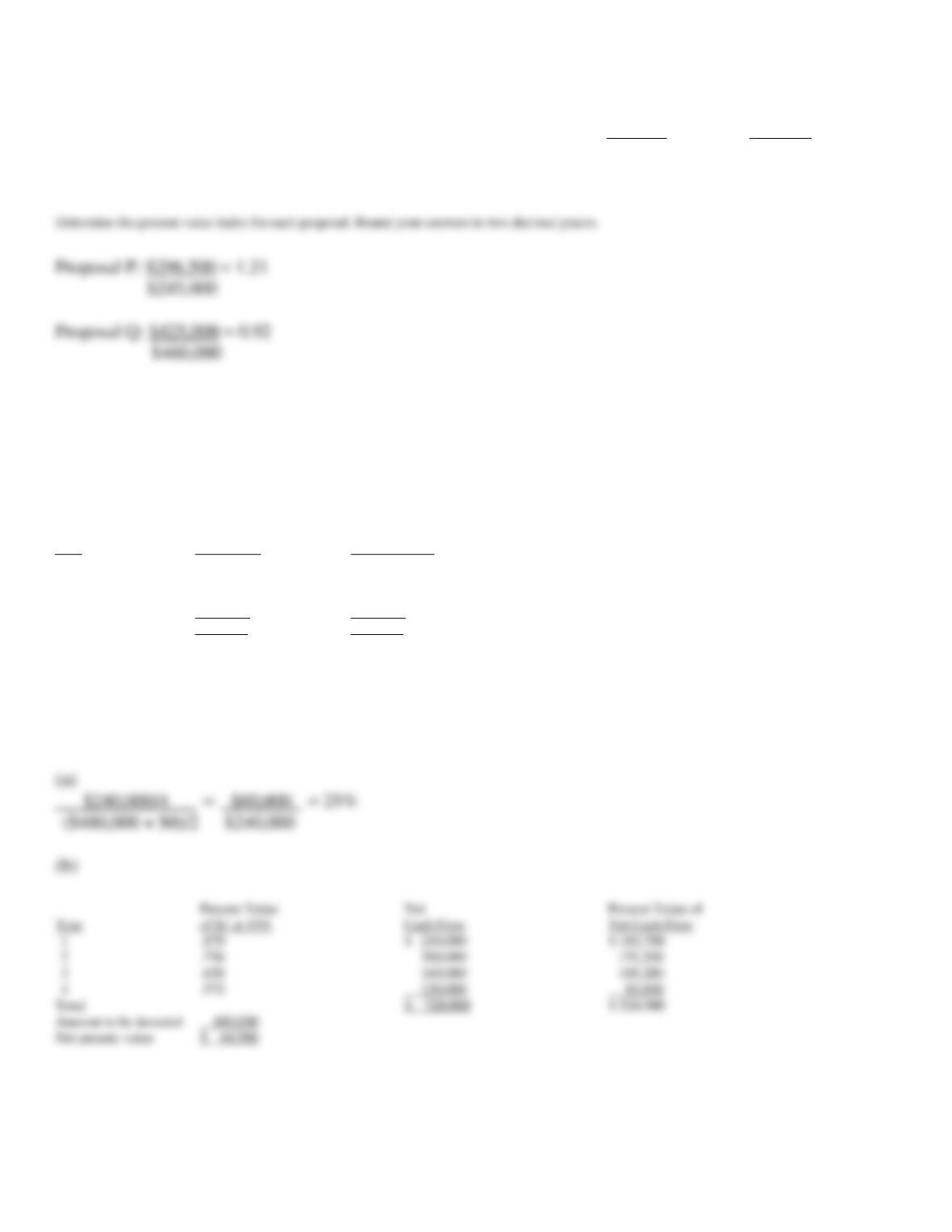
171. The net present value has been computed for Proposals P and Q. Relevant data are as follows:
Proposal P
Proposal Q
Amount to be invested
$245,000
$460,000
Total present value of net cash flow
296,500
425,000
172. Vanessa Company is evaluating a project requiring a capital expenditure of $480,000. The project has an
estimated life of 4 years and no salvage value. The estimated net income and net cash flow from the project are
as follows:
Year
Net Income
Net Cash Flow
1
$ 90,000
$210,000
2
80,000
200,000
3
40,000
160,000
4
30,000
150,000
$240,000
$720,000
The company’s minimum desired rate of return for net present value analysis is 15%. The present value of $1 at compound interest of 15% for 1, 2, 3,
and 4 years is .870, .756, .658, and .572, respectively.
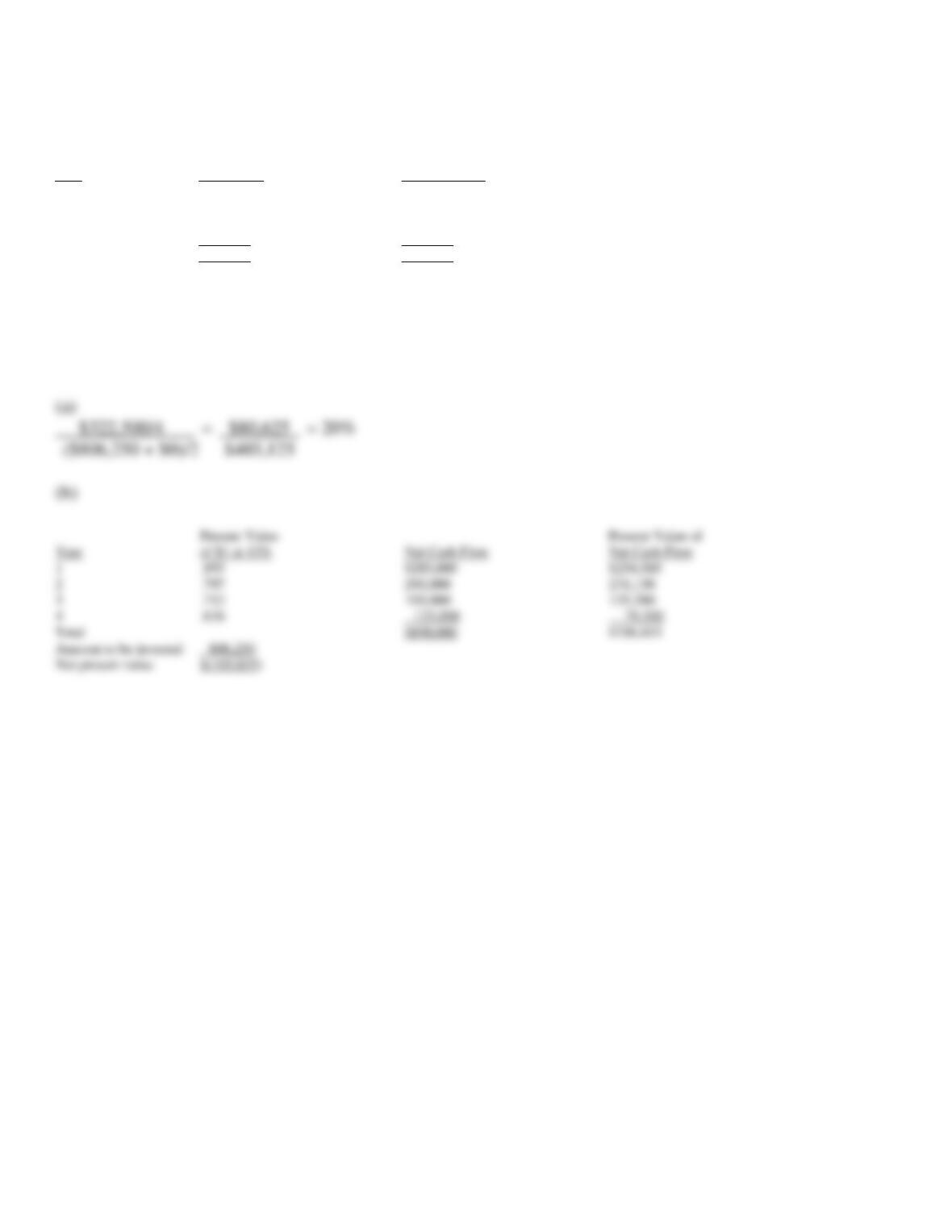
Determine (a) the average rate of return on investment, using straight line depreciation, and (b) the net present value.
Year
of $1 at 15%
Cash Flow
Net Cash Flow
1
.870
$ 210,000
$ 182,700
2
.756
200,000
151,200
3
.658
160,000
105,280
4
.572
150,000
85,800
Total
$ 720,000
$ 524,980
Amount to be invested
480,000
Net present value
$ 44,980
173. BAM Co. is evaluating a project requiring a capital expenditure of $806,250. The project has an estimated
life of four years and no salvage value. The estimated net income and net cash flow from the project are as
follows:
Year
Net Income
Net Cash Flow
1
$ 75,000
$285,000
2
102,000
290,000
3
109,500
190,000
4
36,000
125,000
$322,500
$890,000
The company’s minimum desired rate of return is 12%. The present value of $1 at compound interest of 12% for 1, 2, 3, and 4 years is .893, .797,
.712, and .636, respectively.
Determine: (a) the average rate of return on investment, including the effect of depreciation on the investment, and (b) the net present value.
1
.893
$285,000
$254,505
2
.797
290,000
231,130
3
.712
190,000
135,280
4
.636
125,000
79,500
Total
$890,000
$700,415
Net present value
$(105,835)
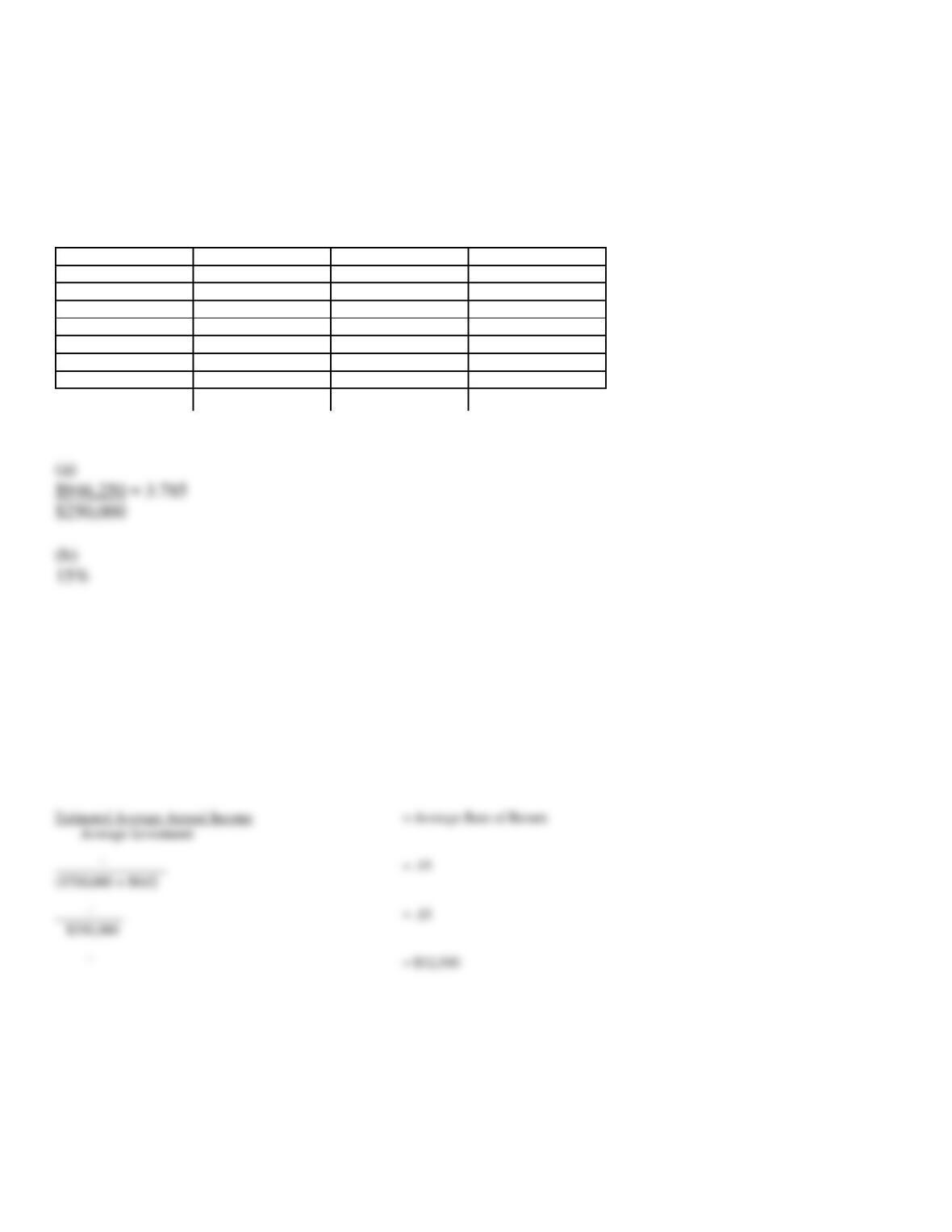
174. The internal rate of return method is used to analyze a $946,250 capital investment proposal with annual
net cash flows of $250,000 for each of the six years of its useful life.
(a)
Determine a present value factor for an annuity of $1 which can be used in determining the internal rate of return.
(b)
Based on the factor determined in (a) and the portion of the present value of an annuity of $1 table presented below, determine the
internal rate of return for the proposal.
Year
10%
15%
20%
1
0.909
0.870
0.833
2
1.736
1.626
1.528
3
2.487
2.283
2.106
4
3.170
2.855
2.589
5
3.791
3.353
2.991
6
4.355
3.785
3.326
7
4.868
4.160
3.605
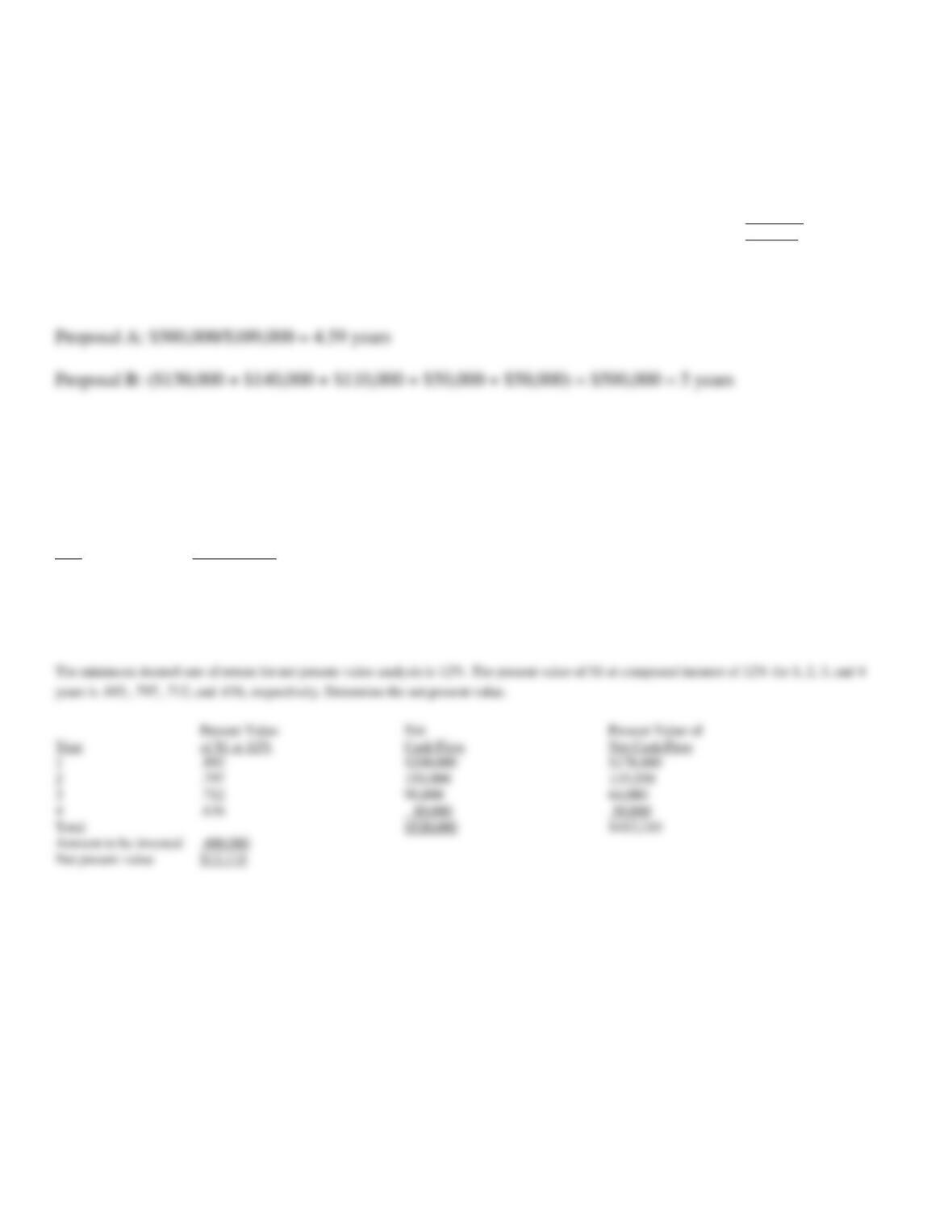
175. Tipper Co. is considering a 10-year project that is estimated to cost $700,000 and has no residual value.
Tipper seeks to earn an average rate of return of 15% on all capital projects. Determine the necessary average
annual income (using straight-line depreciation) that must be achieved on this project for this project to be
acceptable to Tipper Co.
Estimated Average Annual Income
= Average Rate of Return
Average Investment
´
= .15
($700,000 + $0)/2
´
= .15
$350,000
= $52,500
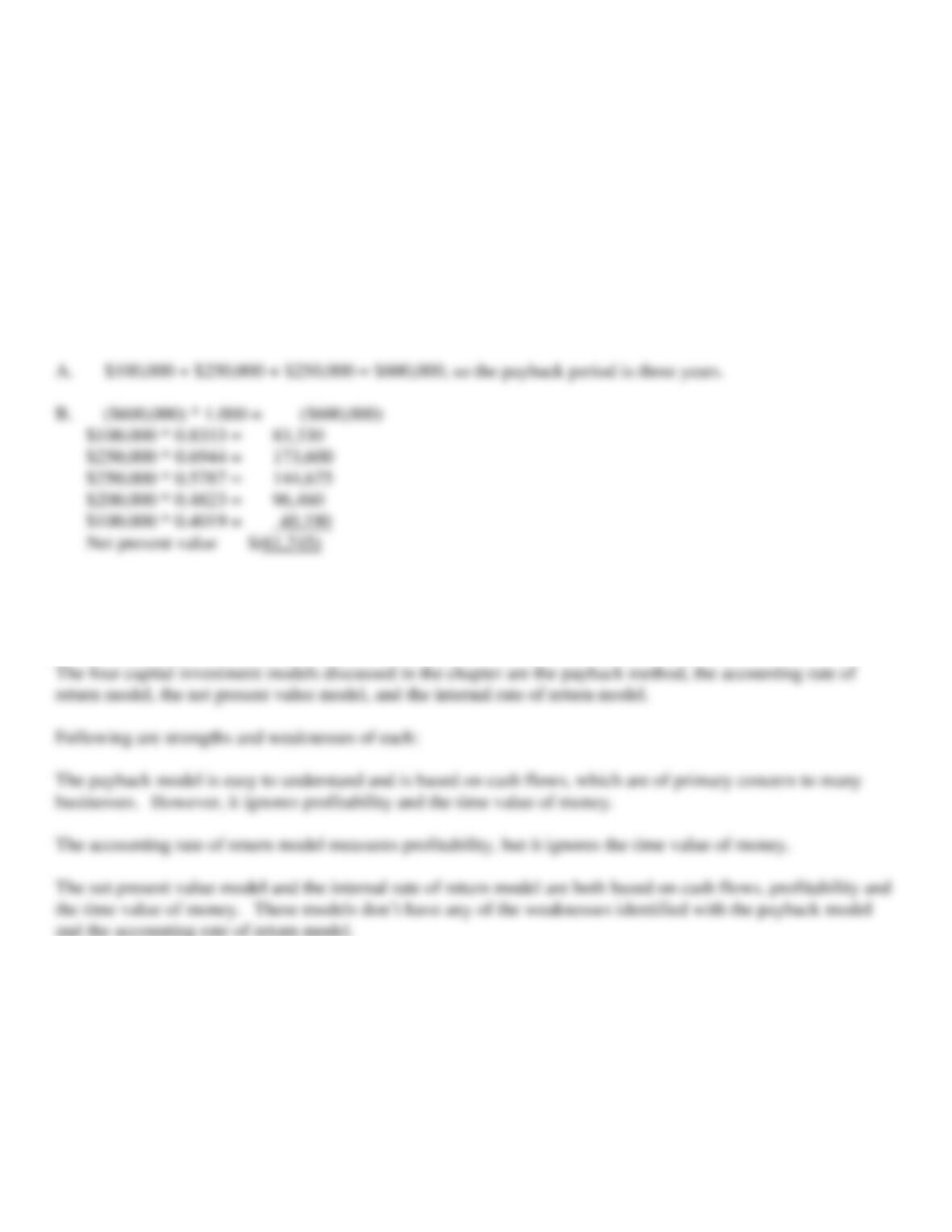
176. Proposals A and B each cost $500,000 and have 5-year lives. Proposal A is expected to provide equal
annual net cash flows of $109,000, while the net cash flows for Proposal B are as follows:
Year 1
$150,000
Year 2
140,000
Year 3
110,000
Year 4
50,000
Year 5
50,000
$500,000
Determine the cash payback period for each proposal. Round answers to two decimal places.
177. A $400,000 capital investment proposal has an estimated life of four years and no residual value. The
estimated net cash flows are as follows:
Year
Net Cash Flow
1
$200,000
2
150,000
3
90,000
4
80,000
1
.893
$200,000
$178,600
2
.797
150,000
119,550
3
.712
90,000
64,080
4
.636
80,000
50,880
Total
$520,000
$413,110
Amount to be invested
400,000
Net present value
$13,110
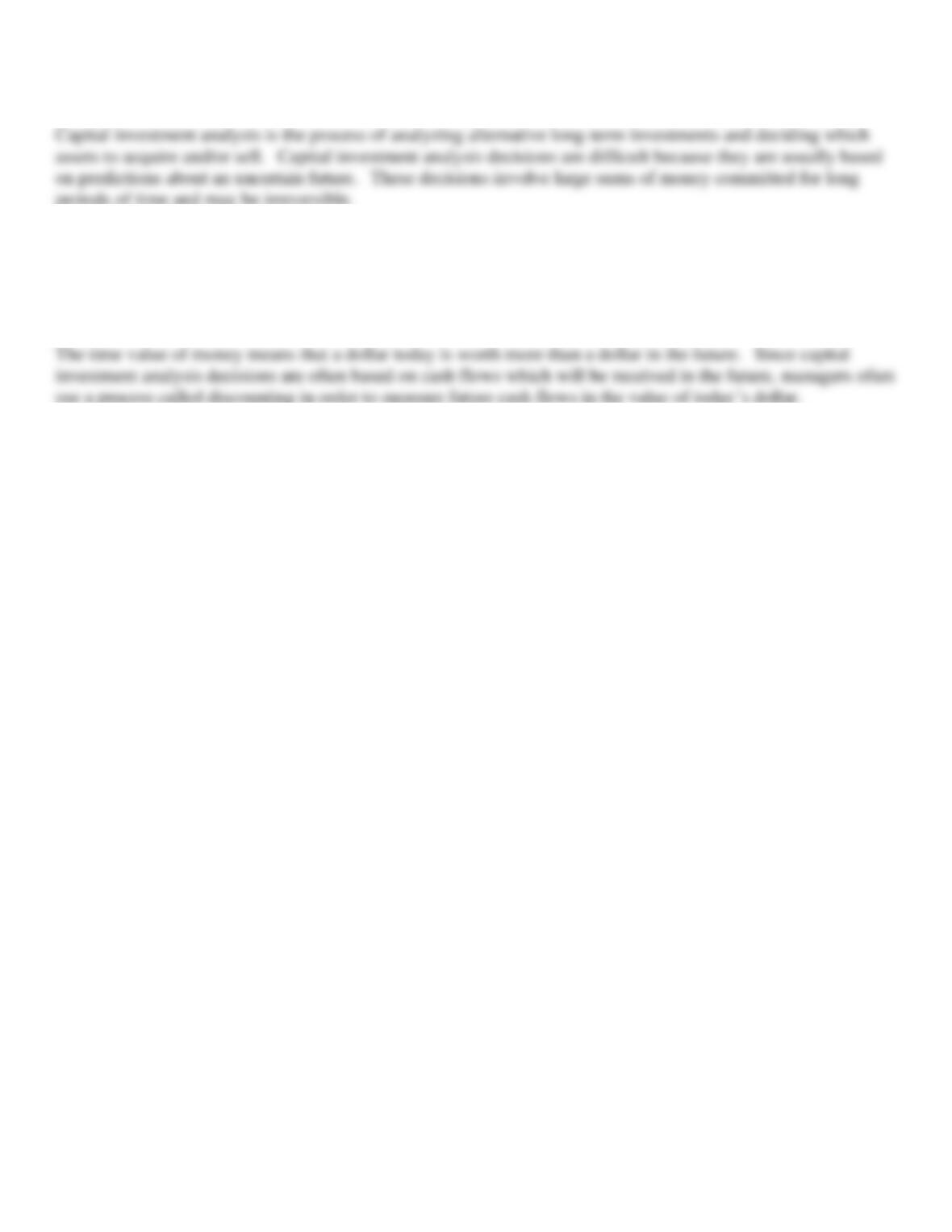
178. Mundall Company is considering a project that will require an initial investment of $600,000 and is
expected to generate the following cash flows:
Year 1 $100,000
Year 2 $250,000
Year 3 $250,000
Year 4 $200,000
Year 5 $100,000
A. What is the project’s payback period?
B. If the required rate of return is 20% and taxes are ignored, what is the project’s net present value? The
present value of $1 at compound interest of 20% for 1, 2, 3, 4 and 5 years is .8333, .6944, .5787, .4823 and
.4019, respectively.
179. Identify four capital investment analysis models discussed in the chapter and discuss the strengths and
weaknesses of each model.
180. What is capital investment analysis? Why are capital investment analysis decisions often difficult and
risky?
181. Briefly describe the time value of money. Why is the time value of money important in capital investment
analysis?