84)
Industry X has four firms. The largest firm in Industry X has more than 90 percent of the market
share. Industry Y also has four firms, but each of those four firms in Industry Y has 25 percent of
the market share. The Herfindahl–Hirschman index will be
84)
A)
the same for both industries, but the four–firm concentration will be larger for Industry X
than Industry Y.
B)
larger for Industry X than Industry Y, but the four–firm concentration will be the same.
C)
larger for Industry Y than Industry X, but the four–firm concentration will be the same.
D)
the same for both industries, but the four–firm concentration will be larger for Industry Y
than Industry X.
85)
In a “game,” strategies are
85)
A)
the plans made by the participants.
B)
the reactions of firms to the changes in the economy.
C)
the potential returns the participants may get.
D)
the laws regulating the industry.
86)
A concentration ratio is used to
86)
A)
determine whether a market structure is oligopoly.
B)
determine the importance of labor in the production process.
C)
see if a firm qualifies for federal assistance.
D)
determine the degree of homogeneity in the market.
87)
The joining of firms that are producing or selling a similar product is known as
87)
A)
economies to scale.
B)
a horizontal merger.
C)
a vertical merger.
D)
a conglomerate merger.
88)
A game in which all the players are worse off at the end of the game is a
88)
A)
positive–sum game.
B)
negative–sum game.
C)
noncooperative game.
D)
dominant strategy game.
89)
In a two–sided market, an intermediary firm that links groups of producers and consumers is
called
89)
A)
a platform.
B)
an operator.
C)
an oligopoly.
D)
an end user.
90)
In a 50–firm industry, two of the smallest firms merge. Yet the 4–firm concentration ratio and the
8–firm concentration ratio did not change. All things considered, we can say that the industry has
90)
A)
moved farther away from competition because the number of firms decreased.
B)
experienced no change in competition even though the number of firms decreased.
C)
to be identified first; otherwise there is no way to tell.
D)
moved closer to pure competition because the number of firms decreased.
91)
The dominant strategy in the prisoners‘ dilemma is for
91)
A)
the dominant player not to confess.
B)
neither player to confess.
C)
both players to confess.
D)
only the dominant player to confess.
92)
If an industry has 25 firms that collectively have $150 million in total sales and the top four firms in
this industry account for $90 million in sales, what is the concentration ratio of the top four firms in
this industry?
92)
A)
60 percent
B)
42 percent
C)
80 percent
D)
70 percent
93)
Cooperation that continues as long as the players continue to cooperate is
93)
A)
a zero–sum game.
B)
tit–for–tat strategic behavior.
C)
a negative–sum game.
D)
opportunistic behavior.
94)
Which of the following is likely among the most concentrated industries in the United States?
94)
A)
primary aluminum
B)
breakfast cereals
C)
printing and publishing
D)
computers
95)
When a cartel breaks down and its members start cheating, the behavior in the industry becomes a
95)
A)
zero–sum game.
B)
noncooperative game.
C)
high stakes game.
D)
positive sum game.
96)
In game theory, actions such as cheating that focus solely on short–run gains are referred to as
96)
A)
territorial behavior.
B)
predatory behavior.
C)
tit–for–tat strategic behavior.
D)
opportunistic behavior.
97)
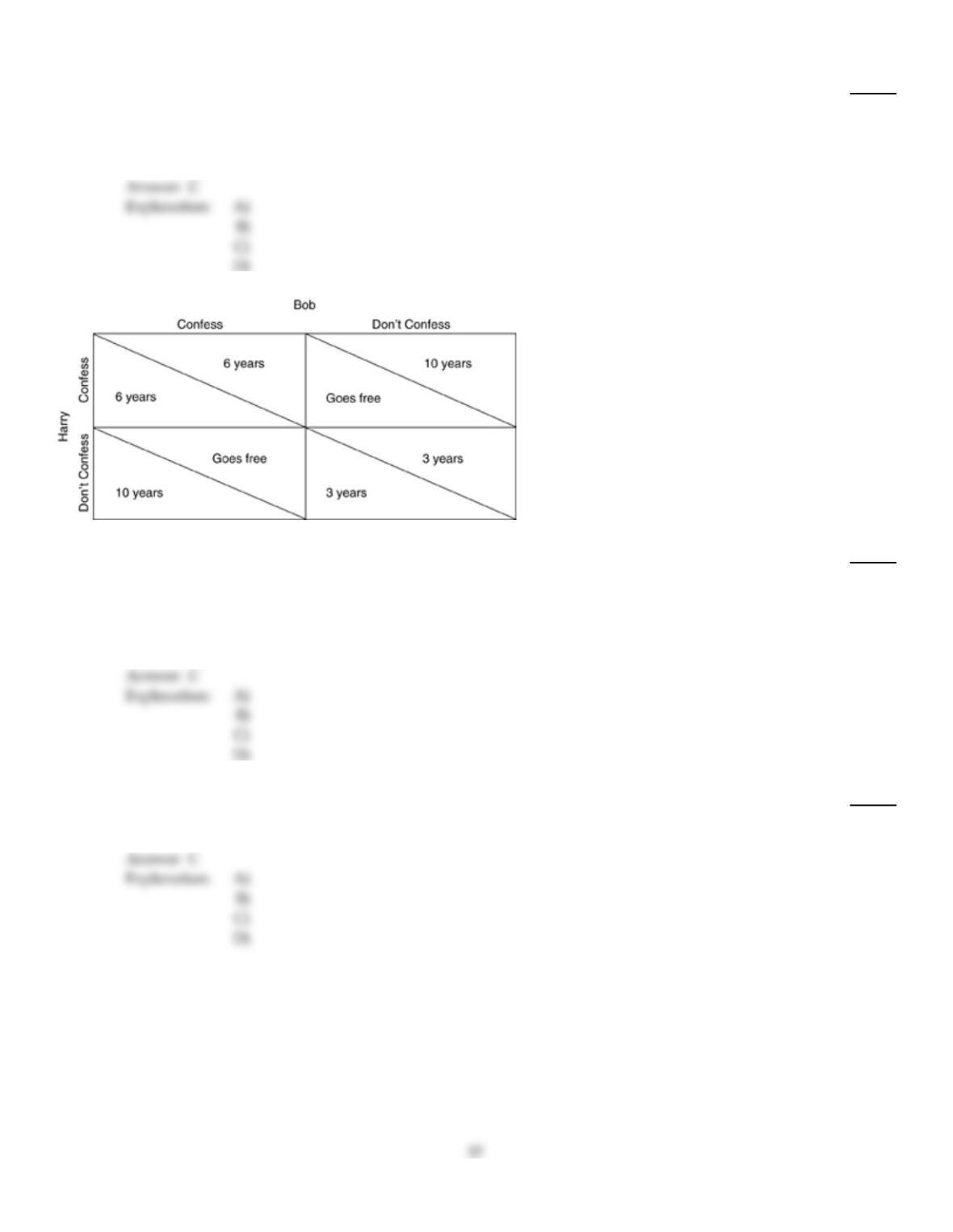
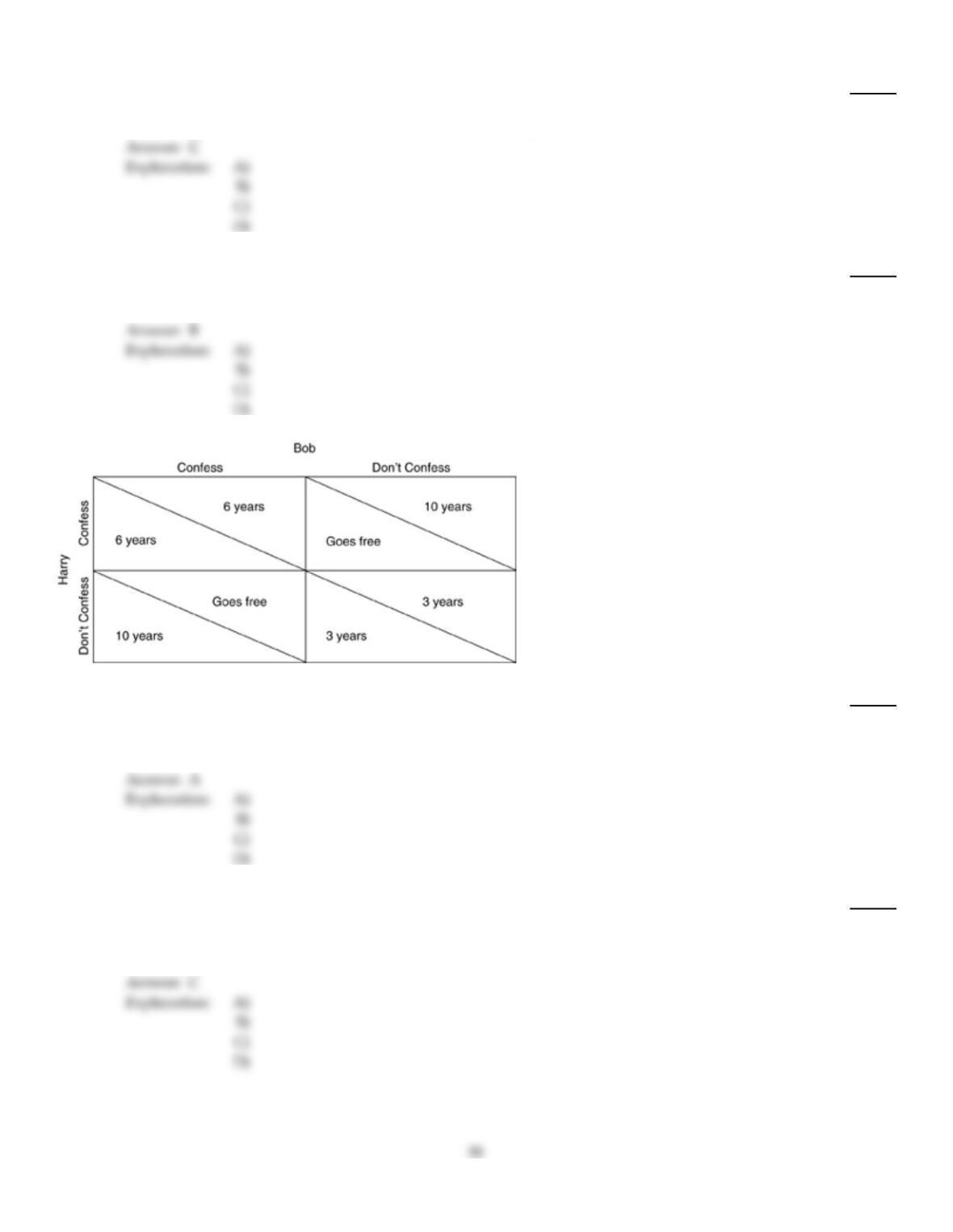
An association of producers in an industry that agree to set common prices and output quotas to
prevent competition is
97)
A)
a patent.
B)
a cartel.
C)
a tariff.
D)
economies of scale.
98)
A dominant strategy is a
98)
A)
last–move strategy.
B)
player’s best strategy when he can make the first move.
C)
player’s best strategy regardless whatever strategies are adopted by his rivals.
D)
losing strategy.
99)
In a cartel, participating members can cheat by
99)
A)
letting more entrants join the cartel.
B)
producing a lower production level than the cartel quota.
C)
charging a slightly lower price and raising production.
D)
leaving the industry.
100)
Which of the following is LEAST likely to be an outcome of a cartel as compared to the situation
before the cartel was formed?
100)
A)
Cartel members reduce production.
B)
Cartel members do not compete with each other in pricing decisions.
C)
Cartel members make fewer profits.
D)
Cartel members charge higher prices.
101)
A game in which the players neither negotiate nor coordinate in any way is a
101)
A)
negative–sum game.
B)
cooperative game.
C)
zero–sum game.
D)
noncooperative game.
102)
A cartel is a form of
102)
A)
negative sum game.
B)
vertical merger.
C)
noncooperative competition.
D)
collusion.
103)
When a falloff in usage of a product by some consumers causes others to stop purchasing the item
there is
103)
A)
price leadership.
B)
negative–sum game.
C)
positive market feedback.
D)
negative market feedback.
104)
In an industry with network effects and differentiated products, it is possible for the industry to
become an oligopoly if
104)
A)
they use a price–leadership model.
B)
a few firms reap most of the sales gains resulting from positive market feedback.
C)
they use a kinked demand curve model.
D)
they engage in a zero–sum game.
105)
Game theory is used to explain the pricing behavior of
105)
A)
oligopolies.
B)
perfect competition.
C)
monopolies.
D)
monopolistic competition.
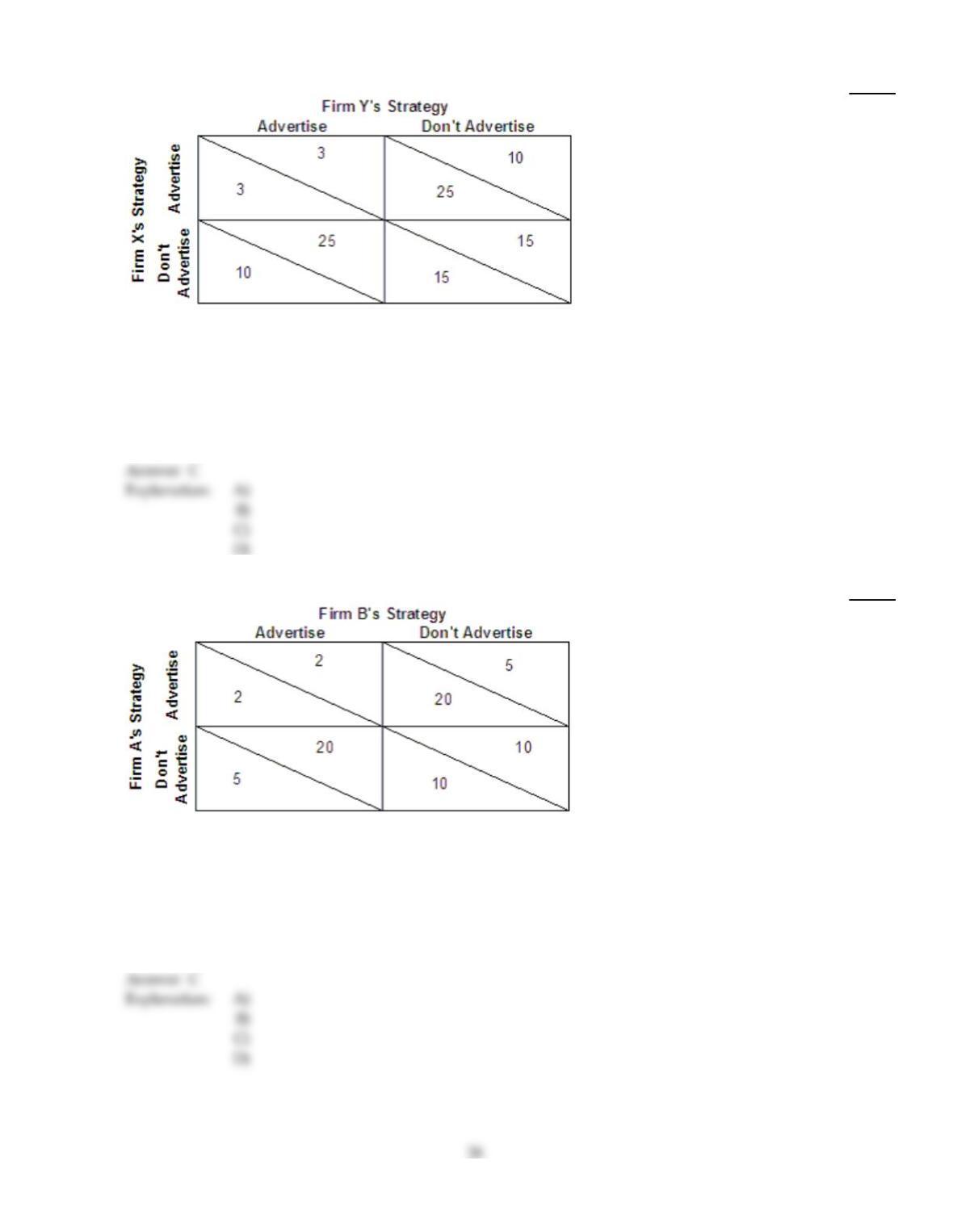
106)
Refer to the above payoff matrix for the profits (in $ millions) of two firms (X and Y) making a
decision to advertise or not. Which of the following is the outcome of the dominant strategy
without cooperation?
106)
A)
Both firm X and firm Y choose not to advertise.
B)
Firm X chooses not to advertise while firm Y chooses to advertise.
C)
Both firm X and firm Y choose to advertise.
D)
Firm X chooses to advertise while firm Y chooses not to advertise.
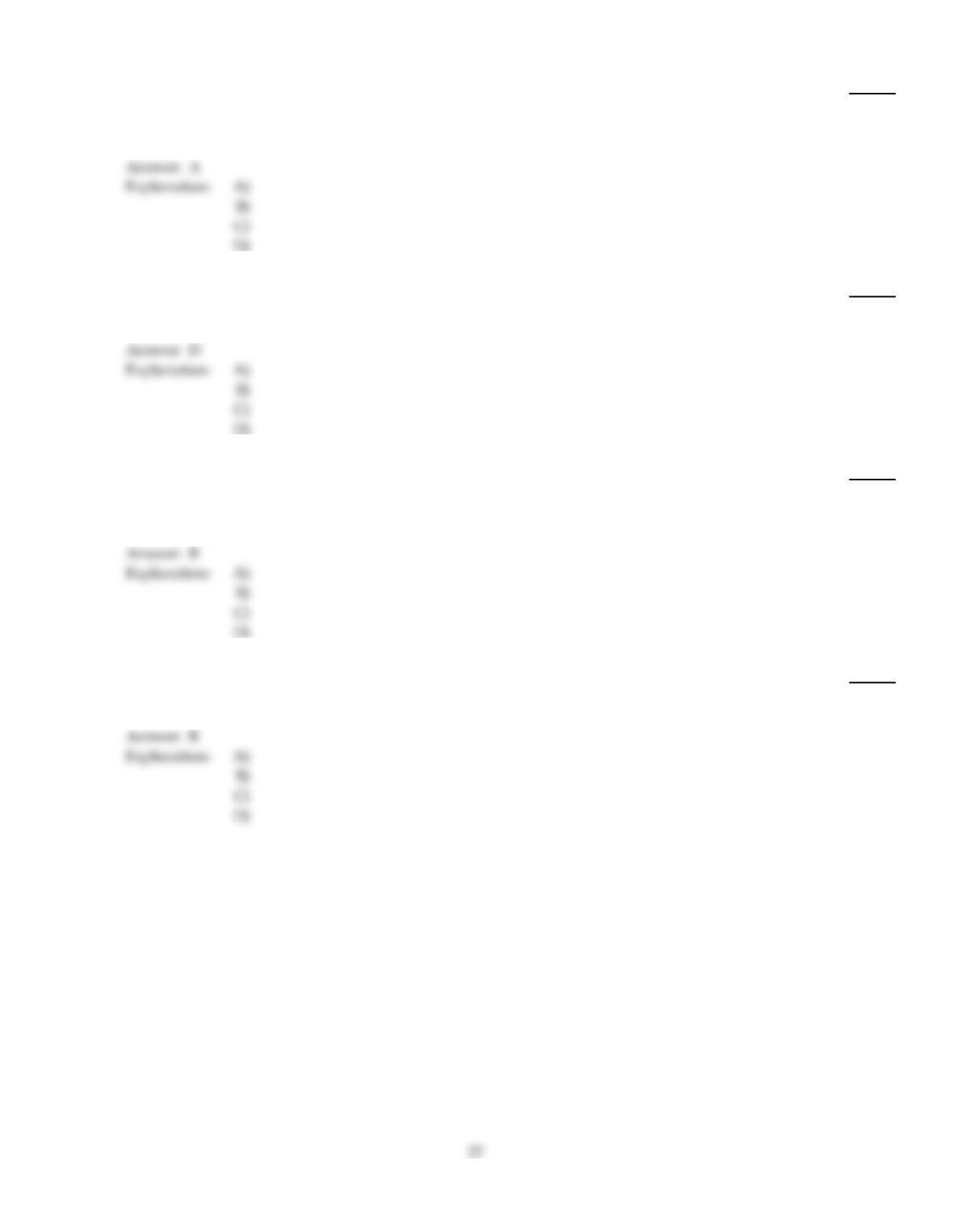
107)
Refer to the above payoff matrix for the profits (in $ millions) of two firms (A and B) making a
decision to advertise or not. Which of the following is the outcome of the dominant strategy
without cooperation?
107)
A)
Both firm A and firm B choose not to advertise.
B)
Firm A chooses not to advertise while firm B chooses to advertise.
C)
Both firm A and firm B choose to advertise.
D)
Firm A chooses to advertise while firm B chooses not to advertise.
108)
Between World War II and the 1970s, three firmsGeneral Motors, Chrysler, and Fordproduced
and sold nearly all the output of the U.S. auto industry. These three firms had
108)
A)
an oligopoly.
B)
a pure monopoly.
C)
colluded.
D)
monopolistic competition.
109)
All of the following are true regarding oligopoly EXCEPT
109)
A)
there is some ability to set price.
B)
entry and exit is partially restricted.
C)
there are few sellers.
D)
there is no competition.
110)
A game in which any gains within the group are exactly offset by equal losses by the end of the
game is a
110)
A)
positive–sum game.
B)
zero–sum game.
C)
strategy.
D)
negative–sum game.
111)
A game in which players collectively gain is known as a
111)
A)
zero–sum game.
B)
positive–sum game.
C)
negative–sum game.
D)
cooperative game.
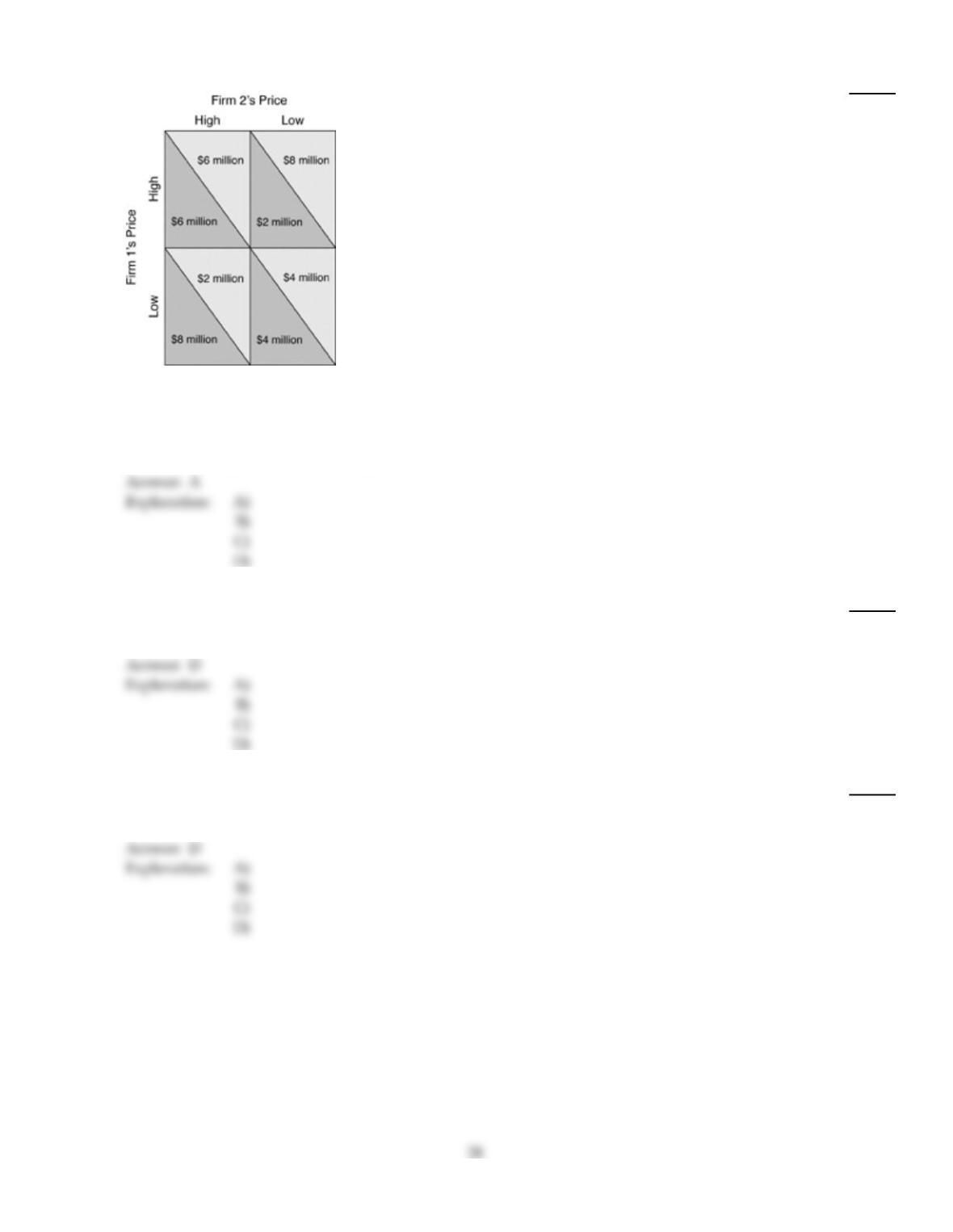
112)
The payoff matrix shows all of the following EXCEPT
112)
A)
if one oligopolist chooses a high price and the other doesn’t, the high–priced firm makes $8
million.
B)
if one chooses a low price and the other doesn‘t, the low priced firm will make $8 million.
C)
if they both choose a low price, each makes $4 million.
D)
if both oligopolists choose a high price, each makes $6 million.
113)
Suppose there are four firms in an industry. The market shares of the four firms are 5 percent, 20
percent, 35 percent, and 40 percent. The Herfindahl–Hirschman index for that industry is
113)
A)
100.
B)
1,250.
C)
6,650.
D)
3,250.
D
114)
Which of the following is a condition that helps enforce a cartel agreement?
114)
A)
relatively differentiated products
B)
large variation in prices
C)
a large number of firms
D)
easily observable prices
D
A
115)
Which of the following statements about concentration ratios is correct?
115)
A)
A high concentration ratio suggests that the industry is characterized by strategic
dependence.
B)
A high concentration ratio indicates that the industry is a monopoly.
C)
A high concentration ratio indicates that the industry is monopolistically competitive.
D)
A high concentration ratio suggests that the industry is characterized by strategic
independence.
116)
Which of the following is most likely to be sold in an oligopoly market?
116)
A)
electricity
B)
pizza
C)
cell phone service
D)
cotton
117)
Using the concentration ratio to measure the degree of competition
117)
A)
may understate the degree of competition because it ignores imported goods.
B)
may understate the degree of competition because market share changes annually.
C)
may overstate the degree of competition because it ignores imported goods.
D)
may overstate the degree of competition because inter–industry competition is ignored.
118)
A situation where a consumer’s willingness to use an item depends on how many others use it is
118)
A)
a vertical merger.
B)
a network effect.
C)
a positive–sum game.
D)
price–leadership.
119)
A game in which players collectively lose is known as a
119)
A)
zero–sum game.
B)
positive–sum game.
C)
negative–sum game.
D)
cooperative game.
120)
A merger between firms in which one firm purchases an input from the other is called a
120)
A)
horizontal merger.
B)
vertical merger.
C)
conglomerate merger.
D)
none of the above.
121)
In a two–sided market, a firm that provides services that link together groups of consumers and
producers is called a(n)
121)
A)
end user.
B)
platform.
C)
tit–tat.
D)
monopoly.
B
122)
A situation in which one firm‘s actions with respect to price, quality, advertising and related
changes may be strategically countered by the reactions of one or more other firms in the industry
is known as
122)
A)
barriers to entry.
B)
the concentration ratio.
C)
strategic dependence.
D)
economies of scale.
C
123)
Which of the following is NOT a condition that helps enforce a cartel agreement?
123)
A)
large variation in input prices
B)
easily observable prices
C)
a small number of firms
D)
nearly homogeneous products
A
124)
Economies of scale means that
124)
A)
the long–run average total cost curve slopes downward over it entire range.
B)
the average fixed cost curve slopes downward over its entire range.
C)
the four–firm concentration ratio is below 80.
D)
the long–run total cost curve slopes downward over it entire range.
A
B
125)
Decision makers in oligopolistic firms must devise a strategy. One that yields the highest benefit,
regardless of what the other players do is a
125)
A)
coherent strategy.
B)
pricing strategy.
C)
dominant strategy.
D)
revenue strategy.
126)
Other things being equal, which market structure would produce the least output and the highest
average product price?
126)
A)
monopolistic competition
B)
perfect competition
C)
monopoly
D)
oligopoly
127)
The market structure of oligopoly is when
127)
A)
there are many producers of a homogeneous product.
B)
there are a small number of interdependent firms that constitute the entire market.
C)
there are many producers of a differentiated product.
D)
there is a single producer of a product.
128)
When there is a tendency for a particular product to fall out favor with additional consumers
because other consumers have chosen not to purchase the product
128)
A)
the network effect will increase.
B)
positive market feedback occurs.
C)
the tit–for–tat strategy will begin.
D)
negative market feedback occurs.
129)
The main objective of the members of a cartel is to
129)
A)
obtain a patent.
B)
make the industry more competitive.
C)
produce efficiently.
D)
earn economic profits.
130)
A tit–for–tat strategy is one in which oligopolies
130)
A)
cooperate as long as other members cooperate, but if anyone cheats, they cut the price until
the cheater reverts to cooperation.
B)
keep cutting prices to punish rivals until the competitive price is reached.
C)
cooperate almost all of the time, but occasionally do not cooperate in order to fool the
antitrust authorities.
D)
try to avoid the problems of the prisoners’ dilemma, but actually make themselves worse off.
131)
The joining of a firm with another to which it sells an output or from which it buys an input is
known as
131)
A)
a vertical merger.
B)
economies to scale.
C)
a conglomerate merger.
D)
a horizontal merger.
132)
An example of a positive market feedback is
132)
A)
the declining use of land–line telephones for long distance calls.
B)
routine maintenance on a car.
C)
the emergence of the iPod.
D)
the use of telegraph services in the twenty–first century.
133)
When a new product is introduced in the market, Lenny always wants to see how popular the item
becomes before he purchases it. Lenny’s behavior is known as
133)
A)
a network effect.
B)
price leadership.
C)
overt collusion.
D)
limit–pricing.
134)
Which of the following is a characteristic of oligopoly?
134)
A)
strategic dependence
B)
easy entry and exit
C)
many firms
D)
none of the above
135)
The way in which an oligopolist acts in response to a price change by a competitor is known as a
135)
A)
reaction function.
B)
zero–sum game.
C)
positive–sum game.
D)
cooperative game.
136)
One of the strongest reasons that oligopolies exist is due to
136)
A)
lowest cost production.
B)
economies of scale.
C)
marginal cost pricing.
D)
the homogeneity of their products.
137)
Monopolies and oligopolies both erect barriers to entry through the use of
137)
A)
price cutting.
B)
advertising.
C)
patents.
D)
franchising.
138)
The success of a cartel rests upon
138)
A)
discouraging some firms in the market from joining.
B)
making exit from the cartel as nearly costless as possible.
C)
inducing all members to differentiate their products and charge different prices.
D)
inducing all members to limit their combined output and charge the same price.
139)
A market with few sellers, some influence over price, high barriers to entry, a differentiated
product, and non–price competition is known as
139)
A)
perfect competition.
B)
monopolistic competition.
C)
oligopoly.
D)
monopoly.
140)
A group of firms that try to work together to earn monopoly profits is called a(n)
140)
A)
natural monopoly.
B)
patent.
C)
public enterprise.
D)
cartel.
D
141)
In game theory, the strategy that always yields the highest benefit for the player using it is the
141)
A)
cooperative strategy.
B)
dominant strategy.
C)
matrix strategy.
D)
prisoners’ strategy.
B
142)
Actions that ignore the possible long–run benefits of cooperation and focus solely on short–run
gains are
142)
A)
a negative–sum game.
B)
tit–for–tat strategic behavior.
C)
opportunistic behavior.
D)
a zero–sum game.
C
143)
The percentage of all sales contributed by the leading four or leading eight firms in an industry is
known as
143)
A)
economies to scale.
B)
a horizontal merger.
C)
the concentration ratio.
D)
a vertical merger.
C
C
144)
Suppose an industry is composed of 10 firms. Each firm‘s share of total sales in the industry is 10
percent. If two of the firms merge, then the four–firm concentration ratio in the industry will
144)
A)
depend on the market condition faced by the industry.
B)
remain unchanged.
C)
decrease as there are fewer firms in the industry.
D)
increase.
145)
A cartel behaves like
145)
A)
a perfectly competitive firm.
B)
a monopolistic competitive firm.
C)
a monopolist.
D)
an oligopolistic firm.
146)
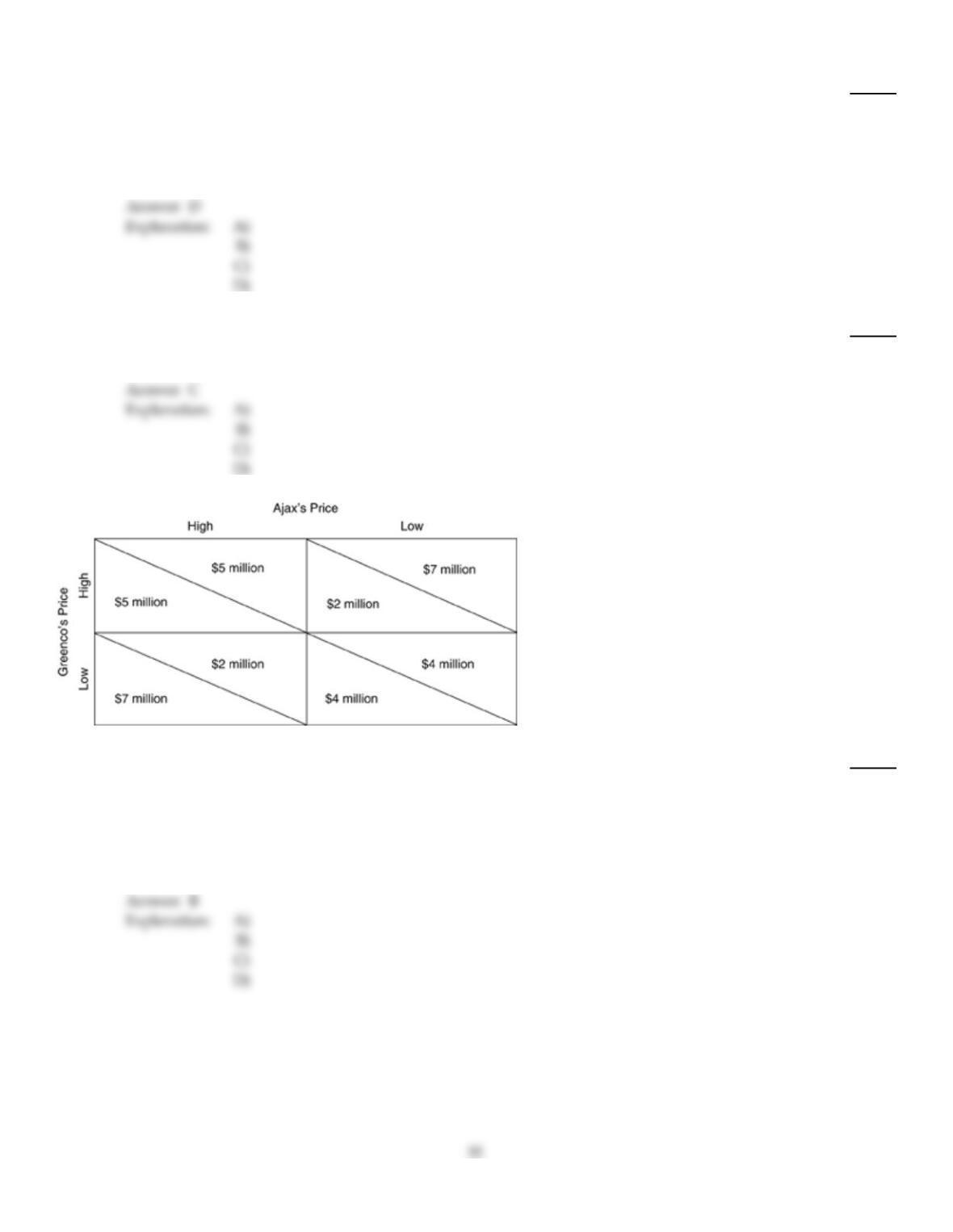
Refer to the above figure. Ajax and Greenco are oligopolists. Above you are given the payoff matrix
for the two firms giving the payoff associated with different pricing strategies. What is the best
strategy for Greenco if Ajax decides on charging a low price?
146)
A)
high price
B)
low price
C)
There is no best strategy.
D)
Not enough information is given to determine the best strategy.
147)
Vertical merger occurs when
147)
A)
two firms producing a similar product merge.
B)
the merger moves the combined firm onto the horizontal portion of its long–run average cost
curve.
C)
two firms merge where each is about the same size.
D)
two firms merge where one had sold its output to the other as an input.
148)
An example of a cooperative game would be
148)
A)
oligopoly.
B)
a cartel.
C)
perfect competition.
D)
monopolistic competition.
149)
Suppose an industry has total sales of $25 million per year. The two largest firms have sales of $6
million each, the third largest firm has sales of $2 million, and the fourth largest firm has sales of $1
million. The four–firm concentration ratio for this industry is
149)
A)
50 percent.
B)
36 percent.
C)
60 percent.
D)
25 percent.
150)
Which of the following has the highest Herfindahl–Hirschman index?
150)
A)
monopolistic competition
B)
monopoly
C)
oligopoly
D)
any of the above, depending on the size of firm sales
151)
For years, your parents claimed they had no desire to join a social web site. Recently, however, they
joined one and said they did so because all their relatives have joined the same site with them. Your
parents’ behavior is an example of
151)
A)
a switching cost.
B)
the impact of positive market feedback.
C)
a network effect.
D)
the impact of negative market feedback.
152)
Refer to the above figure. The figure gives the payoff matrix for two individuals who are being
accused of robbing a bank together. Which of the following is the outcome with cooperation?
152)
A)
Both confess.
B)
Harry confesses while Bo does not confess.
C)
Both don’t confess.
D)
Bob confesses while Harry does not confess.
153)
Suppose Nabisco merges with both a wheat firm and milling firm. This is an example of a
153)
A)
parallel merger.
B)
horizontal merger.
C)
vertical merger.
D)
diagonal merger.
154)
Which of the following does NOT help explain why oligopolies exist?
154)
A)
product homogeneity
B)
mergers
C)
economies of scale
D)
barriers to entry
155)
Which of the following is NOT true of an oligopoly?
155)
A)
The firms recognize their interdependence.
B)
Firms are price takers.
C)
They advertise their product.
D)
A few firm account for a large portion of the total output.
Firm Annual Sales Firm Annual Sales
A$1000 G $800
B900 H1200
C120 I 1050
D 75 J 90
E50 K75
F40 L600
156)
According to the above table, if the fourth and fifth largest firms in the industry merge, the
four–firm concentration ratio in the industry will be
156)
A)
82.5 percent.
B)
35.8 percent.
C)
84.1 percent.
D)
69.0 percent.
157)
Which of the following is NOT a necessary condition for oligopoly?
157)
A)
barriers to entry
B)
differentiated products
C)
either a small number of firms or market dominance by a small number of firms
D)
strategic dependence of firms
158)
Jane purchases snickle–dees only because her friends do. This is
158)
A)
price–leadership.
B)
negative–sum game.
C)
positive market feedback.
D)
negative market feedback.
159)
Interdependence is the key characteristic of
159)
A)
monopoly.
B)
oligopoly.
C)
monopolistic competition.
D)
perfect competition.
B
160)
Refer to the above figure. The figure gives the payoff matrix for two individuals who are being
accused of robbing a bank together. What is dominant strategy for Bob?
160)
A)
Confess.
B)
Don’t confess.
C)
Flip a coin to decide what to do.
D)
There is no dominant strategy.
A
161)
Industry X comprises only very few large firms engaged in stiff competition with each other.
Industry X can best be described as
161)
A)
pure competition.
B)
monopolistic competition.
C)
oligopoly.
D)
pure monopoly.
C
C
162)
When oligopolistic companies engage in collusion, the companies are involved in a
162)
A)
cooperative game.
B)
negative–sum game.
C)
competitive game.
D)
noncooperative game.
163)
A noncooperative game situation may occur when
163)
A)
firms agree to price fixing.
B)
firms merge.
C)
firms find collusion too costly.
D)
firms collude.
164)
Firms face downward sloping demand curves in
164)
A)
monopolies and oligopolies only.
B)
monopolies only.
C)
monopolies and oligopolies that collude only.
D)
all market structures except perfect competition.
165)
In an oligopolistic market, each firm
165)
A)
has a constant marginal cost.
B)
produces at minimum average cost in the long run.
C)
faces a perfectly elastic demand function.
D)
must consider the reaction of rival firms when making a pricing or output decision.
166)
According to game theorists, a cartel of several firms is an example of a(n)
166)
A)
uncooperative game.
B)
noncooperative game.
C)
zero–sum game.
D)
cooperative game.