Exam
Name___________________________________
MULTIPLE CHOICE. Choose the one alternative that best completes the statement or answers the question.
1)
Within a game theory model, if a change in decision–making raises corporation A’s profits by $50
and lowers corporation B’s profits by $40, the game is a
1)
A)
positive–sum game.
B)
zero–sum game.
C)
cooperative game.
D)
negative–sum game.
2)
Positive market feedback refers to a tendency for
2)
A)
a particular product to come into favor with additional consumers because other consumers
have chosen to purchase the product.
B)
potential entrants to an oligopolistic industry to respond to entry deterrence strategies by
contemplating producing more output than the quantities produced by firms already in the
industry.
C)
price leaders to respond to an increase in market demand by increasing the prices of their
products.
D)
potential entrants to an oligopolistic industry to respond to entry deterrence strategies by
contemplating setting their prices above prices established by firms already in the industry.
3)
Which of the following is an example of a vertical merger?
3)
A)
Northeastern Illinois University merging with Roosevelt University.
B)
Northeastern Illinois University going from a public to a private university.
C)
Northeastern Illinois University merging with McDonald’s.
D)
Northeastern Illinois University merging with a training academy for new professors.
4)
The prisoner’s dilemma shows that
4)
A)
monopolies are beneficial to society.
B)
players would be better off if they cooperated.
C)
people will always cheat.
D)
players are better off if they act independently.
5)
An association of producers in an industry that agree to set common prices and output quotas to
prevent competition is
5)
A)
an oligopolist.
B)
a cartel.
C)
a monopolistic competitor.
D)
a constrained monopoly.
6)
The network effect in the TV broadcasting industry results in
6)
A)
a negative market feedback between the number of advertisers and the number of TV
channels.
B)
a positive market feedback between the number of advertisers and the number of TV
channels.
C)
a negative market feedback between the number of advertisers and the size of TV audience.
D)
a positive market feedback between the number of advertisers and the size of TV audience.
7)
When U.S. Steel, a steel producer, bought control of iron ore companies at the beginning of the 20th
century, the company was initiating
7)
A)
a horizontal merger.
B)
a vertical merger.
C)
an expropriation.
D)
a cartel.
8)
There are fewer than half as many publishers of college textbooks in the United States now as a
generation ago. Three companies alone account for almost two–thirds of the sale of new textbooks.
This market situation characterized by very few sellers is known as
8)
A)
an oligopoly.
B)
pure monopoly.
C)
perfect competition.
D)
monopolistic competition.
9)
The market structure of perfect competition exists when
9)
A)
there are many producers of differentiated products.
B)
there is a single producer of a product.
C)
there are many producers of a homogeneous product.
D)
there are a small number of interdependent firms that constitute the entire market.
C
10)
For years, your neighbor insisted she had no desire to own a computer. Recently, however, she
purchased one and says she did so because all her relatives have computers and she wants to
exchange e–mail with them. Your neighbor’s behavior is an example of
10)
A)
a network effect.
B)
a switching cost.
C)
limited–pricing behavior.
D)
the impact of negative market feedback.
A
11)
Which of the following is likely among the most concentrated industries in the United States?
11)
A)
printing and publishing
B)
tobacco products
C)
household vacuum cleaners
D)
soft drinks
B
12)
Retail trade is an example of
12)
A)
perfect competition.
B)
oligopoly.
C)
monopoly.
D)
monopolistic competition.
D
A
13)
A member in a cartel can earn more profits by
13)
A)
producing less than the agreed rate.
B)
selling less than the agreed amount.
C)
charging a slightly lower price and raising production.
D)
none of the above.
14)
A market situation in which there are a few large firms is called
14)
A)
oligopoly.
B)
imperfect competition.
C)
monopolistic competition.
D)
monopoly.
A
15)
Opportunistic behavior by oligopolies means
15)
A)
that firms refuse to cooperate in the short run.
B)
that firms refuse to honor their product guarantees.
C)
that firms cooperate in the short run for current gains.
D)
that firms cooperate in both the long run and in the short run to prevent others from entering
the industry.
C
16)
A radio station is best described as
16)
A)
an end user in a matchmaking market.
B)
a platform in a shared–input market.
C)
an end user in a transaction–based market.
D)
a platform in an audience–making market.
D
17)
A game in which the players explicitly coordinate their decisions to make themselves better off is a
17)
A)
cooperative game.
B)
zero–sum game.
C)
noncooperative game.
D)
negative–sum game.
A
C
18)
Monopolistically competitive markets and oligopolies are similar in that
18)
A)
nonprice competition is a tool used.
B)
the kinked demand curve can be used to analyze the firms’ pricing decisions.
C)
there is mutual interdependence amongst the firms.
D)
the number of firms is identical.
19)
A market structure characterized by a small number of interdependent sellers is called a(n)
19)
A)
monopsony.
B)
monopoly.
C)
oligopoly.
D)
monopolistic competition.
C
20)
Which of the following is NOT a cause for an oligopoly to exist?
20)
A)
barriers to entry
B)
horizontal mergers
C)
economies of scale
D)
structural dependence
D
21)
Which of the following would be the best example of an oligopolistic industry?
21)
A)
retail convenience stores
B)
confections
C)
large aircraft manufacturing
D)
agriculture
C
22)
A given industry, Z, is such that the 1–firm, 2–firm, 4–firm and 8–firm concentration ratios are the
same. Based on this, we can conclude that Industry Z is
22)
A)
monopolistic competition.
B)
pure monopoly.
C)
oligopoly.
D)
pure competition.
B
A
23)
The combining of First Union National Bank and The National Bank of Memphis is an example of
23)
A)
a conglomerate merger.
B)
a horizontal merger.
C)
a downstream formation.
D)
a vertical merger.
24)
In the cable TV service industry, end users are
24)
A)
advertisers only.
B)
no one.
C)
both advertisers and cable TV subscribers.
D)
cable TV subscribers only.
C
25)
Product differentiation always exists in
25)
A)
oligopoly.
B)
monopolistic competition.
C)
perfect competition.
D)
monopoly.
B
26)
A network effect arises whenever
26)
A)
firms in an oligopolistic industry engage in limit pricing.
B)
a producer’s willingness to produce a good or service is influenced by how many other firms
also produce or have produced the item.
C)
firms in an oligopolistic industry engage in a zero–sum game.
D)
a consumer’s willingness to purchase a good or service is influenced by how many others also
buy or have bought the item.
D
B
27)
The higher the concentration ratio is in an industry, the more likely it is that
27)
A)
the industry is perfectly competitive.
B)
the industry has an oligopoly.
C)
the market share of the smallest four firms is larger.
D)
the market share of the largest four firms is smaller.
28)
Games can be judged according to the payoffs
28)
A)
as zero–sum, negative–sum, and positive–sum games.
B)
as competitive or noncompetitive games.
C)
whether all companies participate or not.
D)
as collusive or noncollusive games.
A
29)
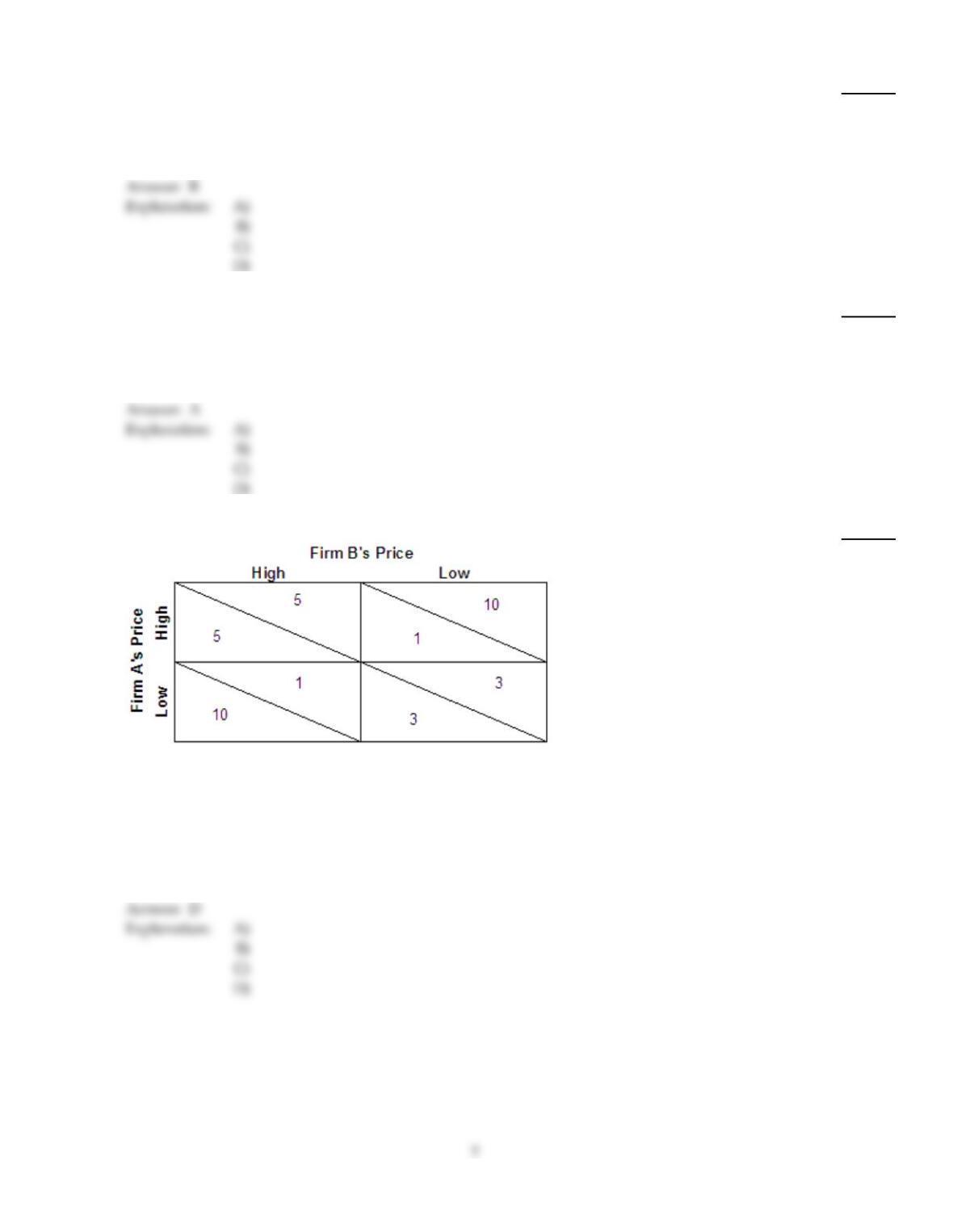
Refer to the above payoff matrix for the profits (in $ millions) of two firms (A and B) and two
pricing strategies (high and low). Which of the following is the outcome of the dominant strategy
without cooperation?
29)
A)
Firm A chooses the low price while firm B chooses the high price.
B)
Firm A chooses the high price while firm B chooses the low price.
C)
Both firm A and firm B choose the high price.
D)
Both firm A and firm B choose the low price.
D
B
30)
If industry sales are $2,000, and the top four firms have sales of $170, $140, $100, and $80,
respectively, what will be the four–firm concentration ratio?
30)
A)
49 percent
B)
24.5 percent
C)
2.45 percent
D)
490 percent
31)
A market situation in which there are very few sellers is
31)
A)
monopoly.
B)
monopolistic competition.
C)
oligopoly.
D)
perfect competition.
C
32)
In game theory, behavior that results in cooperation as long as the other players continue to
cooperate, is referred to as
32)
A)
simple behavior.
B)
nice behavior.
C)
tit–for–tat strategic behavior.
D)
opportunistic behavior.
C
33)
Your teacher decides to play a game where every student must contribute a dollar. All money
collected is distributed at the end of the game among the students. This is an example of a
33)
A)
positive–sum game.
B)
zero–sum game.
C)
strategy.
D)
negative–sum game.
B
34)
A game in which players as a group gain at the end of the game is referred to as
34)
A)
zero–sum game.
B)
positive–sum game.
C)
tit–for–tat game.
D)
negative–sum game.
B
B
35)
Which of the following combinations would constitute a vertical merger?
35)
A)
General Motors and Bridgestone Tire Company
B)
Philip Morris and Barnes & Nobles Booksellers
C)
General Motors and Ford Motor Company
D)
Philip Morris and RJ Reynolds
36)
A cartel is
36)
A)
a group of producers that agree to set common prices and output quotas.
B)
a government agency that regulates markets.
C)
a group of consumers that bid against each other for the same product.
D)
an arbitrator to settle disputes between consumers and producers.
A
37)
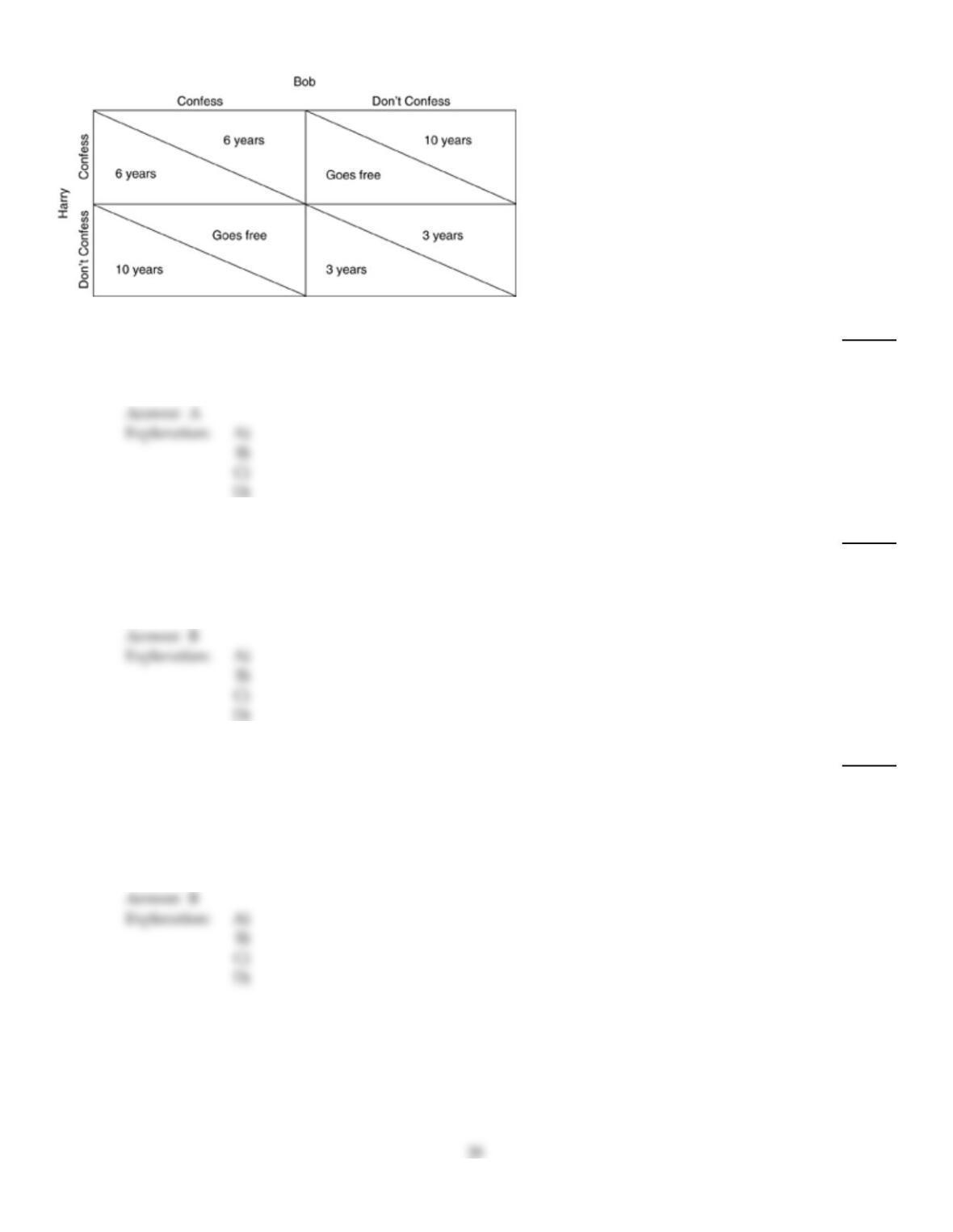
Refer to the above figure. The figure gives the payoff matrix for two individuals who are being
accused of robbing a bank together. Which of the following is the outcome of the dominant strategy
without cooperation?
37)
A)
Both don’t confess.
B)
Both confess.
C)
Bob confesses while Harry does not confess.
D)
Harry confesses while Bo does not confess.
B
A
38)
A game in which any gains one player makes are offset by equal losses by another player is known
as a
38)
A)
zero–sum game.
B)
positive–sum game.
C)
negative–sum game.
D)
cooperative game.
39)
Suppose that an industry consists of 10 firms, and the top 4 firms have annual sales of $2.5 million,
$2 million, $1.5 million, and $1 million, respectively. If the entire industry has annual sales of $10
million, the four–firm concentration ratio is
39)
A)
10 percent.
B)
85 percent.
C)
50 percent.
D)
70 percent.
D
40)
The most common reason for the existence of oligopolies is
40)
A)
ease of entry.
B)
economies of scale.
C)
advertising.
D)
diseconomies of scale.
B
41)
The manner in which one oligopolist reacts to a change in price, output, or quantity on the part of
another oligopolist in the industry is known as
41)
A)
the reaction function.
B)
a positive–sum game.
C)
a noncooperative game.
D)
a zero–sum game.
A
42)
Suppose a ten firm industry has total sales of $35 million per year. The largest firm have sales of
$10 million, the third largest firm has sales of $4 million, and the fourth largest firm has sales of $2
million. If fifth through tenth largest firms combined have annual sales of $12 million, the
four–firm concentration ratio for this industry is
42)
A)
65.7 percent.
B)
45.7 percent.
C)
80 percent.
D)
none of the above.
A
A
43)
When a player in a game adopts a strategy which always yields the highest benefit regardless of
what the other player does, that player is using a(n)
43)
A)
dominant strategy.
B)
opportunistic strategy.
C)
tit–for–tat strategy.
D)
aggressive strategy.
44)
Which of the following is an example of a horizontal merger?
44)
A)
Northeastern Illinois University merging with Roosevelt University.
B)
Northeastern Illinois University merging with McDonald’s.
C)
Northeastern Illinois University going from a public to a private university.
D)
Northeastern Illinois University merging with a training academy for new professors.
45)
Suppose two firms are in a game situation, and they each must decide on a strategy regarding
whether to select a high price or a low price. Profits for a firm are highest when it selects a low
price, while the other selects a high price; profits are lowest if one selects a high price, while the
other selects a low price; profits are in between when both select low prices; and profits are slightly
higher when both select high prices. In the absence of collusion we expect
45)
A)
one of the firms to select a high price and the other a low price.
B)
one firm to select a high price and the other a low price in the first period, followed by a
reversal in the second period.
C)
both to select high prices.
D)
both to select low prices.
46)
The joining of firms that are producing or selling a similar product is
46)
A)
a vertical merger.
B)
a horizontal merger.
C)
competition by merger.
D)
a hostile takeover.
47)
If a retail food chain merged with a meat packing company, this would be an example of a
47)
A)
conglomerate merger.
B)
vertical merger.
C)
diagonal merger.
D)
horizontal merger.
48)
The idea that if enough consumers cut back on their use of a product it induces other consumers to
do the same is referred to as
48)
A)
negative market feedback.
B)
positive market feedback.
C)
elicit market feedback.
D)
non–dynamic market feedback.
49)
The mutual interdependence of oligopolists ensures that each oligopolist has
49)
A)
a fundamental dilemma about whether to collude or not.
B)
a unique demand curve.
C)
a perfectly elastic demand curve.
D)
a reaction function.
50)
A game in which all the players are better off at the end of the game is a
50)
A)
positive–sum game.
B)
noncooperative game.
C)
dominant strategy game.
D)
tit–for–tat game.
51)
If a company that drilled for and produced oil acquired a firm which refined oil into gasoline, this
would be referred to as a
51)
A)
vertical merger.
B)
conglomerate merger.
C)
horizontal merger.
D)
reverse merger.
52)
A concentration ratio gives
52)
A)
the percentage of all sales contributed by the four or eight largest firms in the industry.
B)
the total sales of four or eight of the mid–sized firms in the industry.
C)
the sales of the four largest firms in the industry divided by the sales of the eight largest firms
in the industry.
D)
the average size of the firms in an industry.
53)
The market structure of monopoly exists when
53)
A)
there is a single producer of a product.
B)
there are many producers of a homogeneous product.
C)
there are many producers of differentiated products.
D)
there are a small number of interdependent firms that constitute the entire market.
Explanation:
54)
Which of the following is NOT a characteristic of pure monopoly?
54)
A)
many sellers
B)
considerable price setting ability
C)
long–run economic profits are possible
D)
restricted ability to enter market
Explanation:
55)
The Herfindahl–Hirschman index is measured by
55)
A)
adding the market shares of all firms in an industry.
B)
squaring the sum of the market shares of the all firms in an industry.
C)
adding the squares of the market shares of all firms in an industry.
D)
adding the market shares of the four largest firms in an industry.
Explanation:
Explanation:
56)
People’s willingness to buy the PC or Mac format of computer software depends on how popular
the software format is among other consumers. This is an example of
56)
A)
a network effect.
B)
a cartel.
C)
the prisoners‘ dilemma.
D)
an opportunity cost.
57)
The market structure of monopolistic competition exists when
57)
A)
there are a small number of interdependent firms that constitute the entire market.
B)
there is a single producer of a product.
C)
there are many producers of a homogeneous product.
D)
there are many producers of differentiated products.
58)
If we observe firms earning zero economic profits in the short run, we know that
58)
A)
any market structure is possible since firms under any market structure can earn zero profits
at some time.
B)
the industry must be either perfectly competitive or monopolistically competitive.
C)
the industry must be perfectly competitive.
D)
there must not be any barriers to entry.
59)
A noncooperative game would refer to a situation in which oligopoly firms
59)
A)
behave as a joint monopoly.
B)
are made worse off by their actions.
C)
do not engage in collusive behavior together.
D)
are too small to be interdependent.
60)
Stephanie listens to punk rock because her friends do. This is
60)
A)
collusion.
B)
positive market feedback.
C)
a positive sum game.
D)
negative market feedback.
61)
Agriculture is an example of
61)
A)
perfect competition.
B)
oligopoly.
C)
monopoly.
D)
monopolistic competition.
A
62)
Suppose a firm can charge a relatively low price to try to compete actively with its rivals, or it can
charge a relatively high, collusive price. If its strategy is to charge the low price regardless of the
other firms’ decisions, this low–price is the firm’s
62)
A)
independent strategy.
B)
dominant strategy.
C)
dependent strategy.
D)
positive sum strategy.
B
63)
When OPEC meets to set production levels, this organization is playing a
63)
A)
reaction function game.
B)
cooperative game.
C)
non–cooperative game.
D)
negative sum game.
B
64)
A market with one seller, considerable influence over price, high barriers to entry, a homogeneous
product, and non–price competition to allow for price discrimination is known as
64)
A)
perfect competition.
B)
monopolistic competition.
C)
oligopoly.
D)
monopoly.
D
B
65)
The outputs of an oligopolistic industry
65)
A)
can be homogeneous or differentiated.
B)
must cost above $100 on the market.
C)
have no substitutes on the market.
D)
always have excise taxes imposed on them.
66)
Product differentiation exists in
66)
A)
monopolistic competition only.
B)
oligopolies only.
C)
monopolies only.
D)
all market structures except perfect competition.
67)
A cooperative game is
67)
A)
a game in which firms will not negotiate in any way.
B)
the manner in which one oligopolist reacts to a change in price made by another oligopolist in
the industry.
C)
companies colluding in order to make higher than competitive rates of return.
D)
when plans made by firms are known as game strategies.
68)
If the United States’ largest bakery buys an agricultural firm that specializes in growing wheat, we
would have an example of
68)
A)
a monopoly.
B)
excessive product differentiation.
C)
a vertical merger.
D)
a horizontal merger.
69)
Collusion always involves firms engaging in a
69)
A)
vertical merger.
B)
cooperative game.
C)
horizontal merger.
D)
noncooperative game.
70)
Suppose an industry is composed of 10 firms. Each firm’s share of total sales in the industry is 10
percent. If two of the firms merge, then the four–firm concentration ratio in the industry is
70)
A)
45 percent.
B)
50 percent.
C)
40 percent.
D)
unable to determine.
71)
Negative market feedback refers to a tendency for
71)
A)
the dominant firm in an oligopolistic industry to react to competing firms’ price increases by
decreasing the price of its own product.
B)
a particular product to fall out of favor with additional consumers because other consumers
have stopped purchasing the product.
C)
price wars to break out in oligopolistic industries in which firms produce products possessing
characteristics that make them prone to network effects.
D)
one or two firms in an oligopolistic industry to respond to price decreases by initiating efforts
to engage in price leadership.
72)
Managers in oligopoly firms must
72)
A)
eliminate any barriers to entry if they hope to make short–run profits.
B)
establish many varieties of their products to cover the spectrum of consumer tastes.
C)
advertise heavily in order to differentiate their product.
D)
anticipate the reaction of rival firms.
73)
Which of the following is NOT a reason why some industries are oligopolies?
73)
A)
mergers
B)
economies of scale
C)
strategic independence
D)
barriers to entry
74)
In the mobile device industry, an example of a platform firm is
74)
A)
a developer of mobile device operation systems.
B)
a retailer of mobile device accessories.
C)
an online retailer.
D)
a mobile apps developer.
A
75)
A market situation in which there are a few firms that recognize their mutual interdependence is
75)
A)
regulated monopoly.
B)
oligopoly.
C)
monopoly.
D)
monopolistic competition.
B
76)
When a consumer’s willingness to buy a good or service is influenced by the number of people who
have purchased that good or service, this is called
76)
A)
a network effect.
B)
an opportunity cost.
C)
a switching cost.
D)
an advertising gimmick.
A
77)
In a two–sided market with network effects, the platform will likely
77)
A)
charge a lower price for end users that are more affected by a positive market feedback.
B)
randomly charge end users.
C)
charge a zero price for all end users regardless of the market feedback effects.
D)
charge a higher price for end users that are more affected by a positive market feedback.
D
C
78)
People do not usually behave in a noncooperative fashion even when it is in their immediate
interest to do so because
78)
A)
they understand the difficulties with game theory.
B)
they realize such behavior is immoral.
C)
they know they will have repeated dealings with the other people.
D)
they know there can be 2 winners.
79)
The manner in which one oligopolist reacts to a change in price, output, or quality made by another
oligopolist in the industry is
79)
A)
a cooperative game.
B)
a zero–sum game.
C)
the concentration ratio.
D)
the reaction function.
D
80)
Which of the following is NOT a characteristic of oligopoly firms?
80)
A)
non–price competition, such as advertising and promotions
B)
strategic dependence
C)
product differentiation
D)
perfectly elastic demand curves
D
C
81)
Refer to the above figure. The figure gives the payoff matrix for two individuals who are being
accused of robbing a bank together. If Bob does not confess, what is the best strategy for Harry?
81)
A)
Confess.
B)
Don’t confess.
C)
Flip a coin to decide what to do.
D)
There is no best strategy.
82)
One of the fundamental problems a cartel faces is
82)
A)
to determine how much each producer will lower it price.
B)
to determine how much each producer will decrease its output.
C)
to determine how much each producer will increase its output.
D)
to determine how much each producer will lower its profit.
83)
Suppose that Industry X has two firms with equal market shares, and Industry Y has three firms
with 65 percent, 30 percent, and 5 percent market shares, respectively. Which of the following is
TRUE?
83)
A)
The HHI for Industry X is 100 higher than the HHI for Industry Y.
B)
The HHI for Industry X is 150 lower than the HHI for Industry Y.
C)
The HHI for Industry X is 50 higher than the HHI for Industry Y.
D)
The HHI is the same between Industry X and Industry Y.