
College Physics: A Strategic Approach, 3e (Knight)
Chapter 26 AC Electricity
26.1 Conceptual Questions
1) A transformer is a device used to
A) transform an alternating current into a direct current.
B) transform a direct current into an alternating current.
C) increase or decrease an ac voltage.
D) increase or decrease a dc voltage.
2) A transformer is a device that normally
A) operates on either dc or ac.
B) operates only on ac.
C) operates only on dc.
3) If the secondary coil of a transformer contains more loops than the primary coil, then it is a
A) step-up transformer.
B) step-down transformer.
4) If the primary coil of a transformer contains more loops than the secondary coil then it is a
A) step-up transformer.
B) step-down transformer.
5) An ideal solenoid has a self-inductance L. If you now double its radius and its length, but do
not change the number of coils, what will its self-inductance be?
A) 4L
B) 2L
C) L
D) L/2
E) L/4
6) A resistor and an inductor are connected in series to an ideal battery of constant terminal
voltage. At the moment contact is made with the battery, the voltage across the resistor is
A) greater than the battery’s terminal voltage.
B) equal to the battery’s terminal voltage.
C) less than the battery’s terminal voltage, but not zero.
D) zero.
E) equal to the voltage across the inductor.
7) A resistor and an inductor are connected in series to an ideal battery of constant terminal
voltage. At the moment contact is made with the battery, the voltage across the inductor is
A) greater than the battery’s terminal voltage.
B) equal to the battery’s terminal voltage.
C) less than the battery’s terminal voltage, but not zero.
D) zero.
E) equal to the voltage across the resistor.
8) A resistor and an inductor are connected in series to a battery. The time constant for the
circuit represents the time required for the current to reach
A) 25% of the maximum current.
B) 37% of the maximum current.
C) 63% of the maximum current.
D) 75% of the maximum current.
E) 100% of the maximum current.
9) A resistor and an inductor are connected in series to a battery. The battery is suddenly
removed from the circuit and replaced by a wire to complete the circuit. The time constant for of
the new circuit represents the time required for the current to decrease to
A) 25% of the original value.
B) 37% of the original value.
C) 63% of the original value.
D) 75% of the original value.
E) zero.
10) A simple ac circuit is composed of a capacitor connected across the terminals of an ac power
source. If the frequency of the source is doubled, what happens to the reactance of the capacitor?
A) It increases by a factor of 4.
B) It increases by a factor of 2.
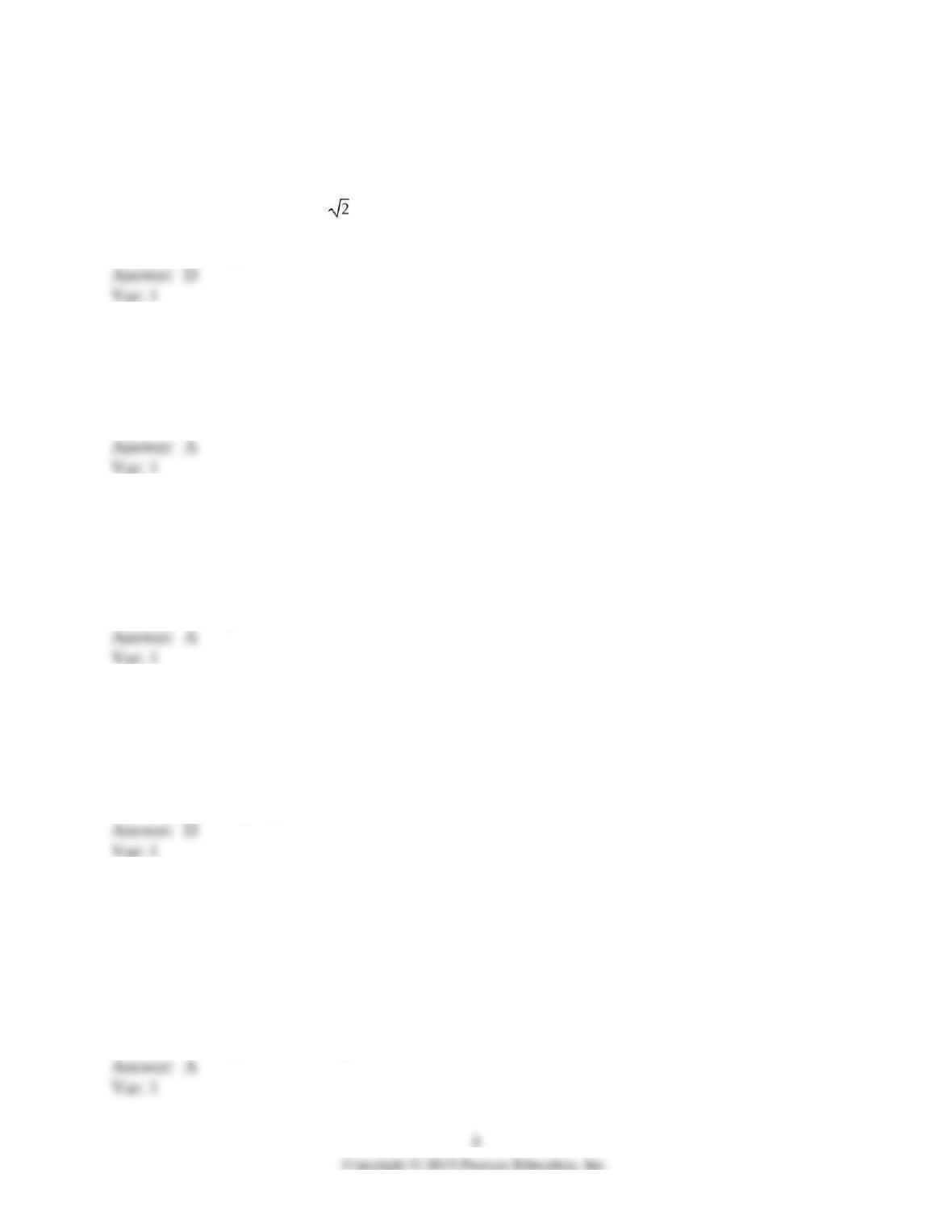
C) It increases by a factor of
D) It decreases by a factor of 2.
E) It decreases by a factor of 4.
11) Consider a capacitor connected across the ac source. As the capacitance is increased, the
current through the capacitor will
A) increase.
B) remain constant.
C) decrease.
12) A pure capacitor is connected to an ac power supply. In this circuit, the current
A) leads the voltage by 90°.
B) lags the voltage by 90°.
C) lags the voltage by 180°.
D) is in phase with the voltage.
E) None of the given answers are correct.
13) A pure inductor is connected to an ac power supply. In this circuit, the current
A) leads the voltage by 90°.
B) is in phase with the voltage.
C) lags the voltage by 45°.
D) lags the voltage by 90°.
E) leads the voltage by 45°.
14) A simple ac circuit consists of an inductor connected across the terminals of an ac power
source. If the frequency of the ac source is decreased by a factor of four, what happens to the
reactance of the inductor?
A) It decreases by a factor of four.
B) It decreases by a factor of eight.
C) It increases by a factor of two.
D) It increases by a factor of four.
E) It increases by a factor of eight.
15) As the frequency of the ac voltage across an inductor approaches zero, the inductive
reactance of that coil
A) approaches zero.
B) approaches one.
C) approaches infinity.
D) becomes negative.
16) What is the phase angle between the voltages of the inductor and capacitor in a RLC series
circuit?
A) 0°
B) 45°
C) 90°
D) 180°
E) 270°
17) Which of the following statements is true for a series RLC ac circuit in resonance? (There
could be more than one correct choice).
A) The inductive reactance and the capacitive reactance are both equal to zero.
B) The inductive reactance is equal to the capacitive reactance.
C) The current in the circuit is a minimum.
D) The current in the circuit is a maximum.
E) The rms current is equal to the peak current.
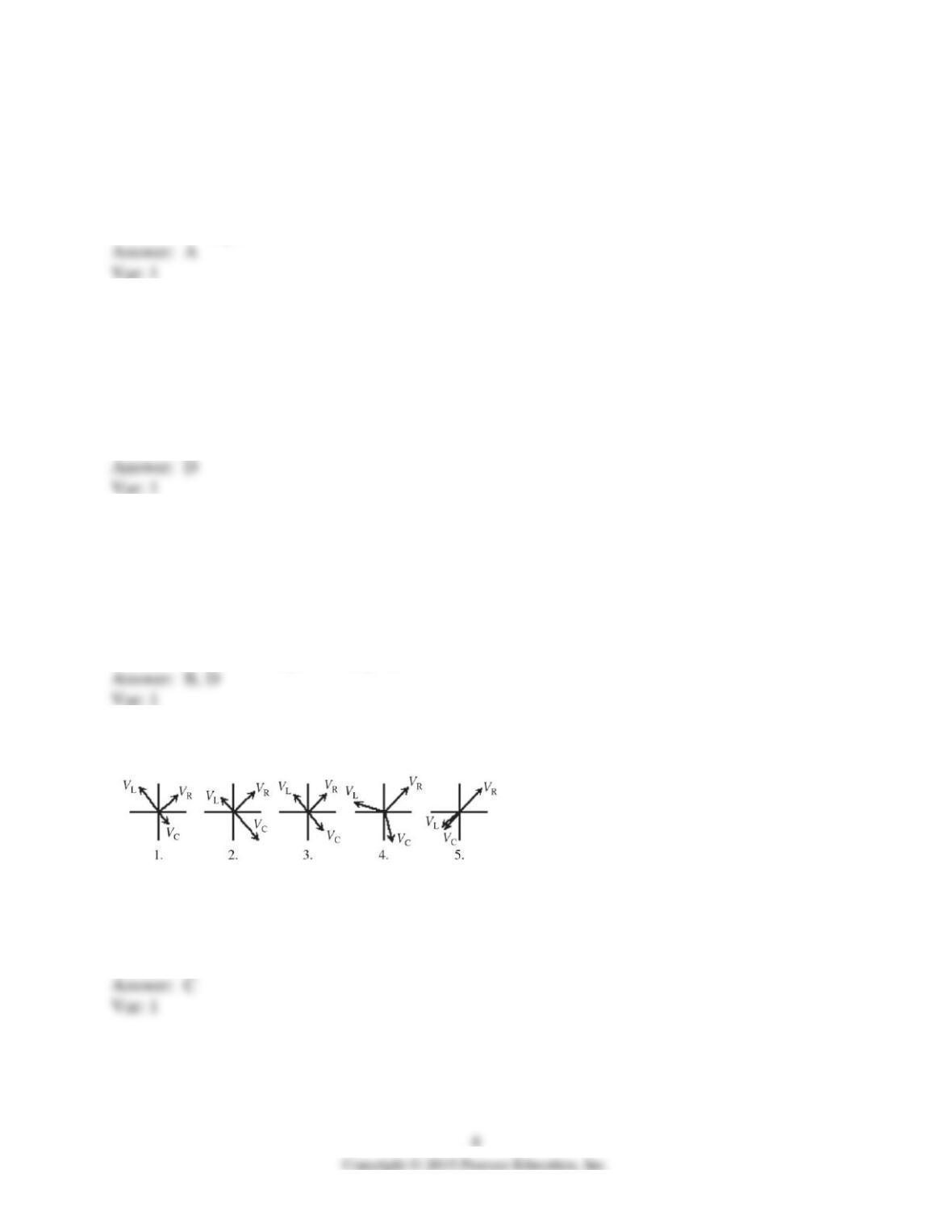
18) In the figure, which of the phasor diagrams represents a series RLC circuit driven at
resonance?
A) 1
B) 2
C) 3
D) 4
E) 5
19) In an RLC ac circuit, the values of the inductance and capacitance are both doubled. As a
result of this change, the resonance frequency of the circuit is
A) the same as before.
B) reduced to one-half the original value.
C) reduced to one-fourth the original value.
D) twice the original value.
E) four times the original value.
20) In a RLC circuit, the values of the inductance and capacitance are both halved. As a result of
this change, the resonance frequency of the circuit is
A) the same as before.
B) reduced to one-half the original value.
C) reduced to one-fourth the original value.
D) twice the original value.
E) four times the original value.
1) The primary coil of an ideal transformer has 100 turns and its secondary coil has 400 turns. If
the ac voltage applied to the primary coil is 120 V, what voltage is present in its secondary coil?
A) 100 V
B) 30 V
C) 70 V
D) 480 V
E) 400 V
2) An ideal transformer has 60 turns on its primary coil and 300 turns on its secondary coil. If
120 V at 2.0 A is applied to the primary,
(a) what voltage is present in the secondary?
(b) what current is present in the secondary?
3) An ideal step-up transformer doubles a primary voltage of 110 V. What is the ratio of the
number of turns in its primary coil to the number of turns in the secondary coil?
A) 1:4
B) 4:1
C) 2:1
D) 1:2
E) 1:8
4) When 5.0 A at 110 V flows in the primary of an ideal transformer, how many amps at 24 V
can flow in the secondary?
A) 1.1 A
B) 4.6 A
C) 5.0 A
D) 23 A
5) The secondary coil of an ideal neon sign transformer provides 7500 V at 10.0 mA. The
primary coil operates on 120 V. What current does the primary draw?
A) 0.625 A
B) 0.625 mA
C) 0.160 A
D) 1.66 A
6) The primary coil of an ideal transformer has 100 turns and its secondary coil has 400 turns. If
the ac current in the secondary coil is 2 A, what is the current in its primary coil?
A) 2 A
B) 8 A
C) 1/2 A
D) 1/4 A
E) 4 A
7) The primary coil of an ideal transformer has 600 turns and its secondary coil has 150 turns. If
the current in the primary coil is 2 A, what is the current in its secondary coil?
A) 8 A
B) 1/2 A
C) 1/4 A
D) 2 A
E) 4 A
8) A current of 2.0 A in the 100-turn primary of an ideal transformer causes 14 A to flow in the
secondary. How many turns are in the secondary?
A) 700
B) 114
C) 14
D) 4
9) In an ideal transformer, how many turns are necessary in a 110-V primary if the 24-V
secondary has 100 turns?
A) 458
B) 240
C) 110
D) 22
10) An ideal transformer consists of a 500-turn primary coil and a 2000-turn secondary coil. If
the current in the secondary is 3.0 A, what is the current in the primary?
A) 0.75 A
B) 1.3 A
C) 12 A
D) 48 A
11) An ideal step-down transformer is needed to reduce a primary voltage of 120 V to 6.0 V.
What must be the ratio of the number of turns in the secondary to the number of turns in the
primary?
12) An ideal transformer steps down 120 V to 12. V and the 2630.-turn secondary supplies 12.
A.
(a) Determine the current in the primary.
(b) Determine the turns ratio.
(c) What is the ratio of output power to input power?
13) An ideal transformer with 120 turns in its secondary supplies 12 V at 220 mA to a toy train.
The primary is connected across a 120-V wall outlet.
(a) How many turns are in the primary?
(b) What is the primary current?
(c) What power is delivered by the wall outlet?
14) An ideal transformer has 60 turns on its primary coil and 300 turns on its secondary coil. If
120 V at 2.0 A is applied to the primary, what voltage and current are present in the secondary?
15) You need an ideal transformer to reduce a voltage of 150 V in the primary circuit to 25 V in
the secondary circuit. The primary circuit has 130 windings and the secondary circuit is
completed through a 55-Ω resistor. How many windings should the secondary circuit contain?
16) The primary of an ideal transformer has 100 turns and its secondary has 200 turns. If the
input current at the primary is 100 A, we can expect the output current at the secondary to be
A) 50 A.
B) 100 A.
C) 200 A.
D) none of the given answers.
17) The primary of an ideal transformer has 100 turns and its secondary has 200 turns. If the
input voltage to the primary is 100 V, we can expect the output voltage of the secondary to be
A) 50 V.
B) 100 V.
C) 200 V.
D) none of the given answers.
18) The primary of an ideal transformer has 100 turns and its secondary has 200 turns.
Neglecting frictional losses, if the power input to the primary is 100 W, we can expect the power
output of the secondary to be
A) 50 W.
B) 100 W.
C) 200 W.
D) none of the given answers.
19) A generator produces 60 A of current at 120 V. The voltage is usually stepped up to 4500 V
by an ideal transformer and transmitted through a power line of total resistance 1.0 Ω. Find the
number of turns in the secondary if the primary has 200 turns.
A) 5
B) 200
C) 4500
D) 7500
20) What is the self-inductance of an ideal solenoid that is 300 cm long with a cross-sectional
area of 1.00 × 10⁻⁴ m2 and has 1000 turns of wire? (μ0 = 4π × 10-7 T ∙ m/A)
A) 4.19 nH
B) 4.19 pH
C) 4.19 μH
D) 41.9 nH
E) 41.9 µH
21) A coil with a self-inductance of 6.0 H has a constant current of 2.0 A flowing through it for
2.0 s. What is the emf induced in this coil?
A) 6.0 V
B) 12 V
C) 0.0 V
D) 4.0 V
E) 8.0 V
22) A coil with a self-inductance of 6.0 H is connected to a dc battery through a switch. As soon
as the switch is closed, the rate of change of current is 2.0 A/s. What is the emf induced in this
coil at this instant?
A) 6.0 V
B) 3.0 V
C) 12 V
D) 0.33 V
E) 0.0 V
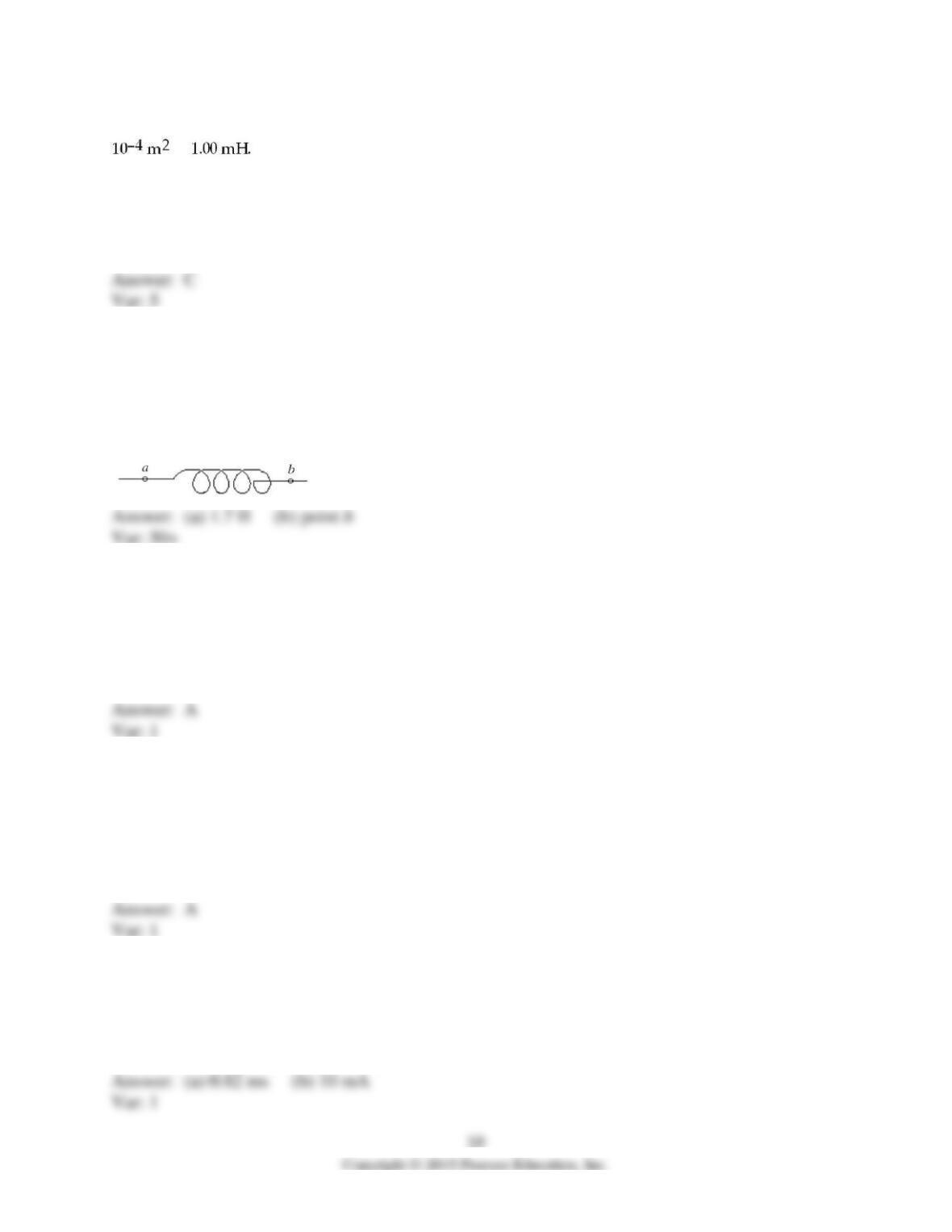
23) The inductance of a solenoid that is 16.0 cm long and has a cross-sectional area of 1.00 ×
is How many turns of wire does this solenoid have? (μ0 = 4π × 10-7 T ∙ m/A)
A) 318,000
B) 159,000
C) 1130
D) 282
E) 150
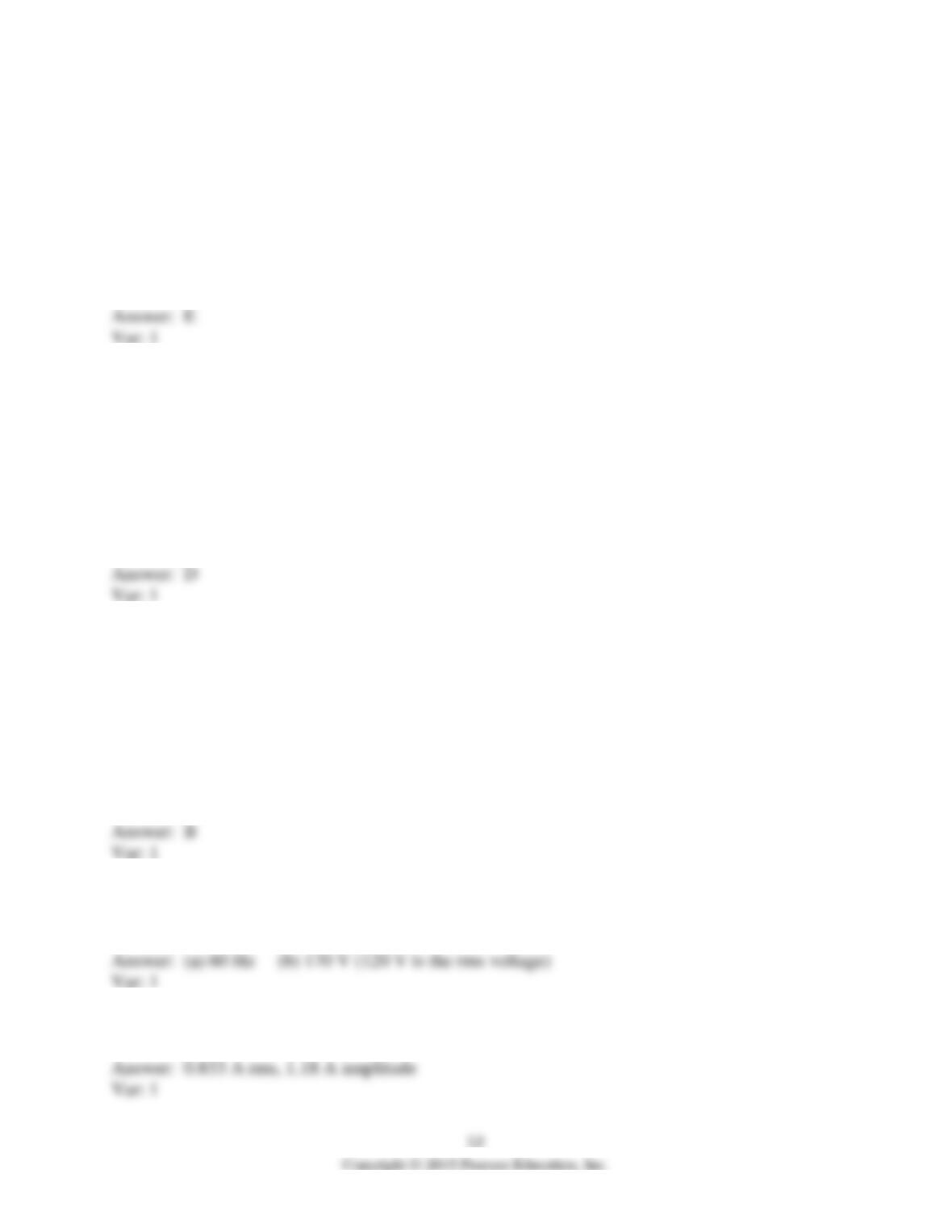
24) The figure shows a solenoid having no appreciable resistance. When the current in this
solenoid is decreasing at a rate of 5.5 A/s, the self-induced emf in the solenoid is measured to be
9.5 V.
((a) What is the self-inductance of this solenoid?
(b) If the current is in the direction from b to a in the figure, which point, a or b, is at higher
potential?
25) The current flowing through a circuit is changing at a rate of 6.0 A/s. If the circuit contains a
190-H inductor, what is the emf across the inductor?
A) 1100 V
B) 11 mV
C) 32 mV
D) 32 V
26) An ideal solenoid with 3000 turns is 70.0 cm long. If its self-inductance is 25.0 mH, what is
its radius? (μ0 = 4π × 10-7 T ∙ m/A)
A) 0.0222 m
B) 0.00199 m
C) 327 m
D) 52.0 m
27) A simple series circuit consists of just a 3.4-µF capacitor and an 80-mH inductor, with no
appreciable resistance. At t = 0 the capacitor has charge 5.4 µC and the current in the inductor is
zero.
(a) How long after t = 0 will the current in the circuit be maximum?
(b) What will be this maximum current?

28) A simple circuit consists only of of a 1.0-μF capacitor and a 15-mH coil in series. At what
frequency will this circuit oscillate?
A) 15 kHz
B) 1.3 kHz
C) 0.77 kHz
D) 67 Hz
29) What inductance is needed in series with a 4.7-μF capacitor so the circuit will oscillate at a
frequency of 10 kHz?
A) 21 μH
B) 54 μH
C) 4.7 mH
D) 5.4 mH
30) What capacitance is needed in series with a 3.7-mH inductor so the circuit will oscillate at a
frequency of 1000 Hz?
A) 0.15 mF
B) 15 μF
C) 6.8 μF
D) 0.015 μF
31) What size capacitor must be placed in series with a 40-mH coil so the circuit will oscillate
with a frequency of 1000 Hz?
A) 0.63 μF
B) 0.50 μF
C) 0.22 μF
D) 0.17 μF
32) A series circuit contains an 80-μF capacitor, a 0.020-H inductor, and a switch. The resistance
of the circuit is negligible. Initially, the switch is open, the capacitor voltage is 50 V, and the
current in the inductor is zero. At time t = 0 s, the switch is closed. How long after closing the
switch does the magnetic energy in the inductor first reach its maximum value?
A) 2.0 ms
B) 4.0 ms
C) 6.0 ms
D) 8.0 ms
E) 10 ms
33) A series circuit contains an 80-μF capacitor, a 0.020-H inductor, and a switch. The resistance
of the circuit is negligible. Initially, the switch is open, the capacitor voltage is 50 V, and the
current in the inductor is zero. At time t = 0 s, the switch is closed. What is the maximum current
in the circuit?
A) 2.2 A
B) 2.4 A
C) 2.8 A
D) 3.0 A
E) 3.2 A
34) A series circuit contains an 80-μF capacitor, a 0.020-H inductor, and a switch. The resistance
of the circuit is negligible. Initially, the switch is open, the capacitor voltage is 50 V, and the
current in the inductor is zero. At time t = 0 s, the switch is closed. When the current in the
circuit is 1.5 A, what is the charge on the capacitor?
A) 2000 µC
B) 2500 µC
C) 3000 µC
D) 3500 µC
E) 4000 µC
35) A series circuit contains an 80-μF capacitor, a 0.020-H inductor, and a switch. The resistance
of the circuit is negligible. Initially, the switch is open, the capacitor voltage is 50 V, and the
current in the inductor is zero. At time t = 0 s, the switch is closed. When the potential across the
capacitor is 30 V, what is the rate of change of the current?
A) 1000 A/s
B) 1500 A/s
C) 2000 A/s
D) 2500 A/s
E) 3000 A/s
36) American power plants usually supply 120 V ac.
(a) At what frequency is this voltage supplied?
(b) What is the maximum voltage?
37) A 100-W light bulb is powered by 120 V ac 60.0-Hz household connection. Determine the
rms current and the current amplitude.
38) The peak current and voltage outputs of a generator are 20 A and 240 V, respectively. What
average power is provided by the generator?
39) The potential applied to a 20-Ω resistor is v = (60 V) cos(33t). What is the rms current
through this resistor?
40) The current through a 50-Ω resistor is I = (0.80 A) sin(240t). What are (a) the current
amplitude and (b) the rms current?
41) A 0.150-kW lamp is plugged into a 120-V ac wall outlet. What are (a) the peak current
through the lamp, (b) the rms current through the lamp, and (c) the resistance of the lamp?
42) The potential applied to a 20-Ω resistor is (60 V) cos(33t). What is the average power
consumed in the resistor?
43) If the maximum voltage of an ac signal is 8.0 V, what is the rms value of this voltage?
A) 2.8 V
B) 5.7 V
C) 6.2 V
D) 4.0 V
E) 16.0 V
44) A 120-V rms voltage at 60.0 Hz is applied across an inductor, capacitor and a 100-Ω resistor
in series. If the maximum value of the current in this circuit is 1.60 A, what is the rms value of
the current in this circuit?
A) 1.13 A
B) 2.26 A
C) 1.82 A
D) 1.60 A
E) 2.66 A
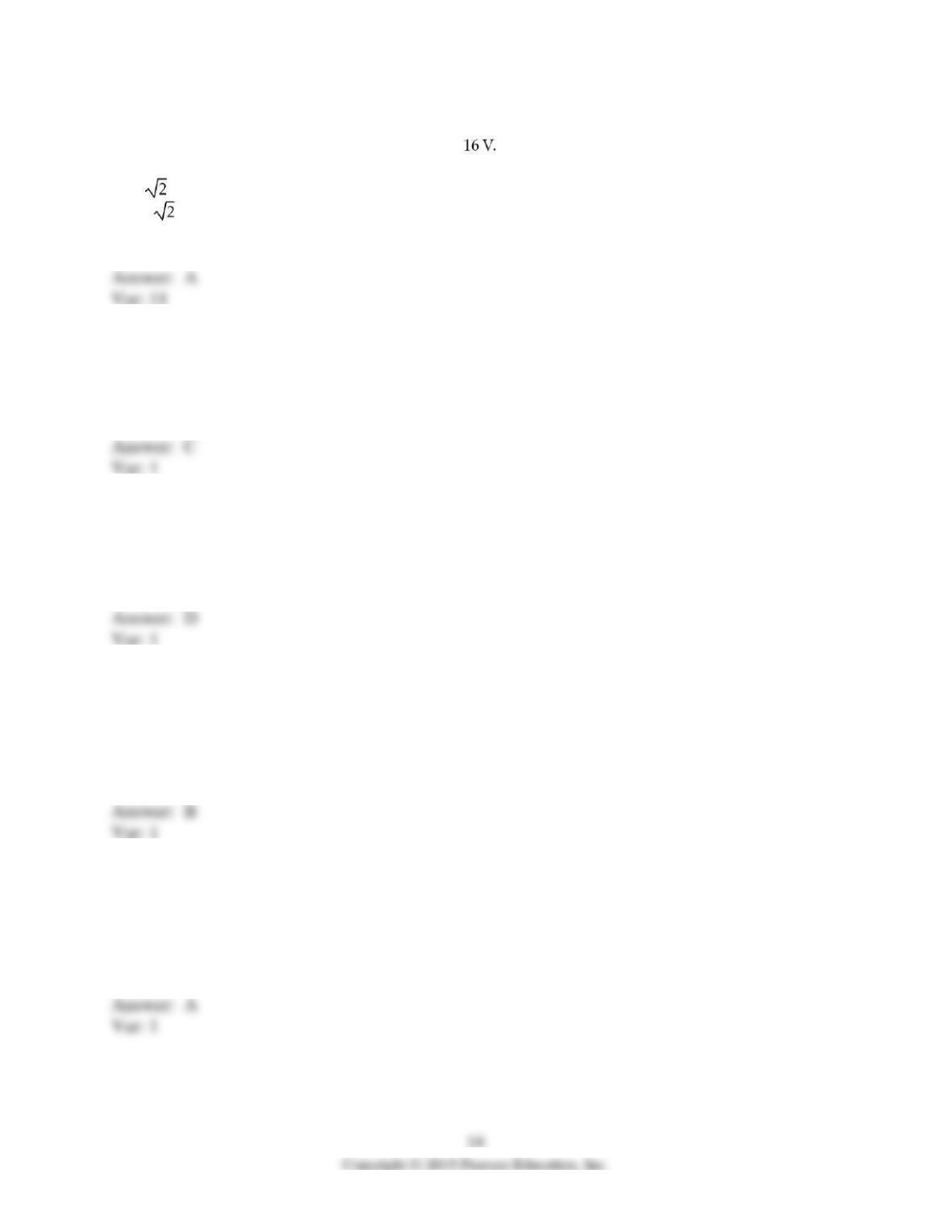
45) An alternating current is supplied to an electronic component with a rating that the voltage
across it can never, even for an instant, exceed What is the highest rms voltage that can be
supplied to this component while staying below the voltage limit?
A) 8 V
B) 16 V
C) 256 V
D) 8 V
46) What is the peak voltage in an ac circuit where the rms voltage is 120 V?
A) 84.8 V
B) 120 V
C) 170 V
D) 240 V
47) A 150-W lamp is placed into a 120-V ac outlet. What is the peak current?
A) 0.80 A
B) 0.88 A
C) 1.2 A
D) 1.8 A
48) A 10-Ω resistor is connected to a 120-V ac power supply. What is the peak current through
the resistor?
A) 12 A
B) 17 A
C) 0.083 A
D) 0.12 A
49) The current through a 50-Ω resistor is I = (0.80 A) sin(240t), where t is measured in seconds.
What is the rms current?
A) 0.57 A
B) 0.80 A
C) 1.1 A
D) 1.6 A