Biology: A Guide to the Natural World, 5e (Krogh)
Chapter 25 The Angiosperms: Form and Function in Flowering Plants
1) The trap of a carnivorous plant such as the Venus flytrap is what plant structure?
A) stem
B) leaf
C) fruit
D) flower
2) Which kind of root system consists of a large central root and numerous lateral roots?
A) fibrous
B) taproot
C) needle-like
D) spinous
3) The major advantage provided to plants by root hairs is:
A) needle-like points for drilling through hard or rocky soil.
B) ability to produce new taproots.
C) underground asexual reproduction.
D) greatly increasing absorptive surface area.
4) About 90 percent of water absorbed through roots is lost to the atmosphere due to the process
of:
A) transpiration.
B) expiration.
C) perspiration.
D) photosynthesis.
2
5) The structure that attaches a leaf to the rest of the plant is the:
A) blade.
B) stoma.
C) petiole.
D) stem.
6) Mesophyll cells are primarily responsible for:
A) transport of water.
B) protection of a leaf.
C) regulating passage of carbon dioxide into the leaf.
D) photosynthesis.
7) Guard cells are responsible for:
A) transport of water and minerals.
B) protection of a leaf.
C) regulating passage of carbon dioxide into the leaf.
D) photosynthesis.
8) The outer portion of the “ground tissue” of a stem is referred to as its:
A) cortex.
B) pith.
C) sepal.
D) mesophyll.
9) Sepals are:
A) pollen-producing structures.
B) leaf-like structures that protect a flower before it opens.
C) pollen receptacles on a carpel.
D) insect-attracting structures of the flower.
10) In both monocotyledons and dicotyledons, a cotyledon is a(n):
A) type of seed.
B) type of flower.
C) embryonic root.
D) embryonic leaf.
11) A ring of vascular bundles in a stem is characteristic of:
A) monocots.
B) many dicots.
C) both monocots and dicots.
D) non-flowering seed plants.
12) Narrow, parallel-veined leaves are characteristic of:
A) monocots.
B) many dicots.
C) both monocots and dicots.
D) non-flowering seed plants.
13) Secondary woody growth is characteristic of:
A) monocots.
B) dicots.
C) both monocots and dicots.
D) non-flowering seed plants.
14) Flower parts arranged in multiples of four or five is characteristic of:
A) monocots.
B) dicots.
C) both monocots and dicots.
D) non-flowering seed plants.
Refer to the scenario below, and then answer the following question(s).
A friend of yours finds a plastic bag containing what appear to be similar seeds collected last
year during a vacation hiking trip. Your friend isn’t quite sure which plant he collected them
from. You open the seed with a sharp knife, examine the inside, and ask him if it was a non-
woody plant with narrow leaves. Now recalling the plant, and astonished by your “detective
work,” he says, “Yes! How did you know?” Your friend then presents several pressed flowers
and states that one of the flowers was from the plant from which he collected the seeds, but he
isn’t exactly sure which one. You examine the petals and sepals of each flower. The first flower
has six parts, the second has five parts, and the third has eight parts.
15) How did you know by examining the seed that it was a non-woody plant with narrow leaves?
A) The seed contained an embryonic flower with four petals.
B) The seed contained a small taproot.
C) The seed contained one cotyledon.
D) The seed contained two cotyledons.
16) Which flower would you select as the one matching the plant from which he gathered the
seeds?
A) The flower with six parts
B) The flower with five parts
C) The flower with eight parts
D) Either the flower with five or the flower with eight parts could match the seeds.
17) Which plant tissue is associated with a waxy coating called the cuticle?
A) meristematic
B) ground
C) vascular
D) dermal
5
18) Which plant tissue may play a role in photosynthesis, nutrient storage, and plant structure?
A) meristematic
B) ground
C) vascular
D) dermal
19) Vascular tissue that conducts water and minerals is the:
A) meristematic tissue.
B) phloem.
C) xylem.
D) ground substance.
20) Vascular tissue that conducts food produced during photosynthesis is the:
A) meristematic tissue.
B) phloem.
C) xylem.
D) ground substance.
21) Which plant tissue contains cells called tracheids?
A) meristematic tissue
B) phloem
C) xylem
D) ground substance
22) You find a leaf that has large stomata and a thick, waxy covering. What is clear about the
original plant?
A) The plant minimizes sunlight uptake.
B) The plant maximizes nutrient uptake.
C) The plant minimizes nutrient uptake.
D) The plant minimizes water loss.
23) Which statement best describes primary growth in angiosperms?
A) Growth occurs at the tips of shoots and roots.
B) Growth occurs evenly throughout the plant.
C) First-year growth occurs at the tips of shoots and roots, and then growth occurs evenly
throughout the plant as it ages.
D) First-year growth occurs evenly throughout the plant, and then growth only occurs at the tips
and shoots as it ages.
24) Growth areas of an angiosperm are called:
A) ground tissue.
B) root caps.
C) cuticles.
D) apical meristems.
25) Lateral buds tend to stay dormant when:
A) conditions are favorable for leaf growth.
B) damaged apical meristems produce hormones that suppress their growth.
C) healthy apical meristems produce hormones that suppress their growth.
D) root growth is rapid.
26) Because a plant can grow indefinitely at the tips of the roots and shoots, we say that a plant’s
growth is:
A) annualized.
B) indeterminate.
C) determinate.
D) limitless.
7
27) Which of the following best describes the nature of the cells of mature, functioning xylem?
A) living, thick-walled tubes
B) dead, thick-walled tubes
C) living cells that have lost their nucleus
D) dead cells that retain some organelles and some maintenance functions
28) Which of the following best describes the nature of the sieve element cells of mature,
functioning phloem?
A) living, thick-walled tubes
B) dead, thick-walled tubes
C) living cells that have lost their nucleus
D) dead cells that retain some organelles and some maintenance functions
29) The force that moves water through xylem is provided by:
A) gravity.
B) transpiration.
C) osmosis.
D) active transport.
30) The force that moves material through phloem is provided by:
A) gravity.
B) transpiration.
C) osmosis.
D) active transport.
31) Companion cells are specialized cells found in which plant tissue?
A) meristematic tissue
B) phloem
C) xylem
D) ground substance
32) The male gametophyte generation of angiosperms is represented by:
A) pollen grains.
B) embryo sacs.
C) seeds.
D) the style.
33) The female gametophyte generation of angiosperms is represented by:
A) pollen grains.
B) embryo sacs.
C) seeds.
D) pollen tubes.
34) Fusion of a sperm cell with the large central cell in an angiosperm embryo sac produces:
A) a spore.
B) the zygote.
C) the endosperm.
D) a pollen tube.
35) Which statement best describes the role of the megaspore in angiosperm reproduction?
A) The megaspore develops into a seed.
B) The megaspore produces pollen grains.
C) The megaspore develops into the anther.
D) The megaspore produces the egg-containing embryo sac.
36) Place the following listed items in the correct order in relation to the life cycle of a flowering
plant:
(1) fertilization, (2) formation of a pollen tube, (3) pollination.
A) 1, 2, 3
B) 3, 2, 1
C) 2, 3, 1
D) 2, 1, 3
37) The source of a fruit produced by an angiosperm is its:
A) endosperm.
B) ovary wall.
C) sepal.
D) seed.
38) A flower’s nectar is food for pollinators, so one might question whether fruit is also an
adaptation for attracting pollinators. Which of the following would be the most valid fact
supporting the hypothesis that fruit is for encouraging seed dispersal rather than to encourage
pollination?
A) Fruit is too large for pollinators to consume.
B) Fruit does not last long enough for long-term pollination cycles.
C) The carpel has already been pollinated when fruit is developing.
D) Pollinators do not have mouthparts appropriate to eat fruit.
39) Although they produce flowers, cacti with needle-like leaves would be classified as
gymnosperms rather than angiosperms.
40) Angiosperm flowers always self-pollinate because they have both male and female
reproductive structures.
41) A fibrous root system is made of roots that are all about the same size.
42) Root hairs develop into taproots.
43) Stomata allow carbon dioxide into a leaf and water vapor out.
44) Most stomata are found on the top surface of a leaf.
45) Guard cells open stomata when they engorge with water and bow outward.
46) The “style” is the long, slender structure of the stamen.
47) Carpels are the often-colorful parts of a flower that attract pollinators.
48) Woody plants such as oaks and maples are dicots.
49) Woody plants exhibit secondary growth in addition to primary growth.
50) Vascular bundles are found in monocot stems but not in dicot stems.
51) The cotyledons of an embryo represent the first leaves of the plant.
52) Ground tissue forms the bulk of the primary plant.
53) The apical meristem produces the primary tissues in a plant.
54) Companion cells play a role in keeping xylem cells alive.
55) The male gametophyte generation develops largely within pollen grains of angiosperms.
56) The anther in a flower produces microspores.
57) Double fertilization occurs within the embryo sac in the carpels of angiosperms.
58) The fruit that surrounds a seed provides the primary nourishment for the germinating
embryo.
59) Although they may look different, all fruits come from one carpel and produce one seed.
60) The pod of a pea plant represents a fruit produced by the plant.
Match the following.
A) connects leaf to stem
B) catches pollen
C) open and close stomata
D) conducts food
E) produces pollen
61) Phloem
Topic: Section 25.3
Skill: Knowledge/Comprehension
62) Guard cells
Topic:
Skill: Knowledge/Comprehension
Section 25.1
63) Anther
Topic: Section 25.1
Skill: Knowledge/Comprehension
64) Petiole
Topic: Section 25.1
Skill: Knowledge/Comprehension
65) Stigma
Topic: Section 25.1
Skill: Knowledge/Comprehension
Match the following. Answers may be used more than once.
A) monocot
B) non-flowering plant
C) dicot
66) Vascular bundles arranged in a ring
Topic: Section 25.2
Skill: Knowledge/Comprehension
67) Fibrous root system
Topic: Section 25.2
Skill: Knowledge/Comprehension
68) Seeds not surrounded by fruit
Topic: Section 25.2
Skill: Application/Analysis
69) May have woody growth
Topic: Section 25.2
Skill: Knowledge/Comprehension
70) Narrow leaves with parallel veins
Topic: Section 25.2
Skill: Knowledge/Comprehension
71) The two basic divisions of the “body” of an angiosperm plant are ________ and ________.
72) The type of root system more common in monocots is the ________ root system.
73) The structures in which xylem and phloem tubes are found are called ________.
74) ________ provides the force that moves water up xylem.
75) After pollination, sperm cells travel through the carpel in a structure called the ________.
76) Of the two basic structures of an angiosperm plant, roots are described as having the more
straightforward function, while shoots have more complex functions. Evaluate and explain why
this is true.
77) Describe how the broad leaf of a typical dicot is so well adapted for its job as the
photosynthetic organ of a plant. In your answer make sure to assess the ways plants evolved to
deal with potential problems the broad leaf might cause.
78) Evaluate and explain this statement: An angiosperm plant could be described as the ultimate
“solar energy organism.”
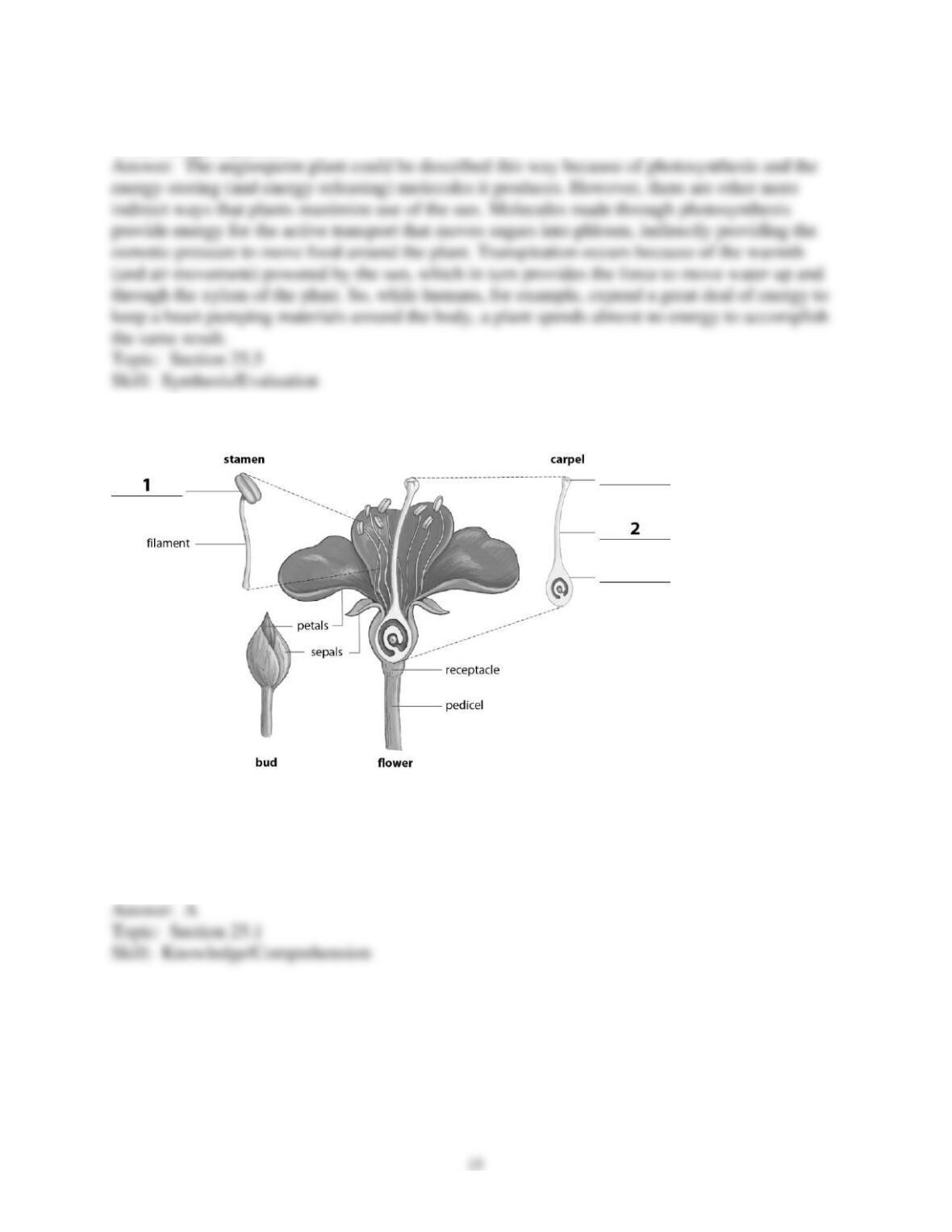
Refer to the figure below, and then answer the following question(s).
79) The missing label indicated by a “1” corresponds to the:
A) anther.
B) stigma.
C) style.
D) ovary.

80) The missing label indicated by a “2” corresponds to the:
A) anther.
B) stigma.
C) style.
D) ovary.