
Chapter 25 – Evolution of Development
Chapter 25
Evolution of Development
Fill in the Blank Questions
1. Marsupial moles and placental moles do not share a recent common ancestor but they are
both adapted to living underground, with similar body shape, reduced eyes, and spade-like
legs for digging. This is an example of _________________ evolution.
Chapter 25 – Evolution of Development
Clarify Question
•
What is the key concept addressed by the question?
•
What type of thinking is required?
•
What key words does the question contain and what do they mean?
Gather Content
•
What do you already know about convergent evolution?
Consider Possibilities
•
What other information is related to the question? Which information is most useful?
Choose Answer
•
Given what you now know, what information and/or problem solving approach is most
likely to produce the correct answer?
Reflect on Process
•
Did your problem-solving process lead you to the correct answer? If not, where did the
process break down or lead you astray? How can you revise your approach to produce a
more desirable result?
Chapter 25 – Evolution of Development
2. An alteration in the timing of a developmental event caused by a genetic mutation is called
________________.
3. The transformation of one body part into another caused by genetic mutation is called
________________.
4. Another name for analogous structures is _________________ structures.
Chapter 25 – Evolution of Development
5. A plant with its floral structures arranged around a central axis has _________________
flowers.
6. A gene that triggers lens formation in the eyes of both vertebrates and insects is the
_________________ gene.
7. Most mutations that affect developmental regulatory genes are ________________.
8. A protein that binds DNA at a specific promoter or enhancer region in order to regulate
RNA production is called a _________________ factor.
Chapter 25 – Evolution of Development
9. A major paradox of development is how highly _________________ genes can produce
diverse morphologies.
10. Indirect development in sea urchins involves the presence of a _________________
stage.
Multiple Choice Questions
11. A major biological paradox is that genes are generally highly conserved and yet
Chapter 25 – Evolution of Development
12. Genes with similar sequences in two different species, such as humans and mice
13. The development of eyes has been intensively studied. Eyes of vertebrates and insects are
14. Regarding genome sequences and organismal development, it is important to remember
that
Chapter 25 – Evolution of Development
15. The evolution of patterns on insect wings can be affected by all of the following functions
except
16. One of the reasons why the model systems of yeast, Arabidopsis, nematode worms, fruit
flies, and mice are so often used to study functional analysis of genes is because
17. Eyes in mammals and _____________ are examples of convergent evolution.
Chapter 25 – Evolution of Development
18. Eyes in different animal groups arose independently many times,
19. The Pax6 gene, responsible for initiating lens formation in mice, can be inserted into fruit
flies and
20. Experiments with ribbon worms and planaria have shown that
Chapter 25 – Evolution of Development
Check All That Apply Questions
21. Choose the true statements about HOX and MADS box genes.
Multiple Choice Questions
22. Experimental mutations in the timing of Hox gene expression cause lab mice to develop
deformed limbs. This is an example of
Chapter 25 – Evolution of Development
Clarify Question
•
What type of thinking is required?
•
What key words does the question contain and what do they mean?
Gather Content
•
What do you already know about heterochrony?
Consider Possibilities
•
Consider the different answer options. Which can you rule out?
Choose Answer
•
Given what you now know, what information and/or problem solving approach is most
likely to produce the correct answer?
Reflect on Process
•
Did your problem-solving process lead you to the correct answer? If not, where did the
process break down or lead you astray? How can you revise your approach to produce a
more desirable result?
Chapter 25 – Evolution of Development
Check All That Apply Questions
23. The change from indirect development to direct development in sea urchins illustrates the
following concepts: (choose all that apply)
Chapter 25 – Evolution of Development
Clarify Question
•
What is the key concept addressed by the question?
•
What type of thinking is required?
•
What key words does the question contain and what do they mean?
Gather Content
•
What do you already know about direct and indirect development in urchins?
Consider Possibilities
•
Consider the different answer options. Which can you rule out?
Choose Answer
•
Given what you now know, what information and/or problem solving approach is most
likely to produce the correct answer?
Reflect on Process
•
Did your problem-solving process lead you to the correct answer? If not, where did the
process break down or lead you astray? How can you revise your approach to produce a
more desirable result?
Multiple Choice Questions
24. The evolution of initiation of limb development in tetrapods is best explained by
25. The gene Brachyury promotes development of the notochord and the vertebrae in
vertebrate animals. Among the rodents, most species have a long tail, but capybaras have a
very short tail. What is the most likely difference you might expect to see for the Brachyury
gene in capybaras compared to long-tailed rodents?
Chapter 25 – Evolution of Development
Clarify Question
•
What is the key concept addressed by the question?
o This question addresses the gene Brachyury.
•
What type of thinking is required?
•
What key words does the question contain and what do they mean?
Gather Content
•
What do you already know about the gene Brachyury?
Consider Possibilities
•
Consider the different answer options. Which can you rule out?
Choose Answer
•
Given what you now know, what information and/or problem solving approach is most
likely to produce the correct answer?
Reflect on Process
•
Did your problem-solving process lead you to the correct answer? If not, where did the
process break down or lead you astray? How can you revise your approach to produce a
more desirable result?
Chapter 25 – Evolution of Development
26. The evolution of development of snout-length in cichlid fish is best explained by
27. The evolution of insect wing patterns is best explained by
Chapter 25 – Evolution of Development
28. The evolution of flower symmetry is best explained by
29. The evolution of petals through the AP3 gene is best explained by
Chapter 25 – Evolution of Development
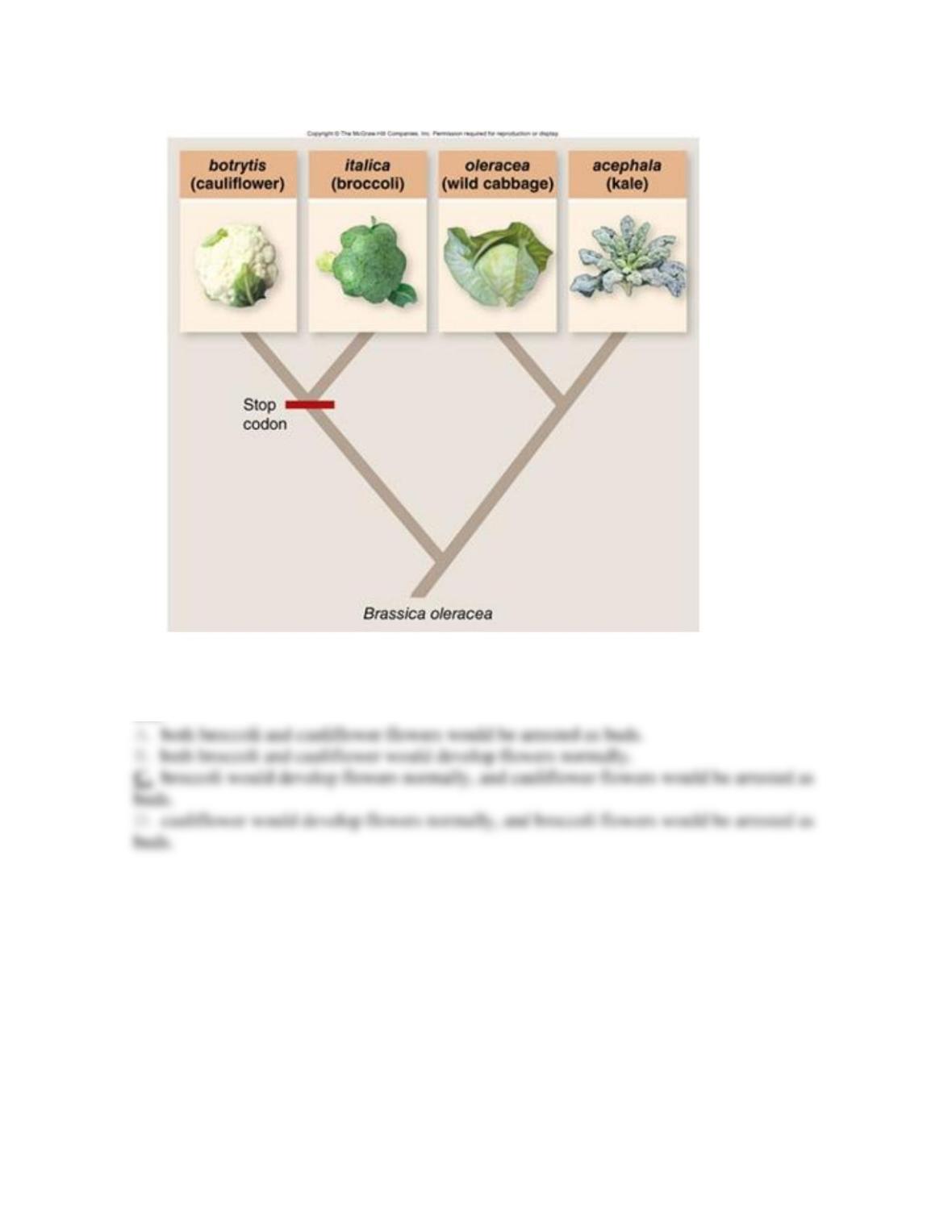
30. The development of cauliflower and broccoli from wild cabbage is partly explained by
Chapter 25 – Evolution of Development
31.
(Note the phylogeny is drawn with diagonal branches rather than the rectangular branches
seen in the text.) If the stop codon in the Brassica plant CAL gene appeared in the cauliflower
lineage after broccoli and cauliflower had diverged from each other, it would be expected
that
Chapter 25 – Evolution of Development
Clarify Question
•
What is the key concept addressed by the question?
•
What type of thinking is required?
•
What key words does the question contain and what do they mean?
Gather Content
•
What do you already know about the CAL gene?
Consider Possibilities
•
Consider the different answer options. Which can you rule out?
Choose Answer
•
Given what you now know, what information and/or problem solving approach is most
likely to produce the correct answer?
Reflect on Process
Chapter 25 – Evolution of Development
•
Did your problem-solving process lead you to the correct answer? If not, where did the
process break down or lead you astray? How can you revise your approach to produce a
more desirable result?
32. Salamanders normally go through a juvenile stage in which they have external gills. Most
salamanders lose these gills when they develop into adults, but axolotl salamanders retain
gills into adulthood by suppressing metamorphosis. This is an example of