Exam
Name___________________________________
MULTIPLE CHOICE. Choose the one alternative that best completes the statement or answers the question.
1) To insure their assets against hazards such as fire, storm damage, vandalism, earthquakes, and other natural
and environmental risks firms commonly purchase
A) key personnel insurance.
B) business liability insurance.
C) business interruption insurance.
D) property insurance.
2) To cover the costs that result if some aspect of the business causes harm to a third party or someone else’s
property a firm would purchase
A) business interruption insurance.
B) property insurance.
C) business liability insurance.
D) key personnel insurance.
3) To protect the firm against the loss of earnings if the business operations are disrupted due to fire, accident,
or some other insured peril a firm would purchase
A) property insurance.
B) key personnel insurance.
C) business liability insurance.
D) business interruption insurance.
4) Insurance that compensates for the loss or unavoidable absence of crucial employees in the firm is called
A) key personnel insurance.
B) business liability insurance.
C) property insurance.
D) business interruption insurance.
5) In reality market imperfections exist that can raise the cost of insurance above the actuarially fair price and
offset some of these benefits. These insurance market imperfections include all of the following except:
A) Adverse selection
B) Agency costs
C) Administrative and overhead costs
D) Taxation of insurance payments
6) Which of the following statements is false?
A) Not all insurable risks have a beta of zero. Some risks, such as hurricanes and earthquakes, create losses
of tens of billions of dollars and may be difficult to diversify completely.
B) When a firm buys insurance, it transfers the risk of the loss to an insurance company. The insurance
company charges an upfront premium to take on that risk.
C) By its very nature, insurance for non diversifiable hazards is generally a positive beta asset; the
insurance payment to the firm tends to be larger when total losses are low and the market portfolio is
high.
D) Because insurance provides cash to the firm to offset losses, it can reduce the firm’s need for external
capital and thus reduce issuance costs.
7) Which of the following statements is false?
A) Because insurance reduces the risk of financial distress, it can relax this tradeoff and allow the firm to
increase its use of debt financing.
B) By lowering the volatility of the stock, insurance discourage concentrated ownership by an outside
director or investor who will monitor the firm and its management.
C) When a firm is subject to graduated income tax rates, insurance can produce a tax savings if the firm is
in a higher tax bracket when it pays the premium than the tax bracket it is in when it receives the
insurance payment in the event of a loss.
D) In a perfect market without other frictions, insurance companies should compete until they are just
earning a fair return and the NPV from selling insurance is zero. The NPV is zero if the price of
insurance equals the present value of the expected payment; in that case, we say the price is actuarially
fair.
Use the information for the question(s) below.
Your firm faces an 8% chance of a potential loss of $50 million next year. If your firm implements new safety policies, it
can reduce the chance of this loss to 3%, but the new safety policies have an upfront cost of $250,000. Suppose that the
beta of the loss is 0 and the risk–free rate of interest is 5%.
8) If your firm is uninsured, the NPV of implementing the new safety policies is closest to:
A) $2.25 million
B) –$.25 million
C) $2.5 million
D) $2..15 million
9) If your firm is fully insured, the NPV of implementing the new safety policies is closest to:
A) $2..15 million
B) $2.5 million
C) $2.25 million
D) –$.25 million
ESSAY. Write your answer in the space provided or on a separate sheet of paper.
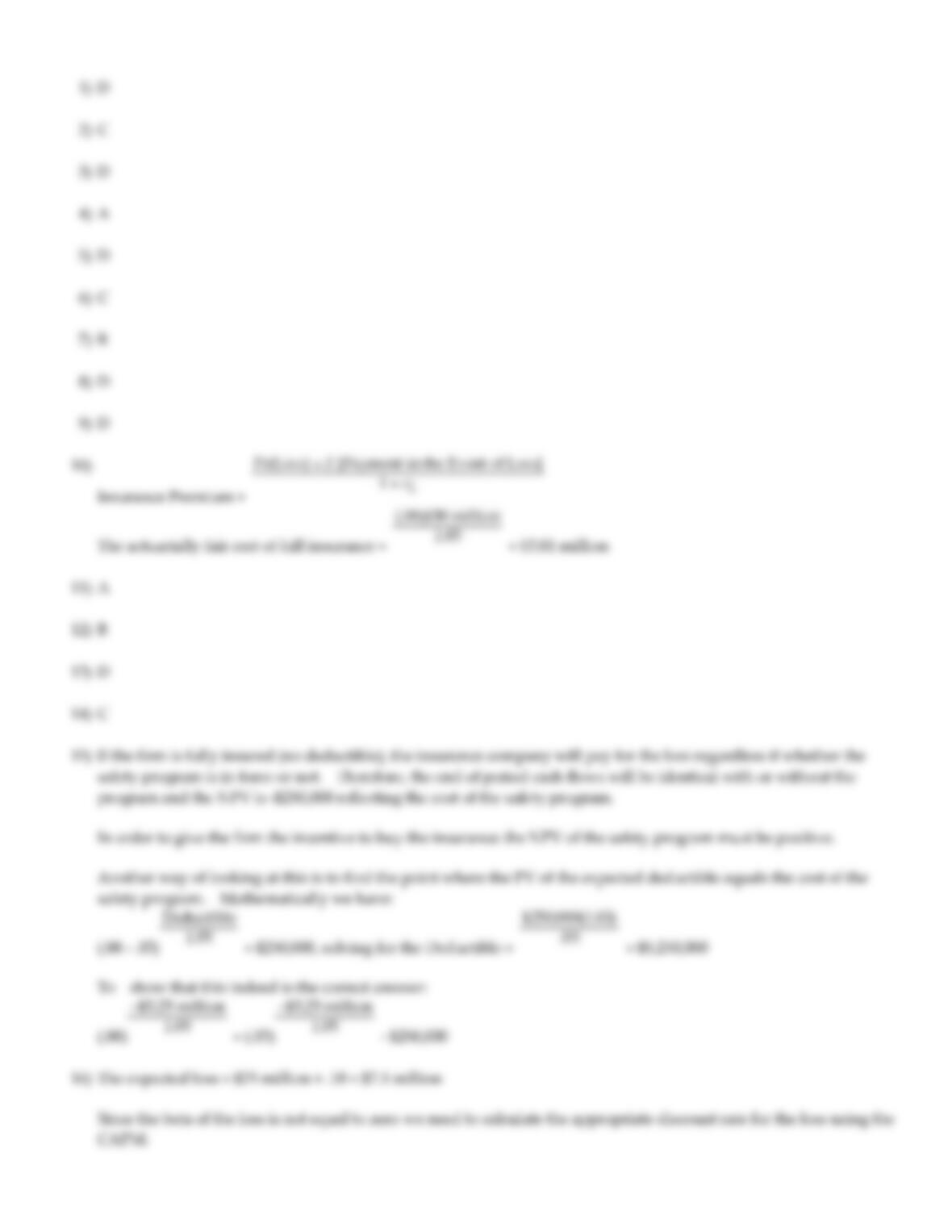
10) What is the actuarially fair cost of full insurance?
MULTIPLE CHOICE. Choose the one alternative that best completes the statement or answers the question.
11) An operator of an oil well has a 0.5% chance of experiencing a catastrophic failure. This failure will cost the
operator $500 million. If the risk–free rate is 2%, the expected return on the market is 8%, and the beta of the
risk is 0, what is the actuarially fair insurance premium?
A) $2,450,980
B) $2,500,000
C) $2,550,000
D) $2,314,815
12) An operator of an oil well has a 0.5% chance of experiencing a catastrophic failure. This failure will cost the
operator $500 million. If the risk–free rate is 2%, the expected return on the market is 8%, and the beta of the
risk is –1.2, what is the actuarially fair insurance premium?
A) $2,500,000
B) $2,637,131
C) $2,550,000
D) $2,753,304
13) The value of insurance comes from its ability to reduce the cost of ________ for the firm.
A) adverse selection
B) vertical integration
C) overhead
D) market imperfections
14) Insurance for large risks that cannot be well diversified has a ________, which increases its cost.
A) positive beta
B) moral hazard clause
C) negative beta
D) actuarially–biased risk
ESSAY. Write your answer in the space provided or on a separate sheet of paper.
Use the information for the question(s) below.
Your firm faces an 8% chance of a potential loss of $50 million next year. If your firm implements new safety policies, it
can reduce the chance of this loss to 3%, but the new safety policies have an upfront cost of $250,000. Suppose that the
beta of the loss is 0 and the risk–free rate of interest is 5%.
15) Assuming that your firm will purchase insurance, what is the minimum–size deductible that would leave
your firm with an incentive to implement the new safety policies?
16) Farmville Industries is a major agricultural firm and is concerned about the possibility of drought impacting
corn production. In the event of a drought, Farmville Industries anticipates a loss of $75 million. Suppose
the likelihood of a drought is 10% per year, and the beta associated with such a loss is 0.4. If the risk–free
interest rate is 5% and the expected return on the market is 10%, then what is the actuarially fair insurance
premium?
MULTIPLE CHOICE. Choose the one alternative that best completes the statement or answers the question.
17) The risk that the firm will not have, or be able to raise, the cash required to meet the margin calls on its
hedges is called
A) liquidity risk.
B) basis risk.
C) commodity price risk.
D) speculation risk.
18) The risk that arises because the value of the futures contract will not be perfectly correlated with the firm’s
exposure is called
A) commodity price risk.
B) basis risk.
C) liquidity risk.
D) speculation risk.
19) Which of the following statements is false?
A) Horizontal integration entails the merger of a firm and its supplier or a firm and its customer.
B) Like insurance, hedging involves contracts or transactions that provide the firm with cash flows that
offset its losses from price changes.
C) For many firms, changes in the market prices of the raw materials they use and the goods they produce
may be the most important source of risk to their profitability.
D) Because an increase in the price of the commodity raises the firm’s costs and the supplier’s revenues,
these firms can offset their risks by merging.
20) Which of the following statements is false?
A) Firms generally do not possess better information than outside investors regarding the risk of future
commodity price changes, nor can they influence that risk through their actions.
B) Cash flows are exchanged on a monthly basis, rather than waiting until the end of the contract, through
a procedure called marking to market.
C) The firm may speculate by entering into contracts that do not offset its actual risks.
D) When a firm authorizes managers to trade contracts to hedge, it opens the door to the possibility of
speculation.
21) Which of the following statements regarding futures contracts is false?
A) Both the buyer and the seller can get out of the contract at any time by selling it to a third party at the
current market price.
B) Futures prices are not prices that are paid today. Rather, they are prices agreed to today, to be paid in
the future.
C) Futures contracts are traded anonymously on an exchange at a publicly observed market price and are
generally very illiquid.
D) Traders are required to post collateral, called margin, when buying or selling commodities using
futures contracts.
22) Which of the following statements regarding long–term supply contracts is false?
A) The market value of the contract at any point in time may not be easy to determine, making it difficult
to track gains and losses.
B) Long–term supply contracts are designed to eliminate credit risk.
C) Long–term supply contracts insulate the firms from commodity price risk.
D) Long–term supply contracts are bilateral contracts negotiated by a buyer and a seller.
23) Which of the following statements is false?
A) Long–term supply contracts such contracts cannot be entered into anonymously; the buyer and seller
know each other’s identity. This lack of anonymity may have strategic disadvantages.
B) A futures contract is an agreement to trade an asset on some future date, at a price that is locked in
today.
C) An alternative to vertical integration or storage is a long–term supply contract.
D) Long–term supply contracts are unilateral contracts negotiated by a seller.
24) Firms use all of the following for reducing their exposure to commodity price movements EXCEPT:
A) horizontal integration.
B) vertical integration.
C) long–term storage of inventory.
D) futures contracts.
25) Which of the following is an agreement to trade an asset on some future date, at a price that is fixed today?
A) Margin
B) Futures Contract
C) Notional Contract
D) Interest Rate Swap
26) A manufacturer of breakfast cereal is concerned about corn prices. The firm anticipates needing 1 million
bushels of corn in one month. The current price of corn is $6.50 per bushel and the futures price for delivery
in one month is $7.00 per bushel. The cost to store the corn for 1 month is $100,000. What should the firm
do?
A) Hedge with futures for a total cost of $7,000,000.
B) Hedge with futures for a total cost of $6,900,000.
C) Buy the corn now and store for 1 month, for a total cost of $6,500,000.
D) Buy the corn now and store for 1 month, for a total cost of $6,600,000.
27) A steel maker needs 5,000,000 tons of coal next year. The current market price for coal is $70.00 per ton. At
this price, the firm expects its EBIT to be $500 million. What will the firm’s EBIIT if the firm enters into a
supply contract for coal for a fixed price of $72.00 per ton?
A) $500 million
B) $510 million
C) $490 million
D) $350 million
ESSAY. Write your answer in the space provided or on a separate sheet of paper.
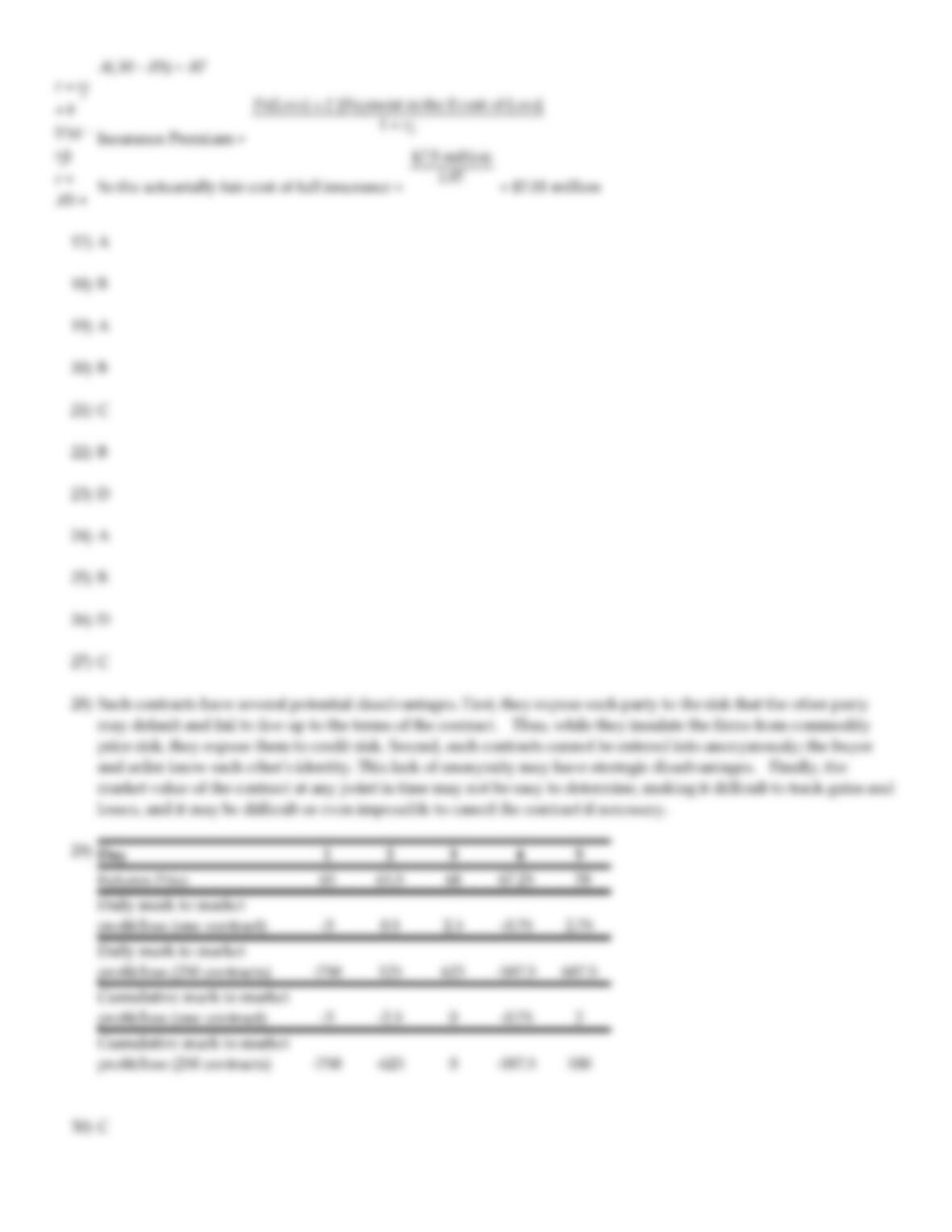
28) What are some of the disadvantages of long–term supply contracts?
29) Your oil refinery will need to buy 250,000 barrels of crude oil in one week and it is worried about crude oil
prices. Suppose you go long 250 crude oil futures contracts, each for 1000 barrels of crude oil, at the current
futures price of $68 per barrel. Suppose futures prices change each day over the next week as follows:
Day
1
2
3
4
5
Futures Price
65
65.5
68
67.25
70
What is the daily and cumulative mark to market profit or loss (in dollars) that you will have on each of the
next five days?
MULTIPLE CHOICE. Choose the one alternative that best completes the statement or answers the question.
30) Which of the following statements is false?
A) We can measure a firm’s sensitivity to interest rates by computing the duration of its balance sheet.
B) Just as the interest rate sensitivity of a single cash flow increases with its maturity, the interest rate
sensitivity of a stream of cash flows increases with its duration.
C) By restructuring the balance sheet to increase its duration, we can hedge the firm‘s interest rate risk.
D) A firm’s market capitalization is determined by the difference in the market value of its assets and its
liabilities.
31) Which of the following statements is false?
A) As interest rates change, the market values of the securities and cash flows in the portfolio change as
well, which in turn alters the weights used when computing the duration as the value–weighted
average maturity.
B) The duration of a portfolio of investments is the simple average of the durations of each investment in
the portfolio.
C) Adjusting a portfolio to make its duration neutral is sometimes referred to as immunizing the portfolio,
a term that indicates it is being protected against interest rate changes.
D) When the durations of a firm’s assets and liabilities are significantly different, the firm has a duration
mismatch.
32) Which of the following statements is false?
A) Interest rate swaps are an alternative means of modifying the firm’s interest rate risk exposure without
buying or selling assets.
B) A portfolio with a negative duration is called a duration–neutral portfolio or an immunized portfolio,
which means that for small interest rate fluctuations, the value of equity should remain unchanged.
C) Maintaining a duration–neutral portfolio will require constant adjustment as interest rates change.
D) A duration–neutral portfolio is only protected against interest rate changes that affect all yields
identically.
33) Which of the following statements is false?
A) The swap contract—like forward and futures contracts—is typically structured as a “zero–cost” security.
B) An interest rate swap is a contract entered into with a bank, much like a forward contract, in which the
firm and the bank agree to exchange the coupons from two different types of loans.
C) In a standard interest rate swap, one party agrees to pay coupons based on a fixed interest rate in
exchange for receiving coupons based on the prevailing market interest rate during each coupon
period.
D) If short–term interest rates were to fall while long–term rates remained stable, then short–term securities
would fall in value relative to long–term securities, despite their shorter duration.
34) Which of the following statements is false?
A) Corporations use interest rate swaps routinely to alter their exposure to interest rate fluctuations.
B) The value of a swap, while initially zero, will fluctuate over time as interest rates change.
C) An interest rate that adjusts to current market conditions is called a floating rate.
D) When interest rates rise, the swap’s value will rise for the party receiving the fixed rate; conversely, it
will fall for the party paying the fixed rate.
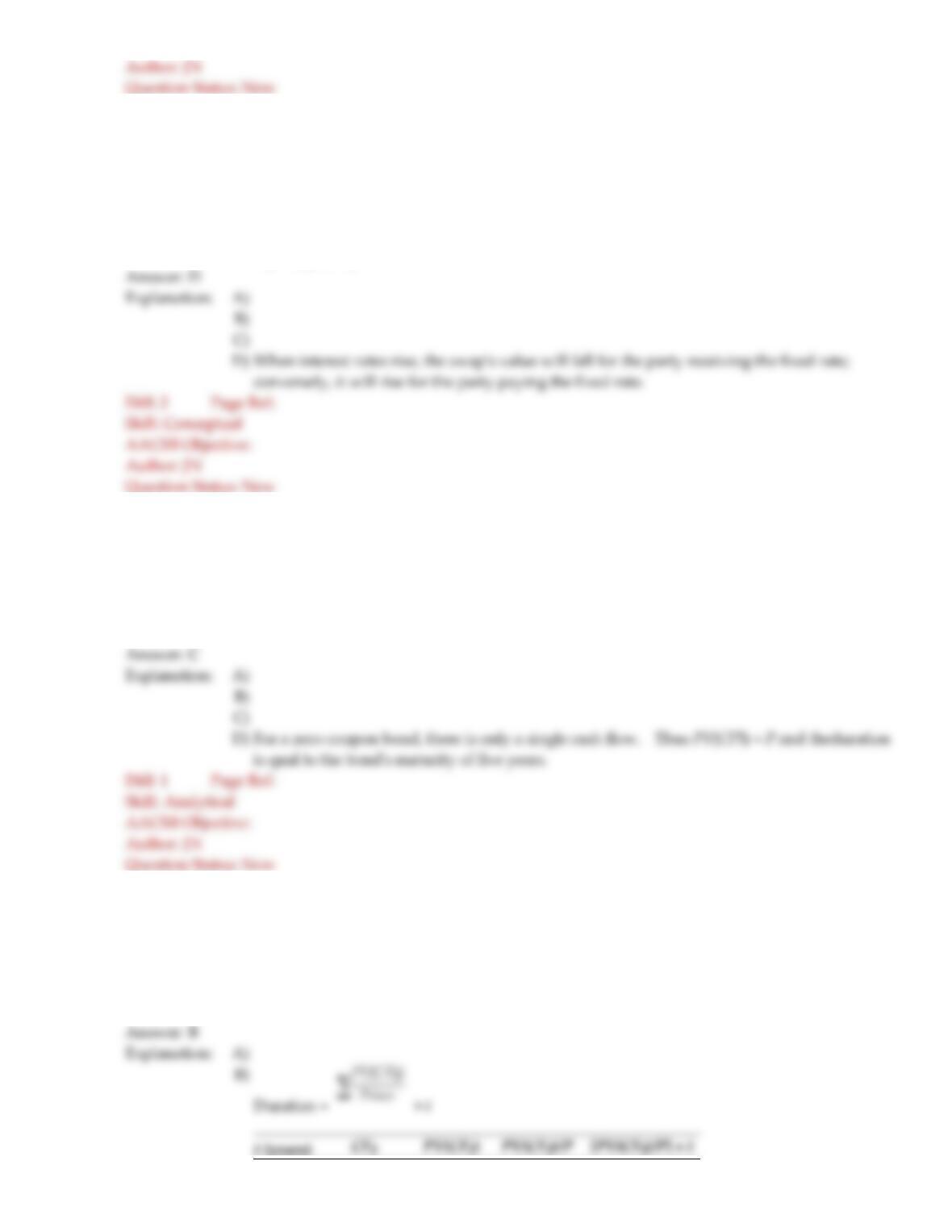
35) What is the duration of a five–year zero–coupon bond?
A) 2.5 Years
B) 1 Year
C) 5 Years
D) 0 Years
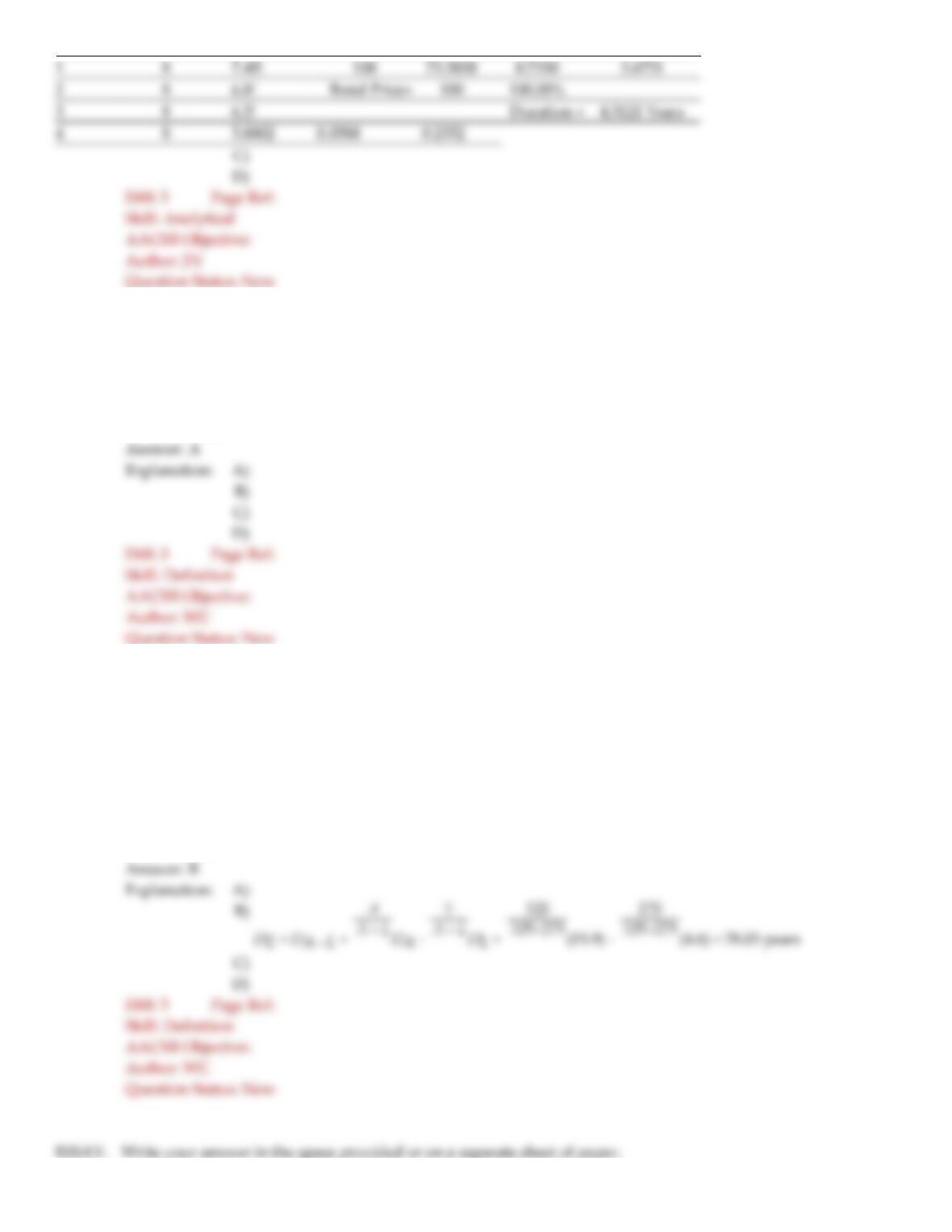
36) The duration of a five–year bond with 8% annual coupons trading at par is closest to:
A) 2.5 Years
B) 4.3 Years
C) 5.0 Years
D) 6.2 Years
37) An interest rate that adjusts to current market conditions is called a ________.
A) floating rate.
B) fixed rate.
C) notional rate.
D) arbitrage rate.
38) An S&L owns mortgages hat have a current market value of $325 million. The duration of this portfolio of
mortgages is 15.9 years. The S&L finances its mortgages by issuing CDs and the current value of these
liabilities is $275 million. The duration of these liabilities is 4.6 years. What is the initial duration of the
equity for the S&L?
A) 103.25 years
B) 78.05 years
C) 25.30 years
D) 53.00 years
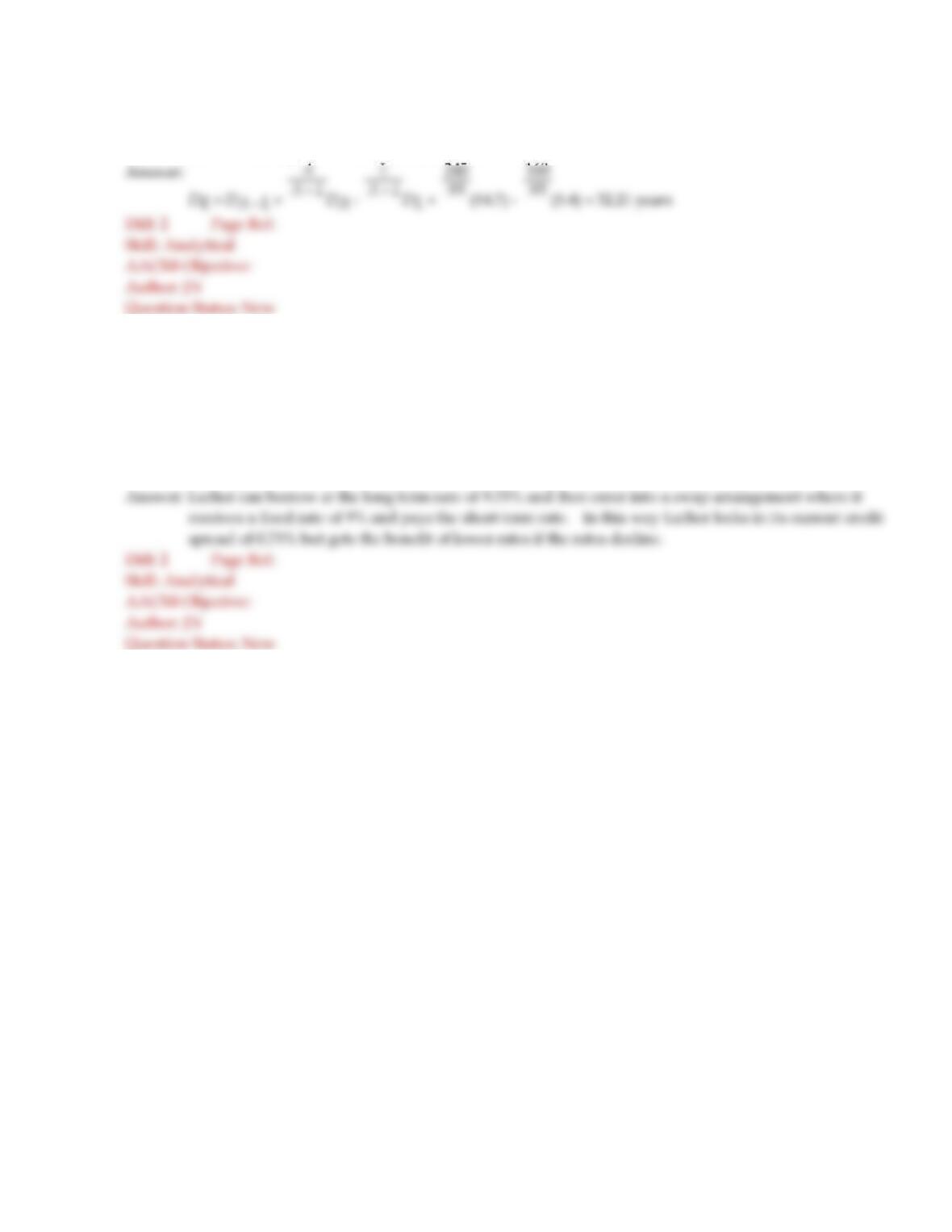
39) The Century 22 fund has invested in a portfolio of mortgaged backed securities that has a current market
value of $245 million. The duration of this portfolio of mortgaged back securities is 14.7 years. The fund
has borrowed to purchase these securities, and the current value of its liabilities (i.e., the current value of the
bonds Century 22 has issued) is $160 million. The duration of these liabilities is 5.4 years. What is the
initial duration of the equity for the Century 22 fund?
40) Luther Industries needs to borrow $50 million in cash. Currently long–term AAA rates are 9%. Luther can
borrow at 9.75% given its current credit rating. Luther is expecting interest rates to fall over the next few
years, so it would prefer to borrow at the short–term rates and refinance after rates have dropped. Luther
management is afraid, however, that its credit rating may fall which could greatly increase the spread the
firm must pay on new borrowings. How can Luther benefit from the expected decline in future interest
rates without exposure to the risk of the potential future changes to its credit ratings bring?