
Elements of Ecology, 9e (Smith)
Chapter 25 Coastal and Wetland Ecosystems
25.1 Short Answer Questions
1) All coastal shores have one feature in common: they are alternately exposed and submerged
by the ________.
2) The ________ fringe occurs above the ocean along a rocky shoreline and is contacted by
saltwater only once every two weeks during spring tides.
3) The ________ zone of a rocky shoreline is submerged and exposed by tides daily.
4) Organisms living on the sediment surface of sandy and muddy beaches are collectively
referred to as ________.
5) Tiny organisms living between the particles of sand and mud on beaches are collectively
referred to as ________.
6) Bacterial decomposition on sandy beaches is most rapid at ________ tide.
7) A salt ________ refers to a herbaceous plant community thriving in the intertidal zone,
typically along the fringe of estuaries and islands along the coast at temperate latitudes.

8) ________ forests typically grow in the intertidal zone of tropical coasts where wave action is
absent, sediments accumulate, and the muds are anoxic.
9) The root extensions of mangroves are called ________.
10) Mangroves forests cover up to ________ percent of the Earth’s coastlines.
11) ________ plants are adapted to grow in water or on soil that is periodically anaerobic
because of excess water.
12) Seasonally flooded, forested wetlands along river systems are referred to as bottomlands or
________ woodlands.
13) Wetlands in which considerable amounts of water are retained by an accumulation of
partially decayed organic matter are referred to as ________.
14) The duration, frequency, depth, and season of flooding of a freshwater period are collectively
referred to as the ________.

25.2 Multiple-Choice Questions
1) The intertidal zone is defined by
A) being a marine environment.
B) containing starfish.
C) being continually exposed and submerged by the ocean.
D) rocky shores.
2) Which zone is also known as the spray zone?
A) infralittoral zone
B) littoral zone
C) midlittoral zone
D) supralittoral zone
3) The part of a rocky shore in which barnacles, oysters, mussels, limpets, and brown algae are
most common is called the
A) littoral or intertidal zone.
B) infralittoral or subtidal zone.
C) supralittoral or supratidal zone.
D) superlittoral or supertidal zone.
4) In tidal pools,
A) oxygen concentrations are usually higher during the day than during the night.
B) carbon dioxide concentrations are usually higher during the day than during the night.
C) salinity is usually higher during the night than during the day.
D) temperature is usually higher during the night than during the day.
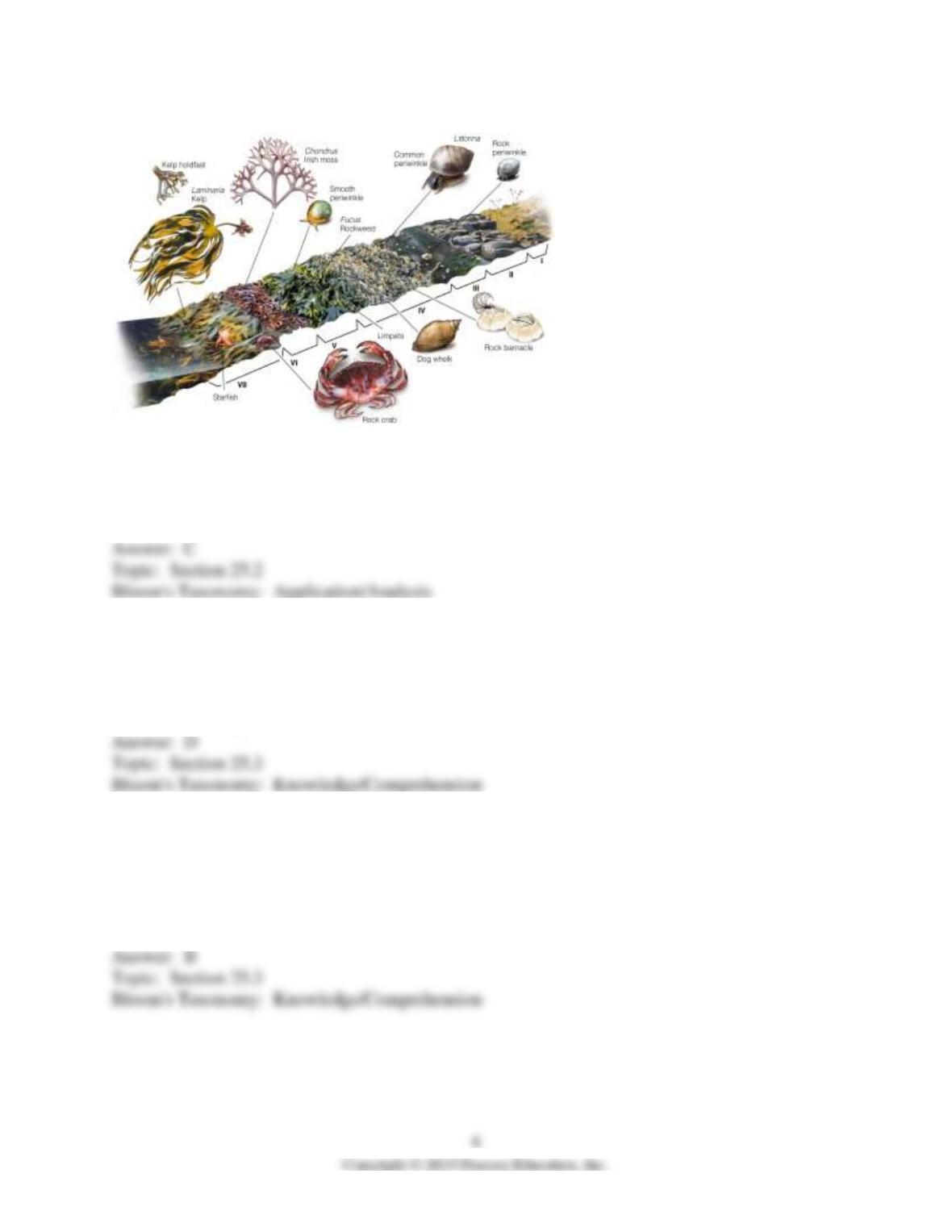
5)
Fucus is found in the
A) infralittoral zone.
B) subtidal zone.
C) midlittoral zone.
D) supralittoral zone.
6) In comparison to rocky coasts, intertidal organisms living on sandy or muddy beaches
A) experience greater variability in salinity.
B) experience greater variability in temperature.
C) are more likely to be attached to the substrate.
D) are more likely to move back and forth with the tides.
7) ________ are the detrital-feeding organisms responsible for the conspicuous coiled and cone-
shaped casts found on sandy beaches.
A) Gastropod mollusks
B) Lugworms
C) Nematodes
D) Polychaete worms

8) The major food sources for both deposit-feeding and filter-feeding organisms are
A) zooplankton.
B) zooanthellae.
C) phytoplankton.
D) bacteria.
9) What is true regarding sandy shores?
A) There are rich biota on the sand surface.
B) Tidal patterns exist.
C) Sea urchins live in this environment.
D) They are much cooler than ocean environments.
10) What is an important attribute of the cordgrass Spartina?
A) It is fast-growing.
B) It is desiccation-resistant.
C) It is salt-tolerant.
D) It lives primarily under water.
11) Salt marshes
A) occur mostly in temperate latitudes.
B) are inhabited by plants that often have root extensions rising above the water.
C) are always submerged, except during the lowest of low tides.
D) are important nurseries for fish.
12) Cordgrass (Spartina), glassworts (Salicornia), and spearscale (Atriplex) are types of plants
commonly found in
A) bogs.
B) salt marshes.
C) mangroves.
D) riparian forests.

13) In salt marshes, predatory fish move in when
A) the tide is high.
B) migratory fishes are spawning.
C) the sun goes down.
D) salinity is low.
14) Compared to low tidal marshes, high tidal marshes are characterized by
A) lower salinity.
B) decreased input of nutrients.
C) higher tidal exchange rates.
D) a phenotypically taller, greener cordgrass (Spartina).
15) The ability to live in a semi-submerged state, have a high salinity tolerance, and possess
hollow tubes for root oxygenation best describes the dominant eastern North American tidal
plant
A) bald cypress (Taxodium distichum).
B) bayberry (Myrica pensylvanica).
C) cordgrass (Spartina alterniflora).
D) rockweed (Fucus spp.).
16) Intertidal mud flats in tropical regions are typically composed of
A) salt marshes.
B) peatlands.
C) mangrove forests or mangals.
D) oysterbeds.
17) Mangrove swamps
A) are formed by a single species of tree adapted to variable salinities.
B) have relatively anoxic soils.
C) occur mostly in temperate latitudes.
D) typically occur along rocky coastlines subjected to heavy wave action.

18) Mangrove forests are found primarily in
A) tropical areas.
B) freshwater areas.
C) eutrophic areas.
D) cold-water areas.
19) Which plants are known for their pneumatophores?
A) cattails
B) ash trees
C) mangroves
D) Spartina
20) A wetland with trees is called a
A) marsh.
B) swamp.
C) fen.
D) bog.
21) Herbaceous vegetation such as reeds, sedges, grasses, and cattails typically grow in
freshwater
A) marshes.
B) swamps.
C) riparian woodlands.
D) peatlands or mires.
22) Freshwater wetlands dominated by woody vegetation are referred to as
A) swamps.
B) marshes.
C) mangrove forests or mangals.
D) prairie potholes.

23) Bogs formed when a lake basin fills in from above rather than from below, creating a
floating mat of peat over open water, are called
A) fens.
B) blanket mires.
C) moors.
D) quaking bogs.
24) Which of the following mismatches a wetland with its location?
A) the Everglades-Florida
B) the Fens-England
C) the Okavango-Egypt
D) the Pantanal-Brazil
25) What type of wetlands would be found adjacent to the Missouri River?
A) fringe wetlands
B) mires
C) bogs
D) bottomlands
26) Which wetland type is known for low pH?
A) fringe wetlands
B) mires
C) bogs
D) bottomlands
27) What is formed when an accumulation of peat rises above the surrounding landscape?
A) moors
B) fens
C) mires
D) marshes
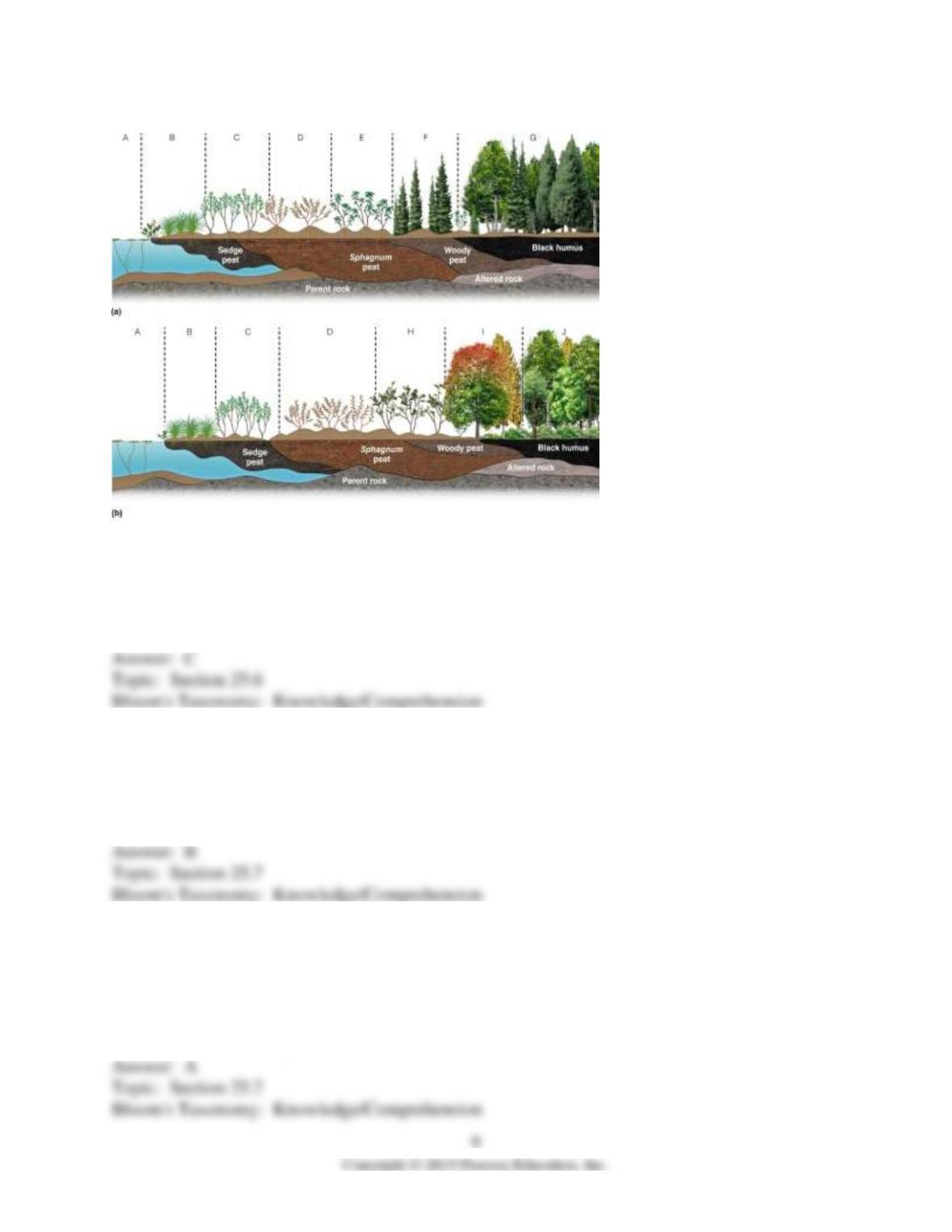
28)
The floating peat over open water makes this habitat a
A) swamp.
B) marsh.
C) bog.
D) fen.
29) The hydroperiod of a wetland is longest for
A) riverine wetlands.
B) basin wetlands.
C) fringe wetlands.
D) coastal wetlands.
30) Peatlands differ from other wetlands in that
A) the rate of organic production exceeds the rate of decomposition.
B) there is no outflow of water, resulting in increasing salinities.
C) they are seasonal, filling with water during the wet season and drying out during the dry
season.
D) they have a two-way flow of water due to tidal action.

31) Peat bogs and mires generally form under ________ conditions.
A) only dystrophic
B) only eutrophic
C) both dystrophic and oligotrophic
D) both oligotrophic and eutrophic
32) Which area is best known for its large effect of hydroperiod?
A) bottomlands
B) prairie potholes
C) fens
D) bogs
33) Sphagnum is an important component of which system?
A) bottomlands
B) peatlands
C) swamps
D) marshes
34) Freshwater wetlands are important in supporting
A) waterfowl.
B) aquatic invertebrates.
C) amphibians.
D) all of the above.
35) The installation of tile drainage systems on farms removes wetlands from the Midwestern
landscape. This with the loss of coastal marshes in the South are dramatically impacting
A) migratory waterfowl.
B) blue crabs.
C) salmon.
D) crayfish.

25.3 True/False Questions
1) Shoreline communities exhibit strong zonation.
2) On rocky shores, shallow pools produced by ebbing tides maintain the same temperature and
salinity as the open ocean.
3) In tidal pools, carbon dioxide concentrations are higher during the day than during the night.
4) Most organisms in the intertidal zone of sandy shores burrow into the sand.
5) The diversity of organisms is greater in the intertidal zone of rocky shores than in sandy and
muddy shores.
6) Salinity is more variable in the intertidal zone of rocky shores than in sandy and muddy
shores.
7) The meiofauna of a sandy beach are organisms living on the surface of sediments.
8) Salt marshes occur mostly below the intertidal zone and are exposed only during very low
tides.

9) Bird and mammal predators are more common in salt marshes during low tide than during
high tide.
10) Cordgrass (Spartina alterniflora) can be found in different forms, such as tall in the low
marsh environment and short in the high marsh environment. This response to environmental
conditions is an example of genotypic plasticity.
11) Ribbed mussels (Modiolus demissus), fiddler crabs (Uca spp.), and marsh periwinkles
(Littorina spp.) are the dominant animals of a high salt marsh.
12) The roots of mangrove trees often have extensions called pneumatophores that facilitate
oxygen absorption by the roots.
13) The environment surrounding the roots of mangrove trees provides a sheltered nursery for
the larvae and juvenile crabs, shrimp, and fish.
14) Because bogs depend on precipitation for nutrient inputs, they are highly deficient in mineral
salts and are low in pH.
15) Riverine wetlands usually have a longer hydroperiod than basin wetlands.
16) Wetlands subjected to a long hydroperiod support more submerged and deep-water
emergents than wetlands with a shorter hydroperiod.

17) The dominant herbivore in prairie marshes is the muskrat (Ondatra zibethicus).
18) The Everglades National Park is one of the smallest natural wetlands in the world.
25.4 Essay Questions
1) Name three ecological zones within a rocky shore, and discuss the different forms of life that
occur in each.
2) Compare the physical conditions to which intertidal organisms must adapt in sandy and rocky
shores.
3) Describe the effects of tides on the composition of animal communities in salt marshes.
4) Describe how tides and salinity dictate the structure of salt marshes.
5) Discuss the adaptations of mangrove trees to their environment.
6) Discuss the flow of water and nutrients in three topographic types of wetlands.
7) For what reasons have humans drained wetlands in the past, and what valuable services are we
losing when we drain a wetland?