Chapter 25—Bankruptcy and Financial Distress
MULTIPLE CHOICE
1. Bankruptcy occurs when:
a.
a firm experiences economic failure.
b.
a firm is unable to pay its liabilities as they come due and is facing a liquidity crisis.
c.
a firm’s liabilities exceed the fair market value of its assets.
d.
a firm comes under the authority of a bankruptcy court.
e.
all of the above.
2. Which of the following is the primary cause of business failure?
a.
corporate maturity
b.
inadequate cash flow planning
c.
overexpansion
d.
economic failure
e.
financial distress
3. A firm has reached a voluntary settlement with its creditors. The firm has outstanding debt of $3.5
million and has agreed to pay all creditors in full in six periodic installments. This arrangement would
be classified as:
a.
an extension
b.
a composition
c.
a combination
d.
a creditor controlled reorganization
e.
a voluntary liquidation
4. In order to satisfy the claims of all its creditors, a firm has arranged to pay 75 cents on the dollar
immediately. This voluntary settlement would be classified as:
a.
a voluntary liquidation
b.
an extension
c.
a composition
d.
a recapitalization
e.
a combination
5. A firm involved in a voluntary reorganization has outstanding debt of $od. The firm has agreed to pay
one group of creditors, to which r1 percent of the debt is owed, d1 cents on the dollar immediately.
The remaining creditors will be paid d2 cents on the dollar in three equal monthly installments
beginning in t days. This plan would be classified as __________ and would involve cash payments
totaling __________.
a.
a combination of extension and composition; $s2
b.
a composition; $s1
c.
an extension; $s1
d.
a combination extension and composition; $s

e.
a composition; $s
6. Which chapter of the Bankruptcy Reform Act of 1978 includes the rules about priority that determine
the order in which creditor claims are to be paid?
a.
25
b.
7
c.
13
d.
11
e.
12
7. Reorganization plans under the unanimous consent procedure (UCP):
a.
are detailed in Chapter 7, Section 25.5 of the Bankruptcy Reform Act of 1978.
b.
yield a division of the company’s value equivalent to what would occur under the absolute
priority rule (APR) of a Chapter 7 liquidation.
c.
can only be employed by solvent companies.
d.
require all creditors and equity holders to consent unanimously to the plan.
e.
require a company to equally weight creditors and equity holders when reorganizing.
8. You must decide whether your firm should be reorganized or liquidated. Reorganization will require
issuance of $ri of new equity, while if the company were liquidated $l would be available to its
common stockholders. If, after reorganizing, the annual earnings for your company are projected to be
$ae and the company would trade at a price/earnings ratio of r, you should suggest the firm be
__________, because the firm’s common stock value would be __________ greater than the
alternative.
a.
reorganized; $ans
b.
reorganized; $ri
c.
reorganized; $ae
d.
liquidated; $ae
e.
liquidated; $ans
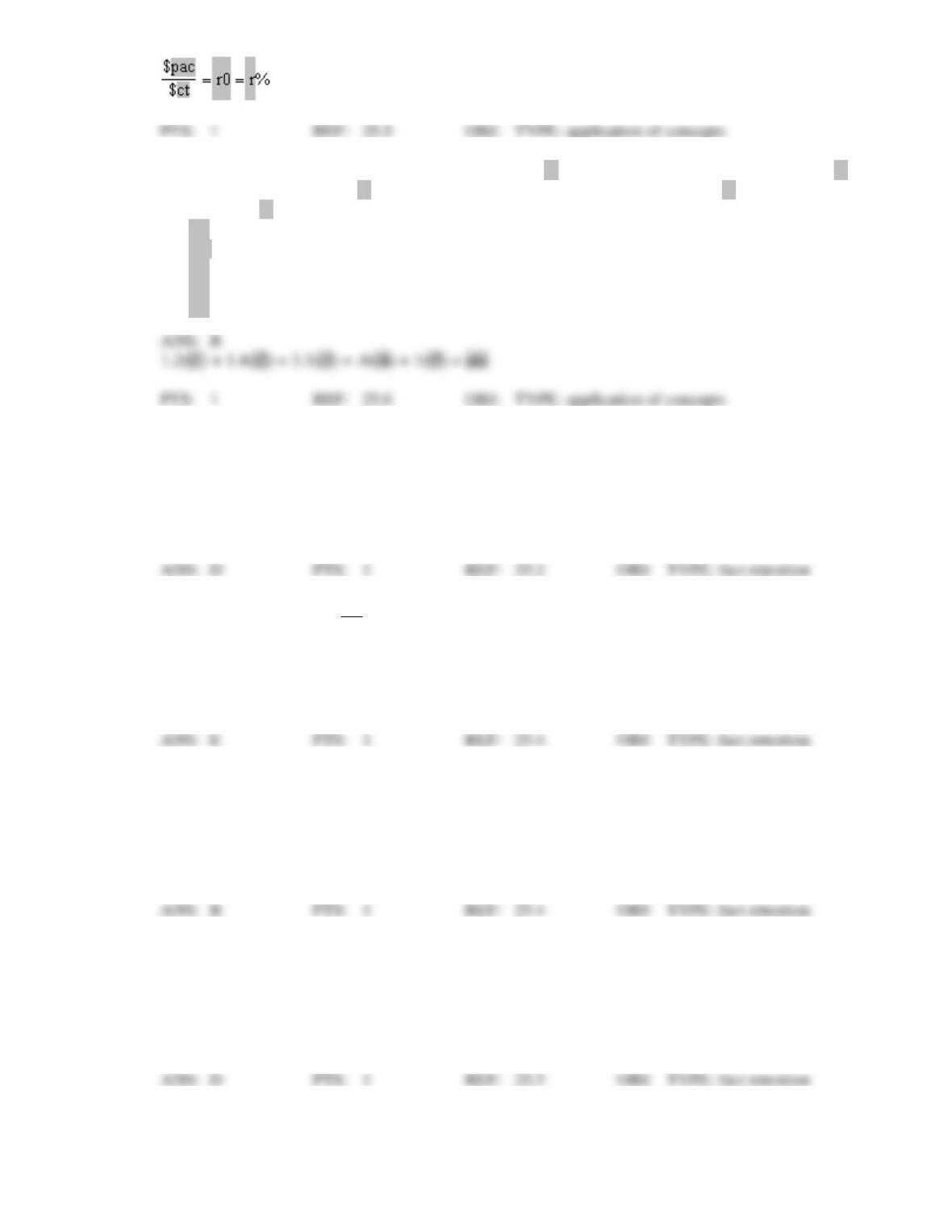
9. Bu-Buy owes $o million and has a market value of assets of $mv million. Bankruptcy administration
costs of $bac, unpaid wages of $w, and other payments have resulted in $pac million in funds available
for unsecured creditors, whose claims total $ct million. Because there are no subordinated claims, the
settlement rate for the unsecured creditors is:
a.
w1 percent
b.
r percent
c.
w2 percent
d.
w3 percent
e.
w4 percent
10. XY Company has a working capital/total assets ratio of r1, a retained earnings/total assets ratio of r2,
an EBIT/total assets ratio of r3, a market value of equity-to–book value of debt of r4, and a sales/total
assets ratio of r5. XY’s Z score is __________, and its probability of failure is __________.
a.
w1; high
b.
ans; unsure
c.
w2; unlikely
d.
w3; unsure
e.
w4; high
11. The objective of the __________ process is to recover as much per dollar owed as possible.
a.
involuntary reorganization
b.
bankruptcy
c.
credit control
d.
voluntary liquidation
e.
reorganization
12. Which of the following is not a step in reorganization under Chapter 11 of the bankruptcy laws?
a.
appointment
b.
development and approval of a reorganization plan
c.
payment of expenses
d.
filing
e.
none of the above
13. The key portion of the reorganization plan generally concerns this firm’s __________.
a.
expenses
b.
capital structure
c.
revenues
d.
general creditors
e.
all of the above
14. Which of the following claims has the highest priority in the bankruptcy procedures?
a.
claims of secured creditors
b.
taxes legally due
c.
unpaid employee benefit plan contributions
d.
wages of not more than $2,000 per worker
e.
claims of farmers in a grain-storage facility
15. Once the court approves the __________, the liquidation is complete.
a.
bankruptcy
b.
reorganization
c.
recapitalization
d.
unanimous consent procedure (UCP)
e.
final accounting
16. Technical insolvency occurs when:
a.
a firm fails to earn a return greater than its cost of capital
b.
a firm’s assets are greater than its liabilities but it is unable to pay liabilities as they come
due
c.
the fair market value of assets is less than the firm’s liabilities
d.
a firm enters bankruptcy court and effectively surrenders control to a bankruptcy judge
e.
a firm breaks a technical covenant in its bond indenture
17. Under a cramdown procedure
a.
all creditors agree to accept a lessened amount
b.
debtors are forced to accept equity in forgiveness of the debt
c.
creditors and equity classes consent unanimously to the reorganization plan
d.
companies in bankruptcy proceedings prepare a reorganization plan negotiated and voted
on by creditors and stockholders before the company files for Chapter 11
e.
the bankruptcy court may approve a reorganization plan if at least one class of creditors
voted for reorganization, as long as each dissenting class is treated fairly and equitably
18. Which of the following is the correct relative order of the priority of claims? Rank from highest to
lowest priority.
a.
Expenses in administering the bankruptcy proceedings; Wages less than $a per worker
prior to bankruptcy; Unsecured customer deposits less than $b; Federal Taxes; Secured
creditors; Preferred stockholders; Common stockholders
b.
Preferred stockholders; Expenses in administering the bankruptcy proceedings; Wages less
than $a per worker prior to bankruptcy; Unsecured customer deposits less than $b; Federal
Taxes; Secured creditors; Common stockholders
c.
Federal Taxes; Secured creditors; Expenses in administering the bankruptcy proceedings;
Wages less than $a per worker prior to bankruptcy; Unsecured customer deposits less than
$b; Preferred stockholders; Common stockholders; Secured creditors; Federal Taxes
d.
Expenses in administering the bankruptcy proceedings; Wages less than $a per worker
prior to bankruptcy; Unsecured customer deposits less than $b; Preferred stockholders;
Common stockholders
19. Using the Altman’s Z score, you determine the Z score is 1.7. The correct interpretation of this score
is
a.
The firm has a low probability of failure within two years
b.
The firm has an unsure probability of failure within two years
c.
The firm has a high probability of failure within two years
d.
Altman’s Z is only useful for forecasting within one year
20. Concerning creditor versus debtor rights, the United States is closest to the _________ model.
a.
British
b.
French
c.
German
d.
Chinese
21. When valuing a firm in bankruptcy, credits want a ______ firm value and managers and equity holders
want a _______ firm value.
a.
Low; low
b.
High; high
c.
Low; high
d.
High; low
22. The Abuse Prevention and Consumer Protection Act of 2005
a.
Increased the power of creditors
b.
Increased the power of debtors
c.
Increased the pay of lawyers in bankruptcy proceedings
d.
Lengthened the bankruptcy process
MATCHING
Match each term with its best description:
a.
economic failure
b.
technical insolvency
c.
insolvency bankruptcy
d.
bankruptcy
e.
financial distress
1. occurs when a firm is unable to pay its liabilities, even though it has positive net worth
2. firm’s liabilities exceed the fair market value of its assets
3. technically occurs only when a company enters bankruptcy court
4. primary cause of business failure
5. firm fails to earn a return that is greater than its cost of capital
Match the term with the appropriate description:
a.
Extension
b.
Composition
c.
Creditor control
d.
Assignment
6. Passing the power to liquidate the firm’s assets to an adjustment bureau, a trade association, or a third
party
7. Replacement of the operating management with a committee taking control of the firm and operating it
until all claims have been settled
8. An arrangement wherein the firm’s creditors are promised payment in full, although not immediately
9. A pro rata cash settlement of creditor claims
SHORT ANSWER
1. Explain the concept of debtor in possession (DIP) and the DIP’s role in the liquidation/reorganization
decision. Why might a creditor object to management remaining the debtor in possession if the firm
value is considerably less than outstanding liabilities?
2. The process of financial distress leads to many clear costs related to attorney’s fees and potential losses
in value if illiquid assets need to be sold quickly at ‘fire-sale’ prices. Discuss two ‘indirect’ costs of
financial distress that TV’s-R-Them (a large television manufacturer) might face as it falls on hard
times and has difficulty meeting its financial obligations. (Hint: Consider TV’s-R-Them’s relationship
with its customers and suppliers.)
3. Discuss why a unanimous consent procedure (UCP) cannot be used when a firm is insolvent.
4. Explain the primary benefits of a prepackaged bankruptcy and discuss a situation in which a
prepackaged bankruptcy might be most likely to occur.
5. UnderWater Inc. distributes scuba gear to a small region in California. Unfortunately, recent history
has forced UnderWater to liquidate and close it doors for business. The liquidation value of assets is
$al. The following facts regarding claimants remain:
•
Liabilities of $l
•
Bankruptcy administration costs of $bac
•
Wages of $w (= $a per employee b employees)
•
Secured debt claims of $sd
•
Unpaid prior dividends of $upd
-Bankruptcy admin. Costs
-Wages
How much will unsecured creditors receive in the liquidation?
6. Altman’s Z score is often used to predict financial distress. In general, discuss at least one problem that
you might expect to observe with the use of Altman’s Z score related to its extensive use of accounting
data. Is this problem mitigated by any other aspects of the Z score’s construction?
7. Identify the types of mismanagement that can cause financial distress.
8. What are the strategies used to implement a voluntary reorganization?
9. Why are individual creditors prevented from beginning or continuing with lawsuits against a debtor
that declares bankruptcy?
10. What is a prepackaged bankruptcy?
11. Why does prepackaged bankruptcy save a company money and frequently generate more for the
creditors?
12. BNC’s trustee has liquidated the firm’s assets, obtaining $ca for the firm’s current assets and fa for the
firm’s fixed assets for a total of $ta. The firm is insolvent because of its $tl in liabilities and $e in
equity as follows:
A/P
$ ap
N/P – bank
np
Accrued wages
aw
Unpaid employees benefits
ueb
Unsecured customer deposits
ucd
Taxes payable
tp
Total current liabilities
$tcl
First mortgage
fm
Second mortgage
sm
Subordinated debentures
ap
Total long-term debt
$tltd
Total liabilities
tl
Equity
$e
Proceeds from liquidation
Bankruptcy administration expenses
Wages owed workers
Wages, employee benefits, and customer deposits all qualify to participate in the bankruptcy. The first
and second mortgage are on the firm’s total fixed assets and the debentures are subordinated to the
bank’s note payable.
Distribute the proceeds to the various creditors if the cost of administering the bankruptcy proceedings
is $bae.
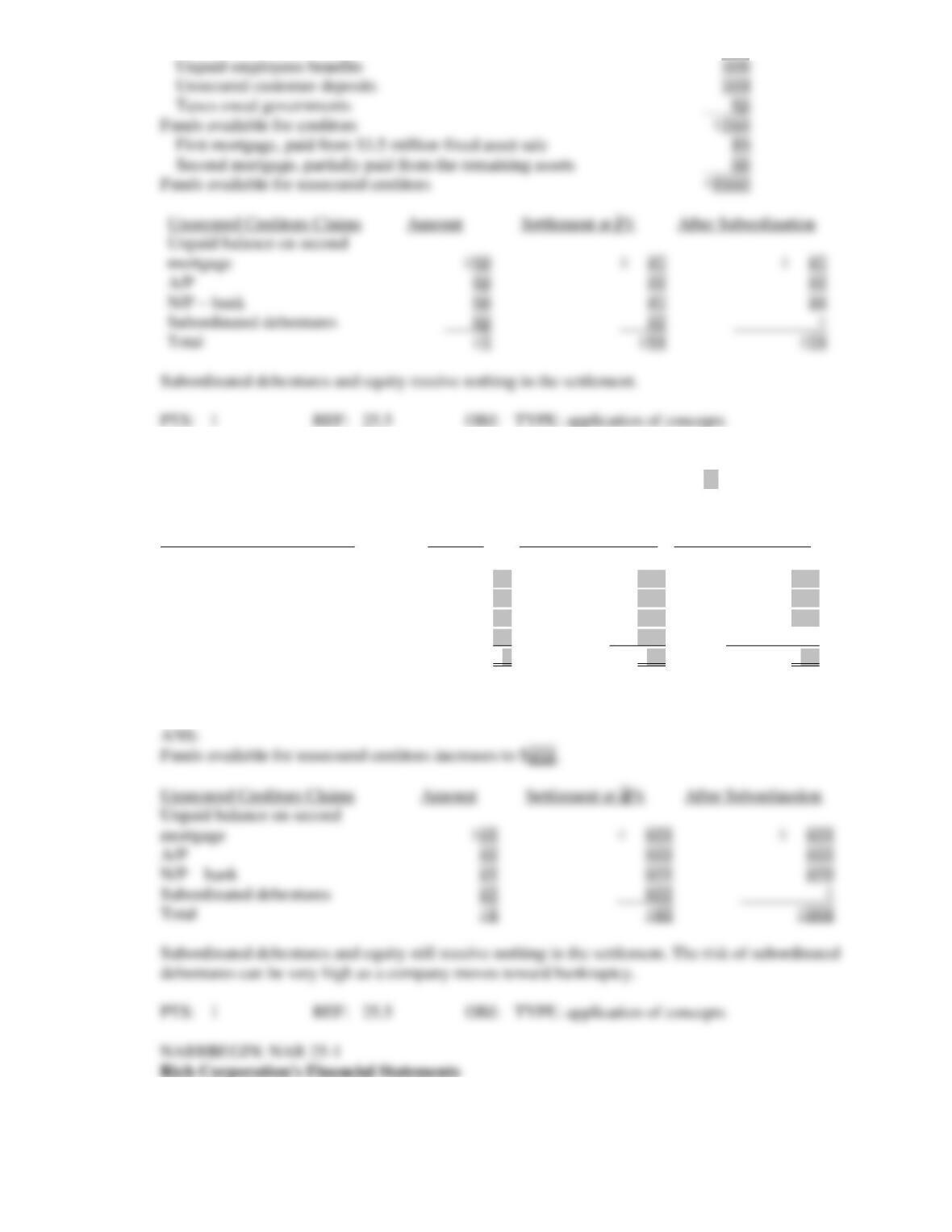
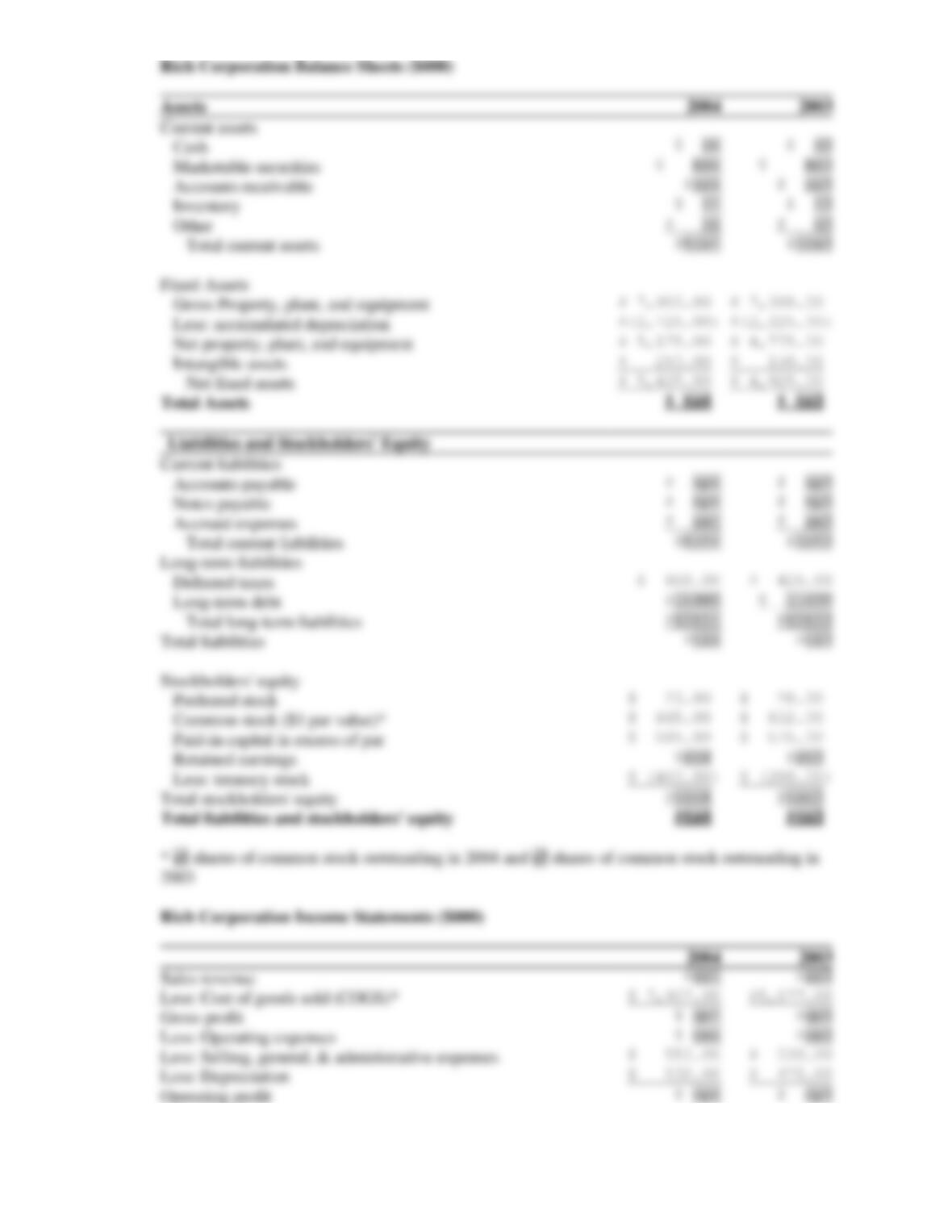
13. The table below describes the settlement among the unsecured creditors of a company. How will the
distribution change if the funds available for unsecured creditors increases by $ds due to better
collection of accounts receivables?
Unsecured Creditors Claims
Amount
Settlement at 41.7%
After Subordination
Unpaid balance on second
mortgage
$a1
$ s11
$ s11
A/P
a2
s12
s12
N/P – bank
a1
s11
s10
Subordinated debentures
a2
s12
0
Total
$a
$s1
$as
Unsecured Creditors Claims
Settlement at st%
Unpaid balance on second
mortgage
A/P
N/P – bank
Subordinated debentures
Total
Subordinated debentures and equity receive nothing in the settlement.
Unpaid employees benefits
ueb
Unsecured customer deposits
Taxes owed governments
Funds available for creditors
First mortgage, paid from $3.5 million fixed asset sale
Second mortgage, partially paid from the remaining assets
Funds available for unsecured creditors
Unsecured Creditors Claims
$np
A/P
ap
N/P – bank
np
Subordinated debentures
Total
Market value of equity to book value of debt
Sales to total assets
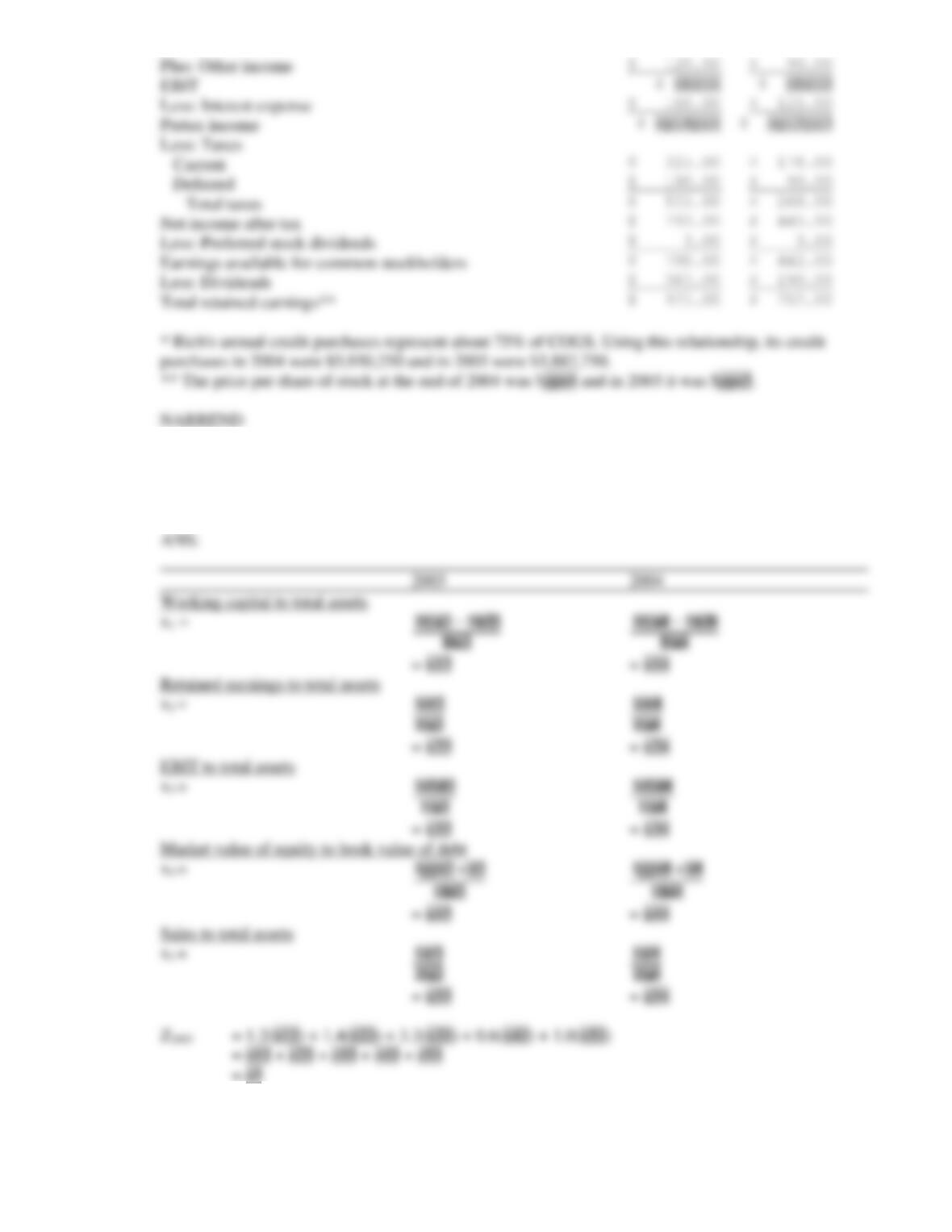
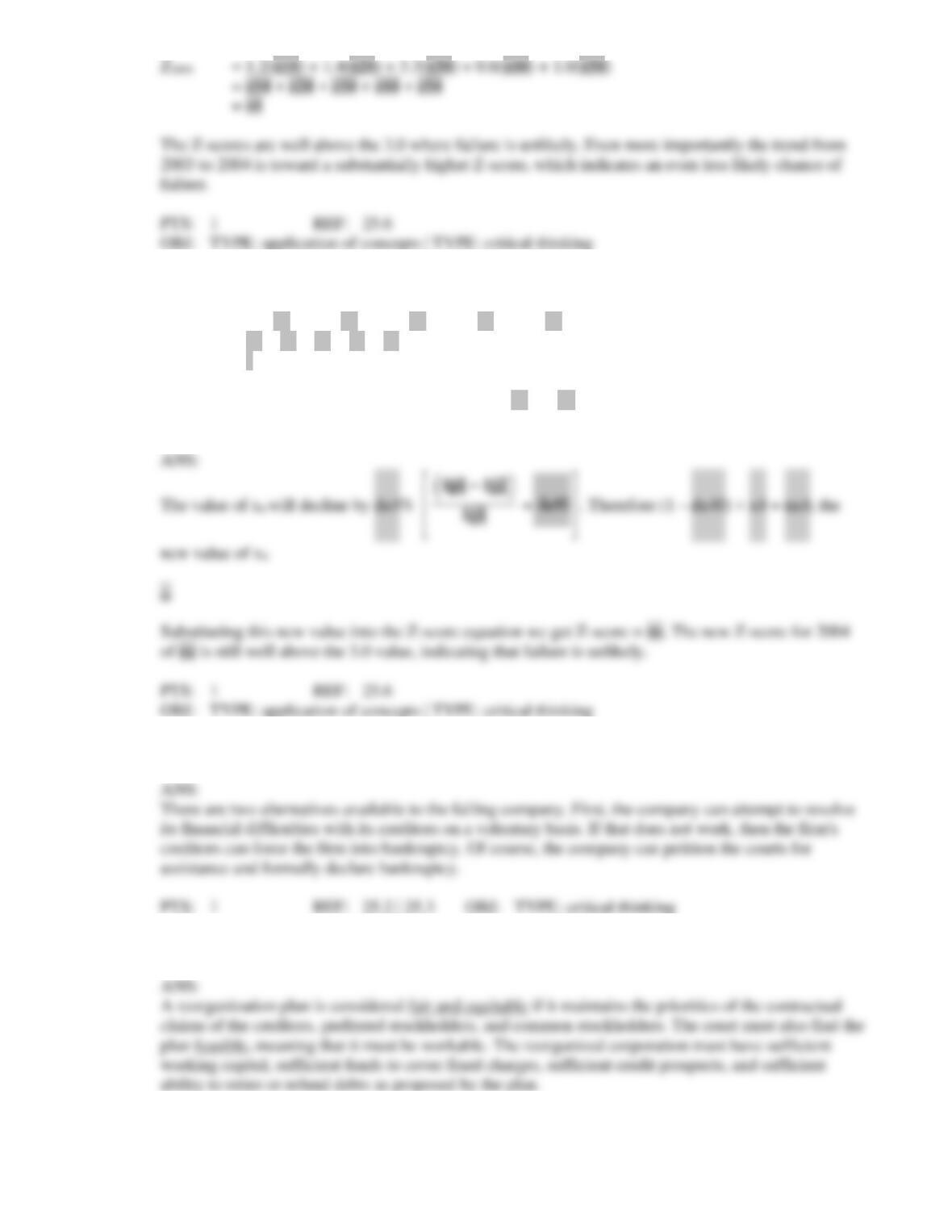
14. Refer to Rich Corporation’s Financial Statements. The balance sheet and income statement of the Rich
Corporation are shown below. Calculate the Z-score for Rich Corporation for 2003 and 2004. Explain
your results.
EBIT
Pretax income
Deferred
Net income after tax
Less: Dividends
purchases in 2004 were $5,930,250 and in 2003 were $3,882,750.
15. A company’s Z-score is computed for the year 2004 as follows:
Z2004
= 1.2(x1) + 1.4(x2) + 3.3(x3) + 0.6(x4) + 1.0(x5)
= z1 + z2 + z3 + z4 + z5
= z
Assume that the company’s stock price falls from $p1 to $p2. How will this cause the value of x4 and
the Z-score to change?
16. What alternatives are available to a failing company?
17. What do fair, equitable, and feasible mean in relationship with the reorganization plan?
Z2004
= 1.2(x14) + 1.4(x24) + 3.3(x34) + 0.6(x44) + 1.0(x54)
= z14 + z24 + z34 + z44 + z54
= z4
ESSAY
1. Explain the reorganization procedures under Chapter 11 of the bankruptcy laws.
2. What are the procedures in the liquidation of a bankrupt firm?
3. Discuss the importance of the components that go into the five factors of the Z-score.
4. Discuss why our financial markets offer ‘protection’ to firms that have failed or are in the process of
failing. You may wish to begin your comments with a view as to what would happen if no protection
were offered.
5. List and describe the subsidies to firms in reorganization.
6. Business failure can take different forms and be a result of different causes. Discuss the major causes
of business failure.
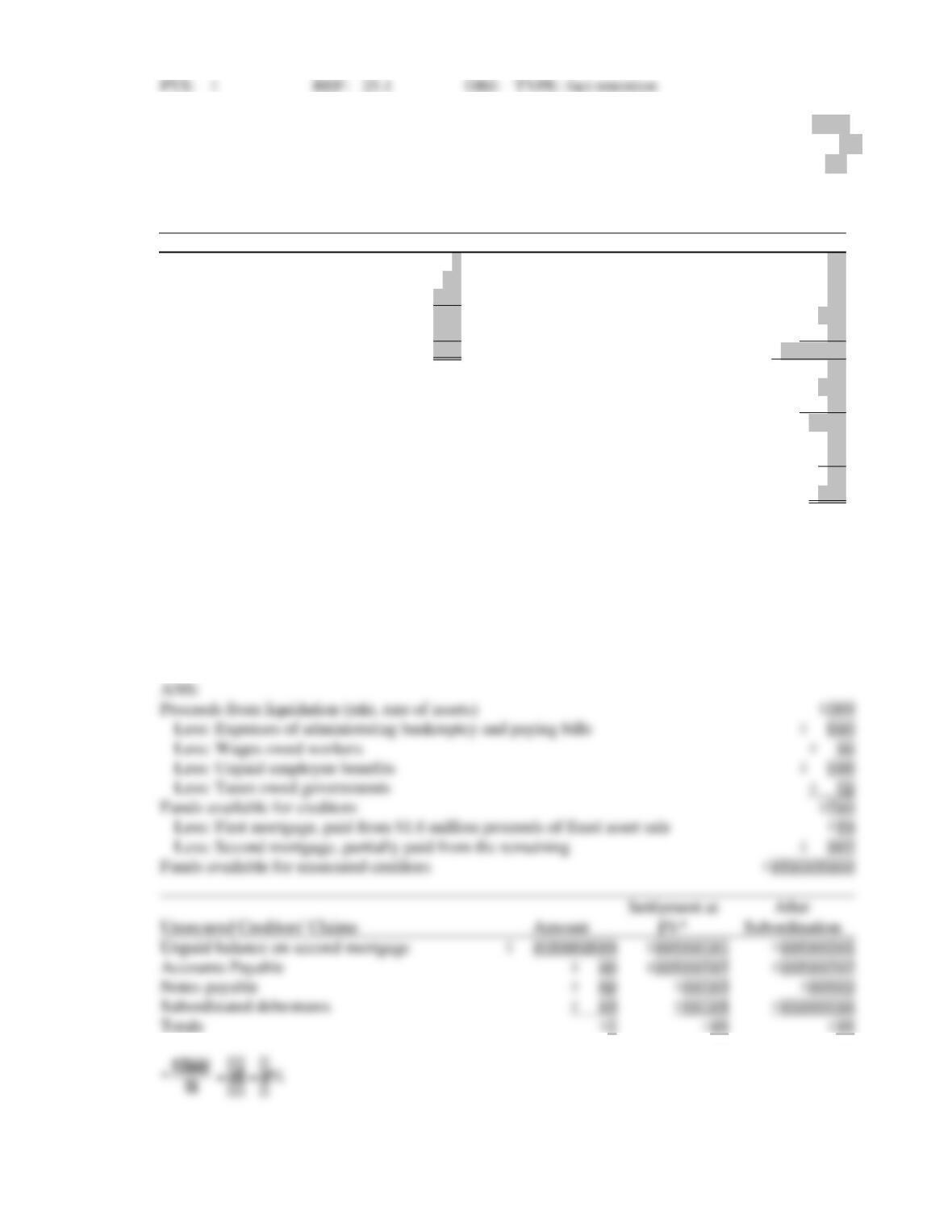
7. Muck Clothing Inc. is legally insolvent and the firm has assets with a current market value of $cmv0
million. The current balance sheet for the firm is given below. The only expense not shown is the $bac
cost of administering the recent bankruptcy proceedings. The firm’s fixed assets can be sold for $fa0
million dollars. Determine what payments will be made with the liquidated funds to the firm’s
creditors and owners.
Assets
Liabilities and Equity
Cash
$ c
Accounts Payable
$ ap
Accounts Receivable
ar
Notes Payable – Bank
$ np
Inventories
cmv
Accrued Wages (a)
$ aw
Total Current Assets
tca
Unpaid Employee Benefits (b)
$ ueb
Net Fixed Assets
nfa
Taxes Payable
$ tp
Total Assets
tle
Total Current Liabilities
$stcltcl
First Mortgage (c)
$fm
Second Mortgage (c)
$ sm1
Subordinated Debenture (d)
$ sd
Total Long Term Debt
$tltd
Common Equity
$ce
Retained Earnings
$re
Total Equity
$te
Total Liabilities and Equity
title
Notes:
(a)
This represents wages of $800 or less per employee earned within 90 days of filing bankruptcy.
(b)
These were due in the 180-day period preceding the firm’s bankruptcy filing, which occurred
simultaneously with the termination of its business.
(c)
The first and second mortgages are on the firm’s fixed assets.
(d)
The debentures are subordinated to the bank’s note payable.
Proceeds from liquidation (mkt. rate of assets)
$cmv
Less: Expenses of administering bankruptcy and paying bills
$ bac
Less: Wages owed workers
$ aw
Less: Unpaid employee benefits
$ ueb
Less: Taxes owed governments
$ tp
Funds available for creditors
$fac
Less: First mortgage, paid from $1.6 million proceeds of fixed asset sale
$fm
Less: Second mortgage, partially paid from the remaining
$ sm2
Funds available for unsecured creditors
Unsecured Creditors’ Claims
Unpaid balance on second mortgage
Accounts Payable
Notes payable
$sstnp
Subordinated debentures
Totals
$st
8. Why might creditors of a financially distressed firm prefer to work with the firm who comes to
voluntary agreements rather than force a firm to file bankruptcy?
9. Predicting bankruptcy with some degree of accuracy is possible using Altman’s Z score. The model is:
Z = 1.2X1 + 1.4X2 + 3.3X3 + 0.6X4 + 1.0X5
The annual report from February 2002 for The Gap, Inc. indicated the following information:
Total current assets = $tca
Total assets = $ta
Total current liabilities = $tcl
Long-Term Debt = $ltd
Retained Earnings = $re
Market Value of Equity = $mve
Sales = $s
Earnings Before Interest and Taxes = $ebit.
Determine whether The Gap, Inc. has a high probability of failure, unsure probability of failure, or
unlikely probability of failure.
10. For a firm with outstanding debt of $5,400,000, classify each of the following voluntary settlements as
an extension, a composition, or a combination of the two.
a.
Paying a group of creditors in full in four periodic installments and paying the remaining
creditors in full immediately.
b.
Paying a group of creditors 75 cents on the dollar immediately and paying the remaining
creditors 70 cents on the dollar in two periodic installments.
c.
Paying all creditors 65 cents on the dollar immediately.
extensions
b.
combinations