
58) The distance between two asteroids is 1600 km. How much time does it take for a light
signal to go from one asteroid to the other? (c = 3.0 × 10⁸ m/s)
A) 19 ms
B) 4.5 ms
C) 5.3 ms
D) 13 ms
E) 19 µs
59) How far does a beam of light travel in 2.0 ms? (c = 3.0 × 10⁸ m/s)
A) 6.0 × 10⁵ m
B) 0.66 × 10⁵ m
C) 90 m
D) 70 m
E) 60 m
60) How far does light travel in 1.0 μs? (c = 3.0 × 10⁸ m/s)
A) 3.0 × 10¹⁴ m
B) 0.30 km
C) 3.0 m
D) 30 cm
61) How long does it take light to travel 1.0 m? (c = 3.0 × 10⁸ m/s)
A) 3.3 ns
B) 3.3 μs
C) 3.3 ms
D) 3.3 s
62) How much time does it take a beam of light to travel 2.9 km through space. (c = 3.0 × 10⁸
m/s)
A) 9.7 s
B) 9.7 ms
C) 9.7 μs
D) 9.7 ns
E) 9.7 ps

63) A radio station broadcasts at 80 MHz. How long does it take for this radio signal to travel a
distance of through space? (c = 3.0 × 10⁸ m/s)
A) 0.15 × 10⁻² s
B) 15 ms
C) 6.7 × 10⁻² s
D) 20 ms
E) 25 ms
64) How far does a beam of light travel through space in one 365-day year? (c = 3.0 × 10⁸ m/s)
A) 80 × 1012 m
B) 95 × 1014 m
C) 30 × 108 m
D) 20 × 1015 m
E) 36 × 1016 m
65) A radio station broadcasts at a frequency of 80 MHz. How far from the transmitter will this
signal travel in 67 ms? (c = 3.0 × 10⁸ m/s)
A) 60 × 106 m
B) 67 m
C) 40 km
D) 80 km
E) 20 × 106 m
66) A laser beam takes 24 ms to travel from a rocket to the reflective surface of a planet and back
to the rocket. How far is the rocket from this planet’s surface? (c = 3.0 × 10⁸ m/s)
A) 2400 km
B) 1200 km
C) 1800 km
D) 3600 km
E) 4800 km
67) A radar receiver indicates that a pulse return as an echo in 20 μs after it was sent. How far
away is the reflecting object? (c = 3.0 × 10⁸ m/s)
A) 1.5 km
B) 3.0 km
C) 6.0 km
D) 9.0 km
68) A sinusoidal electromagnetic wave is propagating in vacuum. At a given point and at a
particular time the electric field is in the +x direction and the magnetic field is in the –y direction,
and at that point the intensity of the wave is
(a) What is the direction of propagation of the wave?
(b) What is the electric field amplitude at the given point?
69) A sinusoidal electromagnetic wave has a peak electric field of What is the intensity
of the wave?
A) 170 kW/m2
B) 85 kW/m2
C) 21 kW/m2
D) 11 kW/m2
70) If the magnetic field in a traveling electromagnetic wave has a maximum value of 16.5 nT,
what is the maximum value of the electric field associated with this wave? (c = 3.00 × 10⁸ m/s)
A) 5.5 × 10⁻¹⁷ V/m
B) 4.95 V/m
C) 0.495 V/m
D) 55.0 × 10⁻¹⁶ V/m
E) 55.0 × 10⁻¹⁵ V/m

71) A certain electromagnetic field traveling in vacuum has a maximum electric field of 1200
V/m. What is the maximum magnetic field of this wave? (c = 3.0 × 10⁸ m/s)
A) 3.4 × 10⁻⁴ T
B) 4.0 × 10⁻⁶ T
C) 2.2 × 10⁻⁵ T
D) 9.6 × 10⁻⁶ T
E) 8.7 × 10⁻⁶ T
72) The amplitude of the electric field for a certain type of electromagnetic wave is 570 N/C.
What is the amplitude of the magnetic field for that wave? (c = 3.00 × 10⁸ m/s)
A) 2.91 µT
B) 1.90 µT
C) 1.10 µT
D) 1.41 µT
E) 2.41 µT
73) The maximum value of the electric field in an electromagnetic wave is 2.0 V/m. What is the
maximum value of the magnetic field in that wave? (c = 3.0 × 10⁸ m/s)
A) 6.7 pT
B) 6.7 mT
C) 6.7 nT
D) 6.7 μT
E) 6.7 T
74) About 1350 W/m2 of electromagnetic energy reaches the upper atmosphere of the earth from
the sun, which is 1.5 × 10¹¹ m away. Use this information to estimate the average power output
of the sun.
A) 1 × 1026 W
B) 2 × 1026 W
C) 3 × 1026 W
D) 4 × 1026 W
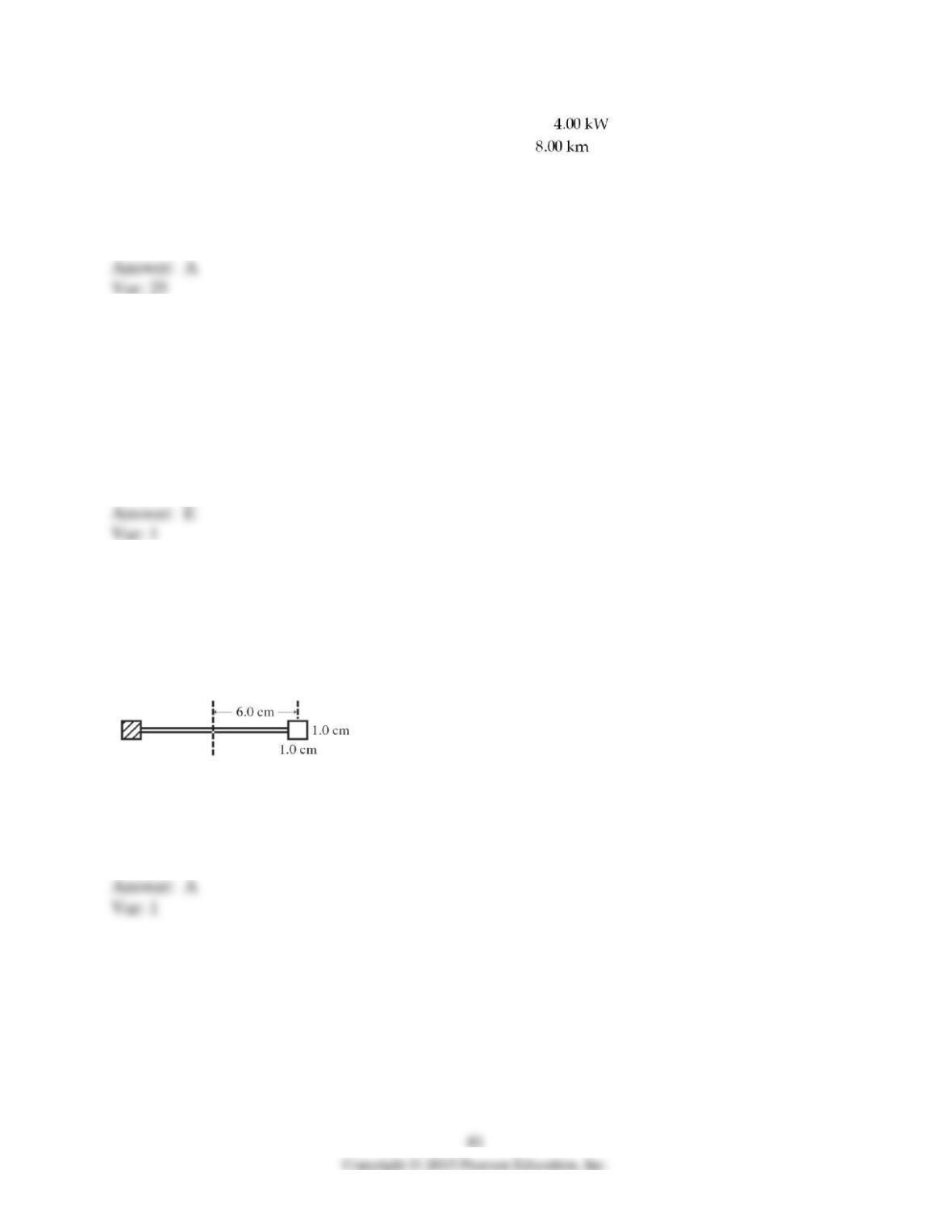
75) A radio transmitter is operating at an average power of and is radiating uniformly in
all directions. What is the average intensity of the signal from the transmitter?
A) 4.97 μW/m2
B) 2.49 μW/m2
C) 0.00497 W/m2
D) 0.00249 W/m2
76) Radiation of a single frequency reaches the upper atmosphere of the earth with an intensity
of 1350 W/m2. What is the maximum value of the electric field associated with this radiation? (c
= 3.00 × 10⁸ m/s, μ0 = 4π × 10-7 T ∙ m/A, ε0 = 8.85 × 10⁻¹² C2/N ∙ m2)
A) 675.0 V/m
B) 1604 V/m
C) 1400 V/m
D) 1350 V/m
E) 1010 V/m
77) A radiometer has two square vanes (1.0 cm by 1.0 cm), attached to a light horizontal cross
arm, and pivoted about a vertical axis through the center, as shown in the figure. The center of
each vane is 6.0 cm from the axis. One vane is silvered and it reflects all radiant energy that falls
upon it. The other vane is blackened and it absorbs all incident radiant energy. Radiant energy,
having an intensity of 300 W/m2, is incident normally upon the front surfaces of both vanes.
What is the radiant power absorbed by the blackened vane?
A) 0.030 W
B) 0.040 W
C) 0.050 W
D) 0.060 W
E) 0.090 W

78) The rate of energy flow per unit area of a sinusoidal electromagnetic wave has an average
value of 0.601 W/m2. What is the maximum value of the magnetic field in the wave? (c = 3.00 ×
108 m/s, μ0 = 4π × 10-7 T ∙ m/A, ε0 = 8.85 × 10⁻¹² C2/N ∙ m2)
A) 7.09 × 10⁻⁸ T
B) 5.02 × 10⁻⁸ T
C) 3.55 × 10⁻⁸ T
D) 9.81 × 10⁻⁸ T
E) 1.42 × 10⁻⁷ T
79) The rate of energy flow per unit area of an electromagnetic wave has an average value of
0.695 W/m2. The wave is incident at right angles upon a rectangular area measuring 1.5 m by
2.0 m. How much total energy falls upon this rectangle each minute? (ε0 = 8.85 × 10⁻¹² C2/N ∙
m2, μ0 = 4π × 10-7 T ∙ m/A, c = 3.0 × 10⁸ m/s)
A) 130 J
B) 160 J
C) 190 J
D) 220 J
E) 250 J
80) An 800-kHz sinusoidal radio signal is detected at a point 6.6 km from the transmitter tower.
The electric field amplitude of the signal at that point is 0.780 V/m. Assume that the signal
power is radiated uniformly in all directions and that radio waves incident upon the ground are
completely absorbed. What is the amplitude of the magnetic field of the signal at that point? (ε0
= 8.85 × 10⁻¹² C2/N ∙ m2, c = 3.0 × 10⁸ m/s, μ0 = 4π × 10-7 T ∙ m/A)
A) 2.6 nT
B) 2.1 nT
C) 1.6 nT
D) 3.1 nT
E) 3.6 nT

81) An 800-kHz sinusoidal radio signal is detected at a point 2.1 km distant from a transmitter
tower. The electric field amplitude of the signal at that point is 0.80 V/m. Assume that the signal
power is radiated uniformly in all directions and that radio waves incident upon the ground are
completely absorbed. What is the intensity of the radio signal at that point? (ε0 = 8.85 × 10⁻¹²
C2/N ∙ m2, μ0 = 4π × 10-7 T ∙ m/A, c = 3.0 × 10⁸ m/s)
A) 8.5 × 10⁻⁴ W/m2
B) 1.2 × 10⁻³ W/m2
C) 1.7 × 10⁻³ W/m2
D) 6.0 × 10⁻⁴ W/m2
E) 4.2 × 10⁻⁴ W/m2
82) What is the maximum value of the magnetic field at a distance of 2.5 m from a light bulb that
radiates 100 W of single-frequency sinusoidal electromagnetic waves uniformly in all directions?
(ε0 = 8.85 × 10⁻¹² C2/N ∙ m2, μ0 = 4π × 10-7 T ∙ m/A, c = 3.0 × 10⁸ m/s)
A) 0.10 μT
B) 0.40 μT
C) 0.50 μT
D) 0.60 μT
E) 0.80 μT
83) A light source radiates 60.0 W of single-wavelength sinusoidal light uniformly in all
directions. What is the average intensity of the light from this bulb at a distance of 0.400 m from
the bulb?
A) 14.9 W/m2
B) 37.2 W/m2
C) 27.4 W/m2
D) 11.9 W/m2
E) 29.8 W/m2
84) A light source radiates 60.0 W of single-wavelength sinusoidal light uniformly in all
directions. What is the amplitude of the electric field of this light at a distance of 0.400 m from
the bulb? (ε0 = 8.85 × 10⁻¹² C2/N ∙ m2, μ0 = 4π × 10-7 T ∙ m/A, c = 3.00 × 10⁸ m/s)
A) 162 N/C
B) 212 N/C
C) 82.1 N/C
D) 150 N/C
E) 52.9 N/C

85) A light source radiates 60.0 W of single-wavelength sinusoidal light uniformly in all
directions. What is the amplitude of the magnetic field of this light at a distance of 0.700 m from
the bulb?(ε0 = 8.85 × 10⁻¹² C2/N ∙ m2, μ0 = 4π × 10-7 T ∙ m/A, c = 3.0 × 10⁸ m/s)
A) 1.76 × 10⁻⁷ T
B) 2.02 × 10⁻⁷ T
C) 2.22 × 10⁻⁷ T
D) 2.86 × 10⁻⁷ T
86) An 8.0-mW laser beam emits a cylindrical beam of single-wavelength sinusoidal light 0.90
mm in diameter. What is the rms value of the electric field in this laser beam? (ε0 = 8.85 × 10⁻¹²
C2/N ∙ m2, μ0 = 4π × 10-7 T ∙ m/A, c = 3.0 × 10⁸ m/s)
A) 2200 N/C
B) 1000 N/C
C) 1100 N/C
D) 4100 N/C
E) 2000 N/C
87) An 8.00-mW laser beam emits a cylindrical beam of single-wavelength sinusoidal light
0.600 mm in diameter. What is the maximum value of the magnetic field in the laser beam? (ε0 =
8.85 × 10⁻¹² C2/N ∙ m2, μ0 = 4π × 10-7 T ∙ m/A, c = 3.0 × 10⁸ m/s)
A) 9.24 µT
B) 17.2 µT
C) 12.4 µT
D) 20.5 µT
E) 15.4 µT
88) How much energy is transported across a 1.00-cm2 area per hour by a sinusoidal
electromagnetic wave whose electric field has a maximum strength of 30.4 V/m? (ε0 = 8.85 ×
10-12 C2/N ∙ m2, μ0 = 4π × 10-7 T ∙ m/A, c = 3.0 × 10⁸ m/s)
A) 0.44 nJ
B) 0.44 μJ
C) 0.44 mJ
D) 0.44 J

89) Unpolarized light of intensity I0 passed through an ideal polarizing sheet with its polarizing
axis at the 12 o’clock position and then through a second ideal sheet with its polarizing axis at the
1 o’clock position. What is the intensity of the emerging light in terms of I0?
90) Three ideal polarizers are oriented as follows: The axis of the second polarizer is at an angle
of 59.0° relative to the first one. The axis of the third polarizer is at an angle of 31.0° relative to
the second one, so the axis of the axis of the third polarizer is perpendicular to the axis of the
first one. Unpolarized light of intensity is incident on the first polarizer.
(a) What is the intensity of the light after it passes through all three polarizers?
(b) What is the intensity of the transmitted light if the second polarizer is removed?
91) Light passes through three ideal polarizing sheets. Unpolarized light enters the first sheet and
the resultant vertically polarized beam continues through the second sheet and third sheet. The
second sheet has its transmission axis at 50° with respect to the first sheet, and the third sheet is
at 70° with respect to the first sheet.
(a) What percent of the original intensity emerges from filter #1?
(b) What percent of the original intensity emerges from filter #2?
(c) What percent of the original intensity emerges from filter #3?
92) Unpolarized light of intensity I0 passes through four ideal polarizing sheets. The polarizing
angle of each sheet is rotated 30° from the one before it, so that the last sheet is aligned at 90° to
the first sheet. What is the intensity of the light emerging from the fourth sheet in terms of I0?
93) An ideal polarizer with its transmission axis rotated 30° to the vertical is placed in a beam of
unpolarized light of intensity 10 W/m2. After passing through the polarizer, what is intensity of
the beam?
A) 2.5 W/m2
B) 5.0 W/m2
C) 8.7 W/m2
D) 7.5 W/m2
E) 10 W/m2
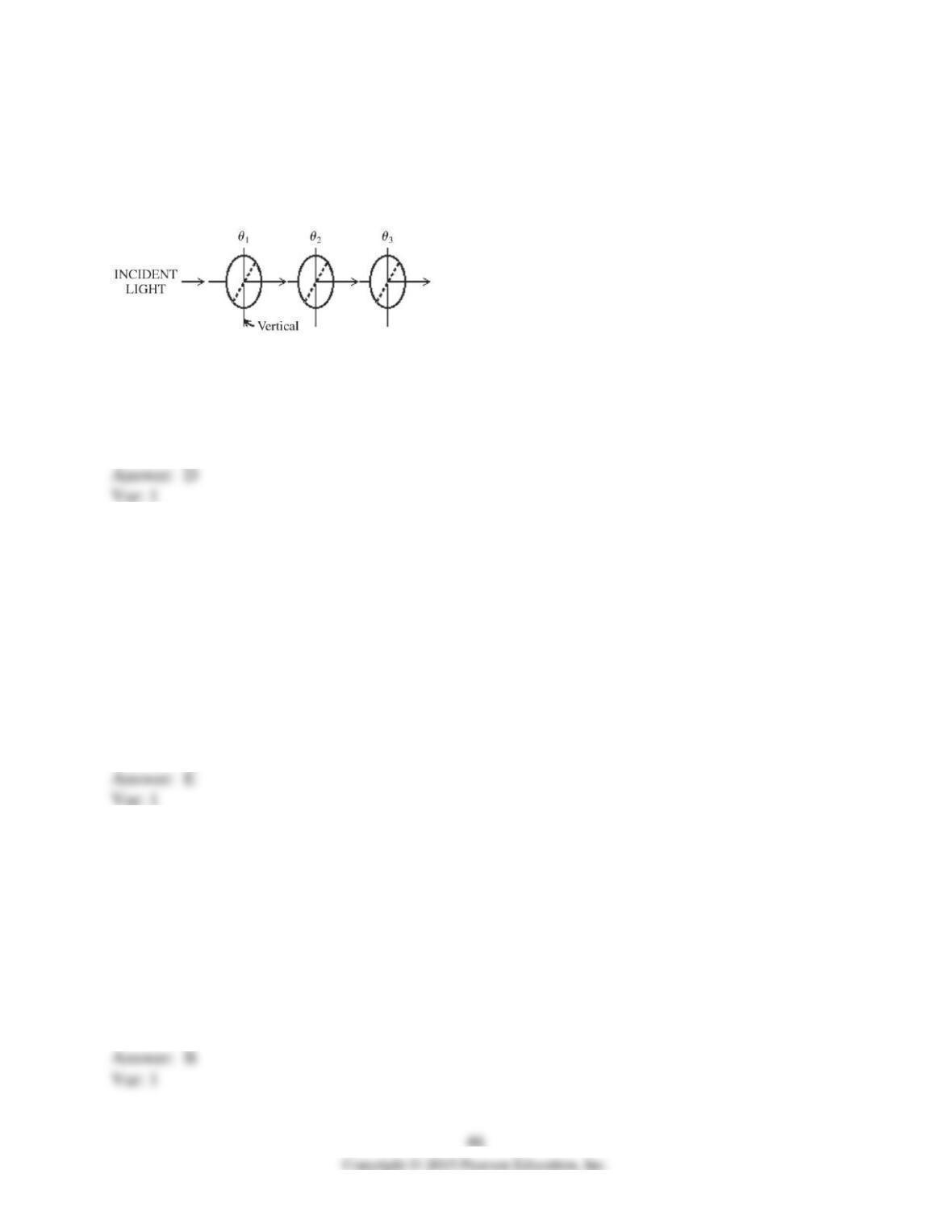
94) As shown in the figure, the orientation of the transmission axis for each of three ideal
polarizing sheets is labeled relative to the vertical direction. A beam of light, polarized in the
vertical direction, is incident on the first polarizer with an intensity of 1.00 kW/m2. What is the
intensity of the beam after it has passed through the three polarizing sheets when θ1 = 30°, θ2 =
30°, and θ3= 60°?
A) 141 W/m2
B) 316 W/m2
C) 433 W/m2
D) 563 W/m2
E) 188 W/m2
95) The following items are positioned in sequence: A source of a beam of natural light of
intensity I0, three ideal polarizers A, B, and C; and an observer. Polarizer axis angles are
measured clockwise from the vertical, as viewed by the observer. The axis angle of polarizer A is
set at 0° (vertical), and the axis angle of polarizer C is set at 50°. Polarizer B is set so that the
beam intensity is zero at the observer. What are the two possible axis angle settings (less than
180°) of polarizer B?
A) 40° and 90°
B) 40° and 130°
C) 40° and 140°
D) 90° and 130°
E) 90° and 140°
96) The following items are positioned in sequence: A source of a beam of natural light of
intensity I0, three ideal polarizers A, B, and C; and an observer. Polarizer axis angles are
measured clockwise from the vertical, as viewed by the observer. The axis angle of polarizer A is
set at 0° (vertical), and the axis angle of polarizer C is set at 50°. Polarizer B is set so that the
beam intensity at the observer is a maximum. What is the axis angle settings of polarizer B?
A) 0°
B) 25°
C) 50°
D) 75°
E) 100°

97) The following items are positioned in sequence: A source of a beam of natural light of
intensity I0, three ideal polarizers A, B, and C; and an observer. Polarizer axis angles are
measured clockwise from the vertical, as viewed by the observer. The axis angle of polarizer A is
set at 0° (vertical), and the axis angle of polarizer C is set at 50°. The axis angle of polarizer B is
set at 120°. What is ratio of the intensity of the beam at the observer to the intensity I0 of the
source?
A) 0.015
B) 0.020
C) 0.025
D) 0.030
E) 0.035
98) A beam of light is polarized in a vertical plane and has an intensity I0. The beam passes
through an ideal polarizer and then through an ideal analyzer whose axis is set horizontally. If
the axis of the polarizer is set at 60° with the vertical, what is the ratio of the intensity of the final
beam to I0?
A) 0.19
B) 0.25
C) 0.31
D) 0.37
E) 0.43
99) Light of intensity S0 that is polarized horizontally passes through three ideal polarizers. The
first and third are horizontal, but the second one is oriented at to the horizontal. In
terms of S0, the intensity of the light that passes through the set of polarizers is closest to which
one of the following choices?
A) 0.729 S0
B) 0.125 S0
C) 0.427 S0
D) 0.854 S0

100) Polarized light of intensity S0 passes through an ideal polarizer. If the electric vector of the
polarized light is horizontal what, in terms of the initial intensity S0, is the intensity of the light
that passes through a polarizer if that polarizer is tilted from the horizontal?
A) 0.812 S0
B) 0.188 S0
C) 0.217 S0
D) 0.284 S0
101) Unpolarized light is incident upon two ideal polarizing filters that do not have their
transmission axes aligned. If of the light passes through this combination, what is the angle
between the transmission axes of the two filters?
A) 52°
B) 72°
C) 0°
D) 0°
102) Unpolarized light passes through a combination of two ideal polarizers. The transmission
axes of the first polarizer and the second polarizer are at 30.0° to each other. What percentage of
the original light gets through the combination?
A) 37.5%
B) 50%
C) 75%
D) 100%
103) Unpolarized light passes through three ideal polarizing filters. The first filter is oriented
with a horizontal transmission axis, the second one has its transmission axis at 30° from the
horizontal, and the third filter has a vertical transmission axis. What percent of the light gets
through this combination?
A) 9.4%
B) 91%
C) 50%
D) 0%
E) 33%
104) A vertically polarized beam of light of intensity 100 W/m2 passes through two ideal
polarizers. The transmission axis of the first polarizer makes an angle of 20.0° with the vertical,
and the transmission axis of the second one makes an angle of 40.0° with the vertical. What is
the intensity of the light after it has passes through both polarizers?
A) 22.2 W/m2
B) 44.4 W/m2
C) 66.6 W/m2
D) 78.0 W/m2
E) 11.7 W/m2
105) If the surface of our bodies is at 37°C, at what wavelength does the radiation that we emit
peak if we behave like a blackbody? The constant in Wien’s law is 0.0029 m ∙ K.
106) The cosmic background radiation permeating the universe has the spectrum of a 2.7-K
blackbody radiator. What is the peak wavelength of this radiation? The constant in Wien’s law is
0.0029 m ∙ K.
107) What are the wavelength and the corresponding photon energy (in electron-volts) of the
primary light emitted by an ideal blackbody at each of the following temperatures? (c = 3.00 ×
108 m/s, h = 6.626 × 10⁻³⁴ J ∙ s, 1 eV = 1.60 × 10⁻¹⁹ J, and the constant in Wein’s law is
0.00290 m ∙ K)
(a) 400°C?
(b) 800°C?
(c) 1200°C?
108) What is the surface temperature of a star, if its radiation peak occurs at a frequency of 1.06
× 1015 Hz? (c = 3.00 × 10⁸ m/s, and the constant in Wien’s law is 0.00290 m ∙ K)
A) 17,000 K
B) 14,500 K
C) 19,000 K
D) 20,400 K
E) 10,200 K

109) If the sunlight from a star peaks at a wavelength of 0.55 µm, what temperature does this
imply for the surface of that star? The constant in Wien’s law is 0.00290 m ∙ K.
A) 9500 K
B) 5300 K
C) 2500 K
D) 25,000 K
E) 15,000 K
110) The surface temperature of the star is 6000 K. At what wavelength is its light output a
maximum? The constant in Wien’s law is 0.00290 m ∙ K.
A) 850 nm
B) 907 nm
C) 311 nm
D) 483 nm
E) 502 nm
111) What is the wavelength of the most intense light emitted by a giant star of surface
temperature 5000 K? The constant in Wien’s law is 0.00290 m ∙ K.
A) 576 nm
B) 578 nm
C) 580 nm
D) 582 nm
112) What is the frequency of the most intense radiation from an object with temperature 100°C?
The constant in Wien’s law is 0.0029 m ∙ K. (c = 3.0 × 10⁸ m/s)
A) 2.9 × 10⁻⁵ Hz
B) 3.9 × 10¹³ Hz
C) 1.0 × 10¹³ Hz
D) 1.0 × 10¹¹ Hz
113) An x-ray tube accelerates electrons through a potential difference of 50.0 kV. If an electron
in the beam suddenly give up its energy in a collision, what is the shortest wavelength x-ray it
could produce? (c = 3.00 × 10⁸ m/s, h = 6.626 × 10⁻³⁴ J ∙ s, e = 1.60 × 10⁻¹⁹ C)

114) At what rate are photons emitted by a 50.0-W sodium vapor lamp if it is producing
monochromatic light of wavelength 589 nm? (c = 3.00 × 10⁸ m/s, h = 6.626 × 10⁻³⁴ J ∙ s)
115) The human eye can just detect green light of wavelength 500 nm if it arrives at the retina at
the rate of 2 × 10-18 W. How many photons arrive each second? (c = 3.0 × 10⁸ m/s, h = 6.626 ×
10-34 J ∙ s)
116) What is the wavelength of a photon having energy 2.00 eV? (c = 3.00 × 10⁸ m/s, h = 6.626
× 10-34 J ∙ s, 1 eV = 1.60 × 10⁻¹⁹ J)
117) A small gas laser of the type used in classrooms may radiate light at a power level of 2.0
mW. If the wavelength of the laser light is 642 nm, how many photons does it emit per second?
(c = 3.0 × 10⁸ m/s, h = 6.626 × 10⁻³⁴ J ∙ s)
118) How much energy is carried by a photon of light having frequency 110 GHz? (h = 6.626 ×
10-34 J ∙ s)
A) 1.1 × 10⁻²⁰ J
B) 1.4 × 10⁻²² J
C) 7.3 × 10⁻²³ J
D) 1.3 × 10⁻²⁵ J
119) What frequency of electromagnetic radiation has photons of energy 4.7 × 10⁻²⁵ J? (h =
6.626 × 10⁻³⁴ J ∙ s)
A) 710 kHz
B) 4.7 MHz
C) 710 MHz
D) 1.4 GHz

120) What is the energy (in eV) of an optical photon of frequency (h = 6.626 × 10–
34 J ∙ s, 1 eV = 1.60 × 10⁻¹⁹ J)
A) 2.66 eV
B) 1.62 eV
C) 1.94 eV
D) 3.27 eV
121) What is the photon energy of red light having a wavelength of 6.40 × 10² nm? (c = 3.00 ×
108 m/s, h = 6.626 × 10⁻³⁴ J ∙ s)
A) 1.13 × 10⁻¹⁹ J
B) 1.31 × 10⁻¹⁹ J
C) 3.11 × 10⁻¹⁹ J
D) 1.94 × 10⁻¹⁹ J
122) Each photon in a beam of light has an energy of 4.20 eV. What is the wavelength of this
light? (c = 3.00 × 10⁸ m/s, h = 6.626 × 10⁻³⁴ J ∙ s, 1 eV = 1.60 × 10⁻¹⁹ J)
A) 321 nm
B) 103 nm
C) 296 nm
D) 412 nm
E) 420 nm