137)
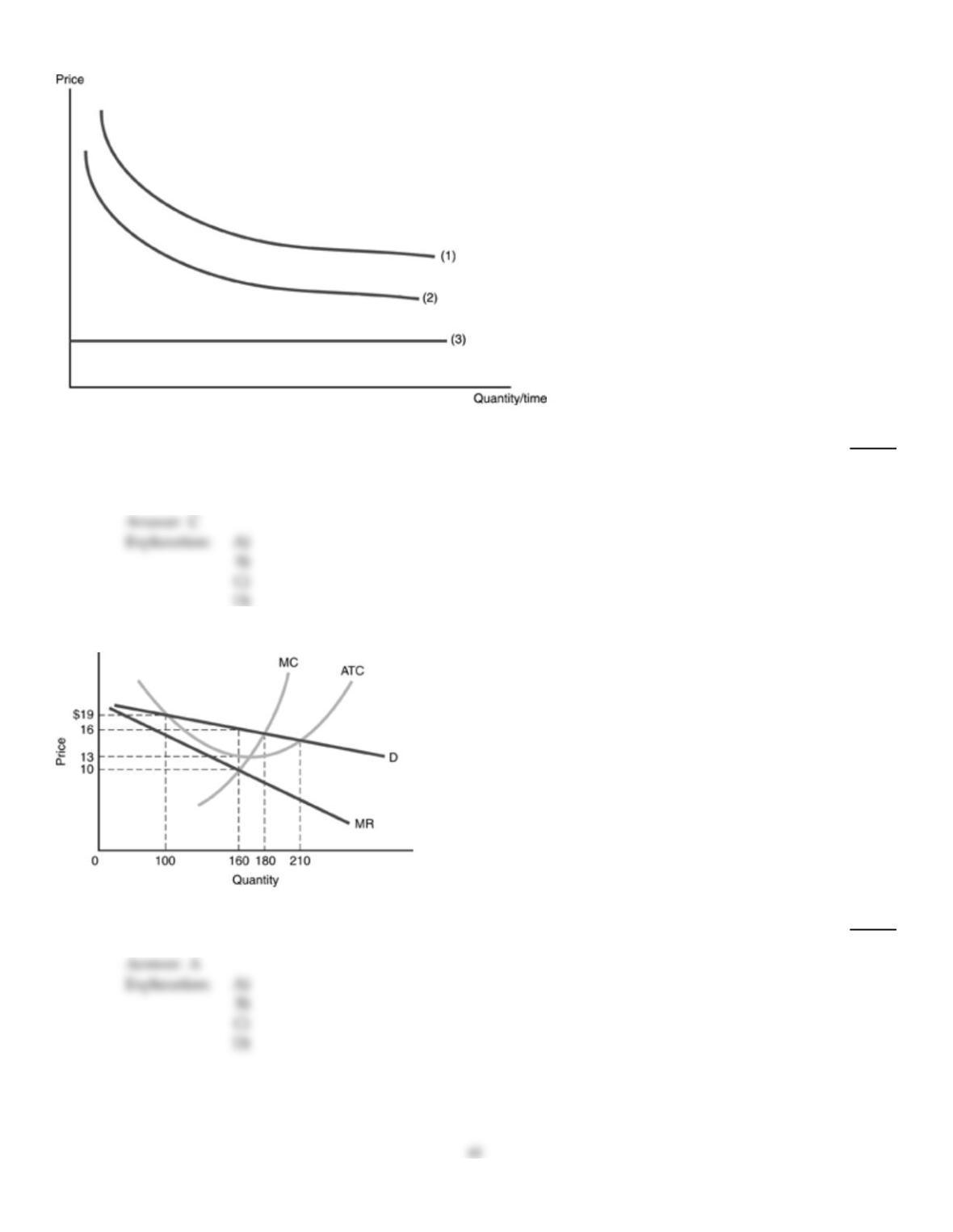
Refer to the above figure. The figure shows the cost structure of a firm producing an information
product. Which curve would represent the marginal cost for an information product?
137)
A)
Curve 1
B)
Curve 2
C)
Curve 3
D)
none of the above
138)
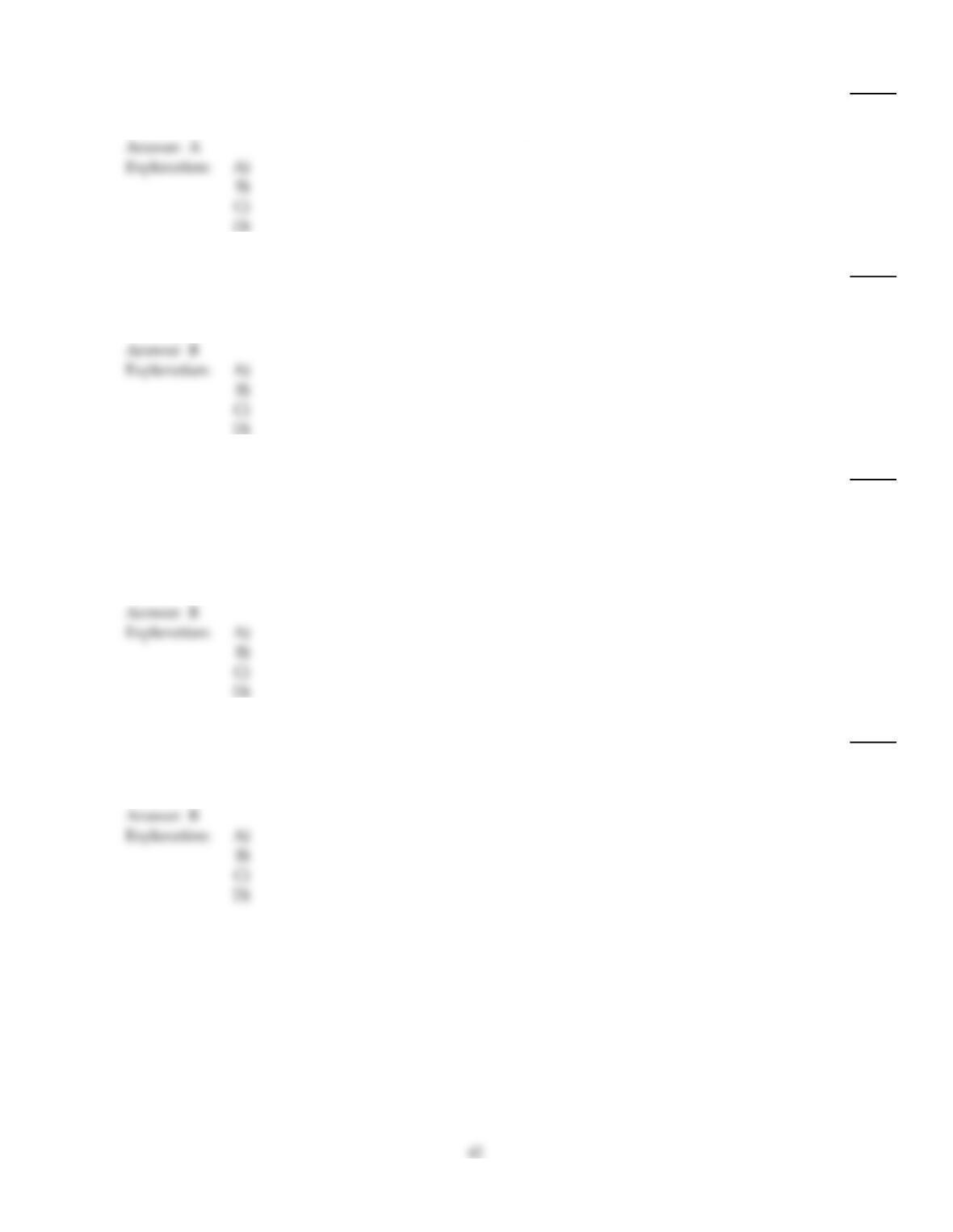
Use the above figure. The total revenue earned by this monopolistically competitive firm is
138)
A)
$2,560.
B)
$1,900.
C)
$480.
D)
$1,600.
139)
A computer game is an example of
139)
A)
an information product.
B)
a capital good.
C)
a credibility product.
D)
a public use product.
140)
Steve can tell if his car has been fixed or notit works, or it doesn’tbut he cannot tell how it was
fixed. The car repair is a(n)
140)
A)
experience good.
B)
credence good.
C)
logo good.
D)
search good.
141)
A monopolistic competitor behaving in a profit–maximizing way will
141)
A)
advertise as much as it can in order to increase its sales.
B)
advertise to the point where the additional revenue from one more dollar of advertising just
equals the extra dollar cost of advertising.
C)
advertise to the point where the additional sales from advertising equal the additional
marginal costs of the product.
D)
not advertise.
142)
The type of advertising that is used to induce a consumer to discover a previously unknown taste
for an item is known as
142)
A)
search advertising.
B)
persuasive advertising.
C)
experience advertising.
D)
informational advertising.
143)
A monopolistically competitive firm maximizes profits when it
143)
A)
produces the quantity at which marginal cost equals marginal revenue and uses the demand
curve to determine the market price.
B)
produces the quantity at which marginal cost equals marginal revenue and sets the price
equal to the marginal cost.
C)
produces the quantity at which marginal cost equals the market price.
D)
produces the quantity at which marginal cost equals marginal revenue and sets the price
equal to the marginal revenue.
144)
Which of the following is TRUE of the price charged by a monopolistically competitive firm at the
profit–maximizing level of output?
144)
A)
P > MC
B)
P = MC
C)
P < AVC
D)
P = MR
145)
In a long–run equilibrium in a monopolistically competitive industry that produces information
products, revenues are equal to the ________ costs of developing, producing, and selling the
product.
145)
A)
marginal
B)
total
C)
variable
D)
fixed
146)
Which of the following is NOT a feature of monopolistic competition?
146)
A)
differentiated products
B)
sales promotion and advertising
C)
inability of firms to enter or exit the market
D)
significant numbers of sellers in a highly competitive market
147)
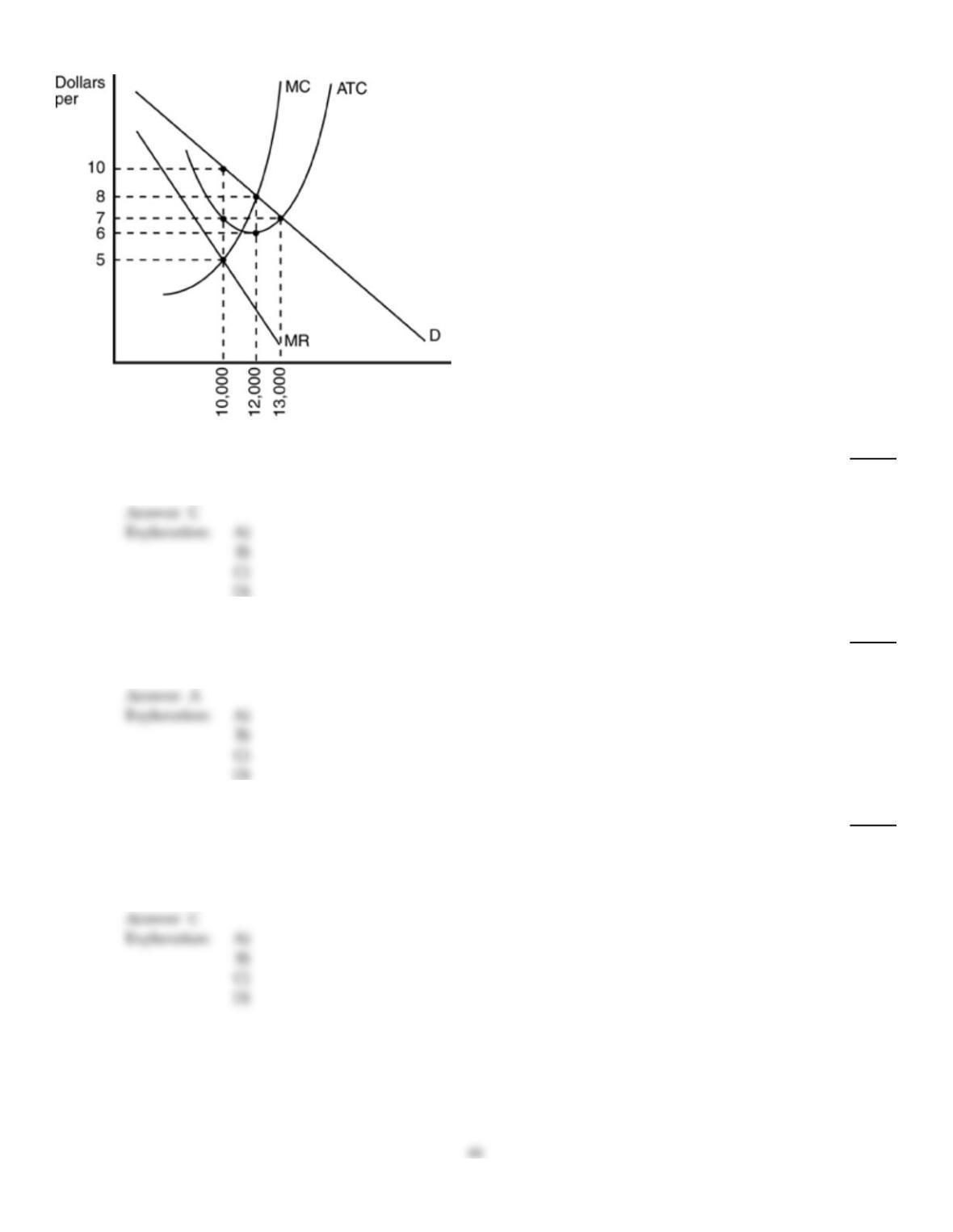
The above figure shows the situation of a monopolistic competitor in the short run. The maximum
economic profits of the firm equal
147)
A)
15,000.
B)
zero.
C)
$30,000.
D)
$50,000.
148)
In the long run, the price of information products in monopolistically competitive markets will be
equal to
148)
A)
ATC.
B)
AFC.
C)
AVC.
D)
MC.
149)
A monopolistic competitor will maximize its profits at the output level at which
149)
A)
the MC curve intersects the demand curve.
B)
MR = ATC.
C)
MC = MR.
D)
TC = TR.
150)
Which of the following is NOT a feature of a monopolistically competitive market?
150)
A)
advertising
B)
numerous buyers and sellers
C)
differentiated products
D)
a homogeneous product
151)
Which of the following statements about a monopolistically competitive firm is FALSE?
151)
A)
It sets price like a perfectly competitive firm.
B)
It produces the quantity at which MC=MR.
C)
It tries to differentiate its product from that of competitors.
D)
It may earn short–run economic profits.
A
152)
Firms in a monopolistically competitive market will advertise because
152)
A)
they want to increase the elasticity of the demand curve.
B)
the elasticity for their product is inelastic.
C)
they want to differentiate their products.
D)
of the significant differences in their product over their competitors.
C
153)
In the long run, firms in a monopolistically competitive market
153)
A)
always earn monopoly profits.
B)
usually earn positive economic profits.
C)
earn zero economic profits.
D)
usually earn economic losses.
C
154)
In both a monopolistically competitive market and a pure monopoly market, firms
154)
A)
can make long–run profits.
B)
are protected by entry barriers.
C)
set price greater than marginal cost.
D)
advertise extensively.
C
D
155)
Compared with a monopolist, the demand curve faced by a monopolistically competitive firm is
155)
A)
perfectly elastic.
B)
perfectly inelastic.
C)
more elastic.
D)
more inelastic.
156)
For the monopolistic competitor, which of the following is INCORRECT?
156)
A)
If the firm in a monopolistically competitive industry were making economic losses, new
firms will enter the industry.
B)
The profit–maximizing rate of output arises at the point at which the marginal cost curve
intersects the marginal revenue curve.
C)
Because the firm is not a perfect competitor, its demand curve slopes downward.
D)
The marginal revenue curve is downward sloping and lies below the demand curve.
157)
The products sold by monopolistically competitive firms
157)
A)
are homogeneous.
B)
are differentiated.
C)
can be either homogeneous or differentiated.
D)
are close substitutes of each other.
158)
In long–run equilibrium in a monopolistically competitive industry, a firm will
158)
A)
produce at a point to the left of the minimum point on its average total cost curve.
B)
have a perfectly elastic demand curve.
C)
produce an output rate at which P = MC.
D)
always earn an economic profit.
159)
Because the short–run average total cost curve slopes downward for an information product, the
firm experiences
159)
A)
long–run diseconomies of scale.
B)
a downward sloping marginal cost curve.
C)
a downward sloping average variable cost curve.
D)
short–run economies of operation.
160)
Advertising that is intended to alter a consumer’s tastes and preferences and induce the customer to
purchase a particular product is
160)
A)
informational advertising.
B)
persuasive advertising.
C)
educational advertising.
D)
effective advertising.
Explanation:
161)
There is no incentive for additional producers of an information product to enter the industry when
the price charged for these products by each firm already in the industry is equal to
161)
A)
average total cost.
B)
average variable cost.
C)
average fixed cost.
D)
marginal cost.
Explanation:
162)
Jim has just researched and purchased a computer through the Internet as a result of responding
directly to a pop–up ad. The pop–up ad is an example of
162)
A)
mass marketing.
B)
direct marketing.
C)
indirect marketing.
D)
interactive marketing.
Explanation:
Explanation:
163)
Direct marketing is
163)
A)
advertising targeted at specific consumers.
B)
advertising intended to reach as many consumers as possible.
C)
advertising that permits a consumer to follow up directly by searching for more information
and placing direct product orders.
D)
advertising that targets a specific audience and allows the consumer to follow up directly by
placing direct product orders usually through television or radio.
164)
A monopolistically competitive firm differs from a perfectly competitive firm in the long run in
that
164)
A)
profits are positive for a monopolistically competitive firm and zero for a perfectly
competitive firm.
B)
the demand curve faced by a monopolistically competitive firm is downward sloping, while
the demand curve faced by a perfectly competitive firm is horizontal.
C)
profits are zero for a monopolistically competitive firm and positive for a perfectly
competitive firm.
D)
marginal cost equals the market price for a monopolistically competitive firm but not for a
perfectly competitive firm.
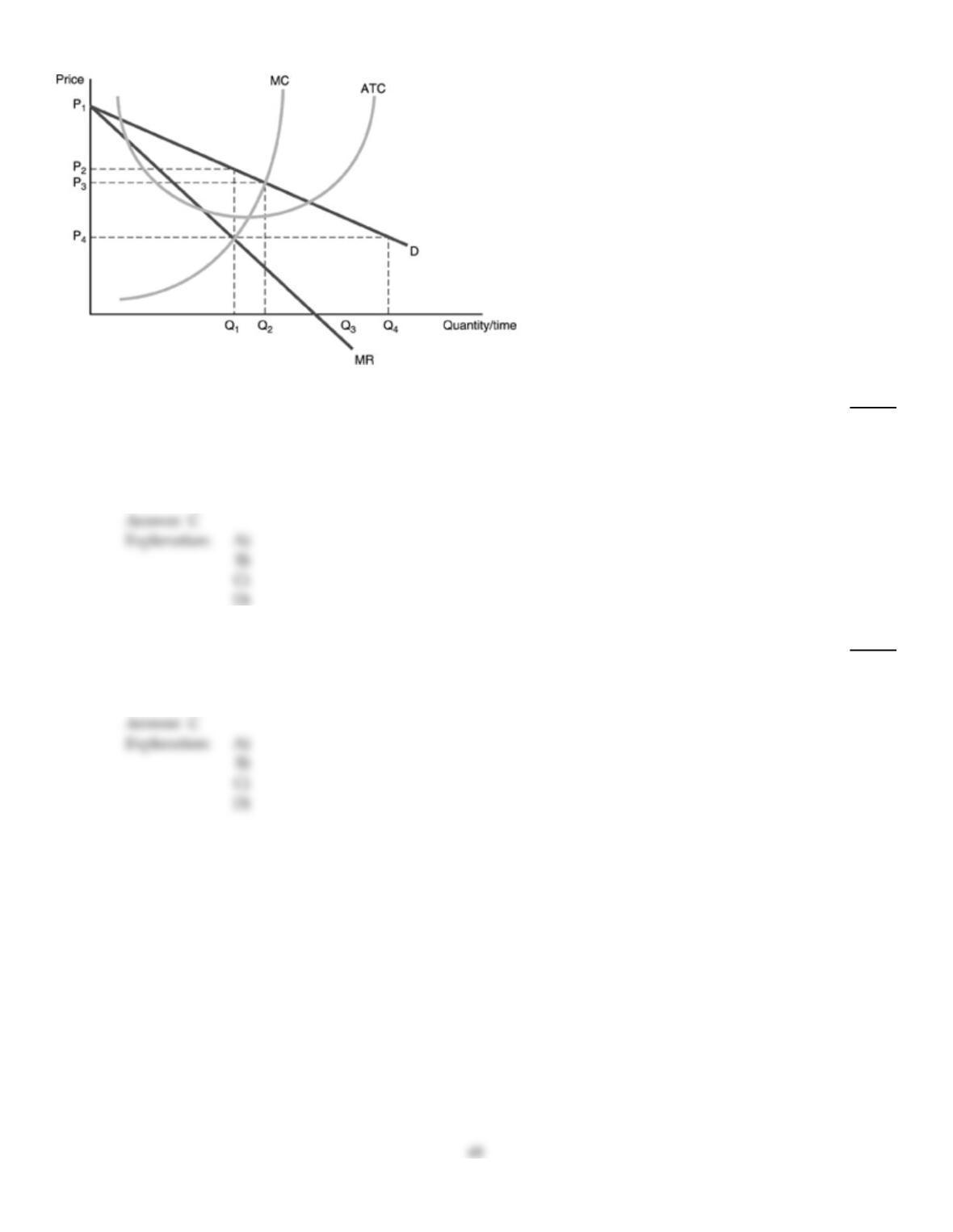
165)
Refer to the above figure. As more and more firms are able to and actually do enter the industry,
the demand curve of each firm and its marginal revenue curve
165)
A)
will become upward sloping.
B)
will become vertical.
C)
will shift inward until the demand curve is tangent to the average total cost curve.
D)
None of the above will occur.
166)
In the long run, equilibrium positions that arise in both monopolistically competitive and perfectly
competitive markets are
166)
A)
MR = MC = P.
B)
MR = MC and P = MC.
C)
MR = MC and P = ATC.
D)
P = ATC and P = MC.
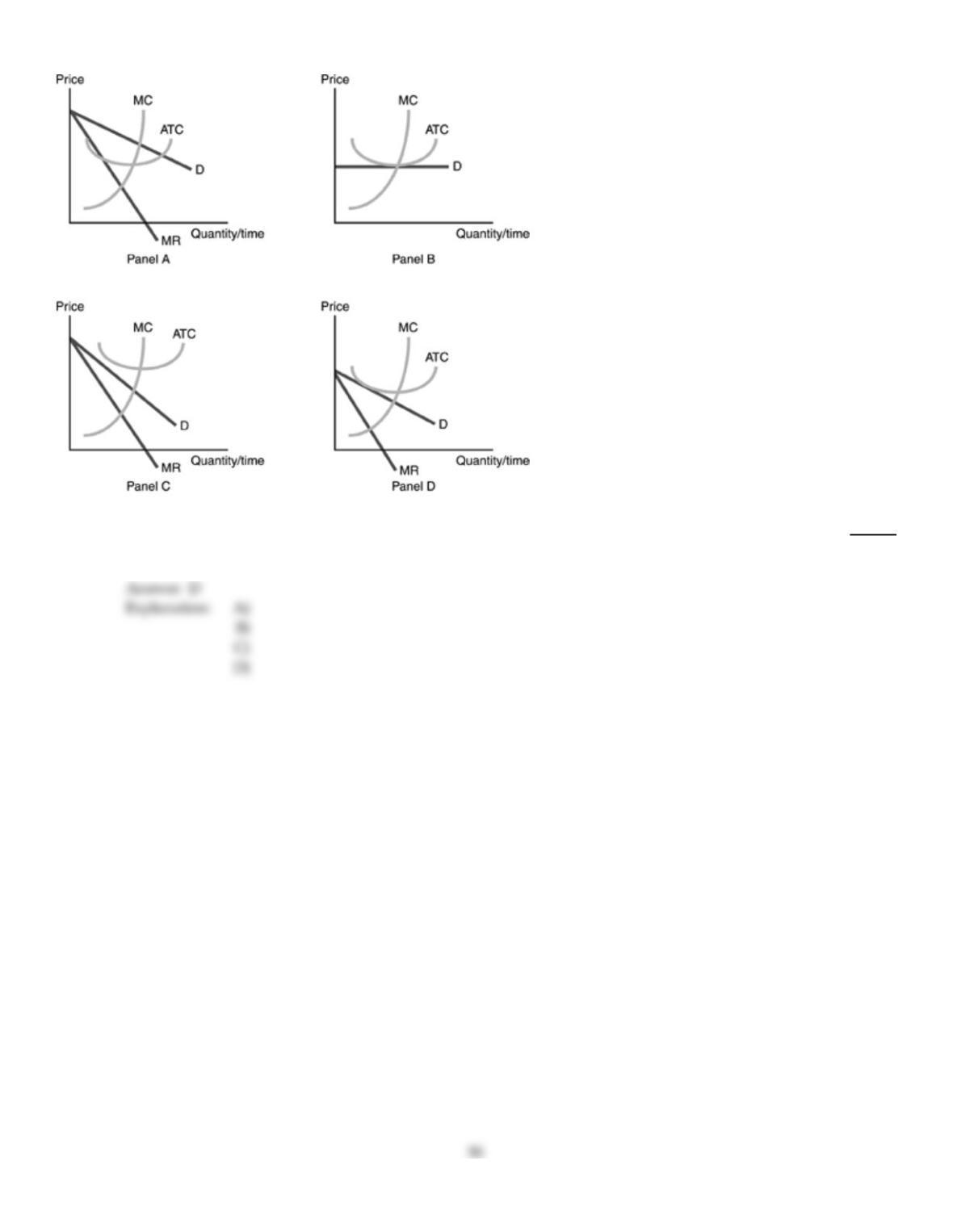
167)
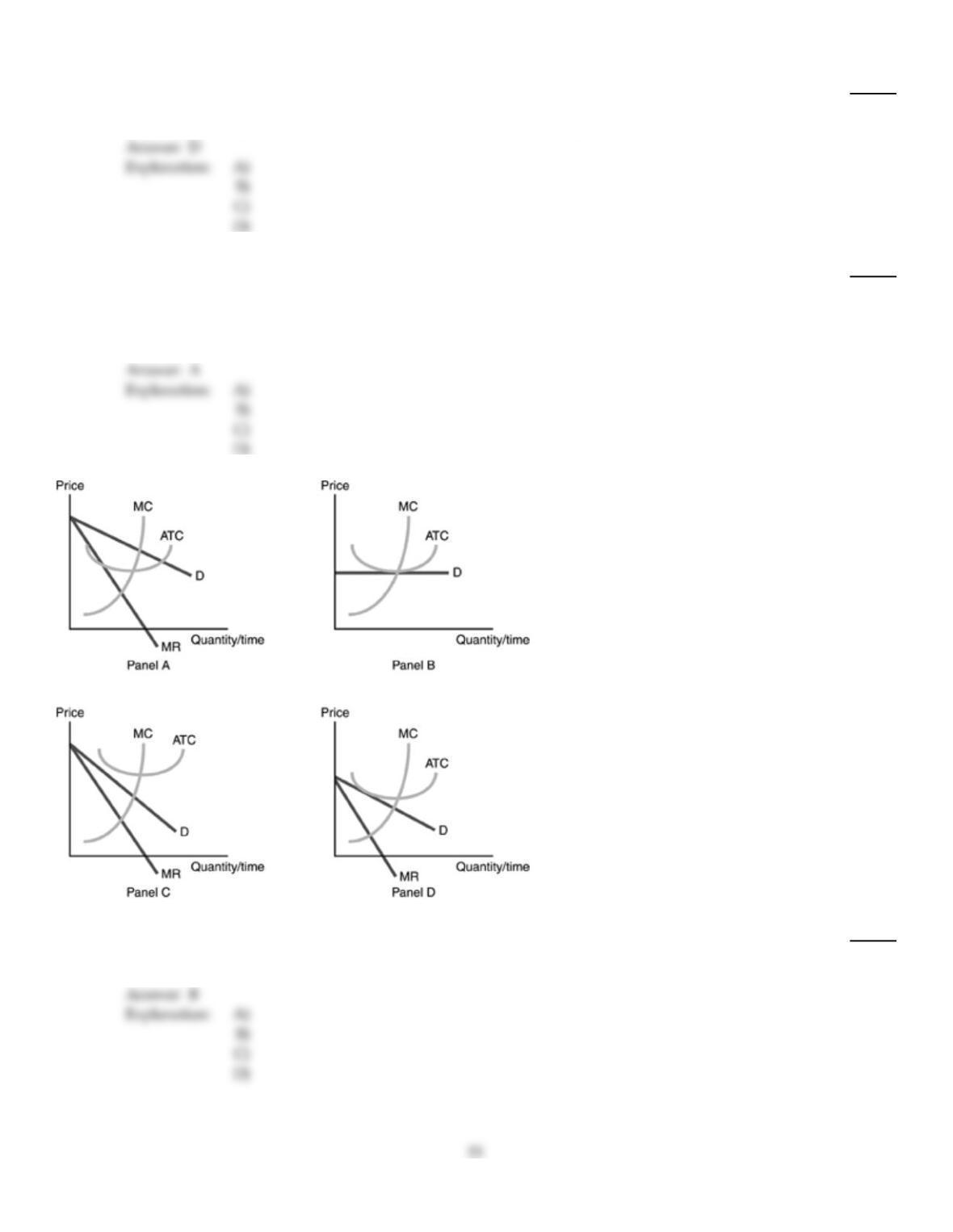
Refer to the above figure. Which panel represents the long–run situation for a monopolistically
competitive firm?
167)
A)
Panel A
B)
Panel B
C)
Panel C
D)
Panel D
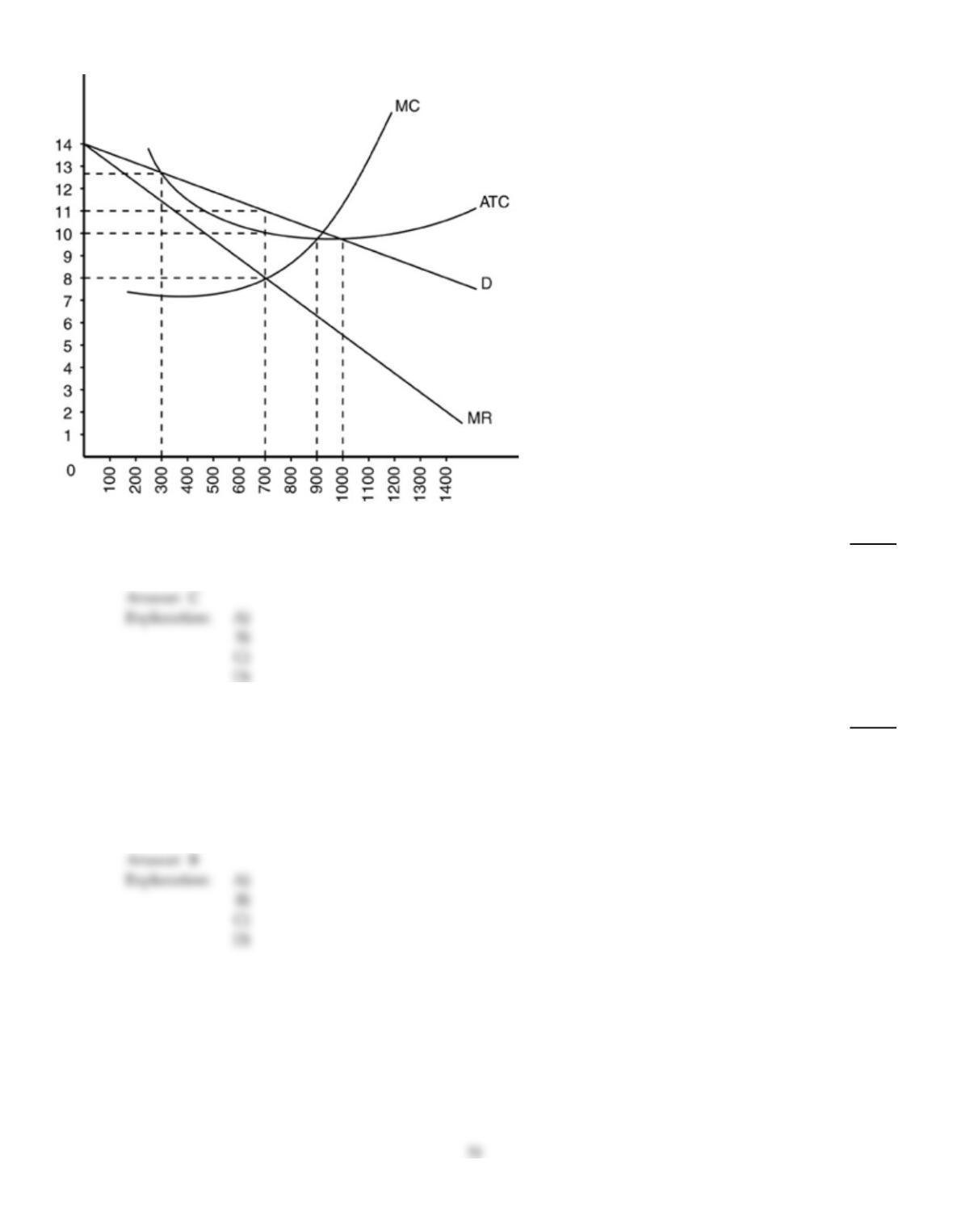
168)
In the above figure, this profit–maximizing monopolistic competitive firm will realize an economic
profit of
168)
A)
$2,100.
B)
$1,400.
C)
$700.
D)
–$1,400.
169)
Which of the following statements is TRUE about the economic profits earned by a monopolistic
competitor firm in the long run?
169)
A)
Economic profits will be positive since the firm has a downward sloping demand curve.
B)
Economic profits will tend towards zero since positive profits will attract new firms into the
industry.
C)
Economic profits can be positive since firms have some degree of monopoly power.
D)
Economic profits can be negative since there is so much competition in the market.
170)
Average total cost for an information product would
170)
A)
increase constantly as quantity increases.
B)
remain constant as quantity increases.
C)
decrease constantly as quantity increases.
D)
first decrease and then increase as quantity increases.
171)
In general, the demand for the product of a monopolistic competitor is
171)
A)
relatively inelastic.
B)
unitary elastic.
C)
perfectly elastic.
D)
relatively elastic.
172)
In the long run, what level of economic profits can a monopolistic competitor expect to receive?
172)
A)
negative
B)
zero
C)
either negative or positive, depending on the demand for its product and its costs
D)
positive
173)
Which of the following is most likely to be the subject of informational advertising?
173)
A)
an experience good
B)
an inexperience good
C)
a credible good
D)
a search good
174)
All of Jill‘s friends have been telling Jill that she must see a certain movie but she is not sure that she
will like it. The movie is a(n)
174)
A)
experience good.
B)
credence good.
C)
logo good.
D)
search good.
175)
Typically a mix of informational and persuasive advertising is used for
175)
A)
credible goods.
B)
search goods.
C)
experience goods.
D)
credence goods.
176)
The demand curve for a monopolistically competitive firm is
176)
A)
more elastic than for a monopoly firm.
B)
more inelastic than for a monopoly firm.
C)
more elastic than for a perfectly competitive firm.
D)
the same elasticity as a perfectly competitive firm.
A
177)
Refer to the above figure. Which panel does not represent a possible short–run situation for a
monopolistically competitive firm?
177)
A)
Panel A
B)
Panel B
C)
Panel C
D)
Panel D
B
D
178)
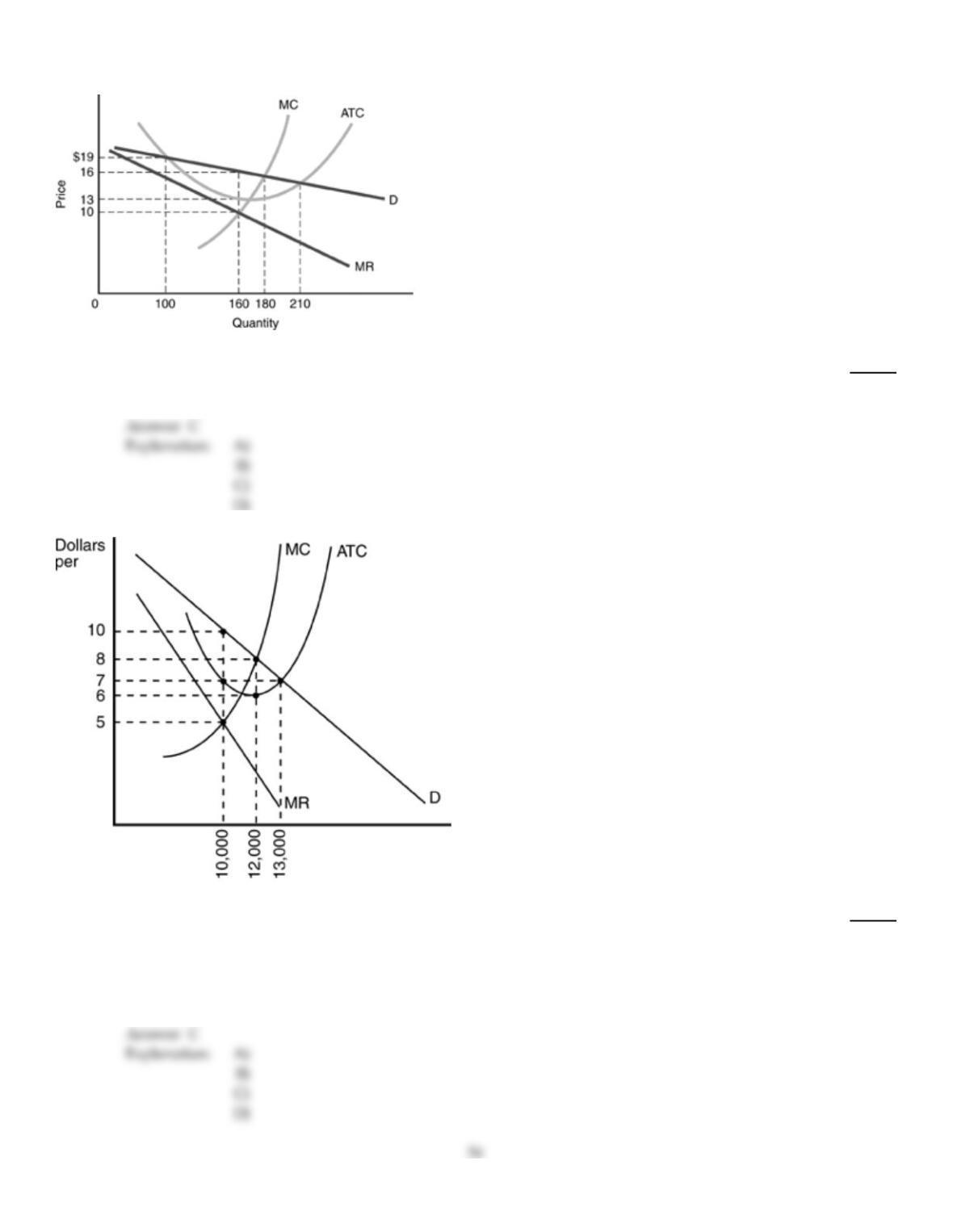
Use the above figure. The profit–maximizing output and price for this monopolistically
competitive firm are respectively
178)
A)
160 and $13.
B)
210 and $15.
C)
160 and $16.
D)
100 and $19.
179)
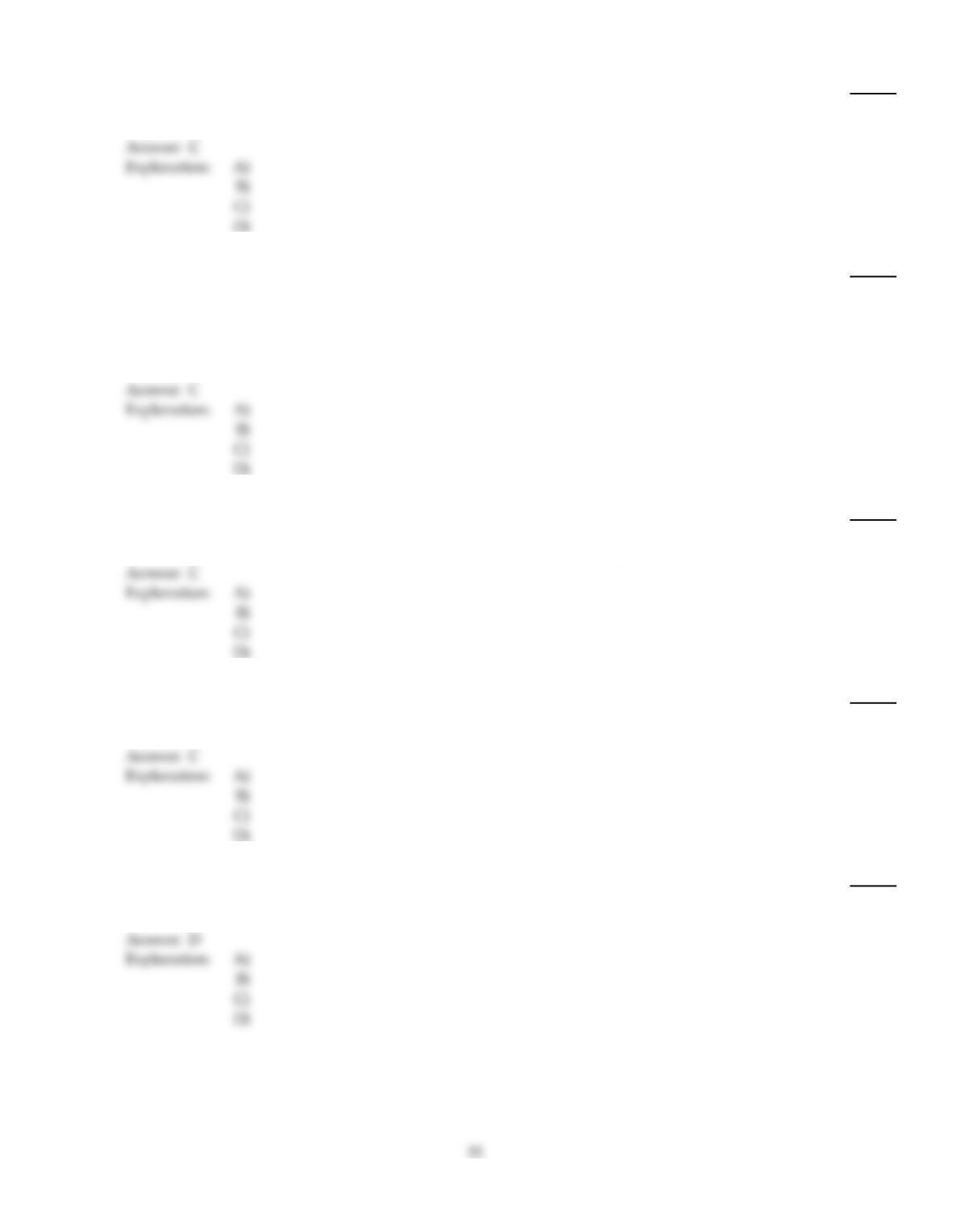
The above figure shows the situations of a monopolistic competitor in the short run. To maximize
profits, the firm should produce
179)
A)
13,000 unit.
B)
12,000 units.
C)
10,000 units.
D)
somewhere between 10,000 and 12,000 units.
180)
Which of the following is a characteristic of monopolistic competition?
180)
A)
homogeneous products
B)
strategic dependence
C)
easy entry and exit
D)
few firms
181)
Which of the following conditions best explain the short–run economies of operation associated
with production of an information product?
181)
A)
AFC is constant, and MC slopes downward, so that AVC slopes downward.
B)
MC is constant, and MC slopes upward, so that AVC slopes upward.
C)
AVC is constant, and AFC slopes downward, so that ATC slopes downward.
D)
AVC slopes downward, and AFC is constant, so that ATC slopes downward.
182)
In the short run, a monopolistically competitive firm can earn
182)
A)
positive profits only.
B)
zero profits only.
C)
zero, positive or negative profits.
D)
zero or positive profits only.
183)
Advertising intended to induce a consumer to discover a previously unknown taste or preference is
183)
A)
direct advertising.
B)
mass marketing advertising.
C)
persuasive advertising.
D)
informational advertising.
184)
If a customer buys an airline ticket based only on the price of the ticket, then the airline ticket is a(n)
184)
A)
experience good.
B)
credence good.
C)
logo good.
D)
search good.
185)
Entry into a monopolistically competitive industry
185)
A)
can be easy or difficult, depending on the type of product.
B)
is relatively easy.
C)
is very difficult.
D)
is about the same as entering a monopoly industry.
186)
In the long run, the economic profits of a monopolistically competitive firm
186)
A)
equal zero.
B)
will be the same as in the short run.
C)
will be the average short–run profits earned in the last five years.
D)
will tend to be larger than in the short run.
187)
In order to differentiate their product brands from those of competing firms, monopolistically
competitive firms
187)
A)
spread false rumors about their competitors.
B)
equate marginal cost to marginal revenue to determine the profit maximizing quantity.
C)
take their competitor’s reactions to changes in their policies into account.
D)
advertise their product.
188)
In the long run, in a monopolistically competitive market, price will be
188)
A)
greater ATC.
B)
equal to ATC.
C)
equal to MC.
D)
equal to MR.
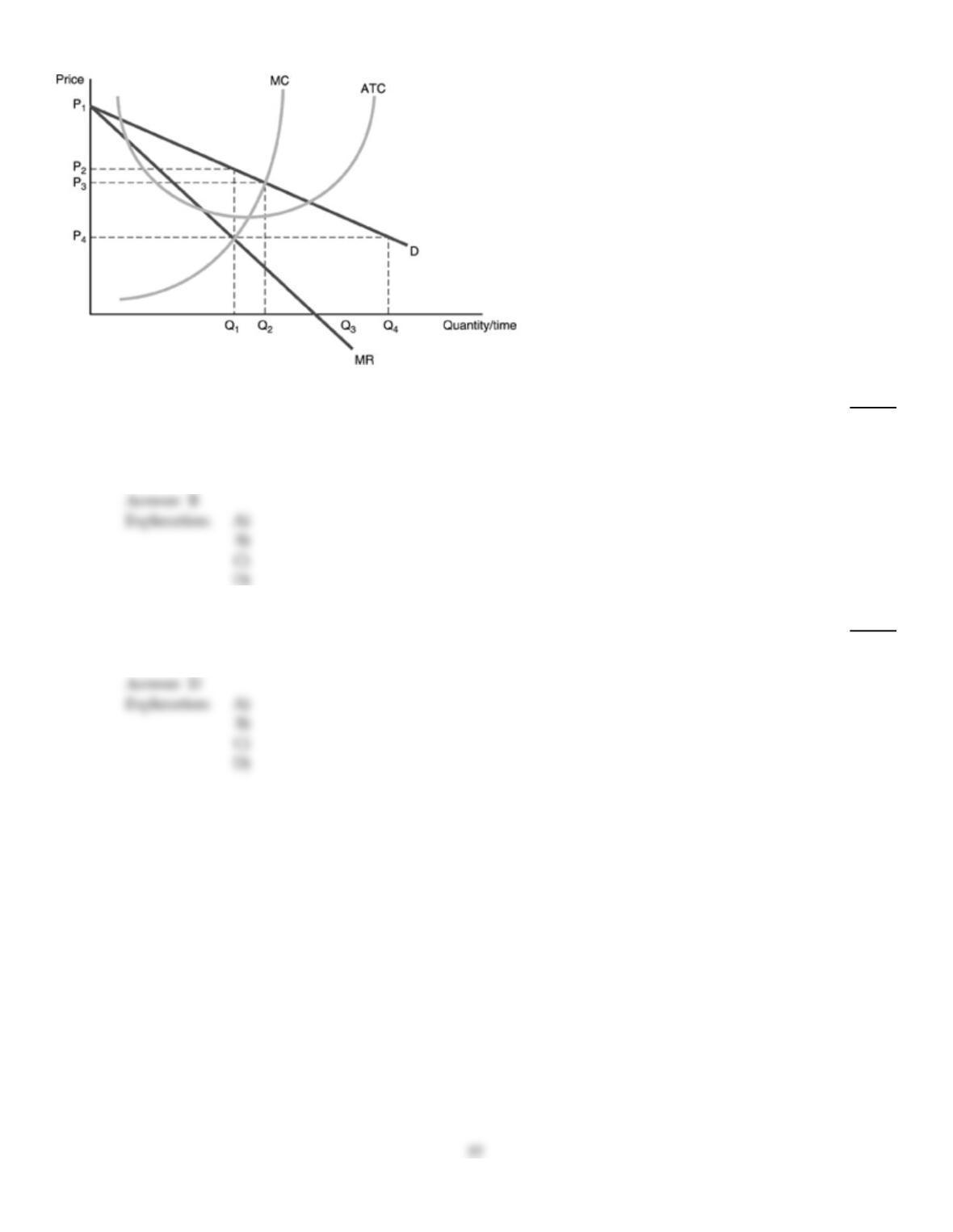
189)
Refer to the above figure. This firm is operating in the
189)
A)
short run since economic profits are less than zero.
B)
short run since economic profits are greater than zero.
C)
long run since economic profits are less than zero.
D)
long run since economic profits are greater than zero.
190)
A good with qualities that consumers lack the experience to assess without assistance is called
190)
A)
a persuasive good.
B)
a search good.
C)
an experience good.
D)
a credence good.
D
B
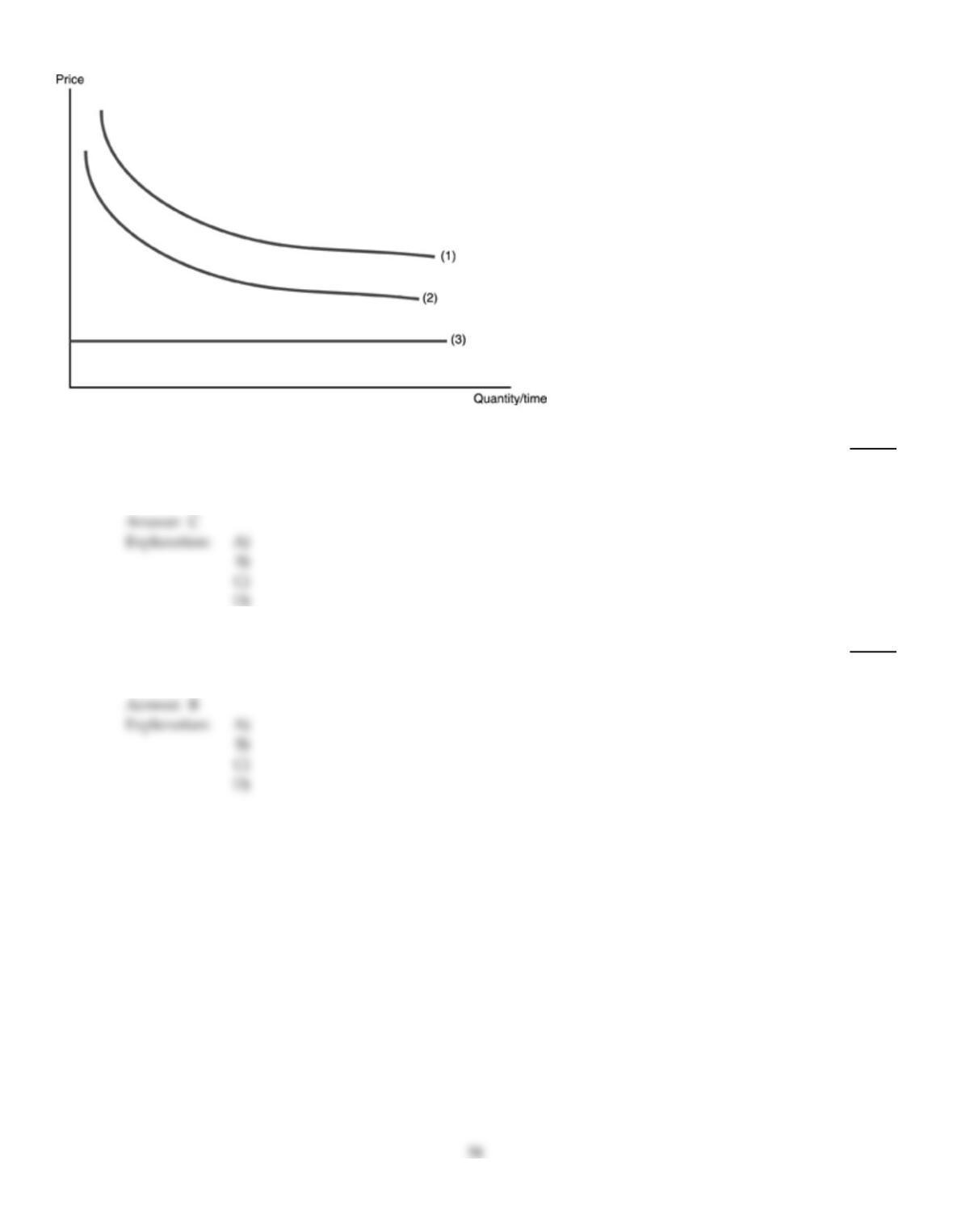
191)
Refer to the above figure. The above figure shows the cost structure of a firm producing an
information product. Which curve would represent the average variable cost?
191)
A)
Curve 1
B)
Curve 2
C)
Curve 3
D)
none of the above
192)
A good example of a monopolistic competitive industry is
192)
A)
mining.
B)
the U.S. auto industry.
C)
the public utility industry.
D)
the computer game industry.
193)
What did Harvard economist Edward Chamberlain say about the observation that a
monopolistically competitive firm’s average cost of production exceeds its minimum average total
cost?
193)
A)
In Chamberlain’s view, this is evidence that monopolistic competition uses society’s resources
inefficiently and in a fashion that merits government intervention.
B)
Chamberlain argued that these higher costs represent the wastefulness of this market
structure.
C)
Chamberlain argued that this belief is incorrect. In his view, monopolistically competitive
firms do not produce at a cost above their minimum average total costs.
D)
According to Chamberlain, this cost difference represents the value consumers place on
variety and having more choice.
Price per Marginal
Output Book ($) Cost
08.00 0
17.00 1.00
26.00 2.00
35.00 3.00
44.00 4.00
194)
The above table depicts prices, quantities, and marginal costs faced by the campus bookstore. Based
on marginal analysis, what is the profit–maximizing level of output for the bookstore?
194)
A)
1 book
B)
2 books
C)
3 books
D)
4 books
195)
The ATC curve and the AFC curve for information products (e.g., software) in the short run are
195)
A)
upward sloping.
B)
horizontal.
C)
downward sloping.
D)
vertical.
196)
The brand name of a firm
196)
A)
has nothing to do with the profitability of a firm.
B)
relates to consumers’ perception of product differentiation and to the market value of a firm.
C)
is important in the short–run but not in the long–run.
D)
has been considered irrelevant by economists since profits for a monopolistic competitive
firm are zero in the long–run.
197)
Persuasive advertising is the type of advertising that
197)
A)
emphasizes the features of its product.
B)
is used to induce a consumer to discover previously unknown tastes and preferences.
C)
is used exclusively on television.
D)
is used exclusively on radio.
B
198)
Firms that sell information products experience relatively high fixed costs but, once they have
produced the first unit, can
198)
A)
experience short–run diseconomies of scale.
B)
sell additional units at a relatively low cost per unit.
C)
provide expensive information products to consumers.
D)
sell additional units at a loss, or above cost.
B
199)
Which of the following is NOT a characteristic of the demand curve faced by a firm in a
monopolistically competitive market?
199)
A)
The firm will produce where the demand curve is elastic.
B)
The slope of the demand curve is negative.
C)
The firm will produce where the demand curve is inelastic.
D)
The demand curve is downward sloping.
C
B