72)
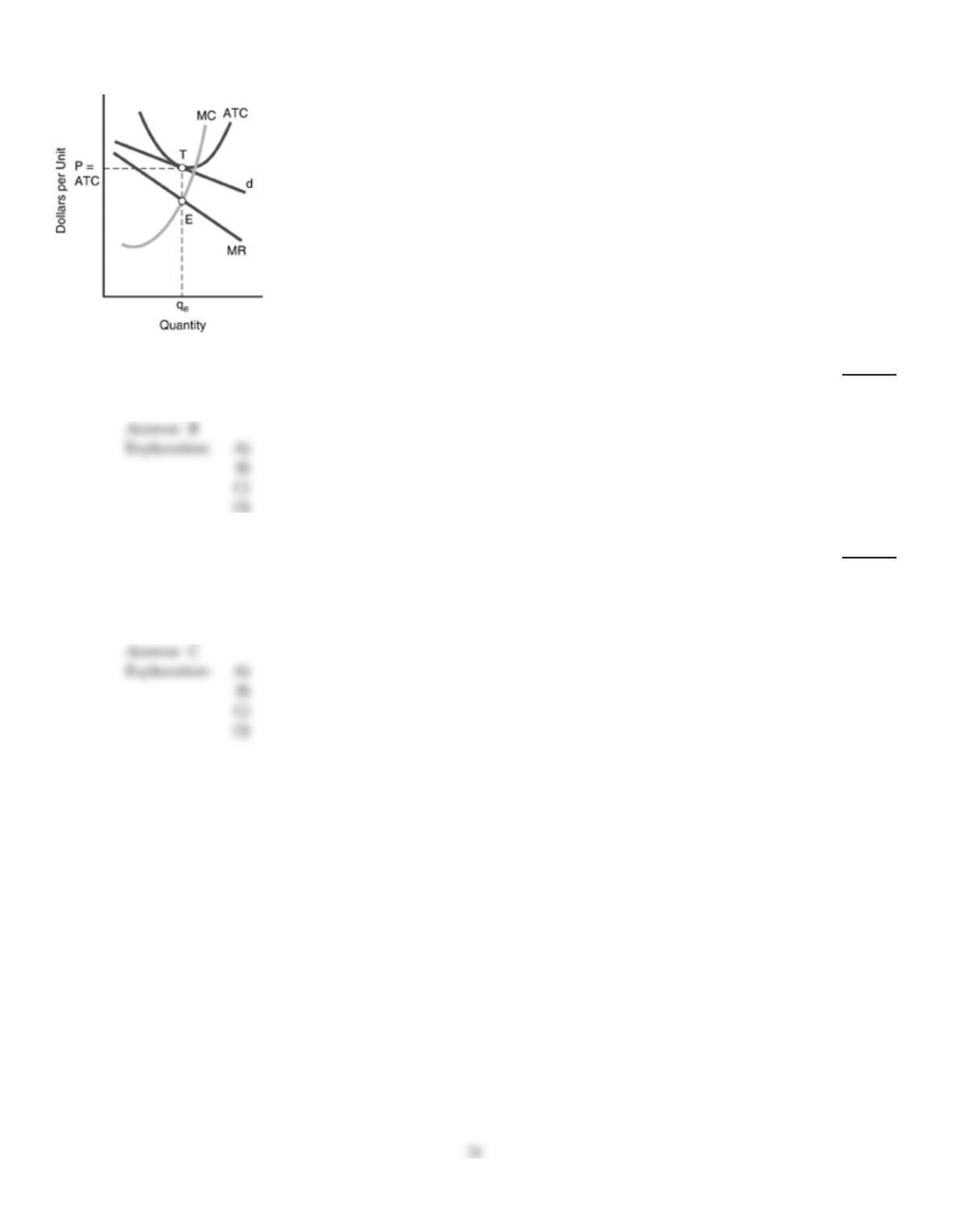
Use the above figure. The economic profit for this firm is
72)
A)
the distance between T and x–axis.
B)
zero.
C)
the distance between E and x–axis.
D)
the distance between T and E.
73)
An information product typically has
73)
A)
low total fixed costs and high marginal costs.
B)
low total fixed costs and low marginal costs.
C)
high total fixed costs and low marginal costs.
D)
high total fixed costs and high marginal costs.
74)
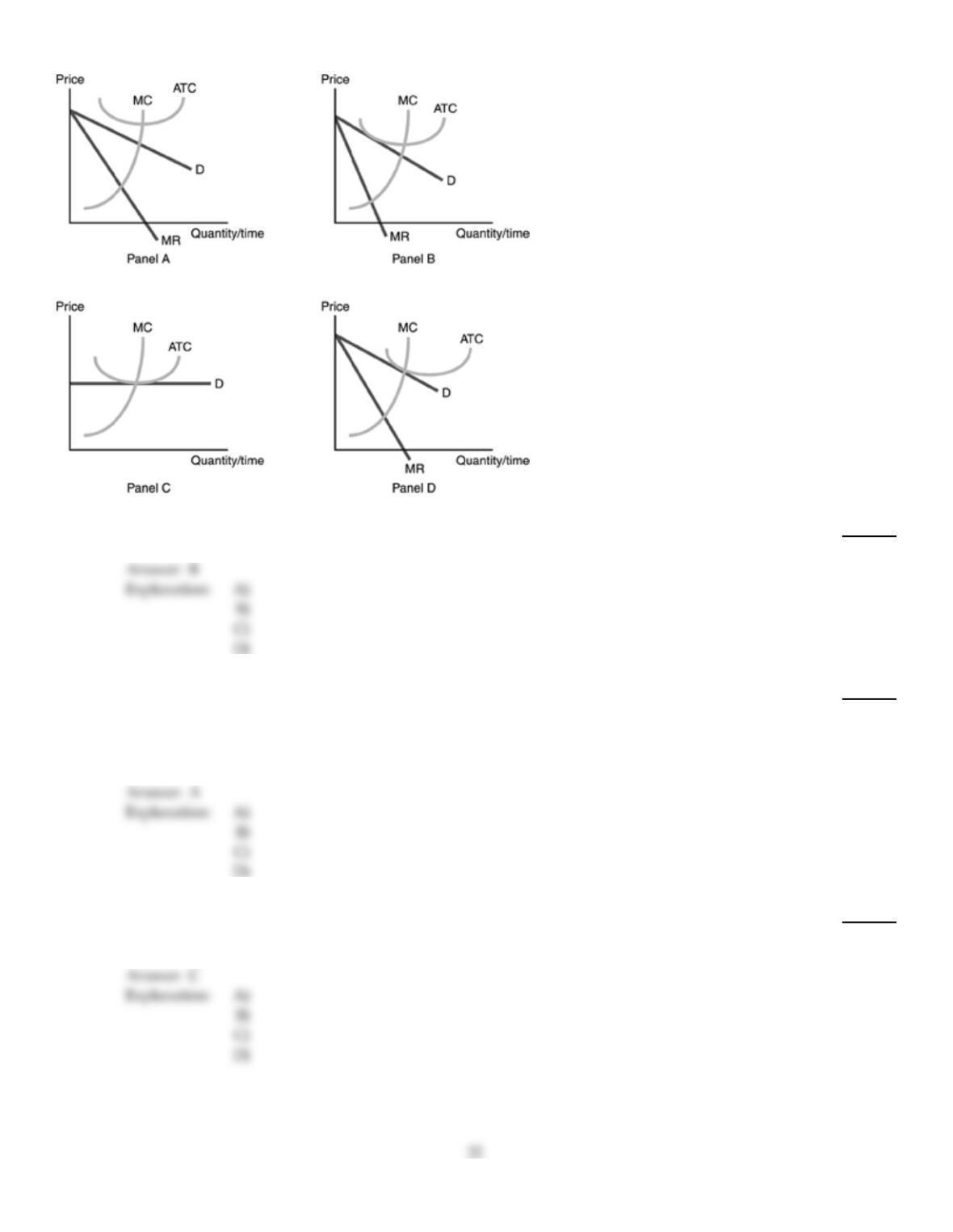
Refer to the above figure. A long–run equilibrium in monopolistic competition is pictured by
74)
A)
Panel A.
B)
Panel B.
C)
Panel C.
D)
Panel D.
75)
The main objective of advertising for a monopolistically competitive firm is
75)
A)
to differentiate the product and boost demand.
B)
to earn long run profits.
C)
to reduce cost.
D)
none of the above.
A
76)
The distinguishing of products by brand name, color, and other attributes
76)
A)
is known as interdependence.
B)
leads to collusion.
C)
is known as product differentiation.
D)
leads to many firms in the market.
C
B
77)
In which market structure will a firm choose not to shut down when price is less than average
variable cost?
77)
A)
monopoly
B)
perfect competition
C)
monopolistic competition
D)
None of the above. All firms will shut down when P < AVC.
78)
If firms in a monopolistically competitive industry are operating with economic losses, over time
we would see
78)
A)
some firms exiting the industry, causing the market supply curve to shift to the left, raising
price.
B)
firms alter their advertising rates until they made at least normal profits.
C)
the firms working together to increase price and everyone’s profitability.
D)
some firms exiting the industry, causing the demand curves of the remaining firms to shift to
the right.
79)
It has been argued that in the long run monopolistic competition is inefficient because
79)
A)
there are too many firms, each with excess capacity, producing too little output.
B)
minimum average total costs are not achieved and marginal cost exceeds price.
C)
there are few many firms, each with excess capacity, producing too much output.
D)
minimum average total costs are achieved but price exceeds marginal cost.
80)
Which of the following is NOT a characteristic of monopolistic competition?
80)
A)
barriers to entry into the market
B)
a significant number of sellers
C)
advertising
D)
product differentiation
81)
A distinguishing characteristic of producers of information products is their
81)
A)
low average fixed costs.
B)
low fixed costs.
C)
low overhead.
D)
short–run economies of operation.
82)
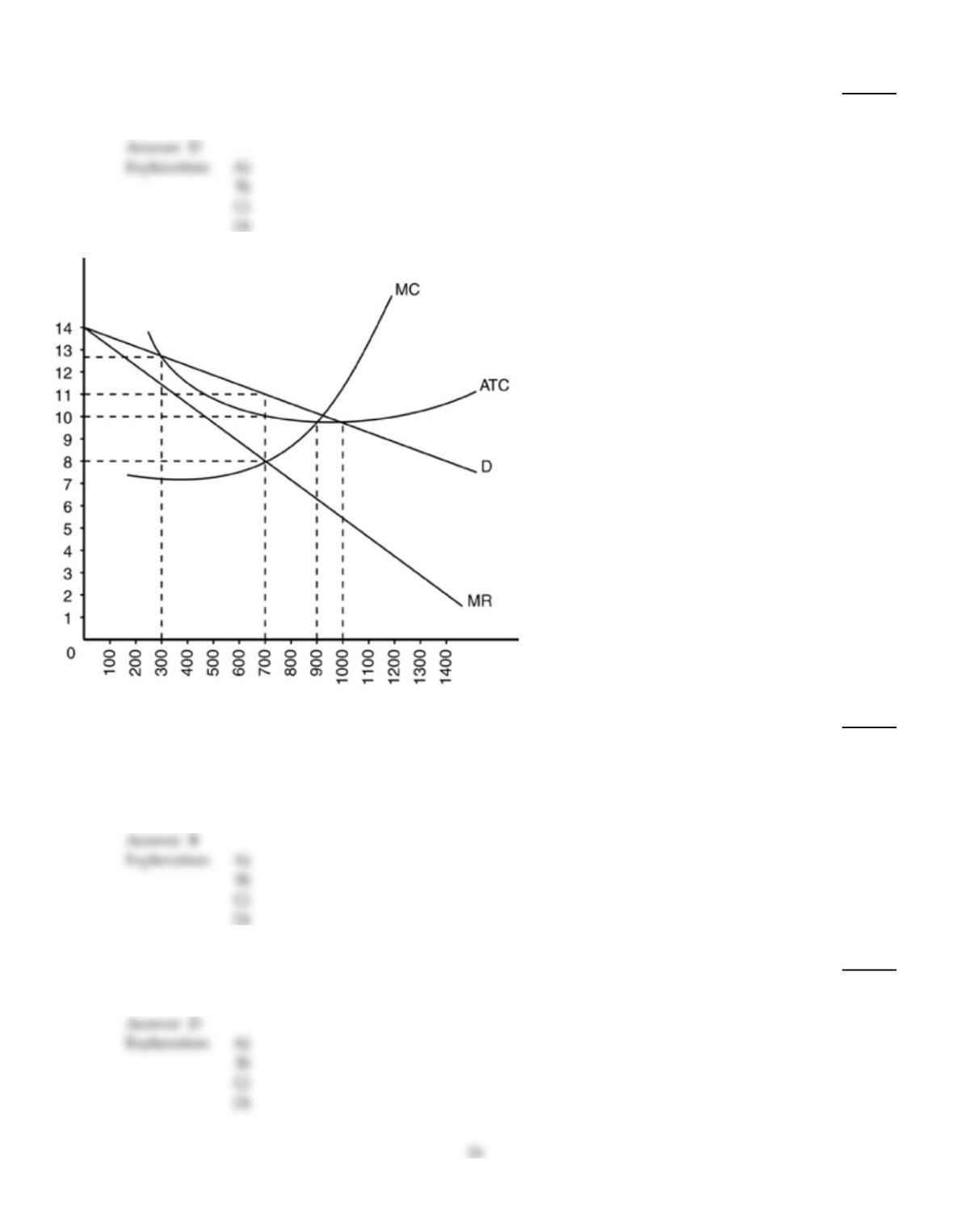
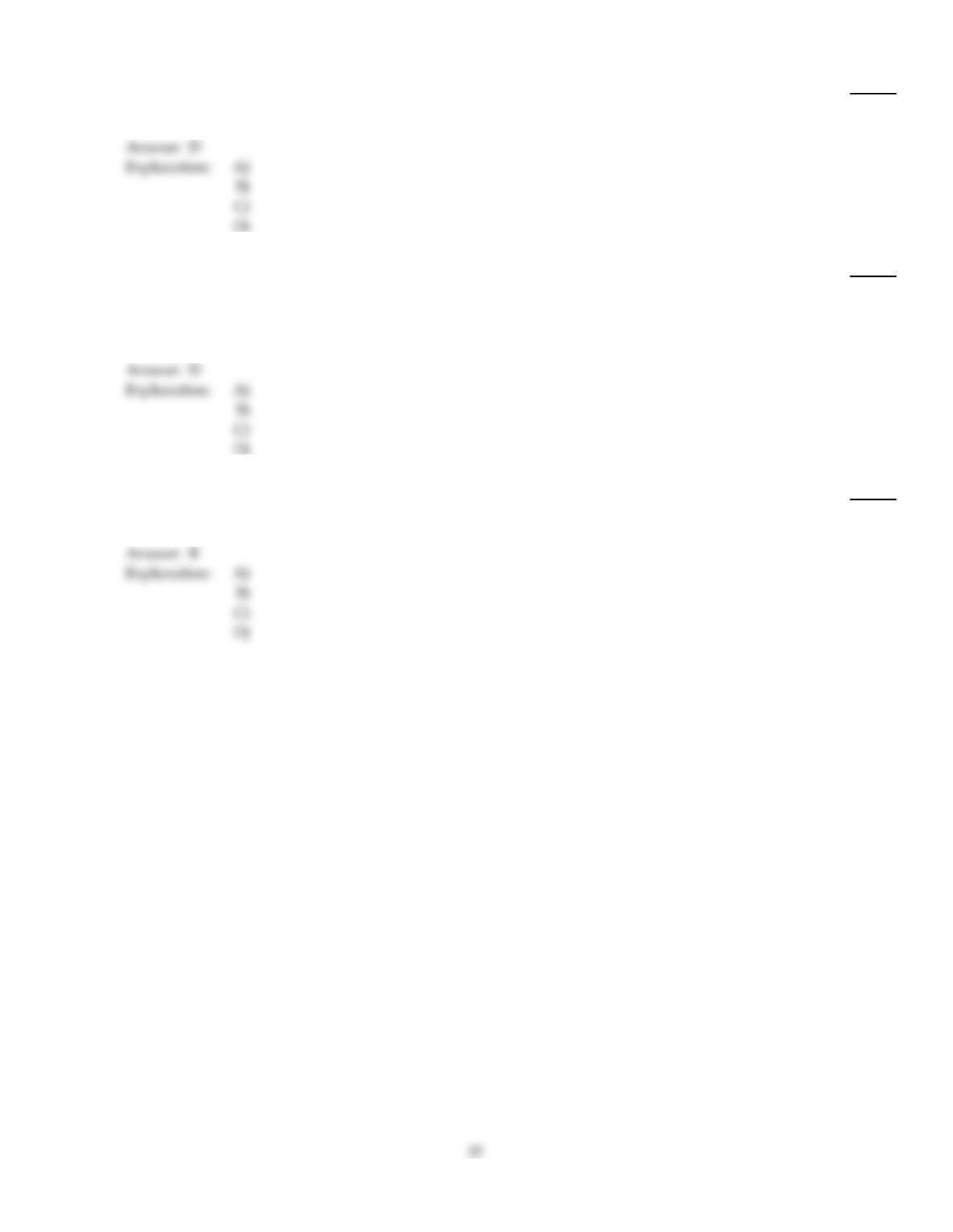
Since the firm in the above figure is operating in a monopolistically competitive industry, in the
long run we can expect to see
82)
A)
each firm expand its share of the total market.
B)
more firms entering the industry until economic profits are zero.
C)
the typical firm producing at the minimum point on its ATC curve.
D)
the typical firm’s economic profits expand as production becomes more efficient.
83)
Which of the following is NOT a characteristic of firms in a monopolistically competitive market?
83)
A)
ease of entry and exit
B)
differentiated products
C)
advertising
D)
existence of significant economies of scale
84)
The type of advertising used for an experience good is
84)
A)
experience advertising.
B)
informational advertising.
C)
persuasive advertising.
D)
search advertising.
85)
In the short run, the profit–maximizing monopolistically competitive firm will produce the rate of
output at which
85)
A)
MR = ATC.
B)
P = ATC.
C)
MR = MC.
D)
P = MC.
86)
Persuasive advertising is used to
86)
A)
cut costs.
B)
induce a consumer to try a product and discover a previously unknown taste for it.
C)
sell to an established clientele.
D)
promote only used goods.
87)
The demand curve for the product of a monopolistically competitive firm slopes downward
because
87)
A)
products are homogeneous.
B)
products are perceived by consumers as different.
C)
people only care about price when they buy a good.
D)
the firm’s goal is to maximize profits.
88)
In the long run, a monopolistic competitor will produce to the point at which
88)
A)
resources are used at the lowest possible cost.
B)
average total costs are at the minimum of possible ATC.
C)
average total costs are higher than the minimum of possible ATC.
D)
at the lowest possible price.
89)
In a monopolistically competitive market if the additional revenue generated from advertising
equals the additional cost of advertising, the firm should
89)
A)
advertise less to decrease costs.
B)
advertise more to lower marginal costs.
C)
advertise more to increase sales.
D)
maintain its current amount of advertising.
90)
The type of advertising that emphasizes the features of its product is
90)
A)
persuasive advertising.
B)
experience advertising.
C)
search advertising.
D)
informational advertising.
91)
In a long–run monopolistically competitive equilibrium
91)
A)
P > ATC, and ATC is at its minimum value.
B)
P = ATC, and ATC is at its minimum value.
C)
P > ATC, and ATC is not at its minimum value.
D)
P = ATC, and ATC is not at its minimum value.
92)
Monopolistic competition and perfect competition are similar in that each market structure is
characterized by
92)
A)
production at minimum average cost in the long run.
B)
a horizontal demand curve.
C)
advertising.
D)
the absence of long–run economic profits.
93)
The two economists associated with the development of the theory of monopolistic competition
were
93)
A)
David Hume and Adam Smith.
B)
Carl Menger and Eugen Von Bohm–Bawerk.
C)
John Neville Keynes and John Maynard Keynes.
D)
Joan Robinson and Edward Chamberlin.
94)
In the long run in a monopolistically competitive market, a firm will, in theory,
94)
A)
earn economic profits.
B)
break even.
C)
earn zero accounting profits.
D)
suffer losses.
95)
All of the following are assumptions of monopolistic competition EXCEPT
95)
A)
many buyers and sellers.
B)
homogeneous product.
C)
profit–maximizing behavior.
D)
easy entry of new firms in the long run.
96)
Harry needs to hire a lawyer but does not know how to find a good one. The lawyer is a(n)
96)
A)
experience good.
B)
credence good.
C)
logo good.
D)
search good.
97)
By promoting its brand name heavily, the monopolistically competitive firm
97)
A)
earns more profit in the long run.
B)
guarantees a short run profit.
C)
signals its long–term intention to stay in the industry.
D)
signals its intention to leave the industry.
98)
The number of firms in a monopolistically competitive market means that
98)
A)
all firms will have substantial monopoly power since there are so few firms in the industry.
B)
the firms will be likely to collude since there are only a few firms in the industry.
C)
firms will have a hard time earning non–negative profits since there are many firms in the
industry.
D)
each firm has a relatively small share of the total market since there are many firms in the
industry.
99)
In the short run, a monopolistically competitive firm
99)
A)
always earns positive economic profits.
B)
always earns positive accounting profits.
C)
never earns positive economic profits.
D)
can earn positive, negative, or zero economic profits.
100)
A monopolistic competitor is like a competitive firm in the long run, because
100)
A)
it earns zero economic profits
B)
it earns positive economic profits.
C)
both firms will earn positive economic profits.
D)
both firms will increase price to increase profits.
101)
For a monopolistic competitive firm, which of the following is TRUE in the long run?
101)
A)
P = MC.
B)
Economic profit is zero.
C)
ATC is minimized.
D)
all of the above
102)
The goal of advertising is to
102)
A)
increase the price elasticity of demand for the firm’s product.
B)
reduce the price elasticity of demand for the firm’s product.
C)
encourage firms to enter into the industry.
D)
increase the standardization of the industry.
103)
A good that people must actually consume before they can determine qualities is called
103)
A)
a credence good.
B)
an experience good.
C)
a persuasive good.
D)
a search good.
B
104)
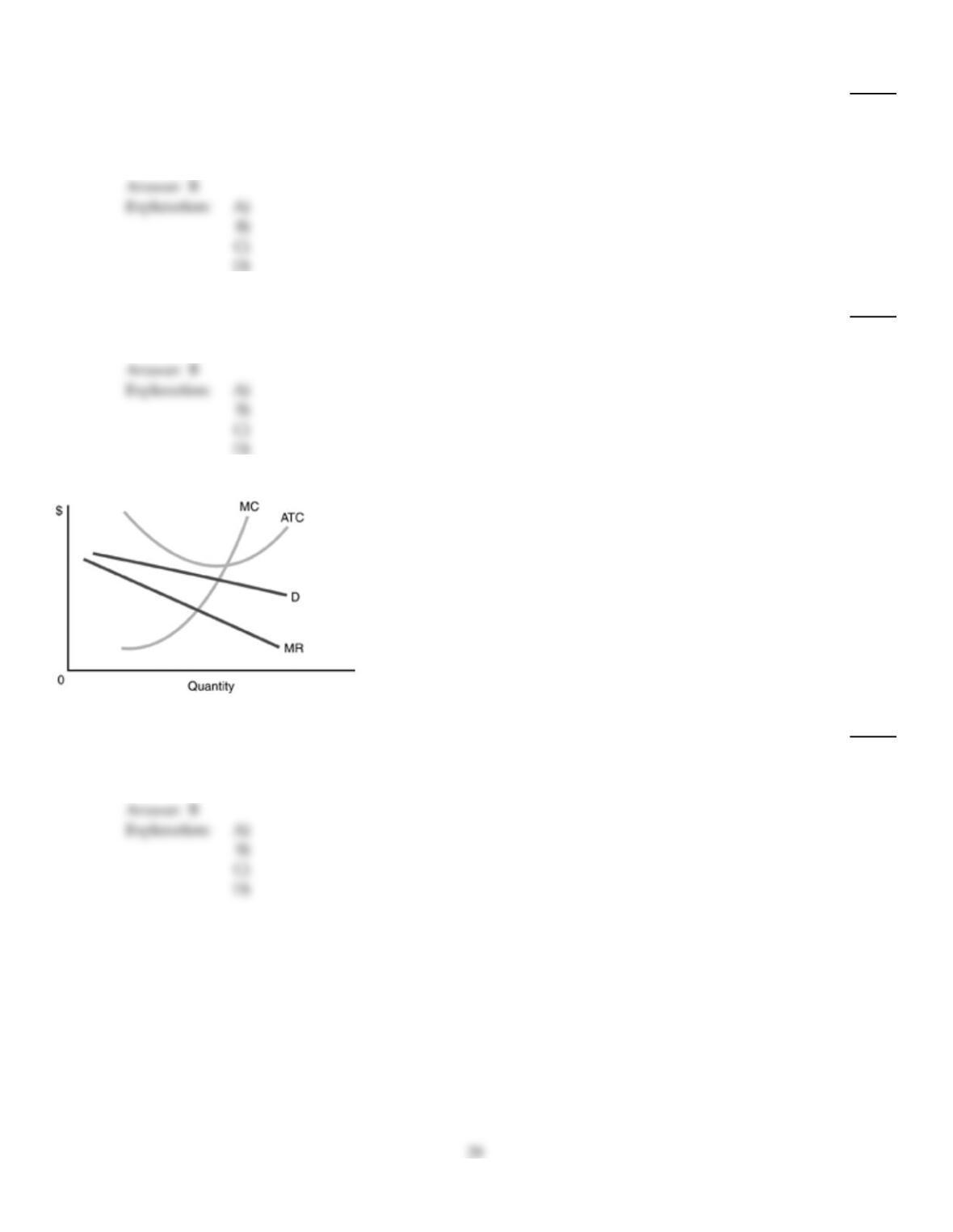
Use the above figure. When it maximizes its economic profits, the monopolistically competitive
firm depicted in the figure
104)
A)
is earning an accounting profit.
B)
is earning an economic loss.
C)
is earning an economic profit.
D)
must increase output to reduce the ATC.
B
B
105)
Which statement is INCORRECT with respect to sales promotion and advertising?
105)
A)
Advertising should be carried to the point at which the additional revenue from one more
dollar of advertising just equals that one dollar of marginal cost.
B)
A perfectly competitive firm, by definition, can sell all that it wants to sell at the going market
price.
C)
Perfect competition differs from monopolistic competition in that no individual firm in a
perfectly competitive market will advertise.
D)
A perfect competitor advertises a product that is different from the products that all other
firms in the industry are selling.
106)
Which of the following is NOT a characteristic of monopolistic competition?
106)
A)
advertising
B)
differentiated products
C)
barriers to entry
D)
large number of sellers
C
107)
If a firm produces an experience good, its mode of advertising will be
107)
A)
direct advertising.
B)
not to advertise.
C)
persuasive advertising.
D)
none of the above.
C
108)
A market situation in which a large number of firms produce similar but not identical products is
called
108)
A)
perfectly competitive.
B)
oligopolistic behavior.
C)
pure monopoly.
D)
monopolistically competitive.
D
D
109)
Advertisement in which firms aim messages to as many customers as possible via media is known
as
109)
A)
direct marketing.
B)
indirect marketing.
C)
mass marketing.
D)
interactive marketing.
110)
When a telemarketer calls you about a product, this is an example of
110)
A)
direct marketing.
B)
indirect marketing.
C)
persuasive marketing.
D)
searching for a good.
111)
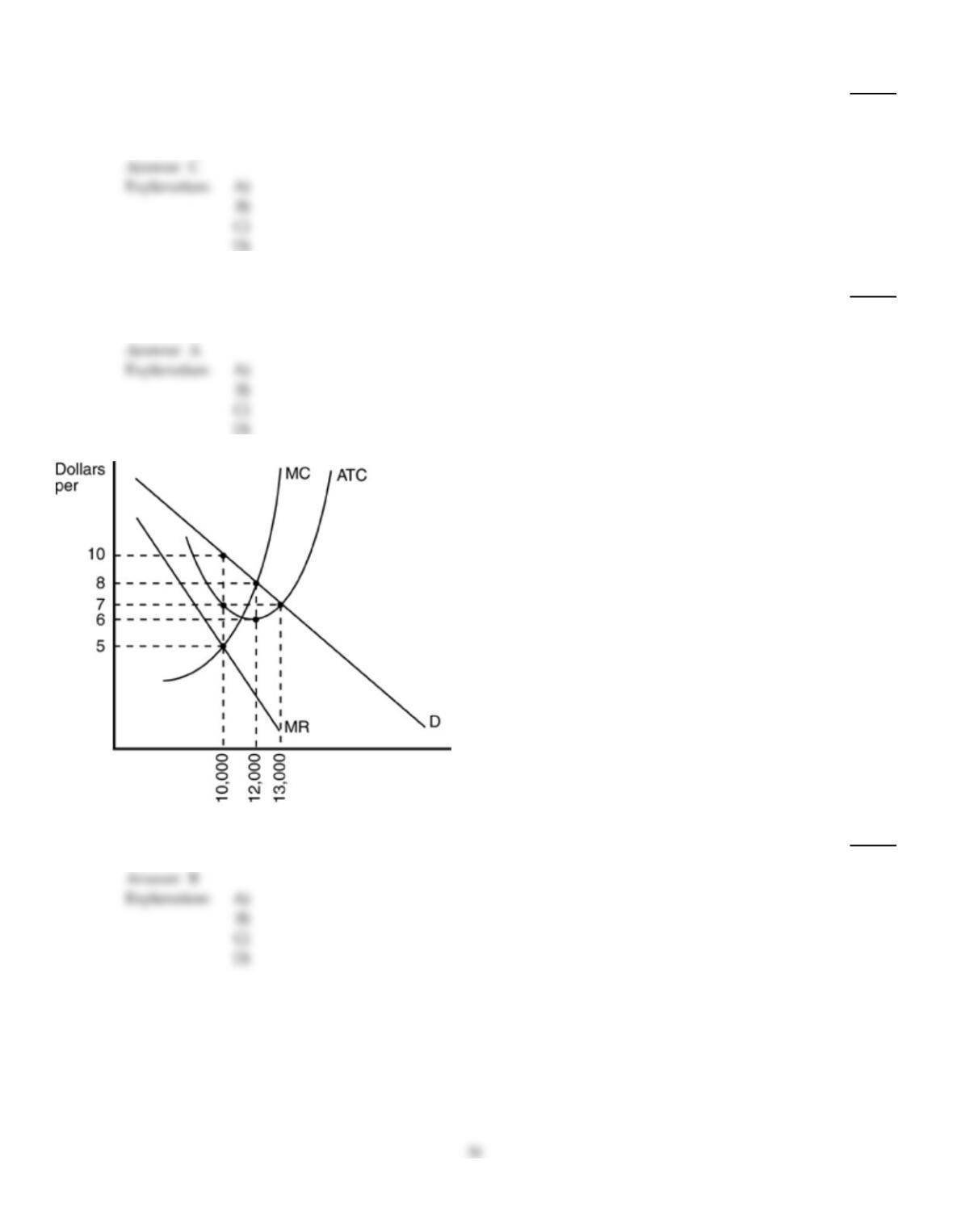
In the above figure, total cost for this profit–maximizing monopolistically competitive firm is
111)
A)
$50,000.
B)
$70,000.
C)
$91,000.
D)
$72,000.
112)
A firm in a monopolistically competitive market determines the profit–maximizing output at
which
112)
A)
MR = AVC.
B)
MR = ATC.
C)
MR = MC.
D)
MR = P.
113)
The ATC curve for a firm that produces an information product
113)
A)
slopes downward, because AVC is constant, AFC slopes downward, and ATC = AVC + AFC.
B)
slopes upward, because AFC is constant, AVC slopes upward, and ATC = AFC + AVC.
C)
slopes downward, because MC slopes downward, AVC is constant, and ATC = AVC +MC.
D)
is U–shaped, because AVC is U–shaped, AFC slopes downward, and ATC = AVC + AFC.
114)
One way to view the cost structure of monopolistic competition is to say that the cost of product
differentiation is equal to
114)
A)
the sum of price and marginal cost.
B)
the difference between the cost of production for a monopolistically competitive firm in an
open market and the minimum average total cost.
C)
the difference between marginal revenue and marginal cost.
D)
the sum of marginal cost and minimum average cost.
115)
In the short run, a firm operating as a monopolistic competitor will produce to the point at which
115)
A)
MR = MC.
B)
MC = ATC.
C)
MR = ATC.
D)
P = MC.
116)
A monopolistic competitor is in long–run equilibrium when
116)
A)
its average total cost curve is tangent to the demand curve at the profit–maximizing rate of
output.
B)
price is greater than marginal cost.
C)
it is making zero profits and price equals marginal cost.
D)
it is making positive profits or zero profits and price is greater than marginal cost.
117)
Out of all advertising spending, the largest share goes to
117)
A)
newspaper ads.
B)
television ads.
C)
magazine ads.
D)
direct marketing.
D
118)
Which of the following statements is INCORRECT regarding the model for information products?
118)
A)
The firm maximizes profit by setting the price of its product equal to marginal cost.
B)
In the long run, accounting profit is positive.
C)
Average total costs slope downward, because average variable cost is constant, average fixed
cost slopes downward.
D)
Marginal cost equals average variable cost.
A
119)
Because of product differentiation in a monopolistically competitive market, the demand curve for
an individual firm will be
119)
A)
vertical.
B)
downward sloping.
C)
upward sloping.
D)
horizontal.
B
120)
For a firm that sells an information product, the long–run equilibrium exists at a point where
120)
A)
price equals marginal cost.
B)
price equals average fixed cost.
C)
price equals average variable cost.
D)
price equals average total cost.
D
A
121)
Which of the following assumptions is TRUE about monopolistic competition?
121)
A)
There are few producers of the product.
B)
It is difficult for firms to enter this industry.
C)
Firms will not advertise.
D)
The firm’s products are differentiated.
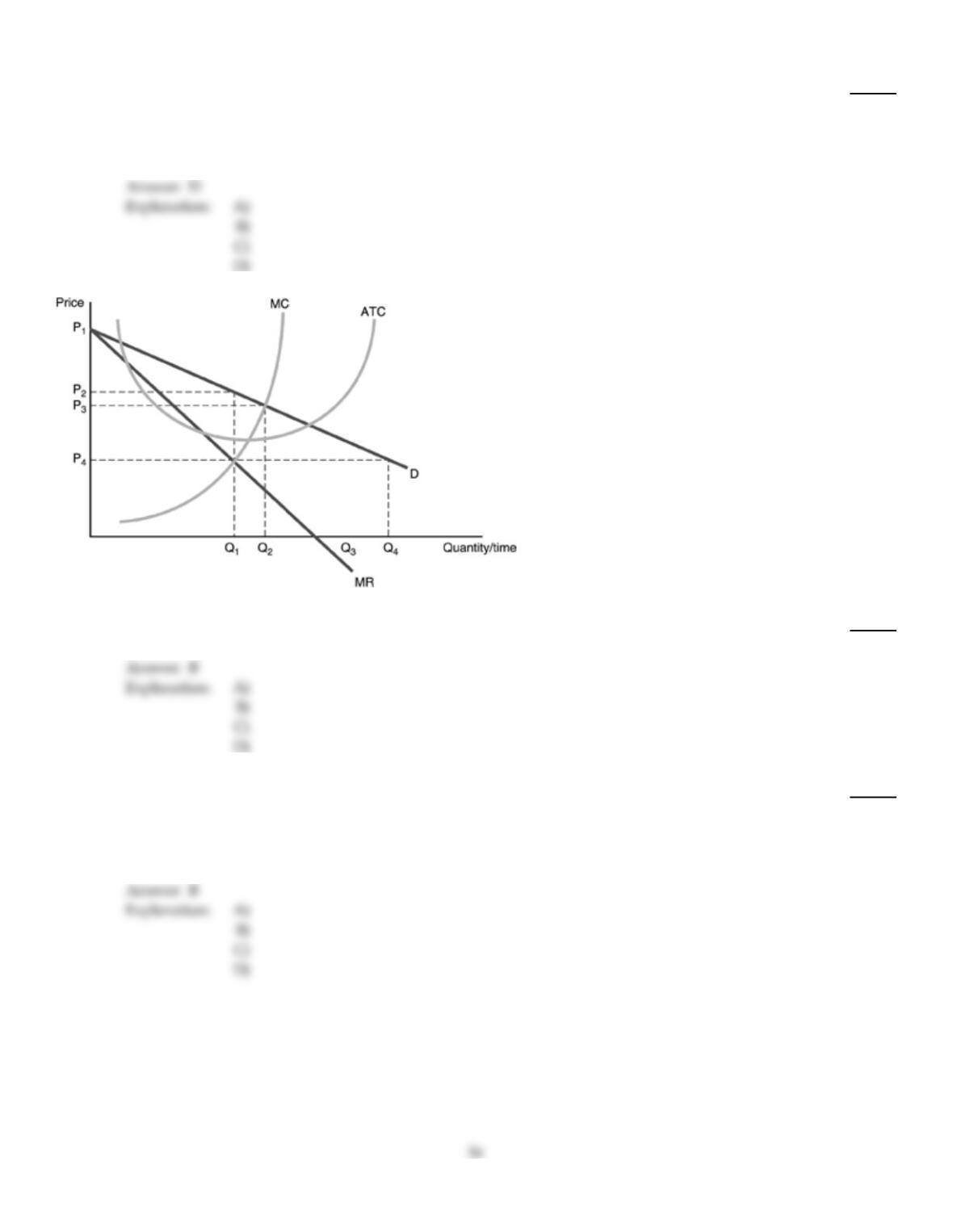
122)
Refer to the above figure. The profit maximizing price for a monopolistic competitor is
122)
A)
P1.
B)
P2.
C)
P3.
D)
P4.
123)
Marginal cost pricing for an information product
123)
A)
would allow the firm to break even.
B)
would cause the firm to experience economic losses.
C)
would cause the firm to expand output to increase economic profits.
D)
would cause the firm to earn economic profits.
124)
The greater the the number and closeness of substitutes available between monopolistically
competitive firms
124)
A)
the smaller the ability of a firm to raise its price above the price of close substitutes.
B)
the greater the positive economic profits for a single firm.
C)
the greater the ability of a firm to raise its price above the price of close substitutes.
D)
the more inelastic the demand curve.
125)
Marginal cost for an information product would
125)
A)
first decrease and then increase as quantity increases.
B)
increase constantly as quantity increases.
C)
remain constant as quantity increases.
D)
decrease constantly as quantity increases.
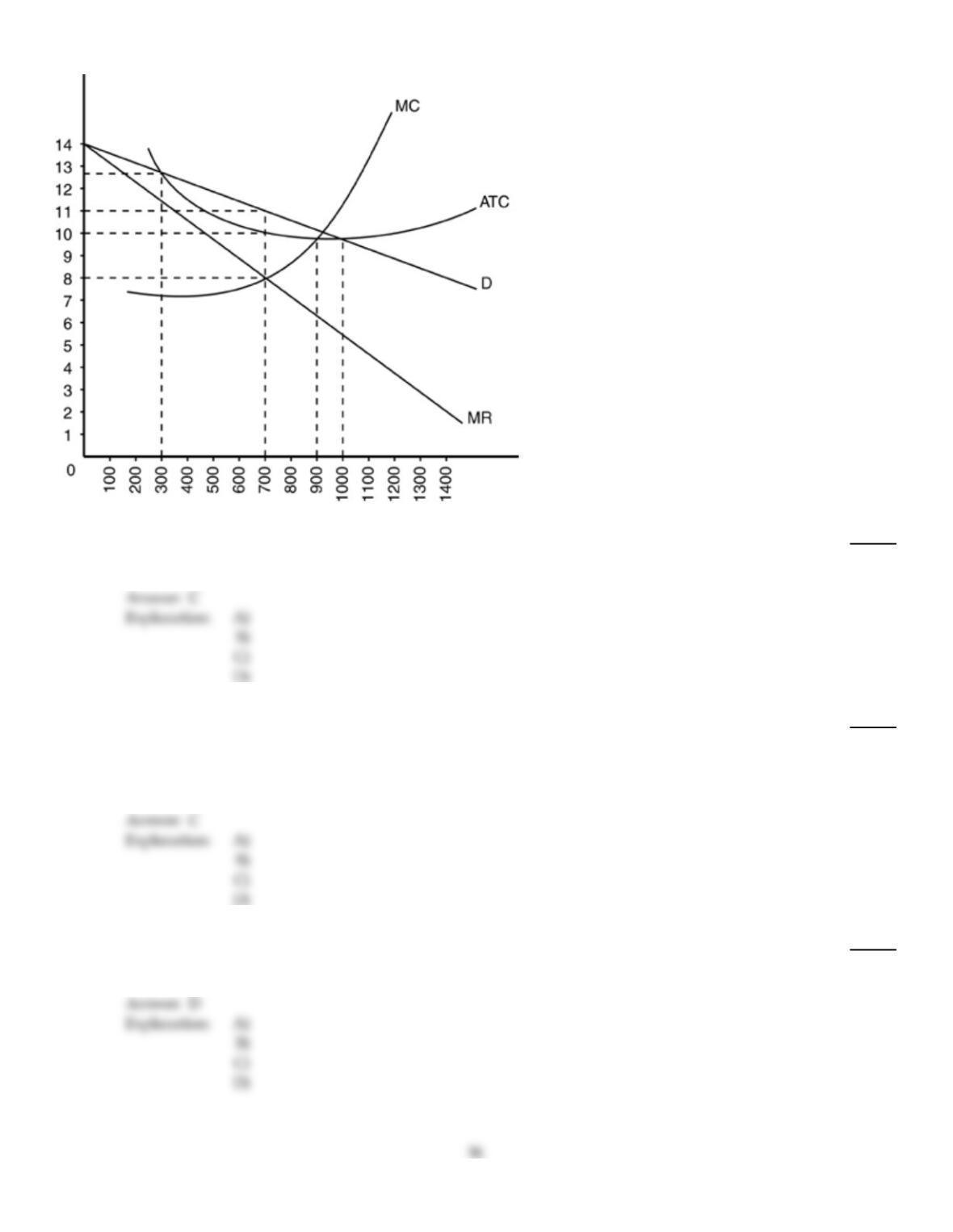
126)
In the above figure, when this monopolistically competitive firm produces its profit–maximizing
output, it sets a per–unit price of
126)
A)
$10.
B)
$8.
C)
$11.
D)
$13.
127)
The demand curve for a monopolistically competitive firm is
127)
A)
inelastic because of barriers to entry.
B)
inelastic because of the profit maximizing behavior of the firm.
C)
elastic because of product differentiation.
D)
elastic because the products produced are homogeneous.
128)
A monopolistic competitor would face a demand curve with a
128)
A)
positive slope.
B)
slope equal to 0.
C)
constant slope.
D)
negative slope.
129)
All of the following are characteristics of monopolistic competition EXCEPT
129)
A)
product differentiation.
B)
many firms in the industry.
C)
advertising.
D)
a few firms dominate the industry.
130)
A monopolistically competitive firm finds its profit–maximizing rate of output by equating
130)
A)
price and marginal cost.
B)
the marginal revenue of advertising with the marginal cost of advertising.
C)
average revenue and average total cost.
D)
marginal revenue and marginal cost.
131)
A firm’s trademark is protected from misuse if it is registered with the
131)
A)
F.C.C.
B)
U.S. Patent and Trademark Office.
C)
U.S. Supreme Court.
D)
U.S.D.A.
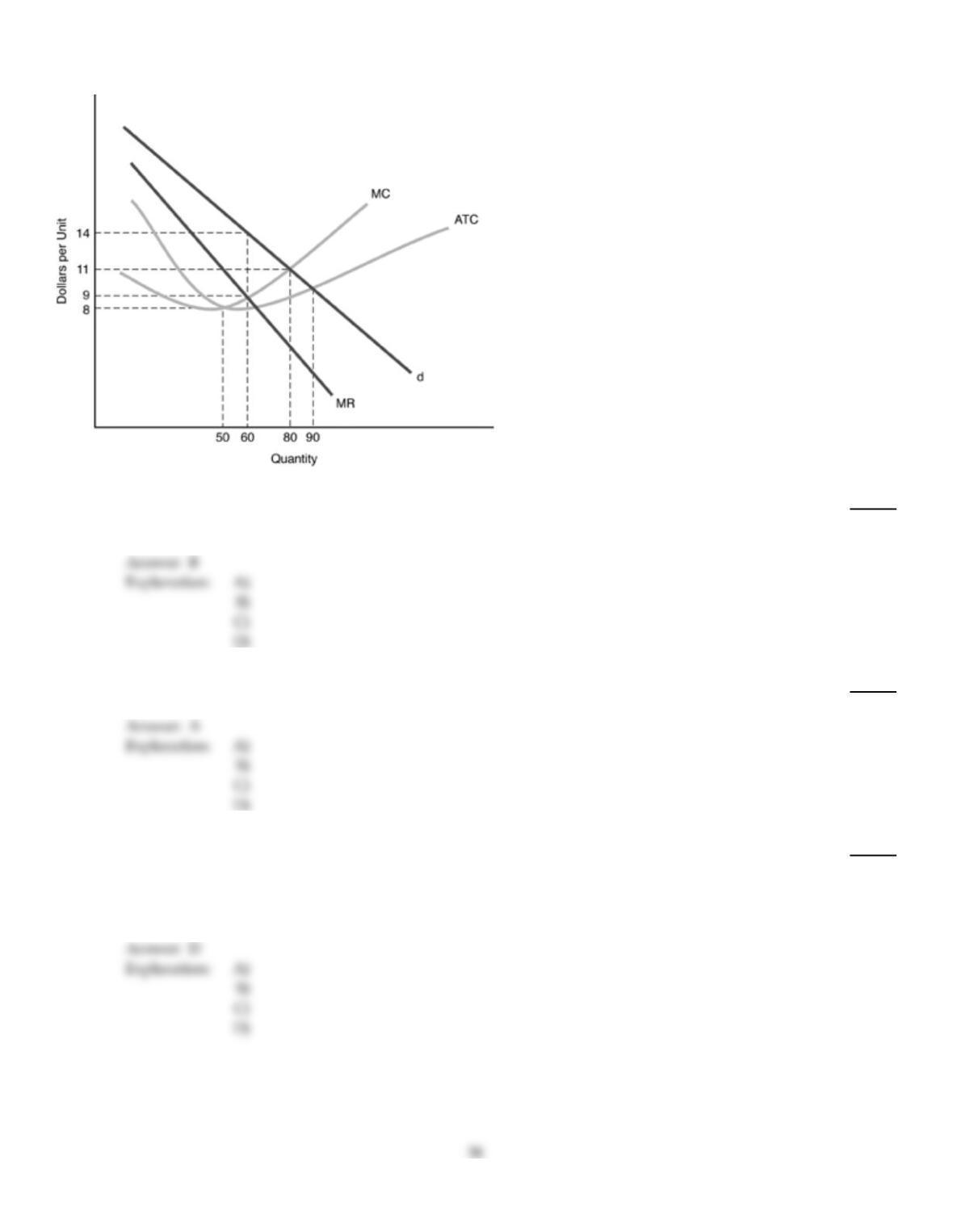
132)
In the above figure for a monopolistically competitive firm, the total cost at the profit–maximizing
point is
132)
A)
$880.
B)
$480.
C)
$400.
D)
$540.
133)
Which will be TRUE for a monopolistic competitor experiencing short–run losses?
133)
A)
P < ATC
B)
P < MC
C)
P > ATC
D)
P = ATC
134)
In the long run, a monopolistically competitive firm
134)
A)
earns negative economic profits.
B)
can have positive, zero, or negative profits.
C)
earns positive economic profits.
D)
earns zero economic profits.
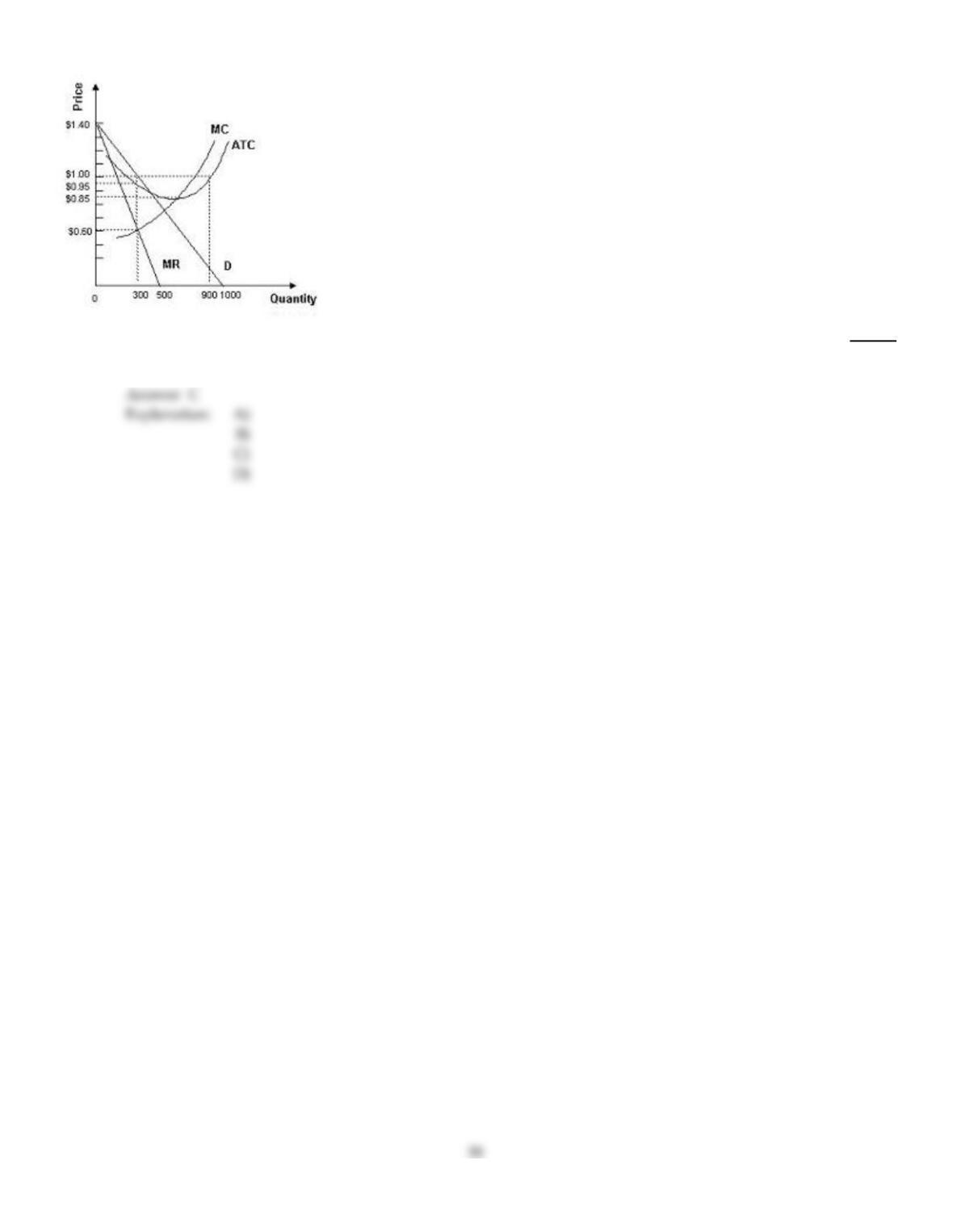
135)
Use the above figure. The profit–maximizing monopolistically competitive firm
135)
A)
is losing $0.05 per unit of output.
B)
is earning $0.40 per unit of output.
C)
is earning $0.05 per unit of output.
D)
is earning $0.15 per unit of output.
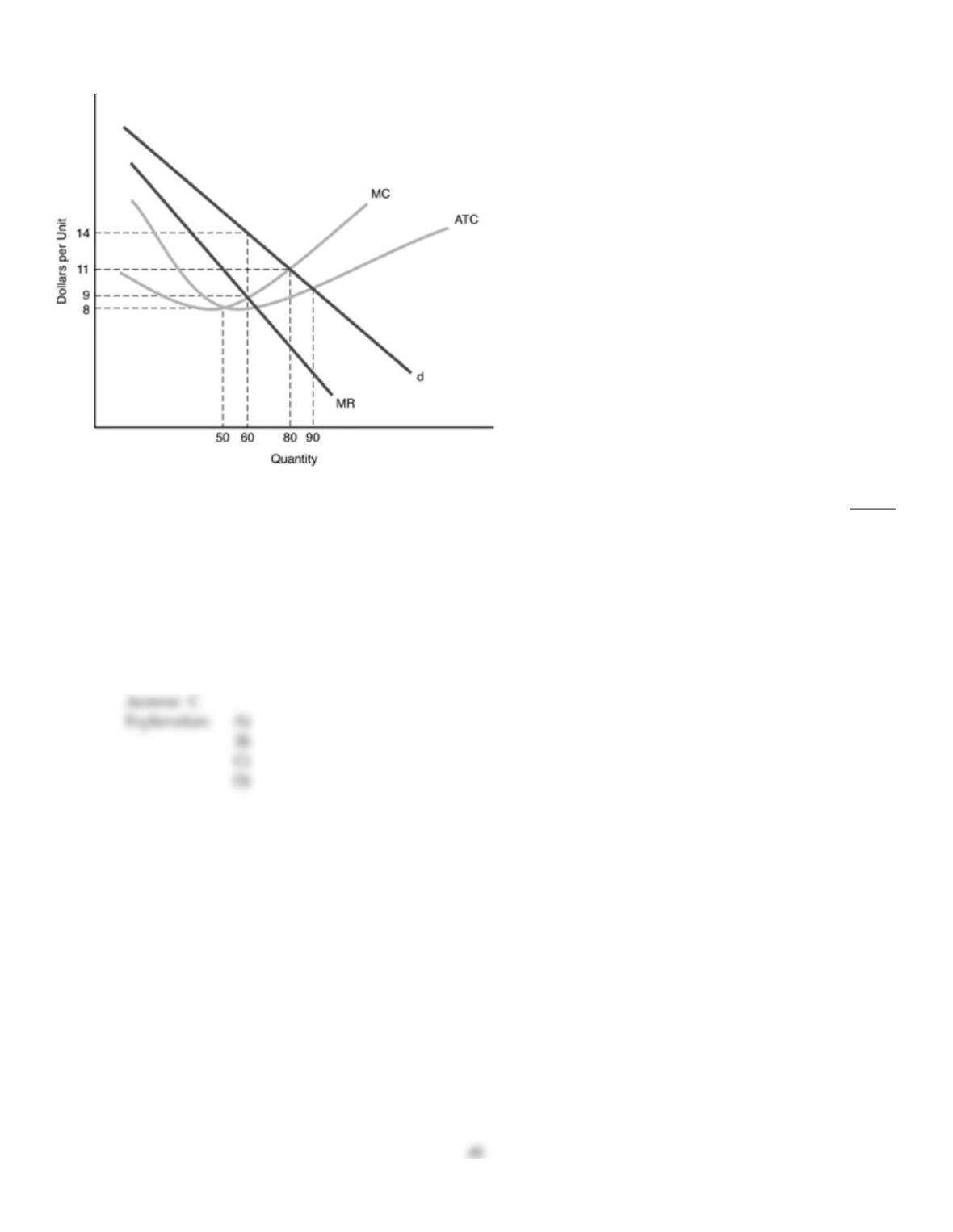
136)
In the above figure, what would happen to the monopolistically competitive industry in the long
run?
136)
A)
More producers would enter the market, and the share of the market to this firm would fall,
which would cause the demand curve to shift leftward until there is negative economic profit.
B)
More producers would enter the market, and the share of the market to this firm would rise,
which would cause the demand curve to shift rightward until there is zero economic profit.
C)
More producers would enter the market, and the share of the market to this firm would fall,
which would cause the demand curve to shift leftward until there is zero economic profit.
D)
More producers would exit the market, and the share of the market to this firm would fall,
which would cause the demand curve to shift leftward until there is zero economic profit.