8) A flat circular loop of radius 0.10 m is rotating in a uniform magnetic field of 0.20 T. Find the
magnetic flux through the loop when the plane of the loop and the magnetic field vector are
parallel.
A) 0 T ∙ m2
B) 3.1 × 10⁻³ T ∙ m2
C) 5.5 × 10⁻³ T ∙ m2
D) 6.3 × 10⁻³ T ∙ m2
9) A flat circular loop of radius 0.10 m is rotating in a uniform magnetic field of 0.20 T. Find the
magnetic flux through the loop when the plane of the loop and the magnetic field vector are
perpendicular.
A) 0 T ∙ m2
B) 3.1 × 10⁻³ T ∙ m2
C) 5.5 × 10⁻³ T ∙ m2
D) 6.3 × 10⁻³ T ∙ m2
10) A flat circular loop of radius 0.10 m is rotating in a uniform magnetic field of 0.20 T. Find
the magnetic flux through the loop when the plane of the loop and the magnetic field vector are
at an angle of 30°.
A) 0 T ∙ m2
B) 3.1 × 10⁻³ T ∙ m2
C) 5.5 × 10⁻³ T ∙ m2
D) 6.3 × 10⁻³ T ∙ m2
11) A 2.00-m long metal wire is formed into a square and placed in the horizontal xy-plane. A
uniform magnetic field is oriented at 30° above the horizontal with a strength of 0.344 T. What is
the magnetic flux through the square due to this field?
A) 0.0745 T ∙ m2
B) 0.172 T ∙ m2
C) 0.0430 T ∙ m2
D) 0.298 T ∙ m2
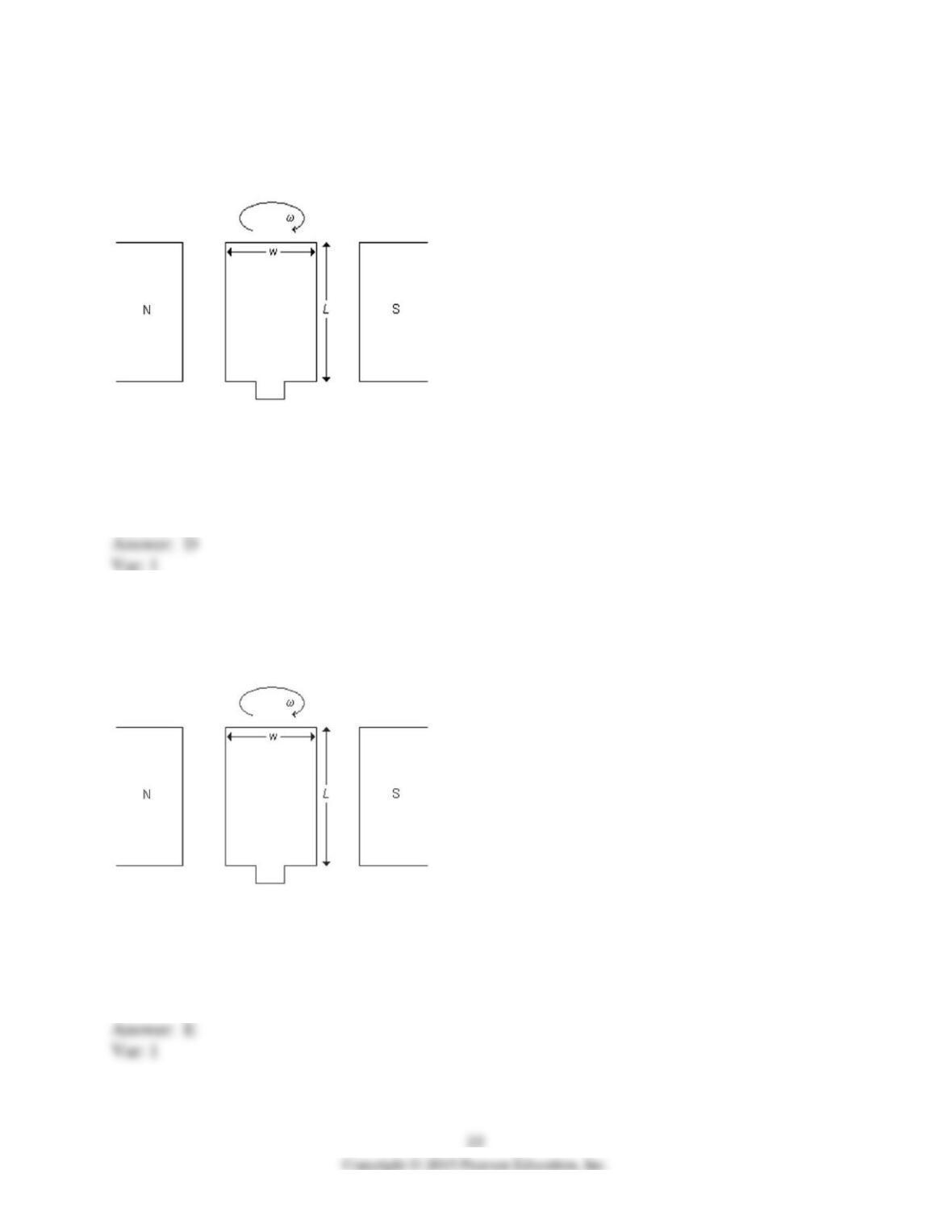
12) A rectangular loop of wire that can rotate about an axis through its center is placed between
the poles of a magnet in a magnetic field with a strength of 0.40 T, as shown in the figure. The
length of the loop L is 0.16 m and its width w is 0.040 m. What is the magnetic flux through the
loop when the plane of the loop is perpendicular to the magnetic field?
A) 13 × 10-3 T ∙ m2
B) 2.6 × 10³ T ∙ m2
C) 0.80 T ∙ m2
D) 2.6 × 10⁻³ T ∙ m2
E) 0 T ∙ m2
13) A rectangular loop of wire that can rotate about an axis through its center is placed between
the poles of a magnet in a magnetic field with a strength of 0.40 T, as shown in the figure. The
length of the loop L is 0.16 m and its width w is 0.040 m. What is the magnetic flux through the
loop when the plane of the loop is parallel to the magnetic field?
A) 13 × 10-3 T ∙ m2
B) 2.6 × 10³ T ∙ m2
C) 0.80 T ∙ m2
D) 2.6 × 10⁻³ T ∙ m2
E) 0 T ∙ m2
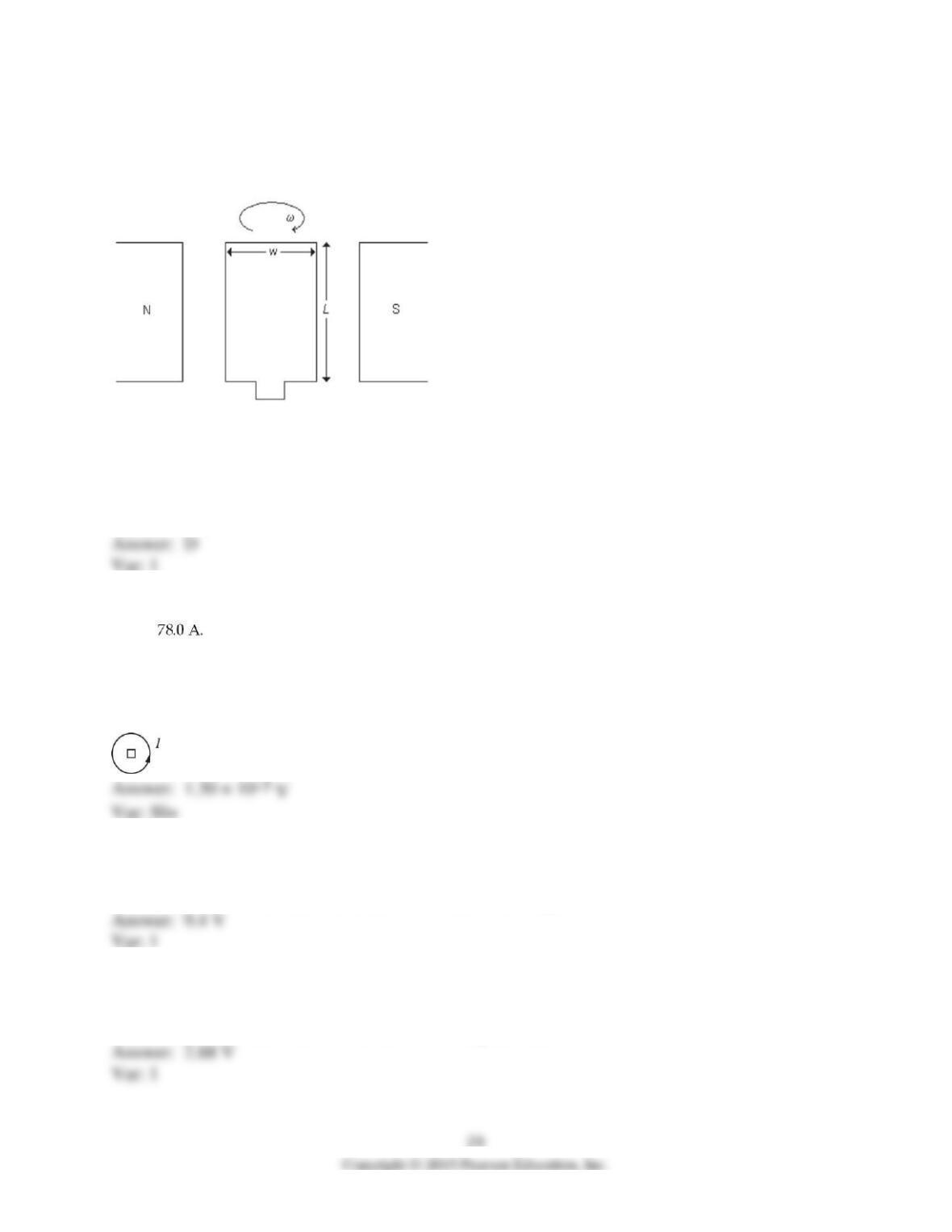
14) A rectangular loop of wire that can rotate about an axis through its center is placed between
the poles of a magnet in a magnetic field with a strength of 0.40 T, as shown in the figure. The
length of the loop L is 0.16 m and its width w is 0.040 m. What is the magnetic flux through the
loop when the plane of the loop makes an angle of 60° with the magnetic field?
A) 2.6 × 10⁻³ T ∙ m2
B) 1.3 × 10⁻³ T ∙ m2
C) 0 T ∙ m2
D) 2.2 × 10⁻³ T ∙ m2
E) 0.80 T ∙ m2
15) As shown in the figure, a large round loop of 269 turns and radius 67.0 cm carries a current
of I = A small square loop of 31.0 turns and 1.00 cm on a side is placed at the center of the
large loop. If the current in the large loop drops to 0.00 A in 0.0470 s, find the induced emf in the
small loop. The square loop is small enough that you can assume that the magnetic field in its
region is uniform and equal to the magnetic field at the center of the round loop. (μ0 = 4π × 10-7
T ∙ m/A)
16) A flat circular loop having one turn and radius 5.0 cm is positioned with its plane
perpendicular to a uniform 0.60-T magnetic field. The area of the loop is suddenly reduced to
essentially zero in 0.50 ms. What emf is induced in the loop?
17) A flat coil having 40 turns, each one of cross-sectional area 12.0 cm2, is oriented with its
plane perpendicular to a uniform magnetic field. The field varies steadily from 0.00 T to 1.20 T
in 20.0 ms. What emf is induced in the coil during this time?
18) A flat circular coil having 16 turns, each of diameter 20 cm, is in a uniform and steady 0.13-
T magnetic field.
(a) Find the total magnetic flux through the coil when the field is perpendicular to the plane of
the coil.
(b) If the coil is rotated in 10 ms so its plane is parallel to the field, find the average induced emf
in the coil.
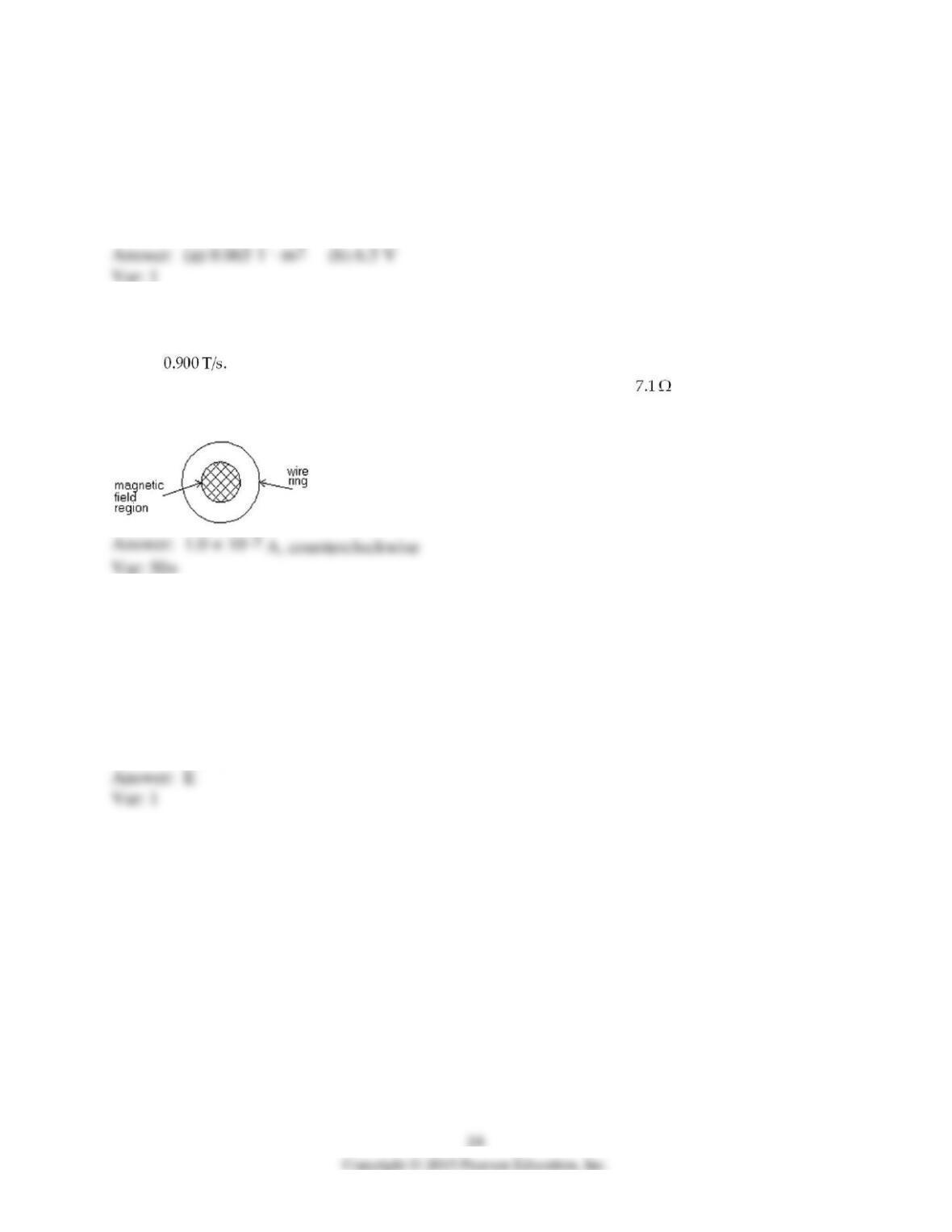
19) As shown in the figure, a uniform magnetic field B is confined to a cylindrical volume of
radius 0.050 m. This field is directed into the plane of the page and is increasing at a constant
rate of Calculate the magnitude and direction (clockwise or counterclockwise) of the
current induced in a circular wire ring of radius 0.16 m and resistance that encircles the
magnetic field region.
20) A flux of 4.0 × 10⁻⁵ T ∙ m2 is maintained through a coil of area 7.5 cm2 for 0.50 s. What
emf is induced in this coil during this time by this flux?
A) 8.0 × 10⁻⁵ V
B) 4.0 × 10⁻⁵ V
C) 3.0 × 10⁻⁵ V
D) 2.0 × 10⁻⁵ V
E) No emf is induced in this coil.
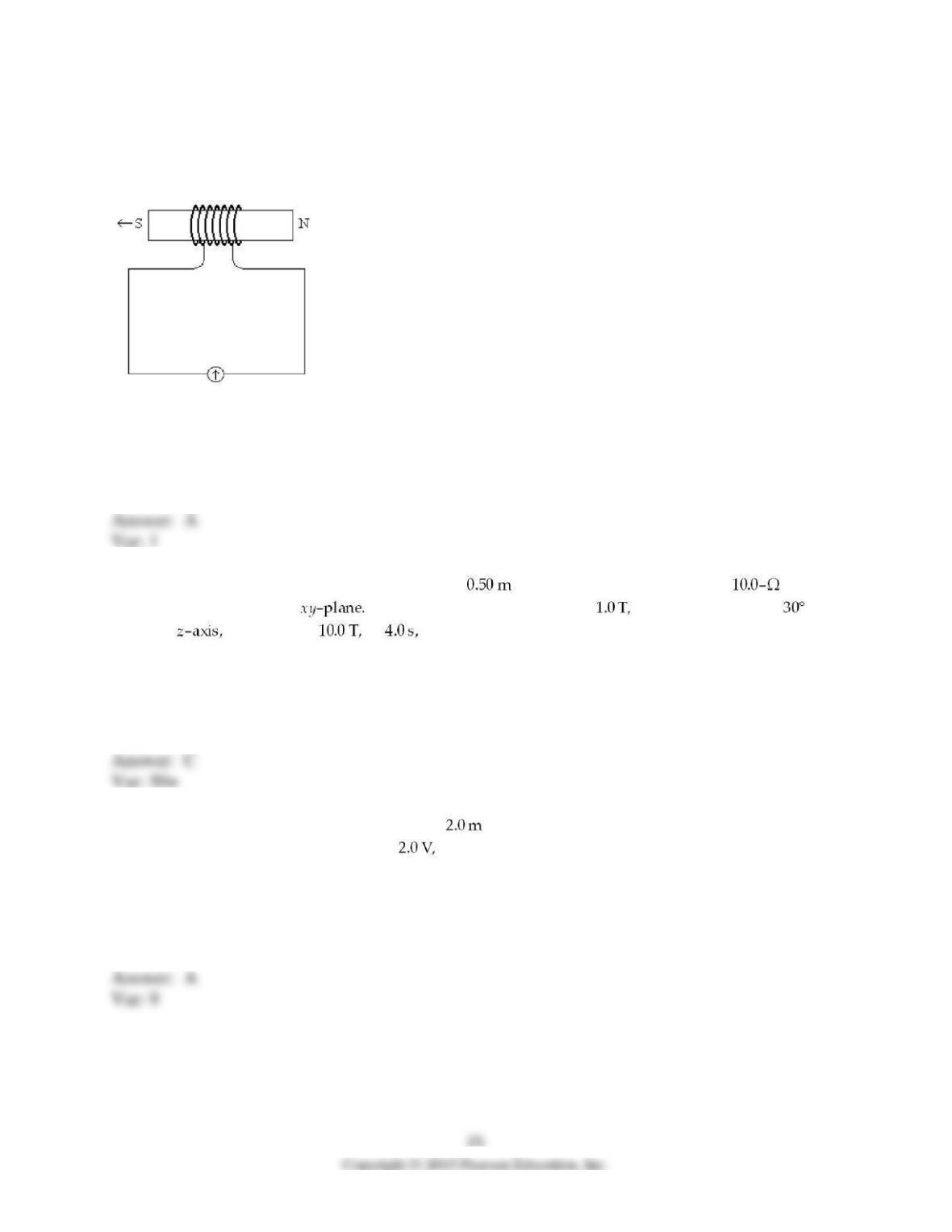
21) A bar magnet is pushed through a coil of wire of cross-sectional area 0.020 m2 as shown in
the figure. The coil has seven turns, and the rate of change of the strength of the magnetic field in
it due to the motion of the bar magnet is 0.040 T/s. What is the magnitude of the induced emf in
that coil of wire?
A) 5.6 × 10⁻³ V
B) 5.6 × 10⁻² V
C) 5.6 × 10⁻¹ V
D) 5.6 × 10⁻⁴ V
E) 5.6 × 10⁻⁵ V
22) A circular conducting loop with a radius of and a small gap filled with a
resistor is oriented in the If a uniform magnetic field of making an angle of
with the increases to in what is the magnitude of the current that will be caused
to flow in the loop if it has negligible resistance?
A) 0.01530393 A
B) 0.08835729 A
C) 0.15303932 A
D) 0 A
23) A closed flat loop conductor with radius is located in a changing uniform magnetic
field. If the emf induced in the loop is what is the rate at which the magnetic field strength
is changing if the magnetic field is oriented perpendicular to the plane in which the loop lies?
A) 0.16 T/s
B) 1.0 T/s
C) 0.080 T/s
D) 2.0 T/s
24) A conductor is formed into a flat loop that encloses an area of The plane of the loop is
oriented at a 30.0° angle with the xy-plane. A uniform time-varying magnetic field is oriented
parallel to the z-axis. If the emf induced in the loop is what is the rate at which the
magnetic field strength is changing?
A) 29 T/s
B) 22 T/s
C) 50 T/s
D) 13 T/s
25) A circular coil of 20 turns and radius 5.0 cm is placed with its plane oriented at 90° to a
uniform magnetic field of The field is now increased at a steady rate, reaching a value of
after 4.0 seconds. What emf is induced in the coil?
A) 0.016 V
B) 0.021 V
C) 0.026 V
D) 0.031 V
E) 0.036 V
26) The magnetic flux through a coil changes steadily from 4.0 × 10⁻⁵ T ∙ m2 to 5.0 × 10⁻⁵ T ∙
m2 in 0.10 s. What emf is induced in this coil?
A) 5.0 × 10⁻⁴ V
B) 4.0 × 10⁻⁴ V
C) 1.0 × 10⁻⁴ V
D) None of the given answers are correct.
27) A flat coil is wrapped with 200 turns of very thin wire on a square frame with sides 18 cm
long. A uniform magnetic field is applied perpendicular to the plane of the coil. If the field
changes uniformly from 0.50 T to 0.00 T in 8.0 s, find the emf induced in the coil.
A) 2.1 mV
B) 4.1 mV
C) 0.21 V
D) 0.41 V
28) A flat square coil of wire with 15 turns and an area of 0.40 m2 is placed with the plane of its
area parallel to a magnetic field of 0.75 T. The coil is flipped so its plane is perpendicular to the
magnetic field in a time of 0.050 s. What is the magnitude of the average induced emf in the
coil?
A) 6.0 V
B) 36 V
C) 45 V
D) 90 V
29) A flat coil having 160 turns, each with an area of 0.20 m2, is placed with the plane of its area
perpendicular to a magnetic field of 0.40 T. The magnetic field changes uniformly from 0.40 T
in the +x direction to 0.40 T in the –x direction in 2.0 s. If the resistance of the coil is 16 Ω, at
what rate is power generated in the coil during this change?
A) 5.0 W
B) 10 W
C) 15 W
D) 20 W
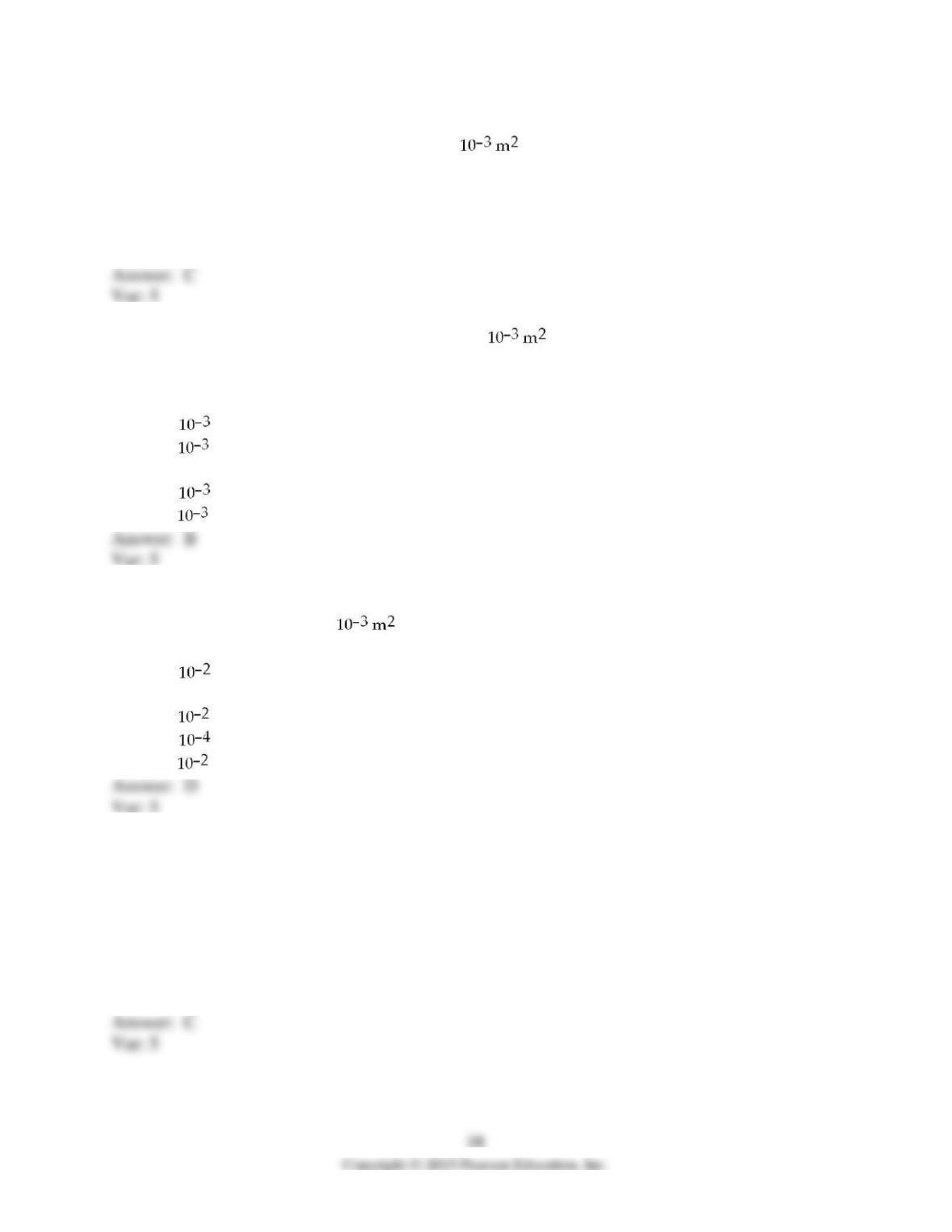
30) As shown in the figure, a wire and a 10-Ω resistor are used to form a circuit in the shape of a
square with dimensions 20 cm by 20 cm. A uniform but non-steady magnetic field is directed
into the plane of the circuit. The magnitude of the magnetic field is steadily decreased from 2.70
T to 0.90 T in a time interval of 96 ms. What is the induced current in the circuit, and what is its
direction through the resistor?
A) 75 mA, from b to a
B) 45 mA, from b to a
C) 75 mA, from a to b
D) 45 mA, from a to b
E) 110 mA, from a to b
31) A round flat conducting loop is placed perpendicular to a uniform 0.50 T magnetic field. If
the area of the loop increases at a rate of 3.0 × /s, what is the induced emf in the loop?
A) 4.3 mV
B) 0 mV
C) 1.5 mV
D) 1.7 mV
E) 5.5 mV
32) The area of a rectangular loop of wire is 3.6 × . The loop is placed in a uniform
magnetic field that changes steadily from 0.20 T to 1.4 T in 1.6 s. The plane of the loop is
perpendicular to the direction of the magnetic field. What is the magnitude of the induced emf in
that loop?
A) 2.8 × V
B) 2.7 × V
C) 0 V
D) 1.8 × V
E) 3.0 × V
33) A constant uniform magnetic field of 0.50 T is applied at right angles to the plane of a flat
rectangular loop of area 3.0 × . If the area of this loop changes steadily from its original
value to a new value of 1.6 × 10⁻³ m2 in 1.6 s, what is the emf induced in the loop?
A) 1.6 × V
B) 0 V
C) 7.5 × V
D) 4.4 × V
E) 9.0 × V
34) A flat rectangular coil with dimensions of 8.0 cm × 10 cm is dropped from a zero magnetic
field position into a 1.4-T magnetic field in 0.10 s. The coil has 60 turns and is perpendicular to
the magnetic field. What is the average induced emf in the coil as a result of this action?
A) 8.6 V
B) 2.4 V
C) 6.7 V
D) 3.6 V
E) 0 V
35) A single-turn loop of wire, having a resistance of 8.00 Ω and a cross-sectional area 200 cm2,
is perpendicular to a uniform magnetic field that increases steadily from 0.200 T to 2.800 T in
2.20 seconds. What is the magnitude of the induced current in the loop?
A) 2.95 A
B) 3.18 A
C) 0 A
D) 3.18 mA
E) 2.95 mA
36) A round flat metal coil has 180 turns and negligible resistance. It is connected in a series
circuit with a resistor, with nothing else in the circuit. You measure that a current
flows through the resistor when a magnetic field through the coil, perpendicular to its area, is
changing at What is the radius of the coil?
A) 0.25 m
B) 0.014 m
C) 0.54 m
D) 0.043 m
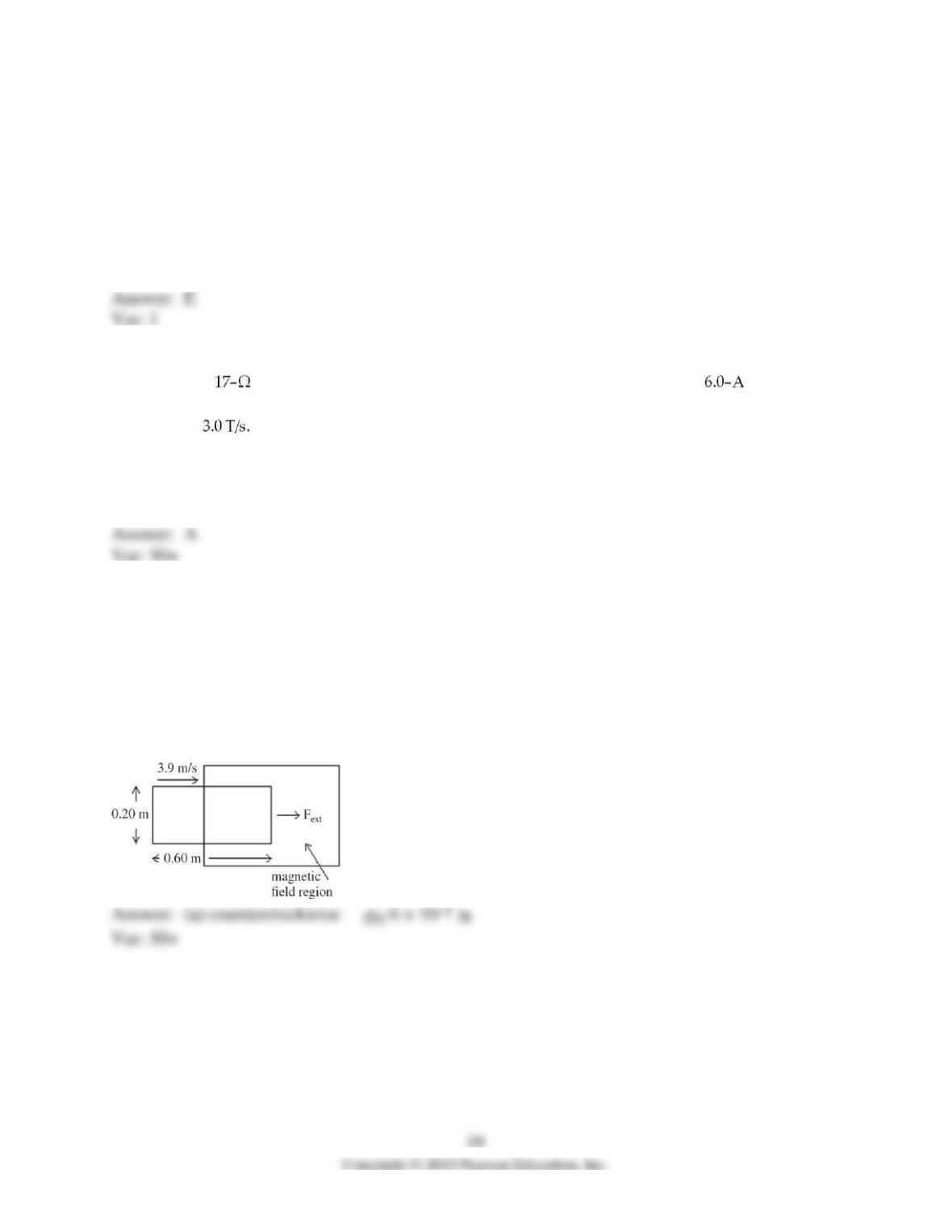
37) As shown in the figure, a region of space contains a uniform magnetic field. The magnitude
of this field is 2.8 T, and it is directed straight into the plane of the page in the region shown.
Outside this region the magnetic field is zero. A rectangular loop measuring 0.20 m by 0.60 m
and having a resistance of 2 Ω is being pulled into the magnetic field by an external force, as
shown.
(a) What is the direction (clockwise or counterclockwise) of the current induced in the loop?
(b) Calculate the magnitude of the external force Fext that is required to move the loop at a
constant speed of 3.9 m/s.
38) A airplane having a metal surface and a wingspan of 25.0 m flies horizontally at 200. m/s
where the earth’s magnetic field is vertical with magnitude 45.0 μT.
(a) What emf is induced across the wings?
(b) What wingspan would the plane need to produce 1.00-V emf across its wings?
(c) The plane now reverses direction. Does the polarity of the wingtip emf change? That is, if the
left wing was positive before, does it now become negative?
39) An eagle, with a wingspread of 2.0 m, flies toward the north at 8.0 m/s in a region where the
vertical component of the earth’s magnetic field is 0.20 × 10⁻⁴ T. What emf would be developed
between the eagle’s wing tips? (It has been speculated that this phenomenon could play a role in
the navigation of birds, but the effect is too small, in all likelihood.)
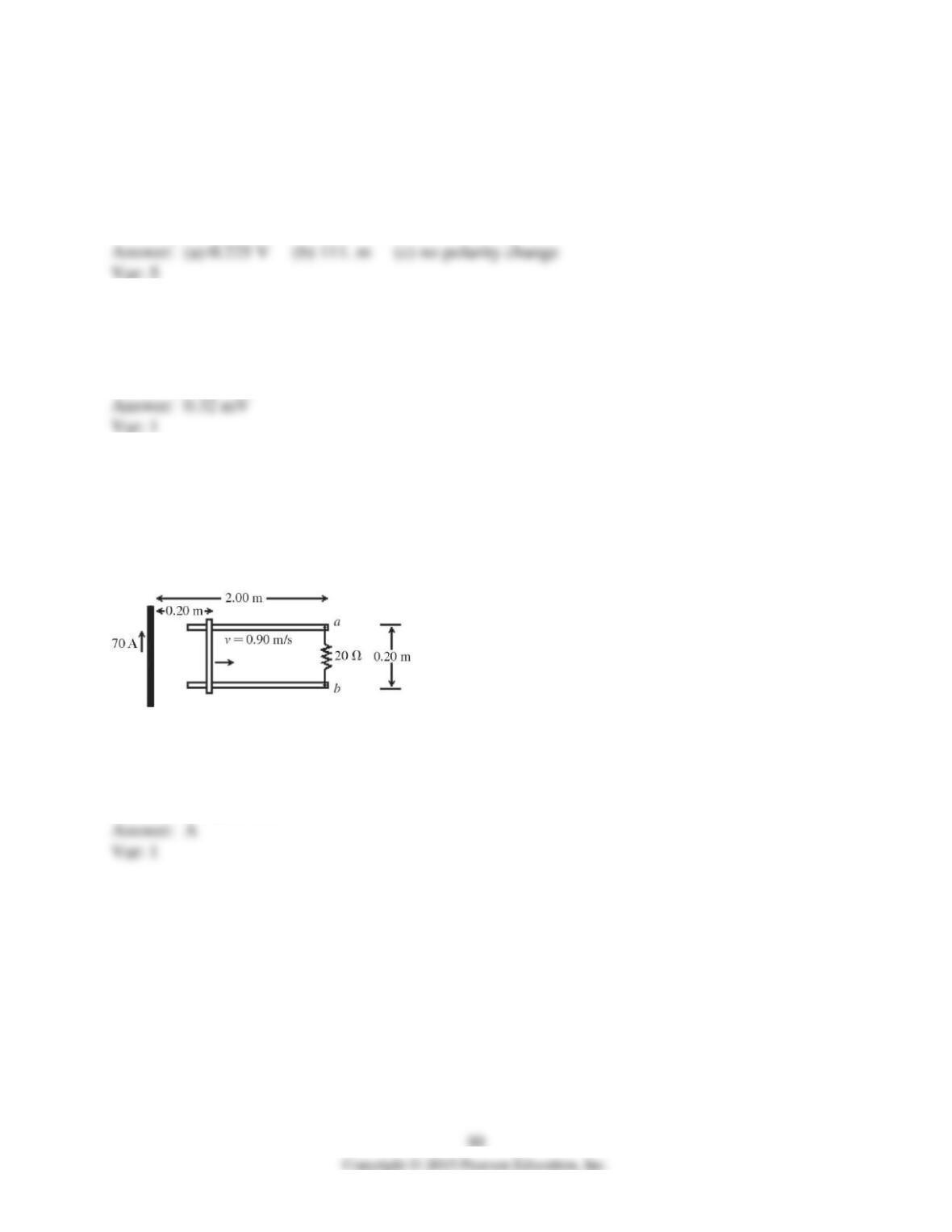
40) A long vertical wire carries a steady 70 A current. As shown in the figure, a pair of
horizontal rails are 0.20 m apart. A 20-Ω resistor connects points a and b, at the end of the rails.
A bar is in contact with the rails, and is moved by an external force with a constant horizontal
velocity of 0.90 m/s to the right, as shown. The bar and the rails have negligible resistance. At
the instant that the bar is 0.20 m from the wire, what are the induced current in the resistor and its
direction through the resistor? (μ0 = 4π × 10-7 T ∙ m/A)
A) 0.63 μA, from a to b
B) 0.63 μA, from b to a
C) 0.32 μA, from a to b
D) 0.32 μA, from b to a
E) 1.9 μA, from b to a
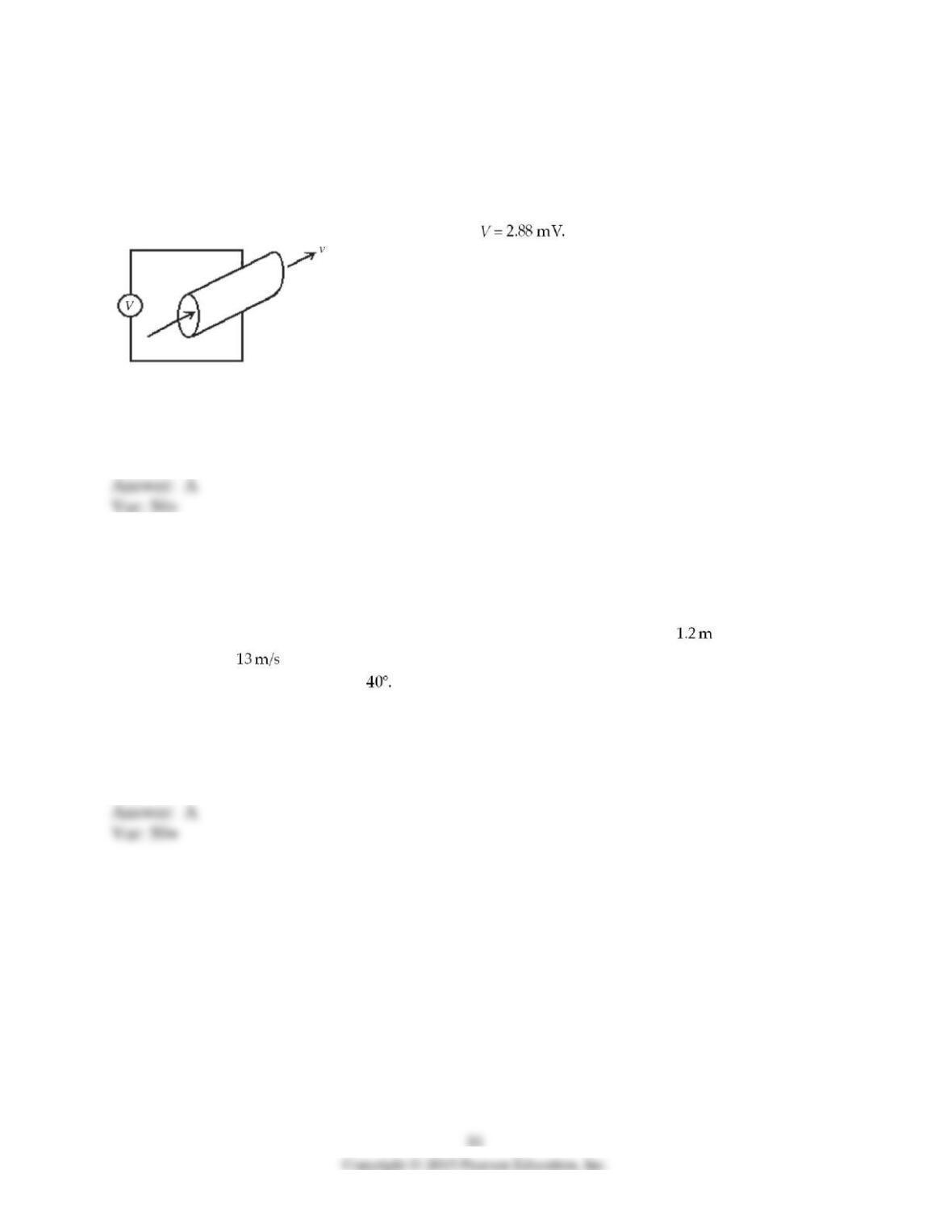
41) An electromagnetic flowmeter is useful when it is desirable not to interrupt the system in
which the fluid is flowing (such as the blood in an artery during heart surgery). Such a device is
illustrated in the figure. The conducting fluid moves with speed v in a tube of diameter d.
Perpendicular to this tube is a magnetic field B. A voltage V is induced between opposite sides of
the tube due to the motion of the conducting fluid in the magnetic field. For a certain case, B =
0.120 T, d = 1.2 cm, and the measured voltage is Determine the speed of the fluid.
A) 2.0 m/s
B) 11 m/s
C) 0.075 m/s
D) 1.1 m/s
E) 750 m/s
42) It is known that birds can detect the earth’s magnetic field, but the mechanism of how they do
this is not known. It has been suggested that perhaps they detect a motional emf as they fly north
to south, but it turns out that the induced voltages are small compared to the voltages normally
encountered in cells, so this is probably not the mechanism involved. To check this out, calculate
the induced voltage across the wingtips of a wild goose with a wingspan of if it is flying
directly south at at a point where the earth’s magnetic field is 5.0 ×10⁻⁵ T directed
downward from the horizontal by
A) 0.50 mV
B) 0.60 mV
C) 0.78 mV
D) 0.060 mV
E) 0.25 mV
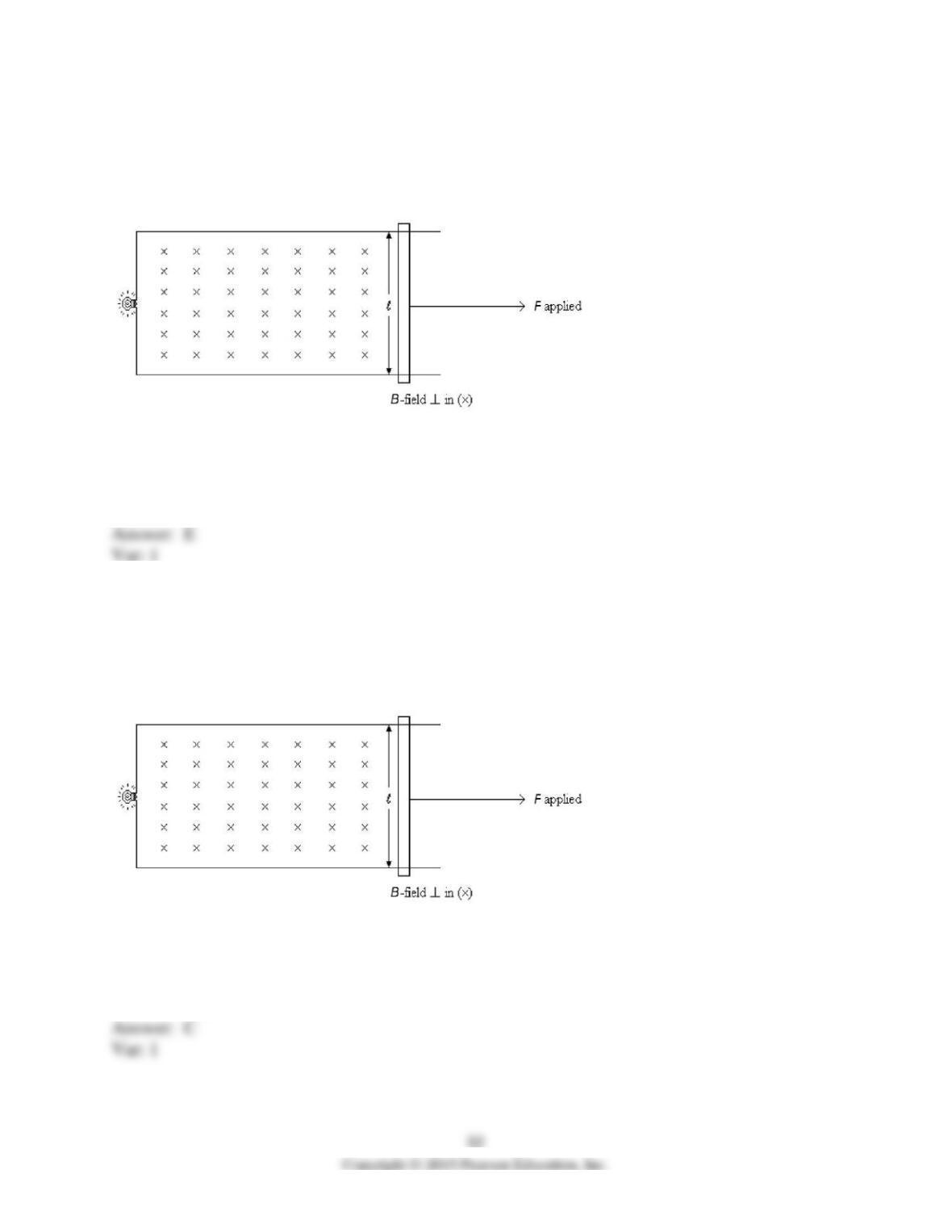
43) A conducting rod of length ℓ= 25 cm is placed on a U-shaped metal wire that is connected to
a lightbulb having a resistance of 8.0 Ω, as shown in the figure. The wire and the rod are in the
plane of the page. A constant uniform magnetic field of strength 0.40 T is applied perpendicular
to and into the paper. An applied external force pulls the rod to the right with a constant speed of
6.0 m/s. What is the magnitude of the emf induced in the rod?
A) 0.20 V
B) 0.30 V
C) 0.40 V
D) 0.50 V
E) 0.60 V
44) A conducting rod with a length ℓ = 25 cm is placed on a U-shaped metal wire that is
connected to a lightbulb having a resistance of 8.0 Ω as shown in the figure. The wire and the rod
are in the plane of the page. A constant uniform magnetic field of strength 0.40 T is applied
perpendicular to and into the paper. An external applied force moves the rod to the right with a
constant speed of 6.0 m/s. What are the magnitude and direction of the induced current in the
circuit?
A) 17 mA clockwise
B) 17 mA counterclockwise
C) 75 mA counterclockwise
D) 75 mA clockwise
E) 52 mA clockwise
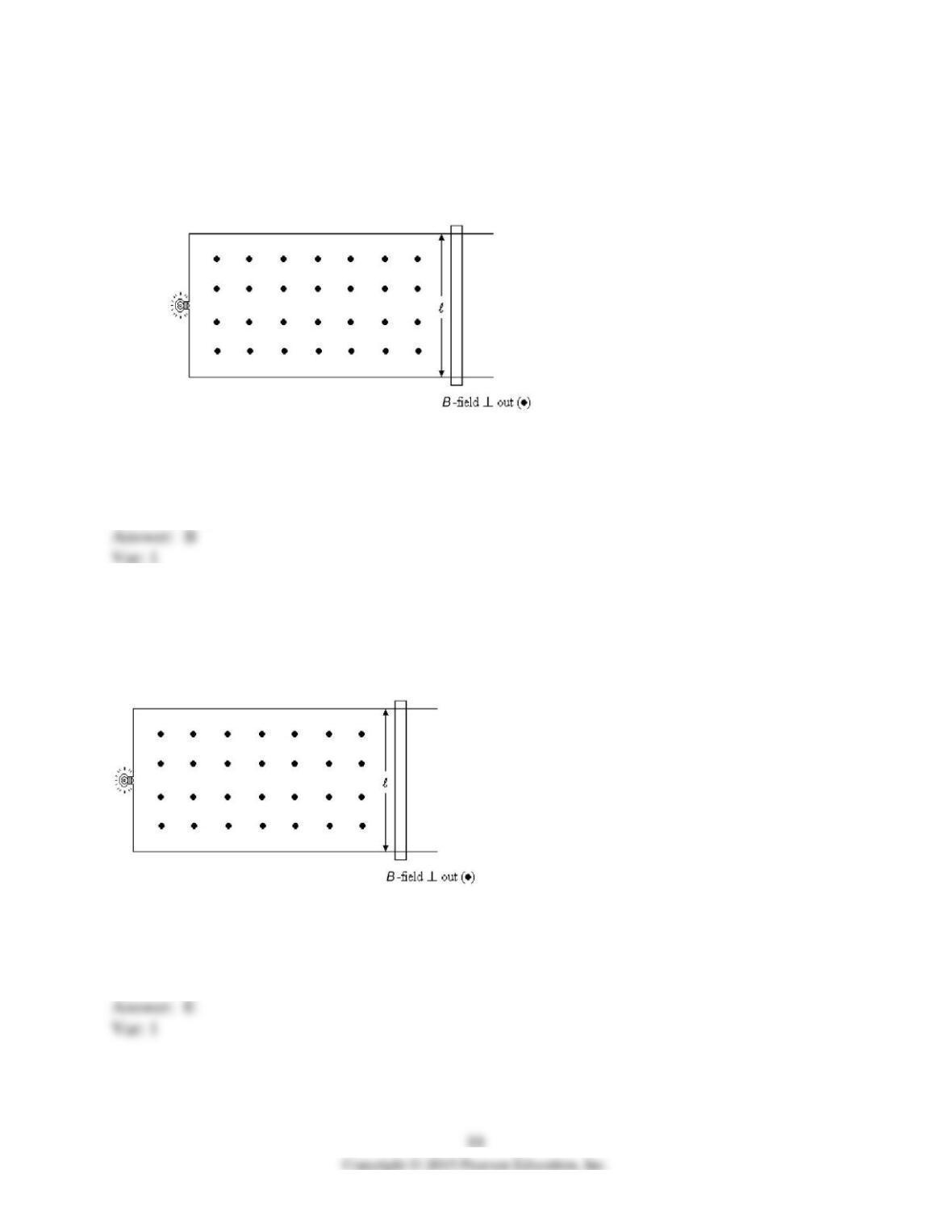
45) A conducting rod whose length is ℓ = 25 cm is placed on a U-shaped metal wire that is
connected to a lightbulb having a resistance of 8.0 Ω as shown in the figure. The wire and the rod
are in the plane of the page. A constant uniform magnetic field of strength 0.40 T is applied
perpendicular to and out of the paper. An external applied force moves the rod to the left with a
constant speed of 12 m/s. What are the magnitude and direction of the induced current in the
circuit?
A) 150 mA clockwise
B) 150 mA counterclockwise
C) 34 mA counterclockwise
D) 34 mA clockwise
E) 100 mA clockwise
46) A conducting rod whose length is ℓ = 1.60 m is placed on frictionless U-shaped metal rails
that is connected to a lightbulb having a resistance of 4.00 Ω as shown in the figure. The rails
and the rod are in the plane of the page. A constant uniform magnetic field of strength 2.20 T is
applied perpendicular to and out of the paper. What is the magnitude of the external applied
force needed to move the rod to the right with a constant speed of 6.00 m/s?
A) 8.60 N
B) 9.30 N
C) 10.6 N
D) 12.6 N
E) 18.6 N
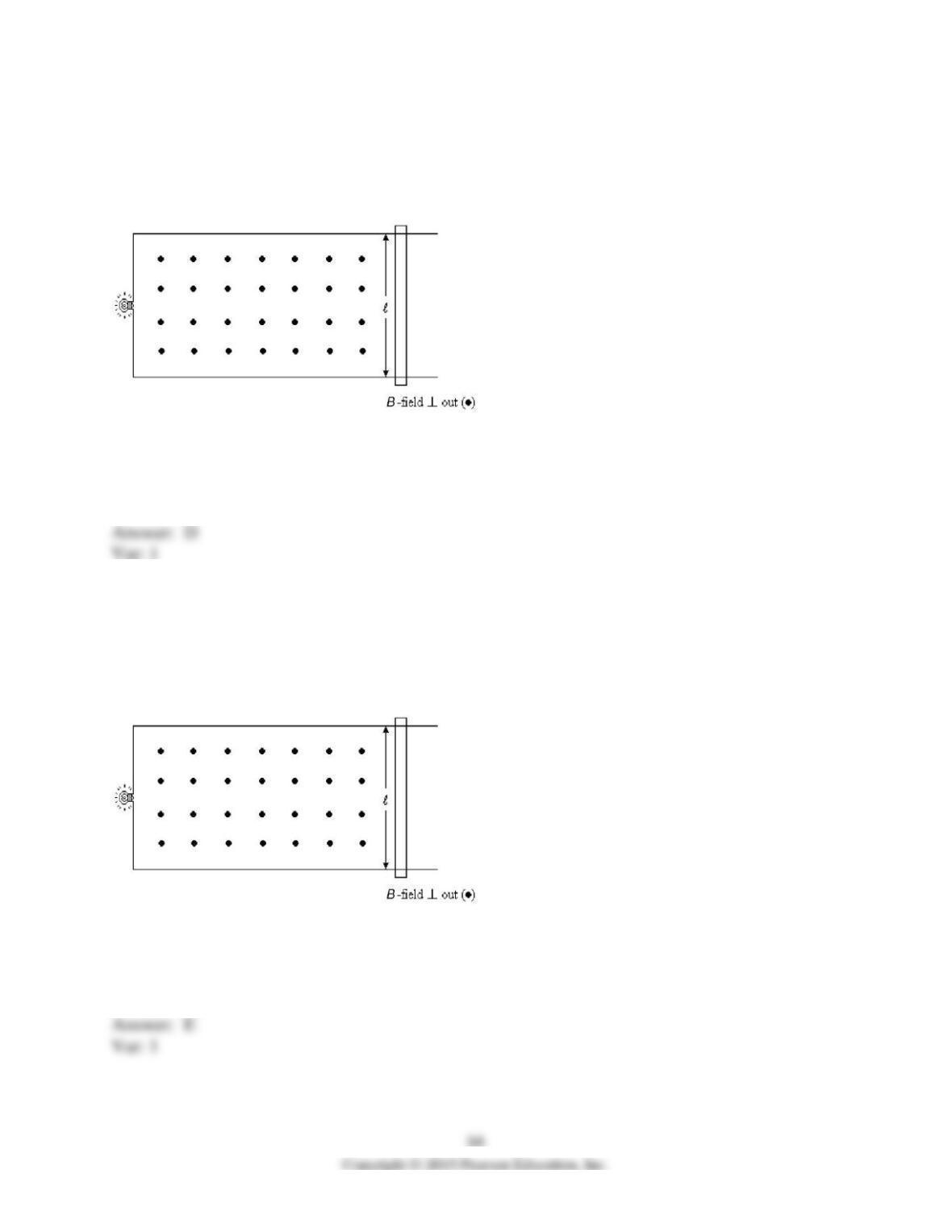
47) A conducting rod whose length is ℓ = 1.60 m is placed on frictionless U-shaped metal rails
that is connected to a lightbulb having a resistance of 4.00 Ω as shown in the figure. The rails
and the rod are in the plane of the page. A constant uniform magnetic field of strength 2.20 T is
applied perpendicular to and out of the paper. An external applied force moves the rod to the
right with a constant speed of 6.00 m/s. At what rate is energy dissipated in the lightbulb?
A) 60.0 W
B) 121 W
C) 21.2 W
D) 112 W
E) 11.5 W
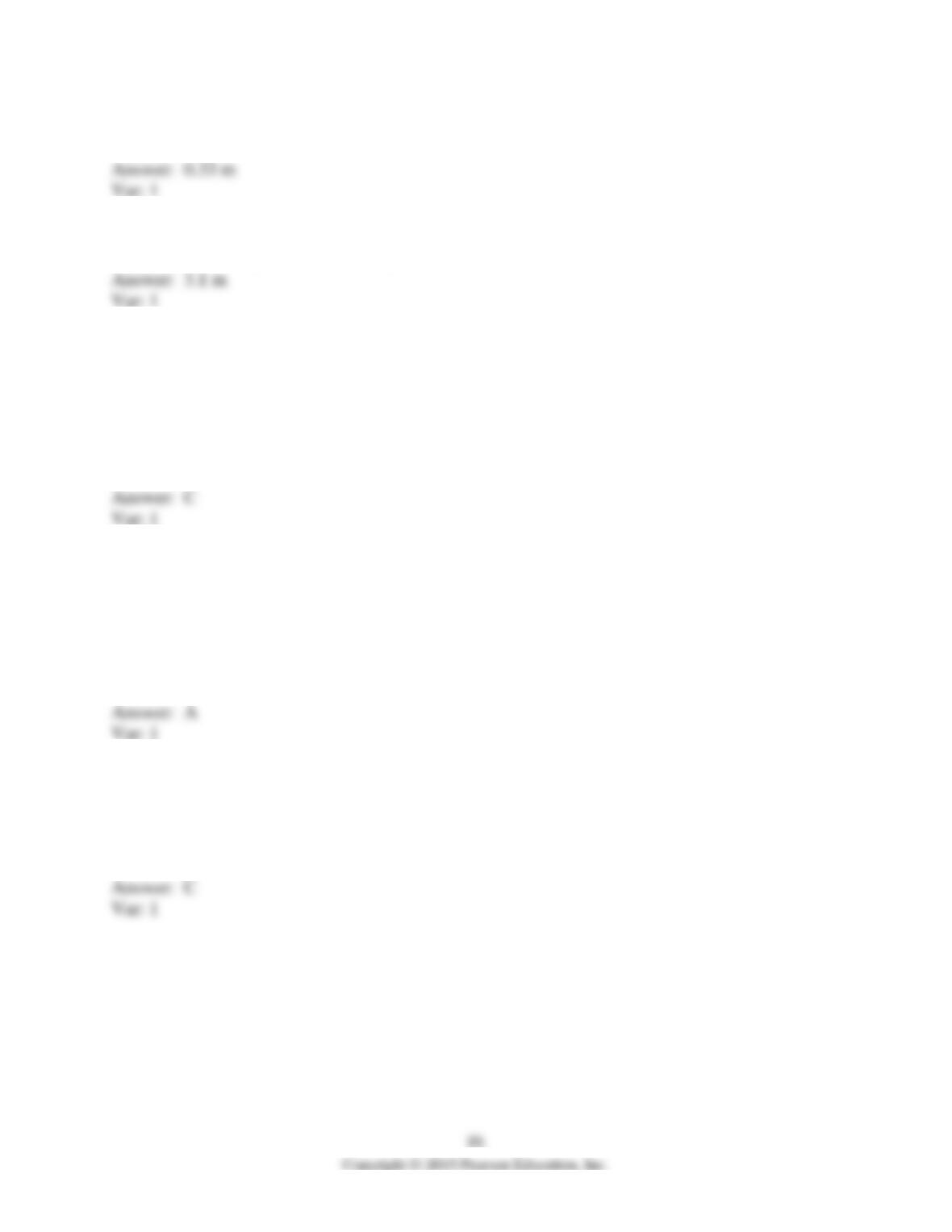
48) A conducting rod whose length is ℓ = 27.0 cm is placed on frictionless U-shaped metal rails
that is connected to a lightbulb having a resistance of 5.00 Ω as shown in the figure. The rails
and the rod are in the plane of the page. A constant uniform magnetic field of strength 1.20 T is
applied perpendicular to and out of the paper. An external applied force moves the rod to the
right with a constant speed. At what speed should the rod be pulled so that the lightbulb will
consume energy at a rate of 1.10 W?
A) 2.00 m/s
B) 3.50 m/s
C) 4.26 m/s
D) 6.00 m/s
E) 7.24 m/s
49) A cordless phone operates at 900 MHz. What is the wavelength of the electromagnetic wave
used by this phone? (c = 3.0 × 10⁸ m/s)
50) An FM radio station broadcasts at 96.7 MHz. What is the wavelength of the radio wave used
for this broadcast? (c = 3.0 × 10⁸ m/s)
51) What is the wavelength used by a radio station that broadcasts at a frequency of 920 kHz? (c
= 3.00 × 10⁸ m/s)
A) 22.6 m
B) 226 m
C) 326 m
D) 175 m
E) 276 m
52) The frequency of a microwave signal is 9.76 GHz. What is its wavelength? (c = 3.00 × 10⁸
m/s)
A) 3.07 cm
B) 2.07 cm
C) 1.07 cm
D) 5.07 cm
E) 4.07 cm
53) What is the frequency of 20-mm microwaves? (c = 3.0 × 10⁸ m/s)
A) 100 MHz
B) 400 MHz
C) 15 GHz
D) 73 GHz
54) The wavelength of an electromagnetic wave is 600 nm. What is its frequency? (c = 3.0 × 10⁸
m/s)
A) 200 × 1012 Hz
B) 300 × 1012 Hz
C) 400 × 1012 Hz
D) 500 × 1012 Hz
E) 600 × 1012 Hz
55) A certain part of the electromagnetic spectrum ranges from 200 nm to 400 nm. What is the
highest frequency associated with this portion of the spectrum? (c = 3.00 × 10⁸ m/s)
A) 1.50 × 10¹⁴ Hz
B) 7.50 × 10¹³ Hz
C) 7.50 × 10¹⁴ Hz
D) 7.50 × 10¹⁵ Hz
E) 1.50 × 10¹⁵ Hz
56) A certain part of the electromagnetic spectrum ranges from 200 nm to 400 nm. What is the
lowest frequency associated with this portion of the spectrum? (c = 3.00 × 10⁸ m/s)
A) 1.50 × 10¹⁴ Hz
B) 7.50 × 10¹³ Hz
C) 7.50 × 10¹⁴ Hz
D) 7.50 × 10¹⁵ Hz
E) 1.50 × 10¹⁵ Hz
57) A 7.55 × Hz electromagnetic wave travels in carbon tetrachloride with a speed of 2.05
×108 m/s. What is the wavelength of the wave in this material?
A) 272 nm
B) 301 nm
C) 338 nm
D) 361 nm
E) 397 nm