64)
A monopolistic competitor finds its profit–maximizing rate of output by
64)
A)
setting average revenue equal to average total cost.
B)
equating marginal revenue and marginal cost.
C)
equating price and marginal revenue.
D)
equating the marginal revenue from advertising with the marginal revenue from selling the
good.
65)
A good example of a monopolistic competitive industry is
65)
A)
oil producing industry.
B)
the federal highway system.
C)
the rap music industry.
D)
farming.
C
66)
Advertising intended to induce a consumer to discover a previously unknown taste or preference is
66)
A)
informational advertising.
B)
persuasive advertising.
C)
direct advertising.
D)
mass marketing advertising.
B
67)
The demand curve for a monopolistically competitive firm is
67)
A)
less elastic than the demand curve of the perfectly competitive firm.
B)
horizontal.
C)
the same as the industry demand curve.
D)
more elastic than the demand curve of the perfectly competitive firm.
A
68)
Products can be differentiated
68)
A)
if the buyers are homogeneous and their number increases.
B)
only by brand name.
C)
by location and by brand name.
D)
none of the above
C
B
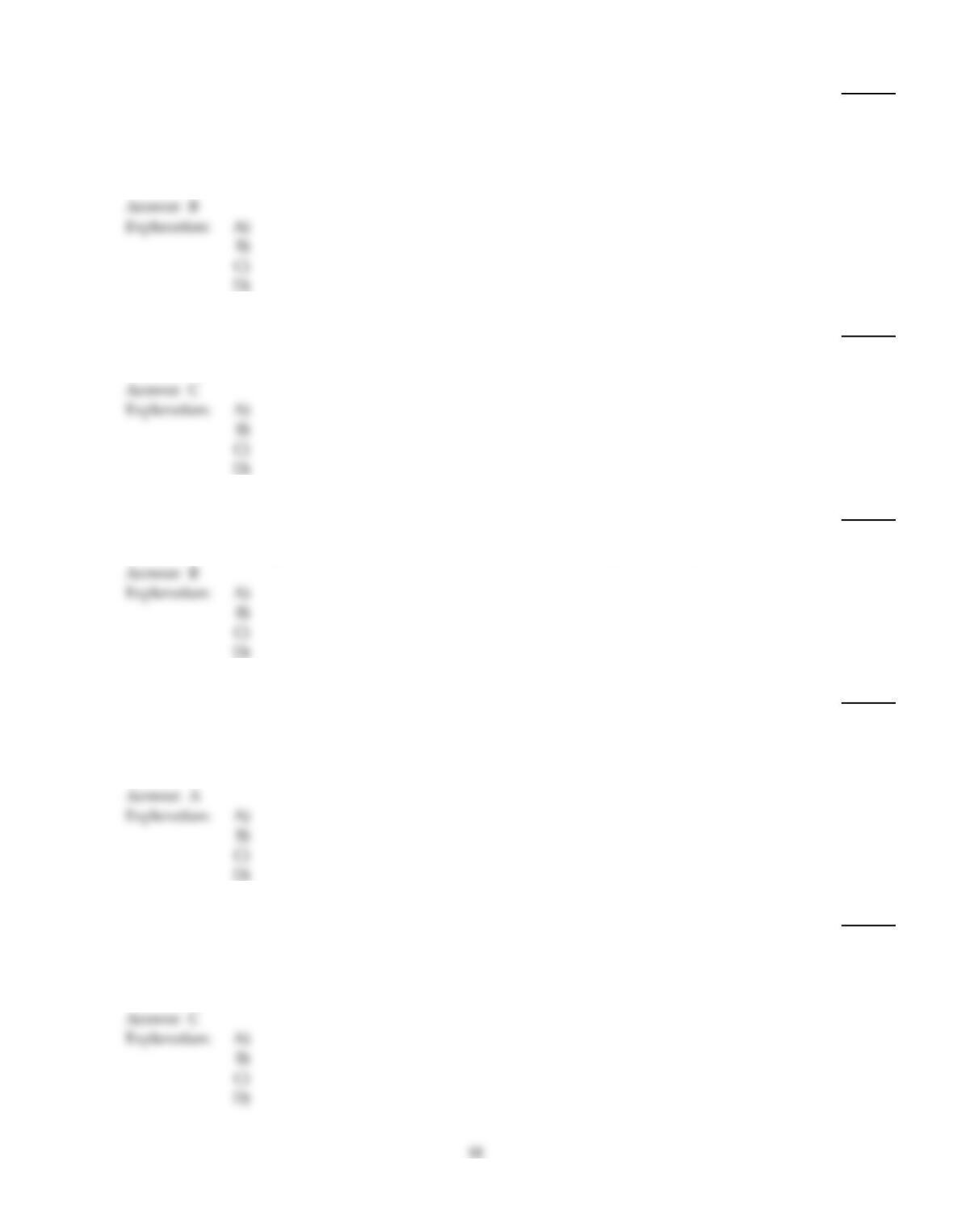
69)
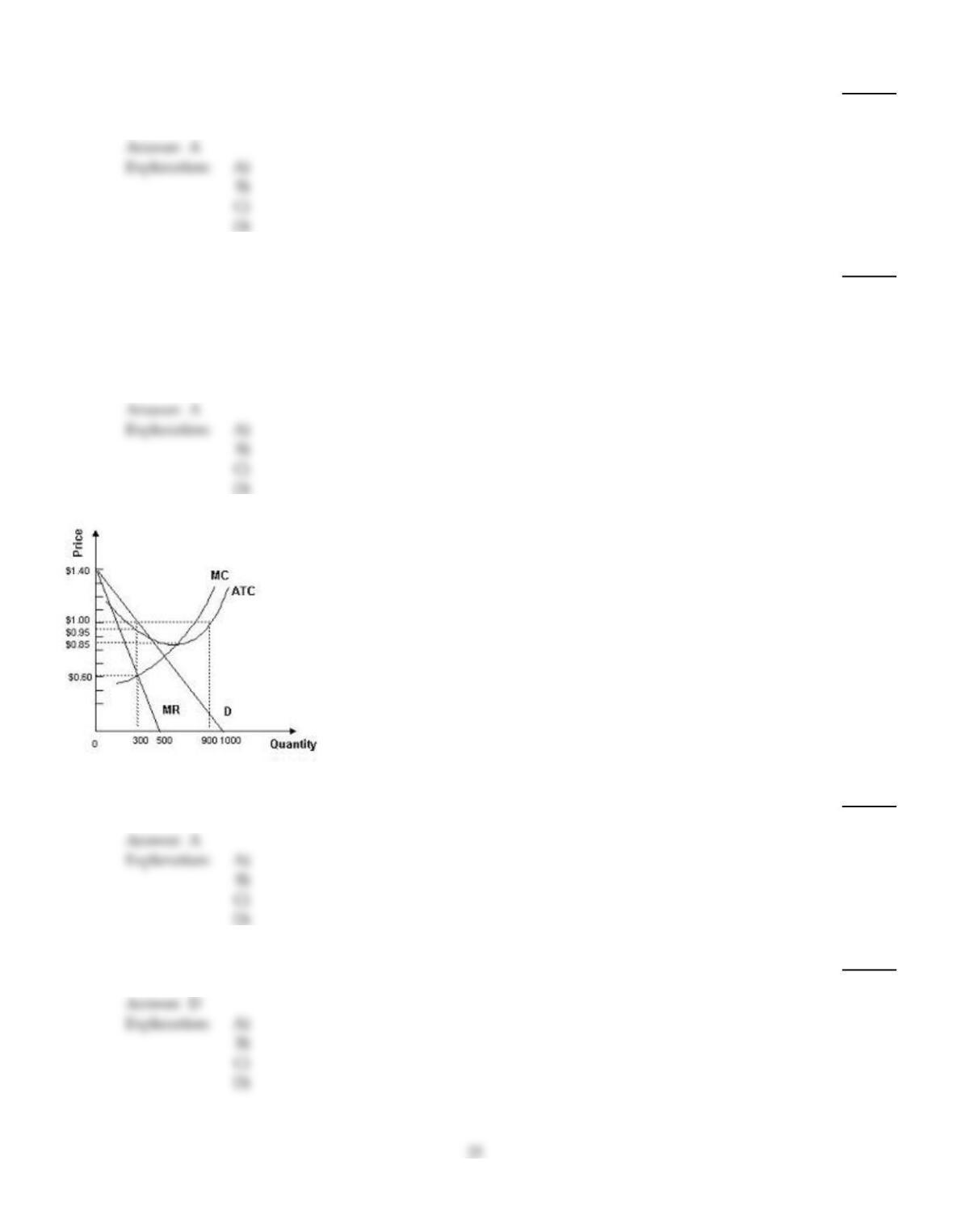
Use the above figure. The economic profit for this firm is
69)
A)
the distance between E and x–axis.
B)
the distance between T and x–axis.
C)
the distance between T and E.
D)
zero.
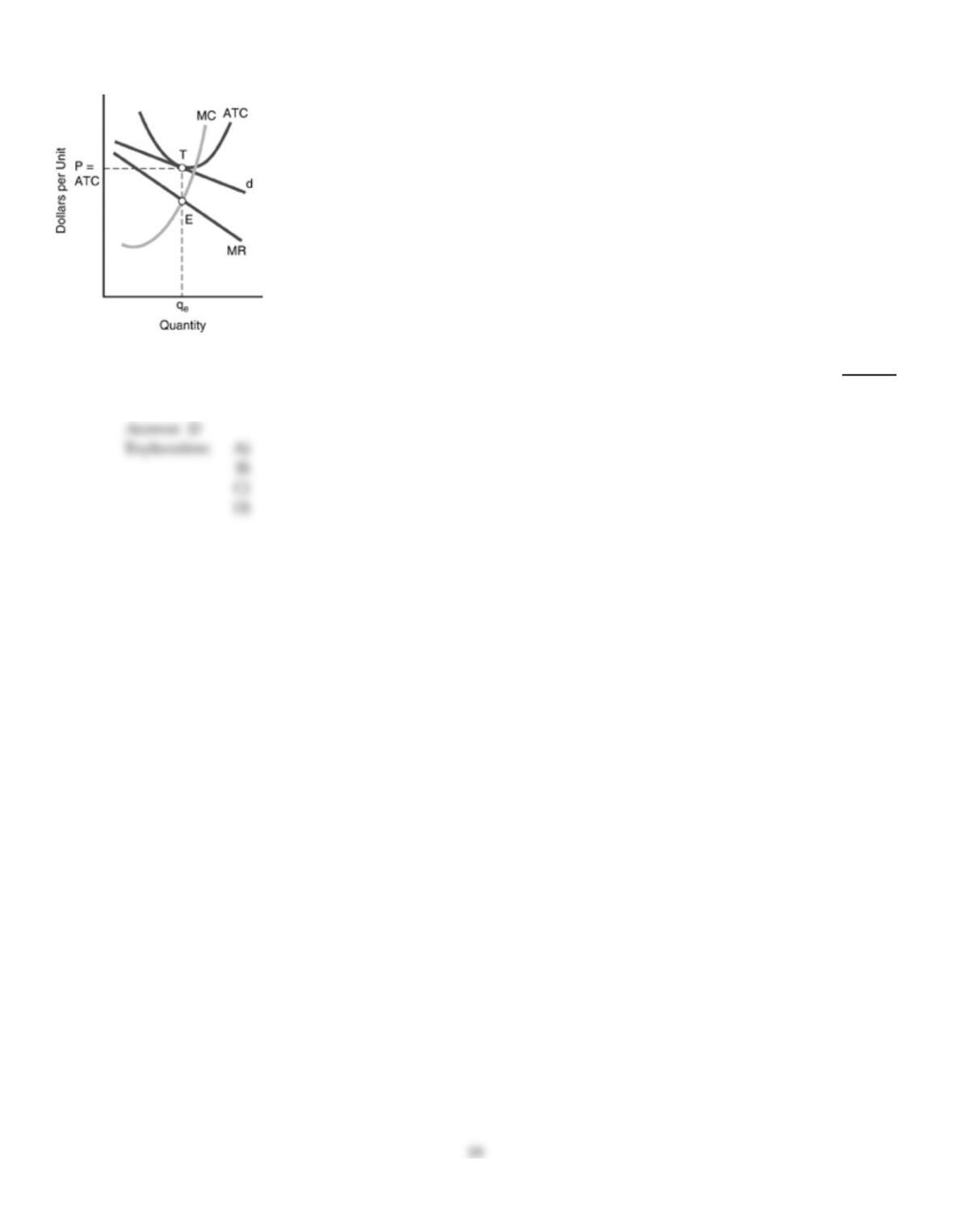
70)
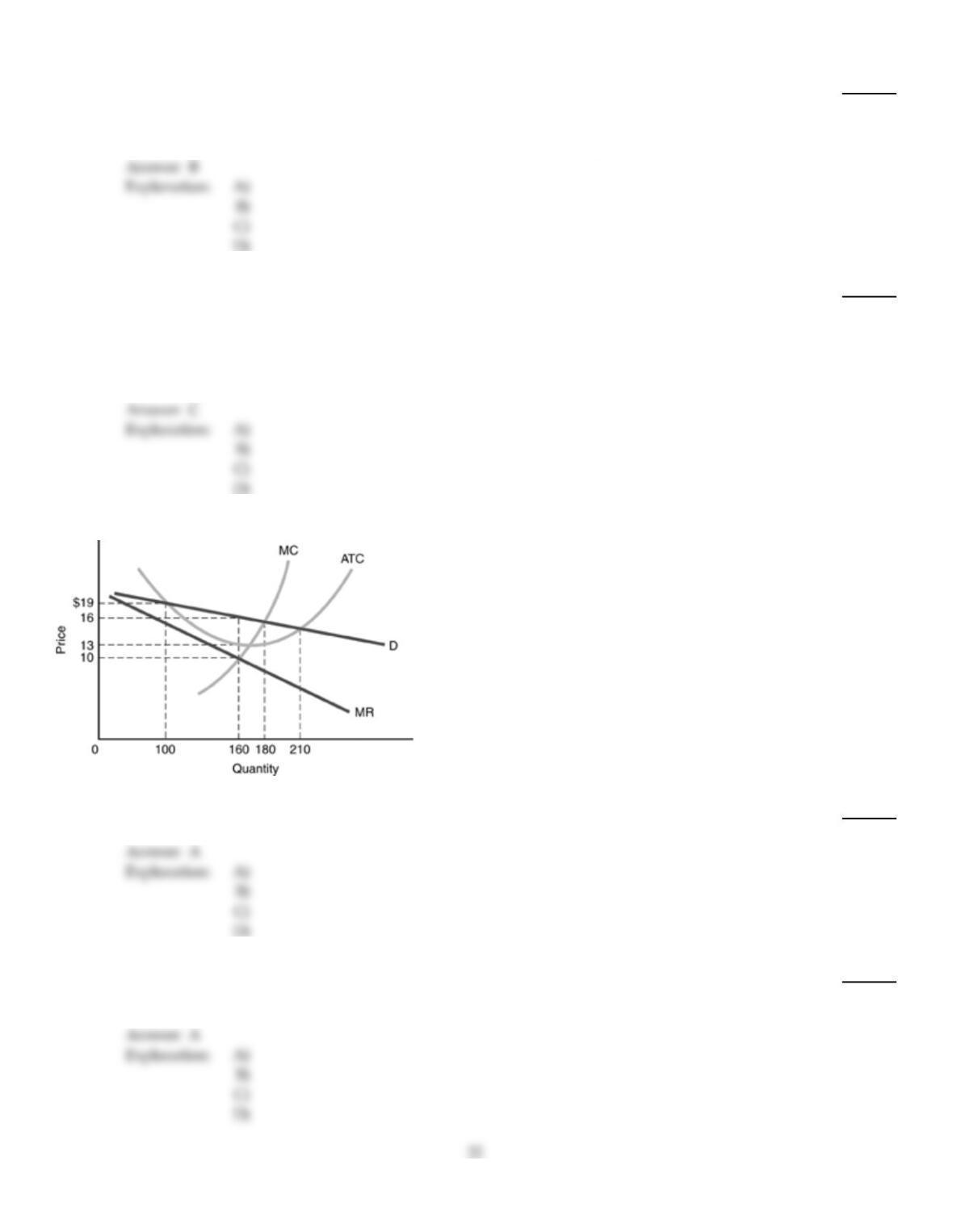
In the above figure, the monopolistically competitive firm’s profit–maximizing output is
70)
A)
300 units.
B)
700 units.
C)
900 units.
D)
1,000 units.
71)
Suppose a sushi restaurant is making significant economic profit in the short run. In the long run
71)
A)
more people will open steak restaurants, increasing the economic profit for the sushi
restaurant.
B)
the government will require the sushi restaurant to sell part of its interests in the city.
C)
high barriers to entry keep people from opening sushi restaurants.
D)
more people will open sushi restaurants, reducing the economic profit for each restaurant.
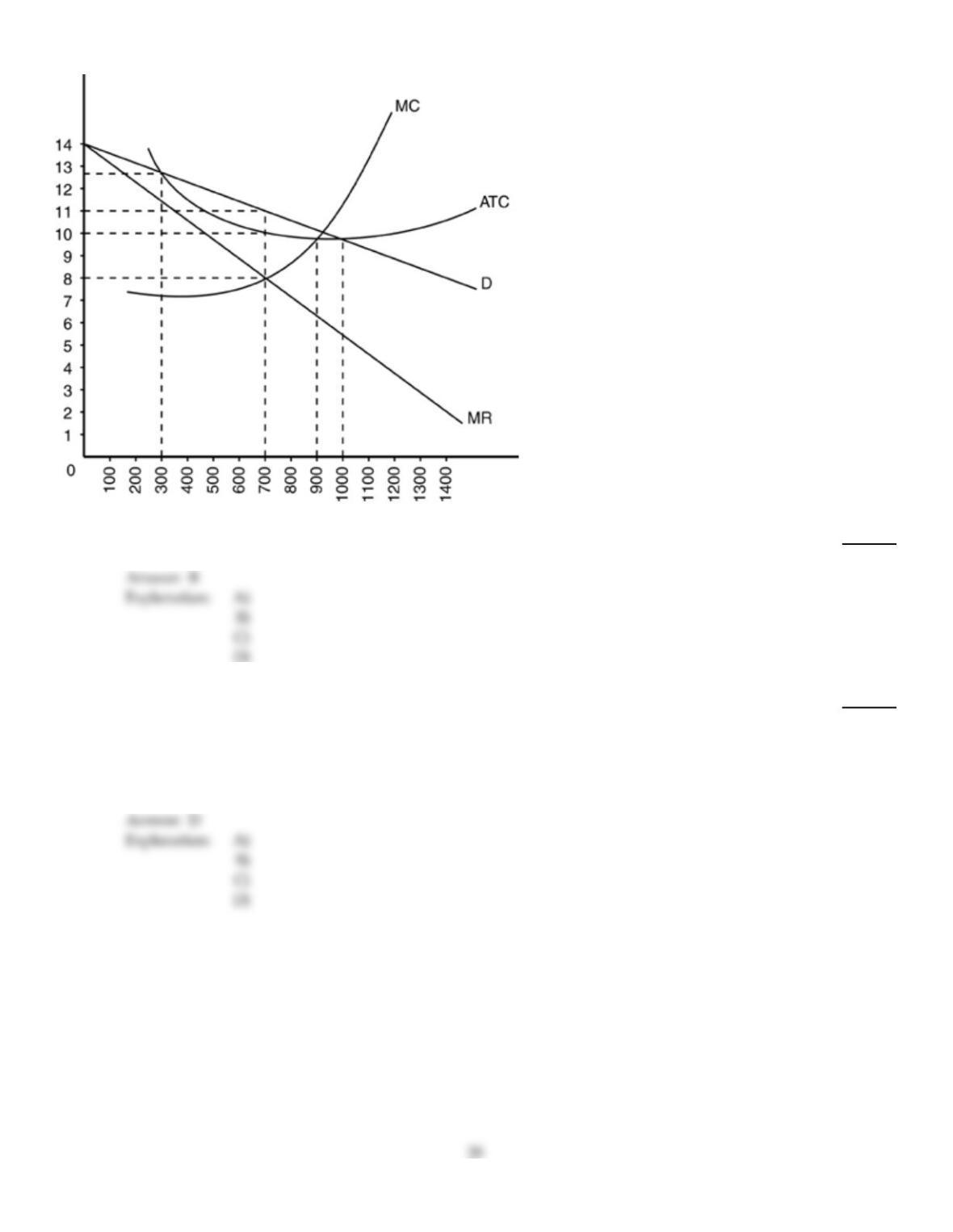
72)
Refer to the above figure. Which panel represents the long–run situation for a monopolistically
competitive firm?
72)
A)
Panel A.
B)
Panel B.
C)
Panel C.
D)
Panel D.
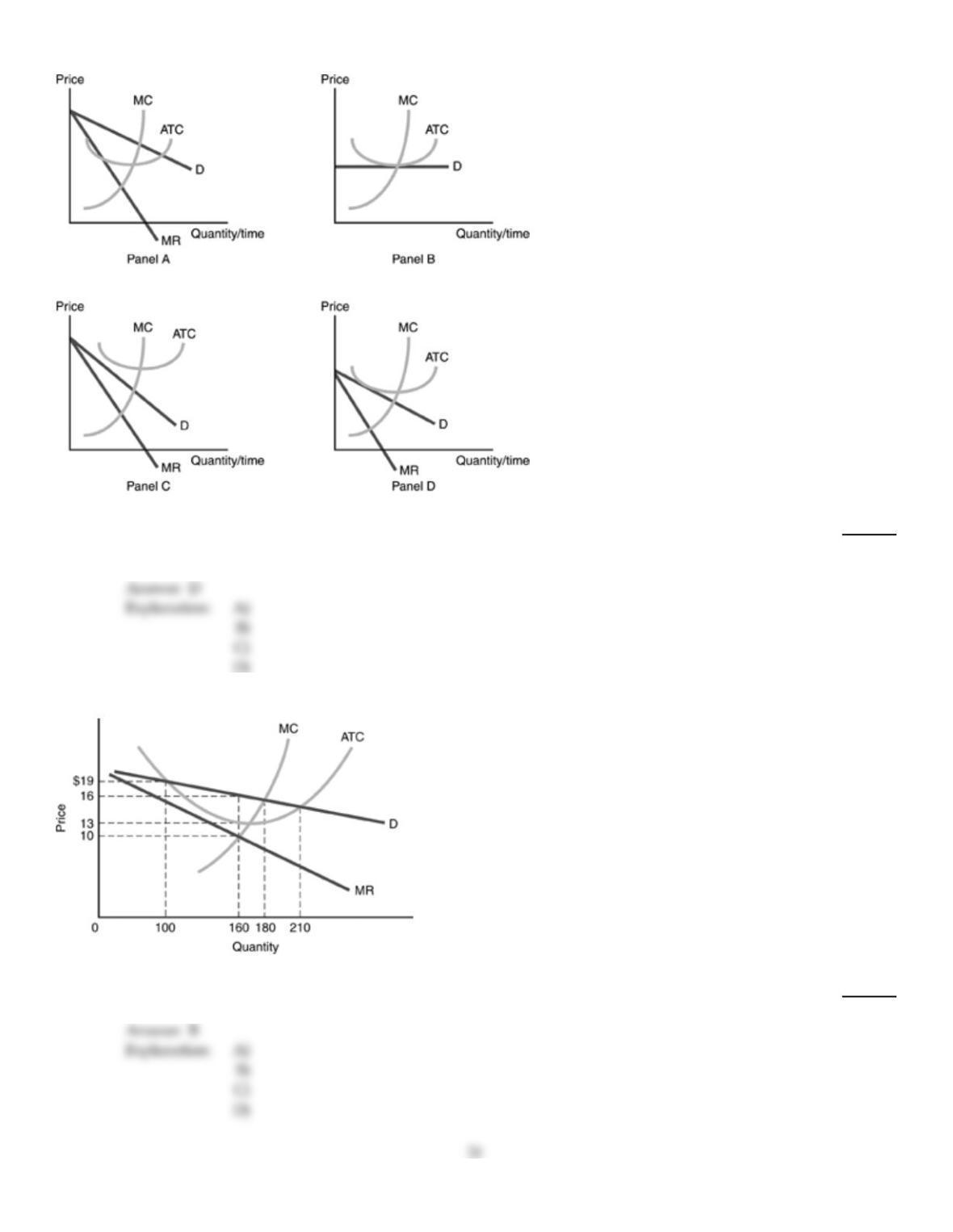
73)
Use the above figure. The total revenue earned by this monopolistically competitive firm is
73)
A)
$1,900.
B)
$2,560.
C)
$480.
D)
$1,600.
74)
A product that must be actually consumed before the quality of the product can be determined is
a(n)
74)
A)
search good.
B)
experience good.
C)
consumption good.
D)
consumable good.
75)
An implication of the downward slope of the demand curve for a monopolistic competitive firm is
that
75)
A)
its marginal revenue curve slopes downward but lies above the demand curve.
B)
its marginal revenue curve and its demand curve are identical (same) line.
C)
its marginal revenue curve slopes downward but lies below the demand curve.
D)
its marginal revenue curve slopes upward.
76)
Use the above figure. The total profit earned by this monopolistically competitive firm is
76)
A)
$480.
B)
$1,900.
C)
$2,560.
D)
$1,600.
77)
Products such as office supplies are examples of
77)
A)
search goods.
B)
selective goods.
C)
experience goods.
D)
simple goods.
78)
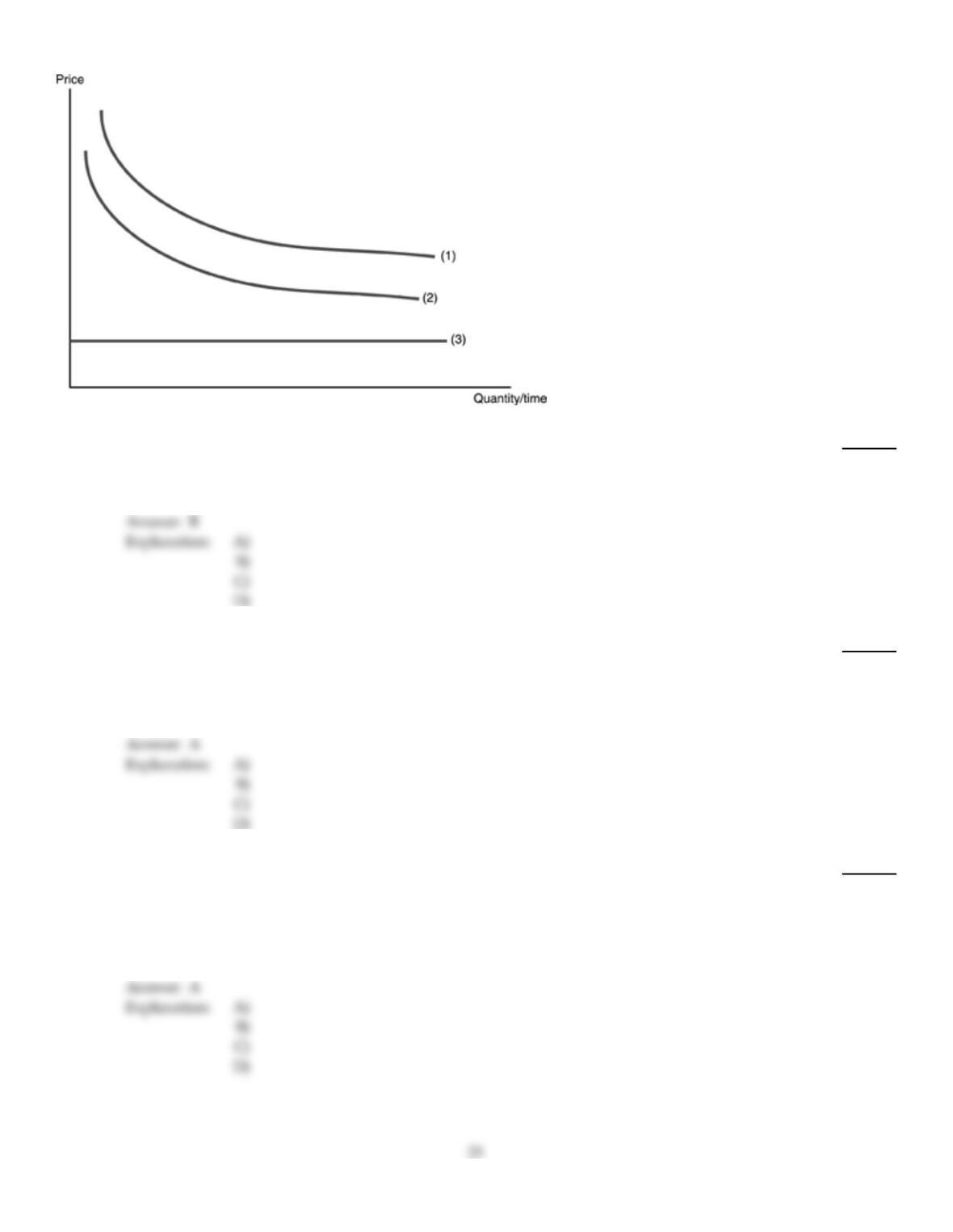
Refer to the above figure. The above figure shows the cost structure of a firm producing an
information product. Which curve represents average total cost?
78)
A)
Any of the 3 could be ATC.
B)
Curve 1
C)
Curve 2
D)
Curve 3
79)
The major similarity between monopolistic competition and perfect competition is
79)
A)
that both assume many buyers and sellers.
B)
price equals marginal revenue in each.
C)
the shape of the demand curve.
D)
both assume products are differentiated.
80)
If a monopolistically competitive firm selling an information product engages in marginal cost
pricing, it will
80)
A)
fail to earn sufficient revenues to cover its fixed costs.
B)
break even.
C)
lower costs.
D)
earn additional profits.
81)
When Crest claims that its toothpaste product whitens teeth more than the products of its
competitors, Crest is practicing
81)
A)
marginal cost pricing.
B)
libel.
C)
marginal revenue pricing.
D)
product differentiation.
82)
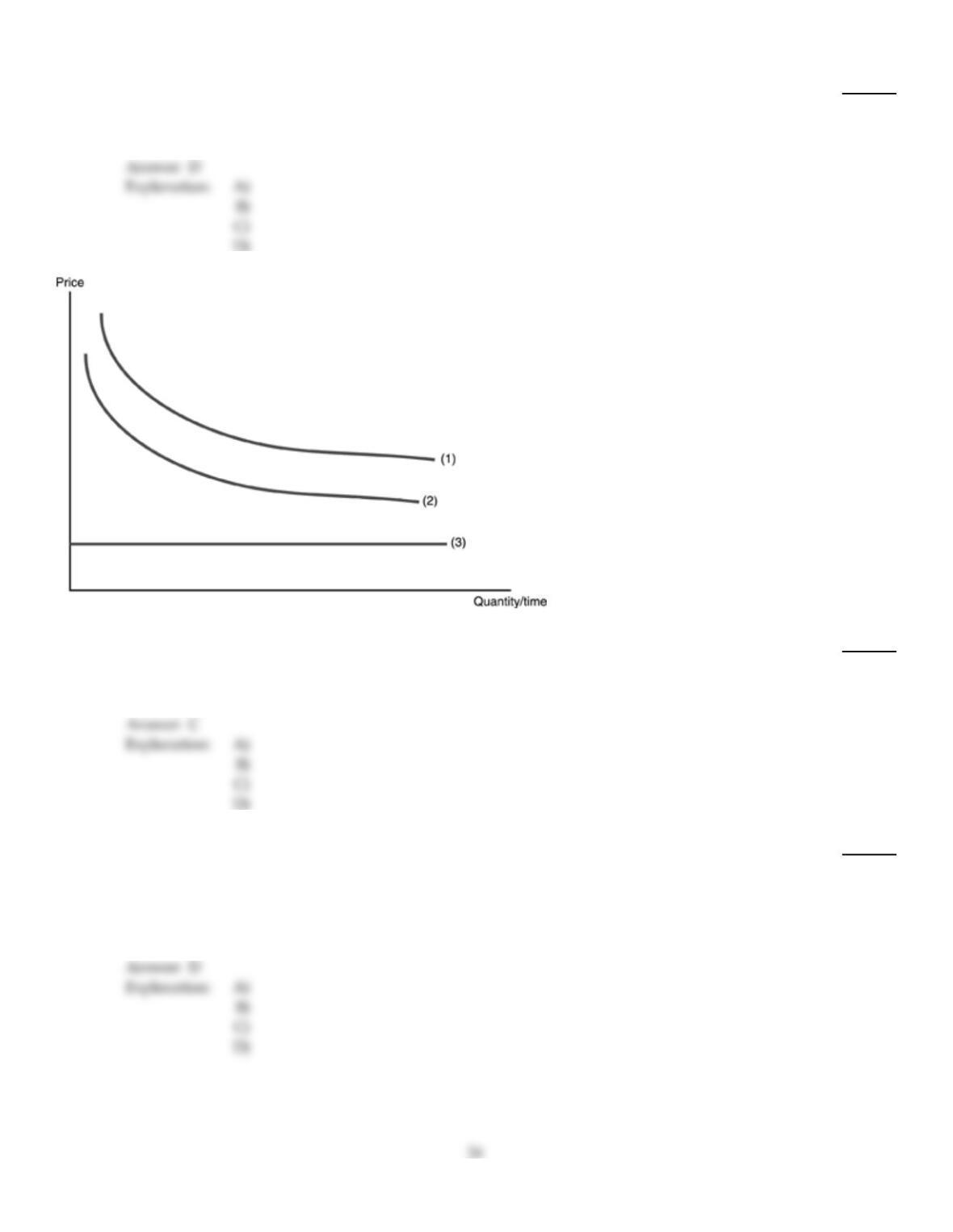
Refer to the above figure. The figure shows the cost structure of a firm producing an information
product. Which curve would represent the marginal cost for an information product?
82)
A)
Curve 1
B)
Curve 2
C)
Curve 3
D)
none of the above
83)
In a monopolistically competitive market if the additional revenue generated from advertising
equals the additional cost of advertising, the firm should
83)
A)
advertise less to decrease costs.
B)
advertise more to lower marginal costs.
C)
advertise more to increase sales.
D)
maintain its current amount of advertising.
84)
The demand curve for the product of a monopolistic competitor is
84)
A)
downward sloping.
B)
horizontal.
C)
unitary elastic.
D)
vertical.
85)
One way to view the cost structure of monopolistic competition is to say that the cost of product
differentiation is equal to
85)
A)
the difference between the cost of production for a monopolistically competitive firm in an
open market and the minimum average total cost.
B)
the difference between marginal revenue and marginal cost.
C)
the sum of marginal cost and minimum average cost.
D)
the sum of price and marginal cost.
86)
Use the above figure. The total profit earned by the monopolistically competitive firm is
86)
A)
+$15.
B)
–$15.
C)
$0.
D)
+$300.
87)
In the long run, in a monopolistically competitive market, price will be
87)
A)
equal to MC.
B)
greater ATC.
C)
equal to MR.
D)
equal to ATC.
88)
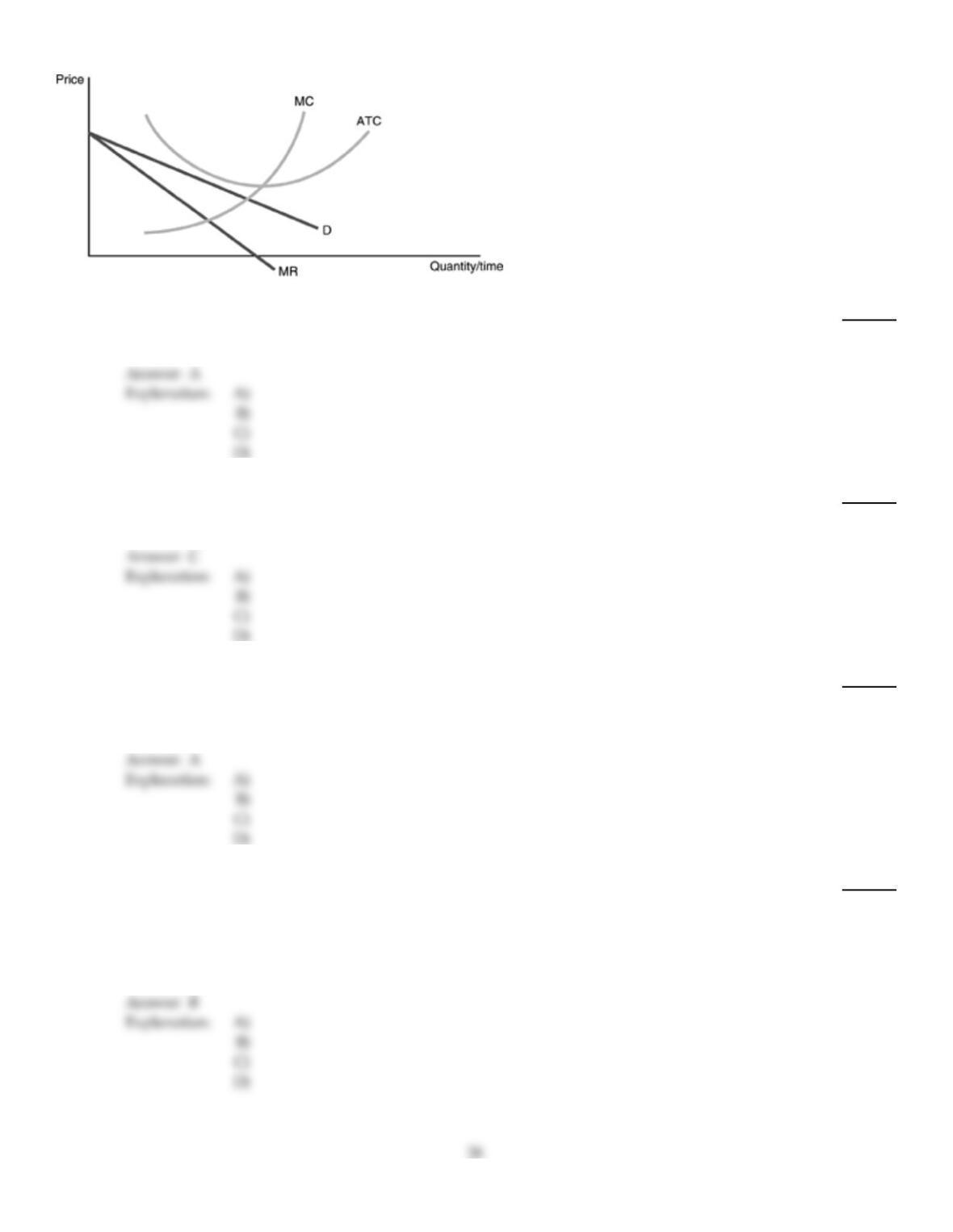
Refer to the above figure. Economic profits for this firm are
88)
A)
negative.
B)
zero.
C)
positive.
D)
undetermined without more information.
89)
A very high fixed cost and a relatively low marginal cost is associated with
89)
A)
every type of good or product.
B)
an experience good.
C)
an information product.
D)
a persuasive good.
C
90)
Because of product differentiation in a monopolistically competitive market, the demand curve for
an individual firm will be
90)
A)
downward sloping.
B)
horizontal.
C)
upward sloping.
D)
vertical.
A
91)
The two economists associated with the development of the theory of monopolistic competition
were
91)
A)
Carl Menger and Eugen Von Bohm–Bawerk.
B)
Joan Robinson and Edward Chamberlin.
C)
John Neville Keynes and John Maynard Keynes.
D)
David Hume and Adam Smith.
B
A
92)
The ATC curve and the AFC curve for information products (e.g., software) in the short run are
92)
A)
vertical.
B)
upward sloping.
C)
downward sloping.
D)
horizontal.
93)
Which of the following short–run outcomes for monopolistic competition is not possible?
93)
A)
P > ATC.
B)
P = MR = MC.
C)
P = ATC.
D)
P > MC > ATC.
94)
For a monopolistic competitive firm, which of the following is true in the long run?
94)
A)
ATC is minimized.
B)
P = MC.
C)
Economic profit is zero.
D)
All of the above.
95)
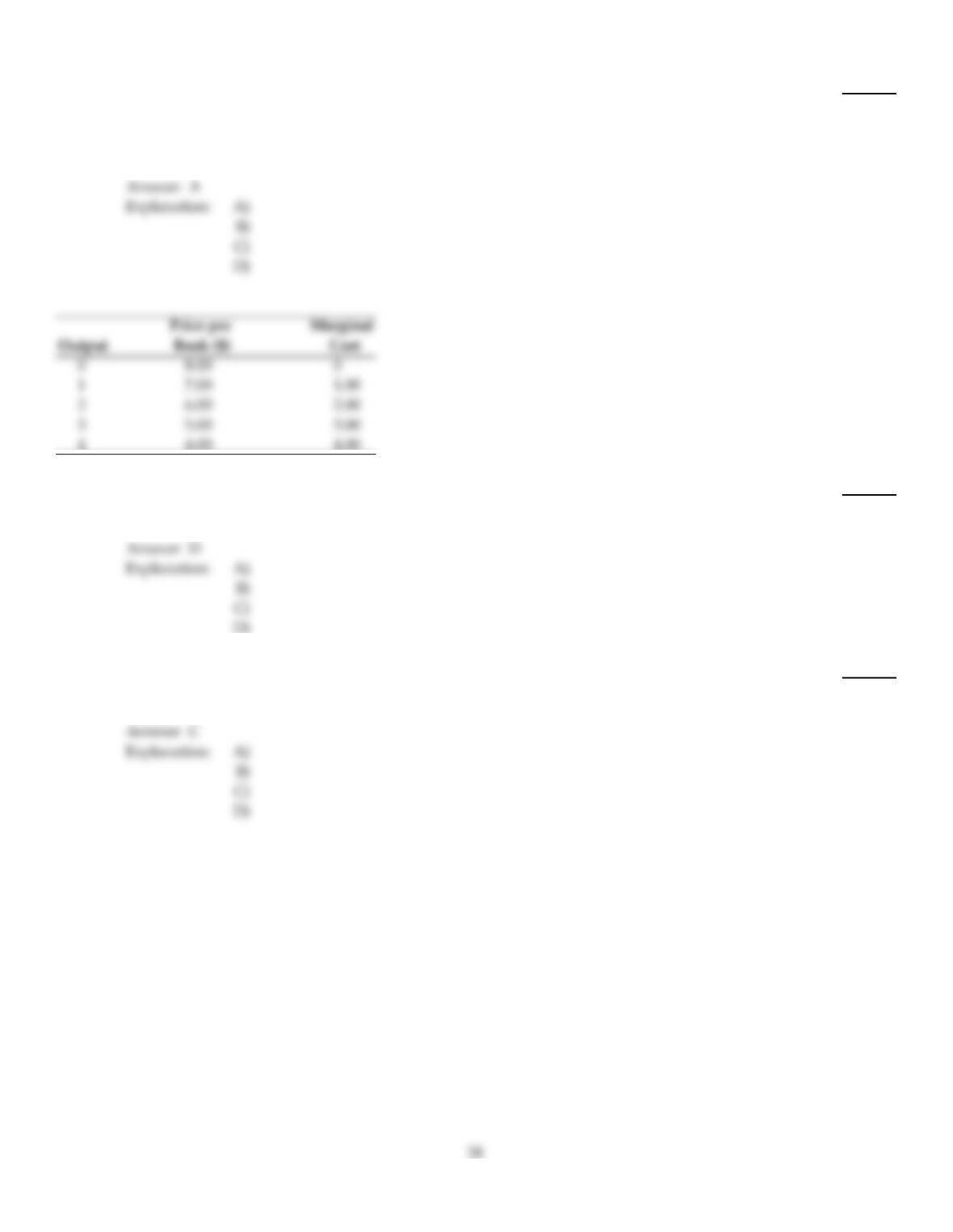
The above table depicts prices, quantities, and marginal costs faced by the campus bookstore. At
the profit–maximizing level of output, what is the profit earned by the store?
95)
A)
$6
B)
$8
C)
$0
D)
$15
96)
Average total cost for an information product would
96)
A)
decrease constantly as quantity increases.
B)
first decrease and then increase as quantity increases.
C)
increase constantly as quantity increases.
D)
remain constant as quantity increases.
97)
The above table depicts prices, quantities, and marginal costs faced by the campus bookstore. At
the profit–maximizing level of output, what is the total cost earned by the store?
97)
A)
$16
B)
$4
C)
$3
D)
$9
98)
If the producer of an information product engages in marginal cost pricing, it earns
98)
A)
positive economic profits.
B)
zero economic profits.
C)
an economic loss.
D)
a normal profit.
99)
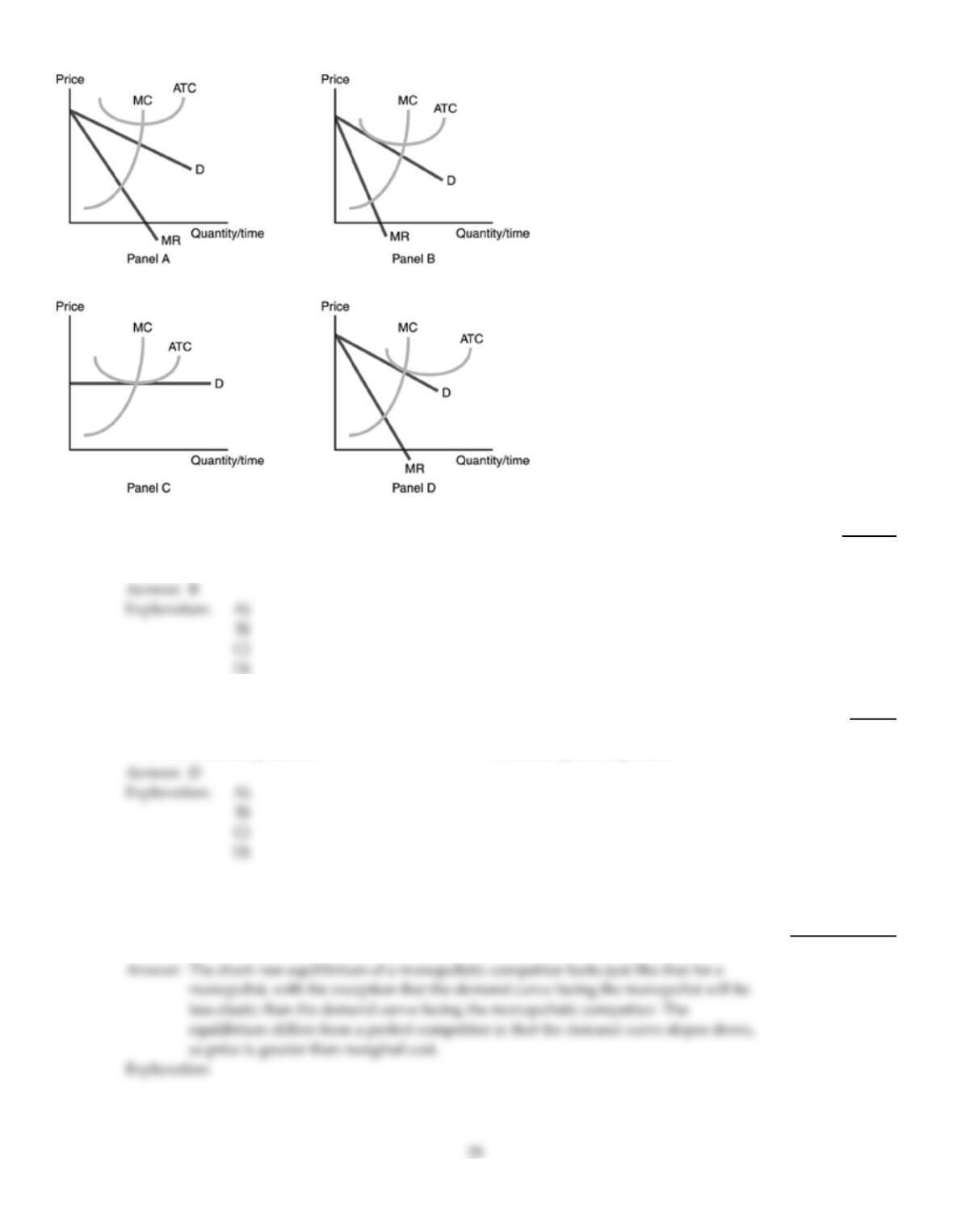
Refer to the above figure. Which panel represents a monopolistic competitor that is earning zero
economic profits?
99)
A)
Panel A.
B)
Panel B.
C)
Panel C.
D)
Panel D.
100)
Which of the following is NOT a feature of a monopolistically competitive market?
100)
A)
advertising
B)
numerous buyers and sellers
C)
differentiated products
D)
a homogeneous product
SHORT ANSWER. Write the word or phrase that best completes each statement or answers the question.
101)
How does the short–run equilibrium of a monopolistic competitor differ from a
monopolist? How does it differ from a perfect competitor?
101)
102)
What is the most important characteristic of monopolistic competition? How do firms
behave differently from perfect competitors?
102)
103)
For an information product, why a profit–maximizing firm unable to practice marginal
cost pricing? How is its price determined in the long run?
103)
104)
How does an information product differ from a product such as a desk?
104)
105)
Why do firms in a monopolistically competitive industry advertise?
105)
106)
Explain how advertising can act as a signal.
106)
107)
How is monopolistic competition like perfect competition? How is it like monopoly?
107)
108)
Why can’t a monopolistic competitor earn economic profits in the long run?
108)
109)
Explain the difference between informational advertising and persuasive advertising. Give
an example of a product that would be the subject of each type of advertising and explain
why that type of advertising fits the product.
109)
110)
Why would Sunkist incur substantial costs to advertise and establish a brand name when
the quality of its oranges can easily be evaluated by consumers?
110)
111)
Explain why the amount that firms spend on advertising depends on the characteristics of
their products.
111)
112)
Explain what will happen if firms in a monopolistically competitive industry are earning
positive economic profits.
112)
Answer Key
Testname: C25
Answer Key
Testname: C25
33
Answer Key
Testname: C25
34