Exam
Name___________________________________
MULTIPLE CHOICE. Choose the one alternative that best completes the statement or answers the question.
1)
In a long–run equilibrium in a monopolistically competitive industry that produces information
products, revenues are equal to the ________ costs of developing, producing, and selling the
product.
1)
A)
fixed
B)
variable
C)
marginal
D)
total
2)
Average variable cost for an information product would
2)
A)
decrease constantly as quantity increases.
B)
increase constantly as quantity increases.
C)
remain constant as quantity increases.
D)
first decrease and then increase as quantity increases.
3)
In a monopolistically competitive market there are
3)
A)
many firms producing similar but not identical products.
B)
many firms producing totally different products.
C)
few firms producing identical products.
D)
many firms producing an identical product.
4)
Entry into a monopolistically competitive industry
4)
A)
is very difficult.
B)
can be easy or difficult, depending on the type of product.
C)
is about the same as entering a monopoly industry.
D)
is relatively easy.
5)
Stephanie has just placed an order for the latest video after she received a personalized e–mail. The
e–mail is an example of
5)
A)
mass marketing.
B)
indirect marketing.
C)
direct marketing.
D)
interactive marketing.
6)
Informational advertising is mostly used for
6)
A)
an experience good.
B)
a search good.
C)
a logo good.
D)
a persuasive good.
B
7)
A monopolistically competitive firm differs from a perfectly competitive firm in the long run in
that
7)
A)
profits are positive for a monopolistically competitive firm and zero for a perfectly
competitive firm.
B)
profits are zero for a monopolistically competitive firm and positive for a perfectly
competitive firm.
C)
the demand curve faced by a monopolistically competitive firm is downward sloping, while
the demand curve faced by a perfectly competitive firm is horizontal.
D)
marginal cost equals the market price for a monopolistically competitive firm but not for a
perfectly competitive firm.
C
8)
Which of the following is NOT a characteristic of firms in a monopolistically competitive market?
8)
A)
advertising
B)
differentiated products
C)
existence of significant economies of scale
D)
ease of entry and exit
C
C
9)
The short–run profit–maximizing output level for a monopolistically competitive firm is the point
at which
9)
A)
P = ATC.
B)
MR > P.
C)
MR = MC.
D)
MR > ATC.
10)
Monopolistic competitors advertise because
10)
A)
they produce goods that can be differentiated from the goods of other firms in the industry.
B)
the demand curves they face are very elastic.
C)
they have downward sloping demand curves.
D)
they can earn long–run profits if they advertise.
11)
Which of the following is most likely to be a monopolistically competitive firm?
11)
A)
a fast food restaurant
B)
a lettuce farmer
C)
a soybean farmer
D)
a municipal water district
12)
Considering the relevant market structures, which is an INCORRECT statement?
12)
A)
In pure monopoly, there is only one firm.
B)
In monopolistic competition, there is a large number of firms.
C)
In any market situation, the number of firms is not very important.
D)
In a perfectly competitive situation, there is an extremely large number of firms.
13)
A monopolistic competitor would face a demand curve with a
13)
A)
negative slope.
B)
constant slope.
C)
positive slope.
D)
slope equal to 0.
14)
Marginal cost pricing for an information product
14)
A)
would allow the firm to break even.
B)
would cause the firm to earn economic profits.
C)
would cause the firm to expand output to increase economic profits.
D)
would cause the firm to experience economic losses.
15)
In the short run, a firm operating as a monopolistic competitor will produce to the point at which
15)
A)
MR = MC.
B)
P = MC.
C)
MR = ATC.
D)
MC = ATC.
16)
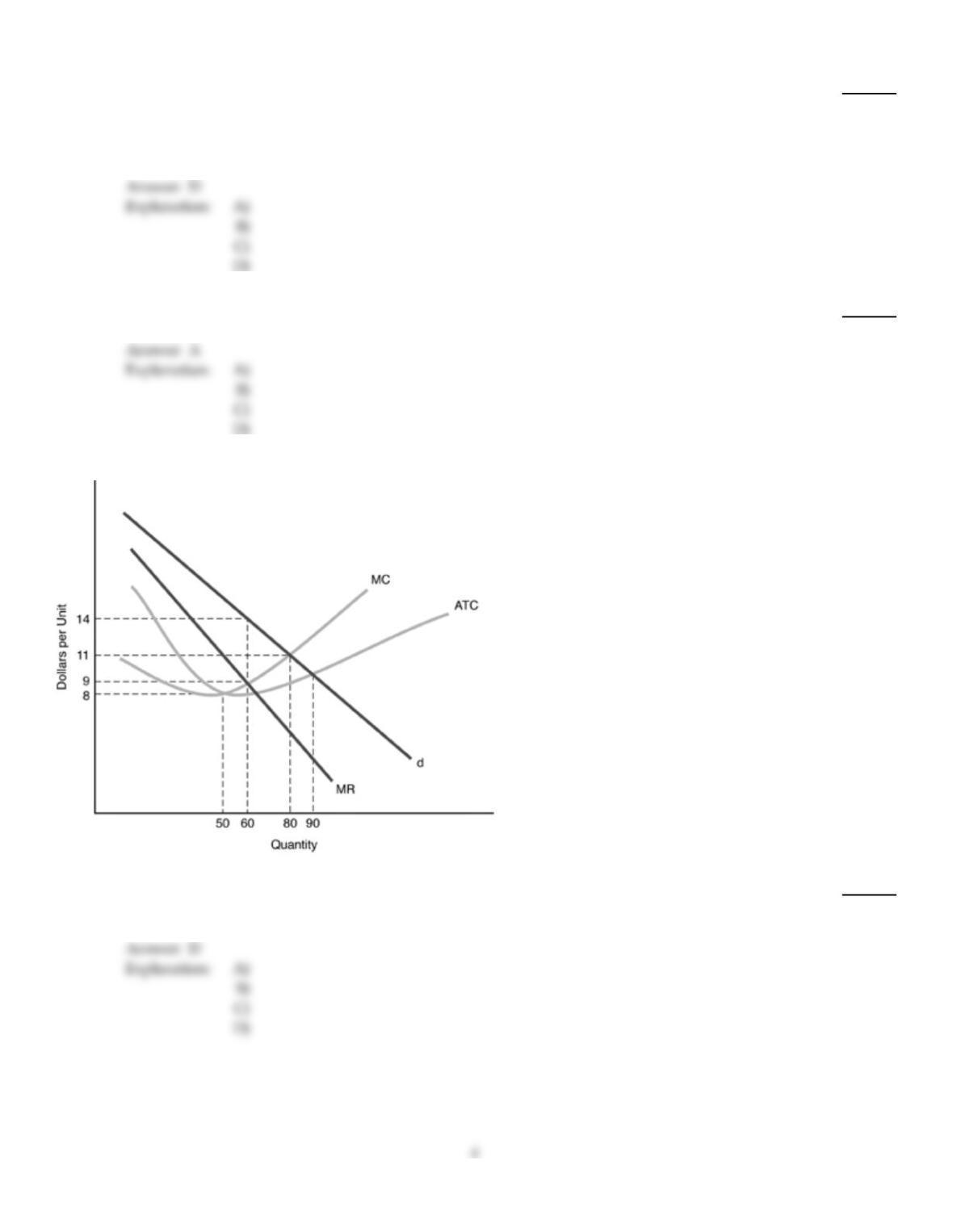
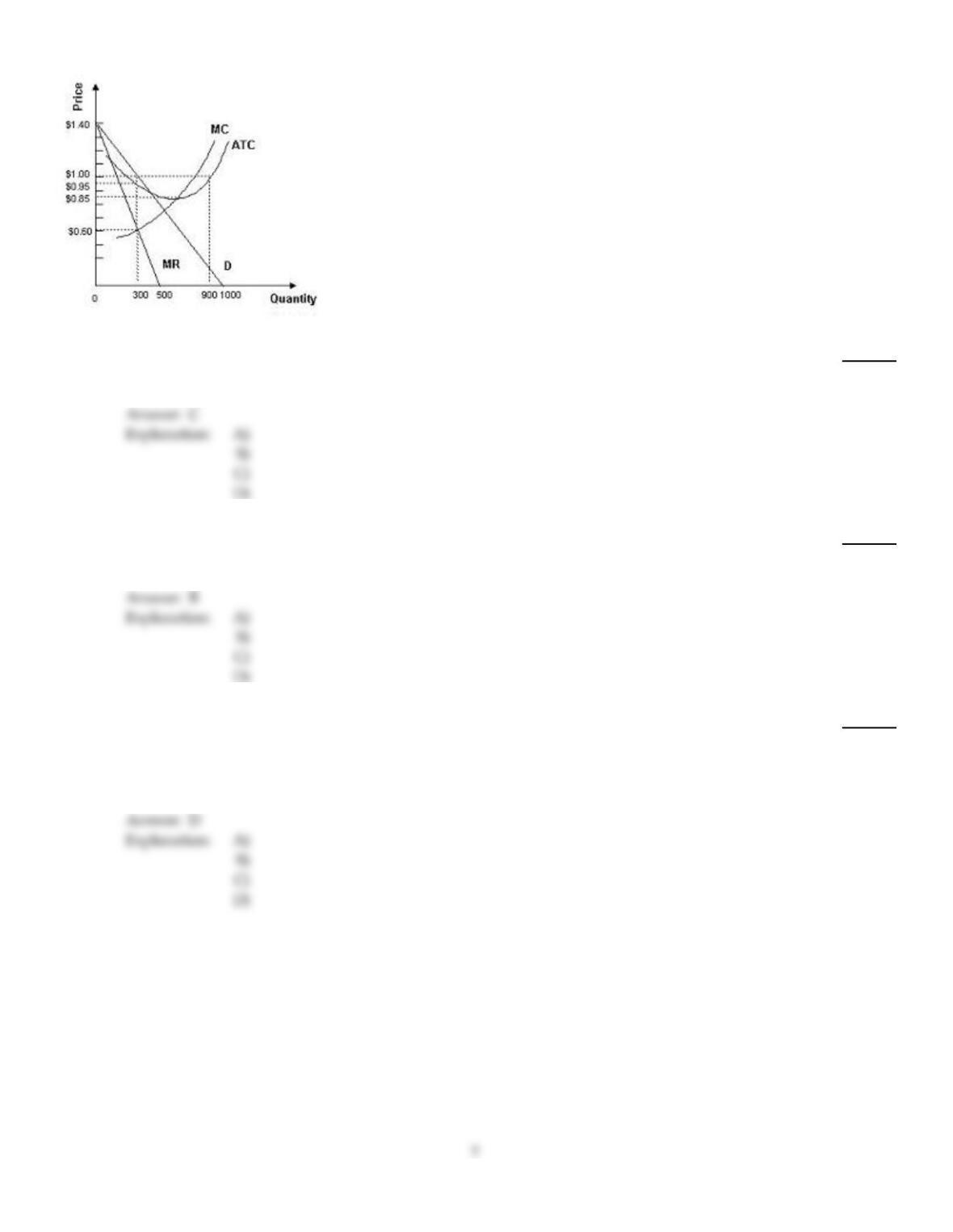
In the above figure for a monopolistically competitive firm, the total cost at the profit–maximizing
point is
16)
A)
$400
B)
$880
C)
$540
D)
$480
17)
Which of the following products would most likely be produced in a monopolistically competitive
market?
17)
A)
oil
B)
pizza
C)
corn
D)
electricity
18)
Firms that sell information products experience relatively high fixed costs but, once they have
produced the first unit, can
18)
A)
experience short–run diseconomies of scale.
B)
sell additional units at a relatively low cost per unit.
C)
sell additional units at a loss, or above cost.
D)
provide expensive information products to consumers.
19)
Long–run equilibrium for a monopolistic competitor is characterized by
19)
A)
marginal cost pricing.
B)
economic profits.
C)
a price exceeding marginal cost.
D)
too few firms in the industry.
20)
A good example of a monopolistic competitive industry is
20)
A)
the computer game industry.
B)
mining.
C)
the public utility industry.
D)
the U.S. auto industry.
21)
The greater the product differentiation between monopolistically competitive firms,
21)
A)
the higher the average variable costs.
B)
the lower the price elasticity of demand.
C)
the lower the barriers to entry.
D)
the greater the price elasticity of demand.
22)
An example of direct marketing is
22)
A)
the use of coupons in newspapers.
B)
charging customers who pay with cash a different price than those using credit cards.
C)
the use of personalized advertising by using mailing lists.
D)
allowing the use of the product for 7 days before the consumer is billed for the product.
23)
The monopolistic competitive firm in short–run equilibrium may experience economic profits that
are
23)
A)
always negative.
B)
always positive.
C)
greater than, equal to, or less than zero.
D)
always zero.
C
24)
The distinguishing of products by brand name, color, and other attributes
24)
A)
is known as product differentiation.
B)
leads to many firms in the market.
C)
leads to collusion.
D)
is known as interdependence.
A
25)
The demand for the product of a monopolistically competitive firm is highly elastic when
25)
A)
firms collude.
B)
there are a lot of close substitutes.
C)
there are fewer firms in the industry.
D)
there is a lot of product differentiation.
B
C
26)
Use the above figure. The total cost of producing at the optimal level for the monopolistically
competitive firm is
26)
A)
$180.
B)
$300.
C)
$285.
D)
$255.
27)
Compared to perfect competition, a monopolistically competitive market will produce ________
output and charge a ________ price.
27)
A)
less; lower
B)
less; higher
C)
more; higher
D)
more; lower
28)
For the monopolistically competitive firm, in both the short run and the long run
28)
A)
production will be at minimum average cost.
B)
there will be no economic profit.
C)
the demand curve is inelastic.
D)
price will exceed marginal cost.
29)
The monopolistically competitive firm’s economic profits tend toward zero in the long run. Why is
this so?
29)
A)
In the long run, other firms will successfully offer substitutes for the profitable firm’s product,
and competition will eliminate economic profits.
B)
Monopolistically competitive firm’s are rarely able to maintain the corporate discipline
necessary to sustain profits in the long run.
C)
Even though the monopolistically competitive firm can successfully maintain barriers to
entry, keeping competition at bay becomes very expensive.
D)
If a monopolistically competitive firm is profitable for more than 2 years, the Justice
Department orders a corporate restructuring to pull the company back to a normal rate of
return.
30)
Compared with a firm in a perfectly competitive market, the demand curve faced by a
monopolistically competitive firm is
30)
A)
more inelastic.
B)
perfectly elastic.
C)
more elastic.
D)
perfectly inelastic.
31)
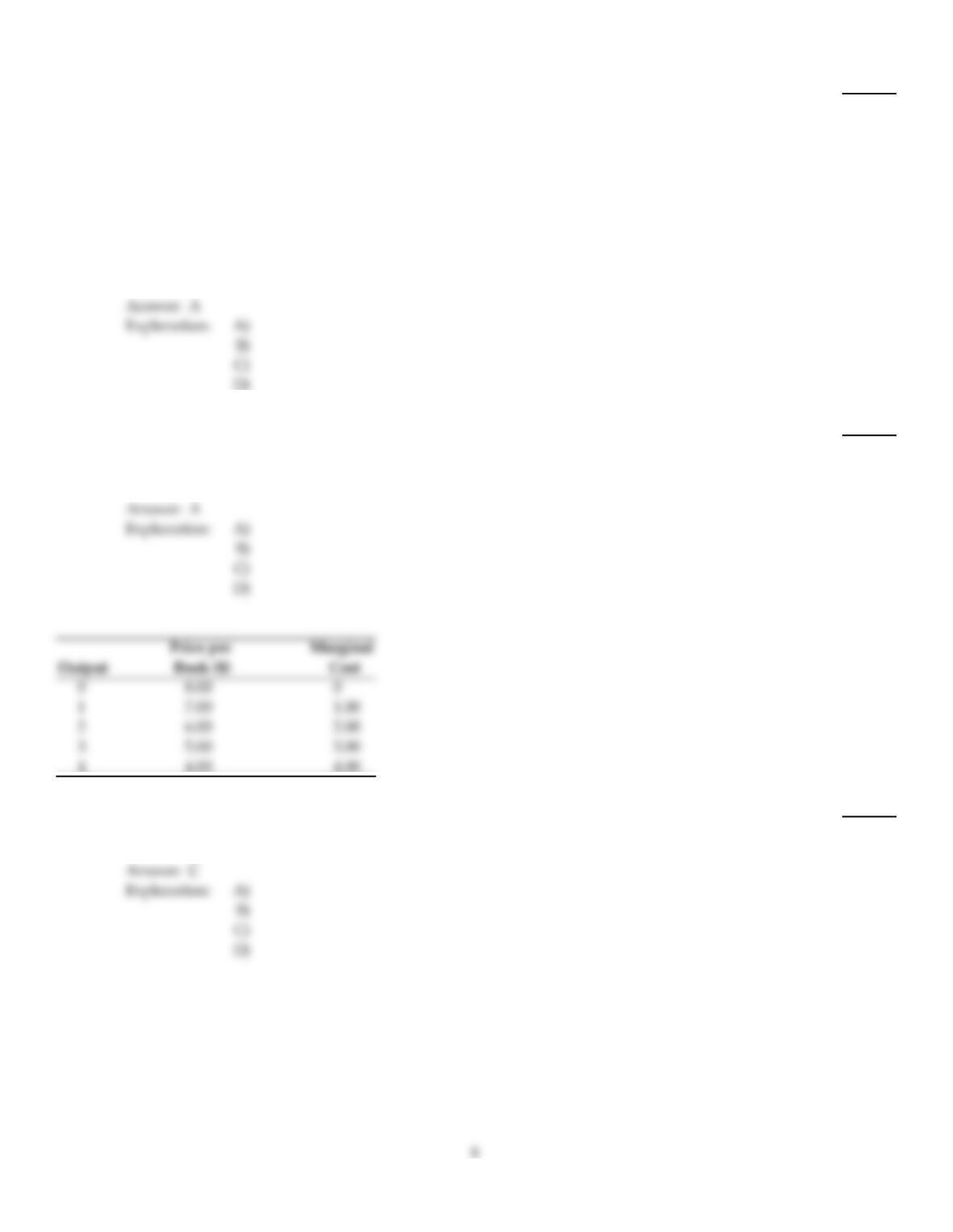
The above table depicts prices, quantities, and marginal costs faced by the campus bookstore. Based
on marginal analysis, what is the profit–maximizing level of output for the bookstore?
31)
A)
1 book
B)
2 books
C)
3 books
D)
4 books
32)
In which industry structure is advertising and sales promotion likely to be most important?
32)
A)
Monopoly
B)
Monopolistic competition
C)
Perfect competition
D)
All of the above are equally reliant on effective advertising and promotion
33)
Which of the following is FALSE with respect to brand names and advertising?
33)
A)
Because “differentness” has value to customers, monopolistically competitive firms regard
their brand names as valuable.
B)
There is considerable shifting over time in the market value rankings of various U.S. product
brands.
C)
Firms use trademarkswords, symbols, and logosto distinguish their product brands.
D)
Companies do not regard their brands as valuable private (intellectual) property because the
value cannot be quantified.
34)
In long–run equilibrium in a monopolistically competitive industry, a firm will
34)
A)
produce at a point to the left of the minimum point on its average total cost curve.
B)
have a perfectly elastic demand curve.
C)
produce an output rate at which P = MC.
D)
always earn an economic profit.
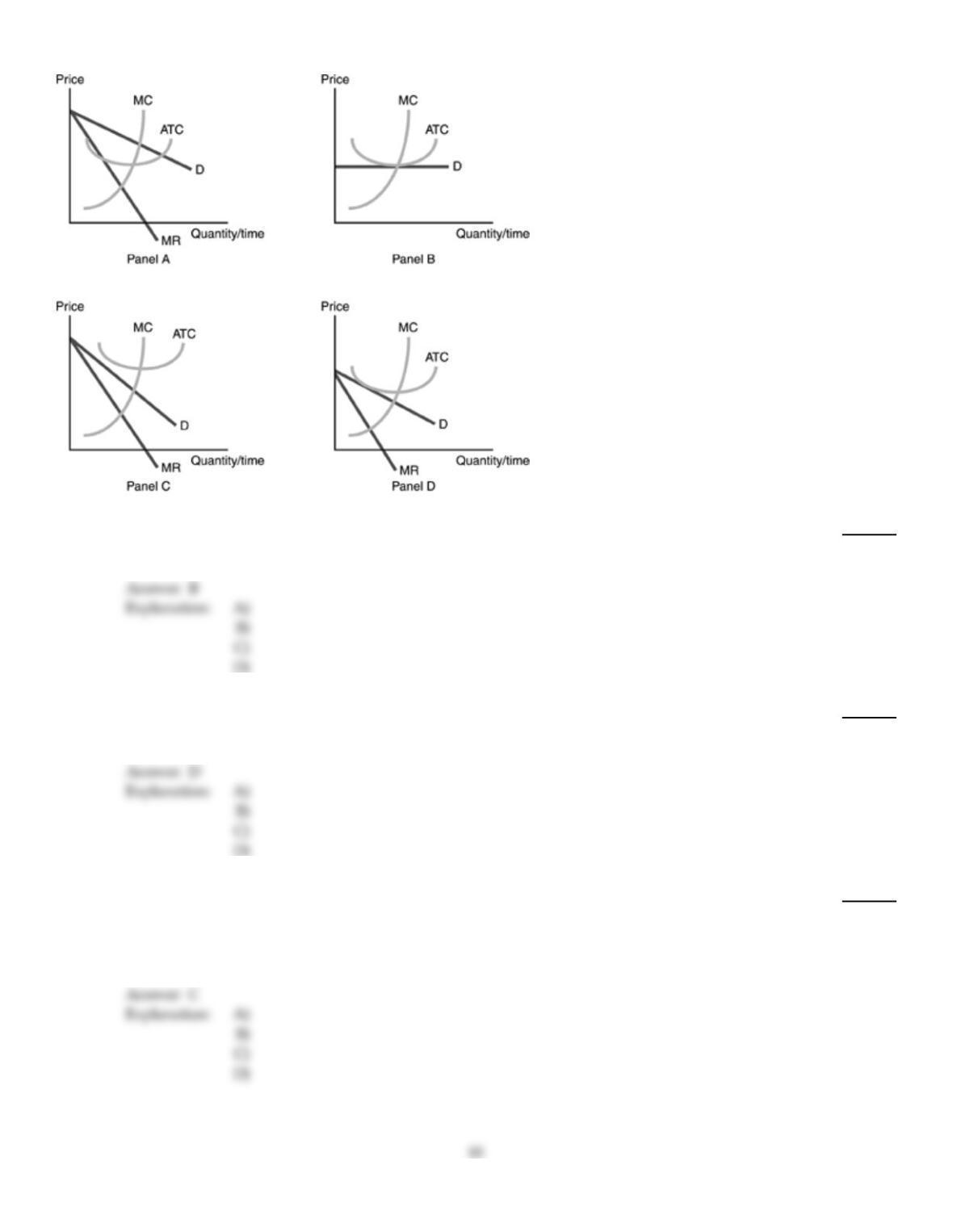
35)
Refer to the above figure. Which panel does not represent a possible short–run situation for a
monopolistically competitive firm?
35)
A)
Panel A.
B)
Panel B.
C)
Panel C.
D)
Panel D.
36)
A good that people must actually consume before they can determine qualities is called
36)
A)
a search good.
B)
a persuasive good.
C)
a credence good.
D)
an experience good.
D
37)
Which of the following assumptions is true about monopolistic competition?
37)
A)
Firms will not advertise.
B)
There are few producers of the product.
C)
The firm’s products are differentiated.
D)
It is difficult for firms to enter this industry.
C
B
38)
The demand curve for a monopolistically competitive firm is
38)
A)
inelastic because of barriers to entry.
B)
inelastic because of the profit maximizing behavior of the firm.
C)
elastic because of product differentiation.
D)
elastic because the products produced are homogeneous.
39)
An information product typically has
39)
A)
low total fixed costs and high marginal costs.
B)
high total fixed costs and high marginal costs.
C)
low total fixed costs and low marginal costs.
D)
high total fixed costs and low marginal costs.
40)
The demand curve for a monopolistically competitive firm is
40)
A)
more elastic than for a perfectly competitive firm.
B)
the same elasticity as a perfectly competitive firm.
C)
more elastic than for a monopoly firm.
D)
more inelastic than for a monopoly firm.
41)
The monopolistically competitive firm maximizes profit by producing to the point at which
41)
A)
MC = AR.
B)
MR = AR.
C)
MC = MR.
D)
ATC = AVC.
42)
Which of the following statements is true about the economic profits earned by a monopolistic
competitor firm in the long run?
42)
A)
Economic profits will tend towards zero since positive profits will attract new firms into the
industry.
B)
Economic profits will be positive since the firm has a downward sloping demand curve.
C)
Economic profits can be negative since there is so much competition in the market.
D)
Economic profits can be positive since firms have some degree of monopoly power.
43)
Entry into a monopolistic competitive industry
43)
A)
is hard.
B)
is easy.
C)
requires governmental approval.
D)
requires collusion.
44)
In the short run, a monopolistically competitive firm can earn
44)
A)
zero or positive profits only.
B)
zero profits only.
C)
positive profits only.
D)
zero, positive or negative profits.
45)
Which of the following is NOT a characteristic of monopolistic competition?
45)
A)
Barriers to entry
B)
Advertising
C)
Large number of sellers
D)
Differentiated products
46)
In the long run, if some monopolistically competitive firms are earning economic losses then
46)
A)
new firms will enter the industry.
B)
they will increase production until marginal costs fall.
C)
raise prices until they earn economic profits.
D)
firms will leave the industry.
47)
What did Harvard economist Edward Chamberlain say about the observation that a
monopolistically competitive firm’s average cost of production exceeds its minimum average total
cost?
47)
A)
In Chamberlain’s view, this is evidence that monopolistic competition uses society’s resources
inefficiently and in a fashion that merits government intervention.
B)
According to Chamberlain, this cost difference represents the value consumers place on
variety and having more choice.
C)
Chamberlain argued that these higher costs represent the wastefulness of this market
structure.
D)
Chamberlain argued that this belief is incorrect. In his view, monopolistically competitive
firms do not produce at a cost above their minimum average total costs.
48)
All of the following are characteristics of a monopolistically competitive industry EXCEPT
48)
A)
sales promotion and advertising.
B)
many firms.
C)
low barriers to entry and exit.
D)
homogeneous products.
49)
Which of the following conditions best explain the short–run economies of operation associated
with production of an information product?
49)
A)
AVC slopes downward, and AFC is constant, so that ATC slopes downward.
B)
AVC is constant, and AFC slopes downward, so that ATC slopes downward.
C)
MC is constant, and MC slopes upward, so that AVC slopes upward.
D)
AFC is constant, and MC slopes downward, so that AVC slopes downward.
50)
In the long run, the monopolistically competitive firm’s demand curve will
50)
A)
intersect the ATC at its minimum point.
B)
become tangent to the ATC curve at its minimum point.
C)
become tangent to the ATC curve somewhere to the left of its minimum point.
D)
intersect the ATC curve somewhere past the minimum point.
51)
The type of advertising used for an experience good is
51)
A)
search advertising.
B)
informational advertising.
C)
persuasive advertising.
D)
experience advertising.
52)
The first unit of an information product is produced at a high fixed cost. Producing additional units
entails relatively low
52)
A)
social cost.
B)
external cost.
C)
total costs.
D)
marginal and average variable cost.
53)
For a firm that sells an information product, the long–run equilibrium exists at a point where
53)
A)
price equals average fixed cost.
B)
price equals marginal cost.
C)
price equals average variable cost.
D)
price equals average total cost.
54)
The manufacturers of information products typically
54)
A)
have high marginal costs.
B)
have high fixed costs.
C)
have low fixed costs.
D)
have zero fixed costs.
55)
In the long run, equilibrium positions that arise in both monopolistically competitive and perfectly
competitive markets are
55)
A)
MR = MC and P = ATC.
B)
MR = MC and P = MC.
C)
MR = MC = P.
D)
P = ATC and P = MC.
56)
Persuasive advertising is the type of advertising that
56)
A)
is used to induce a consumer to discover previously unknown tastes and preferences.
B)
is used exclusively on television.
C)
emphasizes the features of its product.
D)
is used exclusively on radio.
57)
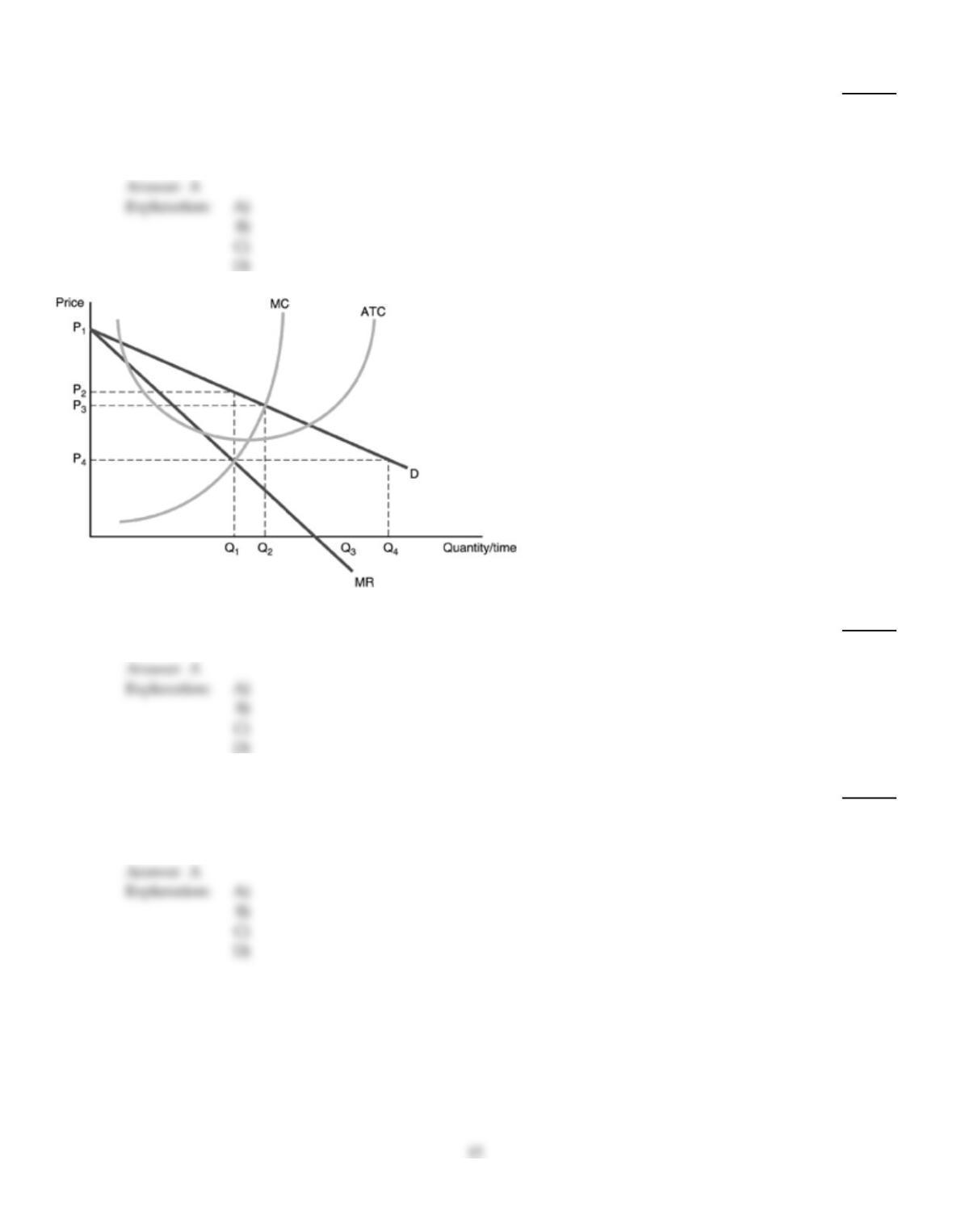
Refer to the above figure. The profit maximizing quantity for a monopolistic competitor is
57)
A)
Q1.
B)
Q2.
C)
Q3.
D)
Q4.
A
58)
Advertising that is intended to alter a consumer’s tastes and preferences and induce the customer to
purchase a particular product is
58)
A)
persuasive advertising.
B)
effective advertising.
C)
informational advertising.
D)
educational advertising.
A
A
59)
In the long run, firms in a monopolistically competitive market
59)
A)
always earn monopoly profits.
B)
usually earn positive economic profits.
C)
earn zero economic profits.
D)
usually earn economic losses.
60)
In the long run in a monopolistically competitive market, a firm will, in theory,
60)
A)
earn economic profits.
B)
break even.
C)
earn zero accounting profits.
D)
suffer losses.
61)
For a monopolistically competitive market, the number of firms in the market implies that
61)
A)
firms will collude to set monopoly price and output.
B)
all firms will make losses.
C)
each firm faces a perfectly elastic demand.
D)
each firm acts independently of other firms.
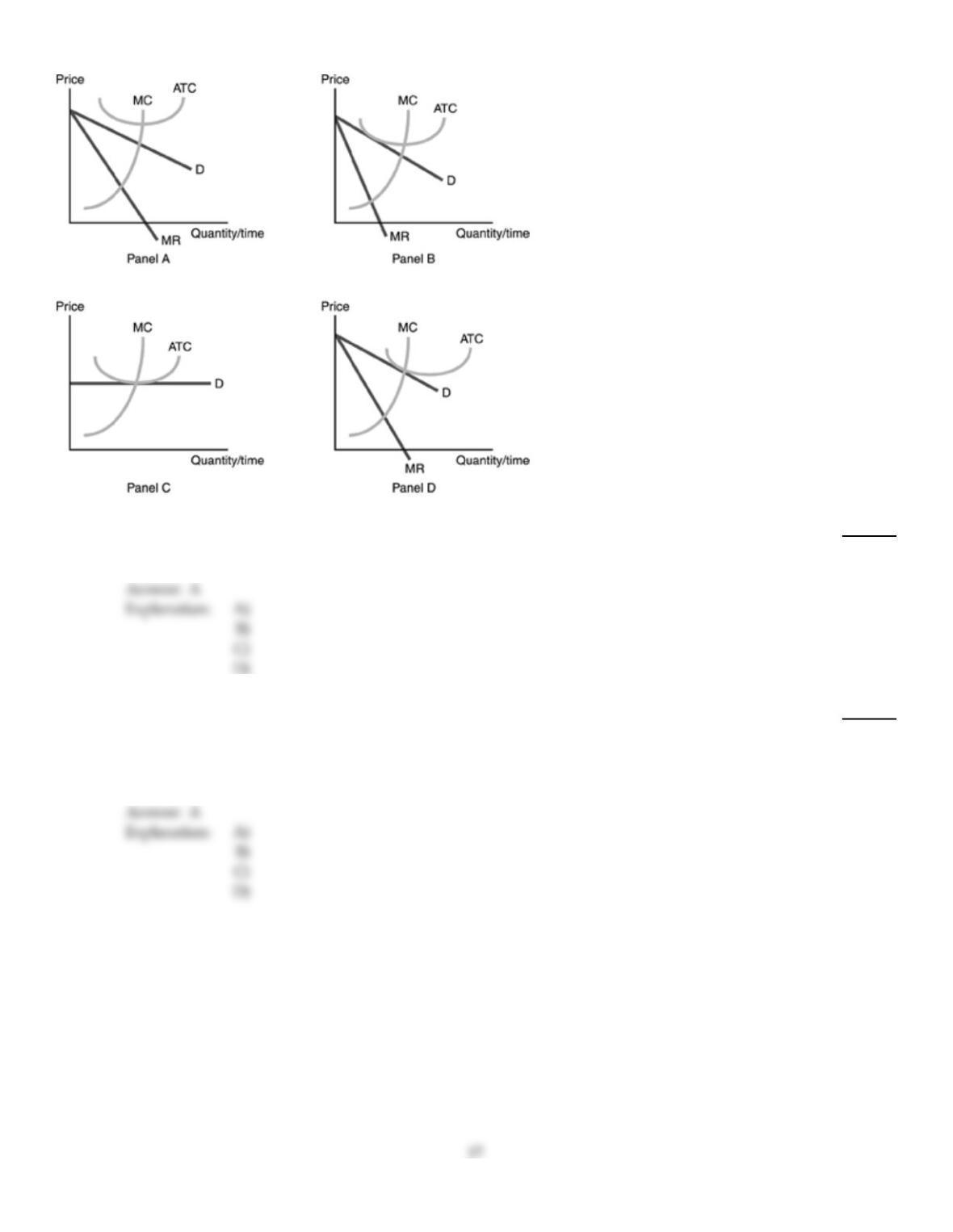
62)
Refer to the above figure. Which panel shows a possible short–run equilibrium for monopolistic
competition, but is not also a long–run equilibrium?
62)
A)
Panel A.
B)
Panel B.
C)
Panel C.
D)
Panel D.
63)
Persuasive advertising is used to
63)
A)
induce a consumer to try a product and discover a previously unknown taste for it.
B)
cut costs.
C)
sell to an established clientele.
D)
promote only used goods.