College Physics: A Strategic Approach, 3e (Knight)
Chapter 25 EM Induction and EM Waves
25.1 Conceptual Questions
1) An object having a fixed emissivity of 0.725 radiates heat at a rate of 10 W when it is at an
absolute temperature T. If its temperature is doubled to 2T, at what rate will it now radiate?
A) 20 W
B) 40 W
C) 80 W
D) 160 W
E) 320 W
2) If the absolute temperature of an object is tripled, the thermal power radiated by this object
(assuming that its emissivity and size are not affected by the temperature change) will
A) increase by a factor of 3.
B) increase by a factor of 9.
C) increase by a factor of 18.
D) increase by a factor of 27.
E) increase by a factor of 81.
3) By what primary heat transfer mechanism does the sun warm the earth?
A) convection
B) conduction
C) radiation
D) All of the above processes are equally important in combination.
4) A flat coil is in a uniform magnetic field. The magnetic flux through the coil is greatest when
the plane of its area is
A) parallel to the magnetic field.
B) at 45° with the magnetic field.
C) perpendicular to the magnetic field.
5) According to Faraday’s law, a coil in a strong magnetic field must have a greater induced emf
in it than a coil in a weak magnetic field.
A) True
B) False
6) At a certain instant, coil A is in a 10-T external magnetic field and coil B is in a 1-T external
magnetic field. Both coils have the same area and are oriented at right angles to the field. Which
coil will have a greater emf induced in it?
A) coil A
B) coil B
C) It is impossible to know without more information about the fields.
7) A coil of wire containing N turns is in an external magnetic field that is perpendicular to the
plane of the coil and it steadily changing. Under these circumstances, an emf ε is induced in the
coil. If the rate of change of the magnetic field and the number of turns in the coil are now
doubled (but nothing else changes), what will be the induced emf in the coil?
A) 2ε
B) ε/2
C) 4ε
D) ε/4
E) ε
8) According to Lenz’s law, the induced current in a circuit always flows to oppose the external
magnetic flux through the circuit.
A) True
B) False
9) According to Lenz’s law, the induced current in a circuit always flows to oppose the external
magnetic field through the circuit.
A) True
B) False
10) A coil lies flat on a tabletop in a region where the magnetic field vector points straight up.
The magnetic field vanishes suddenly. When viewed from above, what is the sense of the
induced current in this coil as the field fades?
A) The induced current flows counterclockwise.
B) The induced current flows clockwise.
C) There is no induced current in this coil.
D) The current flows clockwise initially, and then it flows counterclockwise before stopping.
11) A coil lies flat on a level tabletop in a region where the magnetic field vector points straight
up. The magnetic field suddenly grows stronger. When viewed from above, what is the
direction of the induced current in this coil as the field increases?
A) counterclockwise
B) clockwise
C) clockwise initially, then counterclockwise before stopping
D) There is no induced current in this coil.
12) A coil lies flat on a horizontal tabletop in a region where the magnetic field points straight
down. The magnetic field disappears suddenly. When viewed from above, what is the direction
of the induced current in this coil as the field disappears?
A) counterclockwise
B) clockwise
C) clockwise initially, then counterclockwise before stopping
D) There is no induced current in this coil.
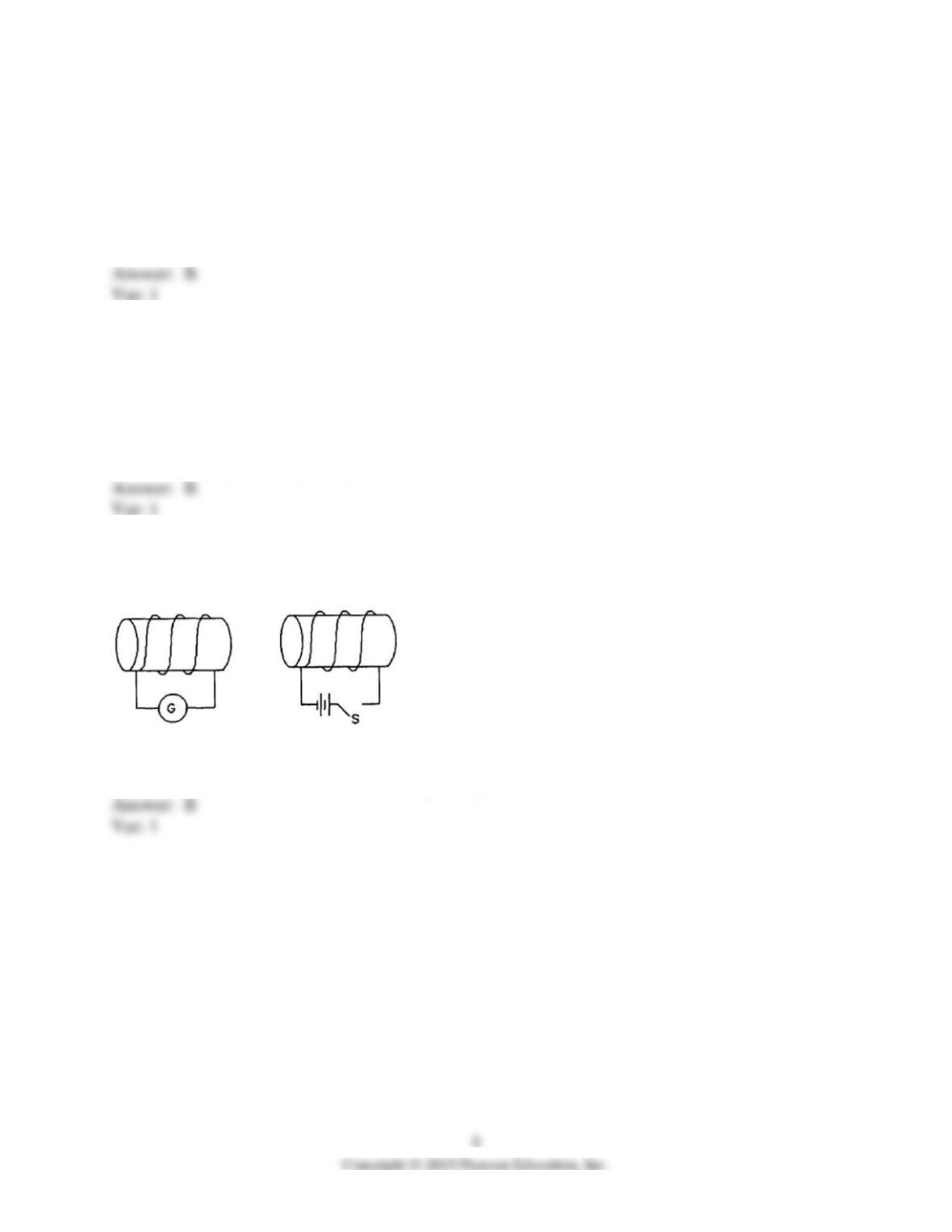
13) Two solenoids are close to each other, as shown in the figure, with the switch S open. When
the switch is suddenly closed, which way will the induced current flow through the galvanometer
in the left-hand solenoid?
A) from left to right
B) from right to left
C) There will be no induced current through the galvanometer.
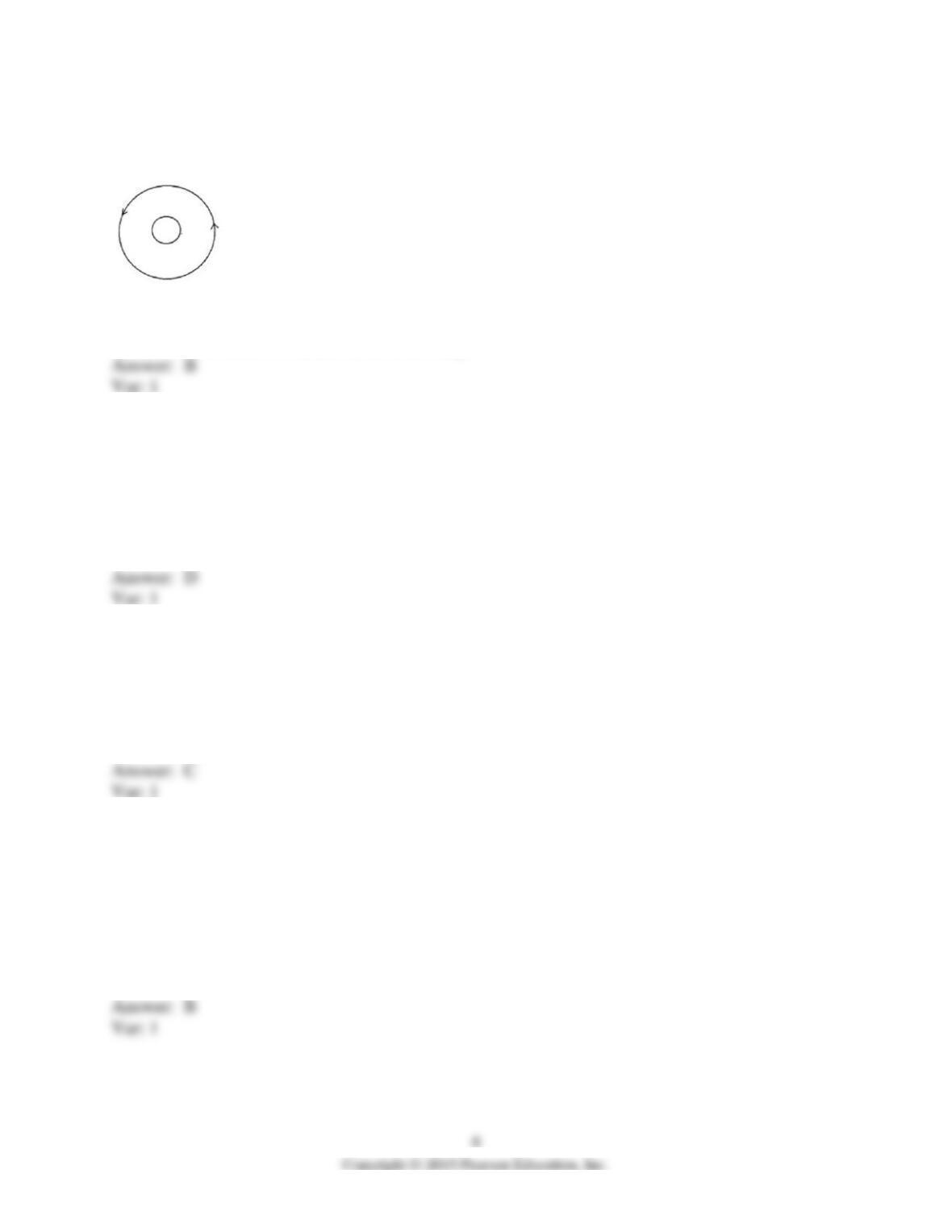
14) An outer metal ring surrounds an inner metal ring, as shown in the figure. The current in the
outer ring is counterclockwise and decreasing. What is the direction of the induced current in the
inner ring?
A) clockwise
B) counterclockwise
C) There is no induced current in the inner ring.
15) A long straight wire lies on a horizontal table and carries an ever-increasing current toward
the north. Two coils of wire lie flat on the table, one on either side of the wire. When viewed
from above, the direction of the induced current in these coils is
A) clockwise in both coils.
B) counterclockwise in both coils.
C) clockwise in the east coil and counterclockwise in the west coil.
D) counterclockwise in the east coil and clockwise in the west coil.
16) A circular coil lies flat on a horizontal surface. A bar magnet is held fixed above the center of
the coil with its north pole pointing downward. What is the direction of the induced current in the
coil, as viewed from above?
A) clockwise
B) counterclockwise
C) There is no current in the coil.
17) A circular coil of copper wire is lying flat on a horizontal table. A bar magnet is held above
the center of the coil with its south pole downward. The magnet is released from rest and falls
toward the coil. As viewed from above, what is the direction of the current induced in the coil as
the magnet approaches the coil?
A) counterclockwise
B) clockwise
C) No current is induced in the coil.
D) An emf but no current is induced in the coil.
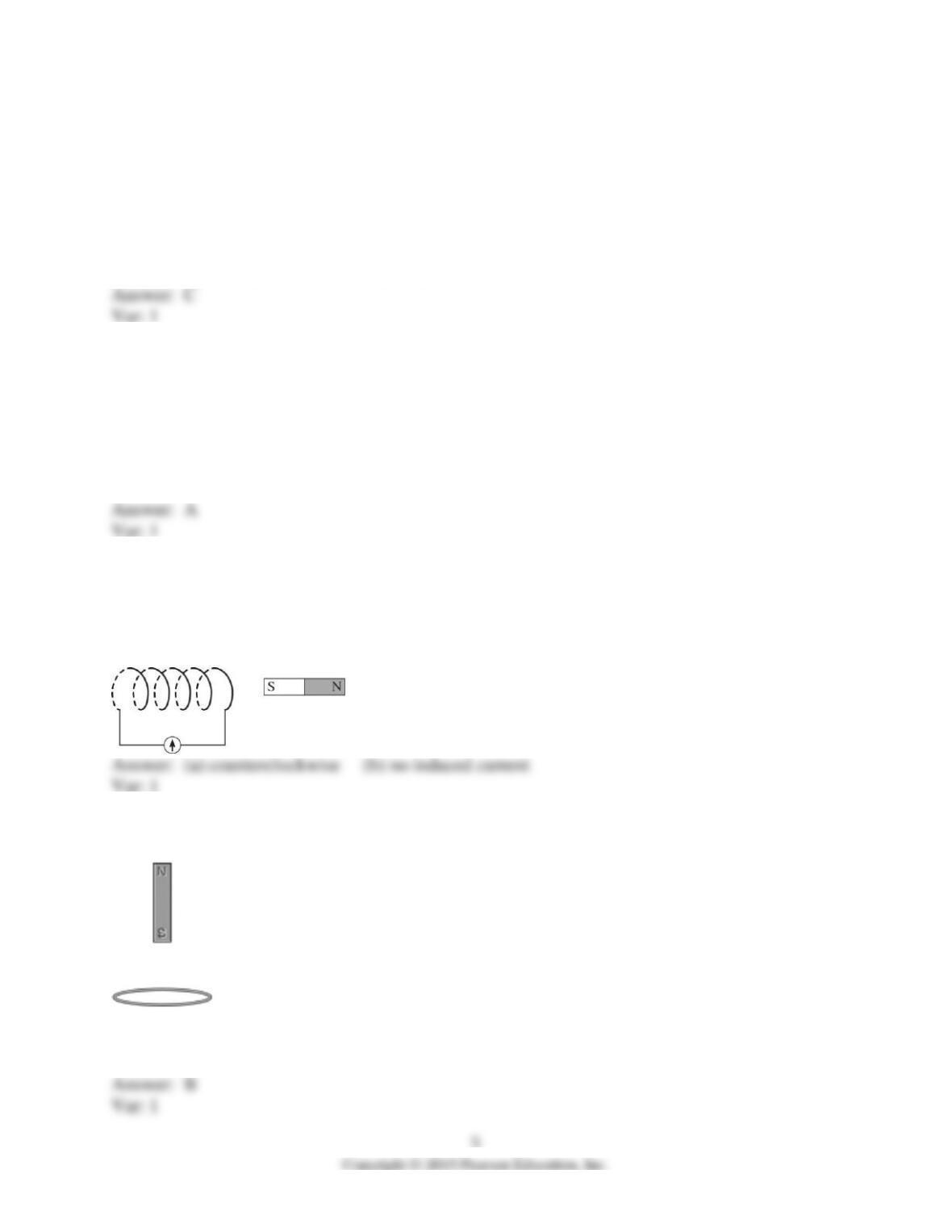
18) A circular coil of copper wire is lying flat on a horizontal table. A bar magnet is held above
the center of the coil with its south pole downward. The magnet and the coil are now both raised
upward with the same velocities. As viewed from above, what is the direction of the current
induced in the coil as the magnet approaches the coil?
A) counterclockwise
B) clockwise
C) No current is induced in the coil.
D) An emf but no current is induced in the coil.
19) A circular coil lies flat on a horizontal surface. A bar magnet is held above the center of the
coil with its north pole pointing down. If the magnet is dropped from this position what is the
direction of the induced current in the coil, as viewed from above?
A) counterclockwise
B) clockwise
C) An emf but no current is induced in the coil.
D) There is no current in the coil.
20) A bar magnet is close to a solenoid, as shown in the figure. As viewed through the solenoid
looking toward the magnet, what is the direction (clockwise or counterclockwise) of the current
(if any) induced in the solenoid in each case?
(a) The magnet is pushed toward the solenoid.
(b) The magnet and solenoid both move to the right at 25 cm/s.
21) A bar magnet is oriented above a copper ring, as shown in the figure. If the magnet is pulled
upward, what is the direction of the current induced in the ring, as viewed from above?
A) There is no current in the ring.
B) counterclockwise
C) clockwise
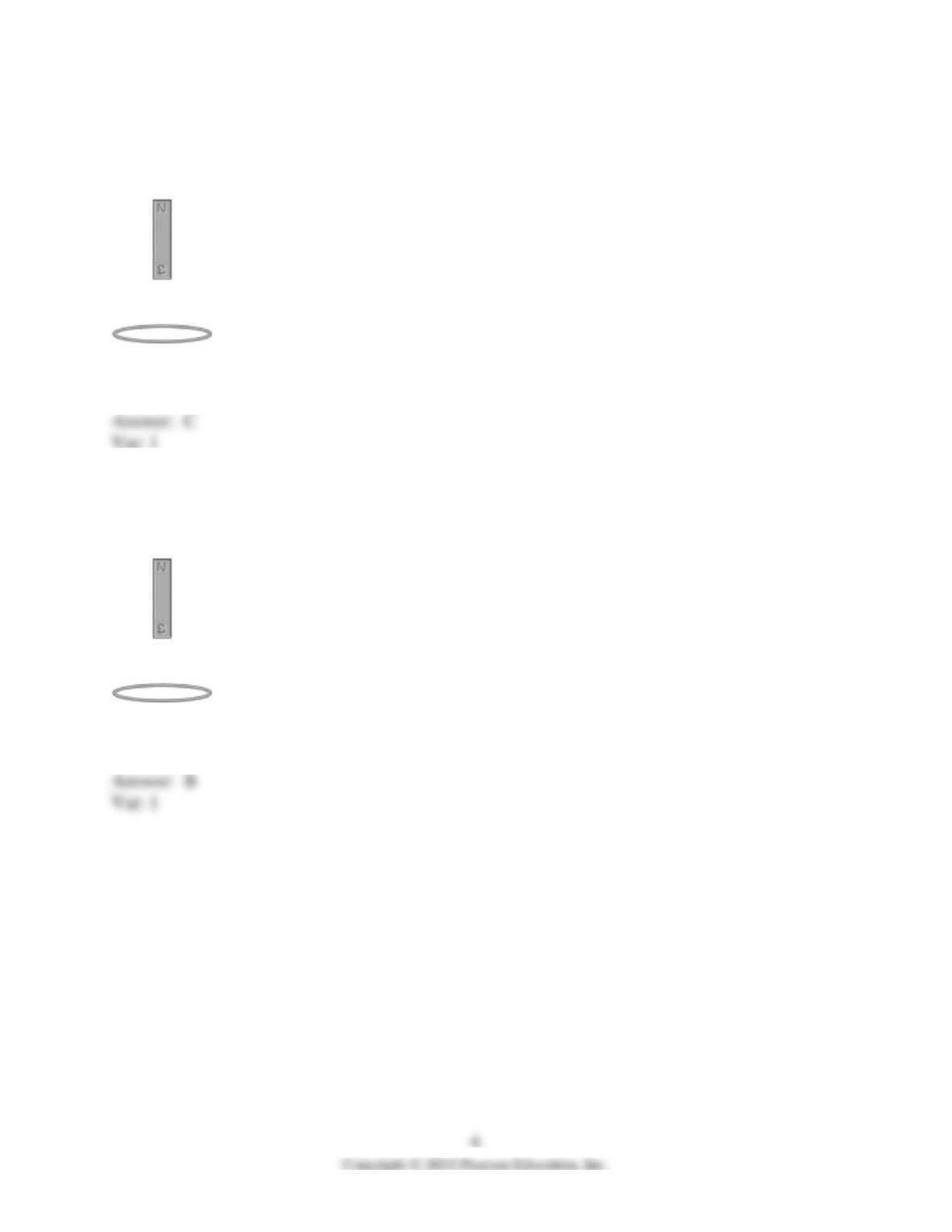
22) A bar magnet is oriented above a copper ring, as shown in the figure. If the magnet is kept
fixed while the ring is dropped, what is the direction of the current induced in the ring, as viewed
from below the ring?
A) There is no current in the ring.
B) counterclockwise
C) clockwise
23) A bar magnet is oriented above a copper ring, as shown in the figure. The magnet is dropped
and passes completely through the ring. As viewed from above, what is the direction of the
current induced in the ring after the magnet has completely passed through the ring and is
somewhat below it?
A) There is no current in the ring.
B) counterclockwise
C) clockwise
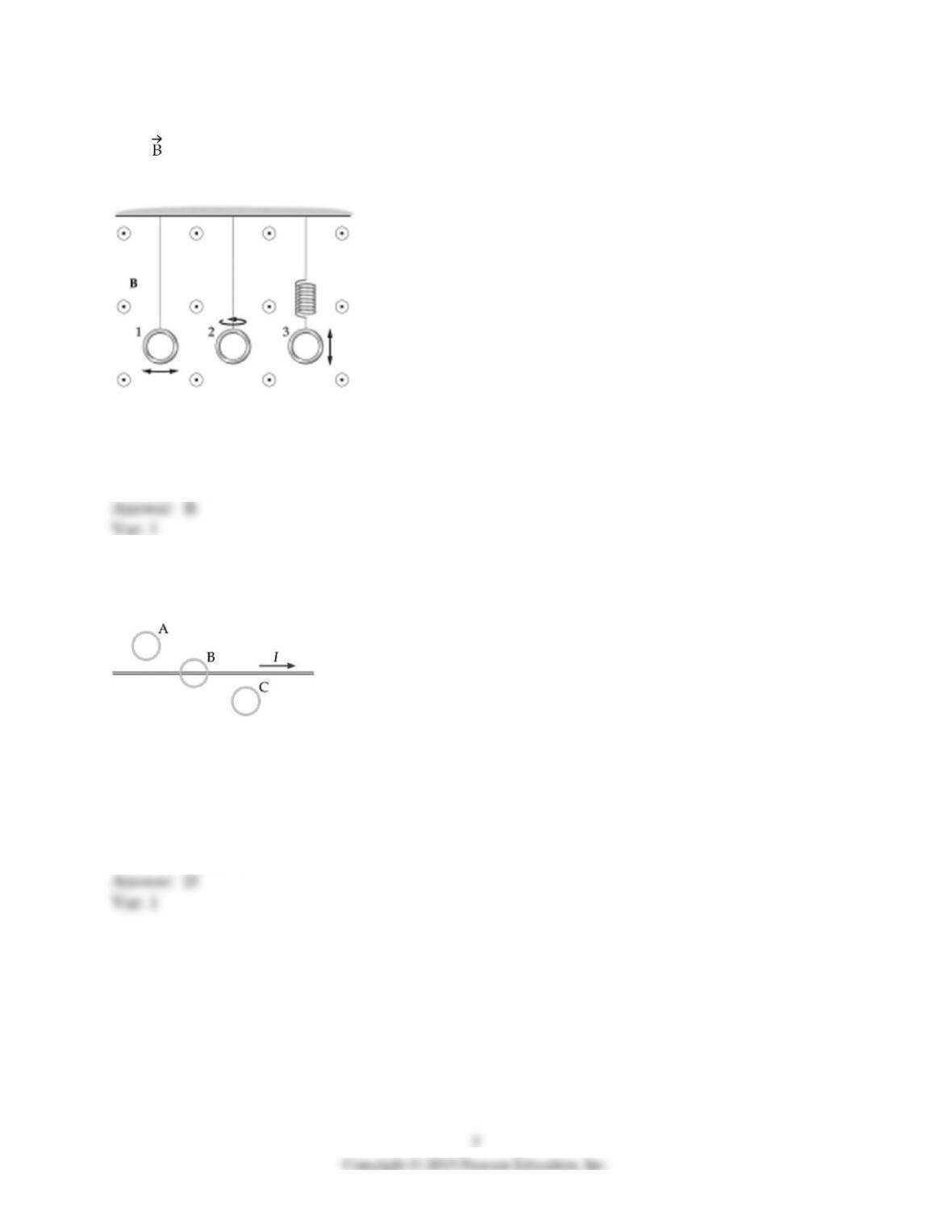
24) The three loops of wire shown in the figure are all hanging in the same uniform magnetic
field that is perpendicular to the page and does not vary with time. Loop 1 swings back and
forth like the bob in a pendulum, Loop 2 rotates about a vertical axis, and Loop 3 oscillates up
and down at the end of a spring. Which loop (or loops) will have an emf induced in them?
A) Loop 1
B) Loop 2
C) Loop 3
D) Loops 1 and 3
E) Loops 2 and 3
25) The wire in the figure carries a current I that is increasing with time at a constant rate. The
wire and the three loops are all in the same plane. What is true about the currents induced in each
of the three loops shown?
A) No current is induced in any loop.
B) The currents are counterclockwise in all three loops.
C) The currents are clockwise in all three loops.
D) Loop A has clockwise current, loop B has no induced current, and loop C has
counterclockwise current.
E) Loop A has counterclockwise current, loop B has no induced current, and loop C has
clockwise current.
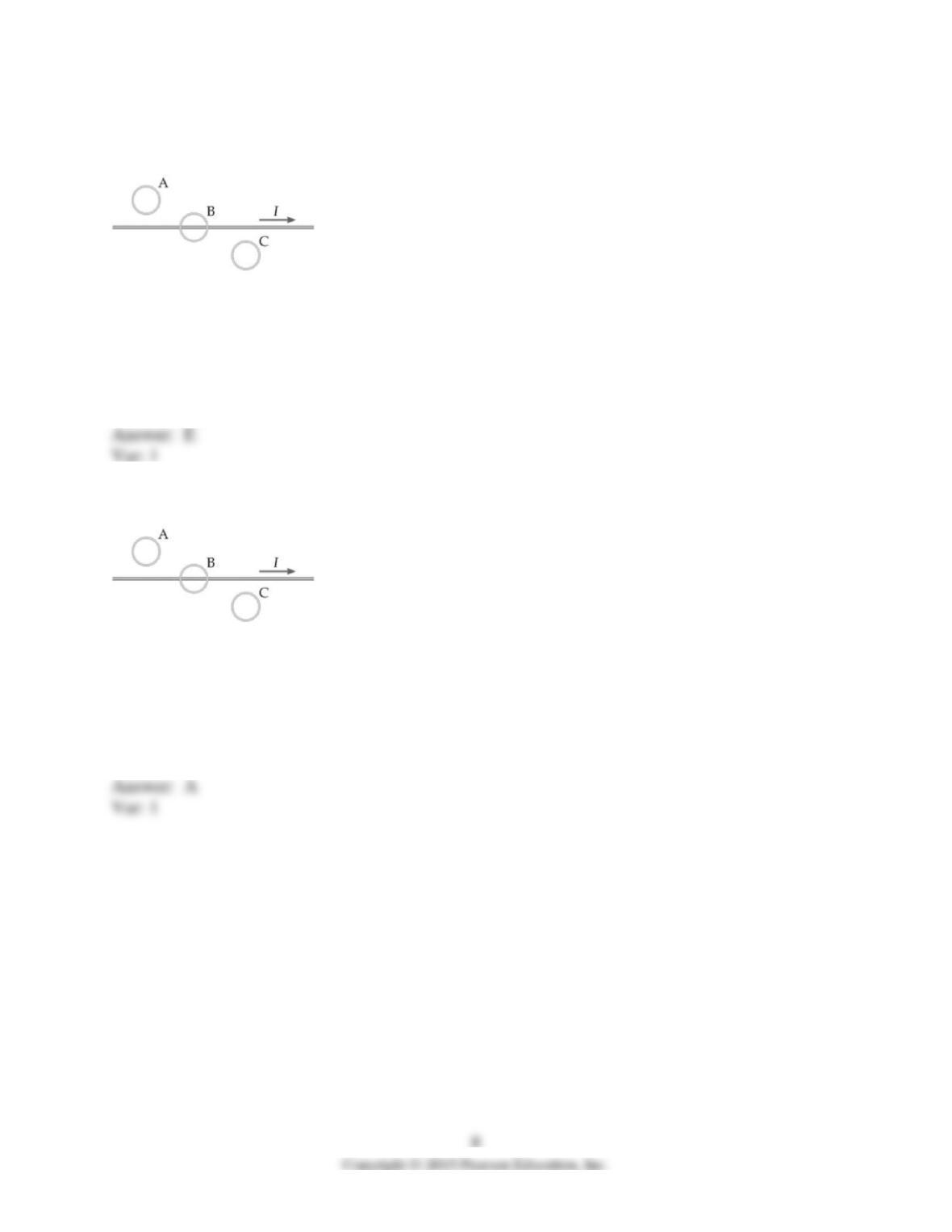
26) The wire in the figure carries a current I that is decreasing with time at a constant rate. The
wire and the three loops are all in the same plane. What is true about the currents induced in each
of the three loops shown?
A) No current is induced in any loop.
B) The currents are counterclockwise in all three loops.
C) The currents are clockwise in all three loops.
D) Loop A has clockwise current, loop B has no induced current, and loop C has
counterclockwise current.
E) Loop A has counterclockwise current, loop B has no induced current, and loop C has
clockwise current.
27) The wire in the figure carries a steady current I. What is true about the currents induced in
each of the three loops shown? The wire and the three loops are all in the same plane.
A) No current is induced in any loop.
B) The currents are counterclockwise in all three loops.
C) The currents are clockwise in all three loops.
D) Loop A has clockwise current, loop B has no induced current, and loop C has
counterclockwise current.
E) Loop A has counterclockwise current, loop B has no induced current, and loop C has
clockwise current.
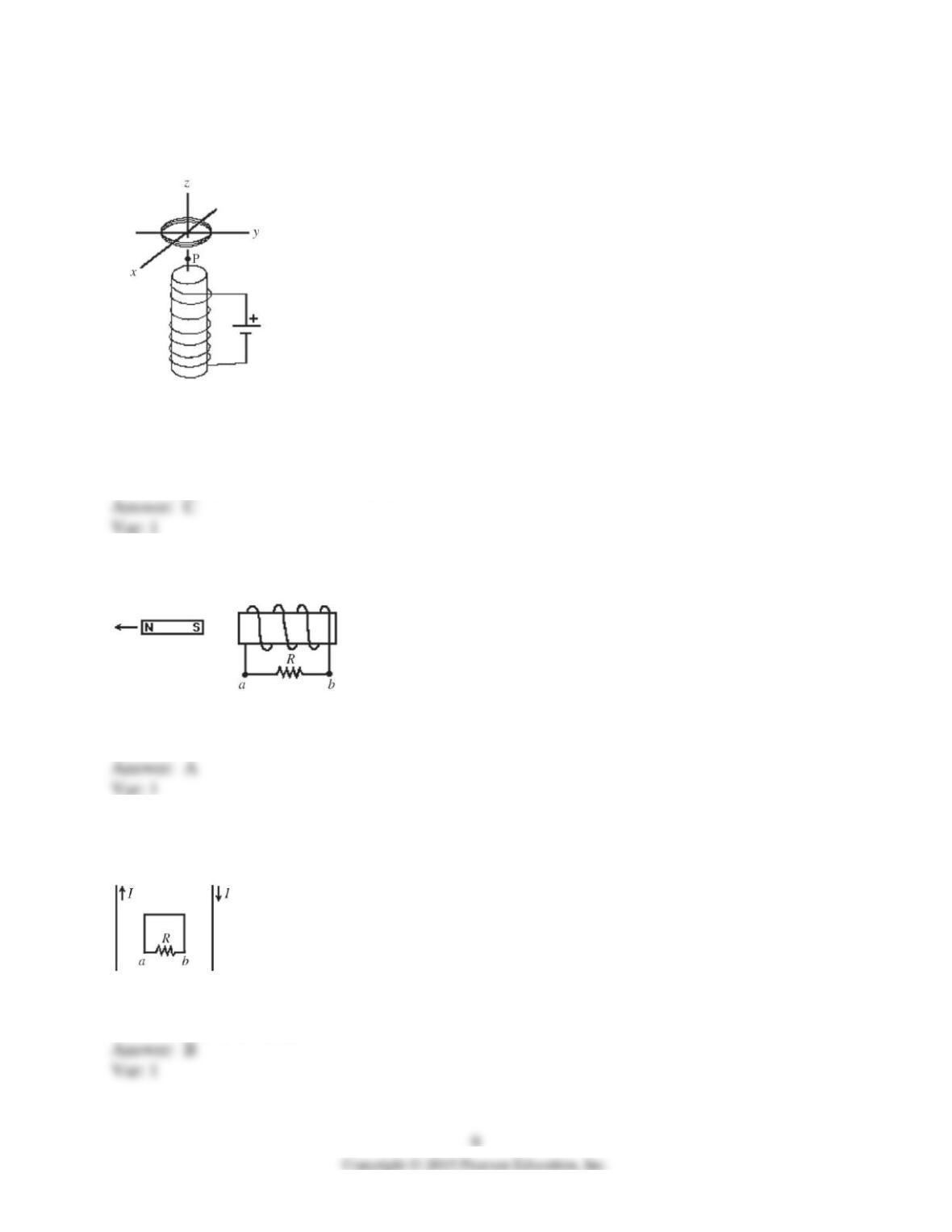
28) As shown in the figure, a coil of wire is placed in the xy-plane, centered on the z-axis. A
solenoid is centered on the z-axis and is carrying a steady dc current. Which one of the following
actions will not result induce an emf in the coil?
A) Rotate the coil about the x-axis.
B) Rotate the coil about the y-axis.
C) Rotate the coil about the z-axis.
D) Move the coil toward point P.
E) Change the current in the solenoid.
29) In the figure, a bar magnet moves away from the solenoid. The direction of the induced
current through the resistor R is
A) from a to b.
B) from b to a.
C) No current is induced.
30) As shown in the figure, two parallel wires carry a current I in opposite directions, and this
current is decreasing. A rectangular loop is centered between the wires. The direction of the
induced current through the resistor R is
A) from a to b.
B) from b to a.
C) No current is induced.
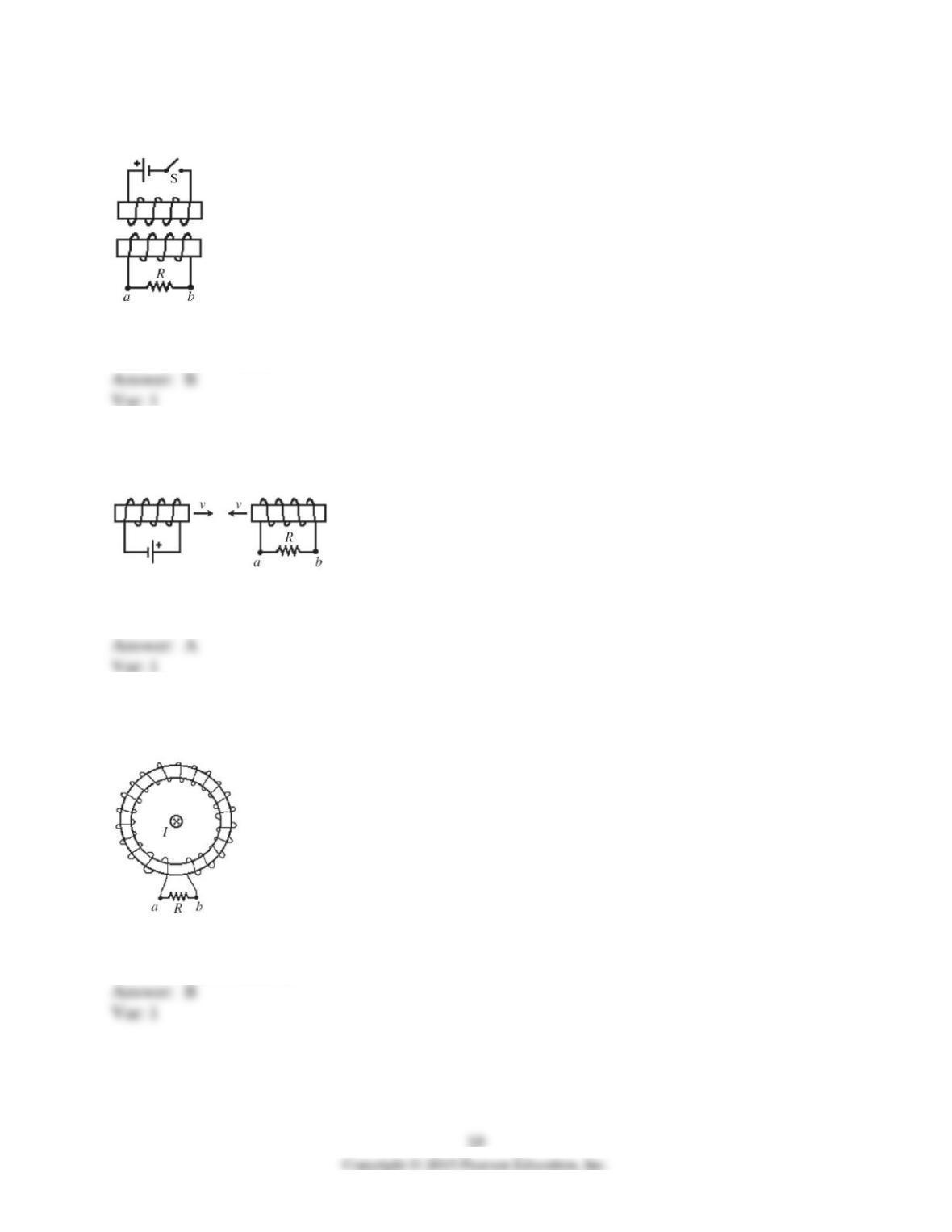
31) As shown in the figure, two solenoids are side by side. The switch S is initially open. When
S is suddenly closed, the direction of the induced current through the resistor R is
A) from a to b.
B) from b to a.
C) No current is induced.
32) As shown in the figure, a battery supplies a steady current to the solenoid on the left. The
two solenoids are moving toward each other with speeds v. The direction of the induced current
through the resistor R is
A) from a to b.
B) from b to a.
C) No current is induced.
33) As shown in the figure, a straight wire carries a current I into the page. The wire passes
through the center of a toroidal coil. If the current I is quickly reduced to zero, the direction of
the induced current through the resistor R is
A) from a to b.
B) from b to a.
C) No current is induced.
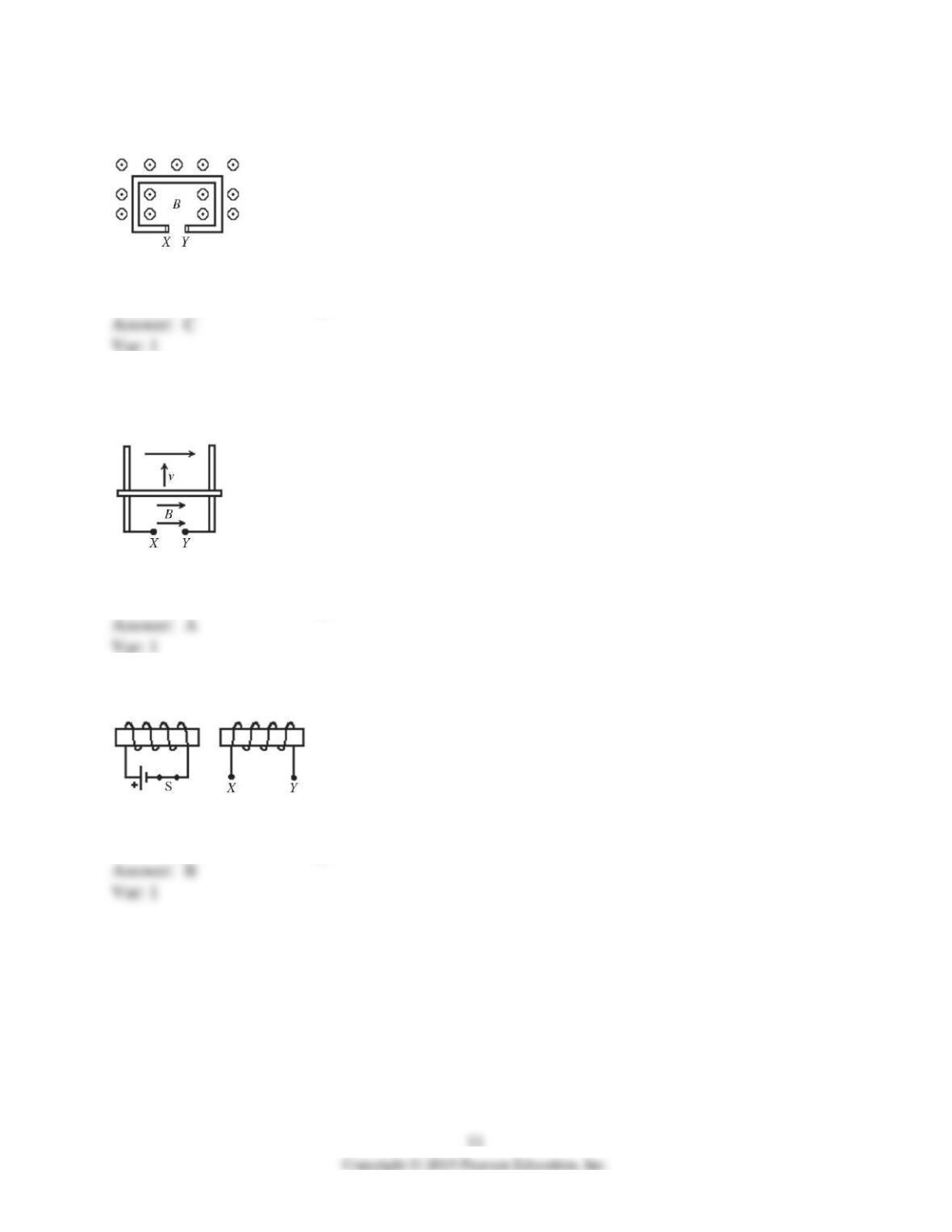
34) As shown in the figure, a C-shaped conductor is in a uniform magnetic field B out of the
page, and this field is increasing. What is the polarity of the induced emf in terminals X and Y?
A) X and Y are at the same potential.
B) X is positive and Y is negative.
C) Y is positive and X is negative.
35) As shown in the figure, a metal bar is in contact with a pair of parallel rails. A steady,
uniform, magnetic field B is present directed to the right. The bar is moving upward with
velocity of magnitude ν. What is the polarity of the induced emf in terminals X and Y?
A) X and Y are at the same potential.
B) X is positive and Y is negative.
C) Y is positive and X is negative.
36) As shown in the figure, two solenoids are in line. The switch S, initially closed, is suddenly
opened. Just after opening S, what is the polarity of the induced emf in terminals X and Y?
A) X and Y are at the same potential.
B) X is positive and Y is negative.
C) Y is positive and X is negative.
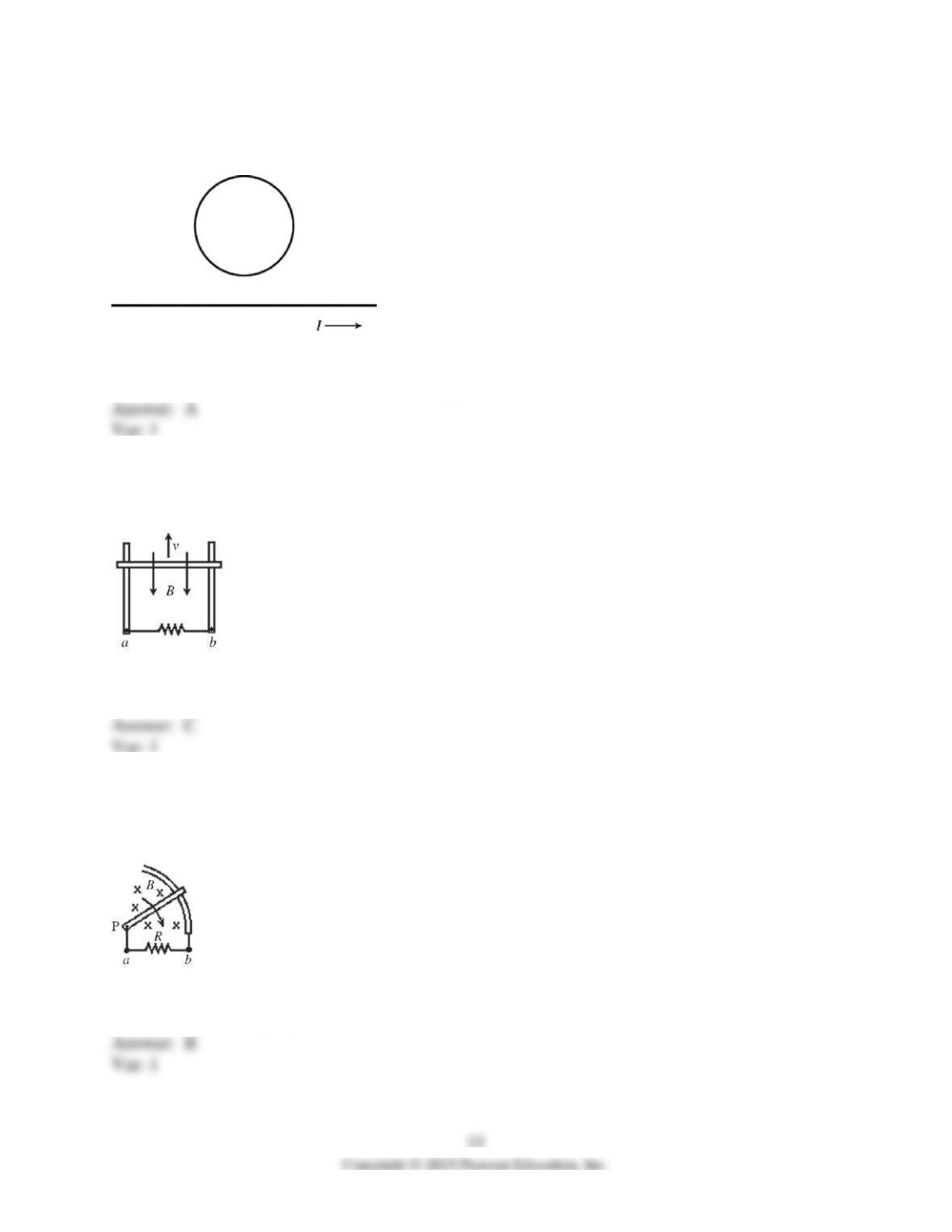
37) A circular wire ring is situated above a long straight wire, as shown in the figure. The
straight wire has a current I flowing to the right, and this current is increasing at a constant rate.
Which of the following statements is true?
A) There is an induced current in the wire ring, directed in clockwise orientation.
B) There is an induced current in the wire ring, directed in a counterclockwise orientation.
C) There is no induced current in the wire ring.
38) As shown in the figure, a metal bar is in contact with a pair of parallel rails and is in motion
with an upward velocity of magnitude ν. A uniform magnetic field is present, directed downward
as shown. The direction of the induced current through the resistor R is
A) from a to b.
B) from b to a.
C) No current is induced.
39) As shown in the figure, one end of a metal bar is in contact with a circular rail and the other
end is pivoted at P. A steady uniform, magnetic field B into the page is present. As the bar rotates
about point P in a clockwise direction, the direction of the induced current through the resistor R
is
A) from a to b.
B) from b to a.
C) No current is induced.
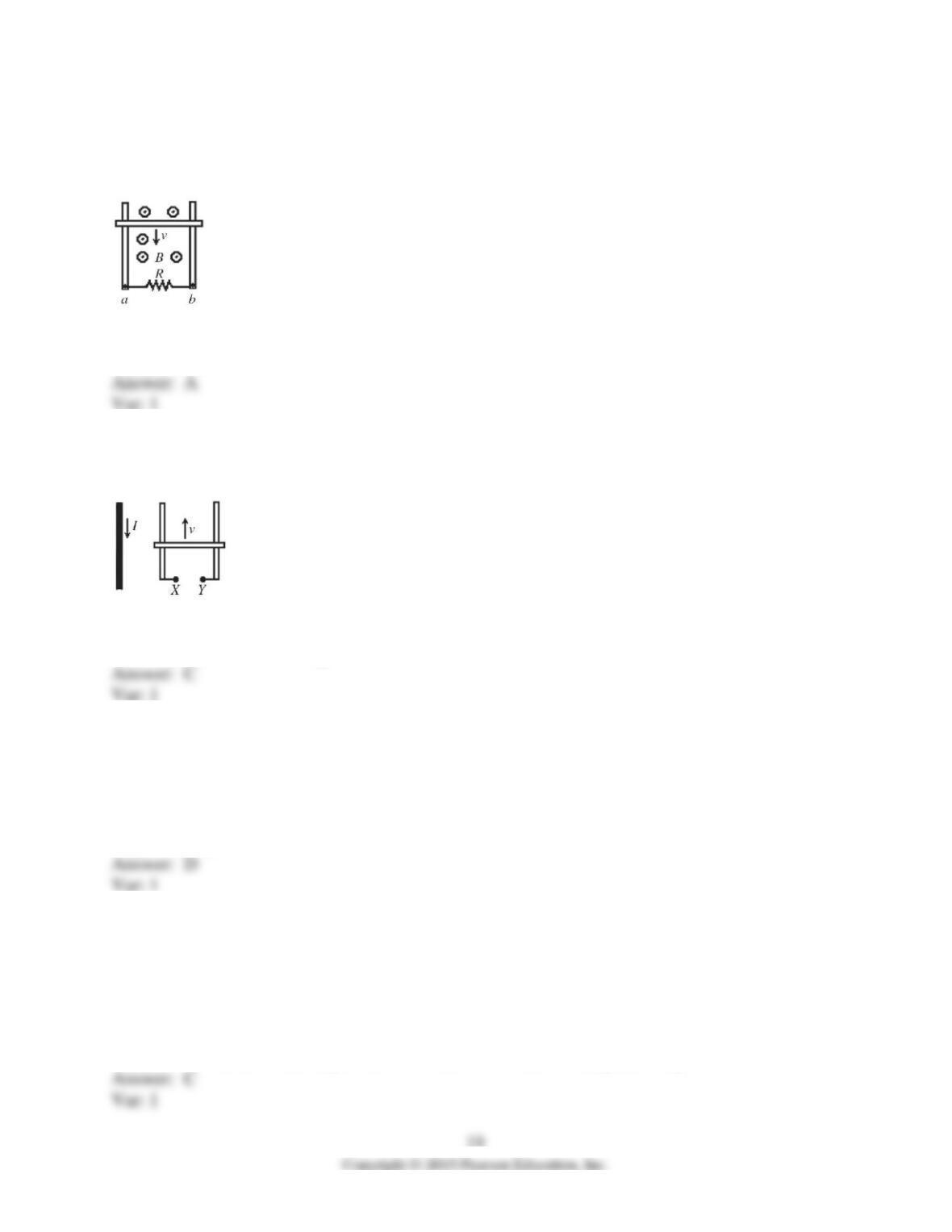
40) As shown in the figure, a metal bar is in contact with a pair of metal parallel rails. A steady
uniform magnetic field B, perpendicular to the plane of the rails and pointing outward from the
page, is present. The bar is in downward motion with velocity of magnitude ν. The direction of
the induced current through the resistor R is
A) from a to b.
B) from b to a.
C) No current is induced.
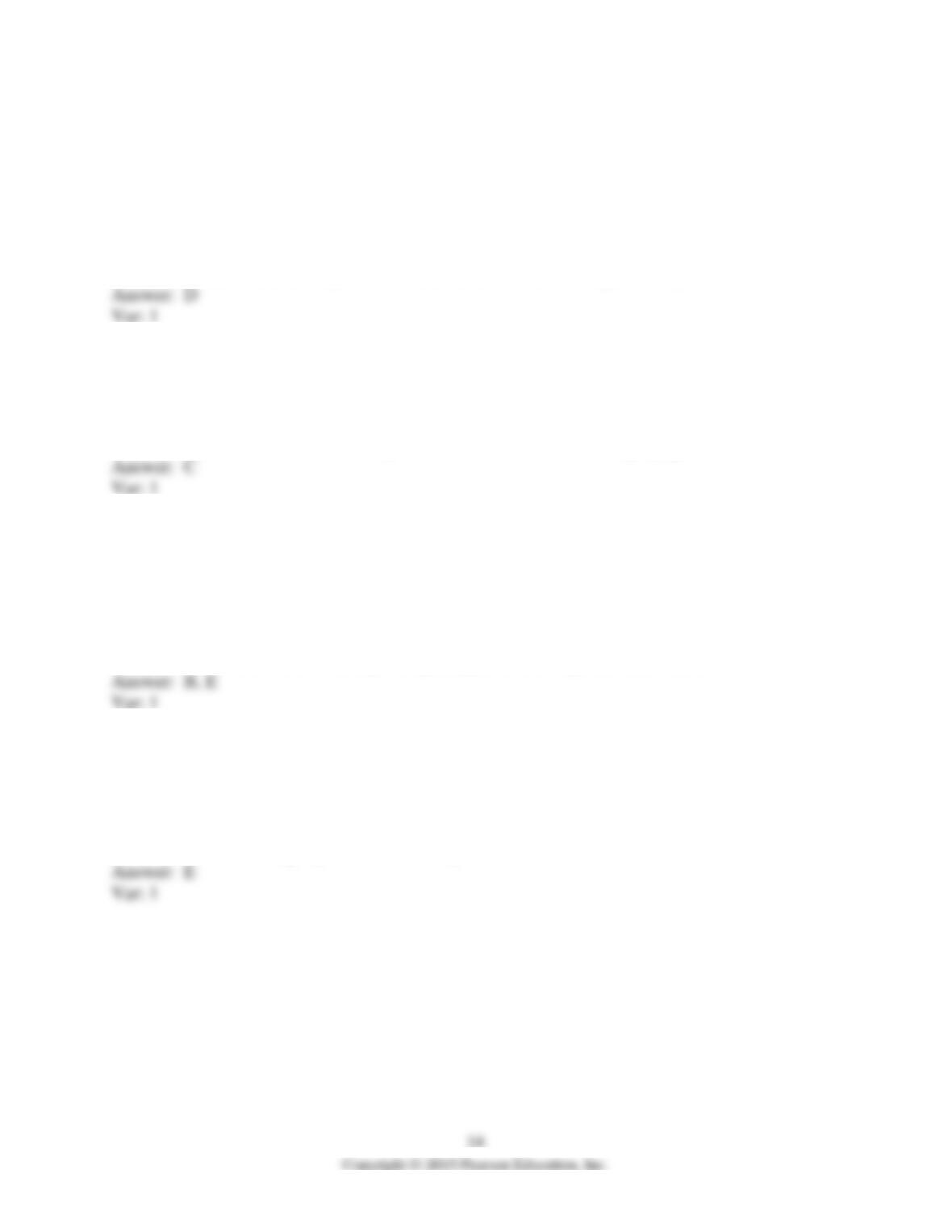
41) As shown in the figure, a straight wire carries a steady current I. A metal bar is in contact
with a pair of rails and is in upward motion with velocity of magnitude ν. The polarity of the
induced emf in terminals X and Y is
A) X and Y are at the same potential.
B) X is positive and Y is negative.
C) Y is positive and X is negative.
42) Which one of the following is not an electromagnetic wave?
A) ultraviolet
B) infrared
C) radio waves
D) sound waves
E) gamma rays
43) Which one of the following lists gives the correct order of the electromagnetic spectrum
from low to high frequencies?
A) radio waves, infrared, microwaves, ultraviolet, visible, x-rays, gamma rays
B) radio waves, ultraviolet, x-rays, microwaves, infrared, visible, gamma rays
C) radio waves, microwaves, infrared, visible, ultraviolet, x-rays, gamma rays
D) radio waves, microwaves, visible, x-rays, infrared, ultraviolet, gamma rays
E) radio waves, infrared, x-rays, microwaves, ultraviolet, visible, gamma rays
44) Which one of the following lists gives the correct order of the electromagnetic waves from
longer wavelength to shorter wavelength?
A) radio waves, infrared, microwaves, ultraviolet, visible, x-rays, gamma rays
B) radio waves, ultraviolet, x-rays, microwaves, infrared, visible, gamma rays
C) radio waves, microwaves, visible, x-rays, infrared, ultraviolet, gamma rays
D) radio waves, microwaves, infrared, visible, ultraviolet, x-rays, gamma rays
E) radio waves, infrared, x-rays, microwaves, ultraviolet, visible, gamma rays
45) In an electromagnetic wave in free space, the electric and magnetic fields are
A) parallel to one another and perpendicular to the direction of wave propagation.
B) parallel to one another and parallel to the direction of wave propagation.
C) perpendicular to one another and perpendicular to the direction of wave propagation.
D) perpendicular to one another and parallel to the direction of wave propagation.
46) Which of the following statements about electromagnetic waves in free space are true?
(There could be more than one correct choice.)
A) The higher-frequency travel faster than the lower-frequency waves.
B) The higher-frequency waves have shorter wavelengths than the lower-frequency waves.
C) The wavelengths of the visible waves are some of the longest electromagnetic waves.
D) The wavelengths of the visible waves are some of the shortest electromagnetic waves.
E) The electric field vector is always at right angles to the magnetic field vector.
47) Which one of the following types of electromagnetic wave travels through space the fastest?
A) radio waves
B) infrared
C) ultraviolet
D) microwaves
E) They all travel through space at the same speed.
15
48) At a certain instant in time, the electric field of an electromagnetic wave in free space points
in the –z direction, and the magnetic field points in the +y direction. In what direction is this wave
traveling?
A) +x direction
B) –x direction
C) +y direction
D) –z direction
E) +z direction
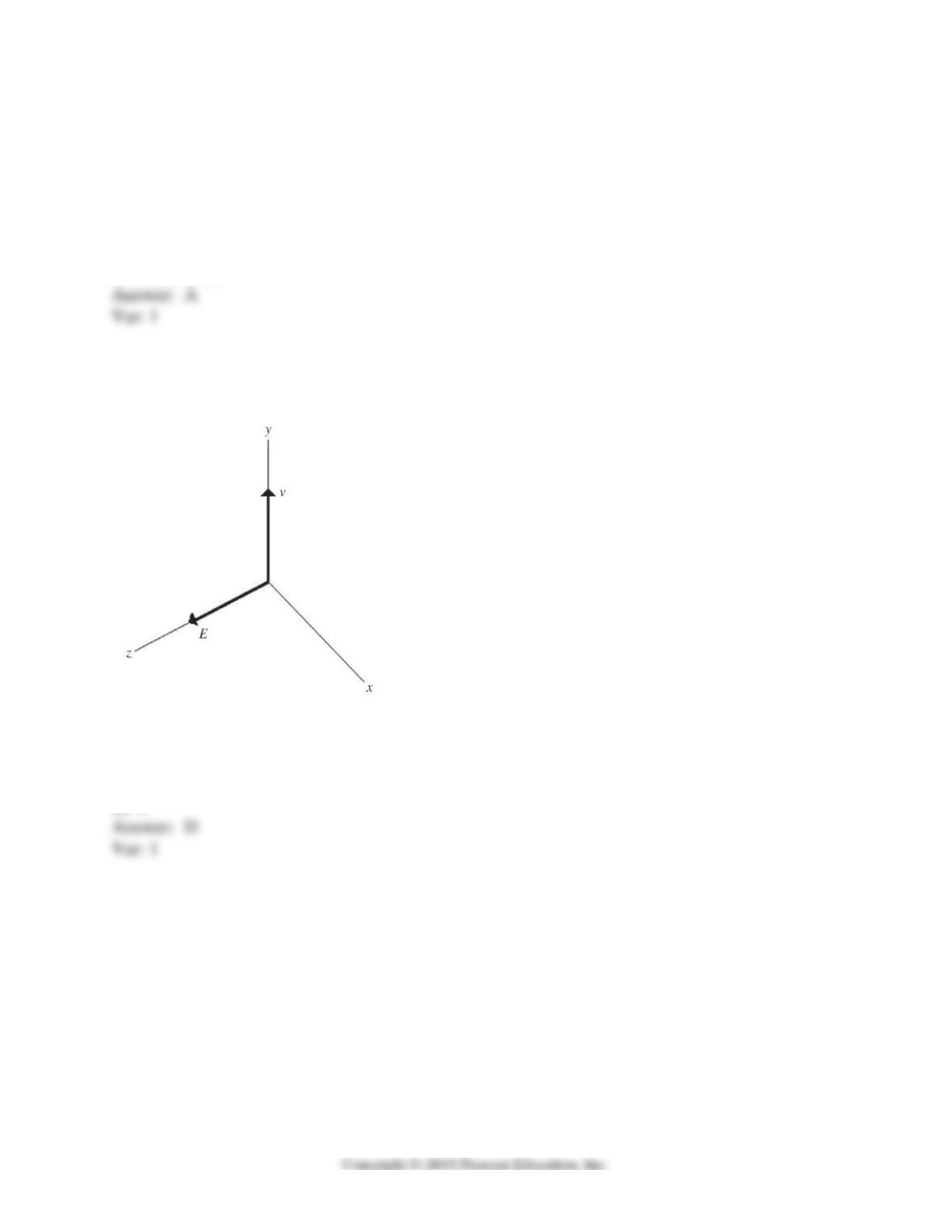
49) An electromagnetic wave travels in free space in the +y direction, as shown in the figure. If
the electric field at the origin is along the +z direction, what is the direction of the magnetic
field?
A) +z
B) –z
C) +y
D) +x
E) –x
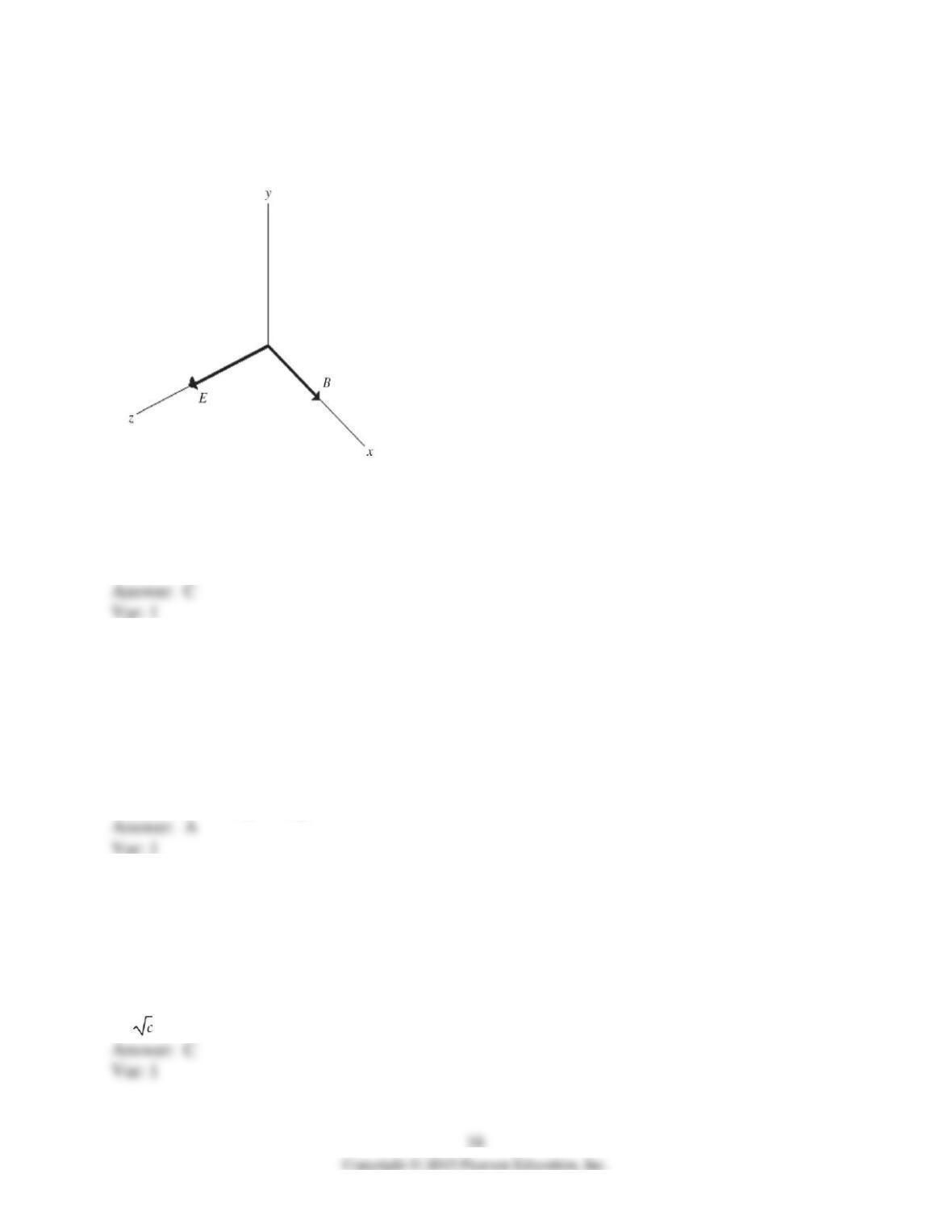
50) For a certain electromagnetic wave in free space, at one instant the electric field vector points
in the +z direction while the magnetic field vector points in the +x direction, as shown in the
figure. In what direction is this wave traveling?
A) +x
B) –x
C) +y
D) –y
E) +z
51) An electromagnetic wave is propagating towards the west in free space. At a certain moment
the direction of the magnetic field vector associated with this wave points vertically upward.
What is the direction of the electric field vector?
A) horizontal and pointing south
B) vertical and pointing down
C) horizontal and pointing north
D) vertical and pointing upward
E) horizontal and pointing east
52) For an electromagnetic wave in free space having an electric field of amplitude E and a
magnetic field of amplitude B, the ratio of B/E is equal to
A) c
B) c2
C) 1/c
D) 1/c2
E)
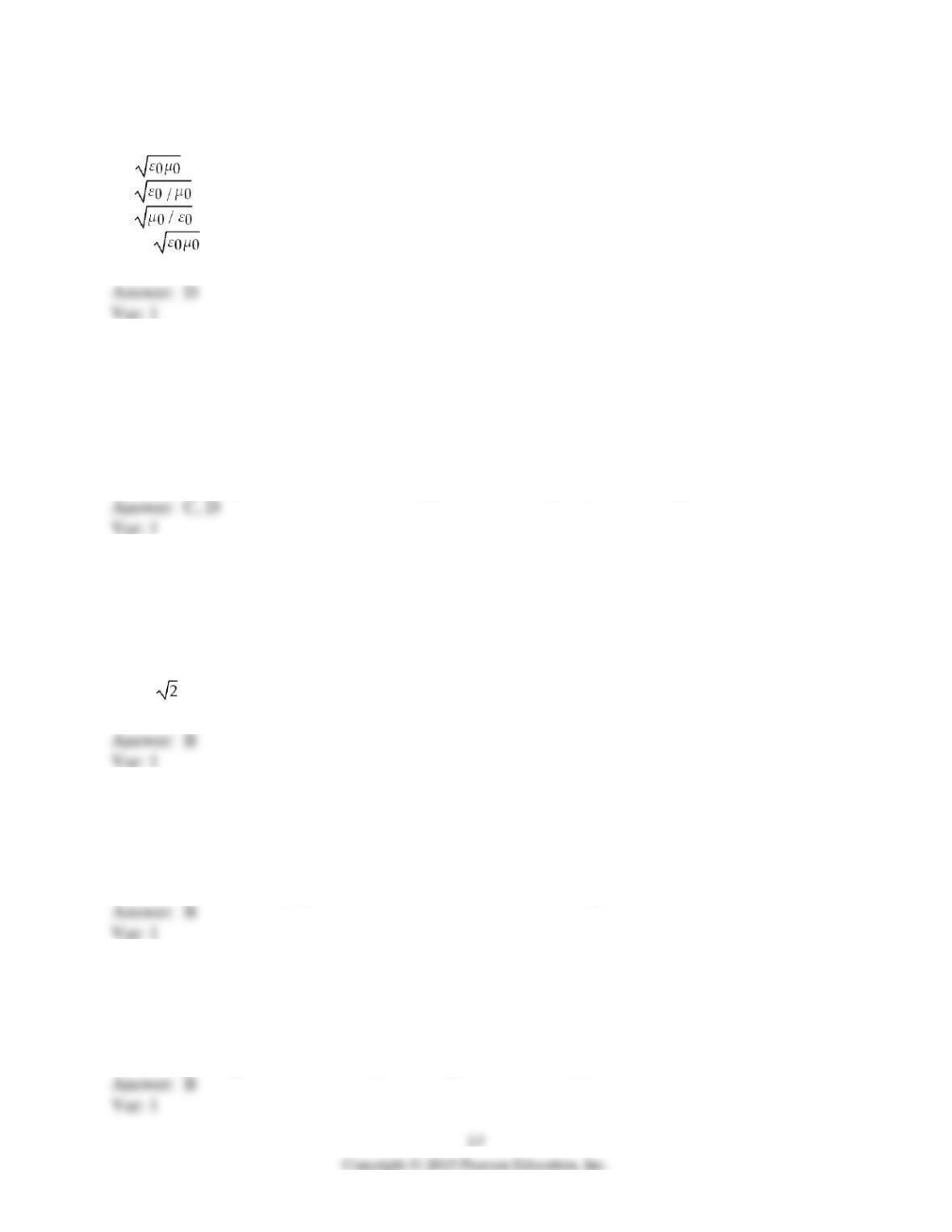
53) Which one of the following expressions is the correct representation for the speed of light in
vacuum?
A)
B)
C)
D) 1 /
E) 1 / ε0μ0
54) Which of the following statements about electromagnetic waves in free space are true?
(There could be more than one correct choice.)
A) The electric field carries more energy than the magnetic field.
B) The electric and magnetic fields have equal amplitudes.
C) The electric field carries the same mount of energy as the magnetic field.
D) The frequency of the magnetic field is the same as the frequency of the electric field.
E) The frequency of the electric field is higher than the frequency of the magnetic field.
55) If unpolarized light of intensity I0 passes through an ideal polarizer, what is the intensity of
the emerging light?
A) I0
B) I0/2
C) I0/4
D) I0/
E) I0/16
56) For a beam of light, the direction of polarization is defined as
A) the beam’s direction of travel.
B) the direction of the electric field’s vibration.
C) the direction of the magnetic field’s vibration.
D) the direction that is perpendicular to both the electric and magnetic field vectors.
57) As the temperature of a blackbody increases, what happens to the peak wavelength of the
light it radiates?
A) It gets longer.
B) It gets shorter.
C) The wavelength is not affected by the temperature of the object.
58) Two identical metal bars are heated up until they are both glowing. One of them is “red hot”
and the other is “blue hot.” Which one is hotter, the one that glows red or the one that glows
blue?
A) the red one
B) the blue one
C) We cannot tell without knowing more about the two bars.
59) A photon of blue light and a photon of red light are traveling in vacuum. The photon of blue
light
A) has a smaller wavelength than a photon of red light and travels with the same speed.
B) has a smaller wavelength than a photon of red light and travels with a greater speed.
C) has a longer wavelength than a photon of red light and travels with the same speed.
D) has a longer wavelength than a photon of red light and travels with a greater speed.
60) Increasing the brightness of a beam of light without changing its color will increase
A) the number of photons per second traveling in the beam.
B) the energy of each photon.
C) the speed of the photons.
D) the frequency of the light.
E) the wavelength of the photons.
61) If the wavelength of a photon is doubled, what happens to its energy?
A) It is reduced to one-half of its original value.
B) It stays the same.
C) It is doubled.
D) It is increased to four times its original value.
E) It is reduced to one-fourth of its original value.
62) If you double the frequency of the light in a laser beam, but keep the number of photons per
second in the beam fixed, which of the following statements are correct? (There could be more
than one correct choice.)
A) The power in the beam does not change.
B) The intensity of the beam doubles.
C) The energy of individual photons does not change.
D) The energy of individual photons doubles.
E) The wavelength of the individual photons doubles.
63) Which of the following actions will increase the energy of a photon? (There could be more
than one correct choice.)
A) Increase its wavelength.
B) Increase its frequency.
C) Decrease its wavelength.
D) Decrease its frequency.
E) Increase its speed.
25.2 Problems
1) A sphere of surface area 1.25 m2 and emissivity 1.0 is at a temperature of 100°C. At what rate
does it radiate heat into empty space? (σ = 5.67 × 10⁻⁸ W/m2 ∙ K4)
A) 7.1 W
B) 0.71 mW
C) 1.4 kW
D) 9.9 mW
E) 3.7 W
2) The cylindrical filament in a light bulb has a diameter of 0.050 mm, an emissivity of 1.0, and
a temperature of 3000°C. How long should the filament be in order to radiate 60 W of power? (σ
= 5.67 × 10⁻⁸ W/m2 ∙ K4)
A) 11 cm
B) 9.4 cm
C) 8.6 cm
D) 7.2 cm
E) 5.9 cm
3) How much power does a sphere with a radius of 10 cm radiate into empty space if is has an
emissivity of 1.0 and is kept at a temperature of 400 K? (σ = 5.67 × 10⁻⁸ W/m2 ∙ K4)
A) 60 W
B) 70 W
C) 180 W
D) 210 W
E) 360 W
4) A blacksmith is flattening a steel plate having dimensions 10 cm × 15 cm × 1 mm. He has
heated the plate to 900 K. If the emissivity of the plate is 0.75, at what rate does it lose energy by
radiation? Ignore any heat exchange with the surroundings. (σ = 5.67 × 10⁻⁸ W/m2 ∙ K4)
A) 360 W
B) 760 W
C) 790 W
D) 850 W
E) 880 W
5) The radius of a star is 6.95 × 10⁸ m, and its rate of radiation has been measured to be 5.32 ×
1026 W. Assuming that it is a perfect emitter, what is the temperature of the surface of this star?
(σ = 5.67 × 10⁻⁸ W/m2 ∙ K4)
A) 6.27 × 10³ K
B) 8.25 × 10³ K
C) 8.87 × 10³ K
D) 3.93 × 10⁷ K
E) 5.78 × 10⁷ K
6) A giant star radiates energy at the rate of 3.0 × 1030 W, and its surface temperature has been
measured to be 3000 K. Assuming that it is a perfect emitter, what is the radius of this star?(σ =
5.67 × 10⁻⁸ W/m2 ∙ K4)
A) 7.8 × 10¹⁰ m
B) 8.7 × 10¹⁰ m
C) 1.4 × 10¹⁰ m
D) 1.9 × 10¹¹ m
E) 2.3 × 10¹¹ m
7) In an electric furnace used for refining steel, the temperature is monitored by measuring the
radiant power emitted through a small hole in the wall of the furnace, of area 0.5 cm2. This hole
acts like a perfect blackbody radiator having the same temperature as the interior of the furnace.
If the temperature of the furnace (and therefore of the hole) is to be maintained at 1650°C, how
much power will the hole radiate?
A) 20 W
B) 30 W
C) 40 W
D) 50 W