Exam
Name___________________________________
MULTIPLE CHOICE. Choose the one alternative that best completes the statement or answers the question.
1)
An information product is a product for which
1)
A)
the first unit is very costly to make but additional units are less costly to produce.
B)
the average fixed cost first falls and then rises, but the average total cost falls throughout its
range.
C)
the first item is produced inexpensively but additional units are more costly to produce.
D)
the marginal cost first falls and then rises but the average total cost rises throughout its range.
2)
Monopolistic competition means
2)
A)
a large number of firms producing differentiated products.
B)
monopolies from several countries compete in the global market.
C)
few firms producing differentiated products.
D)
a large number of firms producing homogeneous products.
3)
For a firm that sells an information product, the long–run equilibrium exists at a point at which
economic profits are
3)
A)
zero.
B)
positive.
C)
negative.
D)
dependent upon the particular product.
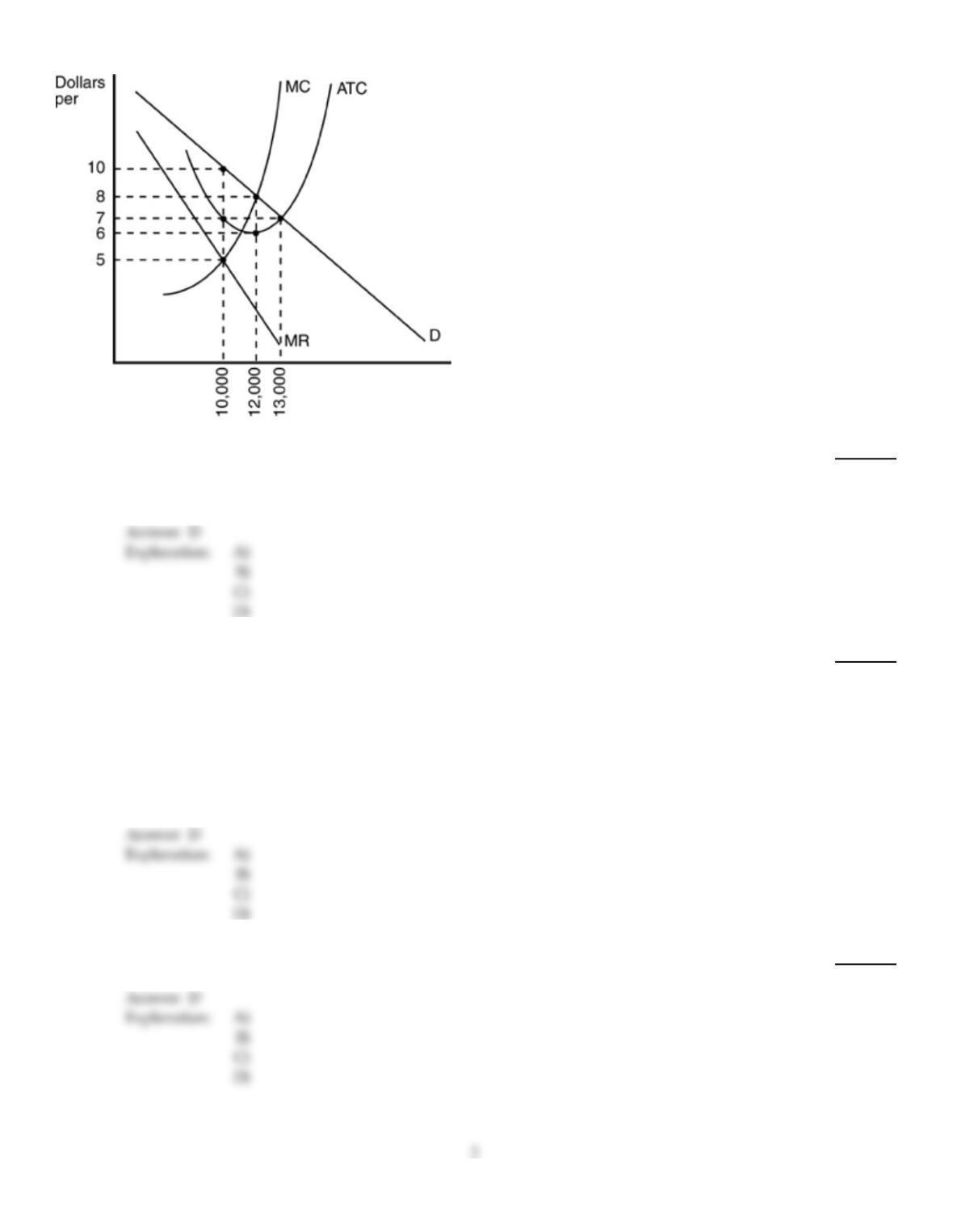
4)
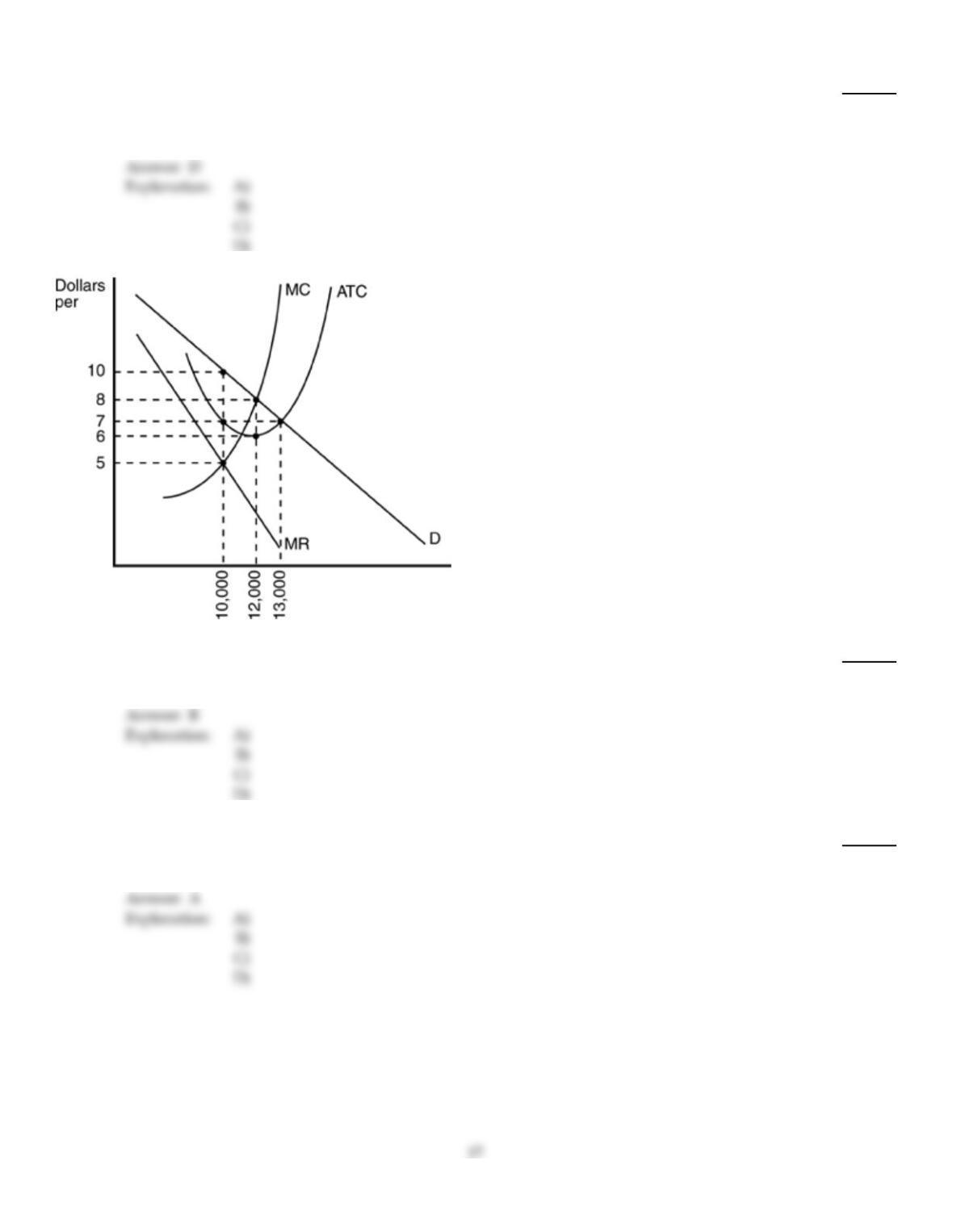
In the above figure, the profit–maximizing output and price for this monopolistically competitive
firm are
4)
A)
12,000 units at a price of $8 per unit.
B)
10,000 units at a price of $5 per unit.
C)
13,000 units at a price of $7 per unit.
D)
10,000 units at a price of $10 per unit.
5)
Which of the following statements about a monopolistically competitive firm is TRUE?
5)
A)
A monopolistically competitive firm produces the quantity at the point at which the demand
curve crosses the marginal cost curve.
B)
A monopolistically competitive firm does not always equate marginal cost to marginal
revenue because it uses other means to maximize profits.
C)
A monopolistically competitive firm maximizes profits by charging a price equal to marginal
cost.
D)
A monopolistically competitive firm maximizes profits when it produces the quantity at
which marginal cost equals marginal revenue.
6)
Which of the following products is most likely to be sold in a monopolistically competitive market?
6)
A)
wheat
B)
coal
C)
electricity
D)
fast food
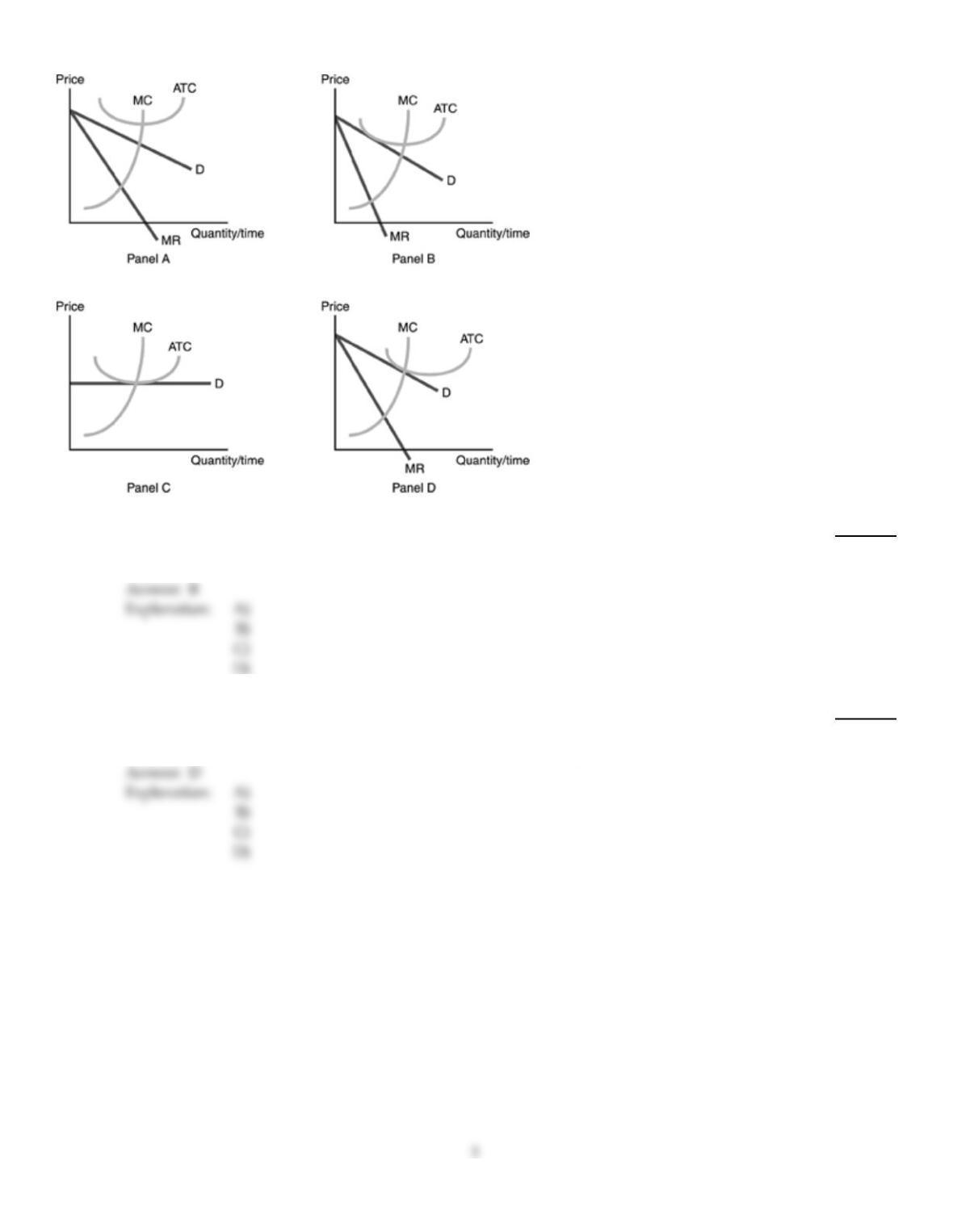
7)
Refer to the above figure. Which panel represents a monopolistic competitor that is earning zero
economic profits?
7)
A)
Panel A
B)
Panel B
C)
Panel C
D)
Panel D
8)
A product with qualities that consumers lack the expertise to assess without assistance is called a(n)
8)
A)
search good.
B)
inferior good.
C)
experience good.
D)
credence good.
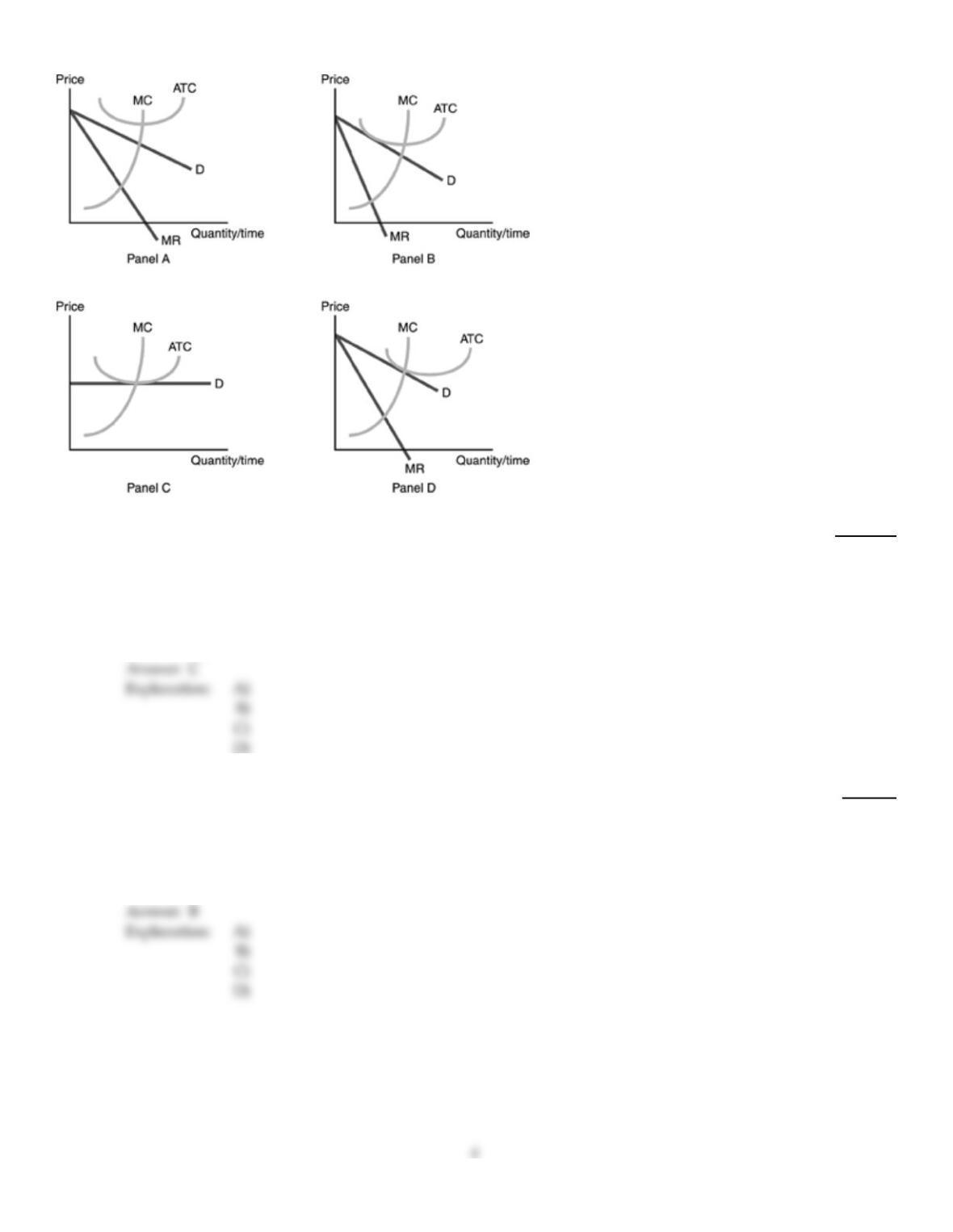
9)
Refer to the above figure. Which of the following statements about panel D in the figure is TRUE?
9)
A)
The figure represents an industry long–run equilibrium for monopolistic competition.
B)
The figure is in error since it doesn’t show the monopolistic competitor making profits in the
long run.
C)
The figure is in error since it has marginal cost intersecting the ATC curve at a point other
than the minimum of ATC.
D)
The figure represents a long–run equilibrium for a monopolistic competitor.
10)
In the long run, a perfectly competitive market produces at ________, whereas the monopolistic
competitive firm does not.
10)
A)
the point at which MR = MC=ATC
B)
the output at which the lowest average total cost of production is reached
C)
an output level at which positive economic profits exist
D)
zero economic profits
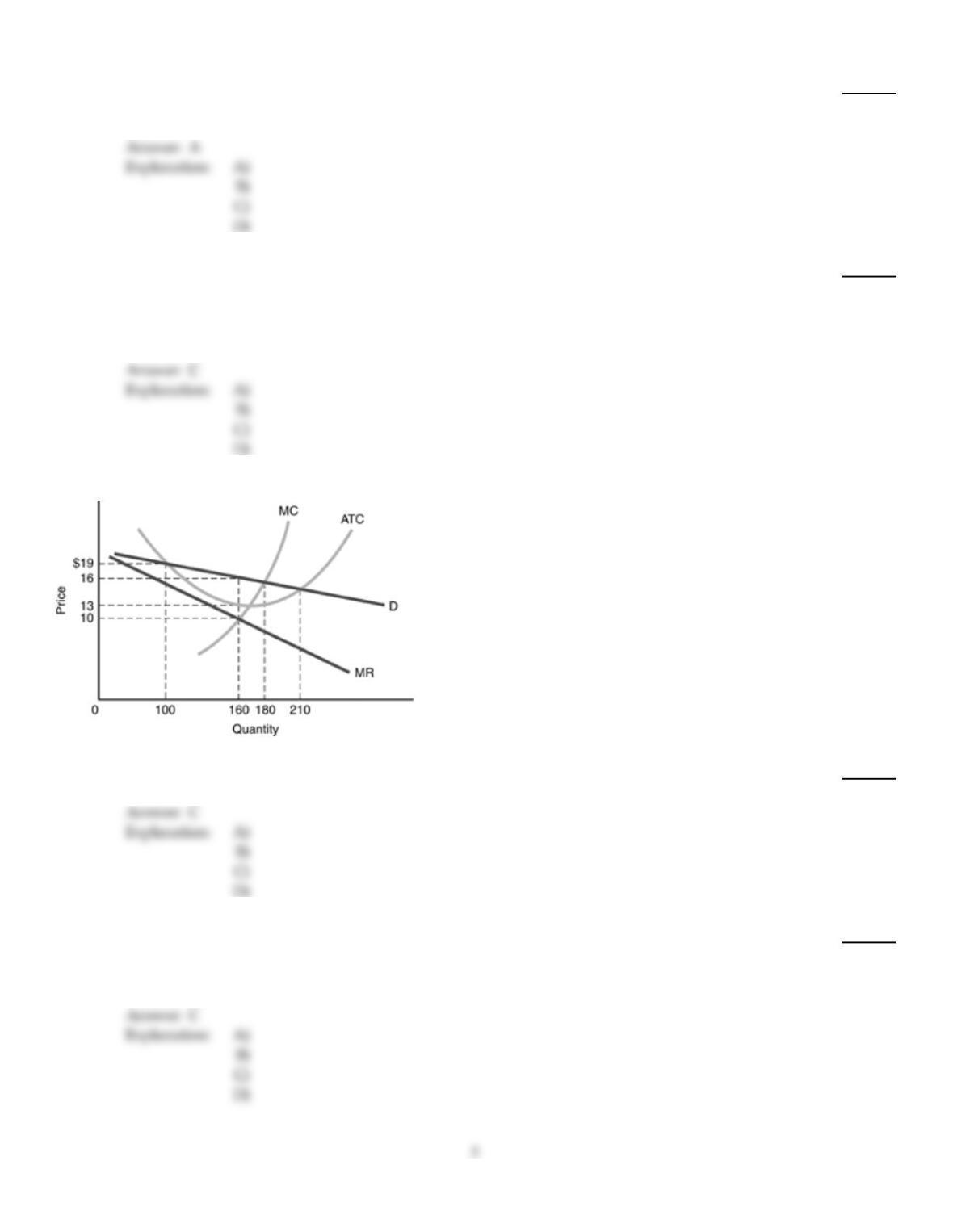
11)
The short–run profit–maximizing output level for a monopolistically competitive firm is the point
at which
11)
A)
MR = MC.
B)
MR > ATC.
C)
MR > P.
D)
P = ATC.
12)
For the monopolistically competitive firm, in both the short run and the long run
12)
A)
production will be at minimum average cost.
B)
there will be no economic profit.
C)
price will exceed marginal cost.
D)
the demand curve is inelastic.
13)
Use the above figure. The total profit earned by this monopolistically competitive firm is
13)
A)
$1,900.
B)
$2,560.
C)
$480.
D)
$1,600.
14)
Compared to a perfectly competitive firm, in a long run the monopolistically competitive firm will
have
14)
A)
a horizontal demand function.
B)
a lower average cost.
C)
a lower rate of output.
D)
a lower price.
15)
When you see a preview of a coming movie at the movie theater, this is
15)
A)
direct market advertising.
B)
persuasive advertising.
C)
informational advertising.
D)
indirect market advertising.
16)
Monopolistic competition and perfect competition are different in that
16)
A)
only perfectly competitive firms are characterized by long–run economic profits of zero.
B)
only monopolistically competitive firms advertise.
C)
only perfectly competitive firms maximize profits where marginal revenue equals marginal
cost.
D)
only monopolistically competitive firms can earn economic losses in the short–run.
17)
The number of firms in a monopolistically competitive industry means that
17)
A)
existing firms in the industry will make sure new firms do not enter.
B)
firms will not cooperate to set a pure monopoly price.
C)
firms will collude.
D)
firms will try to set a common price.
18)
An experience good is a product
18)
A)
with qualities that consumers lack the expertise to assess without assistance.
B)
that emphasizes the features of its product.
C)
that an individual must consume before the quality can be established.
D)
with characteristics that enable an individual to evaluate the product’s quality in advance of a
purchase.
19)
A monopolistic competitor is like a monopolist in the short run in that when economic profits are
19)
A)
equal to zero, price below marginal cost.
B)
greater than zero, price exceeds marginal cost.
C)
greater than zero, changes in output are due to changes to plants by existing firms and there is
no entry.
D)
equal to zero, price equals marginal cost.
20)
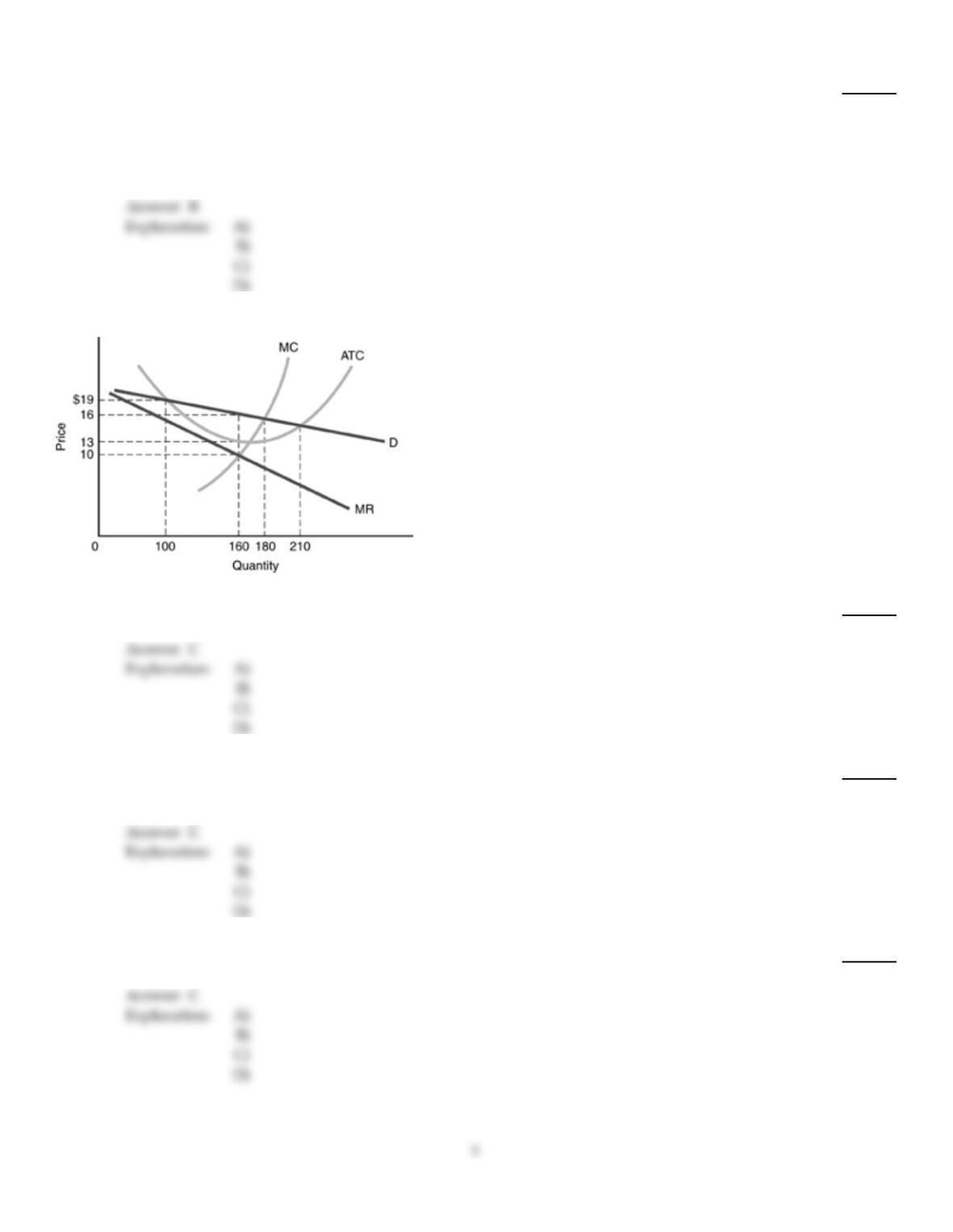
Use the above figure. The total cost earned by this monopolistically competitive firm is
20)
A)
$3,150.
B)
$1,900.
C)
$2,080.
D)
$1,600.
21)
If the producer of an information product engages in marginal cost pricing, it earns
21)
A)
positive economic profits.
B)
zero economic profits.
C)
an economic loss.
D)
a normal profit.
22)
The monopolistically competitive firm maximizes profit by producing to the point at which
22)
A)
MR = AR.
B)
ATC = AVC.
C)
MC = MR.
D)
MC = AR.
23)
The production of information products is characterized by
23)
A)
relatively low fixed cost.
B)
an upward sloping marginal cost curve.
C)
relatively low marginal cost.
D)
diseconomies of operation.
24)
A monopolistic competitor finds its profit–maximizing rate of output by
24)
A)
setting average revenue equal to average total cost.
B)
equating marginal revenue and marginal cost.
C)
equating price and marginal revenue.
D)
equating the marginal revenue from advertising with the marginal revenue from selling the
good.
B
25)
In a monopolistically competitive market there are
25)
A)
few firms producing identical products.
B)
many firms producing similar but not identical products.
C)
many firms producing an identical product.
D)
many firms producing totally different products.
B
26)
All of the following are advertisement methods EXCEPT
26)
A)
interactive marketing.
B)
direct marketing.
C)
mass marketing.
D)
indirect marketing.
D
27)
A market situation in which a large number of firms produce similar but not identical products is
27)
A)
a homogeneous market.
B)
monopolistic competition.
C)
competitive monopoly.
D)
a collusive market structure.
B
C
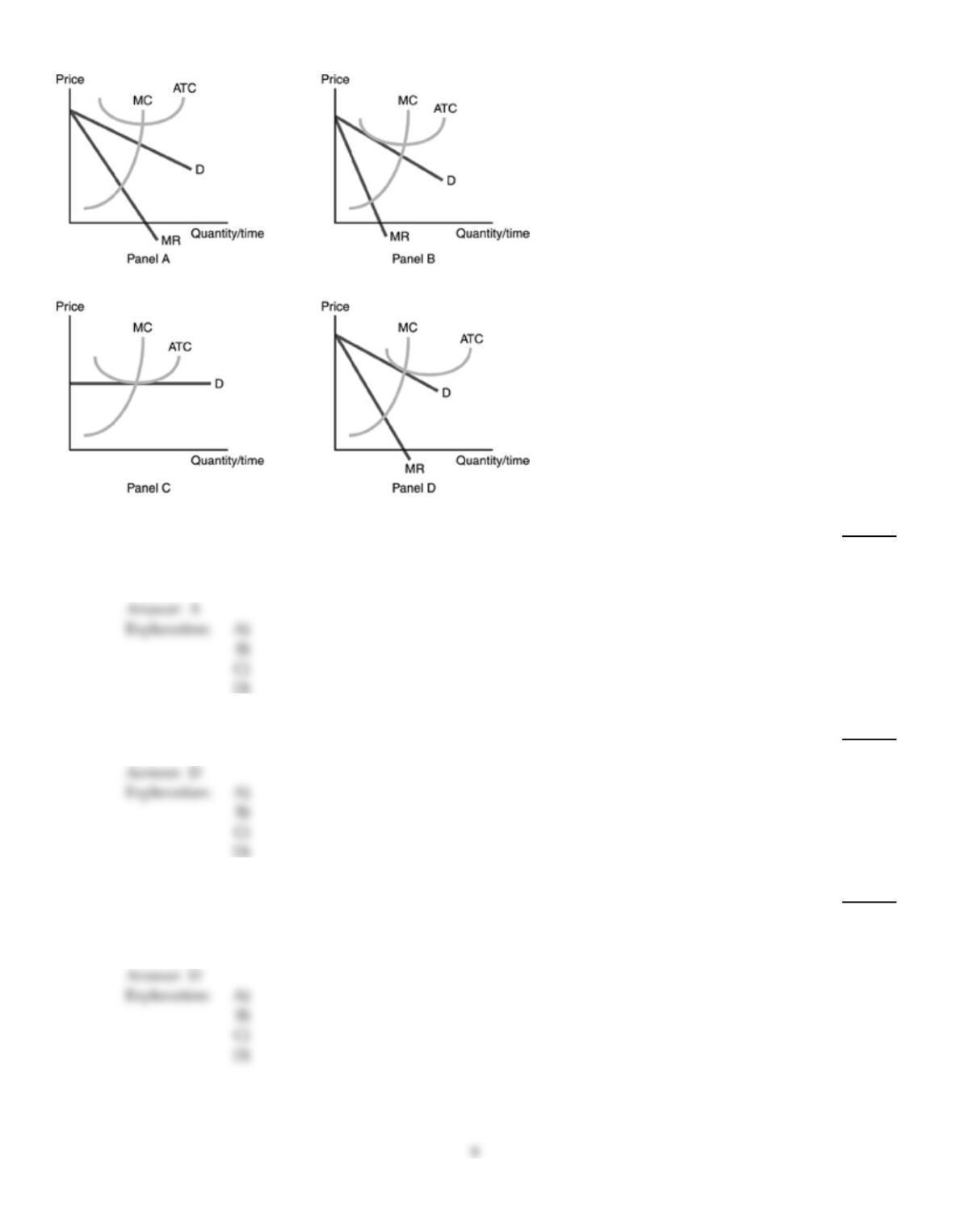
28)
Refer to the above figure. Which panels represent long run equilibrium for the perfectly
competitive firm and monopolistic competitive firm, respectively?
28)
A)
Panel C and Panel B
B)
Panel B and Panel C
C)
Panel C and Panel D
D)
Panel C and Panel A
29)
The long–run equilibrium of monopolistic competition is characterized by
29)
A)
P = MR = MC.
B)
P = MC = ATC.
C)
P = MC > ATC.
D)
P = ATC > MC.
30)
The first unit of an information product is produced at a high fixed cost. Producing additional units
entails relatively low
30)
A)
external cost.
B)
social cost.
C)
total costs.
D)
marginal and average variable cost.
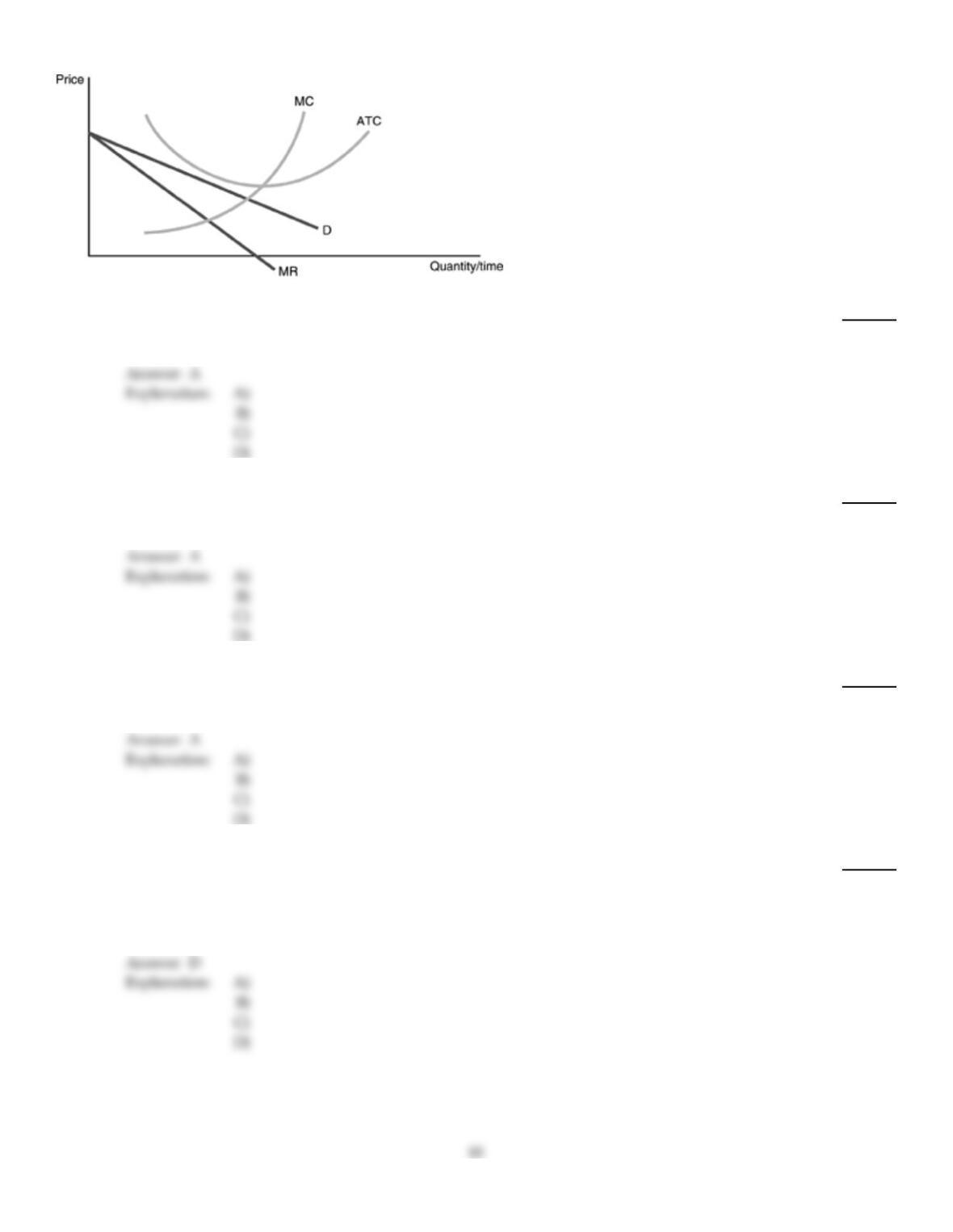
31)
Refer to the above figure. Economic profits for this firm are
31)
A)
negative.
B)
zero.
C)
positive.
D)
undetermined without more information.
32)
Which of the following is most likely to be a monopolistically competitive firm?
32)
A)
computer software maker
B)
college textbook publisher
C)
smart phone producer
D)
cell phone service provider
33)
The type of advertising used for a search good is
33)
A)
informational advertising.
B)
experience advertising.
C)
persuasive advertising.
D)
search advertising.
34)
For a monopolistically competitive firm
34)
A)
price is less than marginal revenue at all levels of output.
B)
price equals marginal revenue at all levels of output.
C)
the demand curve is perfectly inelastic and marginal revenue is zero.
D)
price is greater than marginal revenue at all levels of output except for the first unit.
35)
In which industry structure is advertising and sales promotion likely to be most important?
35)
A)
monopolistic competition
B)
perfect competition
C)
monopoly
D)
All of the above are equally reliant on effective advertising and promotion.
36)
The theory of monopolistic competition was developed in two separate models by
36)
A)
Edward Chamberlin and Joan Robinson.
B)
John Kenneth Galbraith and John Maynard Keynes.
C)
Adam Smith and David Ricardo.
D)
Roger Leroy Miller and Paul Samuelson.
37)
The demand for the product of a monopolistically competitive firm is highly elastic when
37)
A)
there are a lot of close substitutes.
B)
firms collude.
C)
there are fewer firms in the industry.
D)
there is a lot of product differentiation.
38)
Considering the relevant market structures, which is an INCORRECT statement?
38)
A)
In any market situation, the number of firms is not very important.
B)
In pure monopoly, there is only one firm.
C)
In a perfectly competitive situation, there is an extremely large number of firms.
D)
In monopolistic competition, there is a large number of firms.
39)
The demand curve for the product of a monopolistic competitor is
39)
A)
unitary elastic.
B)
horizontal.
C)
vertical.
D)
downward sloping.
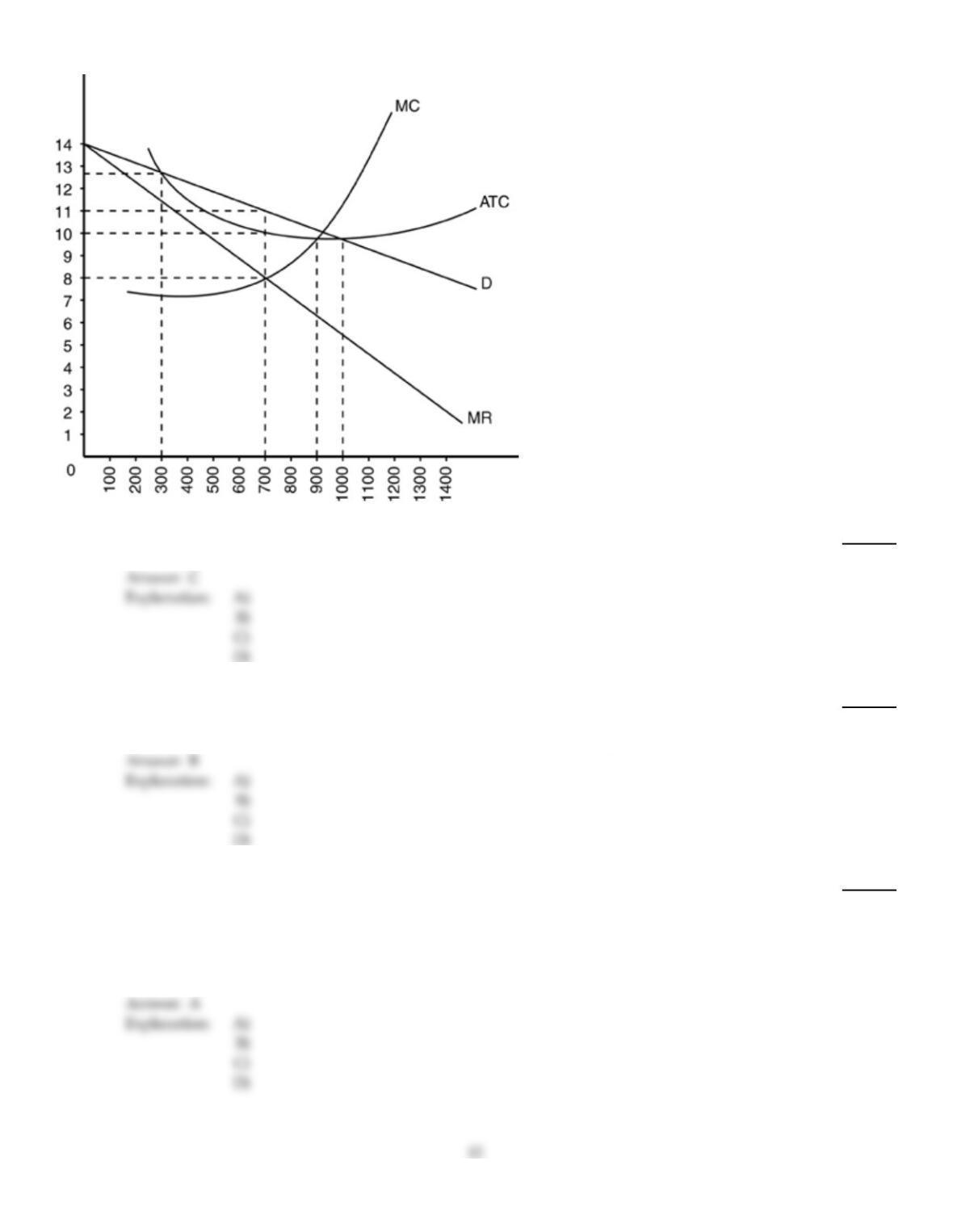
40)
In the above figure, the monopolistically competitive firm’s profit–maximizing output is
40)
A)
1,000 units.
B)
900 units.
C)
700 units.
D)
300 units.
41)
The manufacturers of information products typically
41)
A)
have low fixed costs.
B)
have high fixed costs.
C)
have zero fixed costs.
D)
have high marginal costs.
42)
An implication of the downward slope of the demand curve for a monopolistic competitive firm is
that
42)
A)
its marginal revenue curve slopes downward but lies below the demand curve.
B)
its marginal revenue curve slopes upward.
C)
its marginal revenue curve slopes downward but lies above the demand curve.
D)
its marginal revenue curve and its demand curve are identical (same) line.
43)
The demand curve faced by a monopolistically competitive firms is
43)
A)
vertical.
B)
unitary elastic.
C)
horizontal.
D)
downward sloping.
44)
It has been argued that a monopolistically competitive industry involves “waste” because
44)
A)
the firms do not equate marginal cost to marginal revenue to find the profit maximizing price
and output.
B)
there is too much product differentiation making shelves too crowded.
C)
they end up producing to the right of the minimum of the average total cost curve and the
price is below the marginal cost.
D)
the firms do not produce at the minimum of the average total cost curve and price is above
marginal cost.
45)
Interactive marketing is
45)
A)
advertising that permits a consumer to follow up directly by searching for more information
and placing direct product orders.
B)
advertising targeted at specific consumers.
C)
advertising intended to reach as many consumers as possible.
D)
advertising that targets a specific audience and allows the consumer to follow up directly by
placing direct product orders usually through television or radio.
46)
The key feature of monopolistic competition is
46)
A)
lack of advertisement.
B)
product differentiation.
C)
the small number of firms in the industry.
D)
interdependence of the firms.
47)
A good example of a monopolistic competitive industry is
47)
A)
wheat farms in the United States.
B)
the country music industry.
C)
the federal highway system.
D)
the four major textbook publishers together with nearly 90 percent of industry sales.
48)
When a pharmaceutical company advertises that its allergy medication is clinically proven to
alleviate hay fever symptoms, the pharmaceutical company is engaging in
48)
A)
persuasive advertising.
B)
informational advertising.
C)
direct marketing.
D)
trademark protection.
49)
A monopolistic competitor is in long–run equilibrium when
49)
A)
economic profits are greater than zero and the marginal cost curve is tangent to the demand
curve.
B)
economic profits are equal to zero and the average total cost curve is tangent to the demand
curve.
C)
economic profits are equal to zero and the marginal cost curve is tangent to the demand
curve.
D)
economic profits are greater than zero and the average total cost curve is tangent to the
demand curve.
50)
Because there are low barriers to entry in a monopolistically competitive market
50)
A)
they produce a homogeneous product.
B)
the firms are price takers.
C)
there is no non–price competition.
D)
there are many firms in the industry.
51)
Which of the following is FALSE about a comparison between a perfectly competitive firm and a
monopolistically competitive firm?
51)
A)
In the long run, the perfectly competitive firm will produce at the minimum of the average
total cost curve, while the monopolistically competitive firm will produce to the left of the
minimum of the average total cost curve.
B)
A perfectly competitive firm has a horizontal demand curve, while a monopolistically
competitive firm has a downward sloping demand curve.
C)
Both the perfectly competitive and monopolistically competitive firm will earn economic
profits equal to zero in the long–run.
D)
In the short run, a perfectly competitive firm will earn zero economic profits, while a
monopolistically competitive firm will earn positive economic profits.
52)
Long–run equilibrium is characterized by zero profits in
52)
A)
market structures in which there are barriers to entry.
B)
perfect competition only.
C)
both perfect competition and monopolistic competition.
D)
monopolistic competition only.
53)
Which of the following is NOT a characteristic of monopolistic competition?
53)
A)
easy entry of new firms in the long run
B)
homogeneous product
C)
sales promotion and advertising
D)
large number of sellers
54)
Which of the following statements is INCORRECT regarding the properties of information
products?
54)
A)
In the long run, the producer earns sufficient revenue to cover the opportunity cost of capital.
B)
Providing an information product entails incurring relatively high fixed costs.
C)
The firm experiences economies of operation in the short run.
D)
The average total cost curve for a firm that sells an information product slopes upward.
55)
Suppose a sushi restaurant is making significant economic profit in the short run. In the long run
55)
A)
more people will open steak restaurants, increasing the economic profit for the sushi
restaurant.
B)
high barriers to entry keep people from opening sushi restaurants.
C)
the government will require the sushi restaurant to sell part of its interests in the city.
D)
more people will open sushi restaurants, reducing the economic profit for each restaurant.
56)
Personalized advertising that uses postal mailings, phone calls, and e–mail messages is known as
56)
A)
mass marketing.
B)
indirect marketing.
C)
direct marketing.
D)
interactive marketing.
Explanation:
57)
According to Chamberlin, the fact that in the long run average total cost exceeds its minimum
value under monopolistic competition is
57)
A)
part of the cost of producing different products for consumers.
B)
the most important reason for why monopolistic competition is not efficient.
C)
actually beneficial because it makes adjustments easier when demand increases.
D)
the social cost of monopolistic competition.
Explanation:
58)
In a monopolistically competitive market, the consumer receives the benefit of
58)
A)
product differentiation.
B)
production at minimum average cost.
C)
production where price equals marginal cost.
D)
allocative efficiency.
Explanation:
Explanation:
59)
Compared with a perfectly competitive firm facing the same costs, long–run equilibrium for a
monopolistically competitive firm will result in
59)
A)
a higher price and greater output.
B)
a lower price and less output.
C)
a lower price and greater output.
D)
a higher price and less output.
60)
In the above figure, the profit–maximizing monopolistically competitive firm will
60)
A)
incur a loss of $20,000.
B)
make a profit of $30,000.
C)
make a profit of $0.
D)
make a profit of $24,000.
B
61)
Which is NOT a characteristic of monopolistic competition?
61)
A)
few firms in the industry
B)
lack of collusion among firms
C)
independence of each firm’s decisions
D)
small share of market to each firm
A
D
62)
The demand curve faced by a monopolistically competitive firm is
62)
A)
vertical.
B)
upward sloping.
C)
horizontal.
D)
downward sloping.
63)
The demand curve for a monopolistically competitive firm is
63)
A)
the same as the industry demand curve.
B)
horizontal.
C)
more elastic than the demand curve of the perfectly competitive firm.
D)
less elastic than the demand curve of the perfectly competitive firm.
64)
A search good is a product
64)
A)
with characteristics that enable an individual to evaluate the product’s quality in advance of a
purchase.
B)
that emphasizes the features of its product.
C)
that an individual must consume before the quality can be established.
D)
with qualities that consumers lack the expertise to assess without assistance.
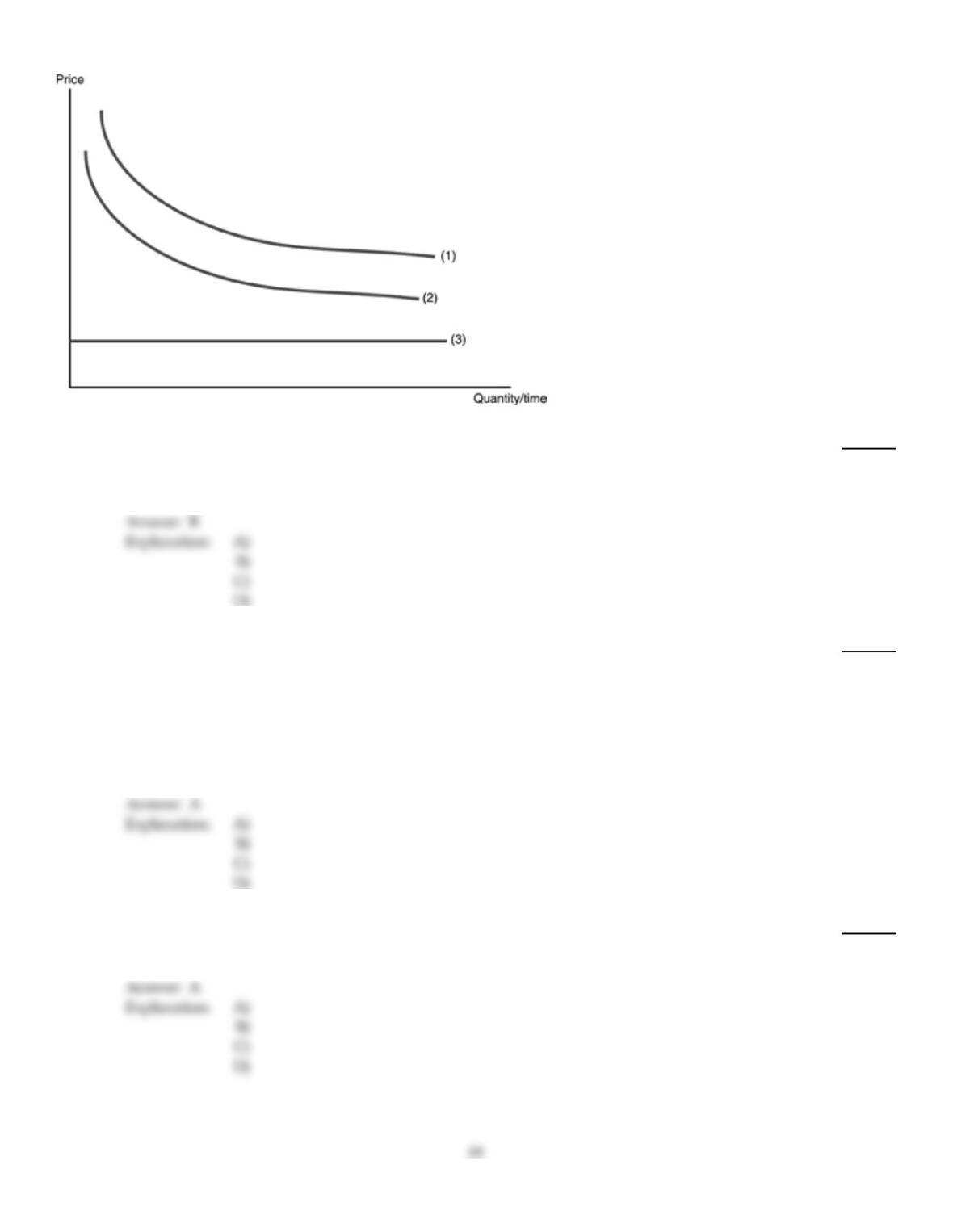
65)
Refer to the above figure. The above figure shows the cost structure of a firm producing an
information product. Which curve represents average total cost?
65)
A)
Any of the 3 could be ATC.
B)
Curve 1
C)
Curve 2
D)
Curve 3
66)
In the 1920s and 1930s, economists became increasingly aware that there were industries that did
not fit the model of perfect competition or pure monopoly. Two separate theories of monopolistic
competition resulted. Edward Chamberlin of Harvard published the Theory of Monopolistic
Competition in 1933. Chamberlin defined monopolistic competition as
66)
A)
a relatively large number of producers offering similar but differentiated products.
B)
a relatively small number of producers offering similar but differentiated products.
C)
a market situation in which a small number of firms produce similar products.
D)
a market situation in which a large number of firms produce identical products.
67)
Which of the following is most likely to be a monopolistically competitive firm?
67)
A)
a fast food restaurant
B)
a lettuce farmer
C)
a municipal water district
D)
a soybean farmer
68)
Stephanie has just placed an order for the latest video after she received a personalized e–mail. The
e–mail is an example of
68)
A)
mass marketing.
B)
direct marketing.
C)
indirect marketing.
D)
interactive marketing.
69)
The demand curve for the product of a monopolistic competitor
69)
A)
is the same as the market demand curve.
B)
is horizontal.
C)
slopes downward.
D)
is vertical.
70)
When Crest claims that its toothpaste product whitens teeth more than the products of its
competitors, Crest is practicing
70)
A)
product differentiation.
B)
marginal cost pricing.
C)
libel.
D)
marginal revenue pricing.
71)
When you see an advertisement on TV for a hair care product in which the actor using the product
is depicted as beautiful and happy, this is
71)
A)
direct market advertising.
B)
indirect market advertising.
C)
persuasive advertising.
D)
informational advertising.