Cost Accounting: A Managerial Emphasis, 6e
Chapter 24 – Multinational Performance Measurement and Compensation
3) Good performance measures do not change significantly with the manager’s performance but change
with factors that are beyond the manager’s control.
4) Well-designed compensation plans for executives focus on risk and long-term incentives.
5) The only criticism of team-based compensation is that the incentives for individual employees to excel
are diminished, harming overall performance.
6) ________ describes contexts in which, once risk is shared, the individual fails to make as much effort to
avoid harm as when risk was not shared.
A) Goal congruence
B) Moral hazard
C) Management compensation
D) Incentive compensation
E) Executive compensation
7) The absence of good performance measures restricts the owner’s ability to motivate managers through
A) rewards for products.
B) performance-based incentives.
C) monetary rewards.
D) compensation.
E) non-financial rewards.

Cost Accounting: A Managerial Emphasis, 6e
Chapter 24 – Multinational Performance Measurement and Compensation
8) Which of the following statements is true relative to performance evaluations?
A) Managers should be evaluated for the whole organization’s performance.
B) Managers should be evaluated on things they can affect.
C) Sales people cannot completely control the level of sales.
D) Managers should not be evaluated on the things they can affect if the factors are not completely
controllable.
E) Managers should be evaluated on all items they affect regardless of the control they exert over them.
9) The benefits of tying performance measures more closely to a manager’s efforts encourage the use of
A) financial measures.
B) nonfinancial measures.
C) nonfinancial and financial measures.
D) performance input measures.
E) moral measures.
10) Measurement of one group’s performance against the best possible level of performance exhibited by
another group, either inside or outside the organization, is known as
A) teamwork analysis.
B) performance-variation analysis.
C) comparative analysis.
D) benchmarking.
E) competition analysis.
11) Team incentives encourage cooperation by
A) forcing people to work together on difficult tasks.
B) changing management style.
C) letting individuals help one another as they strive toward a common goal.
D) rewarding all teams members by the same amount.
E) rewarding team members individually.
Cost Accounting: A Managerial Emphasis, 6e
Chapter 24 – Multinational Performance Measurement and Compensation
12) Which type of compensation is most prevalent when a satisfactory performance measure cannot be
designed?
A) dividends
B) stock options
C) salary
D) bonus based on ROI
E) bonus based on ROI and/or RI
13) Endicott Inc. has four divisions. Each division produces and sells a variety of industrial products. The
company is developing a compensation plan for division managers. Three options are being considered:
(a) salary, (b) performance based incentive using RI, (c) mix of salary and a performance based incentive
using RI. What factors should be considered in designing this plan?
Cost Accounting: A Managerial Emphasis, 6e
Chapter 24 – Multinational Performance Measurement and Compensation
14) Bob Cellular Phone uses ROI to measure divisional performance. Annual ROI calculations for each
division have traditionally employed the ending amount of invested capital along with annual operating
income and net revenue. The DuPont method is generally used. The company’s Phone Accessories
Division had the following results:
Previous Year ROI = ($2,000,000/$20,000,000) × ($20,000,000/$10,000,000) = 0.20
Current Year ROI = ($2,400,000/$25,000,000) × ($25,000,000/$15,000,000) = 0.16
Corporate management was disappointed in the performance of the division for the current year since it
had made an additional investment in the division which was budgeted for a 23 percent ROI.
Required:
a. Discuss some factors that may have contributed to the decrease in ROI for the current year.
b. Assume ‘total assets employed’ are 10% less than total assets. What is the effect of using ‘total assets
employed’ when calculating ROI?
Cost Accounting: A Managerial Emphasis, 6e
Chapter 24 – Multinational Performance Measurement and Compensation
15) Broughton Industries Ltd. is a publicly traded company and is organized into divisions. The company
currently has a stock option plan for its head office executives only and it now is considering establishing
an incentive program for its divisional managers. The proposal is to create a bonus pool based on a
predetermined percentage of corporate net income after taxes. Divisional managers will be eligible for
money from the bonus pool based on achievement of divisional return on investment (ROI). The
calculation of the divisional ROI will be based on divisional net income (including an allocation of head
office charges) and investment is defined as total assets.
Required:
Evaluate the proposed incentive plan. What changes would you recommend, if any, to the proposal?
Cost Accounting: A Managerial Emphasis, 6e
Chapter 24 – Multinational Performance Measurement and Compensation
24.5 Apply strategic concepts to analyze the four levers of control and evaluate their
usefulness.
1) Ethical behaviour on the part of managers, while important for its own sake, is not paramount in
importance.
2) An interactive control system is a formal information system that managers use to focus organization
attention and learning on key strategic issues.
3) Boundary systems describe standards of behaviour and codes of conduct expected of all employees,
especially actions that are off-limits.
4) The “four levers” of control are operating profit before taxes, return on investment, residual income,
and economic value added.
5) Measures which monitor critical performance variables that help managers track progress toward
achieving a company’s strategic goals are collectively called diagnostic control systems.

Cost Accounting: A Managerial Emphasis, 6e
Chapter 24 – Multinational Performance Measurement and Compensation
6) How should environmental and ethical issues affect managers’ performance evaluations?
A) Socially responsible companies set aggressive targets for income and ROI, which must be met before
environmental and ethical issues become relevant.
B) Environmental responsibilities are met by adhering to the law of the land (e.g., pollution laws).
C) Issues that may be ethical concerns in Canada (e.g., bribery) may not be illegal in other countries, and
multi-national companies must adhere to local custom.
D) Socially responsible companies include environmental and ethical targets in managers‘ performance
evaluations.
E) Illegal behaviour is not part of management’s concern, unless it affects the bottom line.
7) Which of the following is a difference between a diagnostic control system and an interactive control
system?
A) A diagnostic control system focuses on meeting expectations, while an interactive control system
focuses on standards of ethical behaviour.
B) A diagnostic control system focuses on standards of ethical behaviour while an interactive control
system focus on meeting expectations.
C) A diagnostic control system focuses on meeting expectations, while an interactive control system
focuses on organizational attention and learning on key strategic issues.
D) A diagnostic control system focuses on organizational attention and learning on key strategic issues,
while an interactive control system focuses on meeting expectations.
8) A part of a control system that focuses on meeting expectations is known as a(n)
A) diagnostic control system.
B) boundary system.
C) belief system.
D) interactive control system.
E) isolated system.

Cost Accounting: A Managerial Emphasis, 6e
Chapter 24 – Multinational Performance Measurement and Compensation
9) A part of a control system that describes standards of behaviour and codes of conduct expected of all
employees, especially actions that are off-limits, is known as a(n)
A) diagnostic control system.
B) boundary system.
C) belief system.
D) interactive control system.
E) isolated system.
10) A part of a control system that articulates the mission, purpose, and core values of a company is
known as a(n)
A) diagnostic control system.
B) boundary system.
C) belief system.
D) interactive control system.
E) isolated system.
11) A part of a control system that attempts to focus an organization’s attention and learning on key
strategic issues is known as a(n)
A) diagnostic control system.
B) boundary system.
C) belief system.
D) interactive control system.
E) isolated system.
12) Managers use ________ to create an ongoing dialog around the organization’s key strategic issues to
personally involve themselves in subordinates’ decision-making activities.
A) diagnostic control systems
B) boundary systems
C) belief systems
D) interactive control systems
E) isolated systems
Cost Accounting: A Managerial Emphasis, 6e
Chapter 24 – Multinational Performance Measurement and Compensation
13) “Levers of control,” in addition to a diagnostic control system, are needed in an organization because
A) diagnostic controls have been found to lead to poor financial performance.
B) diagnostic controls have no place in a Balanced Scorecard system.
C) pressure to perform on diagnostic controls may lead to unethical behaviour.
D) they are mandated by the external accounting agencies.
E) they are mandated by taxation agencies.
14) Briefly explain each of the four levers of control. Why does a company need to implement more than a
diagnostic control system?

Cost Accounting: A Managerial Emphasis, 6e
Chapter 24 – Multinational Performance Measurement and Compensation
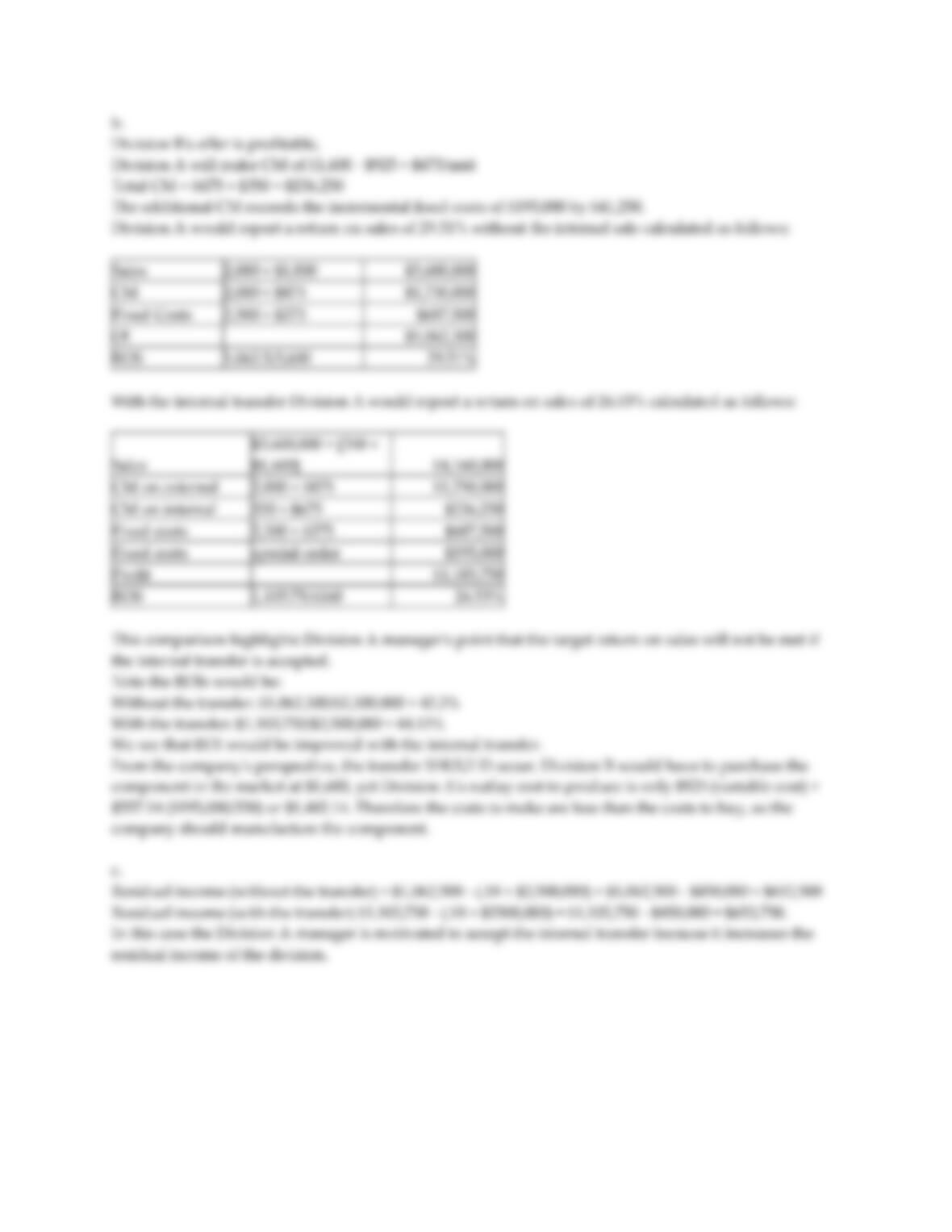
15) Alpine Ltd. has two divisions. Division A manufactures components that can be sold in the external
market place or transferred to Division B for further processing. The following data relate to Division A’s
component product.
Variable Manufacturing Costs/unit $925.00
Fixed Costs/Unit at capacity $275.00
Selling Price/Unit $1,800.00
The capacity of the plant is 2,500 units per year.
Division B has offered to purchase 350 units from Division A at a price of $1,600/unit, which is the market
price of the component. The manager of Division A has refused this offer stating that it would only return
a rate of 25.00%, when the divisional target return on sales is 28.00%. The Division A manager also states
that additional fixed costs of $195,000 would be required to produce the 350 units.
The corporate required rate of return is 18% of assets and the existing asset base in Division A is
$2,500,000.
Required:
a. How many units must Division A sell in order to achieve its target ROI? What profit margin would
be earned at this level of sales?
b. Assume Division A currently sells 2,000 units to the external market and can accept Division B’s offer
without affecting its external sales. Evaluate the refusal of Division B’s offer from the standpoint of the
corporation as a whole and from Division A manager’s perspective.
c. Assume Division A currently sells 2,000 units to the external market and can accept Division B’s offer
without affecting its external sales. Calculate Division A’s residual income with and without the sale to
Division B.
d. What recommendations would you give to the President of Alpine Ltd. with respect to performance
evaluation of the divisions?
Cost Accounting: A Managerial Emphasis, 6e
Chapter 24 – Multinational Performance Measurement and Compensation
24–63

Cost Accounting: A Managerial Emphasis, 6e
Chapter 24 – Multinational Performance Measurement and Compensation
24–64