Chapter 24—New Measures of Performance Key
1. Which of the following is NOT one of the components of economic value added?
2. Which of the following is NOT one of the components of residual income?
3. A performance measurement system that emphasizes the income earned over and above the income required
4. The weighted average cost of capital is:
5. The formula for economic value added is:
6. A company’s interest-bearing debt and stockholders’ equity is equal to its:
7. A company’s invested capital is equal to its:
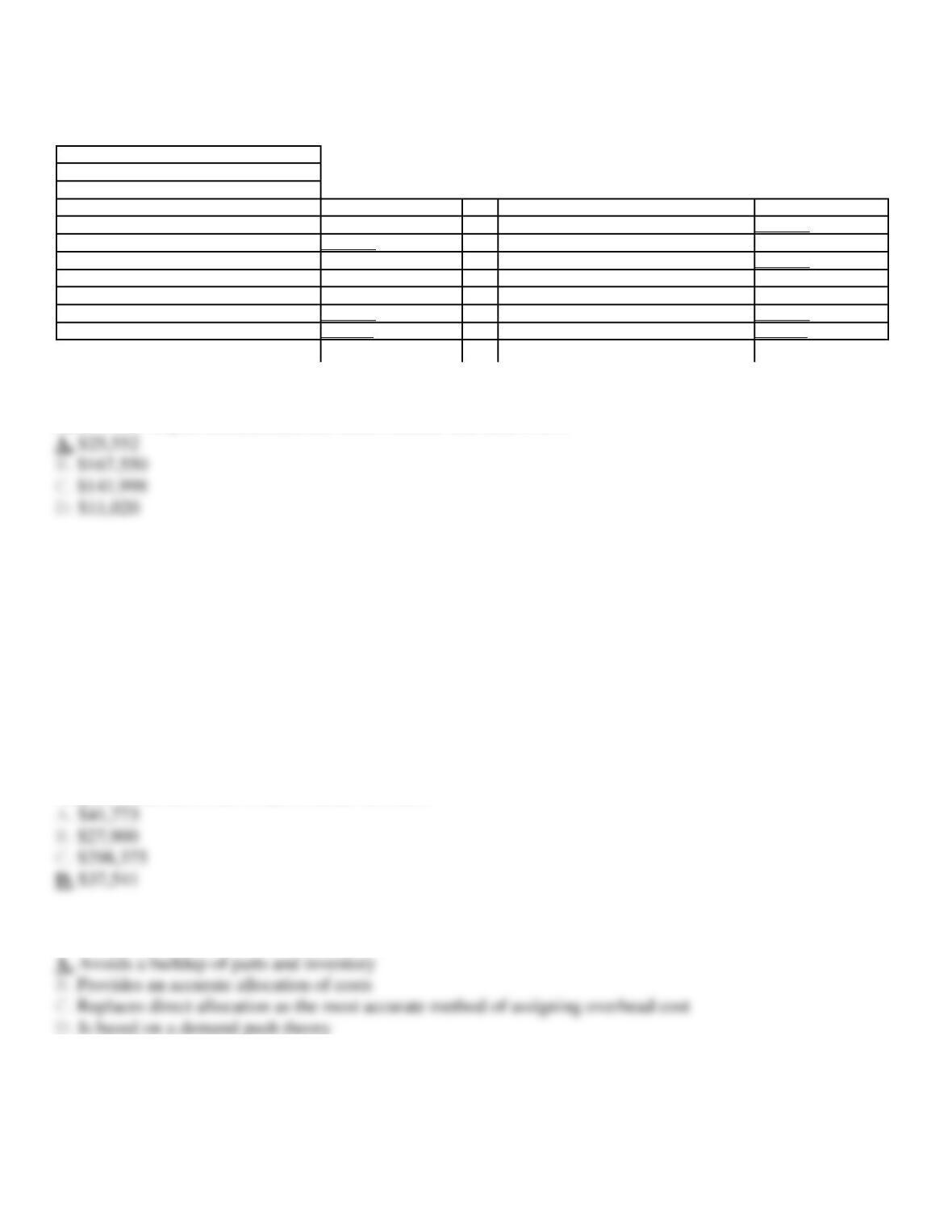
8. Exhibit 24-1
Shriber Company had the following balance sheet at the end of 2012:
Shriber Company
Balance Sheet for December 31, 2012
Cash
$ 2,280
Accounts payable
$ 3,990
Inventory
10,450
Wages payable
7,030
Accounts receivable
6,080
Total current liabilities
$ 11,020
Total current assets
$ 18,810
Long-term liabilities
357,200
Equipment
148,200
Total liabilities
$368,220
Buildings
446,500
Common stock
418,000
Land
285,000
Retained earnings
112,290
Total assets
$898,510
Total liabilities and equity
$898,510
Refer to Exhibit 24-1. Using the information above, determine Shriber’s invested capital assets.
9. Exhibit 24-1
Shriber Company had the following balance sheet at the end of 2012:
Shriber Company
Balance Sheet for December 31, 2012
Cash
$ 2,280
Accounts payable
$ 3,990
Inventory
10,450
Wages payable
7,030
Accounts receivable
6,080
Total current liabilities
$ 11,020
Total current assets
$ 18,810
Long-term liabilities
357,200
Equipment
148,200
Total liabilities
$368,220
Buildings
446,500
Common stock
418,000
Land
285,000
Retained earnings
112,290
Total assets
$898,510
Total liabilities and equity
$898,510
Refer to Exhibit 24-1. Shriber Company had $223,400 in operating income before taxes this year, a tax rate of 25% and a weighted average cost of
capital of 16%. Using this information, determine Shriber’s economic value added for 2012.
10. Yavapai Industries has decided to start calculating economic value added. Yavapai’s accountant gathered the
following information:
Operating income
$ 426,250
Total assets
$1,891,000
Current liabilities
$ 27,900
Stockholders’ equity
$ 720,500
Tax rate
30%
Weighted average cost of capital
14%
Using this information, calculate Yavapai’s economic value added.
11. Adoption of a just-in-time inventory system:
12. The just-in-time inventory system focus is:
13. Suppliers for a company using a just-in-time inventory system:
14. Organizations using just-in-time:
15. Just-in-time provides savings by:
16. When using the just–in-time inventory system, production schedules are based on:
17. The emphasis of JIT is to:
18. The just-in-time inventory system increases:
19. Which of the following is the revolutionary management accounting tool that tends to reduce waste
associated with inventories?
20. Which of the following requires that quality be manufactured rather than inspected into products?
21. Which of the following statements is NOT true under the JIT philosophy?
22. A signaling device that pulls parts forward through the production system is known as a(n):
23. Costs incurred to inspect products after manufacturing are:
24. Costs incurred due to reduced product yield are:
25. Costs incurred to handle customer complaints are:
26. Costs incurred to train production employees are:
27. Costs incurred for routine maintenance of production equipment are:
28. The amount of warranty claims due to product defects would be classified as a(n):
29. Costs incurred for downtime of production equipment are:
30. Costs incurred to educate suppliers are:
31. Costs incurred to repair products under warranty are:
32. An example of a prevention cost would be:
33. An example of an appraisal cost would be:
34. An example of an external failure cost would be:
35. An example of an internal failure cost would be:
36. The process of measuring, monitoring, and minimizing prevention, appraisal, internal failure, and external
failure costs is:
37. Which of the following costs are generally the highest?
38. Which of the following are NOT included in the COQ model?
39. Which of the following is a management philosophy on increasing profitability by improving the quality of
products and processes?
40. Which of the following are some of the defining characteristics of total quality management?
41. A technical tool that provides users with the ability to study, control, and improve processes of all types is
a:
42. The criticism of traditional management accounting measures is that they focus too much on:
43. A balanced scorecard approach to performance measurement would allow the inclusion of all BUT which of
the following measures?
44. Performance measures that allow a company to monitor factors such as whether it is gaining market share
and customer profitability are called:
45. In general, performance measures that allow a company to monitor the cost, quality, and time of producing
goods or services are called:
46. What can be used to measure performance with respect to customer satisfaction?
47. An example of an outcome performance measure is:
48. An example of a leading performance measure is:
49. Which of the following is NOT an outcome performance measure?
50. Which of the following is NOT a leading performance measure?
51. An example of an outcome performance measure is:
52. An example of a leading performance measure is:
53. Which of the following is NOT part of the Balanced Scorecard Framework?
54. The first key to strong financial performance is:
55. Customer satisfaction is the result of the right combination of:
56. Traditional financial measures are now being supplemented in which area(s)?
57. Performance measures that monitor a company’s effectiveness in identifying new products or services and
then creating and bringing those products to market are:
58. A performance measure that monitors a company’s commitment to warranty its product would be called
a(n):
59. Defective products per million produced is an example of a(n):
60. Design cycle time is an example of a(n):
61. An example of an operations process measure is:
62. An example of an innovation process measure is:
63. An example of a service-after-sale process measure is:
64. Performance measures that allow a company to monitor the capabilities of the employee, the information
system, and the organizational structure would best be called:
65. An example of an outcome measure of learning and growth is:
66. An example of a leading measure of learning and growth is:
67. Which of the following is NOT true of the balanced scorecard approach to performance measurement?
68. Which of the following is NOT true of the balanced scorecard approach to performance measurement?
69. A process that measures all costs involved in creating, producing, and using a product is known as:
70. What are the two types of customer performance measures?
71. Which of the following processes is NOT effective in supporting customer satisfaction?
72. An operation process that has six sigma quality:
73. Which of the following is NOT a factor with respect to learning and growth?
74. Which of the following is a measure of learning and growth in an organization?
75. Which of the following is a measure of performance that, if accomplished, should lead to a desired result?
76. Which of the following is NOT true regarding changes in accounting information that external users desire?
77. List and describe the three major differences between residual income and economic value added.
78. Mohave Company has decided to start calculating economic value added. Mohave’s accountant gathered the
following information:
Operating income
$1,705,000
Total assets
$7,564,000
Current liabilities
$ 111,600
Stockholders’ equity
$2,882,000
Tax rate
35%
Weighted average cost of capital
12%
Economic value added
Net operating profit after tax $1,705,000 ´ (1 – 0.35)
$1,108,250
Invested capital $7,564,000 – $111,600
$7,452,400
Economic value added $1,108,250 – (12% ´ $7,452,400)
$ 213,962
Using this information, calculate Yavapai’s economic value added.
79. At the end of 2012, Bernal Corporation reported the following information:
2012
2011
Total current assets
$ 29,950
$ 30,170
Total assets
$964,250
$969,570
Total current liabilities
$ 11,600
$ 13,800
Total liabilities
$436,600
$417,300
Common stock
$374,920
$418,000
Retained earnings
$152,730
$134,270
Operating income before taxes
$275,300
$259,400
Tax rate
40%
40%
Minimum required rate of return
12%
12%
Weighted average cost of capital
14.5%
14%
Using this information, calculate the following:
a.
Bernal’s residual income for 2012
b.
Bernal’s economic value added for 2012
organization’s specific cost of capital which is essentially the average return expected by both equity owners and debt holders.
equation.
80. Below is a list of activities performed by Gila and Greenlee, a CPA firm. Indicate whether each activity is a
value-added activity or a non-value added activity.
a.
Preparing tax returns for clients
b.
Assisting clients with their accounting systems
c.
Reformatting layout of financial statements
d.
Updating clients’ fixed asset records
e.
Redesigning its website
f.
Paying the accounts payable
g.
Helping clients to develop tax-saving strategies
h.
Maintaining computer systems
i.
Preparing financial statements for clients
j.
Preparing internal financial statements
a.
Preparing tax returns for clients
Value-added
b.
Assisting clients with their accounting systems
Value-added
c.
Reformatting layout of financial statements
Non-value added
d.
Updating clients’ fixed asset records
Value-added
e.
Redesigning its website
Non-value added
f.
Paying the accounts payable
Non-value added
g.
Helping clients to develop tax-saving strategies
Value-added
h.
Maintaining computer systems
Non-value added
i.
Preparing financial statements for clients
Value-added
j.
Preparing internal financial statements
Non-value added
a.
2012 Residual Income:
Average total assets (964,250 + $969,570) ¸ 2
$966,910
Residual income: $275,300 – (12% ´ $966,910)
$159,271
b.
2012 Economic value added
Net operating profit after tax $275,300 ´ (1 – 0.40)
$165,180
Invested capital $964,250 – $11,600
$952,650
Economic value added $165,180 – (14.5% ´ $952,650)
$ 27,046
Alternative calculation based on average invested capital
2012 Economic value added
Net operating profit after tax $275,300 ´ (1 – 0.40)
$165,180
Invested capital [($964,250 + $969,570) ¸ 2] – $11,600
$955,310
Economic value added $165,180 – (14.5% ´ $955,310)
$ 26,660
81. Cochise Company manufacturers top of the line camping tents. The customers of Cochise Company expect,
and usually receive, high-quality tents. The following chart is an accumulated list of all of the costs that Cochise
acquired during the past year that relate to quality.
Cost of product recalls
$ 70,000
Wages paid to tent engineers
170,000
Cost to satisfy warranty issues
50,000
Quality training costs for production line workers
120,000
Wages paid to tent inspectors
90,000
Cost of interest on short-term loan
24,000
Wages paid to rework tents that failed parts of inspection
102,000
Cost of high-quality, water-proof, raw materials
48,000
Cost of scrapped tents that completely failed inspection
90,000
Cost of salary for CEO
200,000
Estimated lost sales due to unhappy customers
240,000
Cost for testing strength of seams
92,000
Compute the total cost for each of the following categories: prevention costs, appraisal costs, internal failure costs, and external failure costs.
82. Listed below are scorecard measures for a merchandising company:
a.
Errors in customer service
b.
Employee turnover rate
c.
Percentage of on-time deliveries
d.
Costs to retain customers
e.
Lead time from order to delivery
f.
Return on investment
g.
Percentage of employees participating in education activities
h.
Unit product cost
i.
Number of new customers
Wages paid to tent engineers
$170,000
Quality training costs for production line workers
120,000
Cost of high-quality, water-proof, raw materials
48,000
$338,000
Wages paid to tent inspectors
$ 90,000
Cost for testing strength of seams
92,000
$182,000
Wages paid to rework tents that failed parts of inspection
$102,000
Cost of scrapped tents that completely failed inspection
90,000
$192,000
Cost of product recalls
$ 70,000
Cost to satisfy warranty issues
50,000
Estimated lost sales due to unhappy customers
240,000
$360,000
Classify each scorecard measure according to perspective (financial, customer, internal process, or learning and growth), focus (cost, quality, or
time), and relationship within the perspective (leading or outcome).
83. Gremi Company provides landscaping services to private home owners. Recently Gremi has decided to
develop a balanced scorecard. Gremi has developed the following goals and objectives:
a.
Goal: To provide excellent
customer service
·
Finish the customer’s landscapes within specified estimate
·
Meet the customer’s landscape needs
·
Exceed the customer’s quality expectations
b.
Goal: To be the industry
leader in innovative
landscapes
·
Introduce water conserving landscapes into market faster than competitors
·
Present the customer with new and innovative possibilities
·
Research and design new landscaping concepts
c.
Goal: To promote well-being
and growth of employees
·
Provide benefits to employees (such as health insurance, retirement plans, etc.)
·
Provide employees opportunities to take classes and learn more about landscaping
Measure
Perspective
Focus
Errors in customer service
Internal process
Quality
Outcome
Employee turnover rate
Learning and growth
Quality
Outcome
Percentage of on-time deliveries
Customer
Time
Leading
Costs to retain customers
Customer
Cost
Outcome
Cycle time from order to delivery
Internal process
Time
Leading
Return on investment
Financial
Cost
Outcome
Percentage of employees participating in education activities
Learning and growth
Quality
Leading
Unit product cost
Financial
Cost
Leading
Number of new customers
Customer
Quality
Outcome
For each of these objectives, provide one measure of performance that Gremi could use.