Chapter 24—Mergers, Corporate Control, and Corporate Governance
MULTIPLE CHOICE
1. The __________ exaggerates the differences between focused and diversified firms.
a.
mixed offering
b.
LBO
c.
Herfindahl Index (HI)
d.
ESOP
e.
MBO
2. The main sources of __________ are economies of scale, economies of scope, and resource
complementarities.
a.
managerial synergies
b.
financial synergies
c.
synergy
d.
operating synergy
e.
market power
3. When did the first major merger wave begin in the U.S.?
a.
1897
b.
shortly after WWI
c.
1925
d.
1950
e.
1960
4. The stringent antitrust enforcement imposed after __________ contributed to the preference of
conglomerate mergers over horizontal mergers.
a.
Williams Act
b.
Celler-Kefauver
c.
Hart-Scott-Radino
d.
Sherman Antitrust
e.
none of the above
5. Giant Co. is considering the acquisition of Well Known Inc. Both companies produce closely related
products, but Giant Co. is a considerably larger firm. Giant Co. will use cash-only financing in its
attempt to capitalize on the brand value of Well Known Inc. This scenario would most likely result in a
__________ merger.
a.
consolidation
b.
vertical
c.
subsidiary
d.
statutory
e.
dual-class recapitalization
6. Want-It-Now (WIN) is offering to buy Like2BU for $p per share. Currently, Like2BU has s million
shares outstanding with a price per share of $cp. The control premium being offered by WIN is:
a.
w1 percent
b.
w2 percent
c.
w3 percent
d.
r percent
e.
none of the above
7. Your firm, which produces a variety of gourmet jams, is hoping to expand. Three options exist. The
first is to acquire a fruit farm, the second is to buy out the operations of a firm producing orange
marmalade, and the third is to acquire a company producing ready-to-serve gourmet fruit smoothies
(found in your grocer’s refrigerated section). These options would be classified as __________,
__________, and __________, respectively.
a.
a horizontal merger; a product extension merger; forward integration
b.
backward integration; a horizontal merger; a product extension merger
c.
forward integration; a product extension merger; a horizontal merger
d.
vertical integration; a conglomerate merger; a horizontal merger
e.
backward integration; forward integration; a conglomerate merger
8. A merger is being negotiated between two firms. The acquirer earns ca percent of its revenues from
chemicals and da percent from retail drugs. The target earns c1t percent of revenues from chemicals dt
percent from retail drugs, and c2t percent from cosmetics. Combined, the merged company would earn
c1c percent of revenues from chemicals, dt percent from retail drugs, and c2c5 percent from cosmetics.
This merger results in __________ corporate focus as the Herfindahl Index (HI) __________.
a.
an increase in; increases from w1 to ha
b.
an increase in; increases from w1 to hc
c.
an increase in; increases from w2 to hc
d.
a decrease in; declines from ha to w1
e.
a decrease in; declines from ha to hc
9. An acquiring firm is willing to pay a r percent premium for a target firm’s shares, currently selling at
$s per share. The target has one million shares outstanding, current assets of $ca million, fixed assets
of $a million, and liabilities of $l million. The amount of goodwill involved in this transaction is:
a.
$ans1
b.
$w1
c.
$w2
d.
$w3
e.
none of the above
10. Internal capital markets are most likely to result from __________; whereas economies of scope are
most likely to be achieved in __________.
a.
vertical mergers; horizontal mergers
b.
internal expansion; conglomerate mergers
c.
conglomerate mergers; horizontal mergers
d.
horizontal mergers; greenfield entry
e.
external expansion; vertical mergers
11. All of the following EXCEPT __________ are value-maximizing motives for pursuing mergers and
acquisition.
a.
diversification
b.
defensive consolidation
c.
international expansion
d.
tax considerations
e.
economies of scale
12. The __________ Act includes regulation regarding public disclosure of ownership levels beyond 5
percent and stock acquisitions via tender offers.
a.
Federal Trade Commission
b.
Hart-Scott-Rodino
c.
Clayton
d.
Celler-Kefauver
e.
Williams
13. Empirical findings suggest that target-firm stockholders generally experience positive returns while
acquirer returns generally follow a negative trend over time. Since the weighted-average return of
targets and acquirers has been found to consistently range between 7 and 8 percent over time, the
combination of the merged firms is expected to:
a.
benefit from diversification, which will lead to increased firm value
b.
reduce agency problems, which will decrease non-value-maximizing decisions
c.
provide synergistic gain
d.
transfer wealth from bondholders and preferred stockholders of the acquiring firm to the
target firm’s common stockholders
e.
transfer wealth by increasing layoffs or decreasing wages, tax payments, capital
expenditures, or R&D spending
14. There are several commonly used antitakeover measures. The poison put is:
a.
A deterrent to hostile takeovers through options attached to bonds that allow the holders to

sell their bonds back to the company at a prespecified price in the event of a takeover.
b.
The dilution of the value of shares acquired by a hostile bidder through the offer of
additional shares to all other existing shareholders at a discounted price.
c.
The payment of a premium price for the shares held by a potential hostile acquirer, but not
paid to all stockholders.
d.
A large termination arrangement made for executives that is activated after a takeover.
e.
A negotiated contract that prevents a substantial shareholder from acquiring more shares
for a defined period of time.
15. An interested potential acquirer could accumulate a substantial number of shares and then follow a
number of acquisition strategies. One of these strategies is the bear hug which is:
a.
To threaten the target with a hostile tender offer and/or proxy fight in order to gain initial
or greater access to the board of directors or to sell its shares to the target firm at a
premium price.
b.
To initiate a tender offer to purchase the remaining shares of the target required for voting
control and then effect a merger.
c.
To approach the target with both a merger offer and the threat of a proxy fight and/or
hostile tender offer to gain the remaining shares needed to obtain voting control of the
target if the merger offer is refused.
d.
To work with another firm with which the target would be agreeable to combining and
with which the acquirer could jointly pursue the target.
e.
To establish a foothold on the company.
16. A forward integration merger:
a.
is created when the buying firm acquires a target firm with the intent of completely
integrating the target’s operations at a future date into the buyers operations
b.
occurs when a seller of a raw material acquires the buyer of the raw material
c.
occurs when companies with unrelated businesses combine
d.
is created when competitors are integrated into one company
e.
is never allowed by the Department of Justice or Federal Trade Commission
17. Which antitrust legislation allowed the Department of Justice (DOJ) or Federal Trade Commission
(FTC) to rule on the permissibility of a merger prior to consummation?
a.
Sherman Antitrust Act of 1890
b.
Clayton Act of 1914
c.
Federal Trade Commission Act of 1914
d.
Celler-Kefauver Act of 1950
e.
Hart-Scott-Rodino Act of 1976
18. Which of the following empirical statements is true?
a.
Acquiring firms’ share price responses are more favorable following stock mergers than
following cash mergers.
b.
Takeover returns are higher when low Tobin’s Q firms buy high Tobin’s Q firms.
c.
Acquirers tend to capture most of the synergy in mergers, as their stock prices rise
substantially.
d.
Average acquirer returns have risen since the passage of the Williams Act.
e.
None of the above

19. A firm pays a premium to buy back its shares from a large shareholder who threatens to acquire
control of the firm. The share purchase would best be described as
a.
the white squire defense
b.
recapitalization
c.
a poison pill
d.
greenmail
e.
the just-say-no defense
20. A regulatory body that exercises authority to review and rule on many mergers is the
a.
Federal Trade Commission
b.
Better Business Bureau
c.
Federal Commission on Interstate Commerce
d.
International Monetary Fund
e.
Securities and Exchange Commission
21. Which mode of payment for a merger has preferential tax treatment (i.e., it does not generate an
immediate tax obligation for target or acquirer)?
a.
Cash
b.
Stock
c.
They’re treated equally—no mergers are taxable
d.
They’re treated equally—both are taxable
22. Company X is displeased by Sarbanes Oxley liabilities and expensive disclosures associated with
being publicly traded, and the disclosures reveal strategic information to competitors. It also has some
shareholders who create a nuisance with misguided proposals. One likely response is a(n)
a.
MBO
b.
statutory merger
c.
equity carve-out
d.
proxy fight
e.
fair price provision
23. In 1968 a law was enacted that regulated tender offers, among other things. This law is known as the
a.
Clayton Act
b.
Celler-Kefauver Act
c.
Williams Act
d.
Sherman Antitrust Act
24. An anti-takeover measure that requires large termination pay for executives after a takeover
a.
Greenmail
b.
Golden parachutes
c.
Poison pills
d.
Poison puts
25. The initiation of a takeover attempts for the hostile acquired itself
a.
Greenmail
b.
Recapitalization
c.
White knight offense
d.
Pac-Man defense
26. Research has found that target firms experience _______ returns; acquiring firms using cash financing
experience ________ returns.
a.
Positive; positive
b.
Positive; negative
c.
Negative; near-zero
d.
Positive; near-zero
27. All of the below are associated with non-value-maximizing motive for mergers except….
a.
Corporate diversification strategies
b.
Hubris hypothesis of corporate takeovers
c.
Agency costs of overvalued equity
d.
Market power strategies
28. Which of the following legal systems are associated with dispersed ownership?
a.
English common law
b.
French civil law
c.
German law
d.
Scandinavian law
MATCHING
Match each term with its best description:
a.
spin-off
b.
split-off
c.
equity carve-out
d.
divestiture
e.
bust-up
1. ownership is subsidiary distributed to subset of parent shareholders
2. assets sold to another organization
3. takeover of a company that is subsequently split up
4. public offering for partial interest of a subsidiary
5. new common stock created for a subsidiary and distributed to shareholders
Match the antitakeover measures with the appropriate effort:
a.
golden parachutes
b.
greenmail
c.
pac-man defense
d.
white knight defense
e.
poison pills
6. payment of a premium price for the shares held by a potential hostile acquirer, but not paid to all
stockholders
7. pursuit of a friendly acquirer to take over a company instead of a hostile acquirer
8. large termination arrangements for executives that are activated after a takeover
9. initiation of a takeover attempt for a hostile acquirer itself
10. dilution of the value of shares acquired by a hostile bidder through the offer of additional shares at a
discount to all other existing shareholders
Match the term with the best corresponding description:
a.
Acquisition
b.
Statutory merger
c.
Subsidiary Merger
d.
Consolidation
11. a combination of two publicly traded companies combining to form an entirely new corporation with
new common stock
12. form of integration in which the identity of the target is maintained separately
13. a form of integration in which the acquirer absorbs the target’s resources directly with no remaining
trace of the target as a separate entity
14. the purchase of additional resources by business enterprise
SHORT ANSWER
1. What is a tender offer?
2. What is a spin-off?
3. How does a split-off differ from a spin-off?
4. Explain the new one standard method of accounting for mergers under FASB statements 141 and 142.
5. How can managers achieve value-enhancing objectives through mergers and acquisitions?
6. What are the sources of operational synergy?
7. What is the basic premise of corporate diversification?
8. How have the five merger waves in U.S. history been similar in nature?
9. What is the most prominent theory to explain the differential returns between cash and stock offers?
10. An acquiring firm with a current stock price of $sp sets an exchange ratio of r0 for a target with a
current stock price of $csp and s million shares outstanding.
a.
In a price stock exchange merger, what would an individual who owns sa shares of the target
stock receive in the acquiring stock?
b.
How would your answer change if the exchange ratio were rb0?
owns sa shares ($a1) of the target stock would own acquirer stock worth ($sp r0 sa shares)
11. A target firm has ts million shares outstanding at a price of $p per share. The acquiring firm offers a
r% takeover premium. The market value of the target’s fixed assets is $fa0 million and it has $ca0
million in current assets. If the firm has $l0 million in liabilities, what is its value for goodwill?
12. What are the reasons firms merge with other firms?
13. Explain how a dual-class recapitalization could be used in a restructuring to retain control of the firm
in a narrow set of hands. Why might the shareholders holding lesser control be willing to accept these
dual class shares?
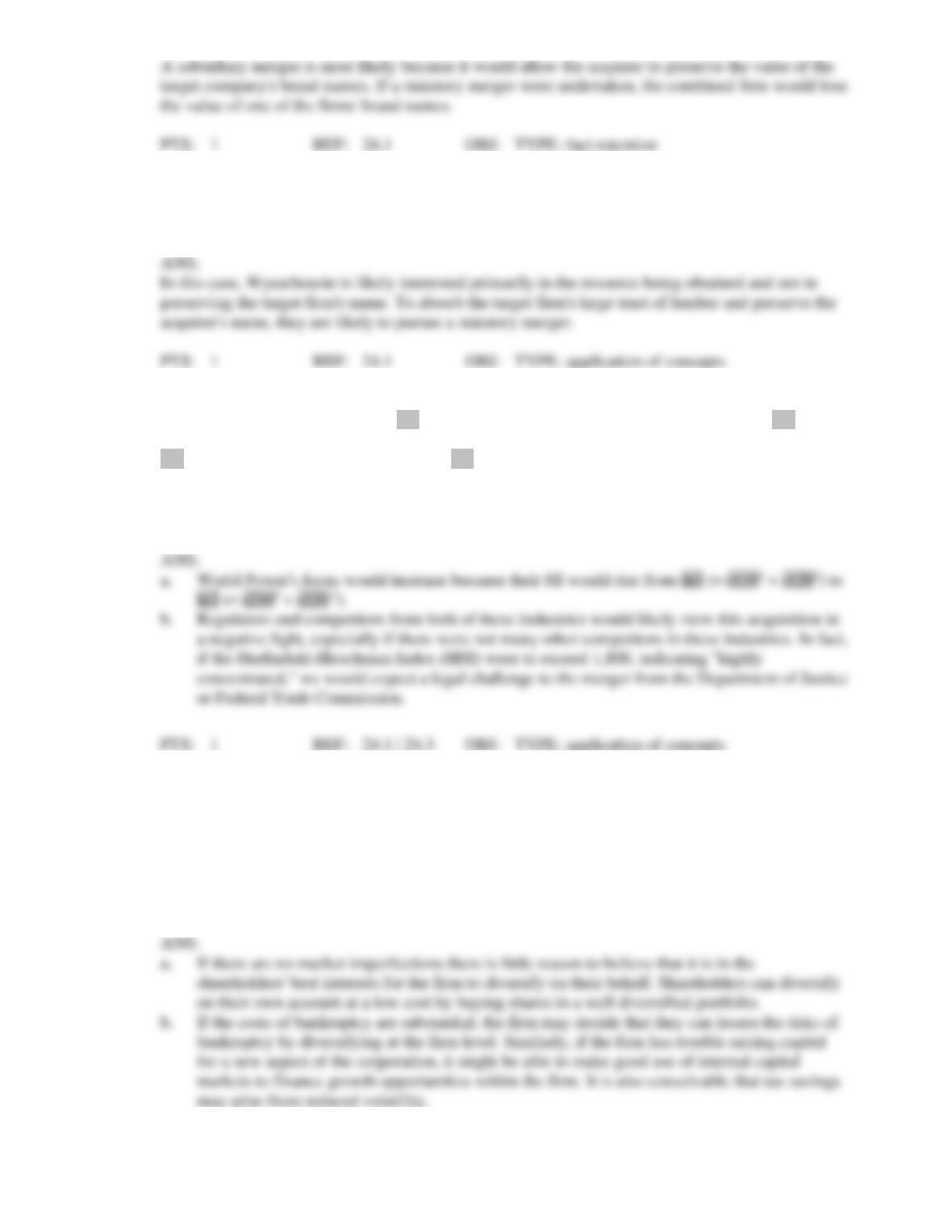
14. Consider two companies with strong individual brand names. If they were to merge, would you expect
to see a subsidiary merger or a statutory merger? Fully explain your view.
15. A large lumber firm, Wyearhousie, is considering the purchase of a small lumber facility to gain
access to a large tract of lumber. Would you expect the merger to be a statutory merger, subsidiary
merger, or consolidation?
16. World Power Inc. is considering a merger with a new firm in its industry, Uppencomer Inc. World
Power’s revenues currently derive r11 percent from the telecommunications industry and r12 percent
from electric power generation. If World Power were to acquire Uppencomer, their revenues would be
r21 percent from telecommunications and r22 percent from electric power generation.
a.
Would this acquisition increase or reduce World Power’s corporate focus?
b.
How might regulators and other competitors in the telecommunications and electric power
generation industries view this acquisition?
World Power’s focus would increase because their HI would rise from hi1 (= r1102 + r1202) to
17. Trucks-4-Fun is interested in acquiring a related firm in an unrelated industry. The rationale for the
merger is solely to reduce the variability in the overall firm’s cash flows. Billy, the largest shareholder,
is in favor of the merger because, as he says, “The diversification benefit is substantial. Our combined
firm cash flows will be much less risky. This is a simple application of portfolio diversification.”
a.
Comment on the benefits of diversification if there are no frictions in capital markets.
b.
Provide two examples where diversification might be meaningful in a situation where markets
are less than perfect.
shareholders’ best interests for the firm to diversify on their behalf. Shareholders can diversify
on their own account at a low cost by buying shares in a well diversified portfolio.
markets to finance growth opportunities within the firm. It is also conceivable that tax savings
may arise from reduced volatility.
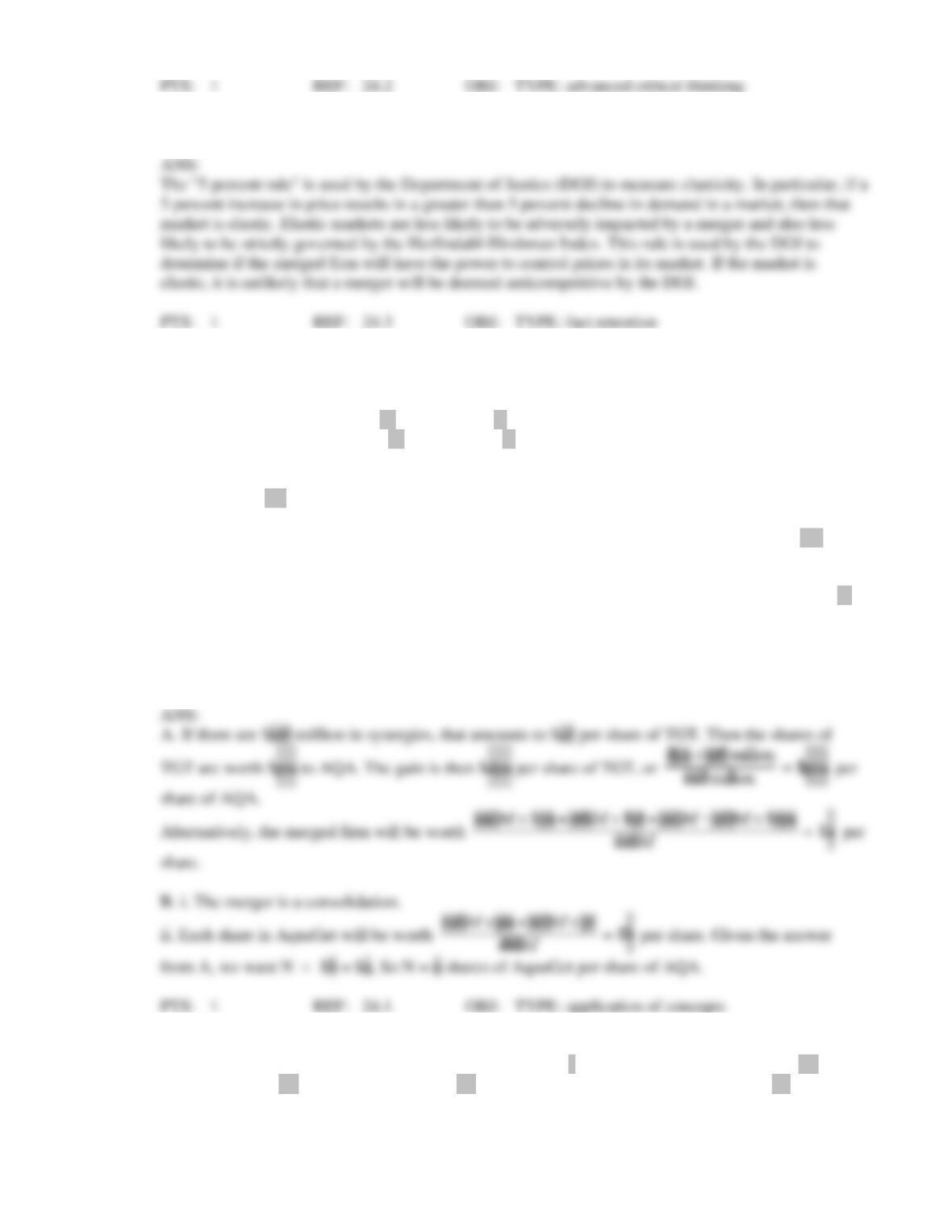
18. Define the “5 percent rule” and discuss how this rule is used to consider potential mergers.
19. AquaCell Technologies (AQA) is considering purchasing Target (TGT). Before any merger
announcements are made, the following is true:
AQA
TGT
Number of shares
na
nt
Stock Price Per Share
$pa
$pt
There will be $m0 million in synergies if these two firms merge (no debt is outstanding).
A. What is the gain (per share of AQA) to current AQA shareholders if AQA buys TGT for $spa per
share?
B. Suppose that, instead of the cash merger, both firms disappear and a new firm, AquaGet, issues sb
shares to be distributed in exchange for shares in either original firm.
i. What is the name for this type of merger?
ii. In order that the synergies be divided as in part A, how many shares of AquaGet should be
granted per original share of AQA?
20. In order that its latest fashions might be promptly displayed by BarbieR and her friends, Gap Inc. has
launched a takeover bid for Mattel. Suppose that Gap has s million shares currently worth $cw each,
while Mattel has ms million shares worth $sw each. If the merger occurs, there will be $ws billion
worth of synergy.
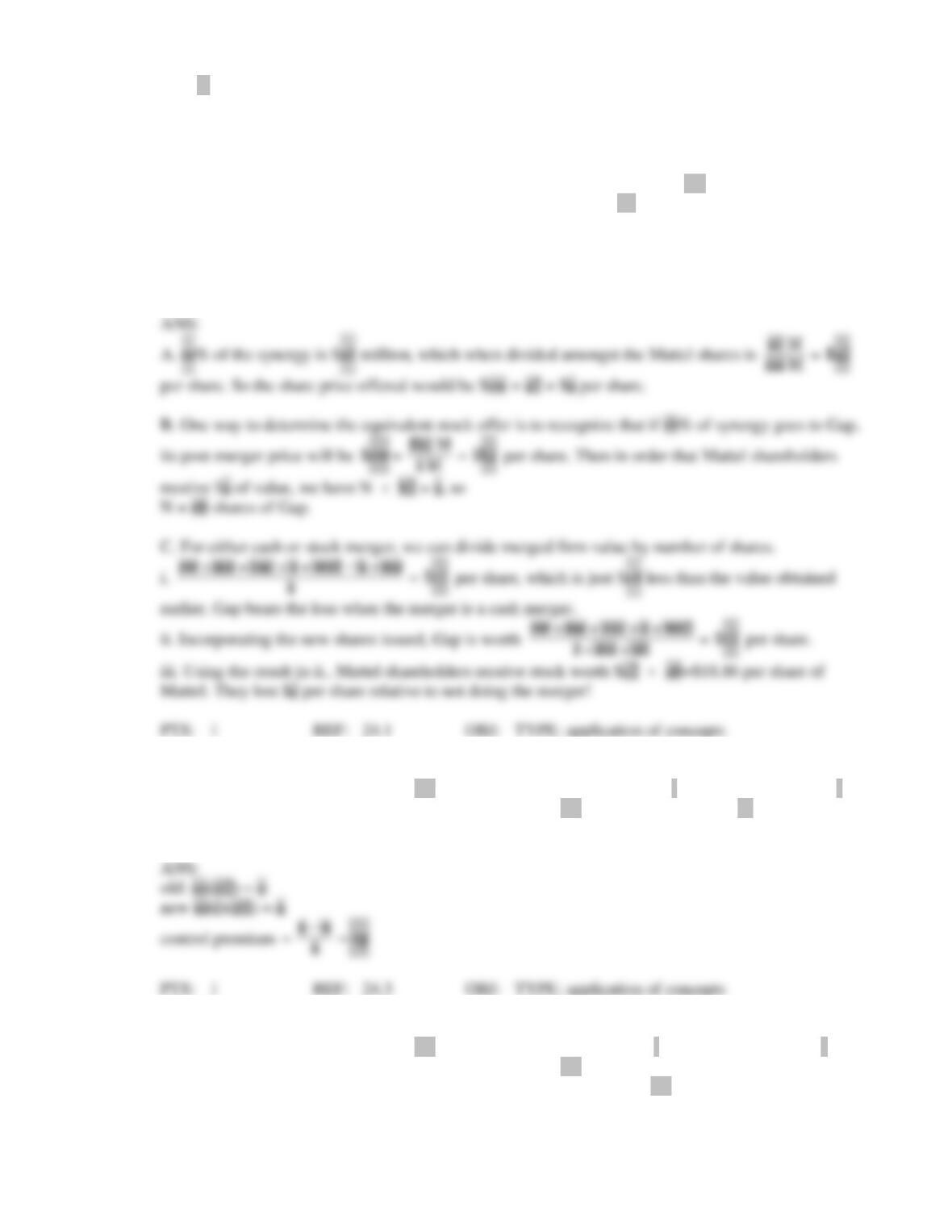
A. If ra% of the total dollar synergy is to go to the target Mattel, what per share price would be offered
in a cash offer?
B.What stock offer would result in the same distribution of synergies?
C. Now suppose that a more correct share price for Gap as a stand-alone is $sac per share. The market
comes to this realization after the merger, and the synergy is still $ws billion.
i.
In the case of a cash merger, what is the value of Gap stock after the merger?
ii.
In the case of a stock merger, what is the value of Gap stock after the merger?
iii.
In the case of a stock merger, how much value was gained or lost per share by Mattel,
relative to remaining as a stand-alone?
21. Bavarian Brew is planning on acquiring Bavarian Sausage in a pure exchange merger. Bavarian
Brew’s stock is currently trading at $ct1 and they set the exchange ratio at r. Bavarian sausage has s
million shares outstanding which are currently trading at $ct2 a share. If you owned so shares of
Bavarian Sausage what would be the percentage control premium?
22. Bavarian Brew is planning on acquiring Bavarian Sausage in a pure exchange merger. Bavarian
Brew’s stock is currently trading at $ct1 and the exchange ratio is set at r. Bavarian Sausage has s
million shares outstanding which are currently trading at $ct2 a share.
Twelve months after the merger Bavarian Brew’s stock price drops to $ct3.
What is the transaction value of the merger before and after the drop in the stock price?
23.
Firm
Market share (%)
1
m1%
2
m2
3
m3
4
m4
5
m5
6
m6
7
m7
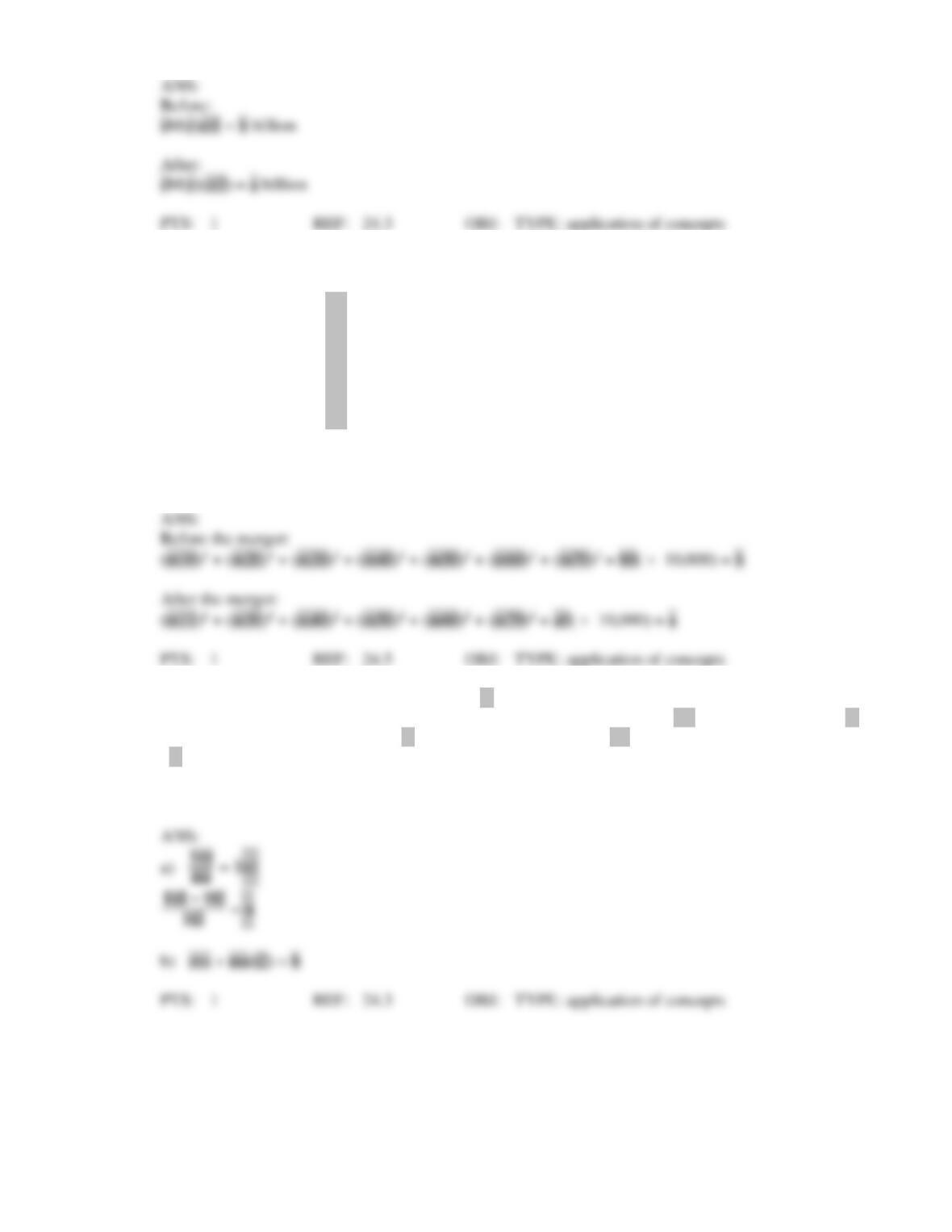
Given the information above, what is the Hefindahl-Hirshman Index of the industry? If companies 1
and 2 were to merge what would be the new HHI?
24. Smith Enterprises can acquire Miller, Inc for $cs in either cash or stock. Both companies are 100%
equity financed. The synergy value created by the acquisition of Smith is $svs. Currently Smith has ss
shares outstanding which trade at $t1 a share, whereas Miller has ms shares outstanding that trade at
$t2 a share.
a) What is the percentage merger premium over Miller’s stock price?
b) What is the value of Miller to Smith?
ESSAY
1. Strategic mergers are often proposed to create a more efficient combined company than either
company in isolation. This is often phrased as “the whole is worth more than the sum of its parts.”
a.
Discuss operational, managerial, and financial synergies as they relate to strategic mergers.
b.
In spite of attractive synergies, why might a merger not occur between two willing firms?
2. The managerialism theory of mergers posits that poorly monitored managers will pursue increases in
firm asset size, even if this is not consistent with shareholder wealth maximization.
a.
Discuss the free cash flow theory, the management entrenchment theory, the hubris hypothesis
of corporate takeovers other explanations of non-value maximizing management decisions.
b.
Do you expect that these problems will be eliminated by our understanding of their existence?
benefits, including greater compensation.. By placing limits on a company’s free cash flow
these problems may be mitigated.
management decisions that make the current management team appear indispensable to the
success of the corporation.
managers may then overbid for the target firms and ultimately realize smaller overall
post-merger returns, thereby diminishing shareholder wealth.
these terms and discuss how they relate to merger and acquisition activity in particular.
Operational synergies include:
through the reduction or elimination of overlapping resources
Economies of scope result when firms can offer functions that were previously infeasible
due to size limitations (such as large-scale R&D efforts or national advertising programs)
Resource complementarities occur when firms’ resources meld to provide advantages to
the whole that neither party could fully capture individually
The resulting combination of managerial expertise provides leadership that can share a vision for
the combined firm.
distress. They are largely the anticipated results of conglomerate mergers.
Trade Commission will prohibit such mergers, which are most often horizontal mergers.
3. Major U.S. antitrust legislation prohibits mergers that would tend to create a monopoly or market
control. The Department of Justice utilizes guidelines to determine whether a market is concentrated.
Currently, the HHI (Herfindahl-Hirschman Index) is used to determine concentration based on market
share. Assume there are n firms in an industry. Eighteen of these firms each have r1% of the market
share. The nineteenth firm has r2% of the market share and the twentieth firm has r3% of the market
share. Discuss market concentration, the use of the HHI, and likely actions if the 19th and 20th firms
in the market are considering merging.
4. An acquiring firm has offered to acquire a target firm for 1 share of acquiring common stock plus $p
for every target share the target shareholders tender. The acquiring firm’s common stock is selling at $s
per share and the target common stock is selling at $t per share.
a.
How much wealth is exchanged and what is the control premium?
b.
Discuss why the acquirer might initially offer (1) less than this or (2) more than this.
serious about the acquisition and not just looking for a bargain purchase.
5. Discuss corporate focus and the use of the Herfindahl Index (HI) incorporating the following
information:
modern corporation.
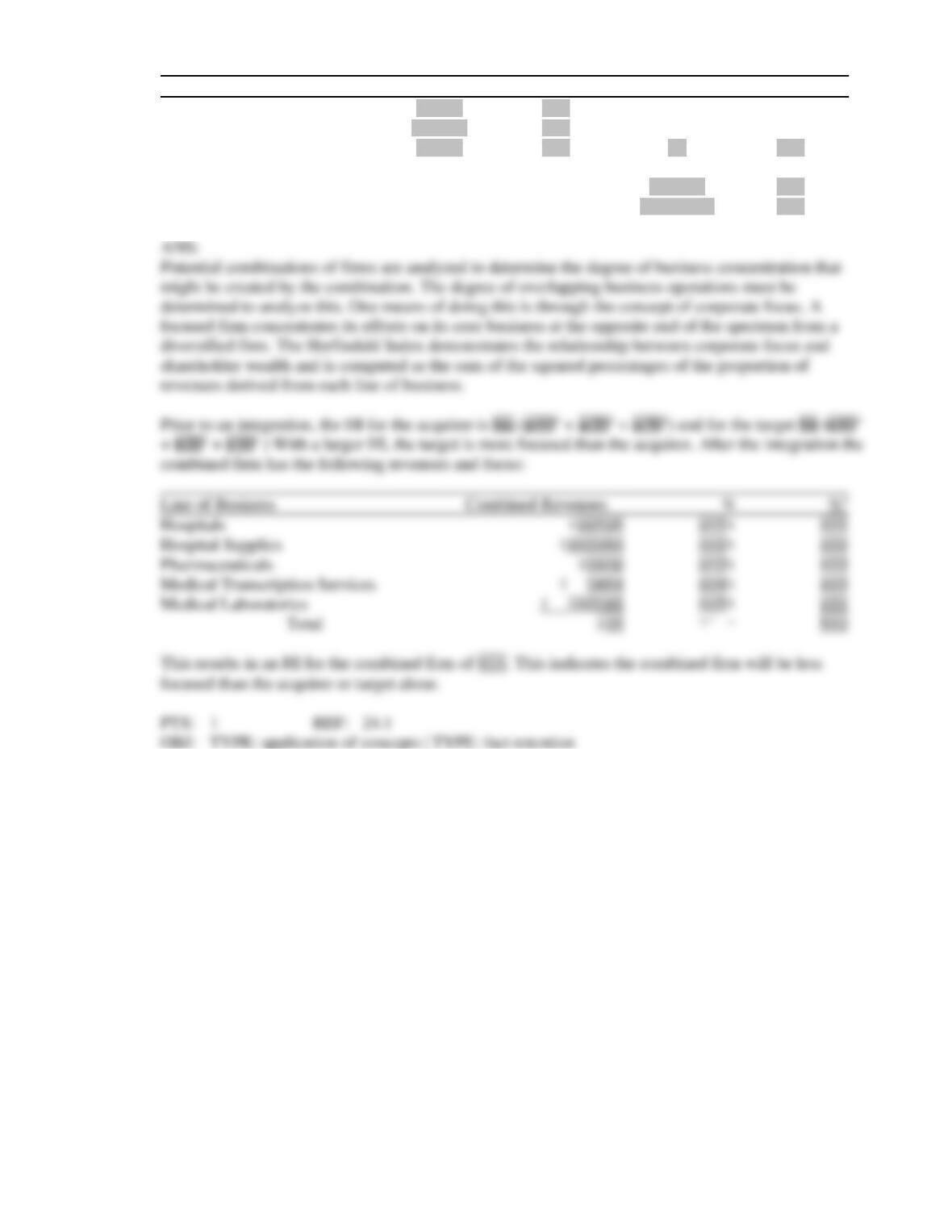
Line of Business
Acquirer Revenues
%
Target Revenues
%
Hospitals
$as1ah
ar1%
Hospital Supplies
$as2ahs
ar2%
Pharmaceuticals
$as3ap
ar3%
$tp
tr1%
Medical Transcription
Services
$tstmts
tr2%
Medical Laboratories
$tsts2tml
tr3%
Line of Business
Hospitals
Hospital Supplies
Pharmaceuticals
Medical Transcription Services
Medical Laboratories