
Biology: A Guide to the Natural World, 5e (Krogh)
Chapter 24 Plants: The Diversity of Life 4
1) Which of the following is characteristic of plants?
A) chloroplasts
B) hyphae
C) a mycelium
D) a cell wall made of chitin
2) Plants are different from all other photosynthetic organisms in that they:
A) are eukaryotic.
B) are green.
C) have photosynthetic pigments.
D) develop from embryos.
3) Woody plants have which two compounds in their cell walls?
A) chlorophyll and cellulose
B) cellulose and lignin
C) chitin and cellulose
D) chitin and lignin
4) In all plants, the diploid (2n) phase produces:
A) sperm and/or eggs.
B) flowers.
C) spores.
D) roots.

5) In alternation of generations in all plants, the multicellular haploid (1n) organism is referred to
as the:
A) zygote.
B) gamete.
C) sporophyte.
D) gametophyte.
6) What trend do we observe as we look at alternation of generations and plant kingdom
evolution?
A) The sporophyte generation is dominant in more advanced plants.
B) The gametophyte generation is dominant in more advanced plants.
C) Only ferns show a significant gametophyte generation.
D) Only gymnosperms show a significant sporophyte generation.
7) Besides cell walls, features often found in plant cells but not in animal cells are:
A) spindle-shaped centrioles.
B) water-filled central vacuoles.
C) mitochondria.
D) nuclei.
E) cell membranes.
8) Bryophytes lack:
A) chlorophyll.
B) spores.
C) gametes.
D) vascular tissue.

9) Which of the following weather conditions would you expect to have the greatest negative
impact on the sexual reproduction of mosses and ferns?
A) cool, damp, and windy conditions
B) above-average temperatures for a few days
C) a long dry period
D) excessively wet and rainy conditions
10) Both mosses and ferns “show their aquatic ancestry” because they:
A) lack a water-repellent cuticle.
B) typically require water for sperm delivery to the egg.
C) have roots that must remain wet at all times.
D) require water for egg laying.
11) Elaborate leaves called “fronds” are found in which group of seedless vascular plants?
A) green algae
B) gymnosperms
C) mosses
D) ferns
12) Which evolutionary plant innovation eliminated the need for sperm to swim through water to
fertilize an egg, resulting in plants being truly adapted for reproduction on land?
A) independent gametophyte
B) rhizoids
C) fruit
D) pollen

4
13) Gymnosperms were the dominant form of plant life on land:
A) around the time the dinosaurs came to dominance.
B) until the discovery of fire by humans.
C) before ferns evolved.
D) about 20 million years ago.
14) Pollen grains contain:
A) spores.
B) eggs.
C) sperm.
D) wings.
15) An advantage that pollen grain evolution gave gymnosperms was:
A) less energy to produce than gametes.
B) airborne sperm transport over great distances.
C) spores with a small food supply inside.
D) eggs no longer had to swim.
16) In general, a seed is a:
A) protected plant embryo with a food supply.
B) reproductive structure that requires pollen to become active.
C) a large spore that grows into the gametophyte.
D) plant ovary.
17) A major difference between gymnosperm and angiosperm seeds is that:
A) gymnosperm seeds are haploid.
B) angiosperm seeds are haploid.
C) gymnosperm seeds are larger.
D) angiosperm seeds are larger.
E) gymnosperm seeds are not surrounded by fruit.
18) You are a naturalist traveling with a group of explorers in the higher elevations of a jungle.
You see an unfamiliar-looking, tall, tree-like plant. It is producing seeds that are attached directly
to a stem, but there appears to be no evidence of flowers associated with the seeds. To which

group of plants does the tree belong?
A) hornworts
B) angiosperms
C) ferns
D) gymnosperms
19) Which statement about conifers such as the spruce tree is most accurate?
A) They comprise a small percentage of angiosperm species.
B) They are rare, fruit-bearing gymnosperms.
C) They comprise about three-fourths of all gymnosperm species.
D) They are the largest seedless vascular plants.
E) Male conifers produce cones while female trees produce flowers.
20) You are a naturalist traveling with a group of explorers in a valley of the Amazon rainforest.
In a particularly wet area, you see a beautiful carpet of small plants. You notice tiny flowers on
most of the plants. To which group do these plants belong?
A) hornworts
B) mosses
C) seedless vascular plants
D) gymnosperms
E) angiosperms
21) Most angiosperms are pollinated with the help of:
A) animals.
B) wind.
C) water currents.
D) farming techniques.
E) fungi.

22) The reserve food in angiosperm seeds is stored in a special tissue called:
A) nectar.
B) the sporophyte.
C) endosperm.
D) the seed coat.
23) Fruit produced by angiosperms is most closely associated with which function?
A) pollination
B) seed dispersal
C) endosperm production
D) nourishing the embryo
E) thigmotropism
24) Which of the following would be an example of an adaptation for seed dispersal?
A) phototropism
B) pinecones
C) nectar production
D) seeds wrapped in burrs
E) deciduous cycles
25) A currently accepted hypothesis for gravitropism in plants is that:
A) sedimentation of organelles triggers hormone release.
B) microscopic eyespots trigger upward (skyward) growth.
C) ground contact inhibits stem growth while air stimulates it.
D) bending of leaves in response to gravity triggers growth in the opposite direction.

26) The hormone IAA helps plants to respond to and grow toward a light source by:
A) slowing growth under low light conditions.
B) increasing mitosis on the side of the shoot facing light.
C) elongating cells on the opposite side of the shoot facing light.
D) triggering release of growth factors at the tip of the stem.
27) You see a plant stem wrapped around a telephone pole, spiraling upward. This plant is
demonstrating:
A) geotropism.
B) thigmotropism.
C) phototropism.
D) photoperiodism.
28) Long-night plants that only flower when they encounter a certain minimum number of hours
of darkness are an example of:
A) geotropism.
B) thigmotropism.
C) phototropism.
D) photoperiodism.
29) Trees that intentionally lose their leaves according to coordinated, seasonal schedules are:
A) deciduous.
B) gametophytes.
C) sporophytes.
D) thigmotropic.

30) Diminished rewards of photosynthesis in winter along with the negatives of water loss and
leaf damage cause many trees to exhibit:
A) photoperiodism.
B) dormancy.
C) thigmotropism.
D) phototropism.
31) In plant life cycles, meiosis produces spores.
32) In plant life cycles, eggs and sperm are produced by mitosis.
33) The life cycle of mosses contains only a haploid generation.
34) The life cycle of flowering plants contains both sporophytes and gametophytes.
35) Ferns differ from mosses in that ferns contain vascular tissue and mosses do not.
36) As a more recently evolved plant group, angiosperms completely lack a gametophyte
generation.
37) Horsetails are a type of seedless vascular plant.
38) Some species of mosses have pollen that does not have to move through water to reach an
egg.

9
39) Endosperm is the nutritional tissue found within a seed.
40) A single type of pinecone is responsible for the production of both pollen and eggs.
Match the following. Answers may be used more than once.
A) seedless vascular plant
B) bryophyte
C) angiosperm
D) gymnosperm
41) Club moss
Topic: Section 24.3
Skill: Knowledge/Comprehension
42) Liverwort
Topic:
Skill: Knowledge/Comprehension
Section 24.3
43) Spruce tree
Topic: Section 24.3
Skill: Knowledge/Comprehension
44) Seeds wrapped in burrs
Topic: Section 24.3
Skill: Knowledge/Comprehension
45) Ferns
Topic: Section 24.3
Skill: Knowledge/Comprehension
Match the following.
A) process that produces spores in plants
B) process that produces gametes in plants
C) the diploid (2n) part of a plant’s life cycle
D) product of gamete fusion

10
E) the haploid (1n) part of a plant’s life cycle
46) Gametophyte
Topic: Section 24.1
Skill: Knowledge/Comprehension
47) Meiosis
Topic: Section 24.1
Skill: Knowledge/Comprehension
48) Zygote
Topic: Section 24.1
Skill: Knowledge/Comprehension
49) Mitosis
Topic: Section 24.1
Skill: Knowledge/Comprehension
50) Sporophyte
Topic: Section 24.1
Skill: Knowledge/Comprehension
51) A spore growing into a plant that will produce sperm or eggs describes the ________
generation of a plant’s life cycle.
52) The three main kinds of seedless vascular plants are: ________, ________, and ________.
53) Ginkgo biloba belongs in the plant group ________.
54) ________ is the angiosperm tissue that is intended for nutrition of the embryo and not animal
seed dispersal but is nonetheless an important food source for people. ________ and ________
are examples of crops in which the endosperm is an important food source for people.
55) Movement of the hormone ________ to different areas of a plant to promote growth is one of
the ways a plant is able to respond to external signals.
56) The story of plant evolution could be described as a story of how plants broke their
dependence on aquatic existence. Explain how you could support this statement.
57) In some areas of the world where there are large numbers of pines, everything is covered in
the spring with a yellow dust that turns out, upon examination, to be pine pollen. Why must
conifers produce so much pollen, and why do we not see as much pollen produced by a field of
flowers?
58) Although they do not possess the nervous and muscular systems animals do, plants are able
to physically respond to their environments. Evaluate and support this statement.
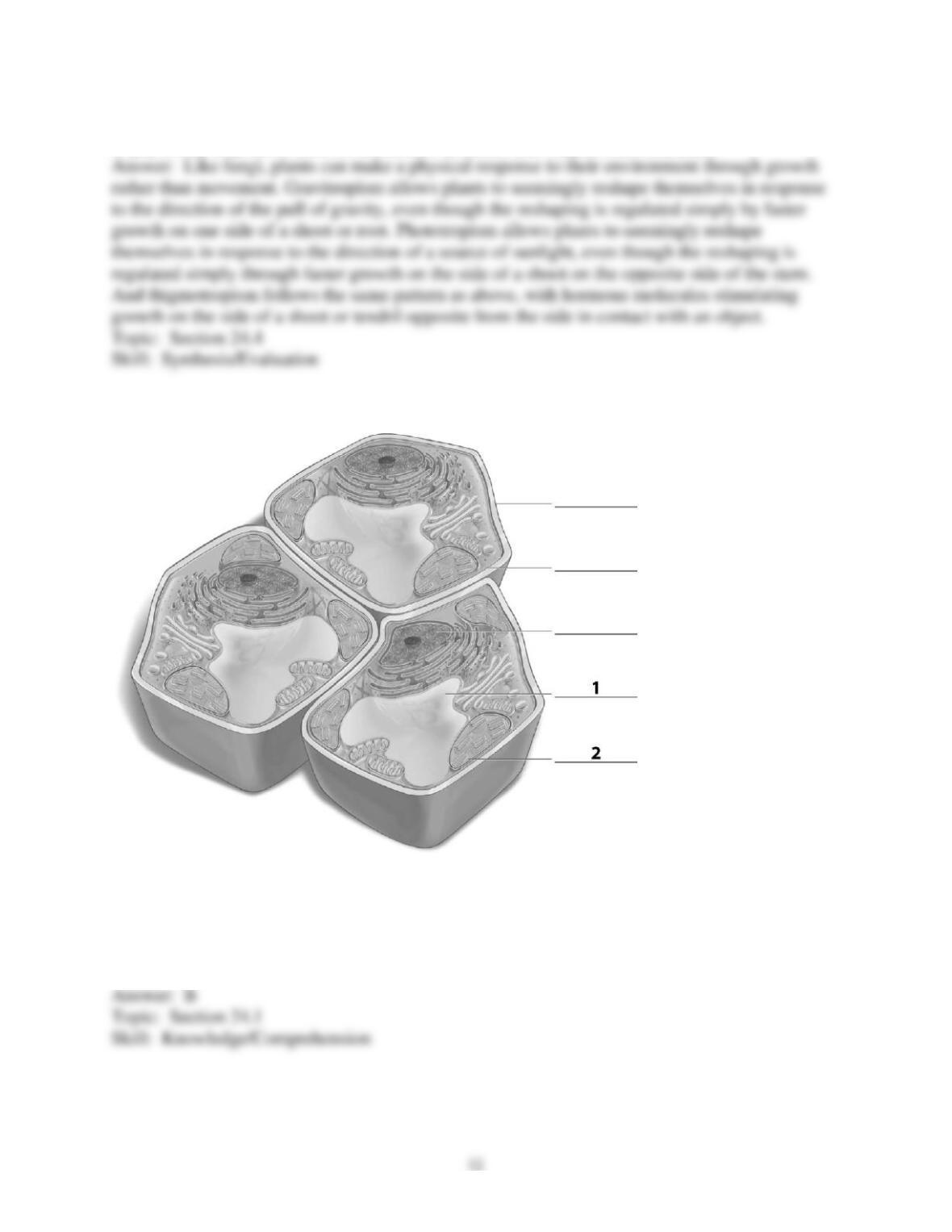
Refer to the figure below, and then answer the following question(s).
59) The missing label indicated by a “1” corresponds to the:
A) cell wall.
B) central vacuole.
C) cell membrane.
D) chloroplast.
60) The missing label indicated by a “2” corresponds to the:
A) cell wall.
B) central vacuole.
C) cell membrane.
D) chloroplast.
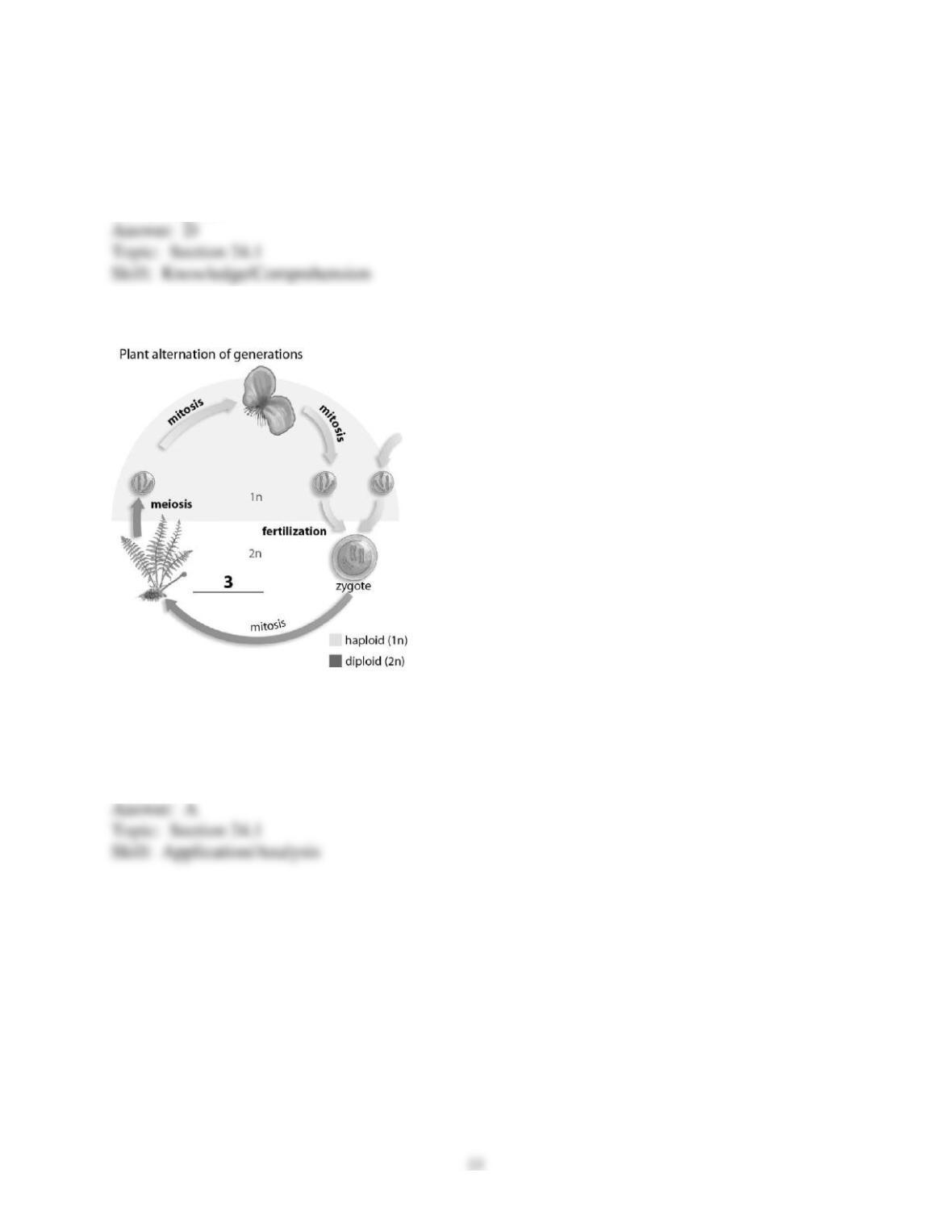
Refer to the figure below, and then answer the question that follows.
61) The missing label indicated by a “3” corresponds to the:
A) multicellular sporophyte.
B) multicellular gametophyte.
C) gametes.
D) spores.