Chapter 24—Lipid Biosynthesis
MULTIPLE CHOICE
1. Fatty acid synthase (FAS) differs from -oxidation in all of the following ways EXCEPT:
a.
occurs in cytosol.
b.
uses NADPH for oxidoreductase reactions.
c.
acyl carrier protein linked intermediates.
d.
all of the enzymes are on one polypeptide.
e.
all are true.
2. What type of linkage occurs between ACP and the intermediates in fatty acid biosynthesis?
a.
an ester
b.
a thioester
c.
an amide
d.
an ether
e.
an acetal
3. There is no transporter for acetyl-CoA to exit the mitochondria, so the carbons must be converted to
____ for transport to the cytosol.
a.
acetone
b.
butyrate
c.
citrate
d.
pyruvate
e.
malonate
4. The main source(s) of NADPH for fatty acid biosynthesis is (are):
a.
TCA cycle.
b.
oxidative phosphorylation.
c.
malic enzyme and the pentose phosphate pathway.
d.
the conversion of OAA to malate by malate dehydrogenase.
e.
glycolysis.
ANS: C PTS: 1
5. The reaction catalyzed by ____ is: Citrate + ATP +CoA → acetyl-CoA + ____ + ____.
a.
citrate synthase; malate; AMP + Pi
b.
citrate synthase; OAA; AMP + PPi
c.
ATP-citrate lyase; OAA; AMP + PPi
d.
ATP-citrate lyase; OAA; ADP + Pi
e.
citrate synthase; OAA; ADP + Pi
6. Reducing equivalents derived from glycolysis in the form of NADH can be transformed into ____ for
fatty acid biosynthesis by the combined actions of ____ and ____.
a.
NADPH; malate dehydrogenase; malic enzyme
b.
NADPH; malate dehydrogenase; malic enzyme
c.
ATP; malate dehydrogenase; malic enzyme
d.
NADH; glyceraldehyde-3-phosphate dehydrogenase; malate dehydrogenase
e.
NADPH; glyceraldehyde-3-phosphate dehydrogenase; malate dehydrogenase
7. The committed step in fatty acid biosynthesis, formation of malonyl-CoA, is catalyzed by:
a.
fatty acid synthase.
b.
pyruvate carboxylase.
c.
propionate carboxylase.
d.
acetyl-CoA carboxylase.
e.
ATP-citrate lyase.
8. All are characteristic of acetyl-CoA carboxylase EXCEPT:
a.
allosteric inhibition by palmitoyl-CoA.
b.
biotin carboxylase and transcarboxylase subunits.
c.
biotin carboxyl carrier protein subunits.
d.
citrate shifts the enzyme toward the active polymer.
e.
all are correct.
9. The coenzyme(s) of acetyl-CoA carboxylase is/are:
a.
biotin and NAD+.
b.
TPP.
c.
NADH and FAD.
d.
TPP and folic acid.
e.
biotin.
10. Which of the following statements regarding phosphorylation of acetyl-CoA carboxylase is correct?
a.
phosphorylation causes activation only in the presence of palmitoyl-CoA
b.
phosphorylation is a result of glucagon binding to its receptor
c.
high [citrate] inhibits the phosphorylated form
d.
phosphorylation causes separation of the polymeric form of the enzyme to inactive
protomers
e.
both b and d are true
11. Acetyl-CoA carboxylase in animals is regulated by all of the following EXCEPT:
a.
allosterically stimulated by citrate.
b.
phosphorylation by protein kinase A.
c.
allosterically inhibited by palmitoyl-CoA.
d.
allosterically stimulated by ATP.
e.
all are correct.
12. Phosphorylation of regulatory sites on acetyl-CoA carboxylase ____ the affinity for citrate and ____
the affinity for fatty acyl-CoAs requiring ____ levels of fatty acyl-CoAs for inhibition.
a.
increases; decreases; low
b.
decreases; increases; high
c.
decreases; increases; low
d.
increases; decreases; high
e.
none are correct
13. Acyl carrier protein has the same ____ group as the “business end” of ____.
a.
thiamin; TPP
b.
biotin; acetyl-CoA carboxylase
c.
phosphoadenosine; cAMP
d.
pyridoxal phosphate; vitamin B6
e.
phosphopantetheine; CoA
14. The formation of acetoacetyl-ACP is catalyzed by:
a.
-ketoacyl-ACP synthase (KSase).
b.
acetyl-CoA carboxylase.
c.
acetyl transacylase.
d.
-hydroxyacyl dehydratase.
e.
-ketoacyl reductase.
15. In fatty acid synthase, the correct sequence of enzyme catalyzed reactions are:
A.
-ketoacyl-ACP synthase
B.
-ketoacyl reductase
C.
-hydroxyacyl dehydratase
D.
enoyl reductase
E.
acetyl transferase
a.
A, B, C, D, E
b.
C, B, D, E, A
c.
B, A, C, D, E
d.
A, C, B, E, D
e.
D, E, A, B, C
16. Which of the following is true regarding fatty acid elongation?
a.
malonyl CoA provides 2 carbons for each round of elongation
b.
two reductions take place with both reactions using NADPH as the source of electrons
c.
the fatty acid that is being elongated is attached to CoA
d.
occurs only in cytosol
e.
by not performing the second reduction reaction, an unsaturated fatty acid with a cis
double bond can be formed
Garrett/Grisham 5e Test Bank 4
17. Stearoyl-CoA desaturase has all of the following characteristics EXCEPT:
a.
NADH and O2 are required.
b.
produces a trans double bond.
c.
involves cytochrome b5 reductase.
d.
involves cytochrome b5.
e.
occurs in the endoplasmic reticulum.
18. In E. coli, -hydroxydecanoyl-ACP is dehydrated by –hydroxydecanoyl thioester dehydrase to form a
double bond ____ to the thioester in the ____ configuration which is further elongated to form ____.
a.
,; cis; palmitoyl-ACP
b.
,; cis; palmitoleoyl-ACP
c.
,; trans; palmitoleoyl-ACP
d.
,; trans; palmitoleoyl-ACP
e.
,; cis; palmitoyl-ACP
19. E. coli does NOT have any ____ fatty acids, plants can introduce double bonds into fatty acids
between 9 and the ____-end of the chain, while mammals can only introduce double bonds between
9 and the ____-end of the chain.
a.
saturated; carboxyl; methyl
b.
mono-unsaturated; carboxyl; methyl
c.
polyunsaturated; carboxyl; methyl
d.
polyunsaturated; methyl; carboxyl
e.
saturated; methyl; carboxyl
20. All of the following are characteristics of arachidonic acid EXCEPT:
a.
it contains five cis-double bonds.
b.
it is a precursor of leukotrienes and most prostaglandins.
c.
it is an omega-6 fatty acid.
d.
it can be synthesized from linoleic acid in mammals.
e.
all are correct.
21. Regulation of fatty acid synthesis in humans is affected by all of the following EXCEPT:
a.
malonyl-CoA binding to carnitine acyltransferase inhibits available substrate for –
oxidation.
b.
citrate stimulates acetyl-CoA carboxylase.
c.
acyl-CoAs are inhibitors of acetyl-CoA carboxylase.
d.
insulin receptor binding maintains acetyl-CoA carboxylase in the inactive form.
e.
glucagon promotes phosphorylation and inactivation of acetyl-CoA carboxylase.
22. Which of the following is correctly paired with its effect upon fatty acid synthesis?
a.
palmitoyl CoA: activates
b.
glucagon: activates
c.
insulin: inhibits
d.
citrate: activates
e.
NADPH: inhibits
23. Insulin promotes the ____ of acetyl-CoA carboxylase and ____ of triacylglycerol lipase by ____ the
phosphodiesterases that converts cAMP to AMP.
a.
activation; inactivation; stimulating
b.
inactivation; activation; stimulating
c.
inactivation; activation; inhibiting
d.
activation; inactivation; inhibiting
e.
none are true
24. Both glycerol and dihydroxyacetone phosphate can serve as precursors for phosphatidic acid. Which
enzyme is NOT USED to catalyze reactions in the synthesis of phosphatidic acid from these two
precursors?
a.
glycerol kinase
b.
triose phosphate isomerase
c.
acyldihydroxyacetone-P reductase
d.
glycerol-3-phosphate acyltransferase
e.
1-acylglycerol-3-phosphate acyltransferase
25. CDP–diacylglycerols are precursors for the synthesis of all EXCEPT:
a.
phosphatidylethanolamine.
b.
phosphatidyl glycerol.
c.
cardiolipins.
d.
phosphatidylinositol.
e.
all are true.
26. In eukaryotes, phosphatidic acid is converted directly either to ____ or to ____ from which all other
____ are derived.
a.
triacylglycerols; monoacylglycerols; acylglycerols
b.
acylglycerols; phospholipids; glycerophospholipids
c.
monoacylglycerols; phospholipids; glycerophospholipids
d.
diacylglycerols; CDP-diacylglycerols; glycerophospholipids
e.
diacylglycerols; CDP-diacylglycerols; acylglycerols
27. Components for plasmalogen biosynthesis include all EXCEPT:
a.
CDP-ethanolamine.
b.
fatty acyl-CoA.
c.
NADPH, NADH and O2.
d.
long-chain alcohol.
e.
glycerol.
28. Platelet-activating factor displays dramatic ability to ____ blood vessels and thus ____ blood pressure,
and to aggregate platelets.
a.
dilate; reduce
b.
dilate; reduce
c.
constrict; increase
d.
constrict; increase
e.
constrict; increase
29. The carbons of sphinganine are derived from:
a.
palmitate and glycerol.
b.
arachidonate and glycine.
c.
fatty alcohol and dihydroxyacetone phosphate (DHAP).
d.
palmitate and serine.
e.
none of the above.
30. Sphinganine is acylated in the ____-position.
a.
3-OH
b.
2-NH2
c.
1-OH
d.
3-NH2
e.
all are true
31. A lipid that does NOT have a sphingosine backbone is:
a.
ganglioside GM1.
b.
sphingomyelin.
c.
phosphatidylinositol.
d.
ceramide.
e.
cerebroside.
32. ____ are all derived from 20-carbon fatty acids that are acylated to membrane phospholipids and
released by the enzyme ____.
a.
Arachidonates; triacylglycerol lipase
b.
Arachidonates; phospholipase A1
c.
Eicosanoids; phospholipase A1
d.
Eicosanoids; phospholipase A2
e.
Arachidonates; phospholipase A2
33. Which of the following statements concerning eicosanoids is correct?
a.
all thromboxanes contain a 1,3-dioxane ring
b.
all prostaglandins contain a cyclic ether
c.
all leukotrienes contain three conjugated double bonds
d.
leukotirenes are derived from prostaglandin H2 while thromboxanes are derived from
arachidonic acid
e.
none of the above
34. An important mechanism of arachidonate release and eicosanoid synthesis involves ____ and ____.
a.
insulin release; high blood sugar
b.
glucagon release; low blood sugar
c.
tissue injury; low blood sugar
d.
inflammation; tissue injury
e.
all are true
35. All are true for aspirin EXCEPT:
a.
it does not affect the peroxidase activity of prostaglandin endoperoxide synthase (COX).
b.
it inhibits the activity of prostaglandin endoperoxide synthase (COX).
c.
it stimulates ring opening in prostaglandin synthesis.
d.
it acetylates the serine in the active site of the cyclooxygenase (COX).
e.
it is classed as a non-steroidal anti-inflammatory drug (NSAID).
36. All are characteristics of COX-2 inhibitors EXCEPT:
a.
selectively block inflammation mediated by COX-2.
b.
are NSAIDs.
c.
less potential for stomach lesions than aspirin.
d.
less renal toxicity than COX-1 inhibitors.
e.
all are correct.
37. The PRIMARY site, but not the only site, of cholesterol synthesis is:
a.
heart.
b.
intestine.
c.
muscle.
d.
liver.
e.
adipose.
38. The correct sequence for synthesis of mevalonate from acetyl-CoA is:
A.
HMG-CoA synthase
B.
formation of 3-hydroxy-3-methylglutaryl-CoA
C.
-ketothiolase catalyzed condensation
D.
HMG-CoA reductase activity
E.
Formation of acetoacetyl-CoA
a.
E, C, D, A, B
b.
C, D, A, B, E
c.
E, B, A, C, D
d.
E, A, B, D, C
e.
C, E, A, B, D
39. The committed step in cholesterol biosynthesis is catalyzed by:
a.
HMG-CoA synthase.
b.
mevalonate kinase.
c.
HMG-CoA reductase.
d.
squalene monooxygenase.
e.
HMG-CoA lyase.
40. All are regulatory mechanisms of HMG-CoA reductase EXCEPT:
a.
low [cholesterol] increases mRNA for HMG-CoA reductase.
b.
high [cholesterol] increases half-life for HMG-CoA reductase.
c.
high [cholesterol] results in lower mRNA for HMG-CoA reductase.
d.
phosphorylation by cAMP cascade inactivates HMG-CoA reductase.
e.
phosphatases activate HMG-CoA reductase.
41. The appropriate sequence of intermediates between mevalonate and squalene are:
A.
geranyl pyrophosphate
B.
isopentenyl pyrophosphate
C.
5-phosphomevalonate
D.
farnesyl pyrophosphate
E.
dimethylallyl pyrophosphate
a.
A, C, D, B, E
b.
C, B, E, A, D
c.
C, E, A, D, B
d.
E, C, B, D, A
e.
B, C, D, A, E
42. Characteristics of squalene monooxygenase include all EXCEPT:
a.
requires a soluble protein activator.
b.
bound to the endoplasmic reticulum (ER).
c.
uses FAD and NADPH.
d.
requires O2.
e.
all are true.
43. The “statins” are a series of drugs used to:
a.
inhibit fatty acid synthesis in diet drugs.
b.
widely prescribed drugs used to inhibit squalene monooxygenase.
c.
derivatives or mimics of mevinolin used to inhibit HMG-CoA reductase.
d.
derivatives of cholesterol used to lower cholesterol levels.
e.
none are true.
44. Order the lipoproteins from lowest density to highest density.
A.
chylomicrons
B.
HDL
C.
IDL
D.
VLDL
E.
LDL
a.
D, A, E, B, C
b.
D, E, C, B, A
c.
A, E, B, D, C
d.
D, C, A, E, B
e.
A, D, C, E, B
45. Dietary lipids are “packaged” in the intestine into ____ for transport via the lymphatic system.
a.
chylomicrons
b.
HDL
c.
IDL
d.
VLDL
e.
LDL
46. Which of the following lipoproteins is INCORRECTLY defined?
a.
chylomicron: transport of dietary lipids to the liver
b.
HDL: scavenger of extra-hepatic cholesterol
c.
LDL: transport of cholesterol to extra-hepatic tissue
d.
VLDL: transport of triacylglycerols from the liver
e.
all of the above are correct
47. The major circulatory complex for cholesterol and cholesterol esters that is often referred to a “bad
cholesterol” is the:
a.
chylomicrons.
b.
HDL.
c.
IDL.
d.
VLDL.
e.
LDL.
48. Lipoproteins consist of a core of ____ and ____ surrounded by a single layer of ____, into which is
inserted ____ and ____.
a.
proteins; triacylglycerols; cholesterol esters; phospholipids; cholesterol
b.
triacylglycerols; cholesterol esters; phospholipids; proteins; cholesterol
c.
phospholipids; cholesterol esters; triacylglycerols; proteins; cholesterol
d.
cholesterol esters; proteins; cholesterol; phospholipids; triacylglycerols
e.
triacylglycerols; cholesterol; proteins; cholesterol esters; phospholipids
Garrett/Grisham 5e Test Bank 10
49. Lipoprotein lipase hydrolyzes ____ from VLDL particles to convert the VLDL into ____.
a.
cholesterol esters; HDL particles
b.
cholesterol esters; LDL particles
c.
triacylglycerols; LDL particles
d.
triacylglycerols; chylomicrons
e.
triacylglycerols; HDL particles
50. Which of the following is FALSE regarding HDL pariticales?
a.
high HDL levels correlates with high risk of cardiovascular disease.
b.
an HDL life span is typically 5 to 6 days.
c.
they are initially formed as HDL precursors that contains no cholesterol or cholesterol
esters.
d.
scavenges excess cholesterol from extrahepatic tissue and returns cholesterol and
cholesterol esters to liver.
e.
accumulates cholesterol esters via LCAT action.
51. The general genetic defect responsible for ____ is the absence or dysfunction of ____ in the body such
that blood cholesterol levels are typically 300 to over 800 mg/dL.
a.
hypocholesterolemia; triacylglycerol lipase
b.
hypercholesterolemia; lipoprotein lipase
c.
LCAT; LDL receptors
d.
familial hypercholesterolemia; LDL receptors
e.
familial hypocholesterolemia; HDL receptors
52. All are correct for bile salts EXCEPT:
a.
made by the liver and utilized in the intestine.
b.
derived from cholesterol.
c.
conjugates of bile acids with glycine and taurine.
d.
highly effective as detergents.
e.
insert well into membranes because they are strictly nonpolar.
53. Characteristics of mixed-function oxidases include all EXCEPT:
a.
usually involve cytochrome P-450.
b.
often catalyze hydroxylation reactions on ring-systems such as sterols.
c.
use both NADPH and O2.
d.
one product is CO2.
e.
all are correct.
54. ____ is an intermediate on the biosynthetic pathway from cholesterol to both male and female
hormones.
a.
Aldosterone
b.
Progesterone
c.
Cortisol
d.
Estradiol
e.
Testosterone
55. Which of the following catalyzes the conversion of cholesterol to pregnenolone, the first step in the
conversion of cholesterol to steroid based hormones?
a.
7--hydroxylase
b.
desmolase
c.
steroid 5--reductase
d.
aromatase
e.
17-ketoreductase
56. Properties of progesterone include all EXCEPT:
a.
produced from pregnenolone in ER.
b.
synthesis in the adrenal cortex activated by ACTH.
c.
prepares the uterus for attachment of a fertilized ovum.
d.
secreted from corpus luteum in late menstrual cycle.
e.
all are true.
57. Male baldness, prostate hyperplasia and prostate cancer have been implicated in elevated levels of
____ and treatment involves inhibition of ____.
a.
glucocorticoids; gluconeogenesis
b.
stanozolol; lactate dehydrogenase
c.
dihydrotestosterone; steroid 5-reductase
d.
cholesterol; mevinolin
e.
none of the above
58. All are true for the action of cortisol EXCEPT:
a.
stimulates gluconeogenesis and glycogen synthesis in liver.
b.
inhibits protein synthesis and stimulates protein degradation in muscle.
c.
inhibits allergic and inflammatory responses.
d.
exerts an immunosuppressive effect and an inhibition of wound healing.
e.
all are true.
59. Which of the following is correctly paired with its precursor?
a.
cholesterol → palmitic acid
b.
arachidonic acid → prostaglandins
c.
testosterone → progesterone
d.
aldosterone → cholic acid
e.
none of the above
60. Which of the following molecules would have an inhibitory effect upon the overall process of fatty
acid synthesis?
a.
citrate
b.
insulin
c.
palmitoyl CoA
d.
NADPH
e.
none of the above
61. How many NADPH are required to make one molecule of palmitic acid from acetyl CoA?
a.
7
b.
8
c.
14
d.
16
e.
21
62. Which of the following CANNOT be made from acetyl CoA?
a.
cholesterol
b.
pyruvate
c.
acetoacetate
d.
squalene
e.
palmitate
63. The role of citrate in fatty acid synthesis makes it an important regulator of the process. Which of the
following enzymes would be allosterically activated by citrate?
a.
Citrate lyase
b.
Malic enzyme
c.
Acetyl-CoA carboxylase
d.
-ketoacyl-ACP synthase
e.
None of the above
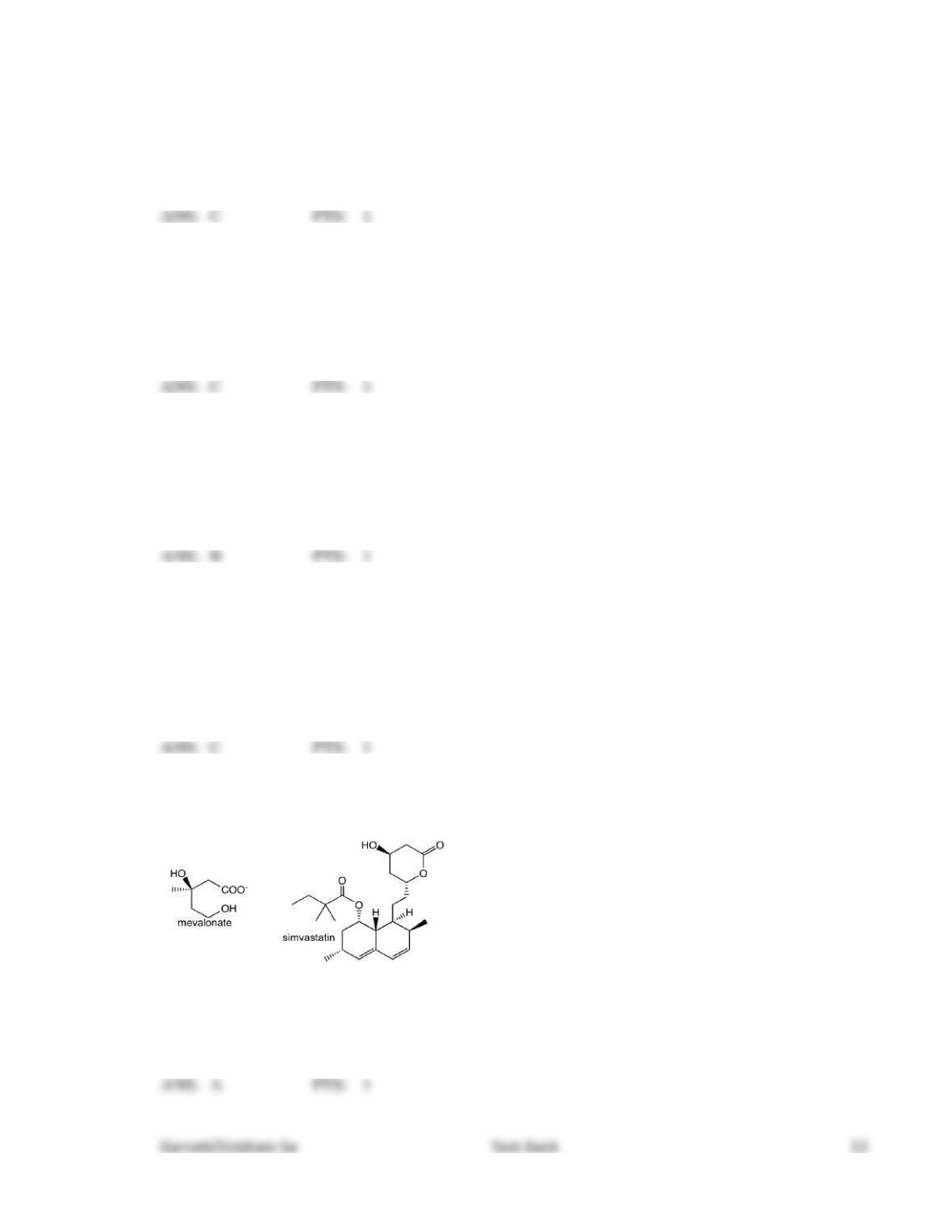
64. HMG-CoA reductase, the regulatory enzyme for the synthesis of cholesterol, is inhibited by
simvastatin. Based upon the structure of the product, mevalonate, and the structure of simvastatin,
what sort of enzyme inhibition would be produced by simvastatin?
a.
competitive
b.
non-competitive
c.
uncompetitive
d.
mechanism-based inactivator
e.
none of the above
65. Which of the following statements is true regarding lipid metabolism?
a.
The synthesis of one molecule of cholesterol requires 5 molecules of mevalonate
b.
The synthesis of fatty acids from acetyl CoA involves reduction by NADPH and FADH2
c.
Synthesis of fatty acids involves a coordinated effort of fatty acid synthase complex and
the acyl carrier protein
d.
The conversion of lanosterol to cholesterol requires only 4 steps, two that remove methyl
groups, an isomerization, and a reduction
e.
The synthesis of fatty acids involves a series of reactions catalyzed by several separate
enzymes, thus requiring the substrates to diffuse from one enzyme to the next