Elements of Ecology, 9e (Smith)
Chapter 24 Aquatic Ecosystems
24.1 Short Answer Questions
1) Classification of aquatic ecosystems is largely based on features of the ________
environment.
2) The general term for flowing bodies of freshwater is ________.
3) Non-flowing water ecosystems, such as ponds and lakes, are also called ________
ecosystems.
4) In lakes and ponds, the open-water zone extending to the depth of light penetration is referred
to as the ________ zone.
5) In lakes and ponds, the ________ zone is a shallow-water zone along the perimeter in which
light reaches the bottom.
6) In lakes and ponds, the depth at which respiration balances photosynthesis is referred to as the
________ depth of light.
7) The tiny, photosynthetic, primary producers of open water such as desmids, diatoms, and
filamentous algae are referred to as ________.
8) In the benthic zone of lakes and ponds, organisms that are attached to or move on a
submerged substrate but do not penetrate it are referred to as ________.
9) A relatively ________ lake is characterized by an abundance of nutrients, abundant algal
growth, and shallow light penetration.
10) Lakes that receive large amounts of organic matter from surrounding land, particularly in the
form of humic materials that stain the water brown, are called ________ lakes.
11) Flowing-water ecosystems often alternate two different but related habitats: the turbulent
________ and the quiet pool.
12) Invertebrates that feed on the algal coating of stones and rubble in streams and rivers are
referred to as ________.
13) Streams generally have a(n) ________ temperature at their headwaters than toward their
outlet.
14) ________ fish are those that live most of their lives in marine environments and return to
freshwater to spawn.
15) When rivers flow into the ocean, they create a zone that mixes freshwater with saltwater
referred to as a(n) ________.
16) The water above the continental shelf belongs to the ________ province of the pelagic zone.
17) The zone in the ocean from the surface to approximately 200 meters deep is called the
________ zone.
18) Smaller than diatoms, the ________, which include tiny cyanobacteria, haptophtyes, and
coccolithophores, make up the largest biomass in temperate and tropical water.
19) Reef-building corals have a symbiotic relationship with algal cells called ________ that live
within the cells of corals.
20) A(n) ________ is a ring of coral reefs and islands surrounding a lagoon that is formed when
a volcanic mountain subsides beneath the surface.
24.2 Multiple-Choice Questions
1) Which of the following bodies of water best represents a lotic ecosystem?
A) salt pond
B) marsh
C) oxbow lake
D) stream
2) ________ are mountainous lakes that have been carved by glacial erosion and deposition.
A) Marshes
B) Oxbows
C) Reservoirs
D) Tarns
3) In lakes and ponds, photosynthesis occurs primarily in the
A) benthic zone.
B) profundal zone.
C) limnetic zone.
D) lotic zone.
4) In ponds and lakes, the zone beneath the depth of effective light penetration but above the
bottom is referred to as the
A) littoral zone.
B) limnetic zone.
C) profundal zone.
D) benthic zone.
5) In lakes and ponds, decomposition occurs primarily in the
A) benthic zone.
B) littoral zone.
C) limnetic zone.
D) profundal zone.
6) What is missing from the profundal zone?
A) nutrients
B) light
C) fish
D) fungus
7) What is the main form of photosynthetic life in the limnetic zone?
A) phytoplankton
B) floating species
C) emerging species
D) submergent species
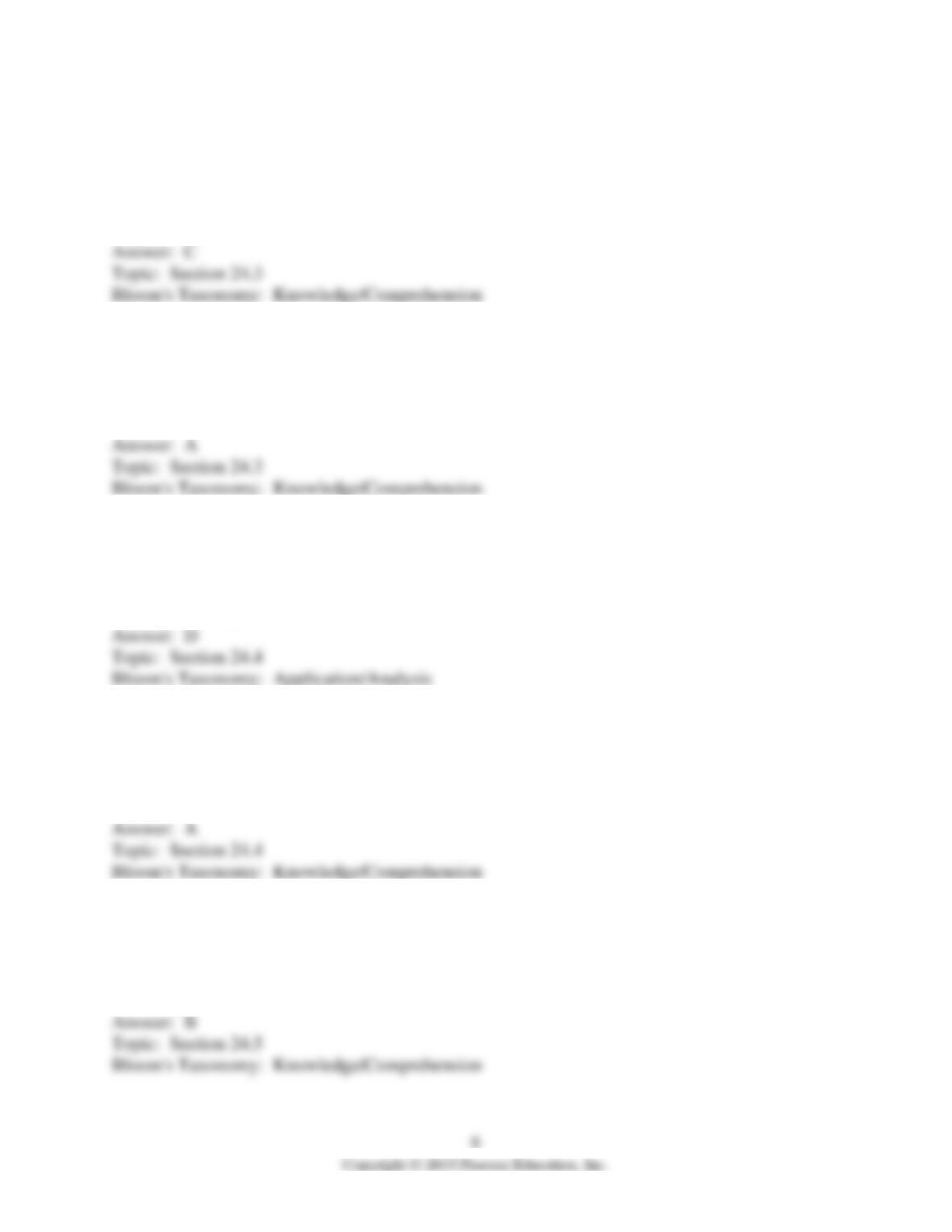
8)
What are present in the photo?
A) phytoplankton
B) zooplankton
C) aufwuchs
D) hellgrammites
9) In lakes and ponds, phytoplankton and zooplankton are most abundant in the
A) benthic zone.
B) littoral zone.
C) limnetic zone.
D) profundal zone.
10) In lakes and ponds, oxygen concentrations are lowest in the
A) benthic zone.
B) littoral zone.
C) limnetic zone.
D) profundal zone.
11) Which of the following lakes is likely to be the most oligotrophic?
A) small and shallow
B) small and deep
C) large and shallow
D) large and deep
12) Which type of lake has the largest amount of nutrients?
A) eutrophic
B) oligotrophic
C) dystrophic
D) lotic
13) In streams and rivers, decomposition occurs primarily in
A) riffles.
B) pools.
C) runs.
D) rapids
14) Streams are classified according to orders. If two first-order streams join, flow through a
valley, and are joined by another first-order stream, what is the final stream order?
A) first order
B) second order
C) third order
D) fourth order
15) What is a riffle?
A) the deepest part of the streambed bottom
B) a pool of water in a stream
C) an herbivorous aquatic insect
D) a fast-moving shallow body of water
16) Which order of stream would likely be found at the highest elevation?
A) first order
B) second order
C) third order
D) fourth order
17) Which of the following feeds on FPOM?
A) caddisflies
B) shredders
C) filtering collectors
D) grazers
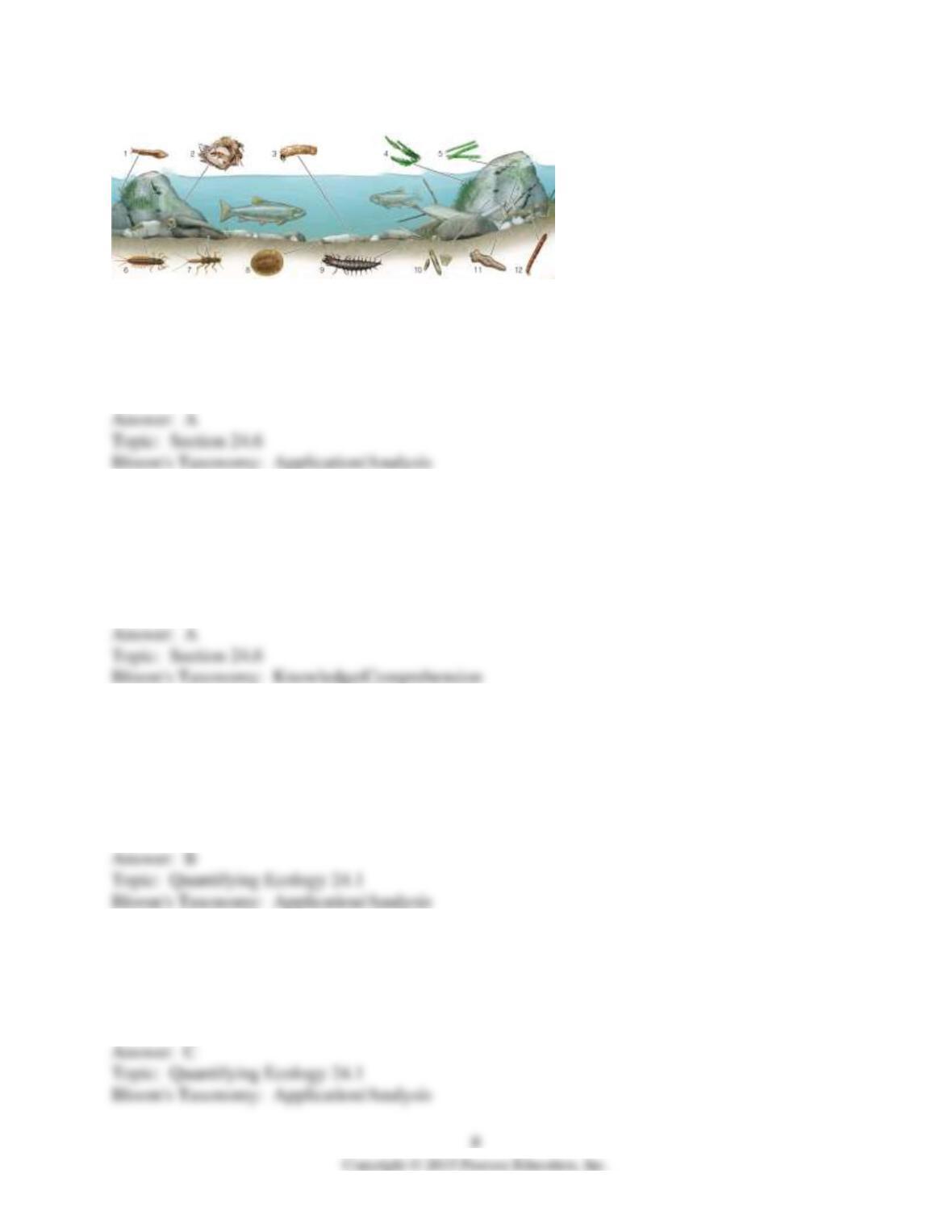
18)
Based on the taxa in the picture, which type of habitat is this?
A) fast stream
B) slow stream
C) pond
D) marine
19) Invertebrates that feed on coarse particulate organic matter (CPOM), such as leaves that fall
into streams and rivers, are referred to as
A) shredders.
B) gougers.
C) grazers.
D) collectors.
20) If a stream has an average depth of 3 meters, an average width of 4 meters, and an average
stream velocity of 0.24 m/s, what is the discharge rate or streamflow (Q)?
A) 0.187 m3/s
B) 3 m3/s
C) 12 m3/s
D) 48 m3/s
21) Which of the following would have the fastest flow, given the same discharge?
A) deep wide stream
B) deep narrow stream
C) shallow narrow stream
D) shallow wide stream
22) As a stream or river descends, it generally grows
A) faster and cooler.
B) slower and warmer.
C) faster and warmer.
D) slower and cooler.
23) Shredders, collectors, and small predatory fish such as sculpins, darters, and trout are the
dominant organisms collectively found in
A) estuaries.
B) small headwater streams.
C) medium-sized streams.
D) large rivers.
24) Semi-enclosed areas of the coastal ocean where seawater is diluted and partially mixed with
freshwater coming from the land are referred to as
A) eddies.
B) coastal reservoirs.
C) tidal basins.
D) estuaries.
25) Many physical features dictate life in an estuary. The physical feature with the most
influence on organismal distribution is
A) light.
B) nutrients.
C) salinity.
D) temperature.
26) The oxygen-minimum layer of an ocean occurs in the
A) abyssalpelagic zone.
B) bathypelagic zone.
C) epipelagic zone.
D) mesopelagic zone.
27) The dominant autotrophs of the open water are
A) phytoplankton.
B) kelp.
C) seagrasses.
D) stromatolites.
28) In the ocean, swimming organisms that can move at will in the water column are referred to
as
A) periphyton.
B) zooplankton.
C) megaplankton.
D) nekton.
29) The organisms living on the bottom of the ocean are collectively referred to as
A) nekton.
B) benthos.
C) meiofauna.
D) epifauna.
30) The benthic community of an ocean, with the exception of hydrothermal vents, is best
described as
A) completely heterotrophic and very diverse.
B) completely autotrophic and very diverse.
C) completely phototrophic and not very diverse.
D) mostly heterotrophic and not very diverse.
31) In hydrothermal vent communities, autotrophic organisms obtain energy by oxidizing
A) reduced sulfur compounds.
B) carbon dioxide.
C) sodium chloride.
D) metals such as copper and iron.
32) The cells of reef-building corals are inhabited by symbiotic species of
A) algae.
B) fungi.
C) bacteria.
D) cyanobacteria.
33) Coral reefs grow best where water is
A) warm, shallow, and clear.
B) warm, deep, and clear.
C) cold, shallow, and clear.
D) cold, deep, and murky.
34) The productivity of oceans is greatest in the
A) neritic province at tropical latitudes.
B) oceanic province at tropical latitudes.
C) neritic province at temperate latitudes.
D) oceanic province at temperate latitudes.
35) Dead zones typically are
A) lacking in nutrients.
B) lacking in decomposers.
C) lacking in oxygen.
D) all of the above.

24.3 True/False Questions
1) Non-flowing water bodies, such as lakes, are referred to as lotic ecosystems.
2) Lakes can be formed from both geological and nongeological activity.
3) In the profundal zone of a lake or pond, the rate of photosynthesis exceeds the rate of
respiration.
4) Phytoplankton thrive in the limnetic zone of lakes and ponds.
5) Oxygen concentrations are relatively high in the bottom ooze of lakes and ponds.
6) Eutrophic lakes are typically clear, with little algal growth.
7) In rivers and streams, the invertebrates that scrape algae off rocks are referred to as shredders.
8) The velocity of water in a stream channel is greater along the margins of the channel than in
the center of the channel.
9) As a stream flows down its course, it generally becomes warmer and slower.
10) Most estuarine organisms are benthic.
11) Inflowing river waters most often impoverish rather than fertilize estuaries.
12) Photosynthesis in the ocean takes place mostly in the mesopelagic zone.
13) The deepest water of an ocean in deep-sea trenches and canyons is referred to as the
hadalpelagic zone.
14) Unlike phytoplankton, which are at the mercy of currents, zooplankton can move at will
within a current.
15) Many zooplankton migrate to the surface to graze on phytoplankton during the day and
retreat to deeper water during the night.
16) Swimming organisms in the ocean that are able to move at will in the water column are
referred to as nekton.
17) Bioluminescence reaches its greatest development in the mesopelagic zone of an ocean.
18) The organisms responsible for the majority of primary production in marine environments
are the copepods.
19) Because of the high pressure and cold temperatures, few species of organisms survive in the
deep benthic zone of the ocean.
20) Organisms living in deep-sea hydrothermal vents do not need light to obtain their energy.
21) Coral reefs occur in nutrient-poor areas of the ocean.
22) Barrier reefs are separated from land by shallow lagoons.
23) Because the thermocline is permanent in tropical oceans, little vertical mixing occurs,
resulting in low productivity.

24.4 Essay Questions
1) Describe three processes that can lead to the formation of a lake or pond.
2) Describe the types of organisms and biological activities that occur within the littoral,
limnetic, and benthic zones of a lake.
3) Describe the differences between eutrophic and oligotrophic lakes. What conditions lead to
the formation of each?
4) Based on their feeding behavior, describe three major groups of invertebrates that inhabit
flowing water.
5) Describe the physical conditions to which organisms living in an estuary must be adapted.
6) Describe the differences between phytoplankton, zooplankton, and nekton. How do they
interact with one another?
7) Describe the microbial loop and how it relates to the plankton food chain.
8) Describe three types of reefs and how they are formed.
9) Describe how primary productivity of the oceans is regulated by light and nutrients.