C) If a firm purchases a piece of equipment, the expense is a capital expenditure. Therefore, the purchase
price can be depreciated over time, generating a depreciation tax shield.
D) If the equipment is leased and the lease is a non–tax lease, there is no capital expenditure, but the lease
payments are an operating expense.
31) Which of the following statements is false?
A) The lease–equivalent loan is the loan that is required on the purchase of the asset that leaves the
purchaser with the same obligations as the lessor would have.
B) Lease obligations themselves could trigger financial distress.
C) When a firm enters into a lease, it is committing to lease payments that are a fixed future obligation of
the firm.
D) When a firm leases an asset, it is effectively adding leverage to its capital structure (whether or not the
lease appears on the balance sheet for accounting purposes).
32) Which of the following statements is false?
A) We can compare leasing to buying the asset using equivalent leverage by discounting the incremental
cash flows of leasing versus buying using the after–tax borrowing rate.
B) A non–tax lease is attractive if it offers a better interest rate than would be available with a loan.
C) Evaluating a true tax lease is much more straightforward than evaluating a non–tax lease.
D) To determine whether a non–tax lease offers a better rate, we discount the lease payments at the firm’s
pretax borrowing rate and compare it to the purchase price of the asset.
33) Which of the following discount rates should be used for the lease versus borrow decision?
A) The risk–free rate of interest.
B) The company’s cost of borrowing.
C) The company’s after–tax cost of borrowing.
D) The company’s weighted average cost of capital.
34) Which of the following is considered an unfair comparison?
A) FMV lease versus $1.00–out lease
B) $1.00–out lease versus true tax lease
C) Lease versus buy
D) Lease versus borrow
Use the information for the question(s) below.
St. Martin’s Hospital plans to purchase or lease a $2 million dollar CT scanner. If purchased, the CT scanner will be
depreciated on a straight–line basis over five years, after which it will be worthless. If leased, the annual lease payments
will be $500,000 per year for five years. St. Martin’s borrowing cost is 8%, and its tax rate is 35%.
35) What is the amount of the lease–equivalent loan for the CT Scanner?
A) $74,890.28
B) $1,749,890.28
C) $3,487,027.19
D) $2,367,559.51
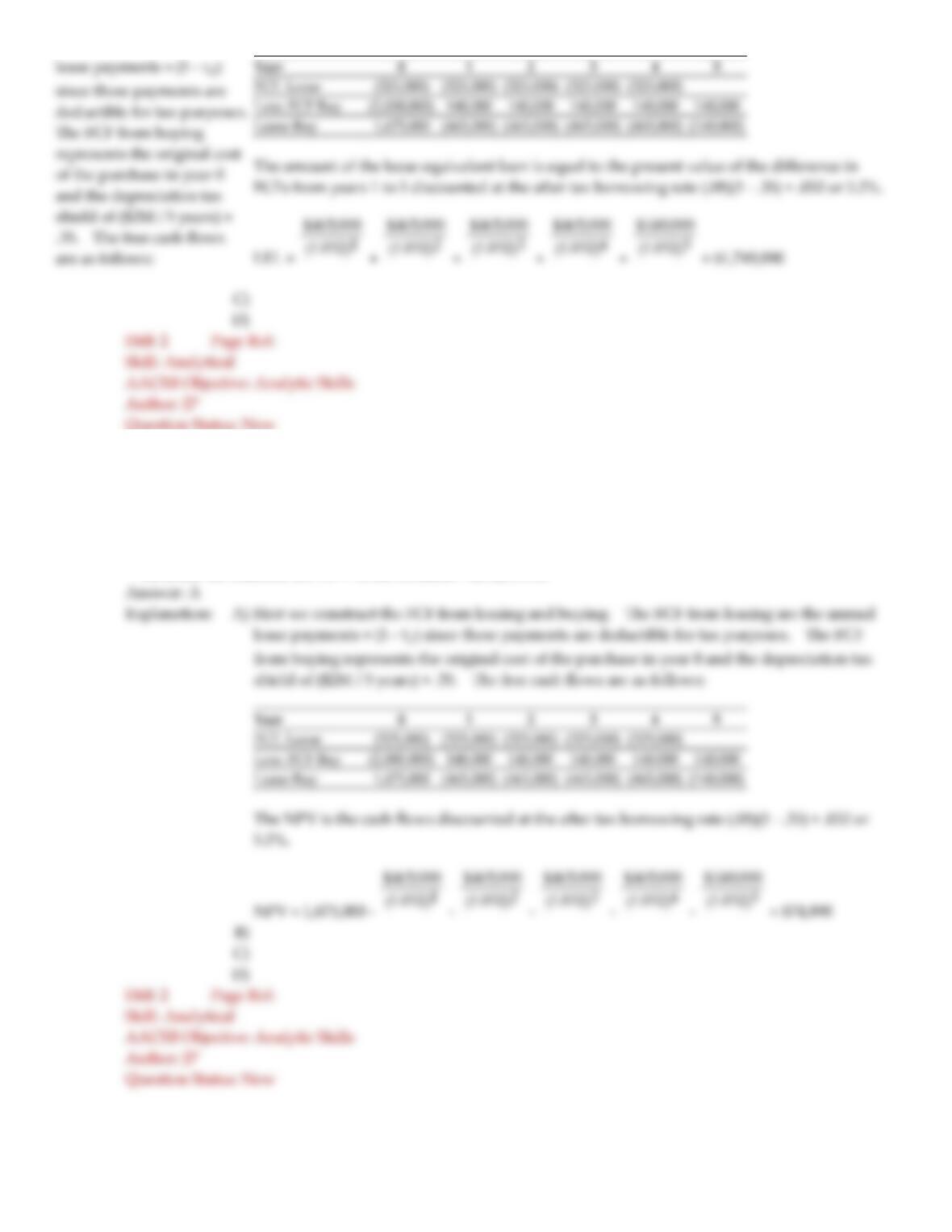
36) Should St. Martin lease the scanner or borrow the funds and buy the scanner?
A) Buy the scanner; the NPV of the decision = $74,890.28.
B) Buy the scanner; the NPV of the decision = $1,749,890.28
C) Lease the scanner; the NPV of the decision = $1,812,027.19
D) Lease the scanner; the NPV of the decision = $692,559.51
SHORT ANSWER. Write the word or phrase that best completes each statement or answers the question.
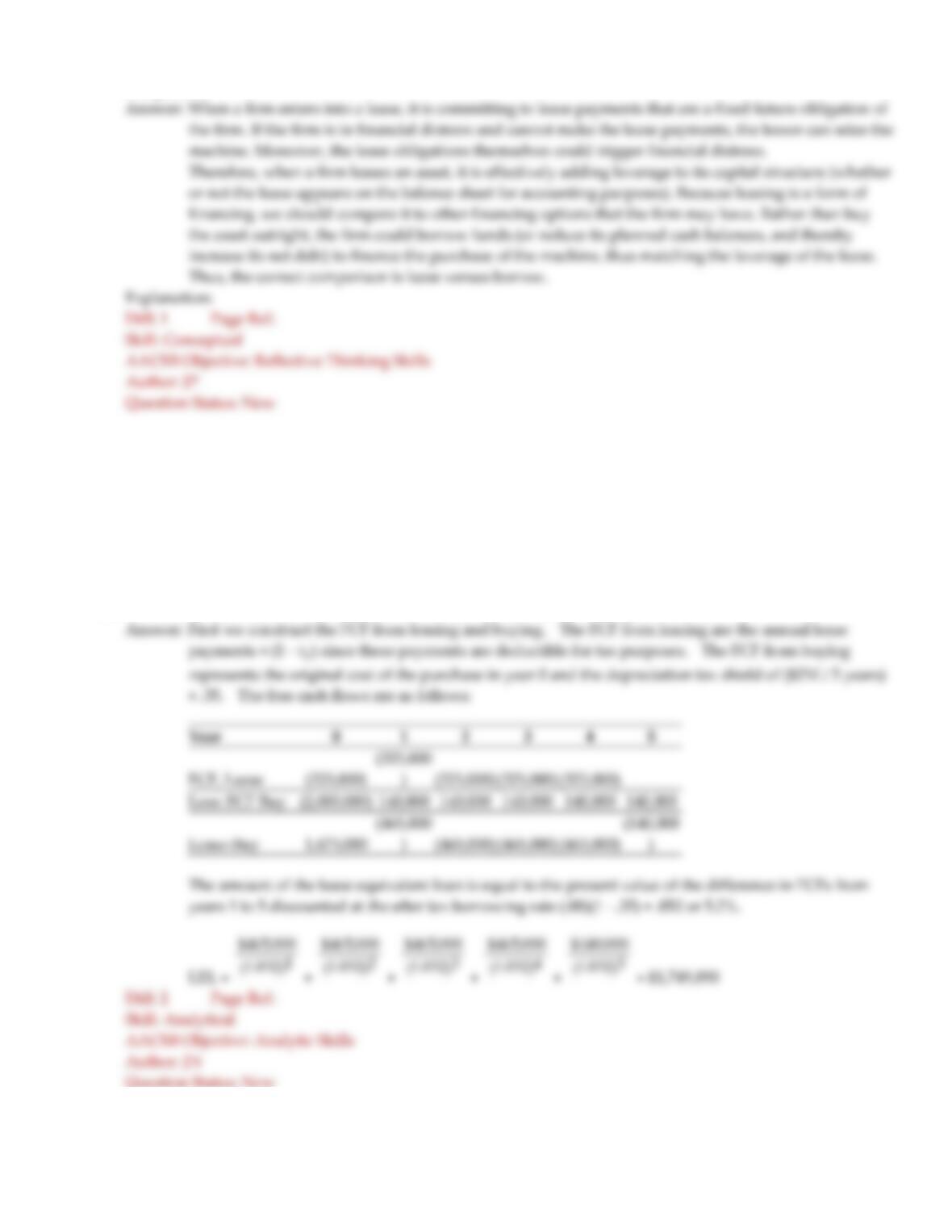
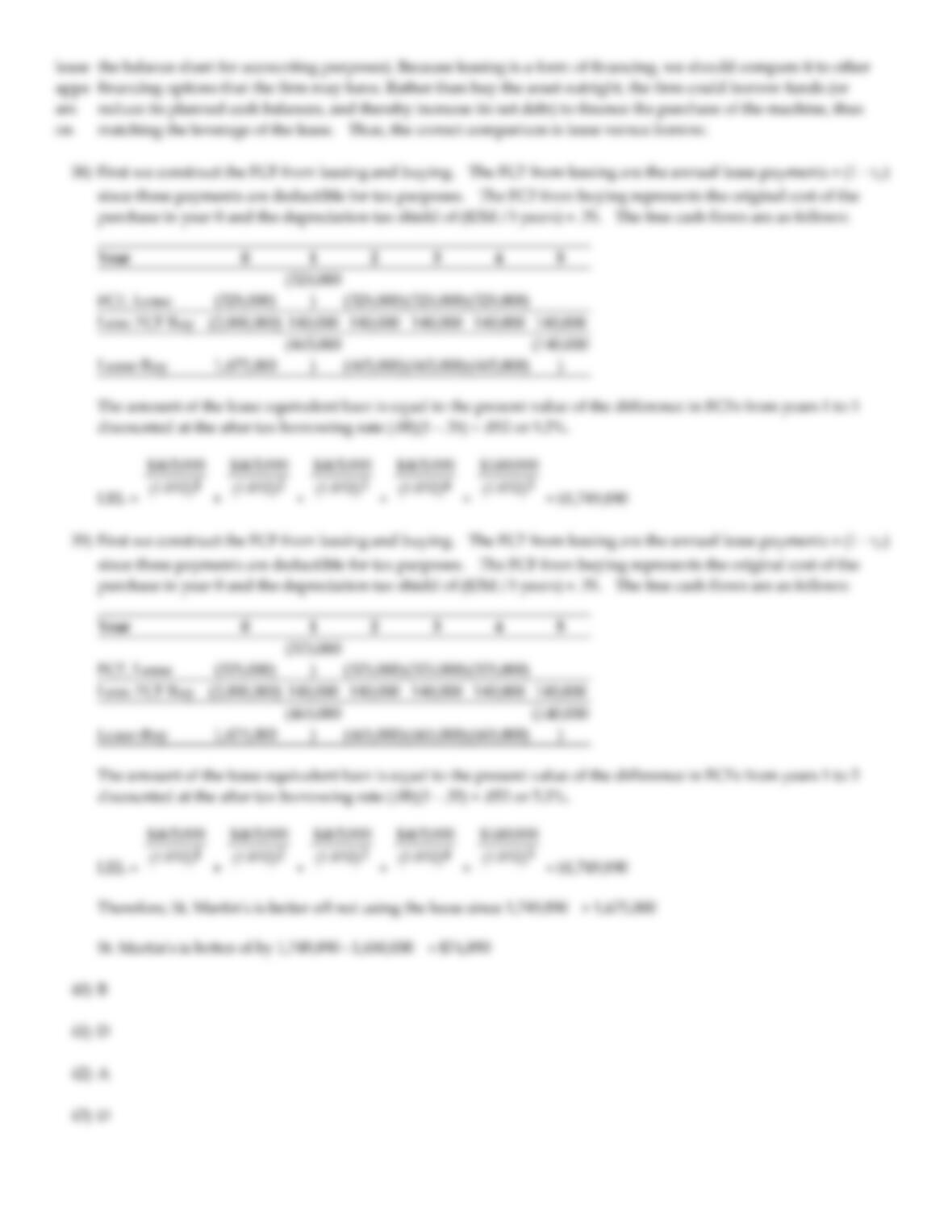
37) In the chapter, the lease versus buy decision was called an unfair comparison. Why? What is the correct
comparison?
ESSAY. Write your answer in the space provided or on a separate sheet of paper.
Use the information for the question(s) below.
St. Martin’s Hospital plans to purchase or lease a $2 million dollar CT scanner. If purchased, the CT scanner will be
depreciated on a straight–line basis over five years, after which it will be worthless. If leased, the annual lease payments
will be $500,000 per year for five years. St. Martin’s borrowing cost is 8%, and its tax rate is 35%.
38) If St. Martin purchases the CT scanner, what is the amount of the lease–equivalent loan?
39) Is St. Martin’s better off leasing the CT scanner or financing the purchase of the CT scanner with a
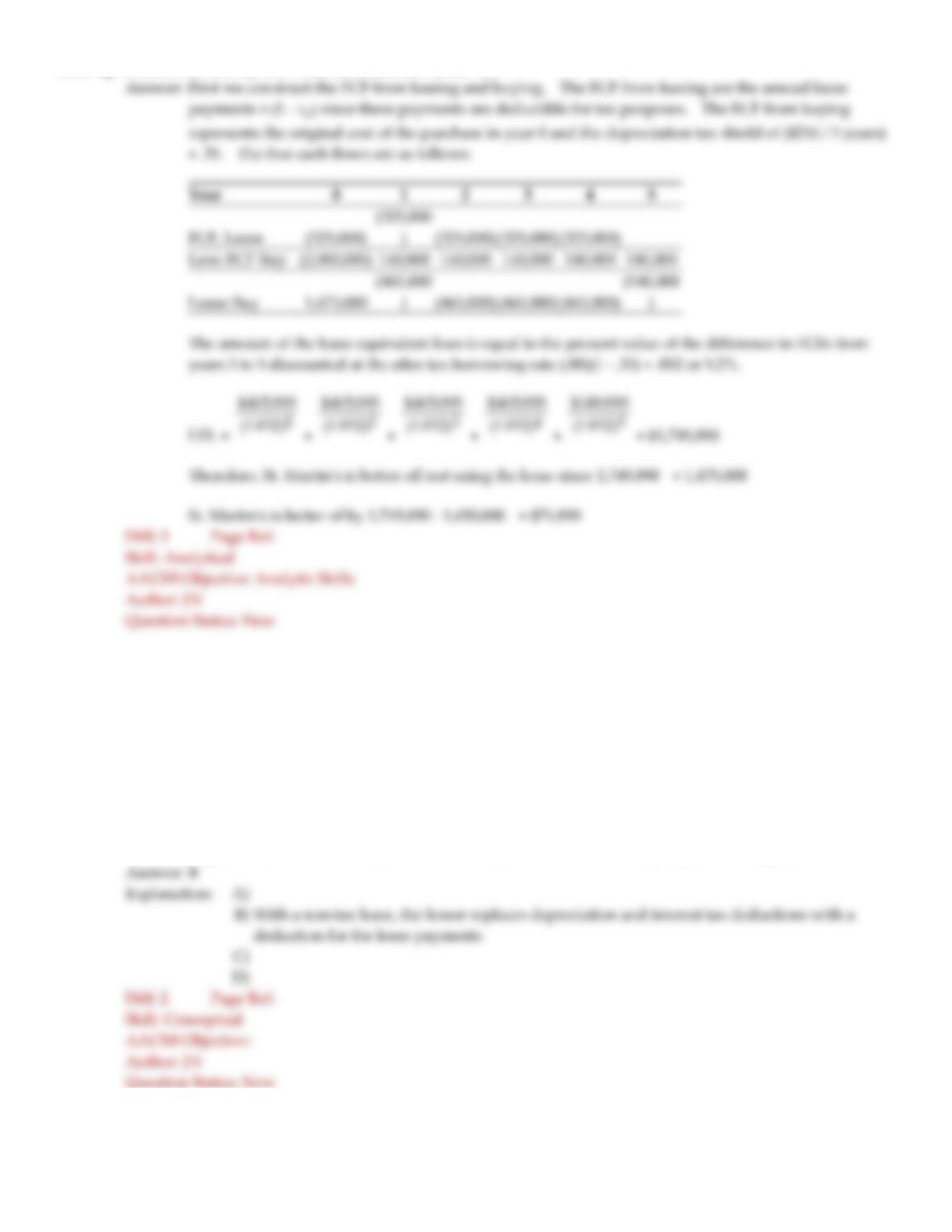
lease–equ ivalent loan and by how much is St Martin’s better off?
MULTIPLE CHOICE. Choose the one alternative that best completes the statement or answers the question.
40) Which of the following statements is false?
A) For a lease to be attractive to both the lessee and the lessor, the gains must come from some underlying
economic benefits that the leasing arrangement provides.
B) With a true tax lease, the lessor replaces depreciation and interest tax deductions with a deduction for
the lease payments.
C) Generally speaking, if the asset’s tax depreciation deductions are more rapid than its lease payments, a
true tax lease is advantageous if the lessor is in a higher tax bracket than the lessee.
D) A tax gain occurs if the lease shifts the more valuable deductions to the party with the higher tax rate.
41) Which of the following is a valid argument for leasing?
A) tax differences
B) reduced resale costs
C) efficiency gains from specialization
D) All of the above are valid arguments for leasing.
42) Which of the following explains why reducing leverage through off–balance sheet financing is not a valid
argument for leasing?
A) Whether they appear on the balance sheet or not, lease commitments are liabilities for the firm.
B) For most large corporations, the amount of leverage the firm can obtain through a lease is unlikely to
exceed the amount of leverage the firm can obtain through a loan.
C) Some companies may place limits on the dollar amounts a manager can invest over a certain period.
D) All of the above are reasons why reducing leverage through off–balance sheet financing is not a valid
argument for leasing.
43) Which of the following statements is false?
A) If a firm only needs to use the asset for a short time, it is probably less costly to lease it than to buy and
resell the asset.
B) While owners of assets are likely to resell them only if the assets are “lemons,” a short–term lease can
commit the user of an asset to return it regardless of its quality. In this way leases can help mitigate the
adverse selection problem in the used goods market.
C) Car dealerships are in a better position to sell a used car at the end of a lease than a consumer is.
D) If the asset’s tax depreciation deductions are faster than its lease payments, there are tax gains from a
true tax lease if the lessor is in a lower tax bracket than the lessee.
44) Which of the following statements is false?
A) By offering assets together with complementary services, lessors can achieve efficiency gains and offer
attractive lease rates.
B) Assets leased under a true lease are afforded bankruptcy protection and cannot be seized in the event
of default.
C) Because of the higher recovery value in the event of default, a lessor may be able to offer more
attractive financing through the lease than an ordinary lender could.
D) Lessors often have efficiency advantages over lessees in maintaining or operating certain types of
assets.
45) Which of the following statements is false?
A) Most financial analysts and sophisticated investors consider operating leases (which must be listed in
the footnotes of the financial statements) to be additional sources of leverage.
B) By carefully avoiding the four criteria that define a operating lease for accounting purposes, a firm can
avoid listing the long–term lease as a liability.
C) Because a lease is equivalent to a loan, the firm can increase its actual leverage without increasing the
debt–to–equity ratio on its balance sheet.
D) For most large corporations, the amount of leverage the firm can obtain through a lease is unlikely to
exceed the amount of leverage the firm can obtain through a loan.
46) Which of the following statements is false?
A) Leasing allows the party best able to bear the risk to hold it. For example, small firms with a low
tolerance for risk may prefer to lease rather than purchase assets.
B) When the lessor is the manufacturer, a lease in which the lessor bears the risk of the residual value can
improve incentives and lower agency costs.
C) For leases in which the lessor retains a substantial interest in the asset’s residual value, the lessee has
more of an incentive to take proper care of an asset that is leased rather than purchased.
D) Whether they appear on the balance sheet or not, lease commitments are a liability for the firm.