333)
Monopolies misallocate resources because
333)
A)
price does not equal average variable cost.
B)
marginal cost does not equal average total cost.
C)
profits are usually positive.
D)
price does not equal marginal cost.
334)
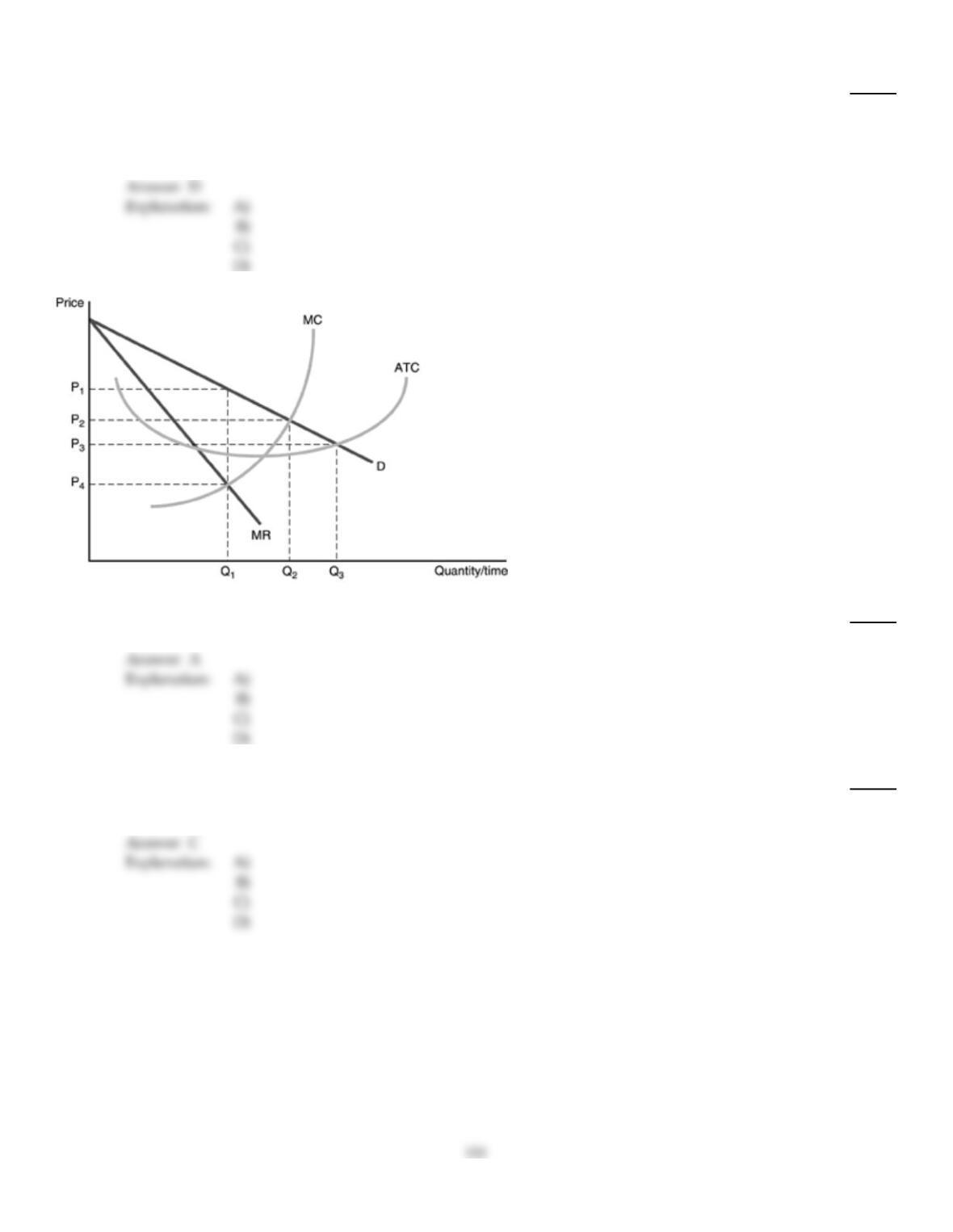
Refer to the above figure. The profit–maximizing price for this firm is
334)
A)
P1.
B)
P2.
C)
P3.
D)
P4.
335)
All of the following are barriers to entry in an industry EXCEPT
335)
A)
governmental restrictions.
B)
a patent.
C)
low marginal tax rates.
D)
economies of scale.
336)
If a monopolist lowers its price
336)
A)
the quantity demanded increases.
B)
it lowers the barriers to entry.
C)
the quantity demanded remains the same.
D)
the quantity demanded decreases.
337)
In the long run, all of the following are true for a monopolist EXCEPT
337)
A)
MR = MC.
B)
P > AVC.
C)
P > ATC.
D)
P = MC.
338)
To be able to engage in profit–maximizing price searching, a monopoly firm must be able to
338)
A)
prevent the entry of other firms into the market for its product.
B)
avoid earning negative economic profits in the short run.
C)
induce the entry of other firms into the market for its product.
D)
always earn zero economic profits.
339)
All of the following are true about a monopolist EXCEPT
339)
A)
it produces a product with no close substitutes.
B)
it is a single seller of a good or service.
C)
its demand curve is the same as the market demand for the industry.
D)
the demand curve for its product is perfectly elastic.
340)
Which of the following is most likely to be a monopoly?
340)
A)
WABC, a television station
B)
a public water utility
C)
The Washington Post
D)
AOL (America On Line), an Internet service provider
P Q MR MC
$7 20 $12 $2
$6 21 $14 $5
$5 22 $16 $10
$4 23 $18 $15
$3 24 $20 $20
$2 25 $22 $26
341)
Refer to the above table. Given the demand and cost schedules, what is the profit maximizing
quantity for this monopolist?
341)
A)
24
B)
20
C)
21
D)
23
342)
An important difference between a perfectly competitive firm and a monopolist is
342)
A)
the price it charges to sell additional units of a good.
B)
the size of the industry.
C)
a monopolist only produces in the long run, while a perfect competitor only produces in the
short run.
D)
the primary objective of the firms.
343)
If it is not possible for a pharmaceutical drug maker to sell its generic cholesterol reducing drug
along with some name brand cholesterol reducing drugs, we have an example of
343)
A)
monopoly due to ownership of key resources.
B)
pure competition.
C)
monopoly due to economies of scale.
D)
monopoly due to governmental entry restrictions.
344)
One problem associated with a monopoly firm is that it
344)
A)
restricts output and charges a relatively higher price than a purely competitive firm.
B)
produces too much output and charges too low a price.
C)
is just as good as a purely competitive firm in terms of output and price.
D)
produces too little output but also charges a low price.
345)
A monopolist’s marginal revenue curve is
345)
A)
below the firm’s demand curve.
B)
a horizontal line at the market price.
C)
the same as a perfectly competitive firm’s marginal revenue curve.
D)
higher than the monopolist’s demand curve.
346)
In order to price discriminate, a firm must
346)
A)
sell to customers with identical price elasticities of demand.
B)
be able to prevent resale of its product.
C)
produce a product that is a close substitute for products of other firms.
D)
have different marginal costs for serving different customers.
B
Explanation:
347)
For a monopolist that is maximizing profits
347)
A)
price equals marginal revenue.
B)
price equals average total cost.
C)
price exceeds marginal cost.
D)
marginal revenue exceeds price.
C
Explanation:
348)
If there are no barriers to entry into an industry
348)
A)
long–run economic profits must be zero.
B)
short–run and long–run profits must still be positive.
C)
both short–run and long–run economic profits must be zero.
D)
short–run economic profits must be zero.
A
Explanation:
A
Explanation:
349)
Which of the following is INCORRECT regarding monopoly and profits?
349)
A)
The monopolist reaches profit–maximizing output by trial and error.
B)
Numerous monopolies have gone bankrupt.
C)
A monopolist will never experience economic losses.
D)
The mere existence of a monopoly does not guarantee high profits.
350)
For the monopolist, marginal revenue is
350)
A)
not a consideration in the firm‘s pricing.
B)
less than average revenue since price must be lowered to sell additional units.
C)
equal to price.
D)
greater than price.
351)
A monopolist
351)
A)
is a price searcher.
B)
is a price taker.
C)
faces a vertical demand curve.
D)
faces an upward sloping demand curve.
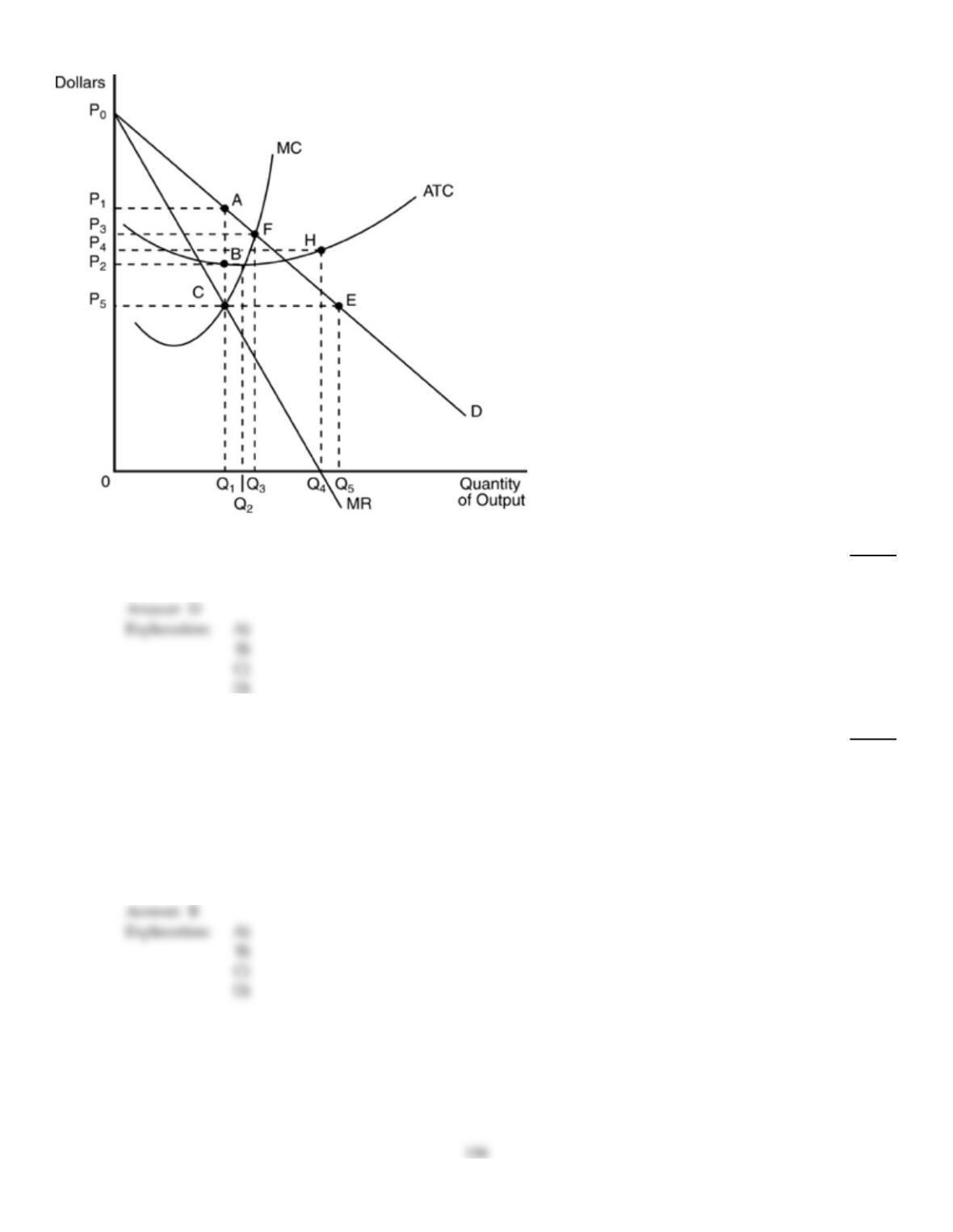
352)
The profit–maximizing price and quantity of the monopolist compared to the perfectly competitive
industry in the above figure are, respectively
352)
A)
A and C.
B)
A and B.
C)
C and F.
D)
A and F.
353)
Which of the following is a TRUE statement about monopoly and perfect competition?
353)
A)
Because costs do not depend on market structure, price is usually higher and output is always
lower under monopoly than perfect competition.
B)
If there are substantial economies of scale, price may be lower and output greater under
monopoly than under perfect competition.
C)
If there are substantial economies of scale, price may be lower and output greater under
monopoly than under perfect competition, and price may be below marginal cost instead of
equal to marginal cost.
D)
Price is always higher and output higher under monopoly than under perfect competition.
354)
Which of the following is NOT necessary in order for a monopolist to practice effective price
discrimination?
354)
A)
The monopolist must be able to segregate its market into different submarkets.
B)
The buyers in various markets must face different price elasticities of demand.
C)
The marginal cost of providing the same good to different groups of buyers must be different.
D)
The monopolist must have a downward sloping demand curve.
355)
In a perfectly competitive market in which identical firms face the same horizontal marginal cost
curve, if demand increases, then the amount of consumer surplus will
355)
A)
increase.
B)
not change.
C)
decrease.
D)
become negative.
356)
Economic inefficiency of a monopoly is indicated by
356)
A)
P > MC.
B)
P = ATCmin.
C)
MR = MC.
D)
P > MR.
357)
Which of the following would most likely be classified as a natural monopoly?
357)
A)
Exxon–Mobil
B)
a city water district
C)
Disneyland
D)
Microsoft
358)
A monopoly will look for opportunities to price discriminate because the practice
358)
A)
is desired by customers.
B)
allows it to charge higher prices.
C)
leads to selling more units.
D)
leads to greater profits.
359)
A natural monopoly
359)
A)
involves multiple firms selling differentiated products.
B)
requires government licensing initially.
C)
usually arises when there are large economies of scale.
D)
is derived from deposits of natural resources.
ESSAY. Write your answer in the space provided or on a separate sheet of paper.
360)
Why would economies of scale be a barrier to entry?
361)
What is a monopolist, and what is required for a monopolist to earn profits in the long run?
362)
“The deadweight loss of a monopoly equals the monopoly firm‘s profits.” Do you agree or disagree? Why?
363)
What is deadweight loss? Whose loss is it? Explain.
364)
Why is price less than marginal revenue for a monopolist?
365)
“A monopolist can charge whatever price it wants.” Do you agree or disagree? Why?
366)
Explain how a monopolist can increase profits by price discriminating. What are the conditions necessary for
price discrimination?
367)
What affects the price elasticity of demand for a monopolist’s product?
368)
Using a graph, show why marginal revenue is always less than price.
369)
“Unlike a perfect competitor, a profit–maximizing monopolist produces at an output rate at which marginal
revenue exceeds marginal cost.” Do you agree or disagree? Why
370)
Discuss and explain the relationships between the monopolist’s demand curve, average revenue curve, and
marginal revenue curve.
371)
What does the demand curve facing a monopoly look like? Why?
372)
How does a monopoly maximize profits? What price does it charge?
373)
“Price discrimination is the same as price differentiation.” Do you agree or disagree? Why?
374)
An upscale fusion bistro in a small town charges higher prices for the same menu items at dinner time than at
lunch time. Does the bistro necessarily practice price discrimination? Explain your answer.
375)
“Unlike a monopoly, consumer surplus in a perfectly competitive market is zero.” Do you agree or disagree?
Why?
376)
What is the main difference between the demand curves for the perfect competitor and the monopolist?
377)
In principle, can a monopolist hold its monopoly power in the long run? Explain.
378)
“All monopolies operate with positive economic profits.” Do you agree or disagree? Why?
379)
“A monopolist refers to any firm that is large in size.” Do you agree or disagree? Why?
380)
What is the social cost of a monopoly? Explain.
381)
Why is a monopoly inefficient?
382)
“The social cost of a monopoly comes from the fact that it charges a price higher than what consumers are
willing to pay.” Do you agree or disagree? Why?
383)
In what ways is government involved with the creation of barriers to entry?