264)
Which of the following is TRUE of a perfectly competitive firm and a monopoly in the long run?
264)
A)
P = ATC
B)
P = MC
C)
MR = MC
D)
P = MR
265)
If a monopolist wishes to increase its output and quantity sold
265)
A)
it must raise its price, so its marginal revenue is less than its price.
B)
it must reduce its price, so its marginal revenue is less than its price.
C)
it must reduce its price, so its marginal revenue is greater than its price.
D)
it must raise its price, so its marginal revenue is greater than its price.
266)
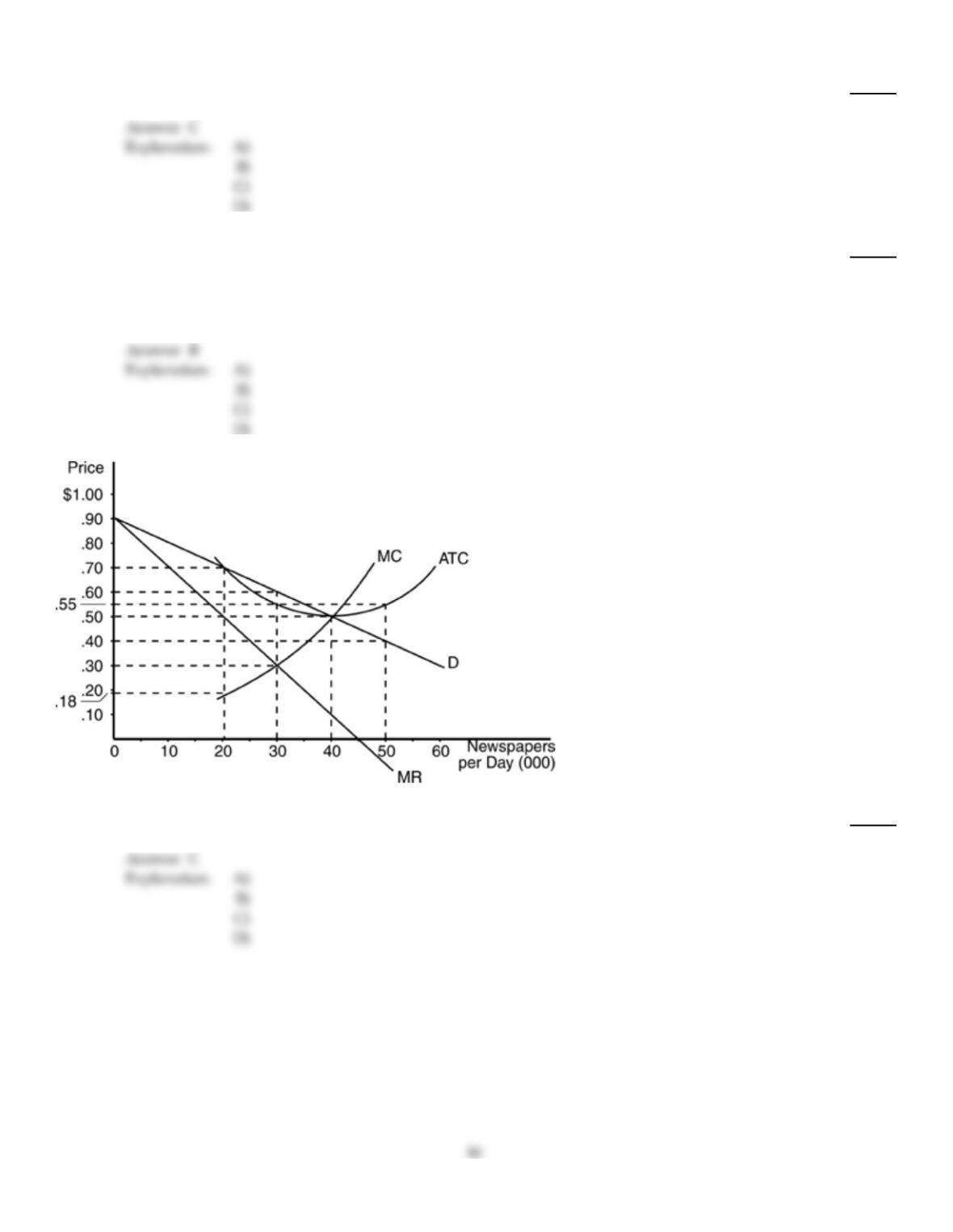
According to the above figure, the maximum profit the monopolist can receive is
266)
A)
0.
B)
$7,500 per day.
C)
$1,500 per day.
D)
$9,000 per day.
267)
A monopolist will not earn any economic profits when
267)
A)
AFC is very high.
B)
ATC lies above the demand curve.
C)
ATC lies below the demand curve.
D)
AVC is a minimum.
268)
A single supplier of a good or service for which there is no close substitute is referred to as a(n)
268)
A)
monopolistic competitor.
B)
strategic competitor.
C)
oligopoly.
D)
monopoly.
D
269)
Some electrical utilities are monopolies because of
269)
A)
diseconomies of scale.
B)
their inability to earn profits.
C)
ownership of resources without close substitutes.
D)
government restrictions that prevent new firms from entering the market.
D
270)
Assume that a monopoly is producing at a profit–maximizing output level. If the firm’s total fixed
costs decrease, the firm
270)
A)
should increase its price.
B)
should continue to produce at the same level.
C)
increase its output level.
D)
should lower its price.
B
271)
In maximizing economic profit, the monopolist will
271)
A)
equate price to marginal cost.
B)
equate marginal cost to minimum average total cost.
C)
equate marginal revenue to marginal cost.
D)
choose the highest price that still permits some output sales.
C
B
272)
Which of the following statements is FALSE?
272)
A)
When both a perfectly competitive industry and a monopolist face the same production costs
and the same market demand curve,the monopolist offers a lower level of output for sale.
B)
The profit–maximizing monopolist will always produce only along the inelastic portion of the
demand curve, whereas equilibrium in a perfectly competitive industry always occurs along
the elastic portion of the demand curve.
C)
When both a perfectly competitive industry and a monopolist face the same production costs
and the same market demand curve, the monopolist charges a higher price for its product
than what would be charged in a perfectly competitive situation.
D)
Other things being equal, society’s overall well–being is reduced when a perfectly
competitive industry is monopolized.
273)
Suppose a monopolist’s costs and revenues are as follows: ATC = $45.00; MC = $35.00; MR =
$35.00; P = $45.00. The firm should
273)
A)
decrease output and increase price.
B)
not change output or price.
C)
shut down.
D)
increase output and decrease price.
P Q TC
$13 10 $15
$12 14 $25
$11 19 $45
$10 25 $75
$9 30 $115
$8 35 $165
274)
Refer to the above table. Given the demand and cost schedules, what is the profit–maximizing price
for this monopolist?
274)
A)
$9
B)
$11
C)
$12
D)
$10
275)
Which of the following conditions is TRUE for a monopolist?
275)
A)
MR = AFC
B)
MR = P
C)
MR < P
D)
MR < AVC
276)
Price discrimination occurs when a firm sells
276)
A)
a given product at different prices to different ethnic groups.
B)
a given product at different prices unrelated to differences in cost.
C)
a given product at different prices at different points in time.
D)
a given product at different prices when it is produced in different colors.
277)
Which of the following statements is TRUE about the price that a monopolist charges?
277)
A)
The price is the same as the price that would be charged if there was perfect competition.
B)
The difference between the price charged by a monopolist and a perfect competitor is due to
differences in costs.
C)
Too much of the good is being produced in a competitive market and not enough is being
produced in a monopoly. Due to the way that prices are set.
D)
The value that society places on the last unit produced in a monopoly is greater than its cost.
278)
The monopolist should NEVER produce in the
278)
A)
elastic segment of its demand curve because it can increase total revenue and reduce total cost
by lowering price.
B)
range of output for which the price elasticity of demand is infinity.
C)
inelastic segment of its demand curve because further lowering of the price reduces total
revenue.
D)
range of output for which there is a price elasticity exceeding one.
279)
A monopolist will not be able to receive a positive economic profit at any price–output
combination at which
279)
A)
marginal cost is less than average variable cost when the monopolist has equated marginal
revenue and marginal cost.
B)
the average total cost curve is everywhere above the demand curve.
C)
marginal cost is less than average total cost when the monopolist has equated marginal
revenue and marginal cost.
D)
marginal revenue falls at a faster rate than marginal cost increases.
280)
A monopolist is
280)
A)
a supplier of a good that everyone needs with the result that it makes large profits.
B)
a single supplier of a good for which there is no close substitute.
C)
a firm with the largest annual sales in a country.
D)
a large firm that makes all the other firms in the industry do what it wants.
281)
Compared to a monopolist, the demand curve for a perfectly competitive firm will be
281)
A)
more elastic.
B)
less elastic.
C)
perfectly elastic.
D)
as elastic.
282)
A monopoly misallocates resources when it
282)
A)
makes an above–normal profit.
B)
sells the same product to different groups of customers at different prices.
C)
restricts output so that the marginal benefit of the last unit sold exceeds the marginal social
cost of producing the good.
D)
exploits scale economies.
283)
All of the following are considered a barrier to entry into a market EXCEPT
283)
A)
persistent declining long–run average costs as output increases.
B)
lowering tariffs.
C)
governmental regulations of business conduct relating to workplace conditions.
D)
government licenses.
284)
If a monopolist is producing at an output rate at which P = ATC, then
284)
A)
it is minimizing its losses.
B)
it is maximizing its profits.
C)
its economic profit will be zero.
D)
its economic profit will be positive.
285)
A firm typically achieves its position as a monopolist as a result of
285)
A)
a downward sloping demand for the product.
B)
the absence of long–run profits in an industry.
C)
barriers to entry.
D)
a small market and a constant average cost.
286)
Which of the following statements is TRUE?
286)
A)
With a monopoly, the value to society of the last unit produced is less than it’s production
cost.
B)
A monopolist always produces a higher level of output than would be produced if the market
were competitive.
C)
At the monopolist’s equilibrium, resources are being efficiently allocated.
D)
Monopolists raise the price and restrict production, compared to a competitive situation.
D
287)
A monopolist will earn economic profits when
287)
A)
ATC lies below the demand curve.
B)
ATC lies above the demand curve.
C)
AVC is a minimum.
D)
ATC intersects the demand curve.
A
288)
Which of the following statements concerning a monopolist is FALSE?
288)
A)
For a monopolist, marginal revenue is less than price.
B)
A monopolist will charge the highest price at which any individual will purchase the product.
C)
A monopolist will produce at which MR = MC.
D)
A monopolist will shut down if price is less than average variable cost.
B
C
289)
In equilibrium, which of the following conditions is common to both unregulated monopoly and
pure competition?
289)
A)
MR = MC
B)
MC = P
C)
AR = ATC
D)
P = MR
290)
Which of the following is NOT a barrier to entry?
290)
A)
economies of scale
B)
U.S. antitrust legislation
C)
patents
D)
licenses
291)
Which of the following can be a barrier to entry, closing a market to new firms?
291)
A)
an elastic industry demand curve
B)
diseconomies of scale
C)
ease of obtaining capital financing
D)
control of a vital resource by one producer
292)
A monopolist is defined as
292)
A)
a producer of a good or service that is expensive to produce, requiring large amounts of
capital equipment.
B)
a single supplier of a good or service for which there is no close substitute.
C)
a large firm, making substantial profits, that is able to make other firms do what it wants.
D)
a firm with annual sales over $10 million.
293)
An important difference between perfect competition and monopoly is
293)
A)
the monopoly faces a downward sloping demand curve and the perfect competitor faces a
horizontal demand curve.
B)
the monopoly faces an inelastic demand curve and the perfect competitor faces an elastic
demand curve.
C)
a monopoly is not regulated by the market, while a perfect competitor is regulated by the
market.
D)
a monopoly is profitable and a perfect competitor is not.
294)
In a perfectly competitive market, if all firms face identical, constant marginal marginal cost curves,
then consumer surplus is
294)
A)
the area beneath the market demand curve and above the market clearing price.
B)
definitely zero.
C)
the area above the market demand curve and above the market clearing price.
D)
the total area beneath the market demand curve.
A
A
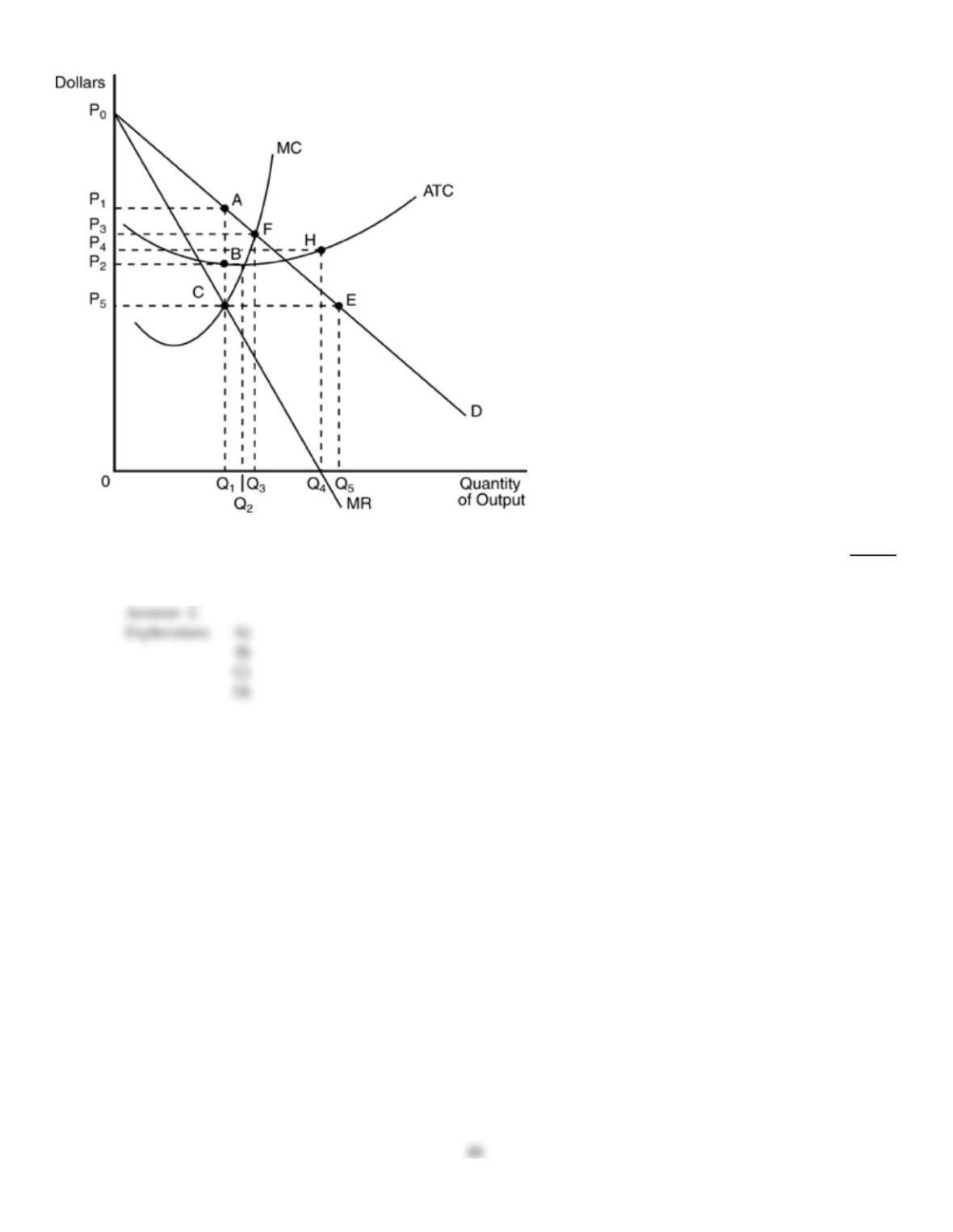
295)
The profit–maximizing price of the monopolist compared to the perfectly competitive industry in
the above figure are, respectively
295)
A)
P1 and P2.
B)
P2 and P5.
C)
P1 and P3.
D)
P1 and P5.
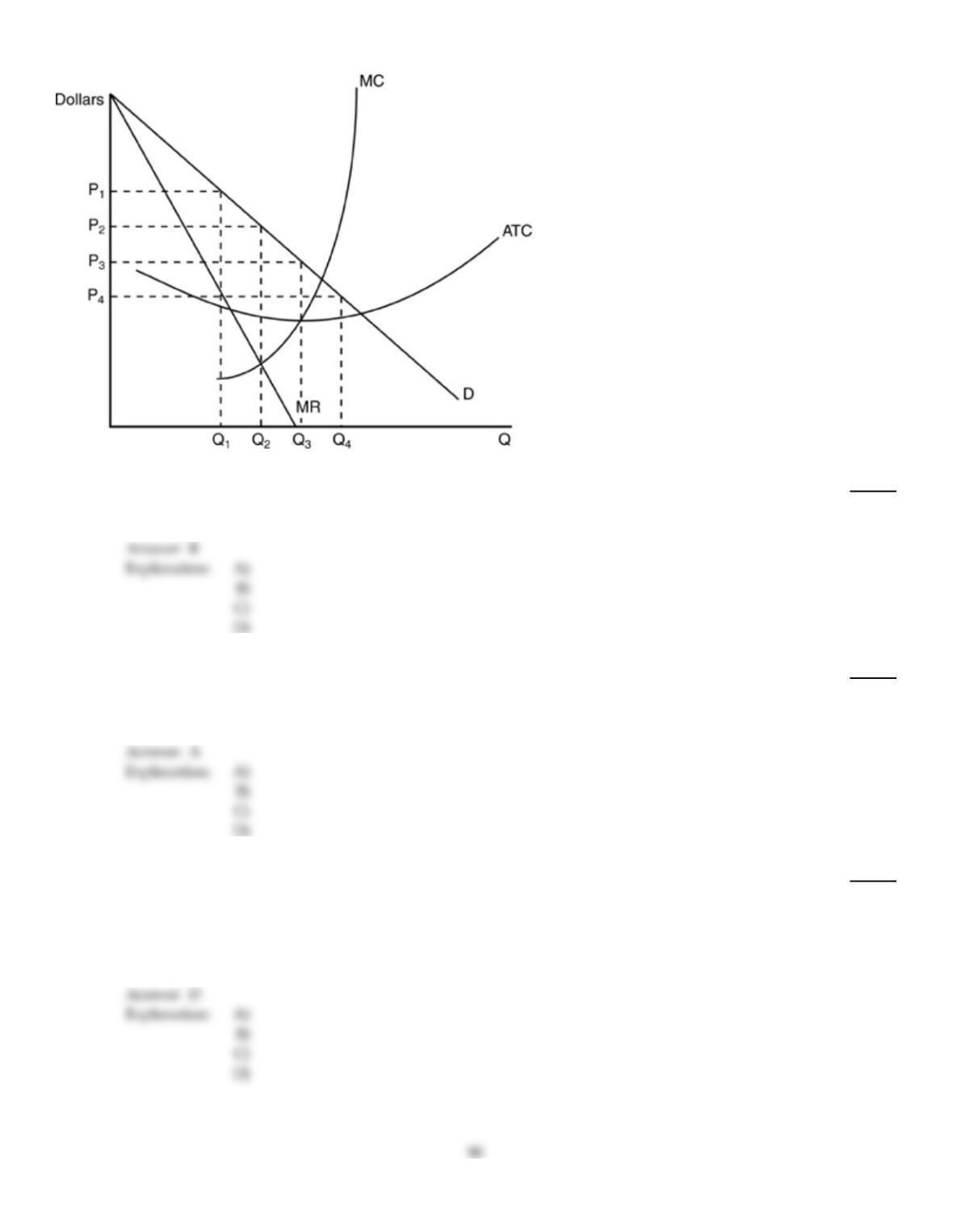
296)
In the above figure, if the firm is producing at Q3 and charging a price of P3, it should
296)
A)
increase output and decrease price.
B)
decrease output and increase price.
C)
not change output or price.
D)
shut down.
297)
A monopoly sells 5 units of output at $20. If the MR of the 6th unit is $14, then the price of the 6th
unit is
297)
A)
$19.
B)
greater than $20.
C)
also $14.
D)
$17.
298)
An important difference between a perfectly competitive firm and a monopolist is
298)
A)
a monopolist normally produces a service, while a perfect competitor normally produces a
good.
B)
the goals of the owners of the firms.
C)
the size of the firms.
D)
the shape of the demand curve each faces.
299)
A monopolist has four distinct groups of customers. Group A has an elasticity of demand of 0.2, B
has an elasticity of demand of 0.8, C has an elasticity of demand of 1.0, and D has an elasticity of
demand of 2.0. The group paying the highest price for the product will be
299)
A)
A.
B)
B.
C)
C.
D)
D.
300)
For a firm facing a downward sloping demand curve, marginal revenue
300)
A)
increases each time prices are lowered.
B)
is at a minimum at the midpoint of the demand curve.
C)
falls each time prices are raised.
D)
is greater at higher prices than at lower prices.
D
301)
Which of the following statements about a monopolist is TRUE?
301)
A)
All monopolies are unlawful in the United States.
B)
Monopolies tend to allocate resources in a socially optimal manner.
C)
Monopolies tend to misallocate resources.
D)
Monopolies will always make a profit in the long run.
C
302)
According to the text, government licensing frequently enables monopoly in
302)
A)
retail sales.
B)
electricity production.
C)
mining.
D)
agriculture.
B
A
303)
Price discrimination is more likely in the case of services than in the case of goods because
303)
A)
producers of goods usually do not face downward sloping demand curves.
B)
it is more difficult to resell services.
C)
it is easier to distinguish customers with different elasticities of demand with respect to
services than with goods.
D)
elasticities of demand vary more with services than with goods.
304)
A monopolist faces a demand curve that
304)
A)
is downward sloping.
B)
coincides with the industry supply.
C)
is below the marginal revenue curve.
D)
is perfectly horizontal at the market price.
305)
Successive downward movements along the demand curve for the product of a monopolist always
generate successive
305)
A)
increases in the monopolist’s average total costs.
B)
decreases in the additional per–unit revenues earned by the monopolist.
C)
increases in the monopolist’s marginal revenue.
D)
decreases in the additional per–unit costs incurred by the monopolist.
306)
Legal or governmental restrictions that give monopolistic advantages to a firm include all of the
following EXCEPT
306)
A)
exclusive ownership of an unimportant resource.
B)
environmental protection.
C)
franchises.
D)
patents.
307)
A monopolist will maximize its profits by charging a higher price for customers with a price
elasticity of
307)
A)
1.
B)
1.5.
C)
10.
D)
0.1.
308)
If a monopolist is producing the quantity at which price equals marginal cost, it should
308)
A)
reduce price and keep output unchanged if it wants to maximize profits.
B)
continue to produce this amount if it wants to maximize profits.
C)
reduce output if it wants to maximize profits.
D)
increase output if it wants to maximize profits.
309)
Which of the following is NOT true about a tariff?
309)
A)
It is a barrier to entry in a market.
B)
It affects imported goods.
C)
It leads to a natural monopoly.
D)
It is a tax.
310)
Monopolies are discouraged in the United States because
310)
A)
they hire too many workers.
B)
they restrict output and boost prices.
C)
they can produce at lower cost in the short run.
D)
they are more efficient than other industries.
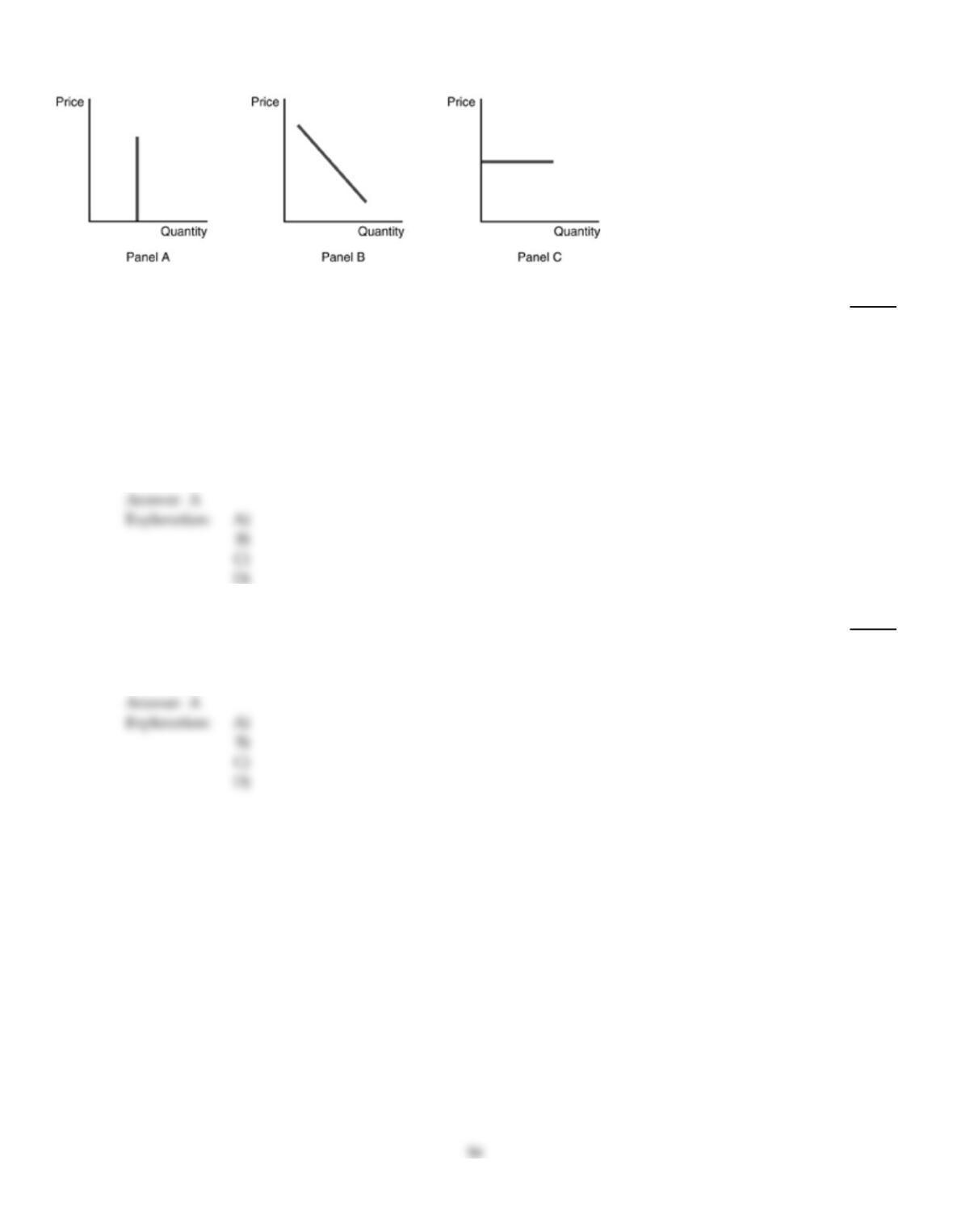
311)
Refer to the above figure. Which of the following statements is true about the demand curves for an
individual firm in a perfectly competitive industry and a monopoly?
311)
A)
Panel C is the demand curve for a perfectly competitive firm and panel B is the demand curve
for a monopoly.
B)
Panel C is the demand curve for a perfectly competitive firm and panel A is the demand
curve for a monopoly.
C)
Panel B is the demand curve for a perfectly competitive firm and panel A is the demand curve
for a monopoly.
D)
Panel A is the demand curve for a perfectly competitive firm and panel B is the demand curve
for a monopoly.
312)
A monopoly sells 10 units of output at $10. If the MR of the 11th unit is $4.50, then the price of the
11th unit is
312)
A)
$9.50.
B)
also $10.
C)
greater than $10.
D)
$7.25.
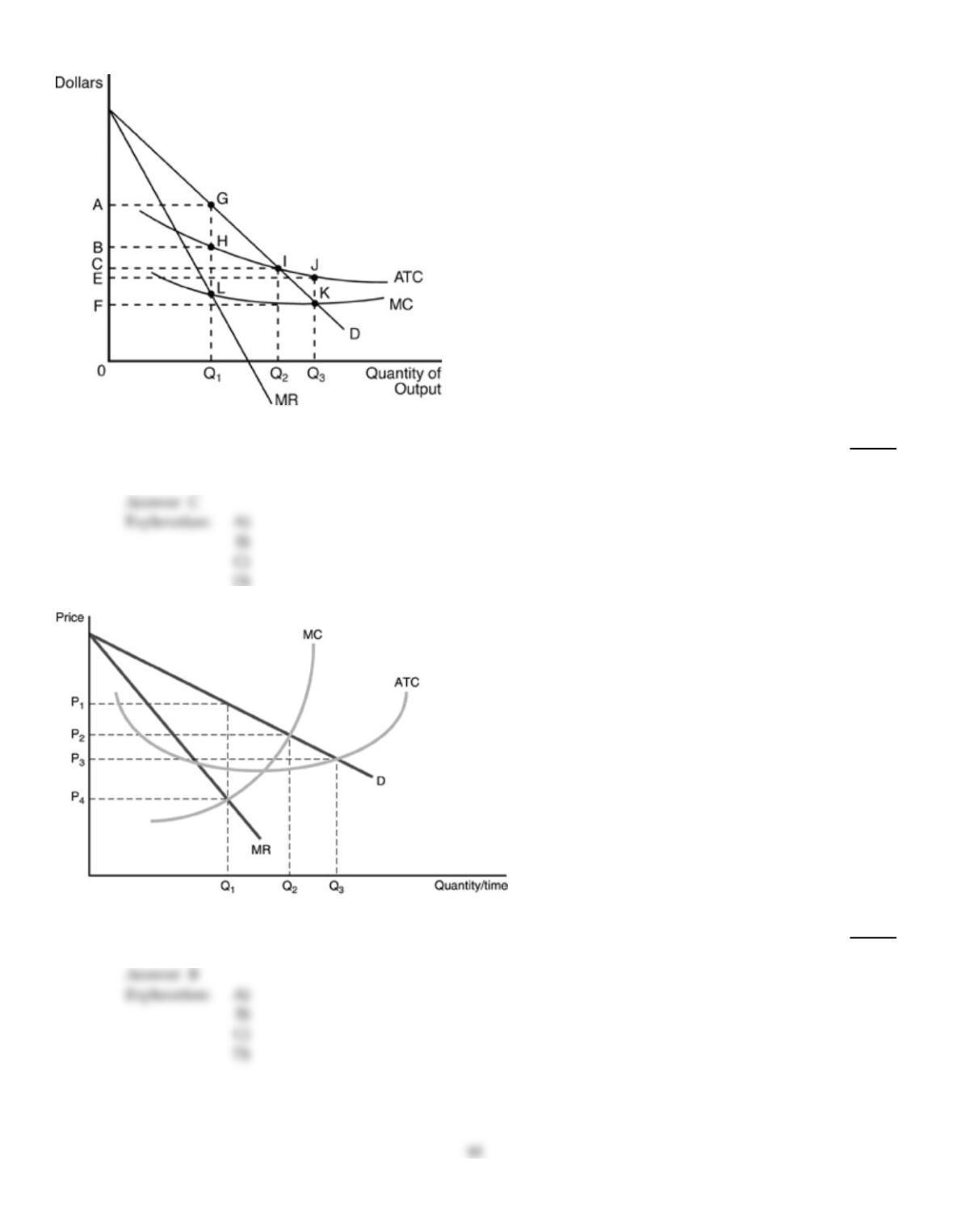
313)
In the above figure, the area of rectangle ABHG represents the monopolist’s
313)
A)
average total profits.
B)
maximized total revenue.
C)
maximized economic profits.
D)
total costs.
314)
Refer to the above figure. The profit maximizing quantity for this firm is
314)
A)
zero.
B)
Q1.
C)
Q2.
D)
Q3.
315)
Economies of scale may be a barrier to entry in a situation in which
315)
A)
large–scale production is inefficient.
B)
only large–scale production can lower the per–unit cost of production.
C)
only small–scale production can lower the per–unit cost of production.
D)
only small–scale production can meet the constantly changing market demand.
316)
Which of the following is NOT a barrier to entry that would allow a monopolist to keep potential
competitors out of its market?
316)
A)
The firm has government authorization to be a monopoly.
B)
The firm has a patent on the good or control over some resource required for the production
of the good.
C)
The market price of the product is too high.
D)
Significant economies of scale exist.
317)
Which of the following statements with respect to the monopolist is FALSE?
317)
A)
A monopoly arises in a situation with few barriers to entry into the marketplace.
B)
Monopoly is a situation in which a single firm dominates.
C)
A monopolist can make higher profits if it can price discriminate.
D)
A monopoly tends to result in a lower quantity being sold than perfect competition does.
318)
A monopolist is producing at an output level at which MR = $6 and MC = $9. It could increase
profits
318)
A)
by increasing output and by reducing price.
B)
by reducing output and by increasing price.
C)
by reducing both output and price.
D)
by increasing both output and price.
319)
Governments and legislatures can erect barriers to entry. Which of the following would NOT be
one of them?
319)
A)
licenses
B)
tariffs
C)
laws that ensure property rights
D)
Patentsp
320)
A monopolist is producing at an output level at which ATC = $5, P = $6, MC = $4, and MR = $3. We
can conclude that
320)
A)
economic profit could be increased by producing more.
B)
economic profit cannot be increased.
C)
the firm is earning $10 in economic profits.
D)
economic profit could be increased by producing less.
D
321)
Price discrimination is the
321)
A)
pricing of a product so that not everyone can afford it.
B)
refusal by a firm to sell to all customers.
C)
selling of a given product at more than one price when the price differences reflect cost
differences.
D)
selling of a given product at more than one price when the price difference is unrelated to cost
differences.
D
322)
If the price elasticity of demand for airline tickets is 2.0 for a leisure traveler and 0.5 for a business
traveler, then a price–discriminating monopolist would charge
322)
A)
a less profitable price for the business traveler than the leisure traveler.
B)
a lower price for the business traveler than the leisure traveler.
C)
a higher price for the business traveler than the leisure traveler.
D)
the same price for both travelers.
C
C
323)
When the marginal cost curve of the monopolist shifts upward, there will be
323)
A)
a decrease in price and in marginal revenue.
B)
a decrease in quantity and a decrease in marginal revenue.
C)
an increase in price but a decrease in quantity.
D)
an increase in both price and quantity.
324)
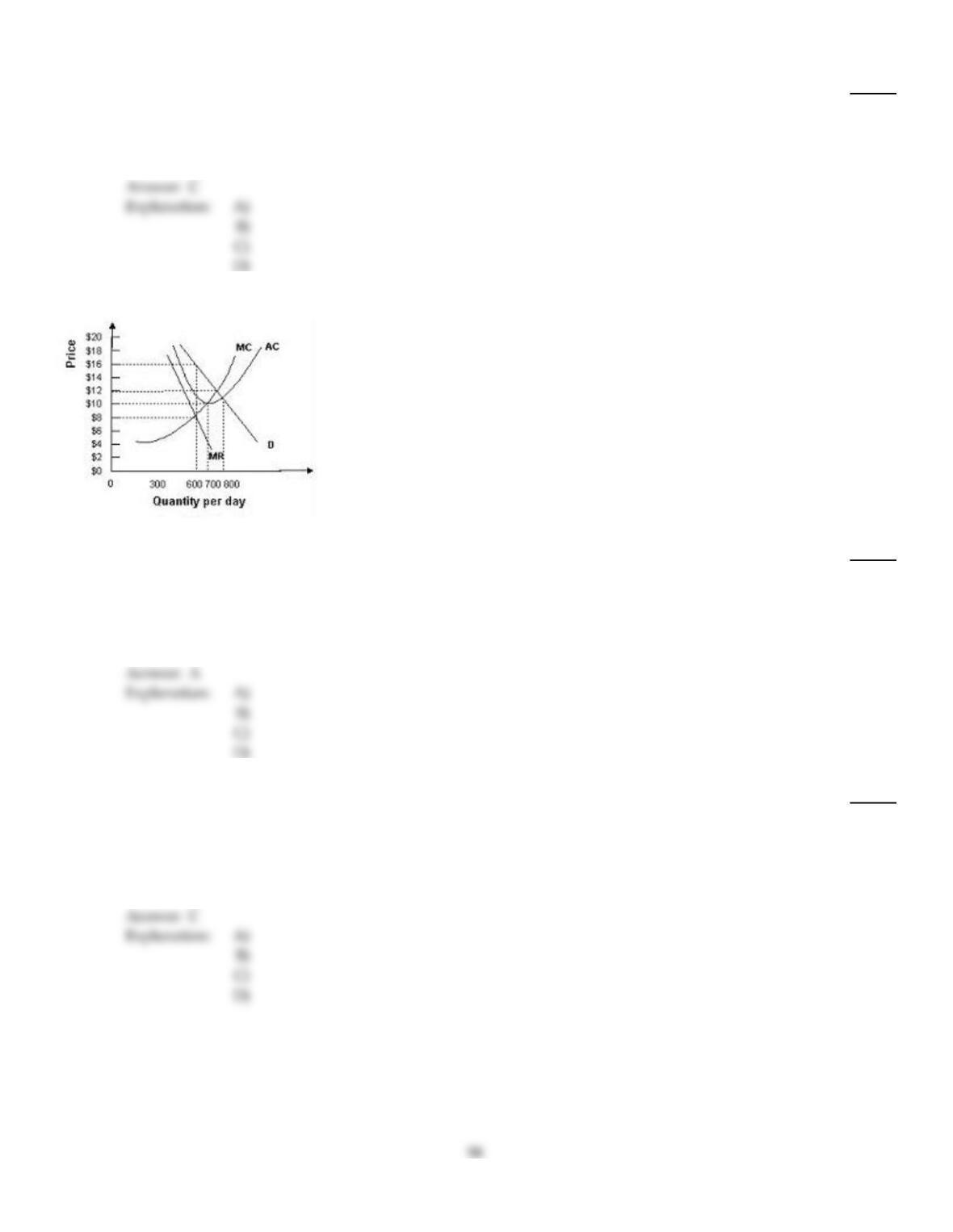
For the monopoly in the above figure, if the firm is currently producing 700 units, which of the
following is correct?
324)
A)
It could earn higher profits if it produced fewer units each day.
B)
It is maximizing its profits.
C)
It could earn higher profits if it produced more units each day.
D)
It is incurring a loss.
325)
A monopolist would not be able to make a positive profit at any price output combination when
325)
A)
the minimum point of the average total cost curve lies to the right of the minimum of the
average variable cost curve.
B)
marginal cost is less than average total cost for one more unit of output.
C)
the average total cost curve is everywhere above the demand curve.
D)
the average variable cost curve is everywhere above the marginal revenue curve.
326)
When it takes one firm in an industry to produce the quantity necessary to realize low unit costs,
the industry
326)
A)
has a license granted by the government.
B)
experiences economies of scale.
C)
has no barrier to entry.
D)
has barriers to entry due to ownership of resources.
327)
Which of the following is issued to an investor to provide protection from having the invention
copied or stolen for 20 years?
327)
A)
a license
B)
a certificate of convenience
C)
a patent
D)
a natural monopoly
328)
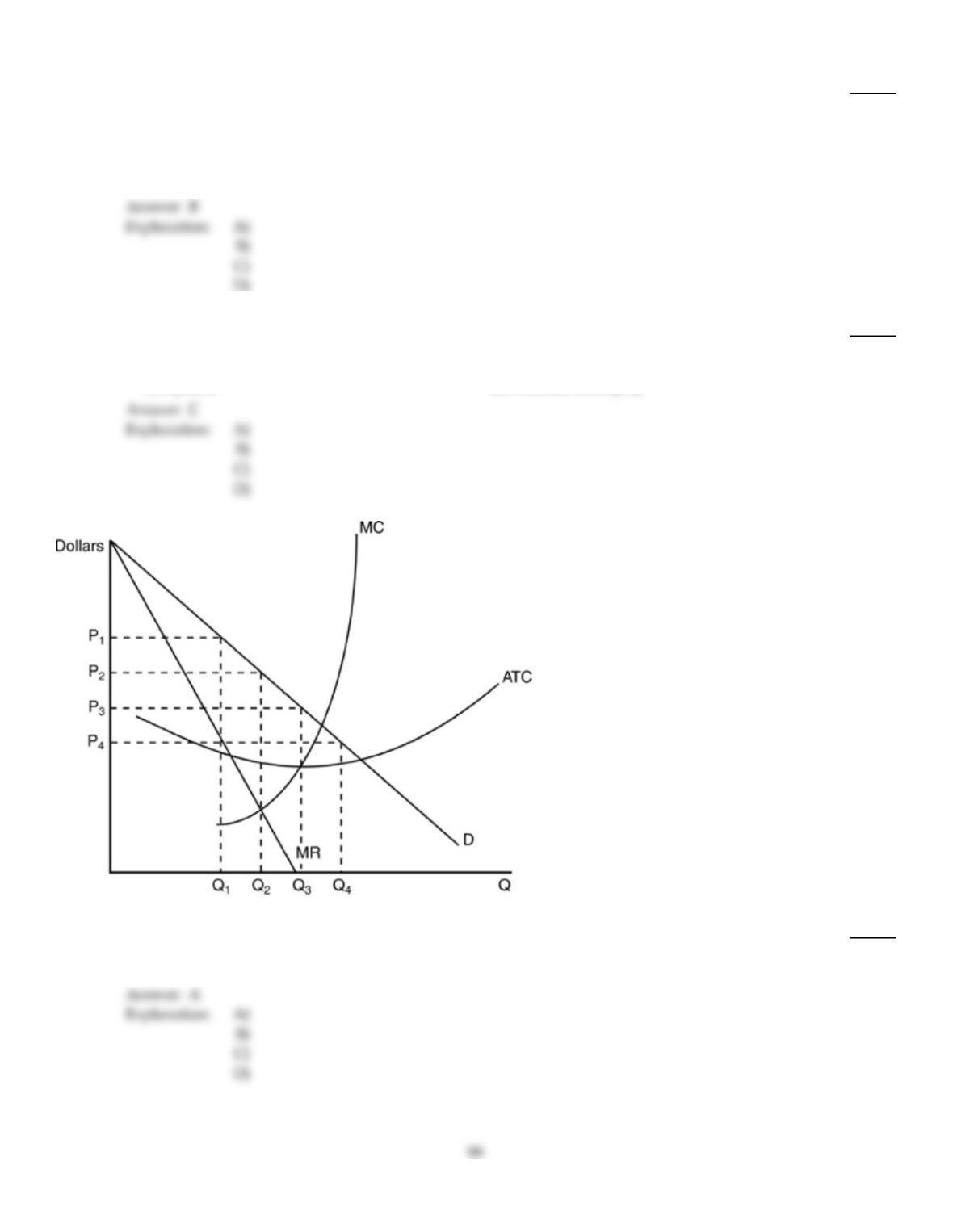
In the above figure, if the firm is producing Q1 units at a price P1, the firm should
328)
A)
increase output and decrease price.
B)
decrease output and increase price.
C)
not change output or price.
D)
shut down.
329)
Economists criticize monopolies because monopolies
329)
A)
receive accounting profits.
B)
always price discriminate.
C)
make consumers pay more for their product than the customers value the product.
D)
restrict output and raise prices compared to a competitive situation.
330)
Which of the following statements is FALSE?
330)
A)
An unregulated, profit–maximizing monopolist will not operate in the inelastic portion of the
demand curve.
B)
Typically there are numerous very close substitutes for the product of a monopolist.
C)
For a profit–maximizing monopolist, marginal revenue equals marginal cost.
D)
The marginal revenue earned by a monopolist will always be less than the product’s price.
331)
Which of the following will make price discrimination difficult for a monopolist?
331)
A)
a downward sloping demand curve
B)
a constant marginal cost curve
C)
the possibility of resale of the product
D)
an increasing marginal cost
332)
The monopolist is a
332)
A)
price taker who tries to find the profit–maximizing rate of output.
B)
price searcher who tries to find the rate of output that maximizes price.
C)
price searcher who tries to find the profit–maximizing price–output combination.
D)
price taker who tries to find the profit–maximizing price.