194)
Which of the following would best describe the demand curve faced by a monopoly firm?
194)
A)
horizontal line at the market price
B)
same as the market demand curve
C)
vertical line at the output level
D)
same as the perfect competitor’s demand curve
195)
For a firm to be able to engage in price discrimination, it must
195)
A)
have customers of different levels of wealth and age.
B)
produce more than one product.
C)
have economies of scale.
D)
face a downward sloping demand curve.
D
196)
The monopolist determines the price and quantity combination that maximizes short–run profits
by
196)
A)
finding the quantity at which average revenue and average total cost are furthest apart.
B)
determining the price by finding the highest price at which sales can be made and then using
the demand curve to find the appropriate quantity.
C)
finding the quantity at which marginal cost and marginal revenue are equal and then using
the demand curve to find price.
D)
finding the point at which marginal revenue and demand intersect. This gives the price and
quantity that maximizes profits.
C
197)
A firm that can determine the price–output combination in order to maximize profit is known as a
197)
A)
price searcher.
B)
demand searcher.
C)
price taker.
D)
cost taker.
A
B
198)
Price differentiation is a situation in which
198)
A)
the demand curve is vertical.
B)
there are different prices for similar products reflecting differences in the marginal cost of
providing the commodities to different groups of buyers.
C)
there are different prices for the same product that are not due to differences in the marginal
cost of providing the commodity to different groups of buyers.
D)
consumers’ comparison–shop.
199)
Monopolies are inefficient because
199)
A)
they price discriminate.
B)
they always make above–normal profits.
C)
they want to maximize profits.
D)
price exceeds marginal cost.
Explanation:
200)
Drug companies protect their monopolies over various drugs they develop by utilizing
200)
A)
low cost production.
B)
patent protection.
C)
zero economic profits in the long run.
D)
diseconomies of scale.
Explanation:
201)
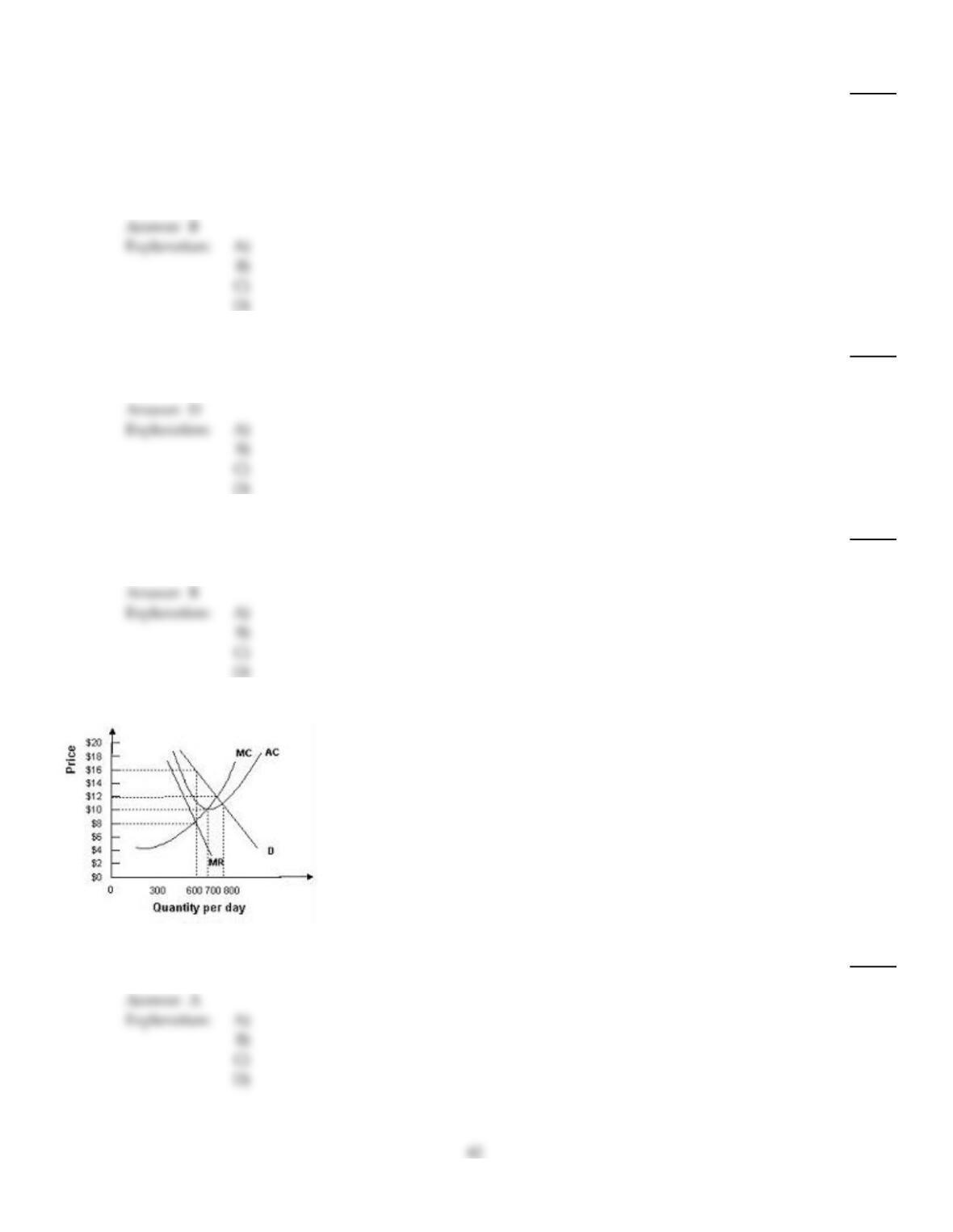
Use the above figure. Total revenue at the profit–maximizing output is
201)
A)
$9,600.
B)
$5,600.
C)
$4,800.
D)
$8,000.
Explanation:
Explanation:
202)
For a monopolist, the marginal revenue gained when one more unit of output is sold is
202)
A)
the average revenue created by the increased sales.
B)
negative if price is above the midpoint of the demand curve.
C)
the price at which the extra unit is sold minus the loss in revenue that results from cutting the
price on units sold previously.
D)
equal to the price of the product.
203)
If a monopolist produces to a point at which marginal revenue is less than marginal cost then
203)
A)
the incremental cost of producing the last unit is less than the incremental revenue.
B)
the incremental cost of producing the last unit exceeds the incremental revenue.
C)
profits will always be negative.
D)
profits are being maximized.
B
204)
The profit maximizing behavior of a monopoly is different from that of a perfectly competitive firm
in that a monopoly can
204)
A)
control the position of its demand schedule, but a competitive firm cannot.
B)
only choose the desired output, while a competitive firm can control only price.
C)
only choose the desired price, while a competitive firm can control only output.
D)
control the desired price and output to maximize profits, but a perfectly competitive firm can
only choose the desired output.
D
C
P Q TC
$13 10 $8
$12 15 $30
$11 20 $68
$10 25 $128
$9 30 $208
$8 35 $308
205)
Refer to the above table. Given the demand and cost schedules, what are the maximized economic
profits for this monopolist?
205)
A)
$150
B)
$220
C)
$152
D)
$122
206)
To maximize profits, the monopolist should produce at which
206)
A)
total revenue is maximized.
B)
total costs are minimized.
C)
MC intersects the demand curve.
D)
MR = MC.
207)
The monopolist faces a downward sloping demand curve, and maximizing profits requires the
monopolist to
207)
A)
search for the price consistent with producing to the point at which marginal revenue equals
marginal cost.
B)
accept the market price for its product.
C)
will produce where the demand curve is inelastic.
D)
search for the highest possible price consistent with maximizing its revenues, irrespective of
its explicit and implicit opportunity costs.
208)
For a monopolist
208)
A)
there is no relationship between marginal revenue and price.
B)
marginal revenue is less than price for all units being sold except the first unit.
C)
marginal revenue is greater than price for all units being sold except for the first unit.
D)
marginal revenue is equal to price for all units being sold.
209)
Price discrimination refers to
209)
A)
charging the same prices to all consumers but selling them different quantities.
B)
selling a product at different prices, with the price difference being unrelated to differences in
marginal cost.
C)
a deliberate effort on the part of a monopoly producer to confuse consumers.
D)
selling a product at different prices according to the differences in marginal cost of providing
it to different consumers.
210)
A firm that faces a downward sloping demand curve is
210)
A)
a price creator.
B)
a price taker.
C)
a price provider.
D)
a price searcher.
211)
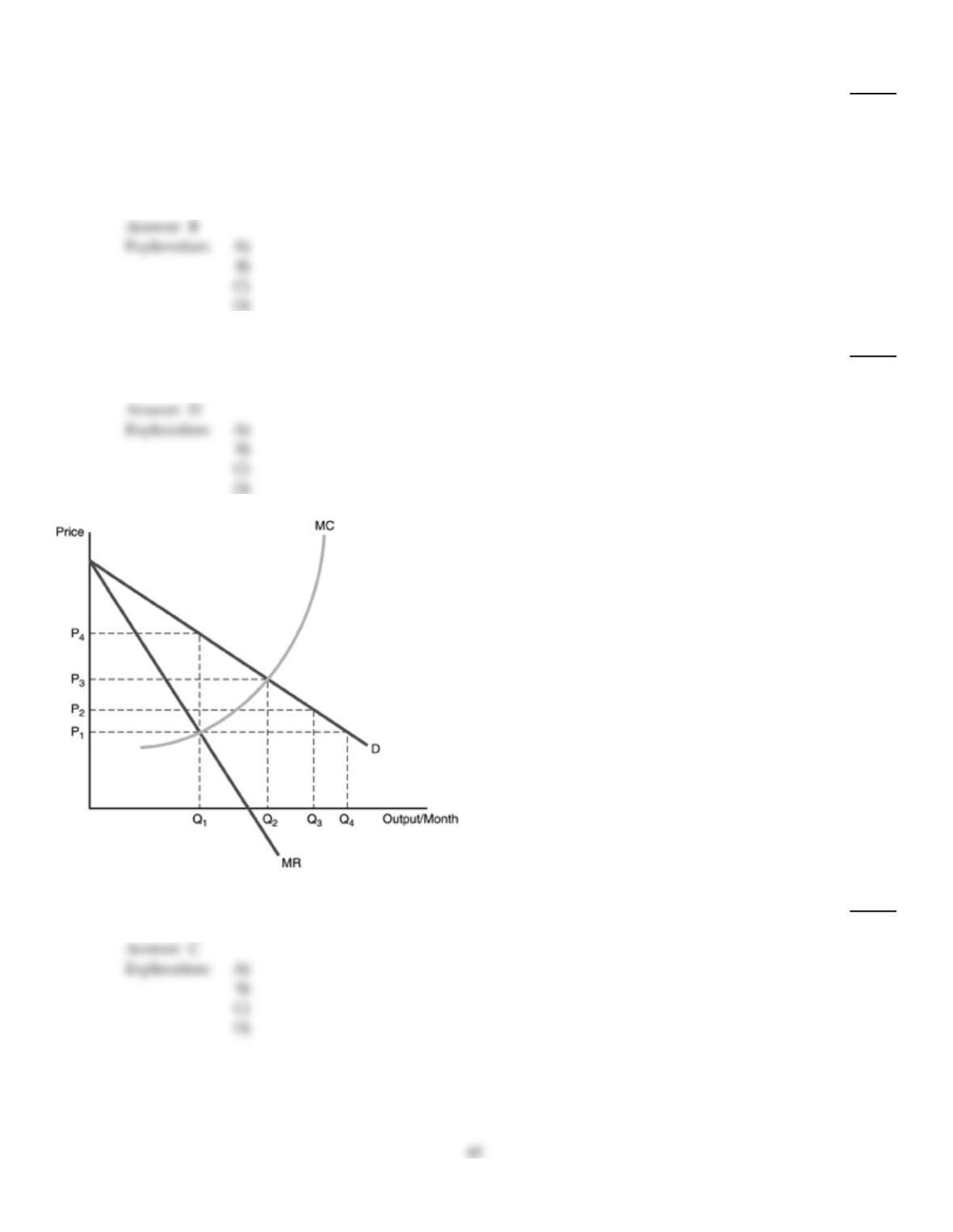
Refer to the above figure. What price–output combination would apply under perfect competition?
211)
A)
P2 and Q3
B)
P4 and Q1
C)
P3 and Q2
D)
P1 and Q1
212)
A monopolist determines the profit–maximizing output
212)
A)
at the point at which MR = MC.
B)
at any point it wants because it is the only producer of the product.
C)
at the point at which TR is maximum.
D)
at the point at which TR = TC.
213)
The demand curve a monopoly faces is
213)
A)
vertical.
B)
upward sloping.
C)
horizontal.
D)
downward sloping.
214)
Suppose a monopolist’s costs and revenues are as follows: ATC = $50.00; MC = $35.00; MR =
$45.00; P = $55.00. The firm should
214)
A)
decrease output and increase price.
B)
shut down.
C)
increase output and decrease price.
D)
not change output or price.
215)
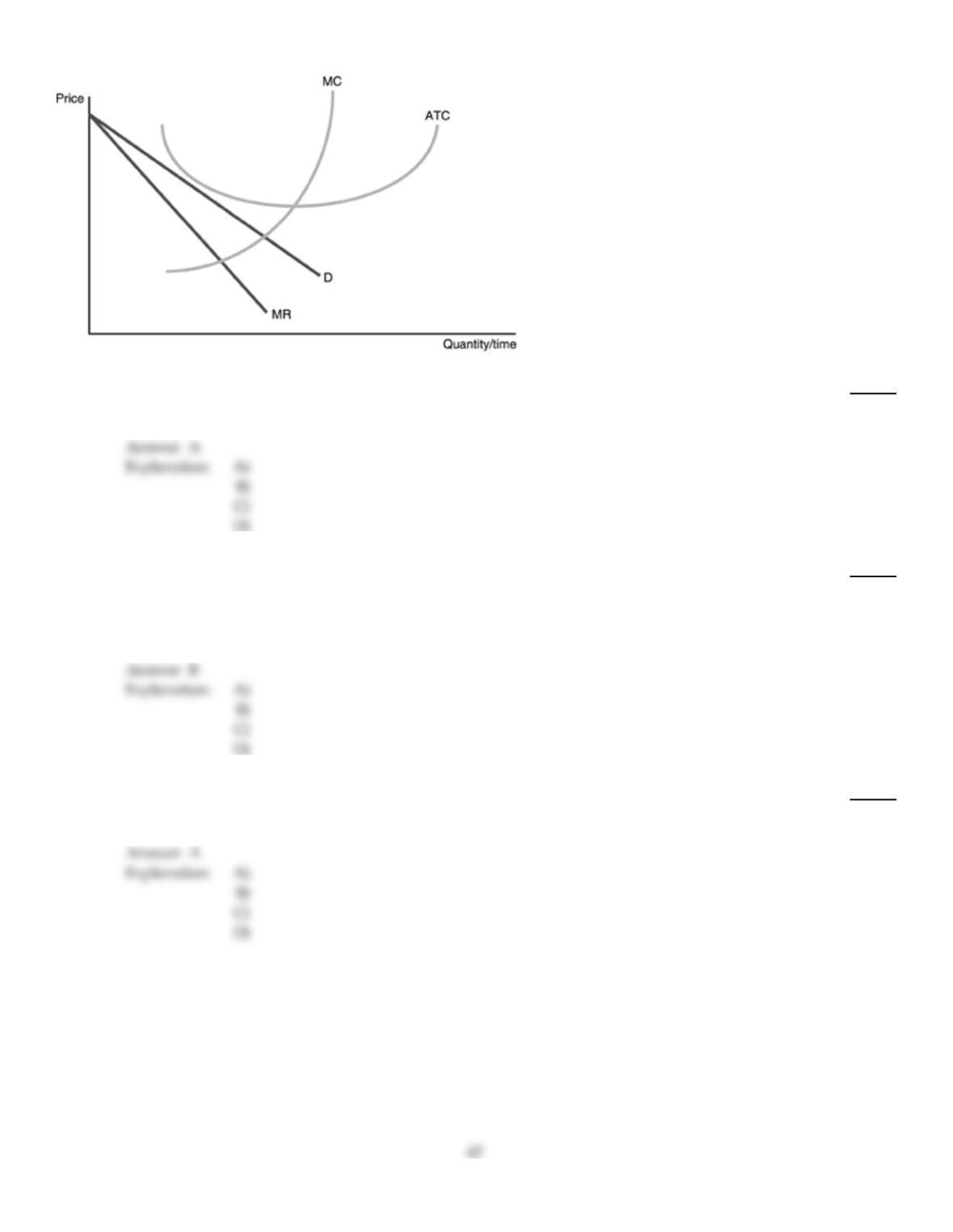
Refer to the above figure. Profits for this firm are
215)
A)
negative.
B)
zero.
C)
positive.
D)
undetermined without more information.
216)
Deadweight loss is
216)
A)
the loss of output when a perfectly competitive firm becomes a monopolist.
B)
a loss of benefit to consumers in a monopoly that no one else in society can obtain.
C)
the amount of taxes that consumers and monopolists pay.
D)
the price that consumers pay for a product in excess of the average cost of producing it.
217)
Compared to perfectly competitive firms, the demand curve for a monopolist will be
217)
A)
less elastic.
B)
as elastic.
C)
perfectly elastic.
D)
more elastic.
218)
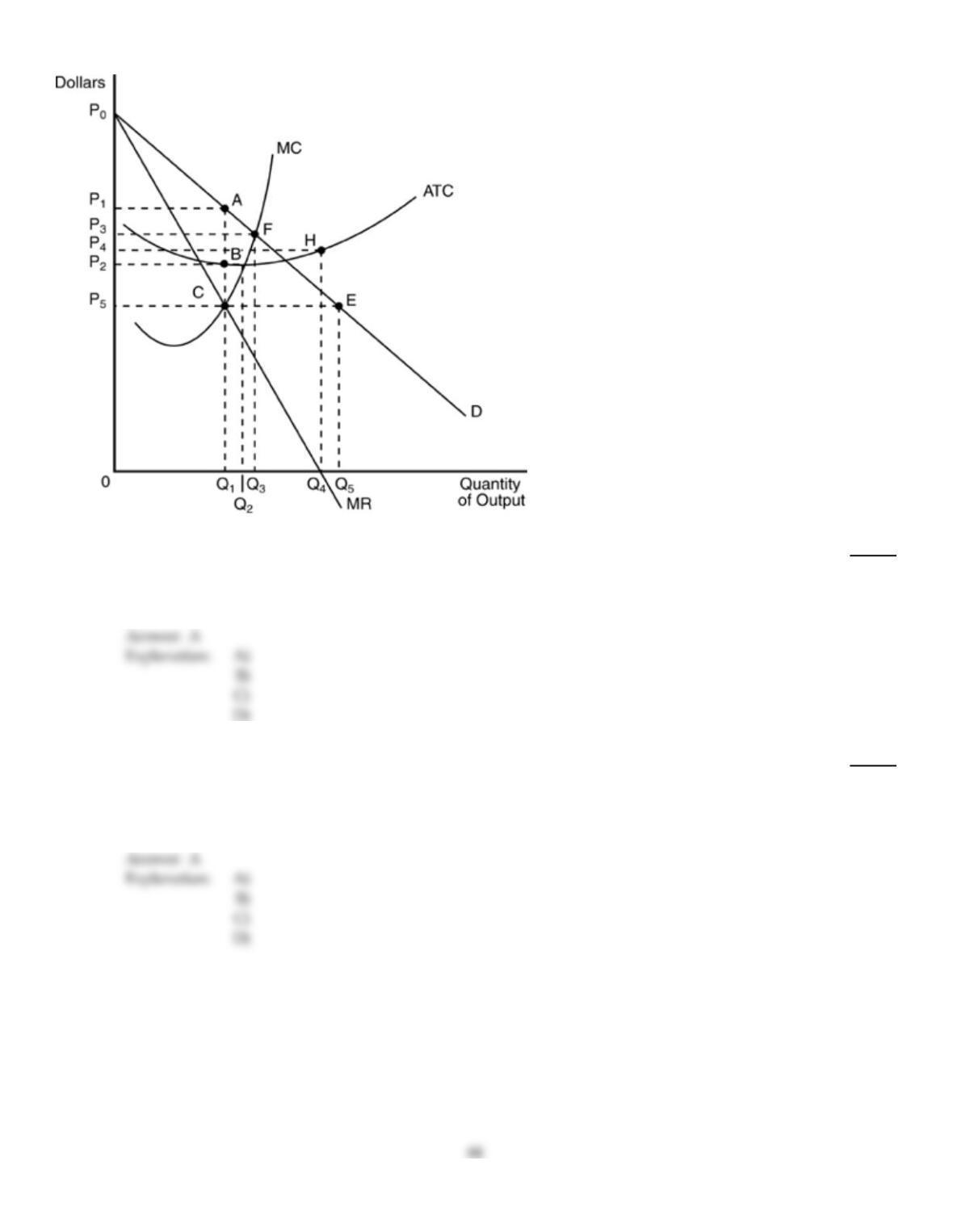
The profit–maximizing price and quantity established by the unregulated monopolist in the above
figure are
218)
A)
Q1 units of output and a price of P1.
B)
Q1 units of output and a price of P5.
C)
Q3 units of output and a price of P3.
D)
Q4 units of output and a price of P4.
219)
Economies of scale can
219)
A)
prevent the entry of new firms into a market.
B)
reduce the rate of return which the firm may earn.
C)
result in an increasing cost industry.
D)
cause input prices to drop.
220)
A monopolist wishing to increase its profit has just discovered that lowering its price and selling
more output yielded the desired result. Profit increased. Based on this, we can conclude that the
cost of the additional production is
220)
A)
precisely equal to the revenue from the additional production.
B)
greater than the revenue from the additional production.
C)
there is no way to answer this because you have not given us the marginal revenue and
marginal cost data.
D)
less than the revenue from the additional production.
221)
In a perfectly competitive market, consumer surplus typically is
221)
A)
zero.
B)
undefined.
C)
positive.
D)
negative.
222)
For a monopoly earning positive economic profits at the profit–maximizing output level, all of the
following are true EXCEPT
222)
A)
P > MC.
B)
P > ATC.
C)
P = MR.
D)
P > MR.
223)
A monopolist finds the price–output combination that maximizes its profits by
223)
A)
equating total revenue and total cost.
B)
equating price and marginal cost.
C)
finding the combination for which the difference between marginal revenue and marginal
cost is the greatest.
D)
equating marginal revenue and marginal cost.
224)
The profit–maximizing monopolist will never operate in a price range over which
224)
A)
P > MC.
B)
the demand curve slopes downward.
C)
demand is inelastic.
D)
P > MR.
225)
When a firm experiences steadily declining long–run average total costs as it produces more
output, it is known as a(n)
225)
A)
monopolistic competitor.
B)
natural monopoly.
C)
rent seeker.
D)
oligopoly.
226)
The profit–maximizing monopolist will operate in a price range over which
226)
A)
supply is elastic.
B)
demand is inelastic.
C)
demand is elastic.
D)
the price elasticity of demand is less than 1.
227)
When a firm practices price discrimination, for each separate set of consumers it will determine the
rate of output at which
227)
A)
MR = MC.
B)
MR = P.
C)
MR > MC.
D)
MR = AVC.
228)
Monopolies that price discriminate do so because
228)
A)
they can increase their profits.
B)
it keeps them out of trouble with the government.
C)
it is more efficient.
D)
they are able to do so and no one else can.
229)
A firm will practice price discrimination when it believes that by doing so it will be able to increase
total
229)
A)
production.
B)
revenue.
C)
profits.
D)
sales.
Price Quantity
$19 11
18 12
17 13
16 14
15 15
14 16
230)
Given the data in the above table, the marginal revenue curve
230)
A)
is equal to the demand curve.
B)
lies above the demand curve.
C)
intersects the demand curve.
D)
lies below the demand curve.
231)
Considering the spectrum of market structures and moving from pure competition to pure
monopoly we can say that
231)
A)
entry gets harder and the number of firms dwindles.
B)
entry barriers get lower but exit gets more difficult.
C)
entry becomes harder but exit becomes easier.
D)
none of the above.
A
232)
A patent provides legal protection for an invention for
232)
A)
20 years.
B)
3 years.
C)
5 years.
D)
9 years.
A
233)
Price discrimination is
233)
A)
refusing to sell a given product to some group of customers.
B)
selling a given product at more than one price, with the price differences being unrelated to
differences in cost.
C)
selling a given product at more than one price.
D)
selling a given product at more than one price, with the price differences reflecting differences
in marginal cost in providing the product to different groups of customers.
B
D
234)
The social cost attached to monopolies is reflected by the fact that
234)
A)
the demand for a monopolist’s product is always lower than the demand for the products of
perfectly competitive firms.
B)
consumers are always willing to pay lower prices for a monopolist’s product than for the
products of perfectly competitive firms.
C)
consumers pay prices that exceed the marginal cost of production.
D)
monopolies produce more output than consumers desire to buy.
235)
Conclusions about the misallocation of resources under conditions of monopoly depend, in part, on
the crucial assumption that
235)
A)
monopolies are interested in economic profits and competitive firms are not.
B)
the marginal cost curve of a monopolist is different from that of a perfectly competitive firm.
C)
the monopolization of a perfectly competitive industry does not change the cost structure of
the industry.
D)
the economies of scale exist only in perfectly competitive industries.
236)
A pure monopolist is selling 7 units at a price of $12. If the marginal revenue of the 8th unit is $4,
then the price of the 8th unit is
236)
A)
$4.
B)
$11.
C)
greater than $12.
D)
$10.
237)
Which of the following is NOT true when there are large economies of scale such that one firm can
produce at a lower average cost than can be achieved by multiple firms?
237)
A)
This situation produces a natural monopoly.
B)
The long–run average cost curve of the firm will increase at a low level of output.
C)
There will only be one firm in this industry.
D)
Proportional increases in output yield proportionally small increases in total cost.
238)
A monopoly which arises from significant economies of scale is referred to as a
238)
A)
monopolistic competitor.
B)
patent monopoly.
C)
natural monopoly.
D)
strategic resource monopoly.
239)
Which of the following is NOT a restriction the government imposes to keep potential entrants out
of a market?
239)
A)
assistance with opening new firms
B)
copyrights
C)
patents
D)
tariffs
240)
A simple way of describing the social cost of monopoly is to say that it
240)
A)
has too much political power.
B)
produces too much.
C)
makes too much money.
D)
restricts output and charges a higher price than a perfectly competitive firm.
P Q TC
$13 10 $8
$12 15 $30
$11 20 $68
$10 25 $128
$9 30 $208
$8 35 $308
241)
Refer to the above table. Given the demand and cost schedules, what is the profit–maximizing price
for this monopolist?
241)
A)
$10
B)
$13
C)
$12
D)
$11
242)
A profit–maximizing monopolist will receive zero profits when
242)
A)
the average total cost curve is tangent to the demand curve at the profit maximizing price.
B)
marginal revenue, marginal cost, and average total cost are all equal.
C)
the average total cost curve lies above the demand curve for all possible rates of output.
D)
a second firm enters the industry.
243)
A price–discriminating monopolist will equate
243)
A)
average revenue and marginal revenue in each market.
B)
price and marginal revenue in each market.
C)
marginal revenue and marginal cost in each market.
D)
price and marginal cost in each market.
C
244)
When considering marginal revenue for the monopolist, which of the following is FALSE?
244)
A)
An essential point for the monopolist, marginal revenue is always less than price.
B)
The more the monopolist wants to sell, the higher the price it has to charge in order to make
more profits.
C)
Marginal revenue is always less than price because price must be reduced on all units to sell
more.
D)
To sell more of a particular product, given the industry demand curve, the monopoly firm
must lower the price.
B
245)
The demand curve faced by the monopolist
245)
A)
slopes upward.
B)
slopes downward.
C)
is perfectly elastic.
D)
is perfectly inelastic.
B
A
246)
To sell more units, a monopolist
246)
A)
moves down its demand curve to a lower price that will increase quantity demand.
B)
must be willing to lower the barriers to entry that have protected it.
C)
simply moves across its horizontal demand curve to a larger quantity.
D)
can continue to receive the same price it always has as long as it has its customers’ goodwill.
Price Quantity
$19 11
18 12
17 13
16 14
15 15
14 16
247)
Given the data in the above table, what is the marginal revenue when the 14th unit is sold?
247)
A)
$7.00
B)
$1.00
C)
$5.00
D)
$3.00
248)
To sell more units, a monopolist must
248)
A)
advertise more.
B)
merely produce more units.
C)
produce the profit maximizing rate of production.
D)
lower price.
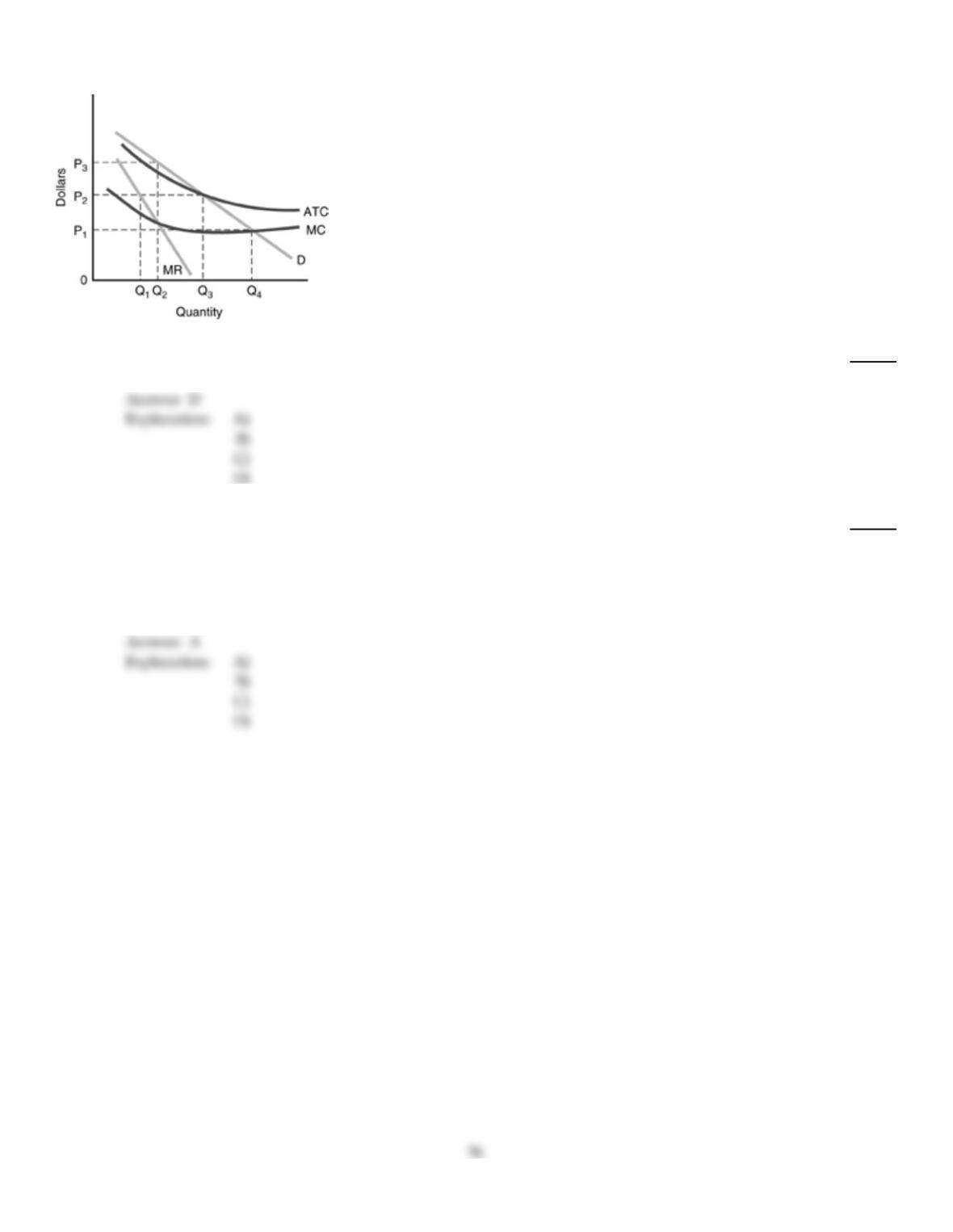
249)
Use the above figure. The profit–maximizing or loss minimizing output and price will be
249)
A)
Q4 and P1.
B)
Q1 and P2.
C)
Q3 and P3.
D)
Q2 and P3.
250)
If the marginal cost curve of all identical firms in a perfectly competitive industry are horizontal at
the same per–unit cost, then the market’s consumer surplus equals the area
250)
A)
beneath the demand curve and above the marginal cost curve.
B)
above the demand curve and beneath the marginal cost curve.
C)
above the demand curve.
D)
below the marginal cost curve.
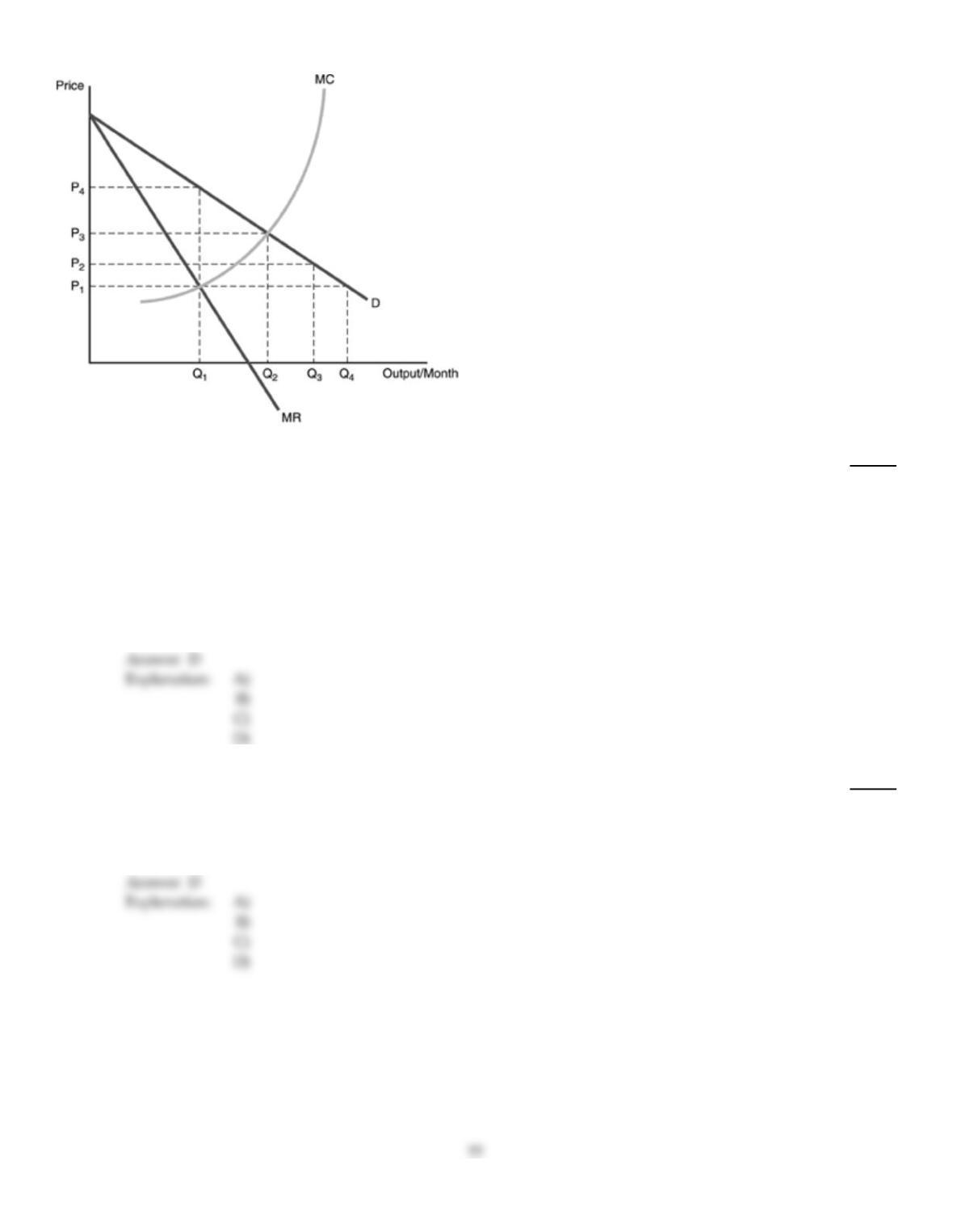
251)
Refer to the above figure. Which of the following statements is TRUE?
251)
A)
Under perfect competition, the efficient price is charged, which is the lowest price possible
(P1) while under monopoly output is too large (Q4) and price is too high (P4).
B)
Price equals marginal cost under both monopoly and perfect competition, but output is too
low under monopoly (Q1 instead of Q2).
C)
The rate of output is the same under both monopoly and perfect competition (Q1), but price is
higher under monopoly (P4 rather than P1).
D)
Under perfect competition price equals marginal cost (P3) while under monopoly price (P4) is
greater than marginal cost (P1).
252)
A firm can be the only firm in an industry and still not be a monopoly if
252)
A)
the firm is not large.
B)
the firm produces a good that is not considered a necessity.
C)
the firm is not making economic profits.
D)
the firm produces a good similar to a good in another industry.
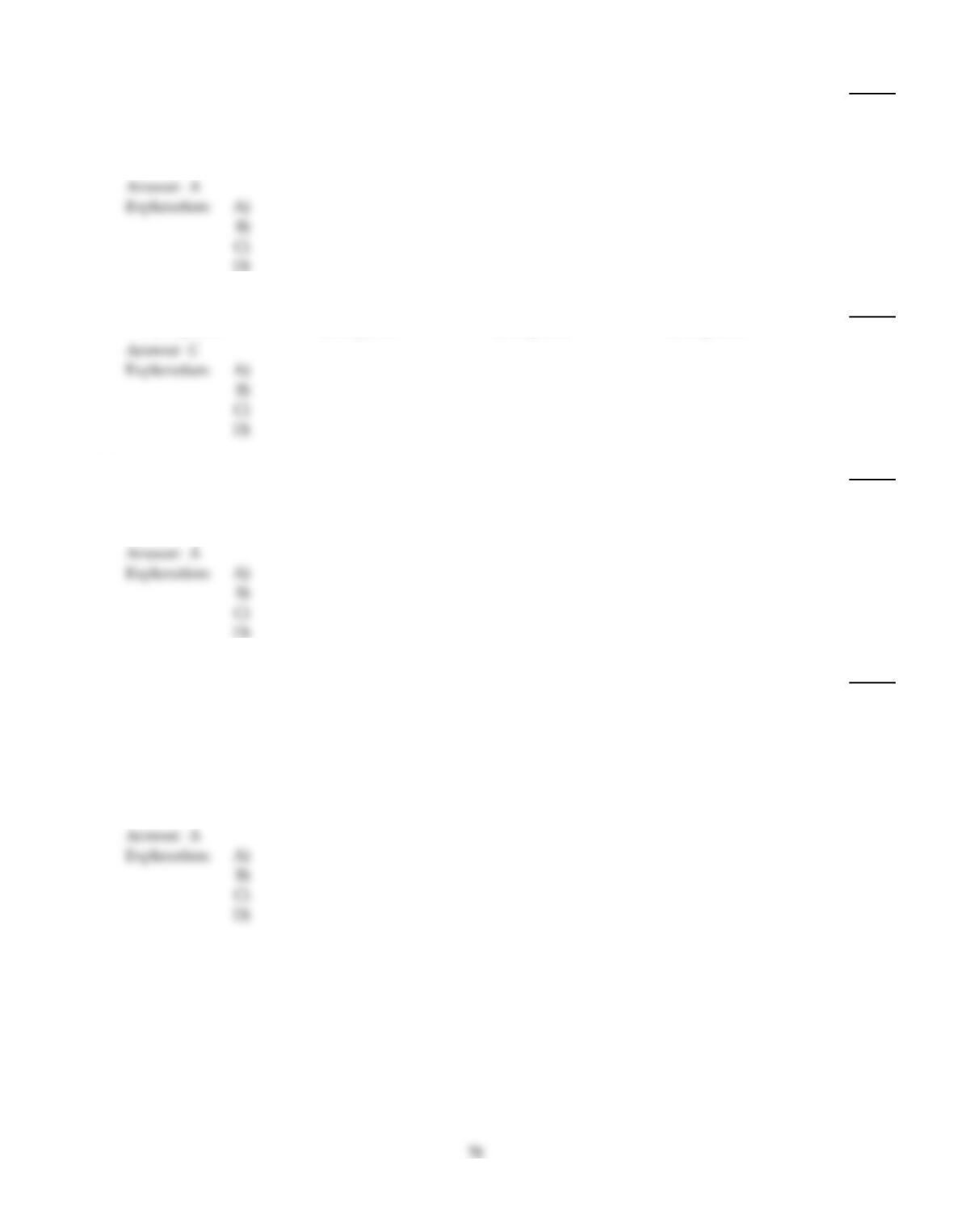
253)
If a monopolist produces to a point at which marginal revenue is greater than marginal cost then
253)
A)
the incremental cost of producing the last unit is less than the incremental revenue.
B)
profits will always be negative.
C)
profits are being maximized.
D)
the incremental cost of producing the last unit exceeds the incremental revenue.
254)
A patent protects an inventor’s creation from being copied or stolen for a period of
254)
A)
10 years.
B)
50 years.
C)
20 years.
D)
30 years.
255)
When grocery stores issue special discount membership cards for shoppers effectively offering
different prices based on quantities consumed, this is an example of
255)
A)
price discrimination.
B)
patent protection.
C)
price differentiation.
D)
product differentiation.
256)
A monopolist is maximizing profit at an output rate of 1,000 units per month. At this output rate,
the price that its customers are willing and able to pay is $8 per unit, average total cost is $5 per
unit, and marginal cost is $6 per unit. It may be concluded that at this monthly output rate,
marginal revenue is
256)
A)
$6 per unit, and the monopolist earns economic profits of $3,000 per month.
B)
$6 per unit, and the monopolist earns economic profits of $2,000 per month.
C)
$6 per unit, and the monopolist earns economic losses of $1,000 per month.
D)
$5 per unit, and the monopolist earns zero economic profits.
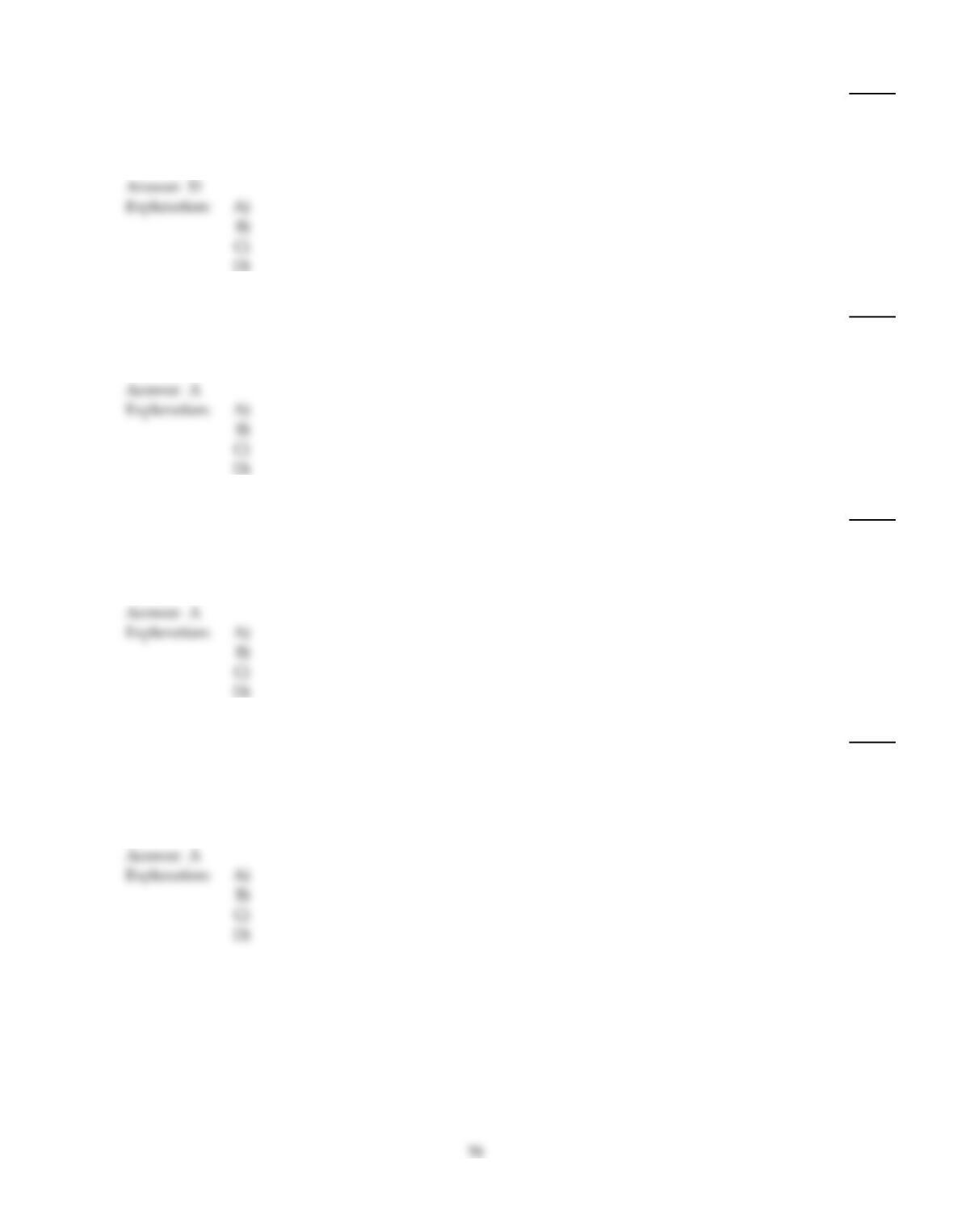
257)
A firm can be the sole supplier of a good and is still not a monopolist if
257)
A)
the firm is not large.
B)
the firm is not making excessive profits.
C)
the good produced is not important to the economy.
D)
there are very close substitutes for the good.
258)
Suppose a monopolist’s costs and revenues are as follows: ATC = $50.00; MC = $45.00; MR =
$40.00; P = $55.00. The firm should
258)
A)
decrease output and increase price.
B)
not change output or price.
C)
shut down.
D)
increase output and decrease price.
259)
If a monopolist produces to a point at which marginal revenue is more than marginal cost then
259)
A)
the firm should increase output.
B)
the firm should reduce output.
C)
the firm is maximizing profits.
D)
we do not know if the firm should increase or reduce without more information.
260)
A monopolist is producing at an output level at which ATC = $5, P = $6, MC = $3, and MR = $4. We
can conclude that
260)
A)
economic profit could be increased by producing more.
B)
economic profit cannot be increased.
C)
the firm is earning $10 in economic profits.
D)
economic profit could be increased by producing less.
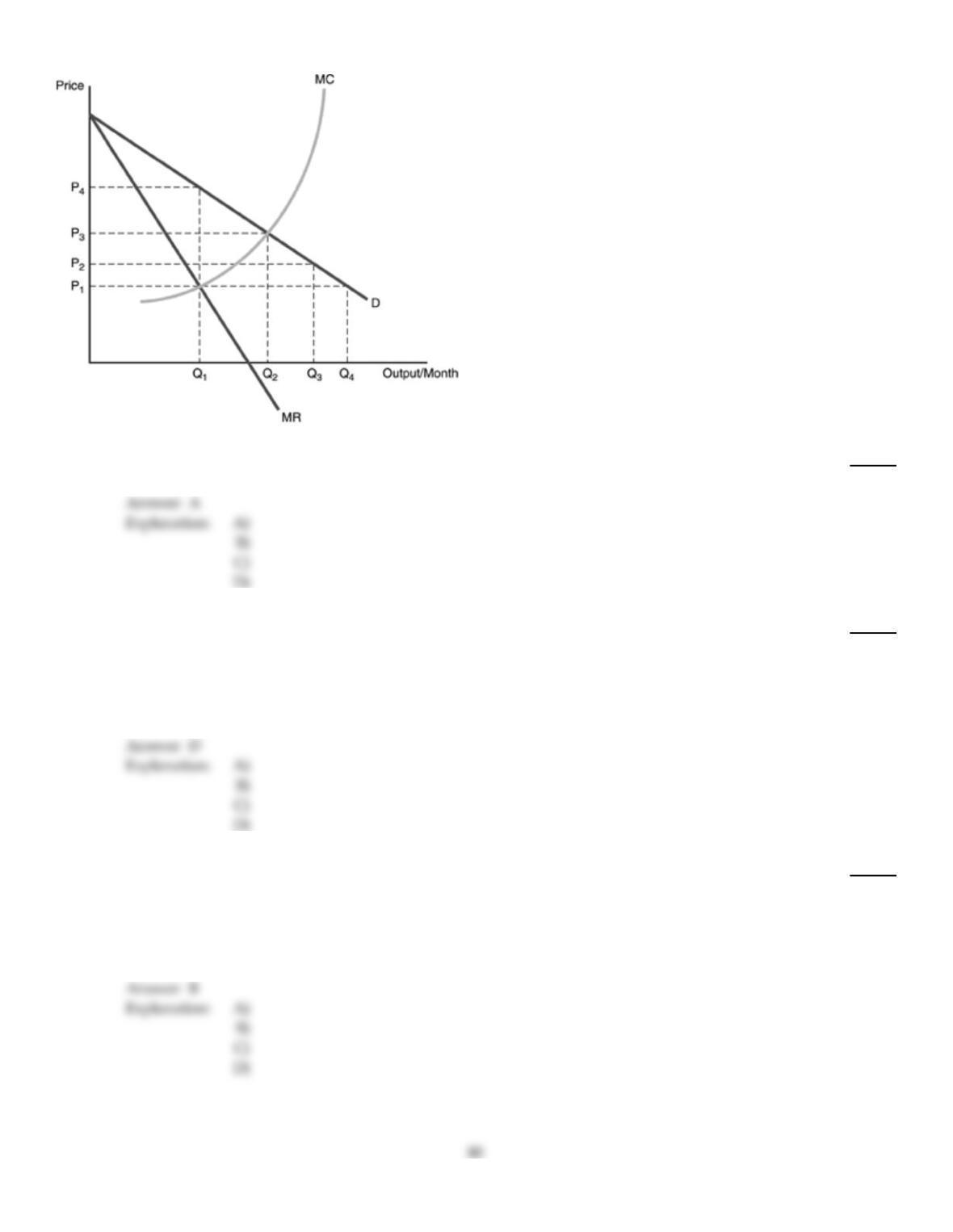
261)
Refer to the above figure. What is the socially optimal point of production?
261)
A)
P3 and Q2.
B)
P4 and Q1.
C)
P1 and Q1.
D)
P1 and Q4.
262)
When comparing perfect competition and monopoly, a major assumption made is that
262)
A)
consumers only care about the price of the good and not whether the seller is a monopoly or
not.
B)
the monopolist can make an above normal rate of return.
C)
the monopolist faces a downward sloping demand curve.
D)
the costs of production are the same under monopoly as under perfect competition.
263)
Which of the following is NOT an example of price discrimination?
263)
A)
student discount at a local movie theater
B)
a hard cover book selling for more than the same book in electronic form
C)
Pharmaceutical companies charge customers living in wealthier countries higher prices than
for identical drugs in poorer nations.
D)
breakfast cereal makers sending coupons to select buyers