125)
The portion of consumer surplus that no one in society is able to obtain in a situation of monopoly
is known as
125)
A)
a deadweight loss.
B)
a market failure.
C)
a market externality.
D)
an unrealized loss.
126)
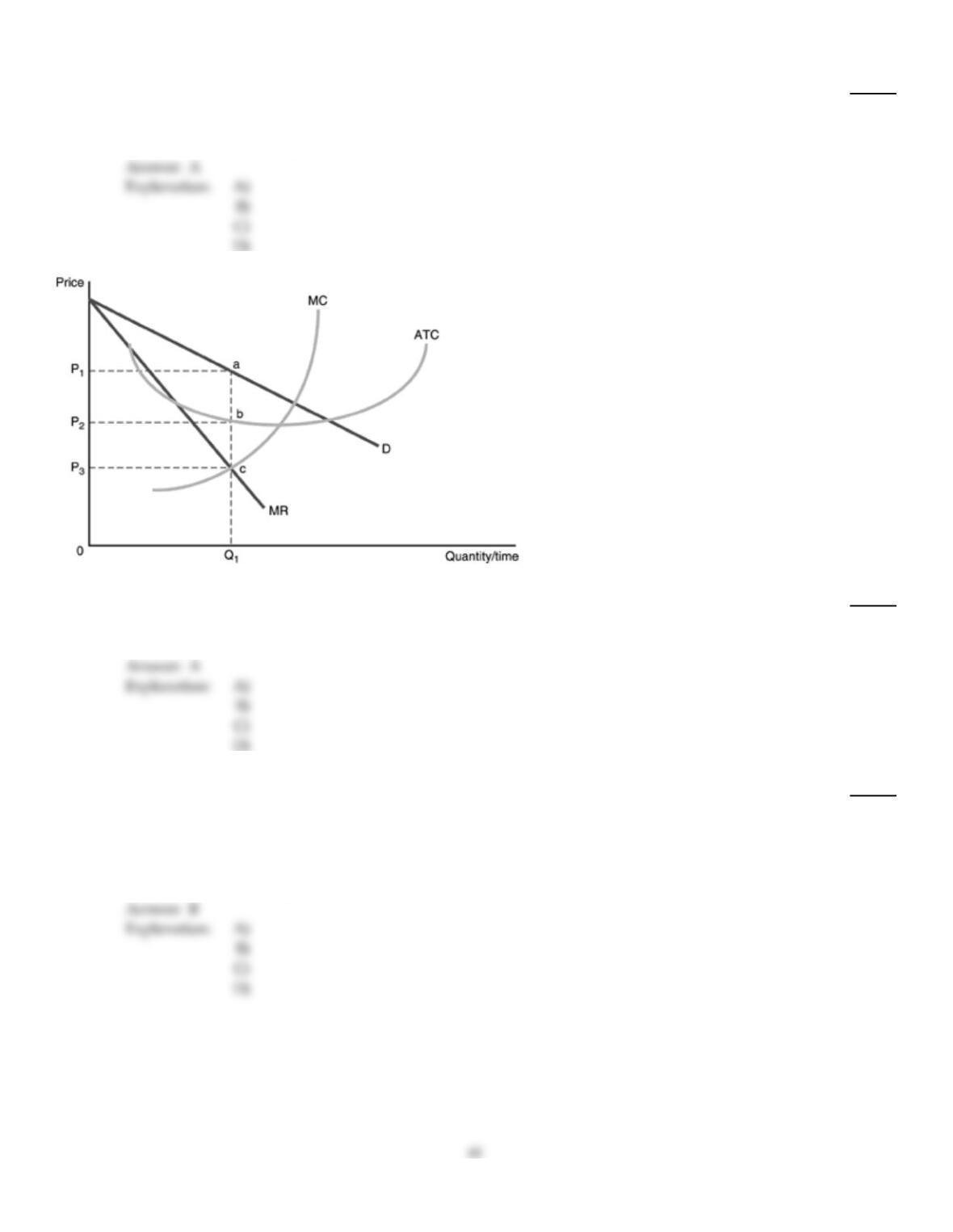
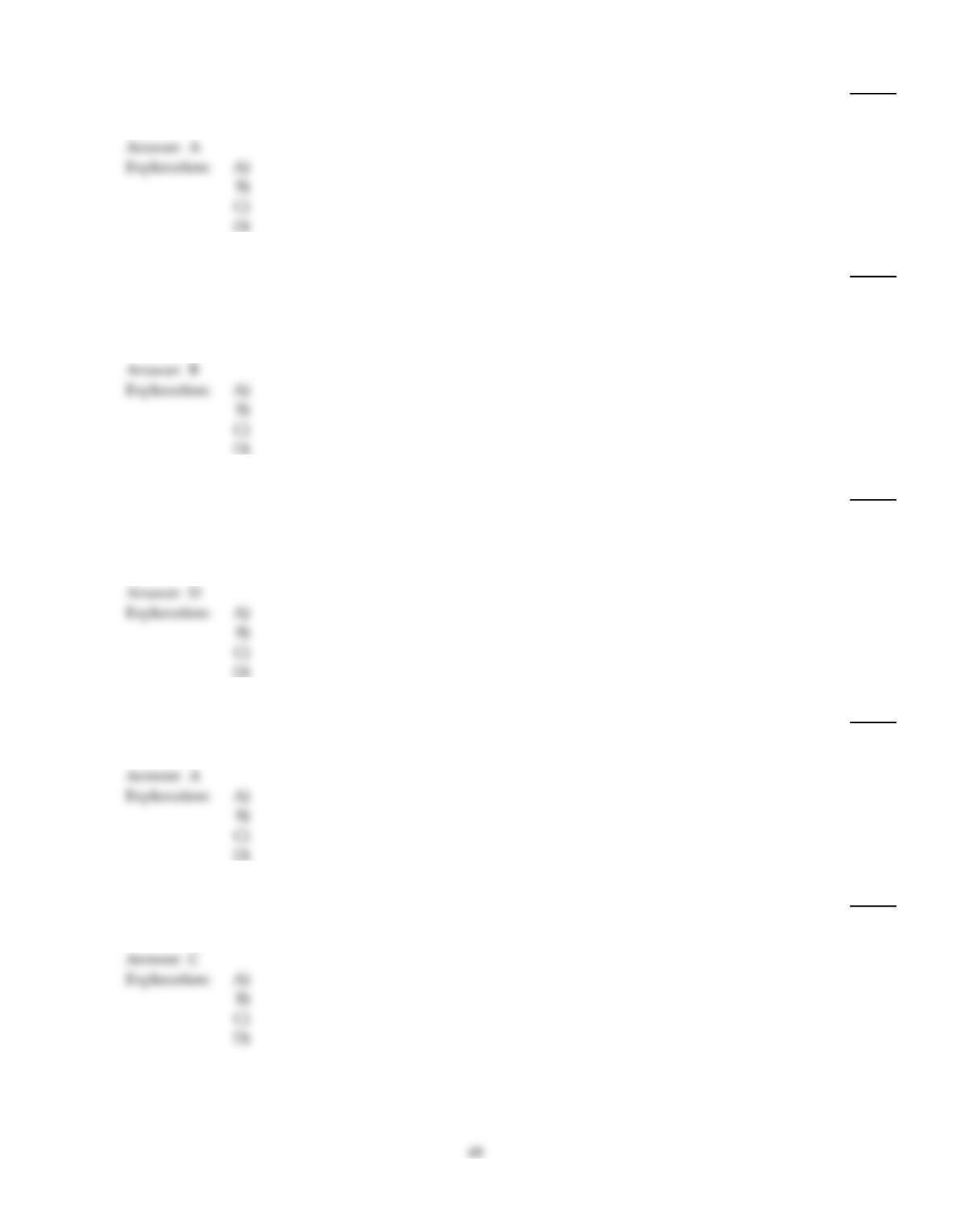
Refer to the above figure. Profits for this firm are
126)
A)
positive and equal to P2P1ab.
B)
negative and equal to 0P3cQ1.
C)
positive and equal to P3P1ac..
D)
negative and equal to P3P2bc.
127)
Shortly after the turn of the century, U.S. Steel owned most of the iron ore reserves in the country.
This is an example of
127)
A)
a barrier to entry from scale economies.
B)
a barrier to entry from owning an important resource.
C)
monopoly due to government restrictions.
D)
monopoly due to governmental entry restrictions.
128)
When TR is increasing as a monopolist’s output increases
128)
A)
MR is negative.
B)
MR = 0.
C)
MR is positive.
D)
MR may be positive or negative.
129)
Which of the following statements is TRUE about the relationship between a firm’s demand curve
under perfect competition and monopoly?
129)
A)
We can define a demand curve under perfect competition but not under monopoly.
B)
Under perfect competition, the demand curve is perfectly elastic; under monopoly, the
demand curve has elastic, unit–elastic and inelastic portions.
C)
Under monopoly, the demand curve is perfectly elastic; under perfect competition, the
demand curve has elastic, unit–elastic and inelastic portions.
D)
The demand curves for a monopoly and perfect competition are always inelastic.
130)
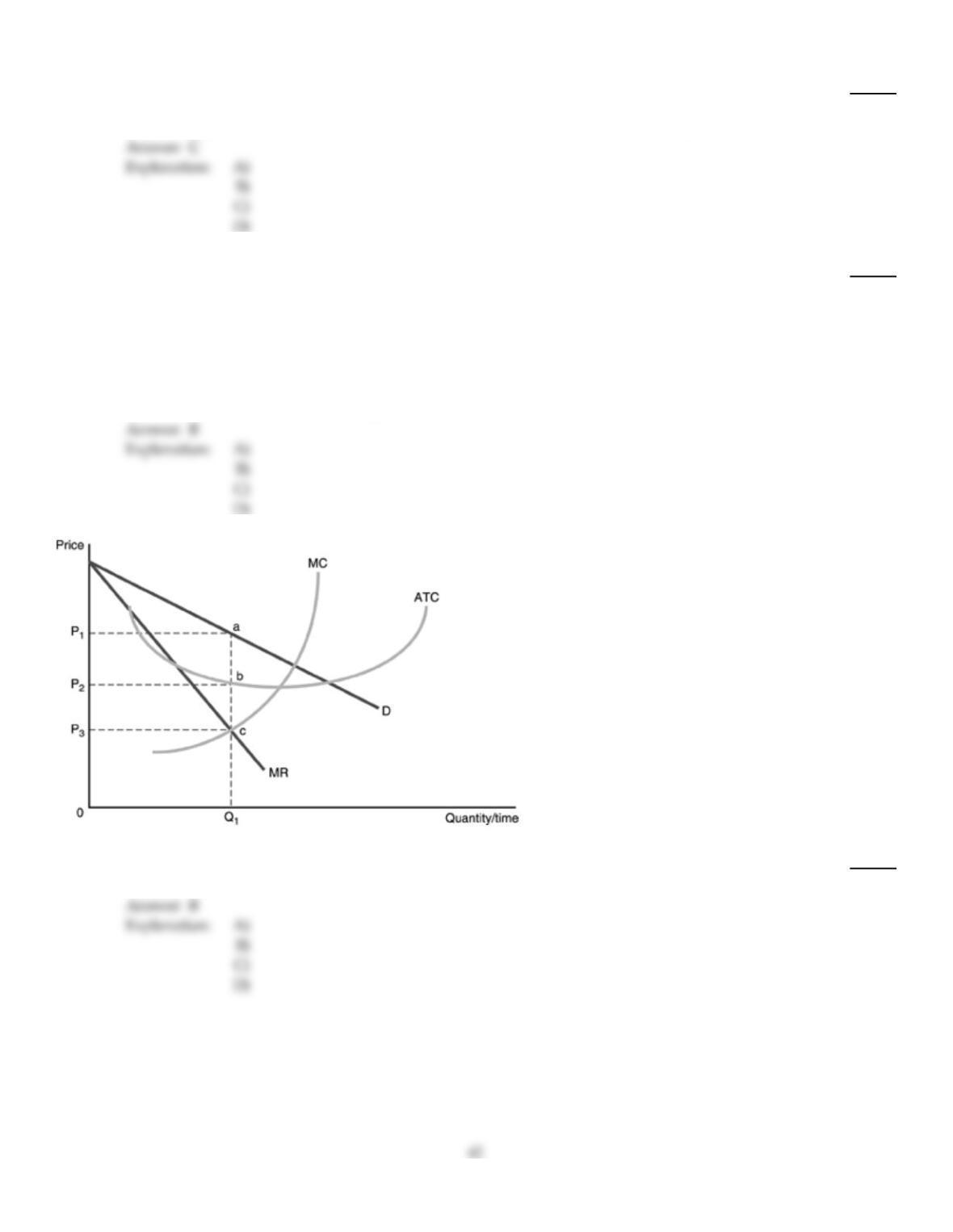
Refer to the above figure. Total cost for this firm equals
130)
A)
P2.
B)
0P2bQ1.
C)
0P3cQ1.
D)
P3.
131)
Which of the following is a characteristic of a monopoly firm?
131)
A)
barriers to entry
B)
easy entry and exit
C)
horizontal individual demand curve
D)
many buyers and sellers
132)
A monopolist
132)
A)
is constrained in its pricing decisions by the demand curve it faces.
B)
can charge whatever price it wants because it is the only firm producing the good.
C)
can usually keep price equal to marginal revenue by lowering the price on the last unit sold
only.
D)
faces a demand curve that is more elastic than the demand curve for the industry.
133)
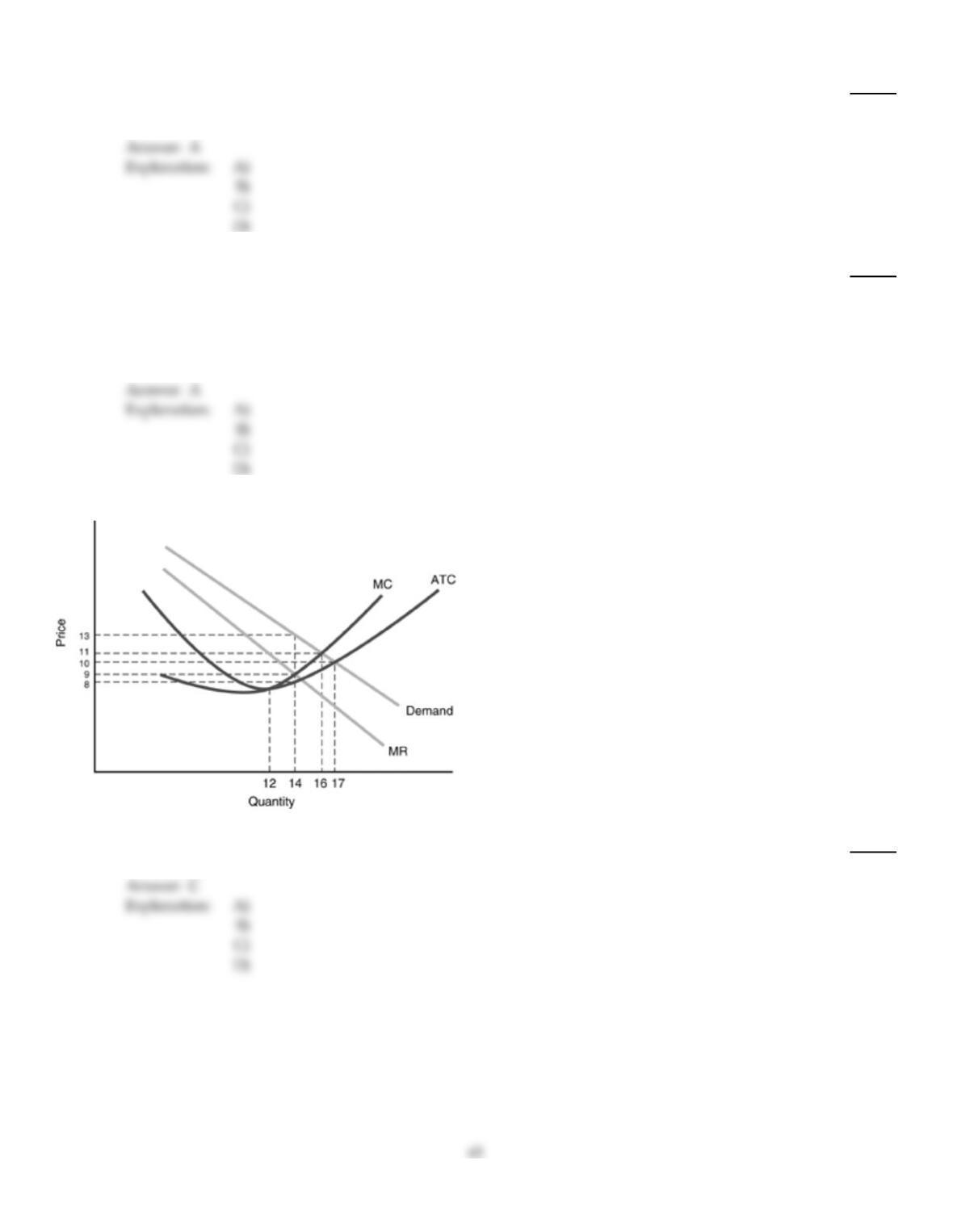
In the above figure, the break–even output and price is
133)
A)
$11 and 16.
B)
$13 and 14.
C)
$10 and 17.
D)
$9 and 14.
134)
The demand curve for a monopolist is
134)
A)
a unitary elastic demand curve.
B)
the industry demand curve.
C)
the same as the demand curve for a perfectly competitive firm.
D)
a perfectly inelastic demand curve.
135)
Which of the following is NOT necessary for price discrimination to occur?
135)
A)
The firm has to be able to prevent resale of the product or service.
B)
The firm must be selling a durable good.
C)
The firm must be able to separate the market into identifiable groups.
D)
The firm must have a downward sloping demand curve.
136)
In order for a firm to receive monopoly profits, there must be
136)
A)
free entry and exit to the market.
B)
mutual interdependence among firms.
C)
homogeneous products.
D)
barriers to market entry.
137)
The demand curve facing a monopolist is
137)
A)
horizontal.
B)
downward sloping.
C)
vertical.
D)
upward sloping.
P Q TC
$13 10 $8
$12 15 $30
$11 20 $68
$10 25 $128
$9 30 $208
$8 35 $308
138)
Refer to the above table. Given the demand and cost schedules, what is the profit maximizing
quantity for this monopolist?
138)
A)
20
B)
25
C)
30
D)
15
139)
Suppose that the profit maximizing level of output for the monopolist is 100 units, and ATC =
$45.00; MC = $35.00; MR = $35.00; P = $50.00. What is the monopoly’s profit?
139)
A)
–$1000
B)
$4500
C)
$500
D)
$5000
140)
The demand curve a monopolist faces is
140)
A)
vertical.
B)
inelastic at all points.
C)
the industry demand curve.
D)
horizontal.
141)
Compared to perfect competition, a monopoly will produce ________ output, and charge a
________ price.
141)
A)
less; higher
B)
less; lower
C)
more; higher
D)
more; lower
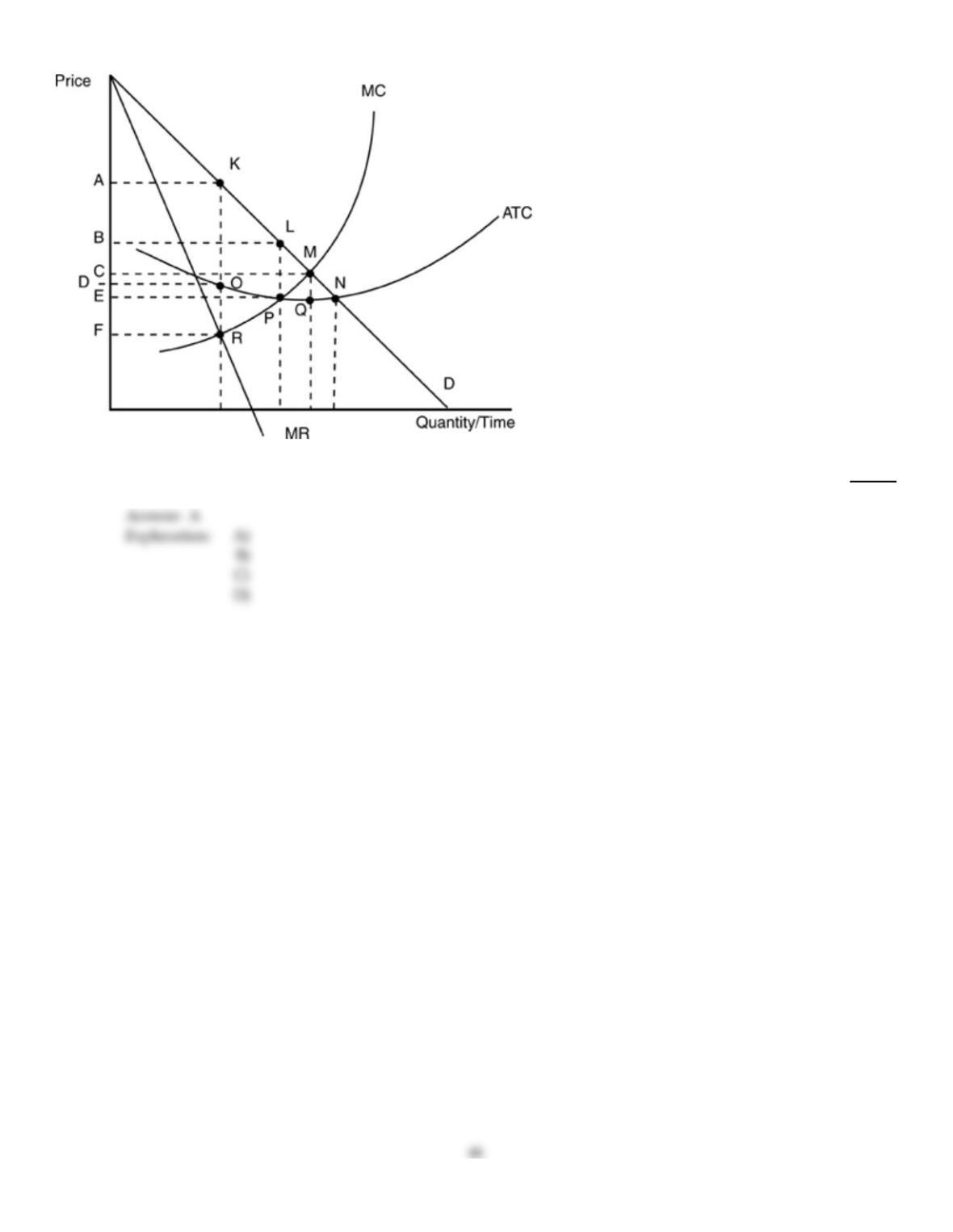
142)
According to the above figure, the profit–maximizing price for the monopolist is
142)
A)
A.
B)
B.
C)
C.
D)
D.
A
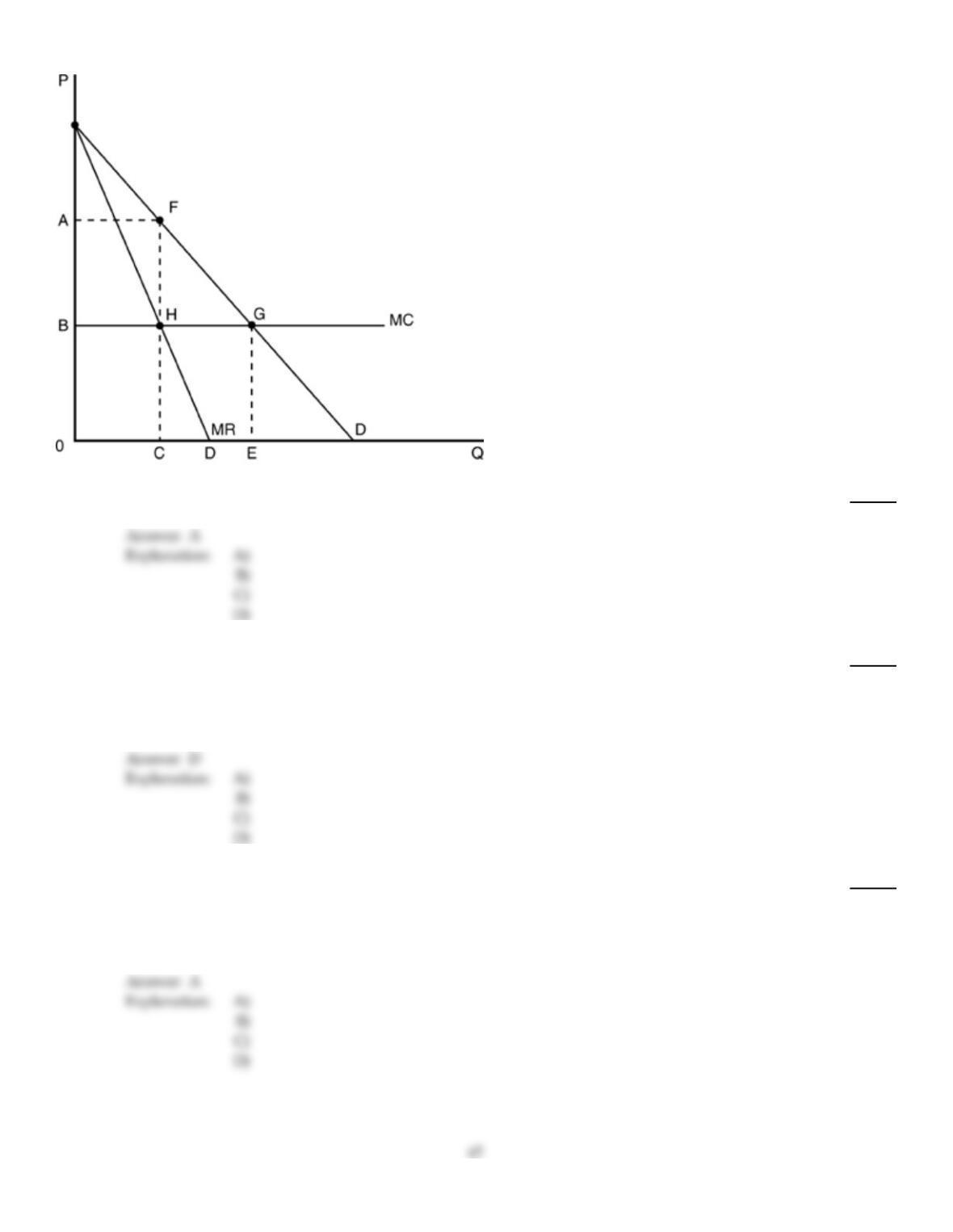
143)
In the above figure, the monopolist’s profit–maximizing price is
143)
A)
A.
B)
B.
C)
C.
D)
D.
144)
Under a monopoly, resources are misallocated such that
144)
A)
too few resources are used in other industries, and too many are used by the monopoly.
B)
resources are being used as efficiently as possible only by the monopoly.
C)
consumers are being forced to pay a price below the MC of the monopolist.
D)
too few resources are used by the monopoly, and too many are used elsewhere.
145)
If a monopolist raises its price
145)
A)
the quantity demanded decreases.
B)
the quantity demanded increases.
C)
the quantity demanded remains the same.
D)
it raises the barriers to entry.
146)
Suppose that the profit maximizing level of output for the monopolist is 10 units, and price = $50,
ATC = $35, and AVC = $25. What is the monopoly’s profit?
146)
A)
$150
B)
$250
C)
$500
D)
$50
147)
If a monopolist is producing the quantity at which marginal revenue equals marginal cost, it
should
147)
A)
reduce output if it wants to maximize profits.
B)
increase price and keep output unchanged if it wants to maximize profits.
C)
increase output if it wants to maximize profits.
D)
continue to produce this amount if it wants to maximize profits.
D
148)
In a monopoly
148)
A)
the firm and the industry are the same thing.
B)
the market is small in an absolute sense.
C)
the monopolist determines how much each firm will produce.
D)
the firm is large in an absolute sense.
A
149)
If government regulations significantly increase the cost of operating within a particular market,
one result is that
149)
A)
new firms are discouraged from entering the market.
B)
a perfectly competitive market environment is encouraged.
C)
new firms are encouraged to enter the market.
D)
barriers to entry are nullified.
A
A
150)
If a monopolist can sell 3 units at price of $150 per unit and 4 units at a price of $140 per unit, its
marginal revenue at an output of 4 is
150)
A)
$110.00.
B)
$10.00.
C)
$560.00.
D)
$–10.00.
151)
Which of the following is NOT a precondition for price discrimination?
151)
A)
The seller must have some market power.
B)
The product is a durable good.
C)
The product cannot be resold to another customer.
D)
The price elasticities of demand are different for each group of consumers.
B
152)
To induce an increase in the quantity demanded of its product, a monopolist must reduce the
152)
A)
quality of its product and thereby generate a downward shift its ATC curve.
B)
quality of its product and thereby generate a downward movement along its ATC curve.
C)
price of its product and thereby generate a rightward shift in its demand curve.
D)
price of its product and thereby generate a rightward movement along its demand curve.
D
153)
A firm that is the only seller of a good with no close substitutes is a(n)
153)
A)
monopolist.
B)
perfect competitor.
C)
monopolistic competitor.
D)
oligopolist.
A
154)
Entry barriers are most significant in
154)
A)
pure competition.
B)
monopolistic competition.
C)
pure monopoly.
D)
oligopoly.
C
A
155)
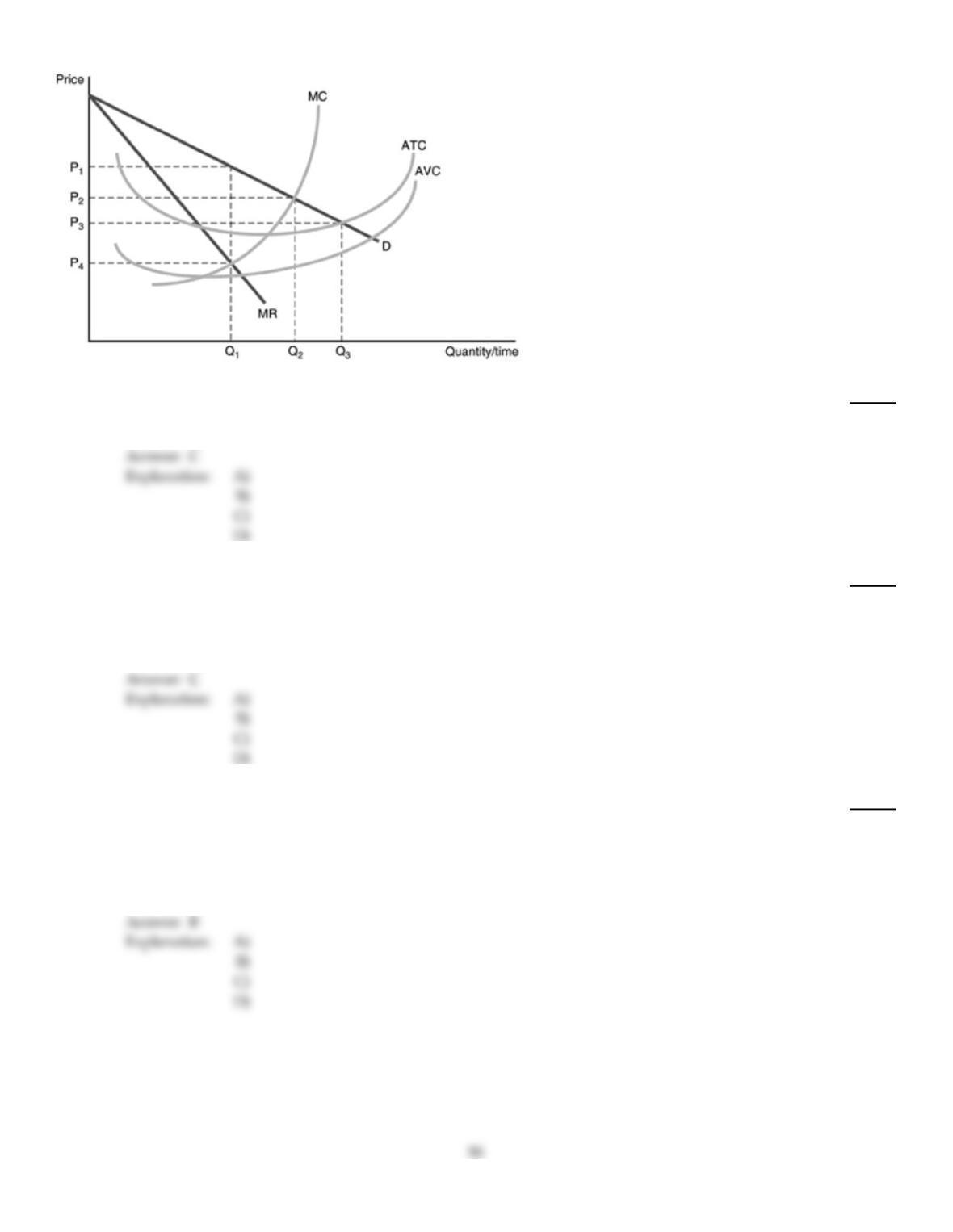
Refer to the above figure. Profits for this firm are
155)
A)
negative.
B)
zero.
C)
positive.
D)
undetermined without more information.
156)
Profits can be maximized by equating MR = MC = Price
156)
A)
only in discriminating monopoly markets.
B)
only in monopoly markets.
C)
only in perfectly competitive markets.
D)
only with government price controls.
C
157)
A barrier to entry is
157)
A)
a term used to explain why monopolies always make economic profits.
B)
a restriction on starting a business.
C)
a restriction on the profits that a monopoly can make.
D)
the situation when the government produces a good instead of relying on private firms to
produce the good.
B
C
158)
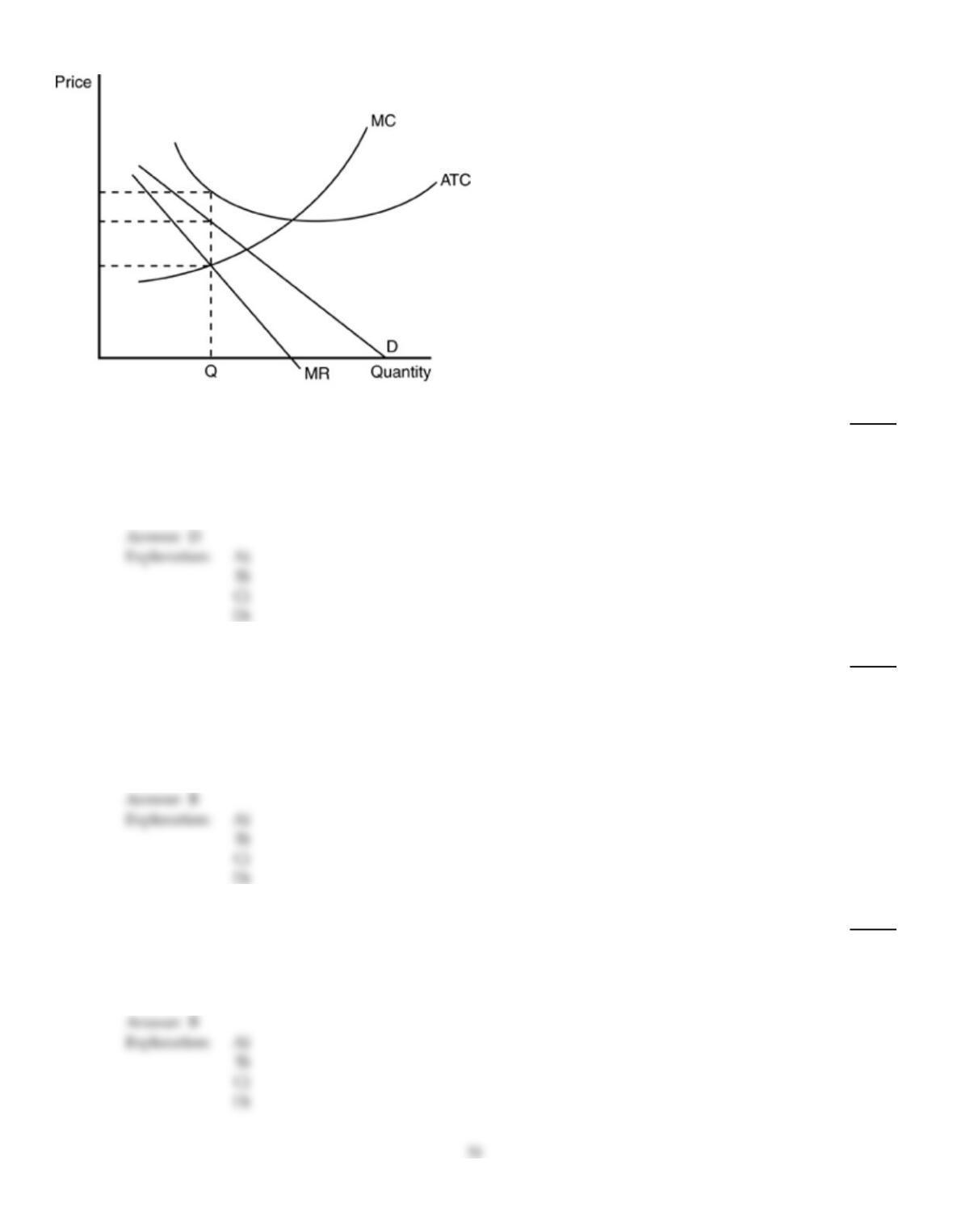
If the above figure accurately portrays the market conditions for a given monopolist, we can be
assured that the monopolist
158)
A)
is producing at the level that will maximize benefit to society.
B)
is making excessive profits.
C)
is making a normal profit.
D)
will be forced to go out of business in the long run.
159)
Suppose that a drug for treating cancer is cleared by the Food and Drug Administration and that
the company is successful in obtaining a patent for its product. Which of the following is then
TRUE?
159)
A)
The patent holder now faces barriers to entry.
B)
The patent holder has a monopoly.
C)
The drug would have many close substitutes.
D)
The method of producing the product would not be considered intellectual property.
160)
For a monopolist
160)
A)
marginal revenue equals average revenue.
B)
marginal revenue is less than price.
C)
marginal revenue equals price.
D)
marginal revenue is greater than price.
161)
Legal or governmental restrictions that give monopolistic advantages to a firm include all of the
following EXCEPT
161)
A)
economies of scale.
B)
licenses.
C)
tariffs.
D)
franchises.
162)
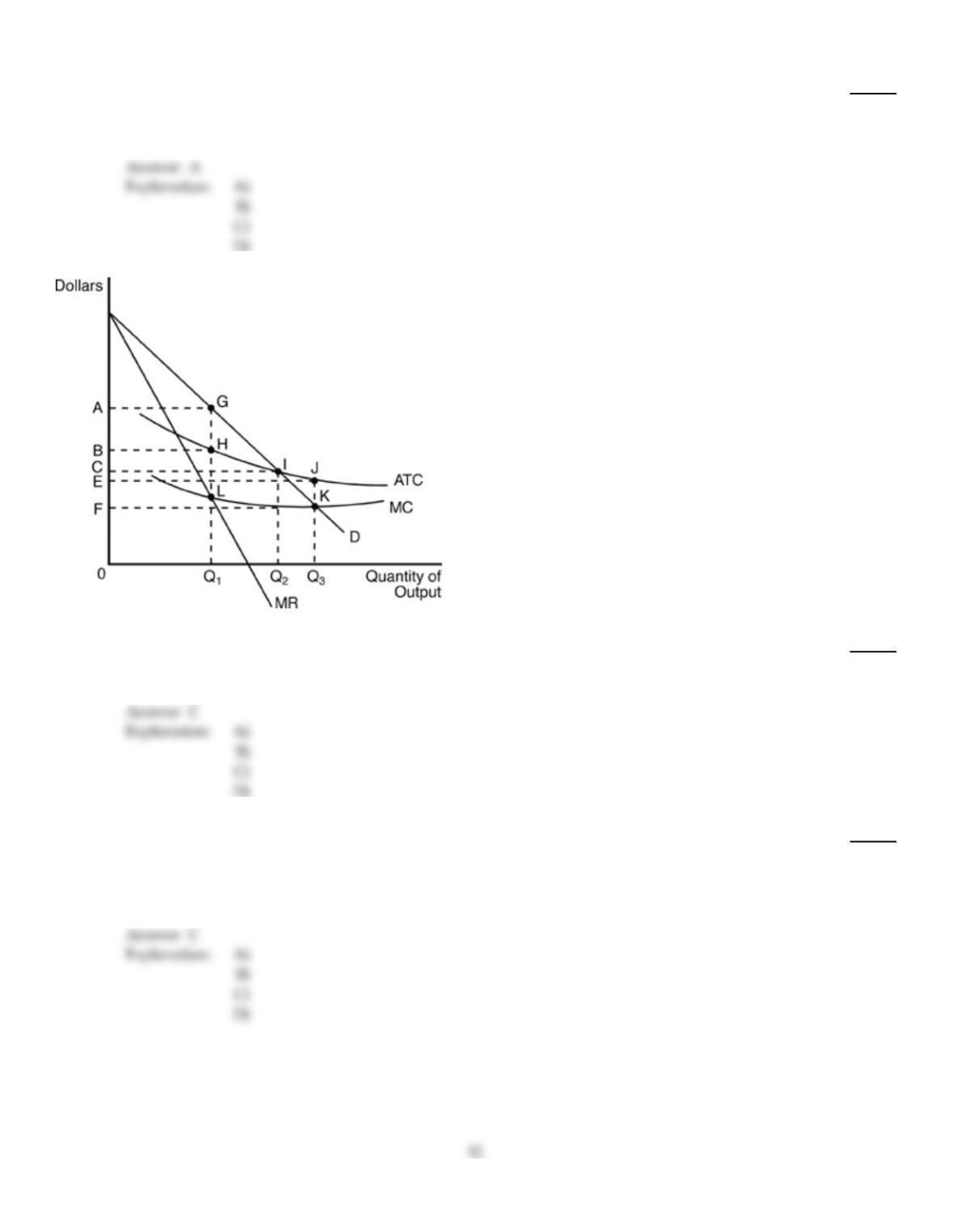
In the above figure, a monopolist will set its level of output and price at
162)
A)
Q2 and C, respectively.
B)
Q1 and B, respectively.
C)
Q1 and A, respectively.
D)
Q3 and F, respectively.
163)
For price discrimination to exist, all of the following are necessary EXCEPT
163)
A)
an identifiable group of buyers with different elasticities of demand.
B)
there can be no resale of the product.
C)
an upward sloping marginal cost curve.
D)
a downward sloping demand curve.
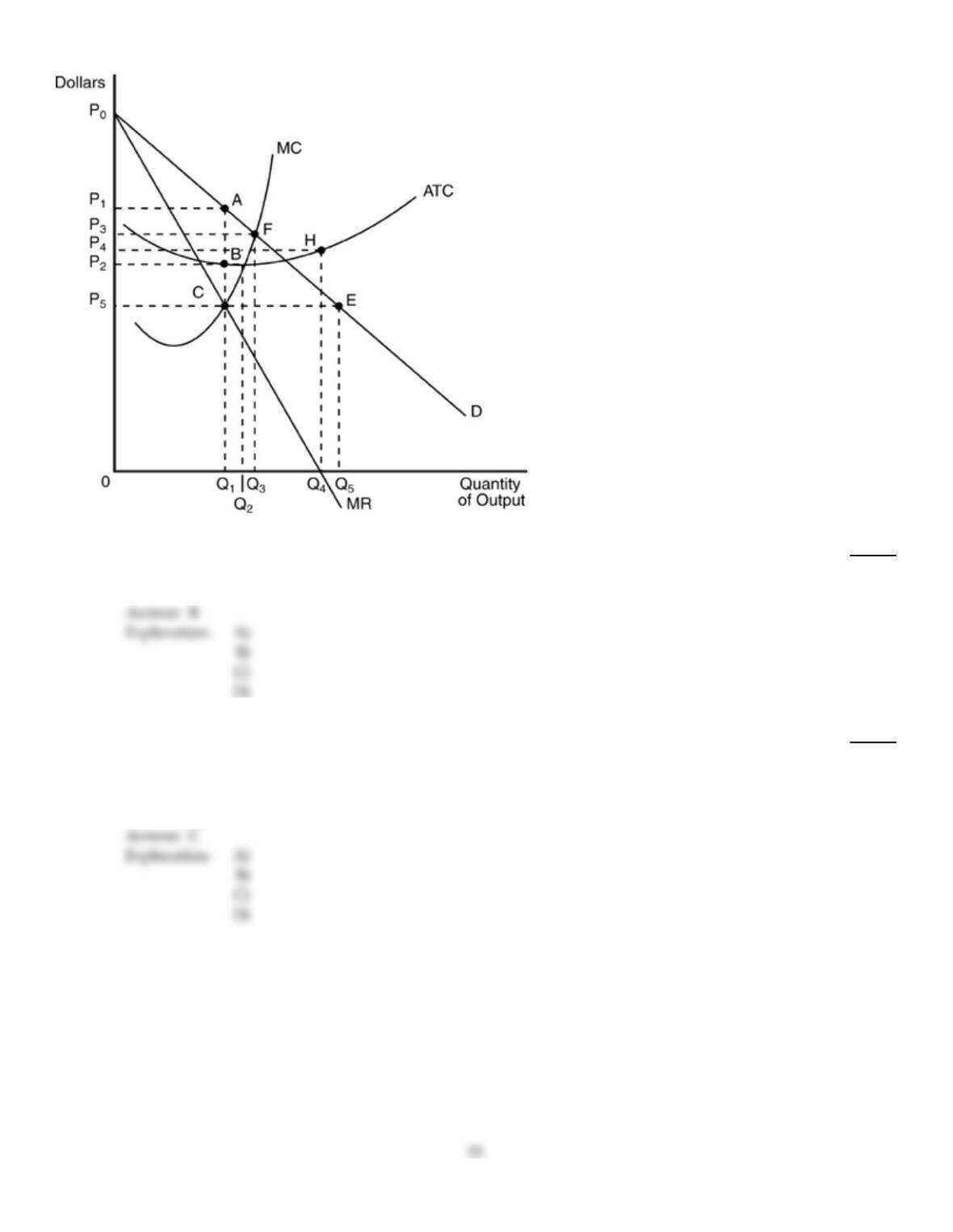
164)
In the above figure, the total cost of producing the profit maximizing level of output is shown by
rectangle
164)
A)
0P5EQ5.
B)
0P2BQ1.
C)
0P4HQ4.
D)
0P1AQ1.
165)
A monopolist who is maximizing profits produces to the point at which
165)
A)
price, marginal cost and average variable cost are equal.
B)
price is greater than average total cost.
C)
price is greater than marginal cost.
D)
marginal cost and average total cost are equal.
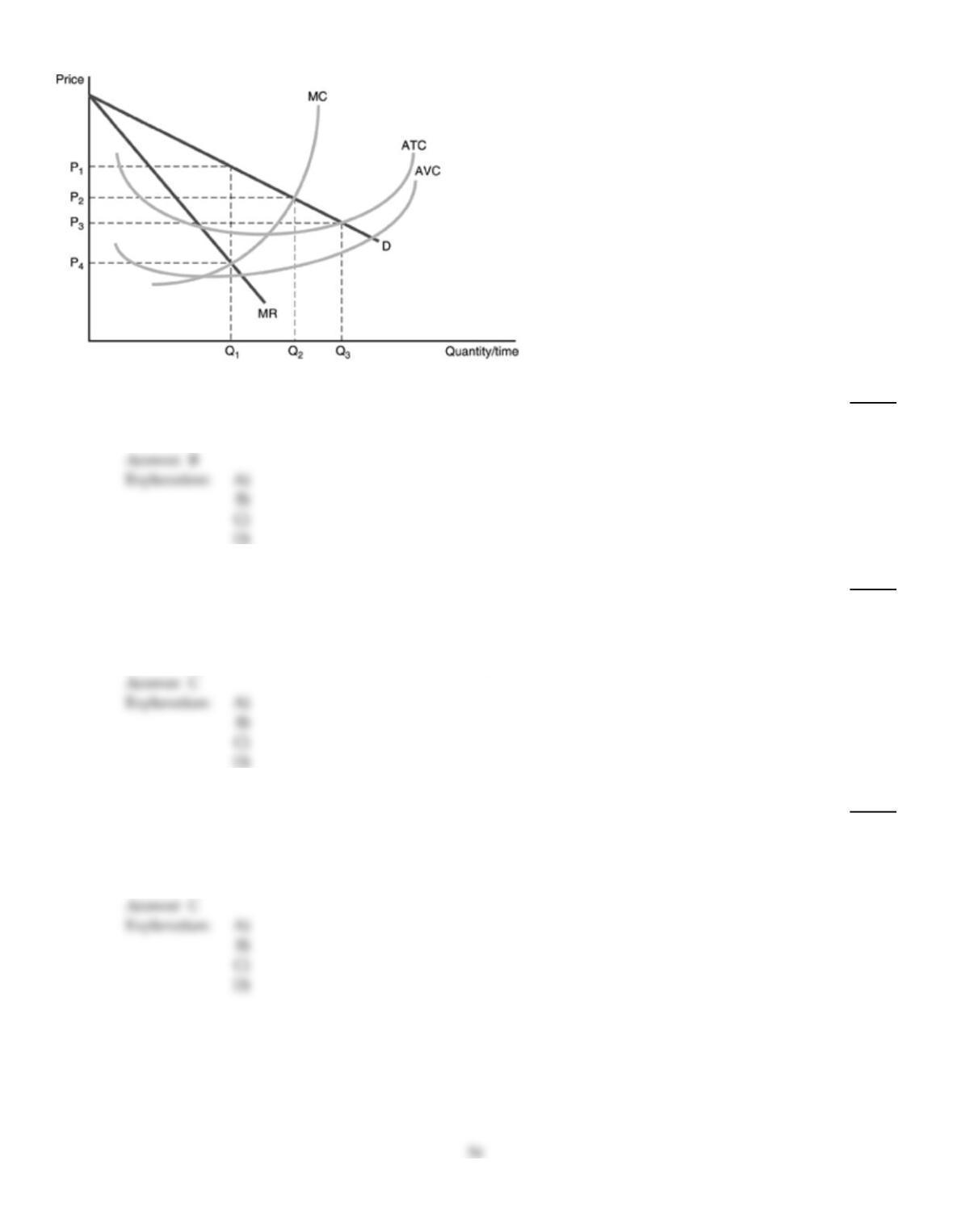
166)
Refer to the above figure. The firm is currently producing at Q2. The firm should
166)
A)
leave production as it is.
B)
reduce production.
C)
increase production.
D)
shut down.
167)
A profit–maximizing monopolist earns an economic loss whenever
167)
A)
it pays taxes to the government on each unit of output it produces.
B)
it produces along the elastic portion of a demand curve.
C)
the demand curve lies completely below the ATC curve.
D)
the price it charges for its product exceeds average total cost.
168)
Which of the following is NOT a necessary condition for a firm to price discriminate?
168)
A)
Resale of the product must be preventable.
B)
Buyers in different markets must have different elasticities of demand.
C)
The firm must be a price–taker.
D)
The firm must be able to separate markets.
169)
In order to sell more goods and/or services, what must a monopoly do?
169)
A)
increase price
B)
nothing, since it is the market
C)
reduce price and increase output
D)
increase output
170)
Which of the following conditions hold true for both the perfectly competitive firm and the
monopoly at the profit–maximizing output level?
170)
A)
MR = P
B)
MC = P
C)
MC = ATC
D)
MR = MC
171)
When a monopolist sells the same product at different prices and the prices are not related to cost
differences, we have
171)
A)
price discrimination.
B)
monopoly pricing.
C)
price differentiation.
D)
marginal cost pricing.
Price Quantity
$19 11
18 12
17 13
16 14
15 15
14 16
172)
Given the data in the above table, what is the marginal revenue when the 12th unit is sold?
172)
A)
$7.00
B)
$1.00
C)
$5.00
D)
$3.00
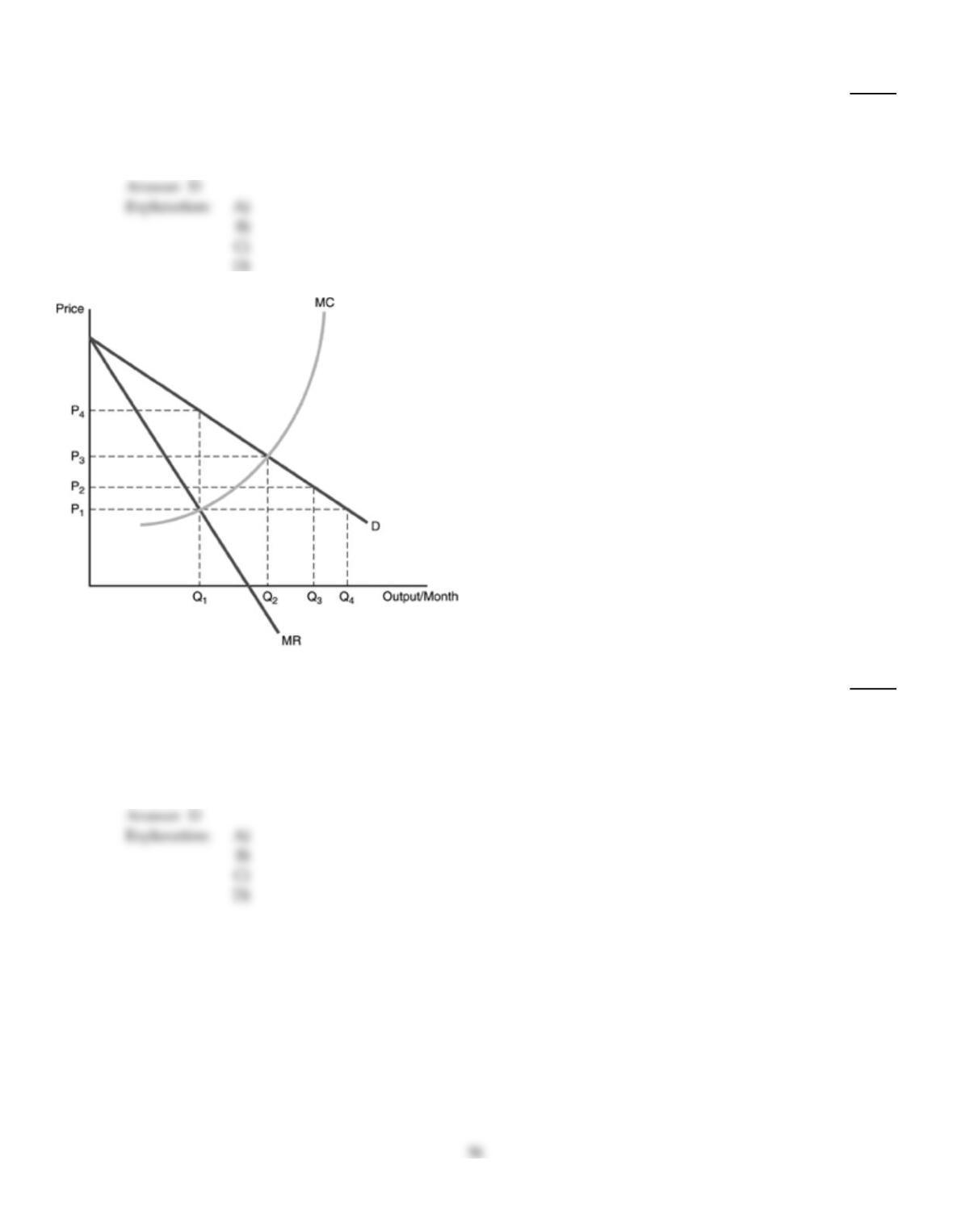
173)
If a government imposes high enough tariffs, one result will be that
173)
A)
consumers will benefit from lower prices.
B)
markets will become more globalized.
C)
foreign producers will be able to sell more goods.
D)
domestic producers will face no foreign competition.
174)
Refer to the above figure. Suppose this industry was perfectly competitive and then merged into
one monopolistic firm. The monopoly would
174)
A)
reduce output from Q3 to Q1.
B)
raise price from P1 to P2.
C)
raise price from P1 to P4.
D)
reduce output from Q2 to Q1 and raise price from P3 to P4.
175)
If a monopolist were to produce in the inelastic segment of its demand curve
175)
A)
total revenue would be at a maximum.
B)
a further drop in the price will change quantity demanded less than proportionately.
C)
total revenue would be at a minimum.
D)
the firm would maximize profits.
176)
The market structure where there is a single supplier of a good or service for which there is no close
substitute is
176)
A)
the most economically efficient market structure.
B)
a tariff.
C)
a price searcher.
D)
a monopoly.
177)
A firm that faces a downward sloping demand curve is known as a
177)
A)
price taker.
B)
perfect competitor.
C)
price searcher.
D)
utility maximizer.
178)
If a monopolist can sell 2 units at price of $200 per unit and 3 units at a price of $180 per unit, its
marginal revenue at an output of 3 is
178)
A)
$140.00.
B)
$–20.00.
C)
$180.00.
D)
$80.00.
179)
The demand curve facing a monopolist will be more elastic
179)
A)
as the number of consumers increases.
B)
the greater is the amount of fixed costs to cover.
C)
the greater is the number of substitute products.
D)
as the consumers’ need for the good increases.
180)
If a monopoly situation arises from a perfectly competitive market, the portion of producer surplus
that increases in a monopoly is transferred from the perfectly competitive market’s
180)
A)
deadweight loss.
B)
consumer surplus.
C)
fixed cost.
D)
long–run positive economic profit.
181)
A firm that must determine the price–output combination that maximizes profit because it faces a
downward–sloped demand curve
181)
A)
has a perfectly inelastic demand curve.
B)
has a perfectly elastic demand curve.
C)
is a price searcher.
D)
is a price–taker.
Explanation:
P Q TC
$13 10 $15
$12 14 $25
$11 19 $45
$10 25 $75
$9 30 $115
$8 35 $165
182)
Refer to the above table. Given the demand and cost schedules, what are the maximum economic
profits for this monopolist?
182)
A)
$175
B)
$164
C)
$143
D)
$155
Explanation:
183)
If a monopolist is producing the quantity at which marginal revenue exceeds marginal cost, it
should
183)
A)
increase output if it wants to maximize profits.
B)
reduce output if it wants to maximize profits.
C)
reduce price and keep output unchanged if it wants to maximize profits.
D)
continue to produce this amount if it wants to maximize profits.
Explanation:
Explanation:
184)
The MR curve of a monopolist is
184)
A)
horizontal and same as the market demand curve.
B)
downsloping and above the demand curve.
C)
downsloping and identical to the demand curve.
D)
downward sloping and below the demand curve.
185)
A monopolist faces
185)
A)
a perfectly elastic demand curve.
B)
the market demand curve.
C)
a perfectly inelastic demand curve.
D)
a two–tiered demand curve.
186)
A monopoly will maximize profits at the level of output at which
186)
A)
MR = MC.
B)
MC = P.
C)
MR = AFC.
D)
MC = ATC.
187)
If a firm sells 5 units of output at $9 per unit and 6 units of output when price is reduced to $8, its
marginal revenue from selling the sixth unit is
187)
A)
$45.
B)
$1.
C)
$48.
D)
$3.
188)
The price elasticity of demand for a good produced by a monopolist
188)
A)
equals zero as long as the good has no close substitutes.
B)
does not equal zero because every good has at least one good substitute for it.
C)
is always inelastic since the demand curve slopes down.
D)
does not equal zero because there will always be some substitutes, however imperfect they
may be.
189)
If a monopolist wants to increase the amount it sells, it
189)
A)
must accept lower profits.
B)
must lower the price on all units.
C)
must lower the cost of production.
D)
will keep the price the same.
190)
A monopolist maximizes profits by finding
190)
A)
the rate of output where price equals marginal cost.
B)
the rate of output where marginal revenue equals marginal cost.
C)
the price where price exceeds marginal revenue by that largest amount.
D)
the price where average revenue and marginal cost are equal.
191)
Which of the following are barriers to entry?
191)
A)
B)
C)
D)
192)
The conclusion that a monopoly results in lower output and higher prices than perfect competition
relies on the assumption that
192)
A)
elasticity of demand varies along the market demand curve.
B)
consumers are ignorant of the effects of monopoly.
C)
the costs of production are the same whether the industry is perfectly competitive or a
monopoly.
D)
the demand curve for a monopoly is horizontal.
193)
If a firm sells 10 units of output at $100 per unit and 11 units of output when price is reduced to
$99, its marginal revenue for the last unit sold is
193)
A)
$89.
B)
$99.
C)
$109.
D)
$11.