75) When you double the number of windings in an ideal solenoid while keeping all other
parameters (radius, length and current) fixed, the magnetic field at the center of the solenoid will
A) double.
B) triple.
C) quadruple.
D) be reduced by a factor of one-half.
E) be reduced by a factor of one-fourth.
76) When a ferromagnetic material is placed in an external magnetic field, the net magnetic field
of its magnetic domains becomes
A) smaller.
B) zero.
C) larger.
24.2 Problems
1) A proton moving at 5.0 × 10⁴ m/s horizontally enters a region where a magnetic field of 0.12
T is present, directed vertically downward. What magnitude force acts on the proton due to this
field?
(e = 1.60 × 10⁻¹⁹ C)
2) A geophysicist measures the magnetic force on a proton that is moving vertically downward at
a point 1.996 km/s at the earth’s equator. At that location, the earth’s magnetic magnetic field is
horizontal and has a strength of 0.40 × 10⁻⁴ T. What are the magnitude and direction of the force
she will measure? (e = 1.60 × 10⁻¹⁹ C)
3) An electron moves with a speed of 5.0 × 10⁴ m/s perpendicular to a uniform magnetic field of
magnitude 0.20 T. What is the magnitude of the magnetic force on the electron? (e = 1.60 × 10–
19 C)
A) 4.4 × 10⁻¹⁴ N
B) 1.6 × 10⁻¹⁵ N
C) 5 × 10-20 N
D) 2.6 × 10⁻²⁴ N
E) zero
4) An electron traveling toward the magnetic north with speed 400 km/s enters a region where
the earth’s magnetic field has the magnitude 5.0 × 10⁻⁵ T and is directed downward at 45° below
horizontal. What magnitude magnetic force acts on the electron? (e = 1.60 × 10⁻¹⁹ C)
5) A proton travels at a speed of 5.0 × 10⁷ m/s through a 1.0-T magnetic field. What is the
magnitude of the magnetic force on the proton if the angle between the proton’s velocity and the
magnetic field vector is 30°? (e = 1.60 × 10⁻¹⁹ C)
A) 2.0 × 10⁻¹⁴ N
B) 4.0 × 10⁻¹⁴ N
C) 2.0 × 10⁻¹² N
D) 4.0 × 10⁻¹² N
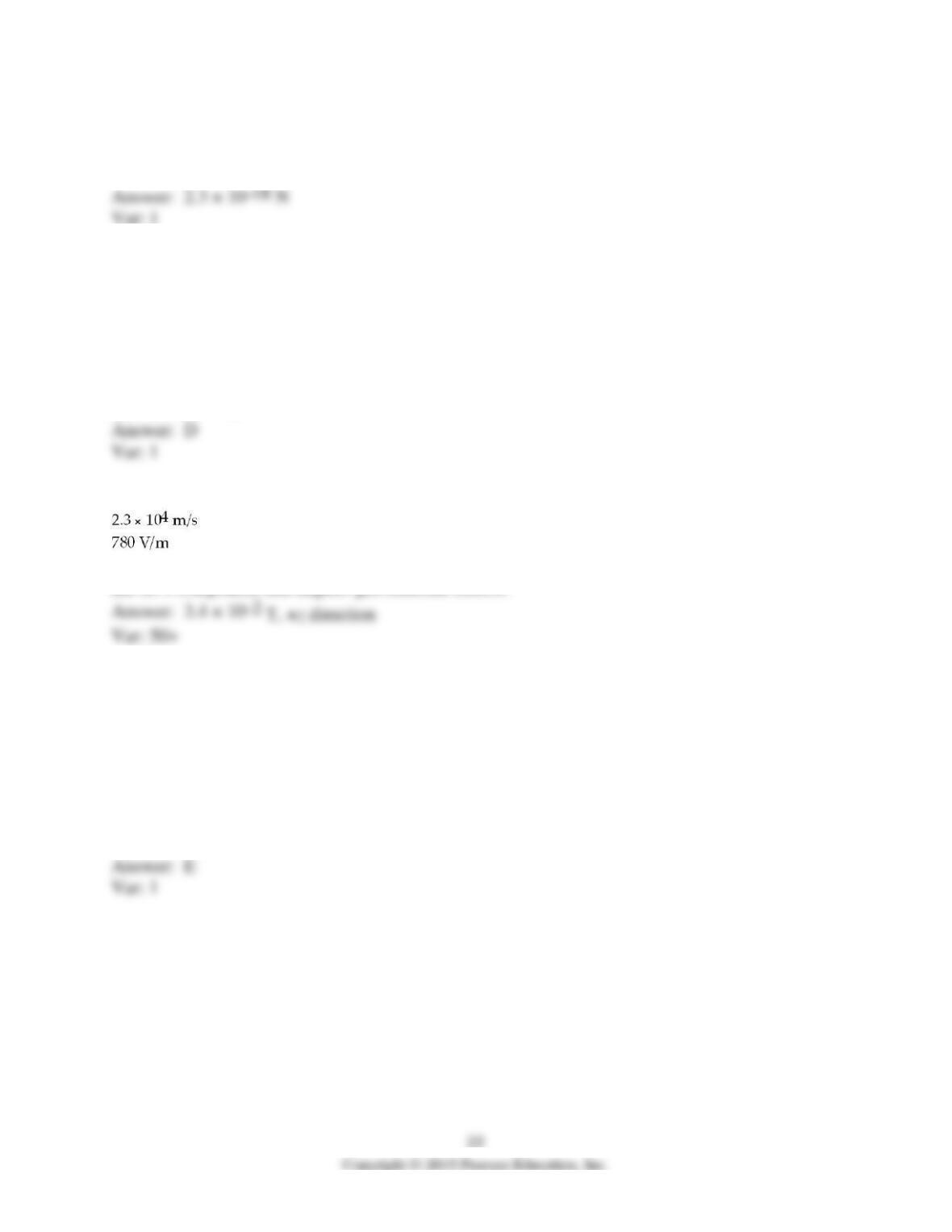
6) A proton, with mass 1.67 × 10⁻²⁷ kg and charge +1.6 × 10⁻¹⁹ C, is sent with velocity
in the +x direction into a region where there is a uniform electric field of magnitude
in the +y direction. What must be the magnitude and direction of the uniform magnetic
field in the region if the proton is to pass through undeflected? Assume that the magnetic field
has no x component and neglect gravitational effects.
7) A proton is projected with a velocity of 7.0 km/s into a magnetic field of 0.60 T perpendicular
to the motion of the proton. What is the magnitude of the magnetic force that acts on the proton?
(e = 1.60 × 10⁻¹⁹ C)
A) 0 N
B) 3.4 × 10⁻¹⁶ N
C) 4.2 × 10⁻¹⁶ N
D) 13 × 10-16 N
E) 6.7 × 10⁻¹⁶ N
8) A proton moving eastward with a velocity of 5.0 km/s enters a magnetic field of 0.20 T
pointing northward. What are the magnitude and direction of the force that the magnetic field
exerts on the proton? (e = 1.60 × 10⁻¹⁹ C)
A) 0 N
B) 1.6 × 10⁻¹⁶ N upwards
C) 1.6 × 10⁻¹⁶ N downwards
D) 1.1 × 10⁻¹⁶ N eastwards
E) 4.4 × 10⁻¹⁶ N westwards
9) A proton moving with a velocity of 4.0 × 10⁴ m/s enters a magnetic field of 0.20 T. If the
angle between the velocity of the proton and the direction of the magnetic field is 60°, what is
the magnitude of the magnetic force on the proton? (e = 1.60 × 10⁻¹⁹ C)
A) 1.8 × 10⁻¹⁵ N
B) 0.60 × 10⁻¹⁵ N
C) 1.1 × 10⁻¹⁵ N
D) 2.2 × 10⁻¹⁵ N
E) 3.3 × 10⁻¹⁵ N
10) A proton moving with a velocity of 4.0 × 10⁴ m/s along the +y-axis enters a magnetic field
of 0.20 T directed towards the –x-axis. What is the magnitude of the magnetic force acting on the
proton? (e = 1.60 × 10⁻¹⁹ C)
A) 8.0 × 10⁻¹⁵ N
B) 3.9 × 10⁻¹⁵ N
C) 2.6 × 10⁻¹⁵ N
D) 0 N
E) 1.3 × 10⁻¹⁵ N
11) An electron moves with a speed of 3.0 × 10⁴ m/s perpendicular to a uniform magnetic field
of 0.40 T. What is the magnitude of the magnetic force on the electron? (e = 1.60 × 10⁻¹⁹ C)
A) 4.8 × 10⁻¹⁴ N
B) 1.9 × 10⁻¹⁵ N
C) 5 × 10-20 N
D) 2.2 × 10⁻²⁴ N
E) 0 N
12) An electron moves with a speed of 8.0 × 10⁶ m/s along the +x-axis. It enters a region where
there is a magnetic field of 2.5 T, directed at an angle of 60° to the +x-axis and lying in the xy–
plane. Calculate the magnitude of the magnetic force on the electron. (e = 1.60 × 10⁻¹⁹ C)
A) 2.8 × 10⁻¹⁰ N
B) 3.2 × 10⁻¹⁰ N
C) 2.8 × 10⁻¹² N
D) 3.2 × 10⁻¹² N
E) 0 N
13) An electron moves with a speed of 8.0 × 10⁶ m/s along the +x-axis. It enters a region where
there is a magnetic field of 2.5 T, directed at an angle of 60° to the +x-axis and lying in the xy–
plane. Calculate the magnitude of the acceleration of the electron. (e = 1.60 × 10⁻¹⁹ C, me1 =
9.11 × 10⁻³¹ kg)
A) 1.3 × 10¹⁸ m/s2
B) 3.0 × 10¹⁸ m/s2
C) 1.3 × 10⁻¹⁸ m/s2
D) 3.0 × 10⁻¹⁸ m/s2
E) 0 m/s2
14) A proton is accelerated from rest through 0.50 kV. It then enters a uniform magnetic field of
0.30 T that is oriented perpendicular to its direction of motion.
(a) What is the radius of the path the proton follows in the magnetic field?
(b) How long does it take the proton to make one complete circle in the magnetic field?.
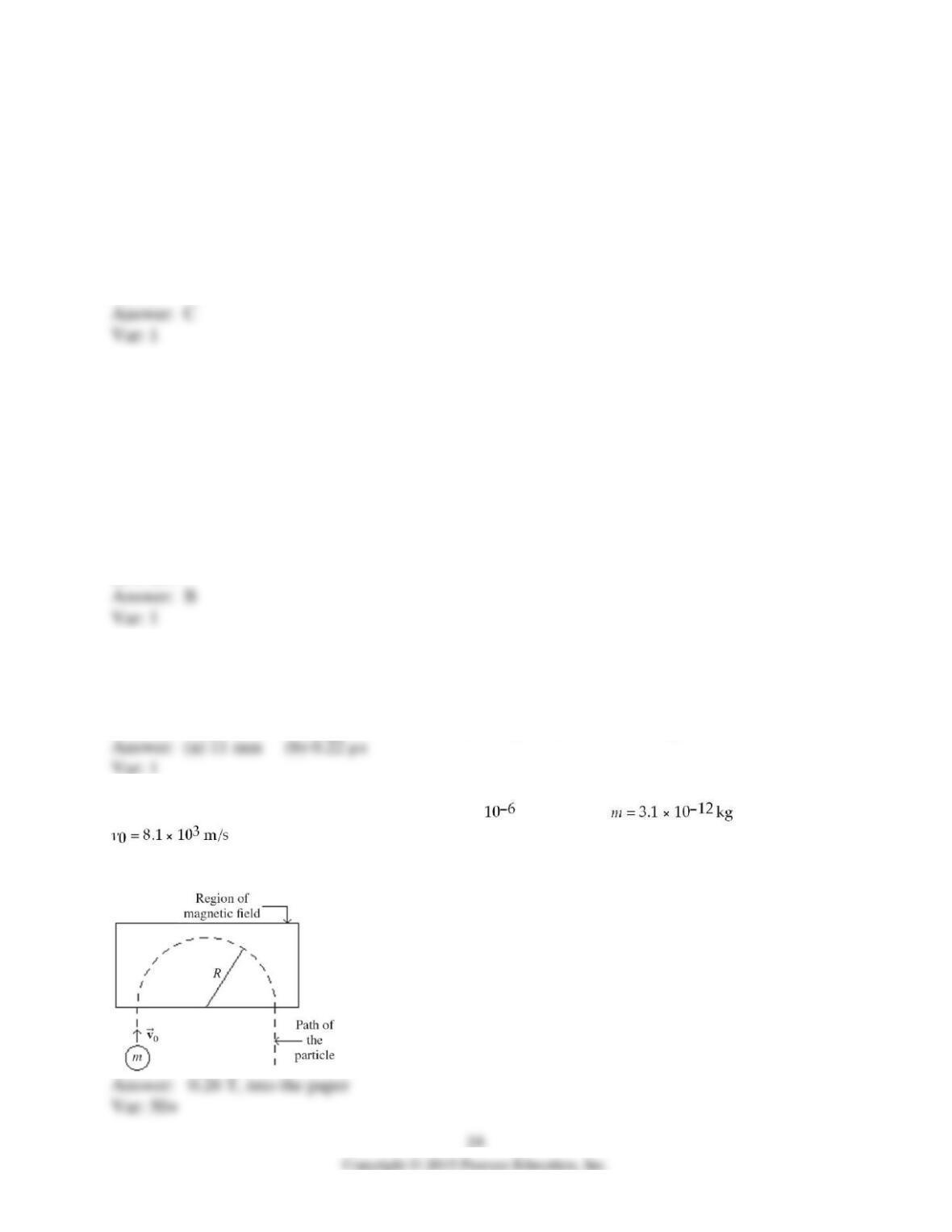
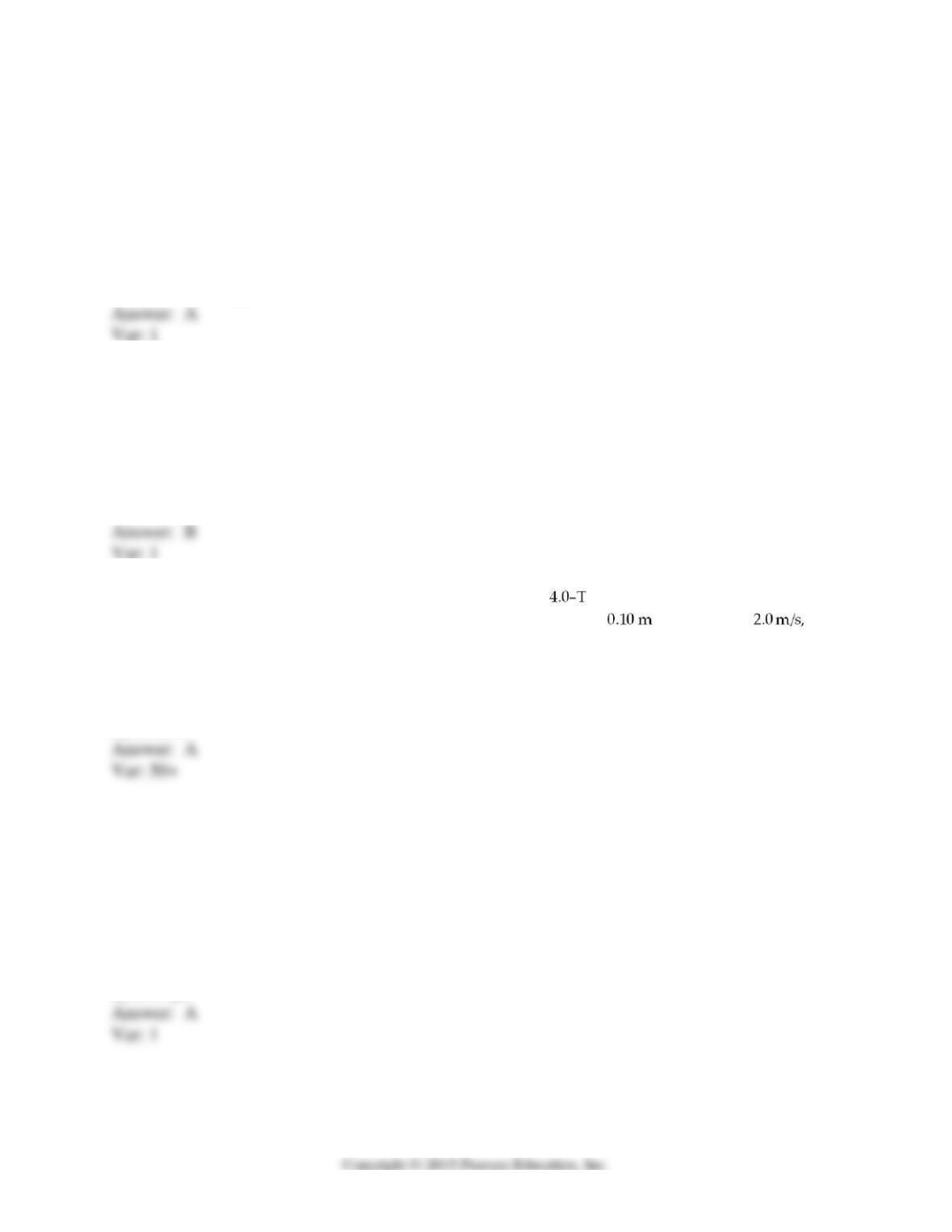
15) In the figure, a small particle of charge -1.9 x C and mass has speed
as it enters a region of uniform magnetic field. The particle is initially traveling
perpendicular to the magnetic field and is observed to travel in the semicircular path shown with
radius R = 5.0 cm. Find the magnitude and direction of the magnetic field in the region.
16) A proton having a speed of 3.0 × 10⁶ m/s in a direction perpendicular to a uniform magnetic
field moves in a circle of radius 0.20 m within the field. What is the magnitude of the magnetic
field? (e = 1.60 × 10⁻¹⁹ C, mproton = 1.67 × 10⁻²⁷ kg)
A) 0.080 T
B) 0.16 T
C) 0.24 T
D) 0.32 T
E) 0.36 T
17) An electron moving perpendicular to a uniform magnetic field of 3.2 × 10⁻² T moves in a
circle of radius 0.40 cm. How fast is this electron moving? (e = 1.60 × 10⁻¹⁹ C, melectron = 9.11
× 10-31kg)
A) 2.2 × 10⁷ m/s
B) 1.9 × 10⁷ m/s
C) 1.9 × 10⁶ m/s
D) 3.0 × 10⁷ m/s
E) 0.80 × 10⁷ m/s
18) An electron moving perpendicular to a uniform magnetic field of 0.22 T moves in a circle
with a speed of 1.5 × 10⁷ m/s. What is the radius of the circle? (e = 1.60 × 10⁻¹⁹ C, melectron =
9.11 × 10⁻³¹kg)
A) 1.5 mm
B) 0.22 mm
C) 2.2 mm
D) 0.39 mm
E) 3.9 mm
19) An electron is accelerated from rest through a potential difference of 3.75 kV. It enters a
region where a uniform 4.0-mT magnetic field is perpendicular to the velocity of the electron.
Calculate the radius of the path this electron will follow in the magnetic field. (e = 1.60 × 10⁻¹⁹
C, melectron = 9.11 × 10⁻³¹ kg)
A) 1.2 cm
B) 2.2 cm
C) 3.2 cm
D) 4.2 cm
E) 5.2 cm
26
20) A doubly charged ion with speed 6.9 × 10⁶ m/s enters a uniform 0.80-T magnetic field,
traveling perpendicular to the field. Once in the field, it moves in a circular arc of radius 30 cm.
What is the mass of this ion? (e = 1.60 × 10⁻¹⁹ C)
A) 11 × 10-27 kg
B) 6.7 × 10⁻²⁷ kg
C) 3.3 × 10⁻²⁷ kg
D) 8.2 × 10⁻²⁷ kg
21) A proton, starting from rest, accelerates through a potential difference of 1.0 kV and then
moves into a magnetic field of 0.040 T at a right angle to the field. What is the radius of the
proton’s resulting orbit? (e = 1.60 × 10⁻¹⁹ C, mproton = 1.67 × 10⁻²⁷ kg)
A) 0.080 m
B) 0.11 m
C) 0.14 m
D) 0.17 m
22) A charged particle of mass 0.0040 kg is subjected to a magnetic field which acts at a
right angle to its motion. If the particle moves in a circle of radius at a speed of
what is the magnitude of the charge on the particle?
A) 0.020 C
B) 50 C
C) 0.00040 C
D) 2500 C
23) Alpha particles, each having a charge of +2e and a mass of 6.64 ×10⁻²⁷ kg, are accelerated
in a uniform 0.80-T magnetic field to a final orbit radius of 0.30 m. The field is perpendicular to
the velocity of the particles. How long does it take an alpha particle to make one complete circle
in the final orbit? (e = 1.60 × 10⁻¹⁹ C)
A) 0.15 μs
B) 0.25 μs
C) 0.33 μs
D) 0.40 μs
E) 0.49 μs
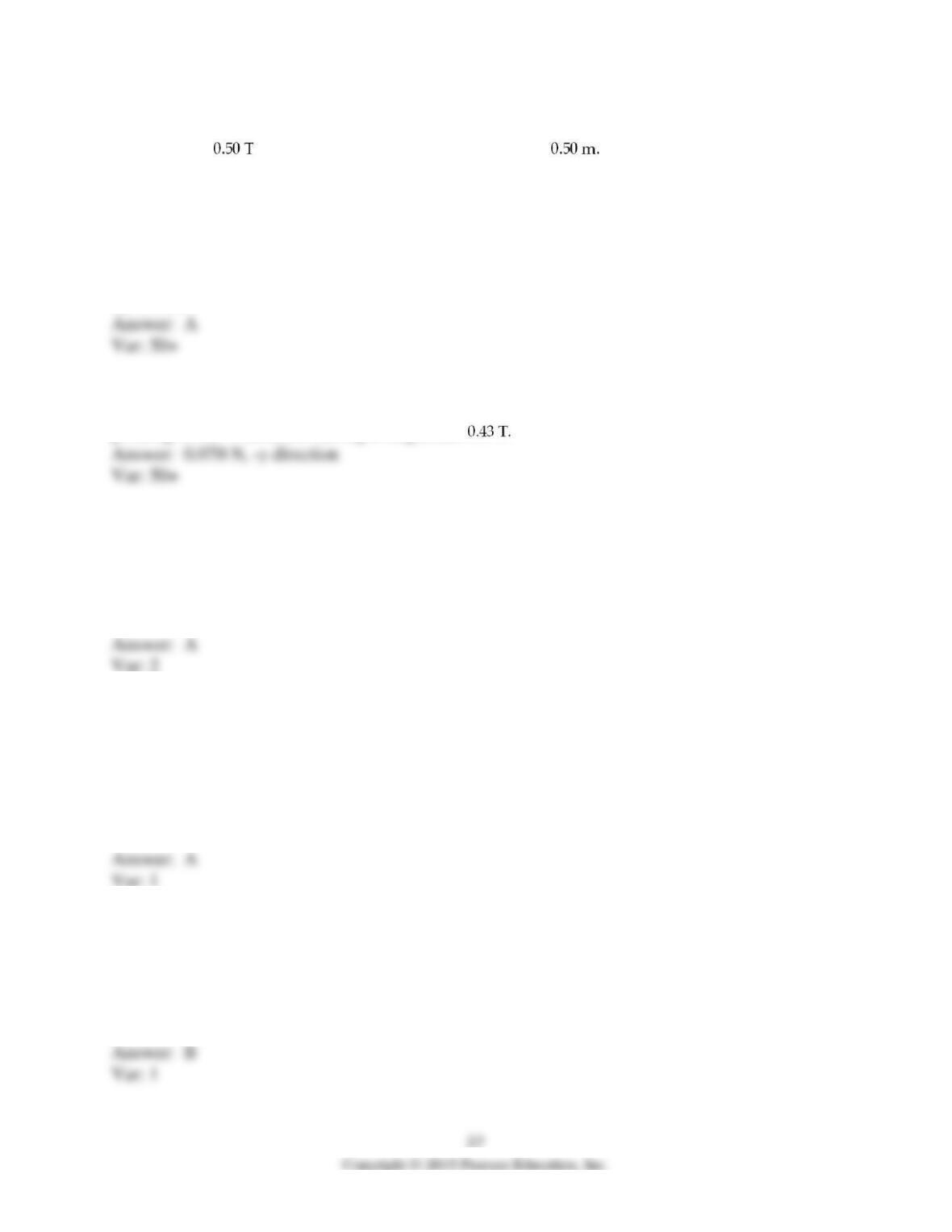
24) Alpha particles, each having a charge of +2e and a mass of 6.64 ×10⁻²⁷ kg, are accelerated
in a uniform magnetic field to a final orbit radius of The field is perpendicular to
the velocity of the particles. What is the kinetic energy of an alpha particle in the final orbit? (1
eV = 1.60 × 10⁻¹⁹ J, e = 1.60 × 10⁻¹⁹ C)
A) 3.0 MeV
B) 2.6 MeV
C) 3.4 MeV
D) 3.9 MeV
E) 4.3 MeV
25) A wire along the z-axis carries a current of 4.9 A in the +z direction. Find the magnitude and
direction of the force exerted on a 3.3-cm long length of this wire by a uniform magnetic field
pointing in the –x direction having a magnitude
26) A 2.0-m straight wire carrying a current of 0.60 A is oriented parallel to a uniform magnetic
field of 0.50 T. What is the magnitude of the magnetic force on it?
A) zero
B) 0.15 N
C) 0.30 N
D) 0.60 N
27) A straight wire carries a current of 10 A at an angle of 30° with respect to the direction of a
uniform 0.30-T magnetic field. Find the magnitude of the magnetic force on a 0.50-m length of
the wire.
A) 0.75 N
B) 1.5 N
C) 3.0 N
D) 6.0 N
28) What is the force per meter on a straight wire carrying 5.0 A when it is placed in a magnetic
field of 0.020 T so that the wire makes an angle of 27° with respect to the magnetic field lines.
A) 0.022 N/m
B) 0.045 N/m
C) 0.17 N/m
D) 0.26 N/m
29) A thin copper rod 1.0 m long has a mass of 0.050 kg and is in a magnetic field of 0.10 T.
What minimum current in the rod is needed in order for the magnetic force to balance the weight
of the rod?
A) 1.2 A
B) 2.5 A
C) 4.9 A
D) 9.8 A
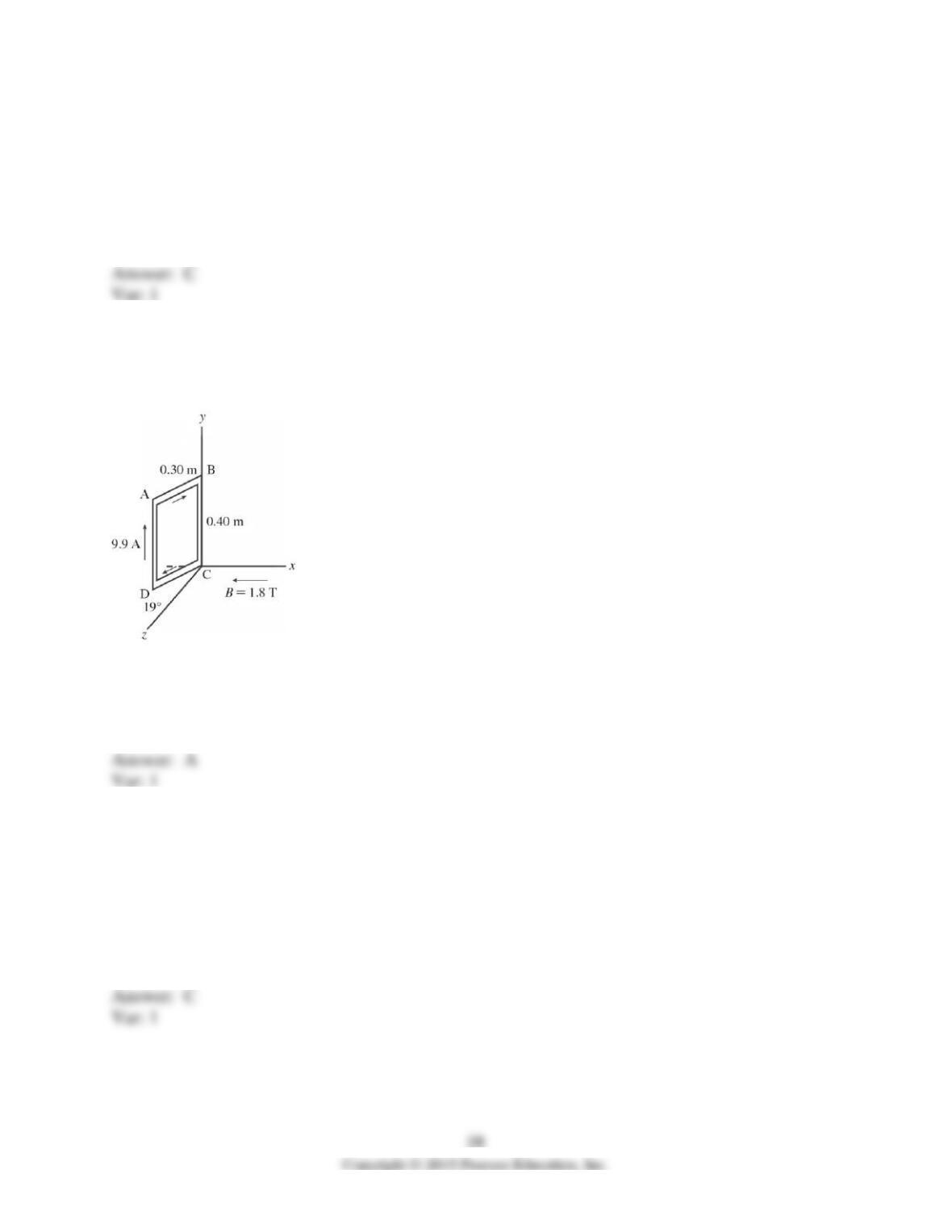
30) A rigid rectangular loop, measuring 0.30 m by 0.40 m, carries a current of 9.9 A, as shown in
the figure. A uniform external magnetic field of magnitude 1.8 T in the –x direction is present.
Segment CD is in the xz-plane and forms a 19° angle with the z-axis, as shown. What is the y
component of the magnetic force on segment AB of the loop?
A) +5.1 N
B) -5.1 N
C) +1.7 N
D) -1.7 N
E) 0.0 N
31) A straight wire that is 0.60 m and carrying a current of 2.0 A is placed at an angle with
respect to the magnetic field of strength 0.30 T. If the wire experiences a force of magnitude 0.18
N, what angle does the wire make with respect to the magnetic field?
A) 20°
B) 25°
C) 30°
D) 35°
E) 60°
32) A straight wire is carrying a current of 2.0 A. It is placed at an angle of 60° with respect to a
magnetic field of strength 0.20 T. If the wire experiences a force of 0.40 N, what is the length of
the wire?
A) 1.0 m
B) 1.2 m
C) 1.4 m
D) 1.6 m
E) 1.8 m
33) A straight 1.0-m long wire is carrying a current. The wire is placed perpendicular to a
magnetic field of strength 0.20 T. If the wire experiences a force of 0.60 N, what is the current in
the wire?
A) 2.0 A
B) 1.0 A
C) 3.0 A
D) 4.0 A
E) 5.0 A
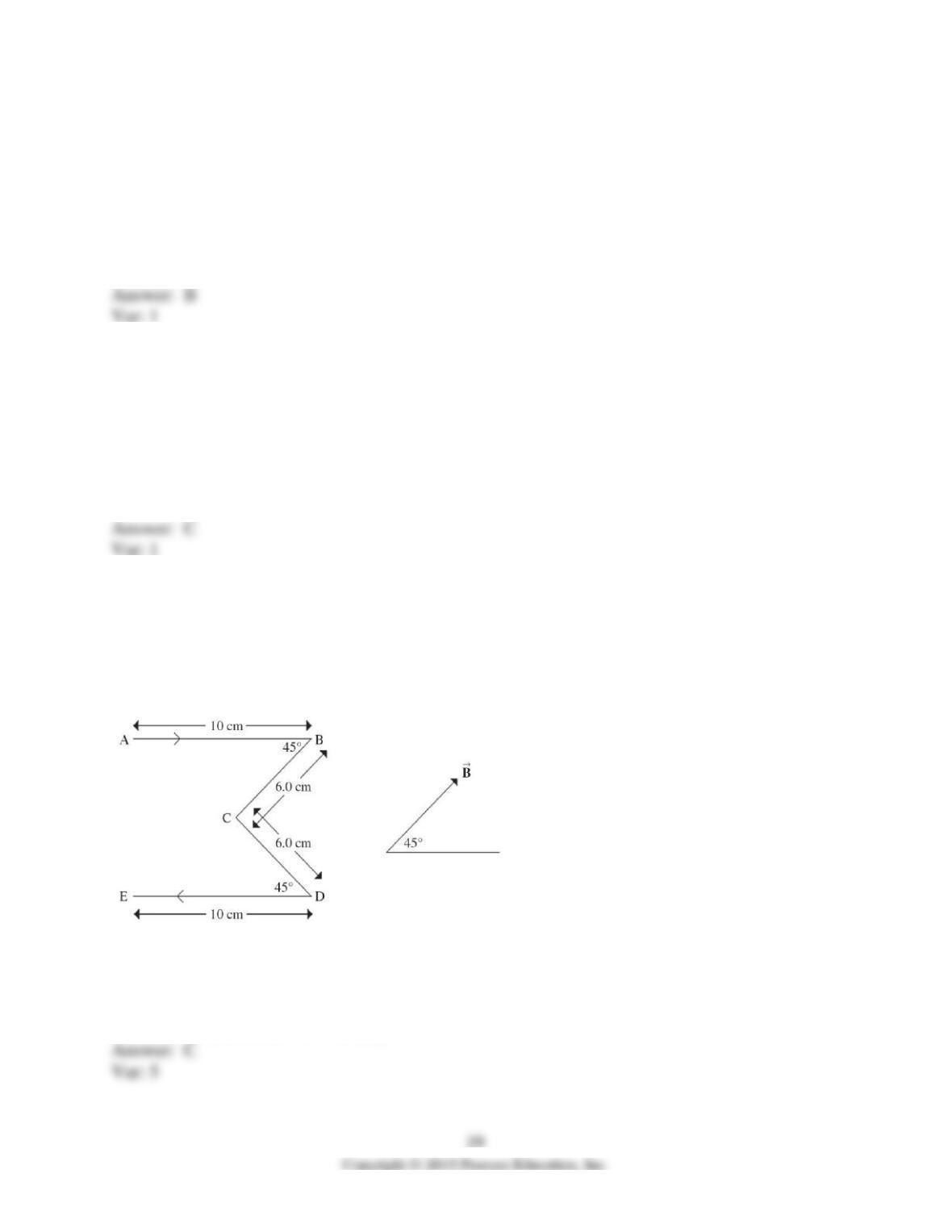
34) A wire in the shape of an “M” lies in the plane of the paper. It carries a current of 2.0 A,
flowing from A to E, as shown in the figure. It is placed in a uniform magnetic field of 0.75 T in
the same plane, directed as shown on the right side of the figure. The figure indicates the
dimensions of the wire. Note that AB is parallel to DE and to the baseline from which the
magnetic field direction is measured. What are the magnitude and direction of the force acting on
section AB of this wire?
A) 0.20 N perpendicular out of the page
B) 0.40 N perpendicular out of the page
C) 0.11 N perpendicular out of the page
D) 0.20 N perpendicular into the page
E) 0.11 N perpendicular into the page
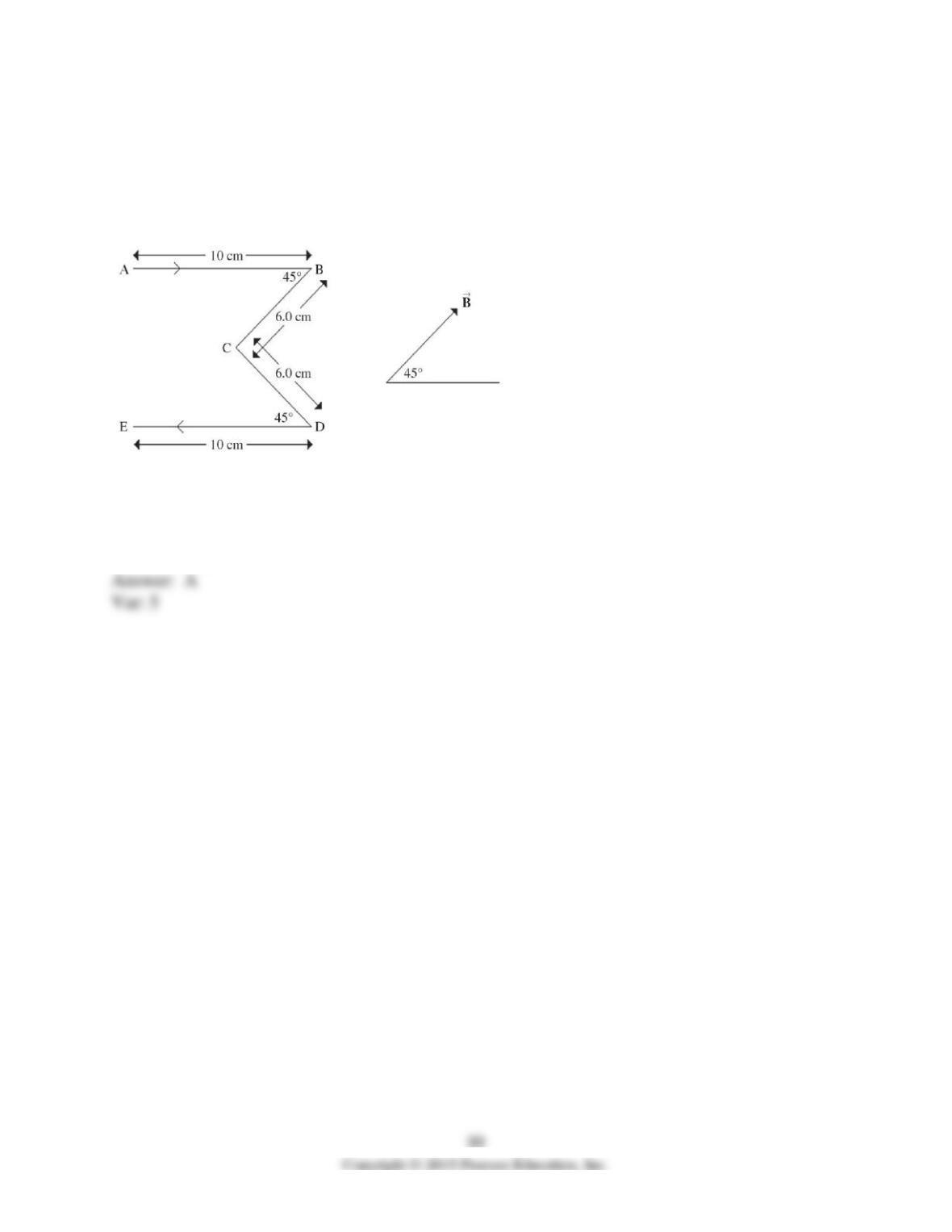
35) A wire in the shape of an “M” lies in the plane of the paper. It carries a current of 2.0 A,
flowing from A to E, as shown in the figure. It is placed in a uniform magnetic field of 0.65 T in
the same plane, directed as shown on the right side of the figure. The figure indicates the
dimensions of the wire. Note that AB is parallel to DE and to the baseline from which the
magnetic field direction is measured. What are the magnitude and direction of the force acting
on section BC of this wire?
A) 0 N
B) 0.090 N perpendicular out of the page
C) 0.090 N perpendicular into the page
D) 0.060 N perpendicular out of the page
E) none of the above
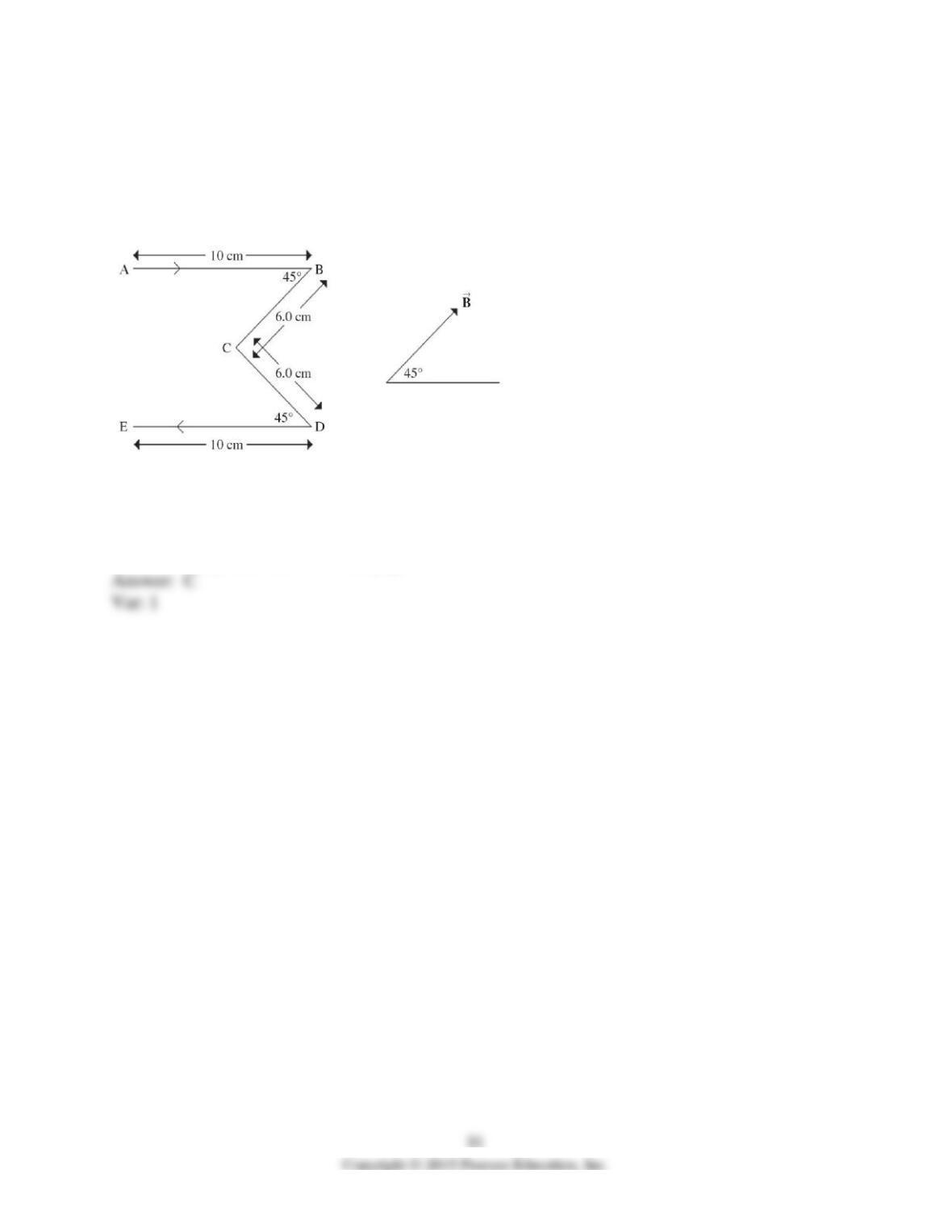
36) A wire in the shape of an “M” lies in the plane of the paper. It carries a current of 2.0 A,
flowing from A to E, as shown in the figure. It is placed in a uniform magnetic field of 0.55 T in
the same plane, directed as shown on the right side of the figure. The figure indicates the
dimensions of the wire. Note that AB is parallel to DE and to the baseline from which the
magnetic field direction is measured. What are the magnitude and direction of the force acting
on section CD of this wire?
A) 0.066 N perpendicular into the page
B) 0.40 N perpendicular out of the page
C) 0.066 N perpendicular out of the page
D) 0.40 N perpendicular into the page
E) 0.20 N perpendicular out of the page
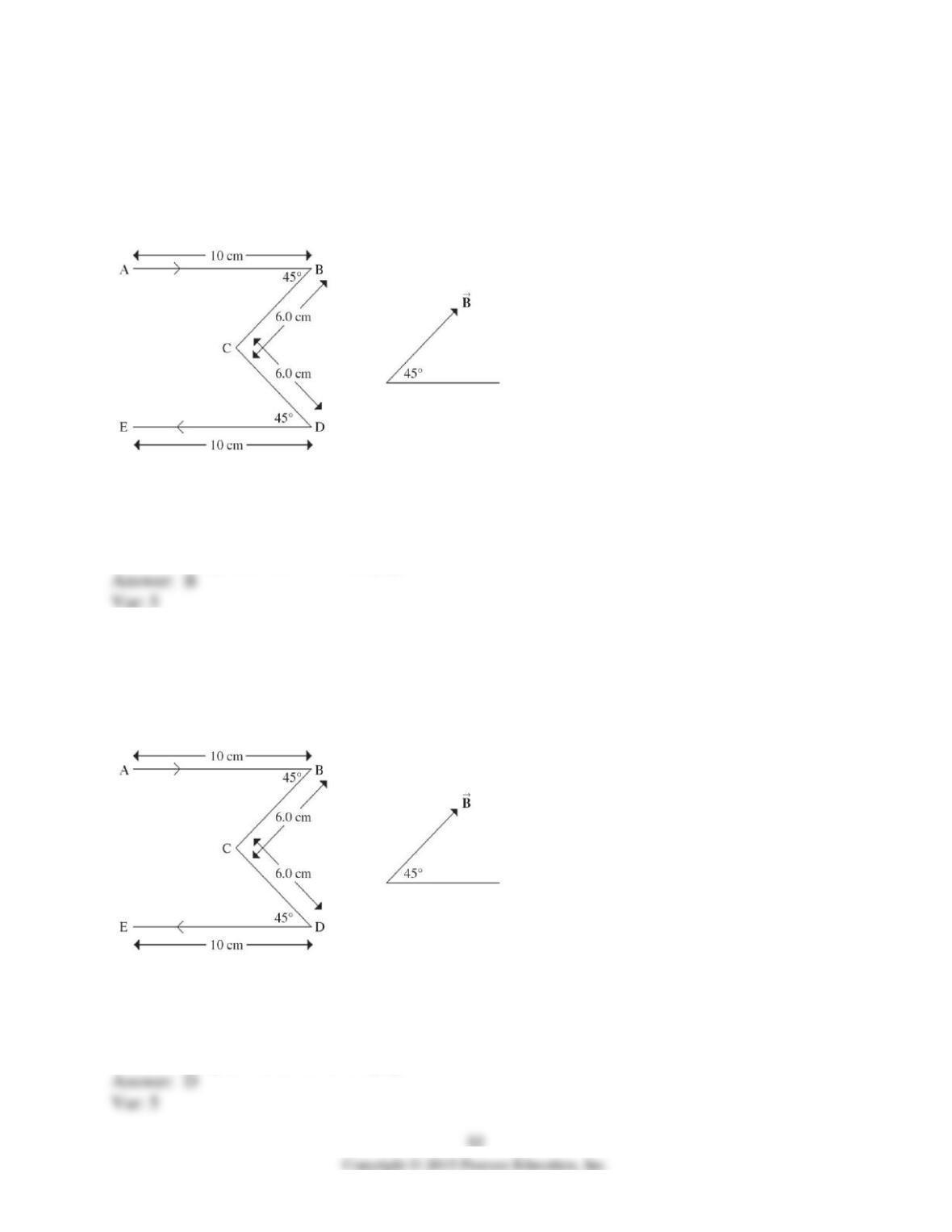
37) A wire in the shape of an “M” lies in the plane of the paper. It carries a current of 2.0 A,
flowing from A to E, as shown in the figure. It is placed in a uniform magnetic field of 0.85 T in
the same plane, directed as shown on the right side of the figure. The figure indicates the
dimensions of the wire. Note that AB is parallel to DE and to the baseline from which the
magnetic field direction is measured. What are the magnitude and direction of the force acting
on section DE of this wire?
A) 0.30 N perpendicular out of the page
B) 0.12 N perpendicular into the page
C) 0.30 N perpendicular into the page
D) 0.12 N perpendicular out of the page
E) 0.20 N perpendicular out of the page
38) A wire in the shape of an “M” lies in the plane of the paper. It carries a current of 2.0 A,
flowing from A to E. It is placed in a uniform magnetic field of 0.85 T in the same plane,
directed as shown on the right side of the figure. The figure indicates the dimensions of the wire.
Note that AB is parallel to DE and to the baseline from which the magnetic field direction is
measured. What are the magnitude and direction of the net force acting on this wire?
A) 0.40 N perpendicular out of the page
B) 0.10 N perpendicular into the page
C) 0.40 N perpendicular into the page
D) 0.10 N perpendicular out of the page
E) 0.20 N perpendicular out of the page
39) Two long parallel wires separated by 7.5 cm each carry 3.3 A in opposite directions. (μ0 = 4π
× 10-7 T ∙ m/A)
(a) What magnetic force per length acts on each of the wires? Is it attractive or repulsive?
(b) Find the magnitude of the magnetic field midway between the two wires.
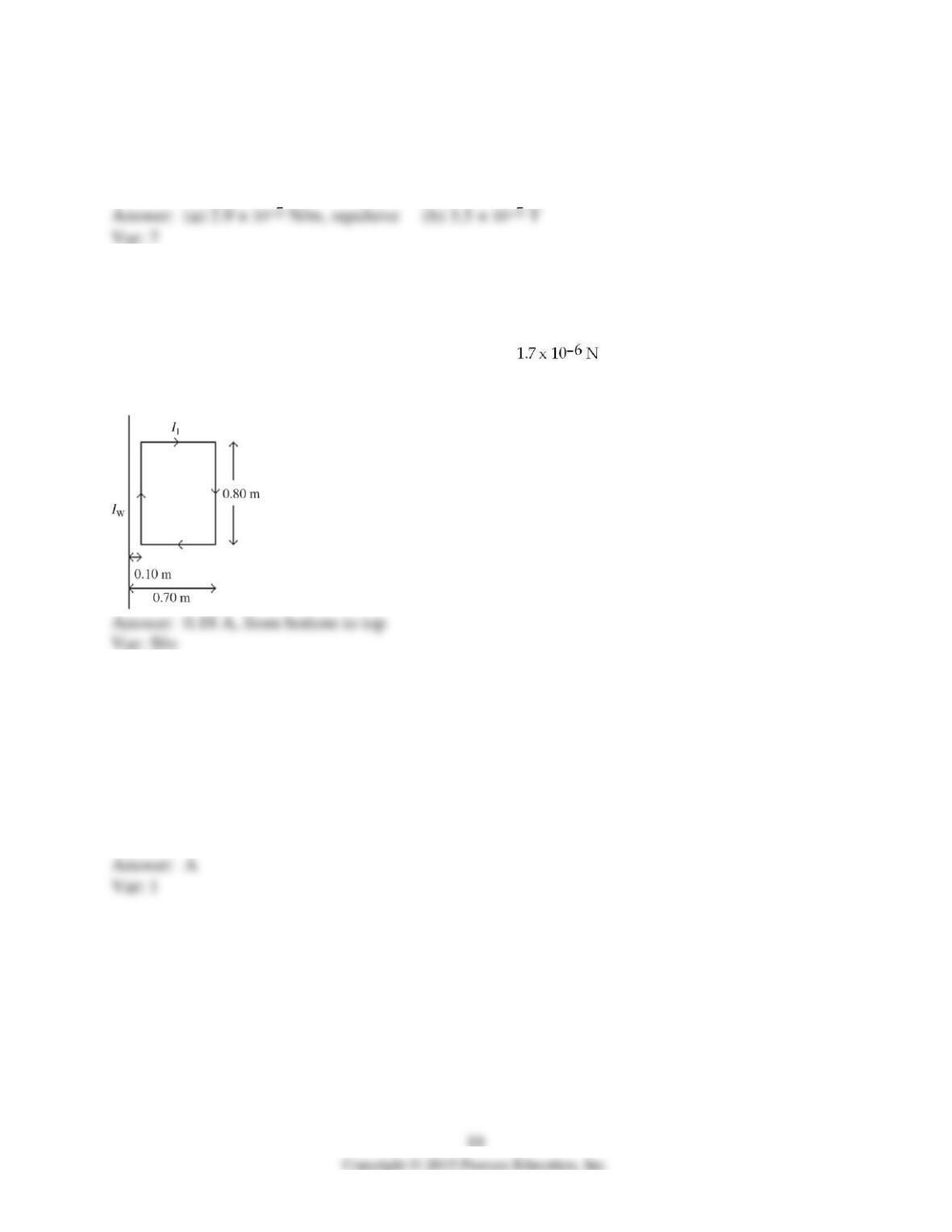
40) In the figure, a rectangular current loop is carrying current I1 = 7.0 A, in the direction
indicated, near a long wire carrying a current Iw. The long wire is parallel to the sides of the
rectangle. The rectangle loop has length 0.80 m and its sides are 0.10 m and 0.70 m from the
wire. If the net force on the loop is to have magnitude and is to be directed towards
the wire, what must be the magnitude and direction (from top to bottom or from bottom to top in
the sketch) of the current Iw in the wire? (μ0 = 4π × 10-7 T ∙ m/A)
41) Two parallel straight wires are 7.0 cm apart and 50 m long. Each one carries a 18-A current
in the same direction. One wire is securely anchored, and the other is attached in the center to a
movable cart. If the force needed to move the wire when it is not attached to the cart is
negligible, with what magnitude force does the wire pull on the cart? (μ0 = 4π × 10-7 T ∙ m/A)
A) 46 mN
B) 37 mN
C) 66 mN
D) 93 mN
42) Two long parallel wires that are 0.30 m apart carry currents of 5.0 A and 8.0 A in the
opposite direction. Find the magnitude of the force per unit length that each wire exerts on the
other wire and indicate if the force is attractive or repulsive. (μ0 = 4π × 10-7 T ∙ m/A)
A) 2.7 × 10⁻⁵ N repulsive
B) 7.2 × 10⁻⁵ N repulsive
C) 3.4 × 10⁻⁵ N attractive
D) 2.7 × 10⁻⁵ N attractive
E) 7.2 × 10⁻⁵ N attractive
43) Two long parallel wires are 0.400 m apart and carry currents of 4.00 A and 6.00 A. What is
the magnitude of the force per unit length that each wire exerts on the other wire? (μ0 = 4π × 10–
7 T ∙ m/A)
A) 2.00 μN/m
B) 5.00 μN/m
C) 12.0 μN/m
D) 16.0 μN/m
E) 38.0 μN/m
44) A flat circular coil has 250 identical loops of very thin wire. Each loop has an area of 0.12
m2 and carries 15 mA of current. This coil is placed in a magnetic field of 0.050 T oriented at
30° to the plane of the loop. What is the magnitude of the magnetic moment of the coil?
45) A flat coil containing 25 identical loops carries 6.4 A of current. When it is placed in a
uniform magnetic field of 0.22 T that is oriented parallel to the plane of the coil, the magnetic
torque on it is 3.7 N ∙ m.
(a) What is the magnetic moment of the coil?
(b) What is the area of each loop?
46) What is the magnetic moment of a rectangular loop having 120 turns that carries 6.0 A if its
dimensions are 4.0 cm × 8.0 cm?
A) 0.23 A ∙ m2
B) 2.3 A ∙ m2
C) 23 A ∙ m2
D) 230 A ∙ m2