61)
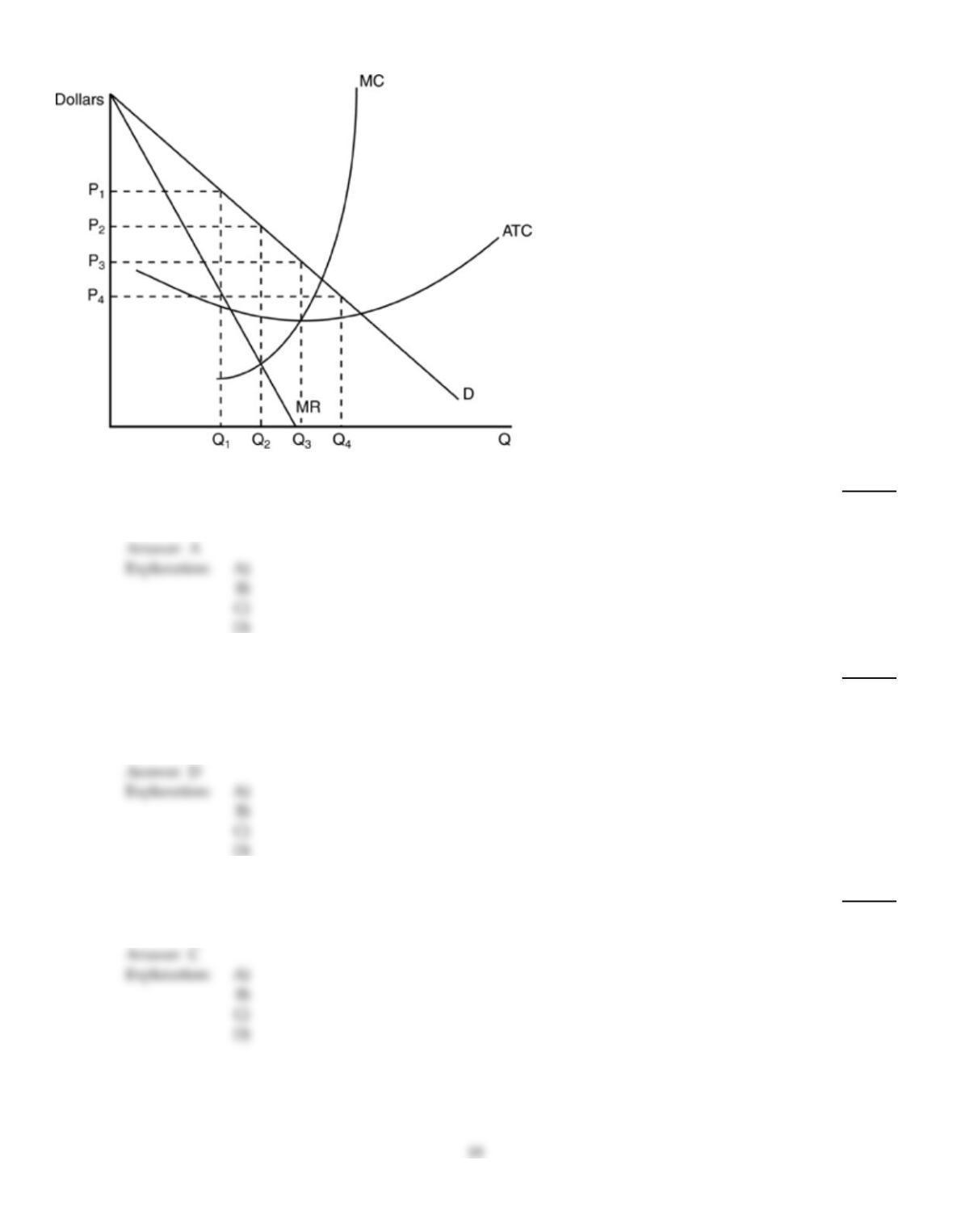
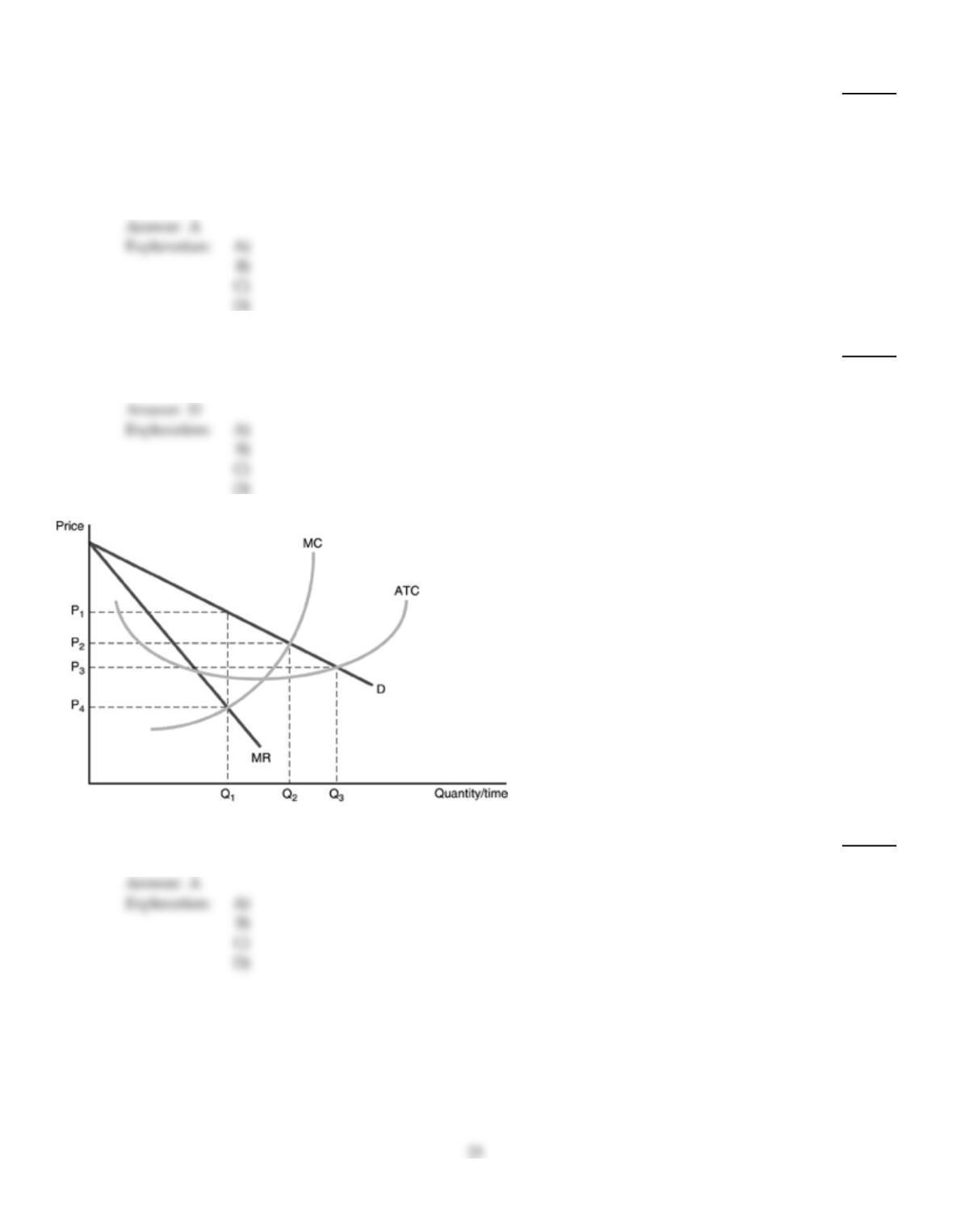
In the above figure, if the firm is producing Q2 units at a price P2, it should
61)
A)
not change output or price.
B)
increase output and decrease price.
C)
decrease output and increase price.
D)
shut down.
62)
Which of the following statements with respect to the monopolist is FALSE?
62)
A)
A monopolist can make higher profits if it can price discriminate.
B)
Monopoly is a situation in which a single firm dominates.
C)
A monopoly tends to result in a lower quantity being sold than perfect competition does.
D)
A monopoly arises in a situation with few barriers to entry into the marketplace.
63)
The demand curve faced by the monopolist
63)
A)
is perfectly inelastic.
B)
is perfectly elastic.
C)
slopes downward.
D)
slopes upward.
64)
To sell more units, a monopolist must
64)
A)
produce the profit maximizing rate of production.
B)
lower price.
C)
advertise more.
D)
merely produce more units.
65)
Price discrimination occurs when a firm sells
65)
A)
a given product at different prices at different points in time.
B)
a given product at different prices when it is produced in different colors.
C)
a given product at different prices to different ethnic groups.
D)
a given product at different prices unrelated to differences in cost.
66)
For price discrimination to exist, all of the following are necessary EXCEPT
66)
A)
there can be no resale of the product.
B)
an identifiable group of buyers with different elasticities of demand.
C)
an upward sloping marginal cost curve.
D)
a downward sloping demand curve.
67)
The price elasticity of demand for a good produced by a monopolist
67)
A)
equals zero as long as the good has no close substitutes.
B)
does not equal zero because there will always be some substitutes, however imperfect they
may be.
C)
does not equal zero because every good has at least one good substitute for it.
D)
is always inelastic since the demand curve slopes down.
68)
When comparing perfect competition and monopoly, a major assumption made is that
68)
A)
the monopolist faces a downward sloping demand curve.
B)
the monopolist can make an above normal rate of return.
C)
the costs of production are the same under monopoly as under perfect competition.
D)
consumers only care about the price of the good and not whether the seller is a monopoly or
not.
69)
Which of the following is not true about the demand curve faced by a monopolist?
69)
A)
The marginal revenue curve is below the market demand curve.
B)
The demand curve is perfectly elastic.
C)
The demand curve is downward sloping.
D)
The firm’s demand curve is the same as the market demand curve.
70)
Suppose that the profit maximizing level of output for the monopolist is 100 units, and ATC =
$45.00; MC = $35.00; MR = $35.00; P = $45.00. What is the monopoly’s profit?
70)
A)
$0
B)
–$1000
C)
$4500
D)
$3500
71)
For a monopoly earning positive economic profits at the profit–maximizing output level, all of the
following are true EXCEPT
71)
A)
P = MR.
B)
P > ATC.
C)
P > MR.
D)
P > MC.
72)
For a firm to become a monopoly in an industry,
72)
A)
the firm must charge higher prices than its competitors.
B)
the firm must produce a faulty product.
C)
barriers to entry must exist.
D)
the firm will engage in unfair practices to drive all competitors out of the market.
73)
If Japanese producers sell computer chips at a higher price in the United States than in Japan, and if
there is no cost difference in producing or transporting the chips, the Japanese producers would be
practicing
73)
A)
price sampling.
B)
price discrimination.
C)
simple monopoly behavior.
D)
cartel pricing.
74)
Monopolies misallocate resources because
74)
A)
price does not equal average variable cost.
B)
profits are usually positive.
C)
marginal cost does not equal average total cost.
D)
price does not equal marginal cost.
75)
A profit–maximizing monopolist earns an economic loss whenever
75)
A)
it produces along the elastic portion of a demand curve.
B)
the demand curve lies completely below the ATC curve.
C)
it pays taxes to the government on each unit of output it produces.
D)
the price it charges for its product exceeds average total cost.
76)
When considering marginal revenue for the monopolist, which of the following is FALSE?
76)
A)
An essential point for the monopolist, marginal revenue is always less than price.
B)
The more the monopolist wants to sell, the higher the price it has to charge in order to make
more profits.
C)
To sell more of a particular product, given the industry demand curve, the monopoly firm
must lower the price.
D)
Marginal revenue is always less than price because price must be reduced on all units to sell
more.
77)
Which of the following is a TRUE statement about a monopoly?
77)
A)
A monopoly does not necessarily earn positive economic profits.
B)
As long as the demand curve slopes down, a monopoly can always find some price–output
combination that generates positive economic profits.
C)
A monopoly must earn an above–normal profit to stay in business.
D)
As long as there are barriers to entry, a monopoly can always find some price–output
combination that generates positive economic profits.
78)
A monopolist’s demand curve is
78)
A)
perfectly inelastic.
B)
perfectly elastic.
C)
of unit elasticity throughout.
D)
the industry demand curve.
79)
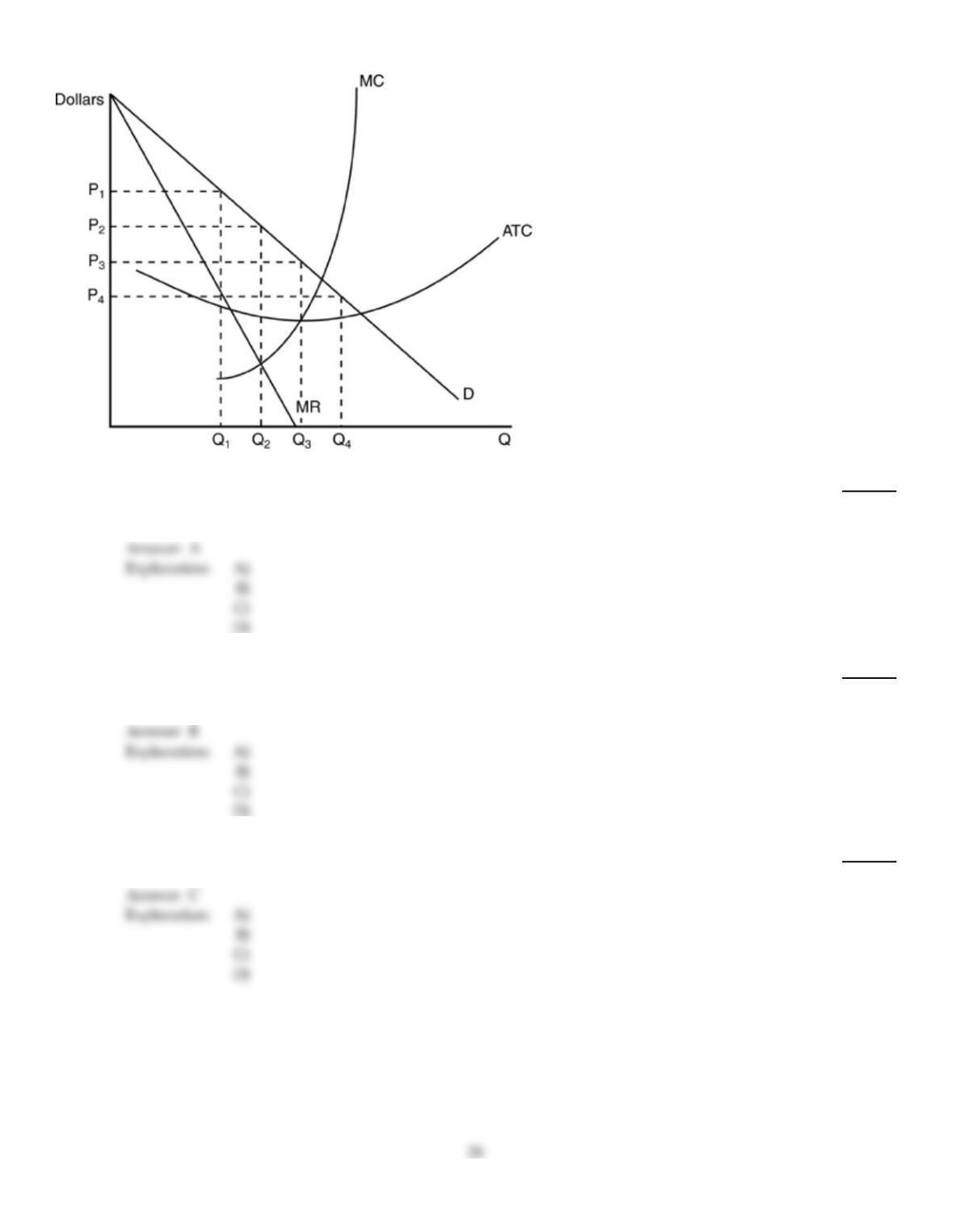
Refer to the above figure. The profit–maximizing price for this firm is
79)
A)
P1.
B)
P2.
C)
P3.
D)
P4.
80)
If the price elasticity of demand for U.S. automobiles is higher in Europe than it is in the United
States, and transport costs are zero, a price–discriminating monopolist would charge
80)
A)
a less profitable price for autos in the United States than in Europe.
B)
the same price for autos in the United States as in Europe.
C)
a higher price for autos in the United States than in Europe.
D)
a lower price for autos in the United States than in Europe.
81)
Suppose a monopolist’s costs and revenues are as follows: ATC = $45.00; MC = $35.00; MR =
$35.00; P = $45.00. The firm should
81)
A)
increase output and decrease price.
B)
decrease output and increase price.
C)
shut down.
D)
not change output or price.
82)
If different markets for a product produced by a monopolist can be separated and if the elasticity of
demand differs between the two markets, then the monopolist will
82)
A)
be able to make higher profits by using price discrimination.
B)
sell the product in only one of the markets with inelastic demand curves.
C)
go out of business.
D)
charge a single price in all markets.
83)
A firm that must determine the price–output combination that maximizes profit because it faces a
downward–sloped demand curve
83)
A)
has a perfectly elastic demand curve.
B)
is a price searcher.
C)
has a perfectly inelastic demand curve.
D)
is a price–taker.
84)
A major difference between a monopolist and a perfectly competitive firm is that
84)
A)
the monopolist charges the highest possible price that he can.
B)
the monopolist’s marginal revenue curve lies below its demand curve.
C)
the monopolist is certain to earn economic profits.
D)
the monopolist engages in marginal cost pricing.
85)
Other things being equal, a price–discriminating firm will charge more to the customers who
85)
A)
have the highest incomes.
B)
are the least rational in making their decisions.
C)
have the least elastic demand for its product.
D)
have the most elastic demand for the product.
Explanation:
86)
If there are no barriers to entry into an industry,
86)
A)
short–run economic profits must be zero.
B)
short–run and long–run profits must still be positive.
C)
long–run economic profits must be zero.
D)
both short–run and long–run economic profits must be zero.
Explanation:
Explanation:
87)
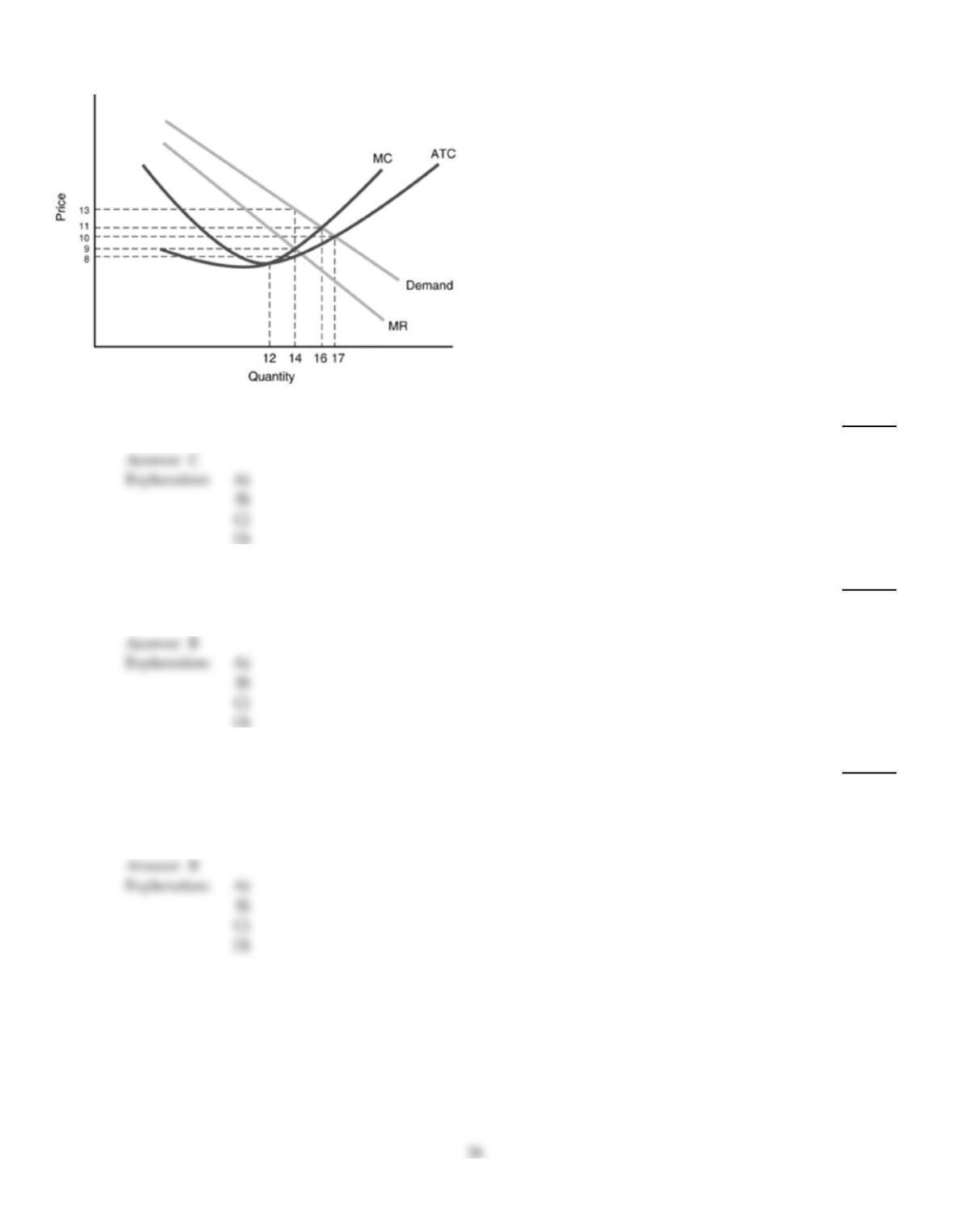
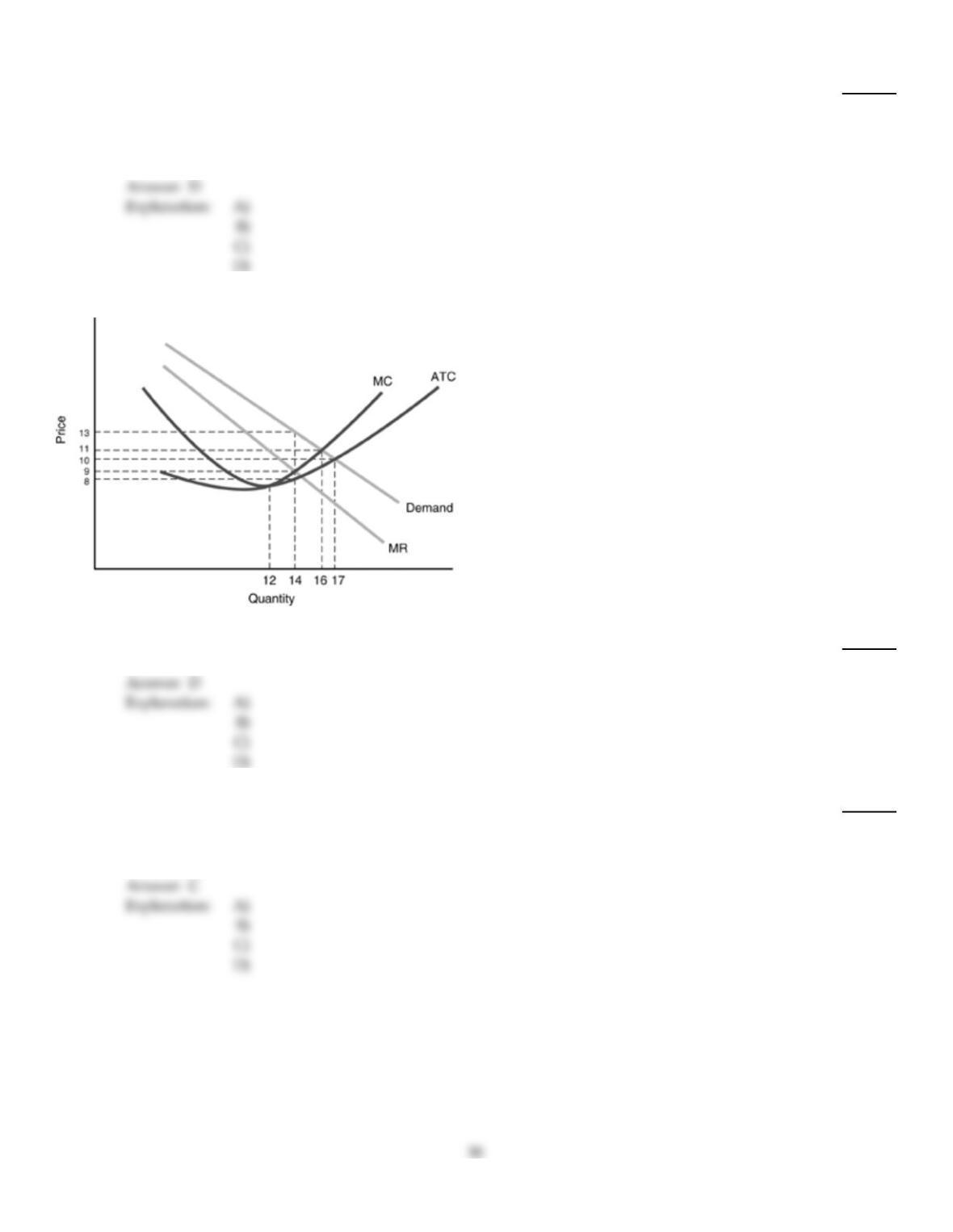
In the above figure, what is total cost at the profit–maximizing point?
87)
A)
$170
B)
$126
C)
$112
D)
$182
88)
A monopoly‘s goal using price discrimination is to increase
88)
A)
total revenue.
B)
total profit.
C)
marginal revenue.
D)
the per unit profit.
89)
A barrier to entry
89)
A)
can be thought of as unrelated to monopoly.
B)
slows or even prevents entry into a market.
C)
usually takes the form of a cartel.
D)
makes it illegal for firms to enter the industry.
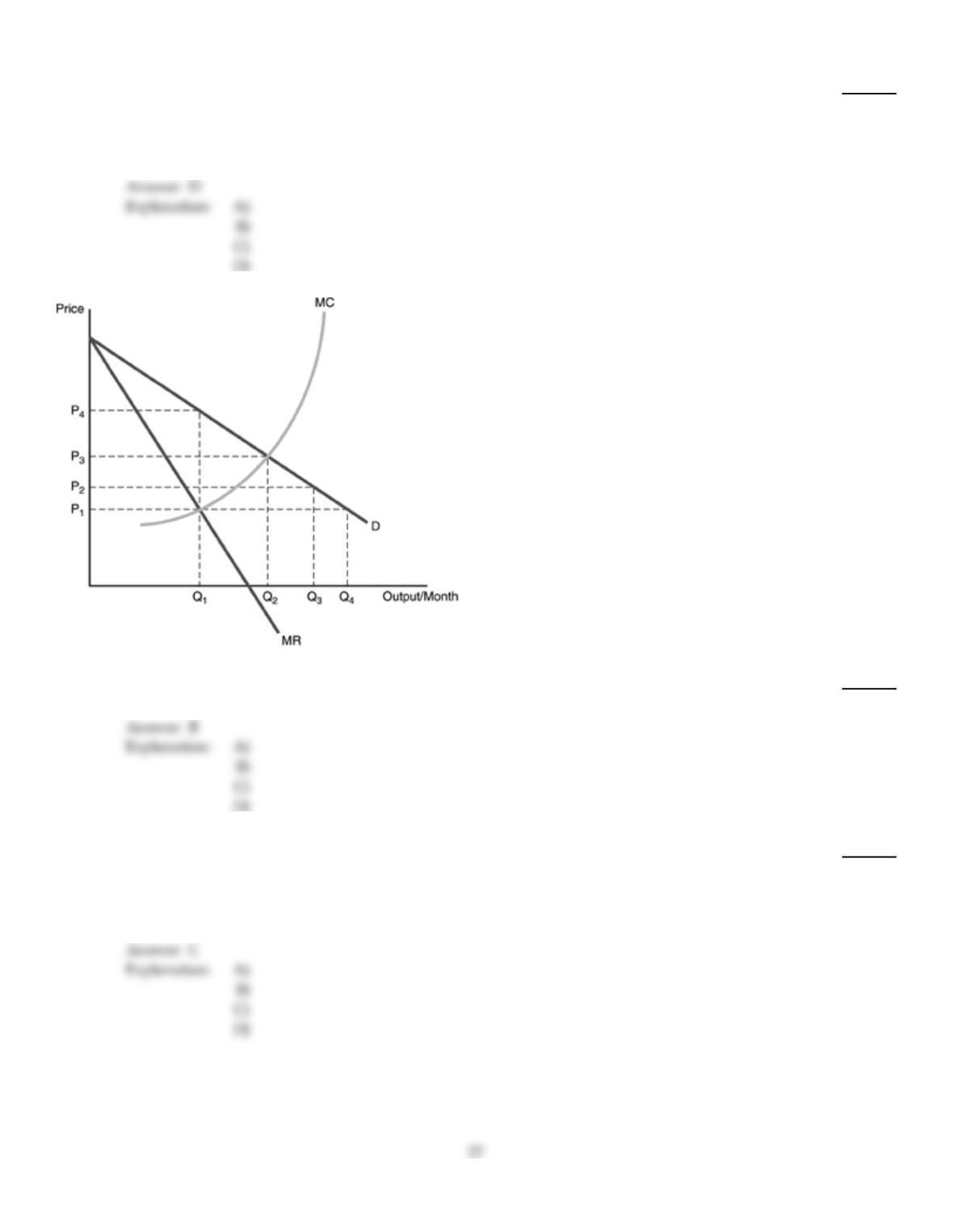
90)
Compared to an efficient perfectly competitive industry, the monopolist will
90)
A)
produce less output at a higher total cost.
B)
produce more output at a higher price and higher profit.
C)
produce more output at a lower price.
D)
produce less output and charge a higher price.
91)
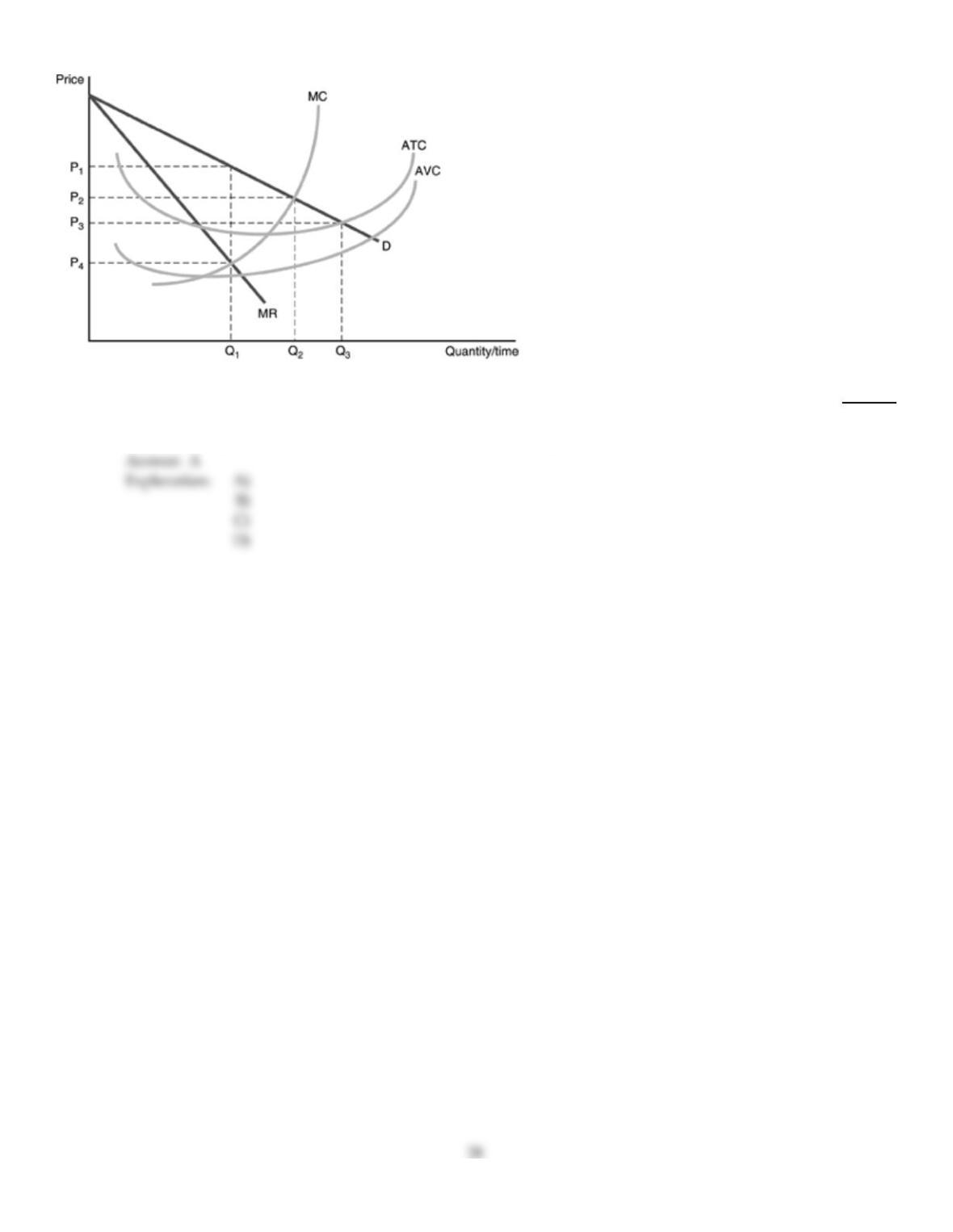
Refer to the above figure. What price–output combination would apply under perfect competition?
91)
A)
P1 and Q1
B)
P3 and Q2
C)
P4 and Q1
D)
P2 and Q3
92)
Some electrical utilities are monopolies because of
92)
A)
ownership of resources without close substitutes.
B)
their inability to earn profits.
C)
government restrictions that prevent new firms from entering the market.
D)
diseconomies of scale.
93)
Refer to the above figure. The firm is currently producing at Q2. The firm should
93)
A)
reduce production.
B)
shut down.
C)
increase production.
D)
leave production as it is.
94)
In the above figure, if the firm is producing at Q3 and charging a price of P3, it should
94)
A)
decrease output and increase price.
B)
increase output and decrease price.
C)
not change output or price.
D)
shut down.
95)
When the number of substitutes increase, the demand curve for a monopolist will
95)
A)
become steeper.
B)
become more elastic.
C)
not change.
D)
become more inelastic.
96)
Suppose a monopolist sells 10,000 units of output at $22 per unit. The firm’s total revenue is
96)
A)
$2,200.
B)
$22,000.
C)
$220,000.
D)
$2,200,000.
97)
A monopolist engages in price discrimination
97)
A)
by charging a higher price to consumers whose demand is more elastic.
B)
by charging the same price to all consumers.
C)
by charging a higher price when marginal cost is lower.
D)
by charging a lower price to consumers whose demand is more elastic.
98)
In the above figure, what is total revenue at the profit–maximizing point?
98)
A)
$126
B)
$170
C)
$176
D)
$182
99)
The portion of consumer surplus that would have existed in a perfectly competitive market but is
unobtainable by anyone in society under a monopoly is known as
99)
A)
an external cost.
B)
monopoly profits.
C)
a deadweight loss.
D)
an unattainable surplus.
100)
Monopolies are discouraged in the United States because
100)
A)
they restrict output and boost prices.
B)
they hire too many workers.
C)
they can produce at lower cost in the short run.
D)
they are more efficient than other industries.
SHORT ANSWER. Write the word or phrase that best completes each statement or answers the question.
101)
What is a monopolist, and what is required for a monopolist to earn profits in the long
run?
101)
102)
What is the main difference between the demand curves for the perfect competitor and the
monopolist?
102)
103)
“Unlike a monopoly, consumer surplus in a perfectly competitive market is zero.” Do you
agree or disagree? Why?
103)
104)
How does a monopoly maximize profits? What price does it charge?
104)
105)
Which of the barriers to entry can last indefinitely and which are more likely to eventually
erode such that a new entry can take place?
105)
106)
An upscale fusion bistro in a small town charges higher prices for the same menu items at
dinner time than at lunch time. Does the bistro necessarily practice price discrimination?
Explain your answer.
106)
107)
Explain how a monopolist can increase profits by price discriminating. What are the
conditions necessary for price discrimination?
107)
108)
What is the social cost of a monopoly? Explain.
108)
109)
“The deadweight loss of a monopoly equals the monopoly firm’s profits.” Do you agree or
disagree? Why?
109)
110)
What affects the price elasticity of demand for a monopolist’s product?
110)
111)
What is deadweight loss? Whose loss is it? Explain.
111)
112)
“A monopolist refers to any firm that is large in size.” Do you agree or disagree? Why?
112)
113)
In principle, can a monopolist hold its monopoly power in the long run? Explain.
113)
Answer Key
Testname: C24
34
Answer Key
Testname: C24
35
Answer Key
Testname: C24
36