61)
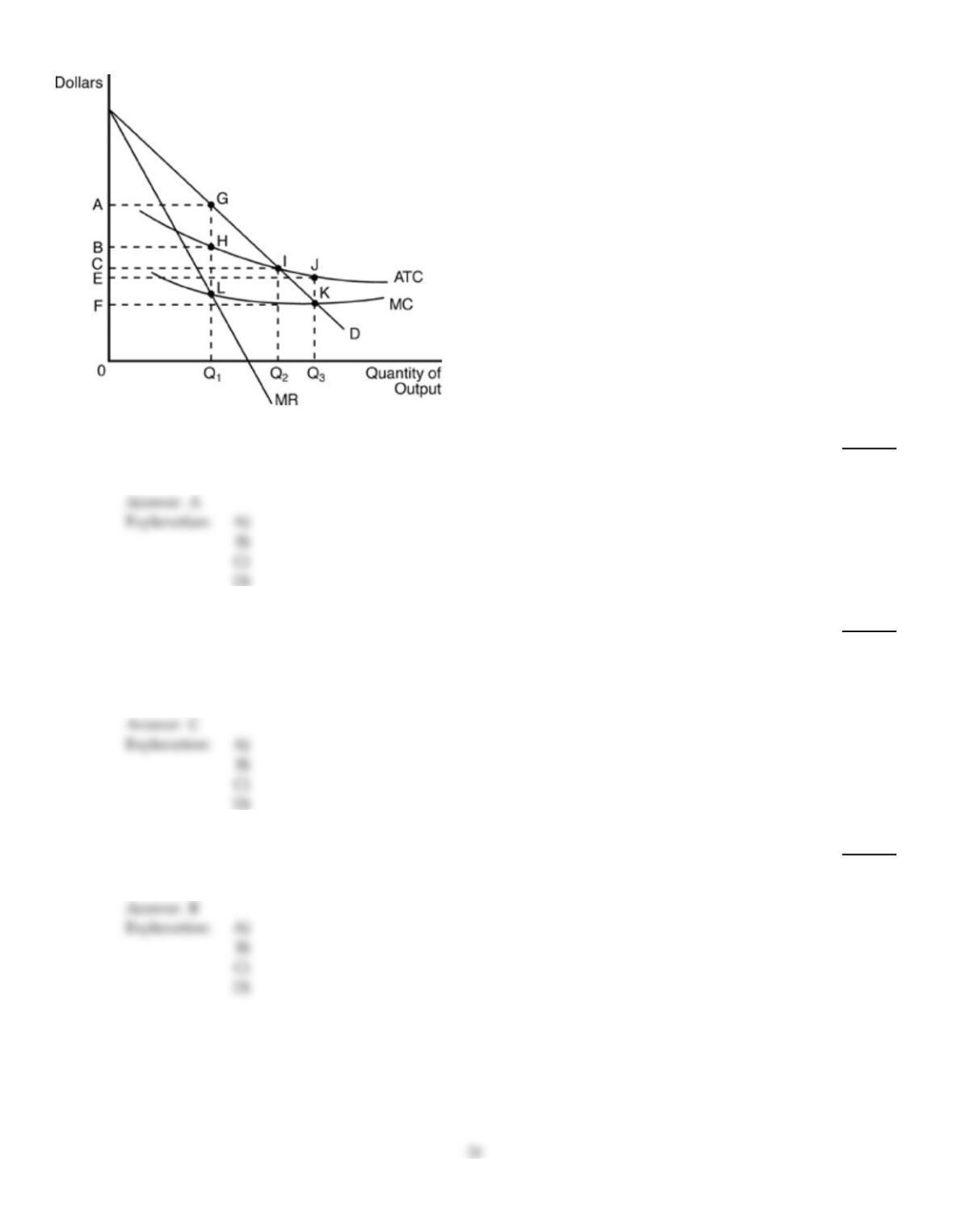
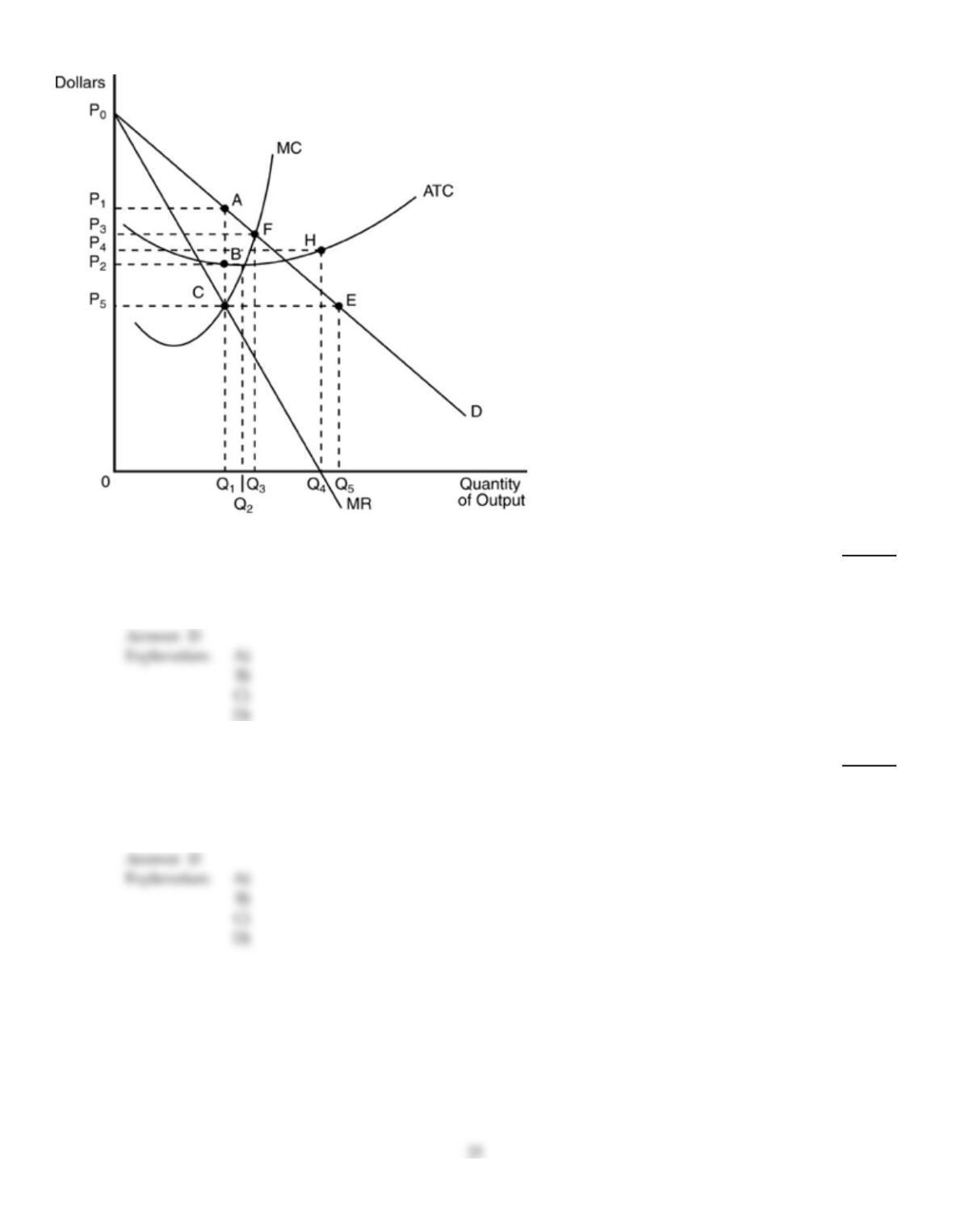
In the above figure, the distance between A and B represents this monopoly firm’s
61)
A)
average profit per unit.
B)
total revenue.
C)
total profit.
D)
average cost per unit.
62)
A barrier to entry
62)
A)
usually takes the form of a cartel.
B)
makes it illegal for firms to enter the industry.
C)
slows or even prevents entry into a market.
D)
can be thought of as unrelated to monopoly.
63)
Which of the following is a characteristic of a monopoly market?
63)
A)
many firms
B)
one firm
C)
Firm is a price taker.
D)
easy entry
64)
Which of the following is NOT a condition for price discrimination to exist?
64)
A)
ability to prevent the resale of the product or service
B)
unpatented product or the service
C)
identification of buyers with differing elasticities
D)
downward sloping demand curve faced by the firm
65)
A monopolist is producing at an output level at which MR = $9 and MC = $8. It could increase
profits
65)
A)
by reducing both output and price.
B)
by increasing both output and price.
C)
by reducing output and by increasing price.
D)
by increasing output and by reducing price.
66)
A price discriminating monopolist will
66)
A)
charge a lower price to those consumers who have more elastic demand.
B)
charge a higher price to those consumers who have more inelastic demand.
C)
charge the same price to all consumers.
D)
charge more to those consumers who have more substitute goods.
67)
The monopolist will choose the price and output combination at which
67)
A)
MC equals price.
B)
MC equals AR.
C)
MC equals MR.
D)
MR equals AR.
68)
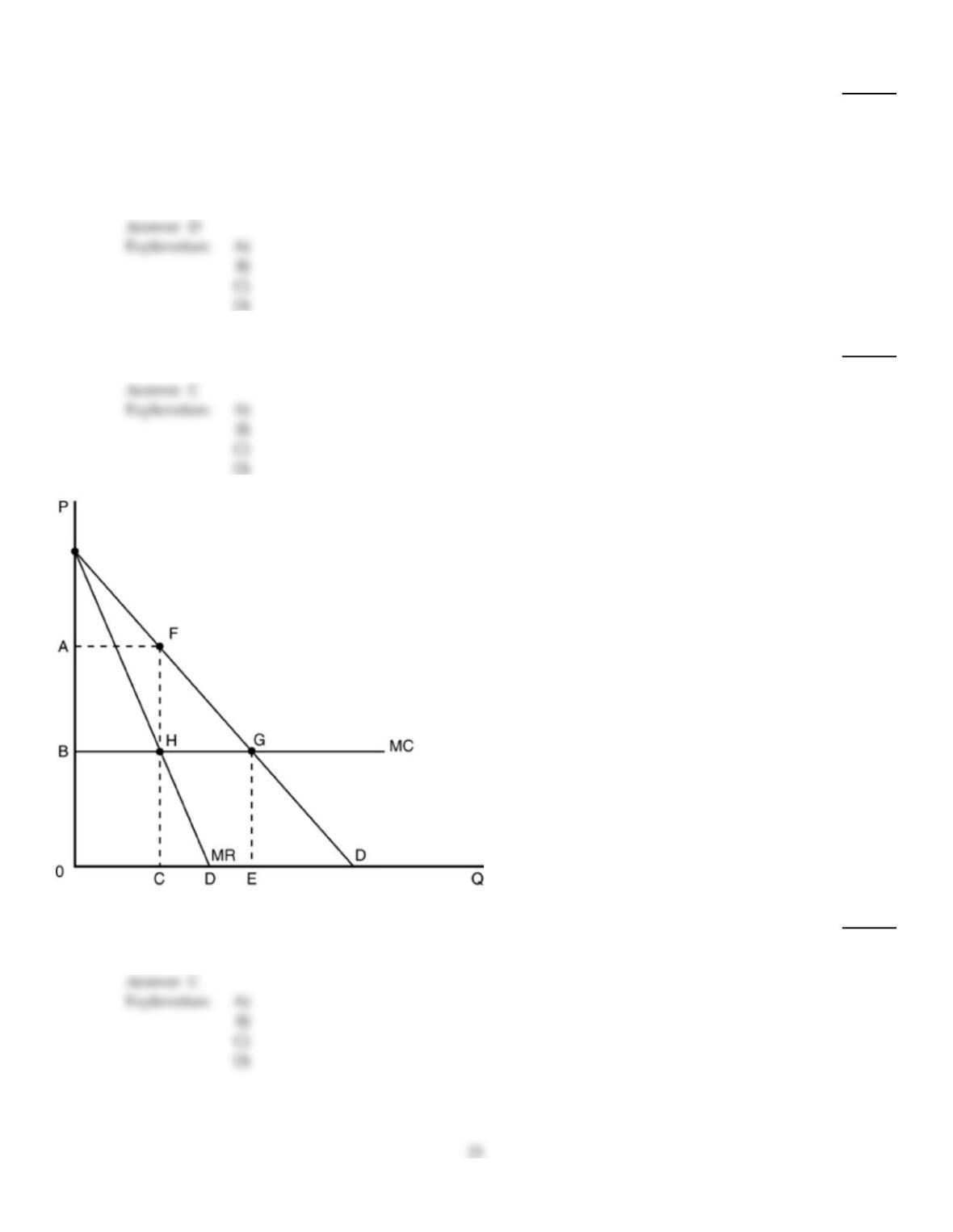
If marginal cost is constant, what happens to a market if it alters from perfect competition to
monopoly without any change in the position of the market demand curve or any variation in
costs?
68)
A)
Consumer surplus is eliminated, and an equal–sized deadweight loss is created.
B)
Consumer surplus increases, and the previously existing deadweight loss decreases.
C)
Consumer surplus increases, and the previously existing deadweight loss increases.
D)
Consumer surplus decreases in size, and a deadweight loss is created.
69)
Suppose a monopolist sells 10,000 units of output at $22 per unit. The firm’s total revenue is
69)
A)
$2,200.
B)
$22,000.
C)
$220,000.
D)
$2,200,000.
70)
In the above figure, the difference between the competitive industry price and that of the
monopolist is
70)
A)
0B.
B)
CE.
C)
AB.
D)
0A.
71)
A monopoly’s goal using price discrimination is to increase
71)
A)
marginal revenue.
B)
total revenue.
C)
the per unit profit.
D)
total profit.
72)
Which of the following is NOT an example of price discrimination?
72)
A)
Gasoline stations charge more for gasoline with higher octane and additional additives.
B)
Airlines charge more for people who don’t stay over a Saturday night.
C)
Colleges give some students more financial aid than they do other students.
D)
College bookstore gives a price discount to faculty.
73)
The profit–maximizing price and quantity established by a perfectly competitive firm in the above
figure are
73)
A)
Q4 units of output and a price of P4.
B)
Q1 units of output and a price of P1.
C)
Q1 units of output and a price of P5.
D)
Q3 units of output and a price of P3.
74)
The price–output combination that maximizes profits for a monopolist occurs at the point where
74)
A)
total revenues are the greatest.
B)
total revenues and total costs are equal.
C)
the elasticity of demand equals one.
D)
the difference between total revenues and total costs is the greatest.
75)
In a monopoly market structure, the firm (the monopolist) always
75)
A)
earns economic profit.
B)
sells faulty products.
C)
is the whole industry.
D)
produces too much.
76)
The market structure in which there is a single supplier of a good or service for which there is no
close substitute is
76)
A)
oligopoly.
B)
monopolistic competition.
C)
monopoly.
D)
perfect competition.
C
77)
Compared to an efficient perfectly competitive industry, the monopolist will
77)
A)
produce less output at a higher total cost.
B)
produce more output at a higher price and higher profit.
C)
produce more output at a lower price.
D)
produce less output and charge a higher price.
D
78)
A monopolist sells a homogeneous good in several distinct submarkets, and the elasticities of
demand differ in these submarkets. If the monopolist selects the rate of output to sell in each
submarket by equating marginal revenue and marginal cost, then
78)
A)
it is not price discriminating, but merely price differentiating.
B)
all customers in all markets end up paying the same price.
C)
customers in markets with more elastic demand will pay higher prices than customers in
markets with less elastic demand.
D)
customers in markets with more elastic demand will pay lower prices than customers in
markets with less elastic demand.
D
C
79)
What is true of the price elasticity of demand faced by a monopoly firm?
79)
A)
Demand is more elastic at lower prices and more inelastic at higher prices.
B)
Demand is perfectly elastic because the monopolist has no competition.
C)
Demand becomes more elastic as the range of imperfect substitutes expands.
D)
Demand is inelastic.
80)
Other things being equal, a price–discriminating firm will charge more to the customers who
80)
A)
have the least elastic demand for its product.
B)
are the least rational in making their decisions.
C)
have the most elastic demand for the product.
D)
have the highest incomes.
81)
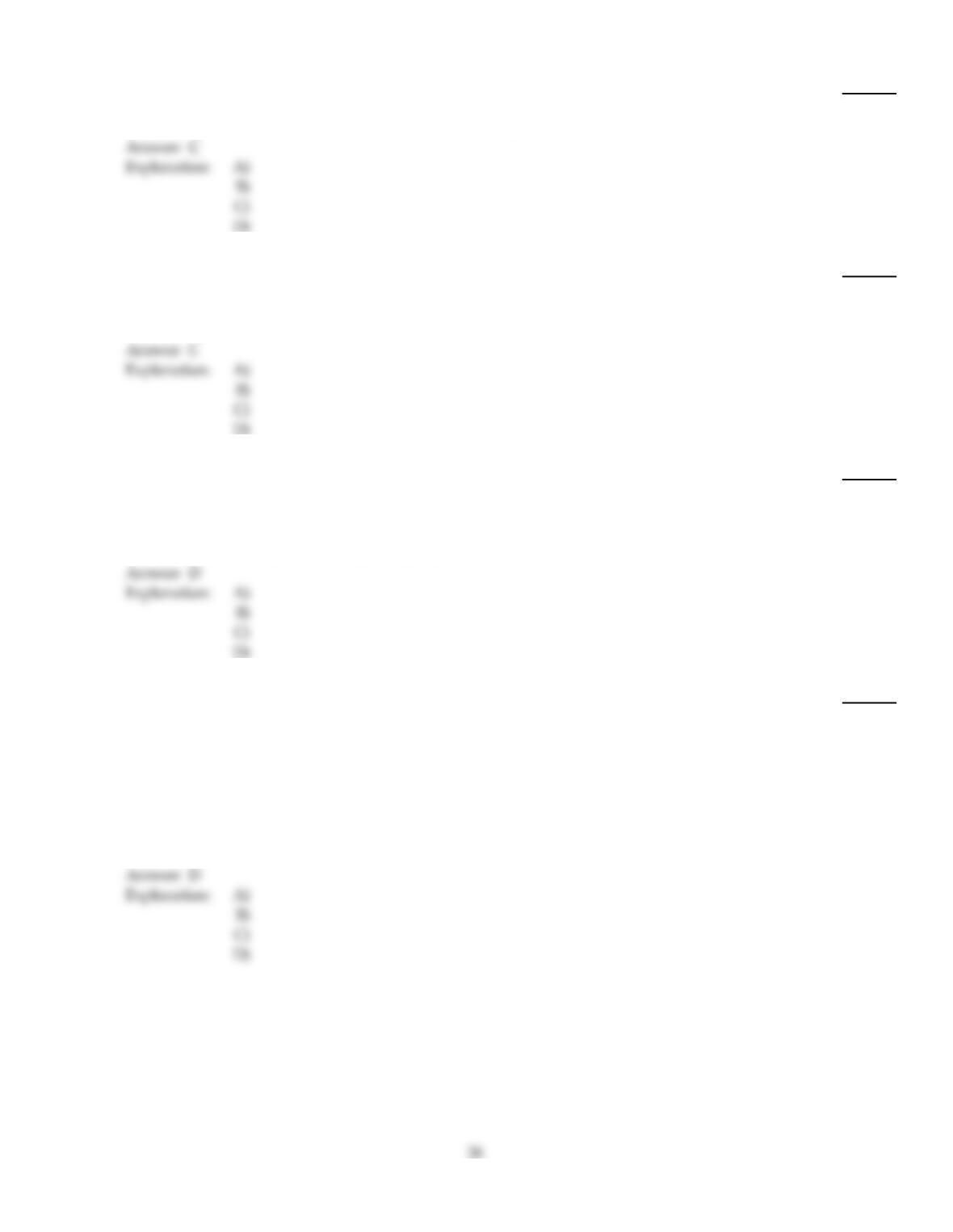
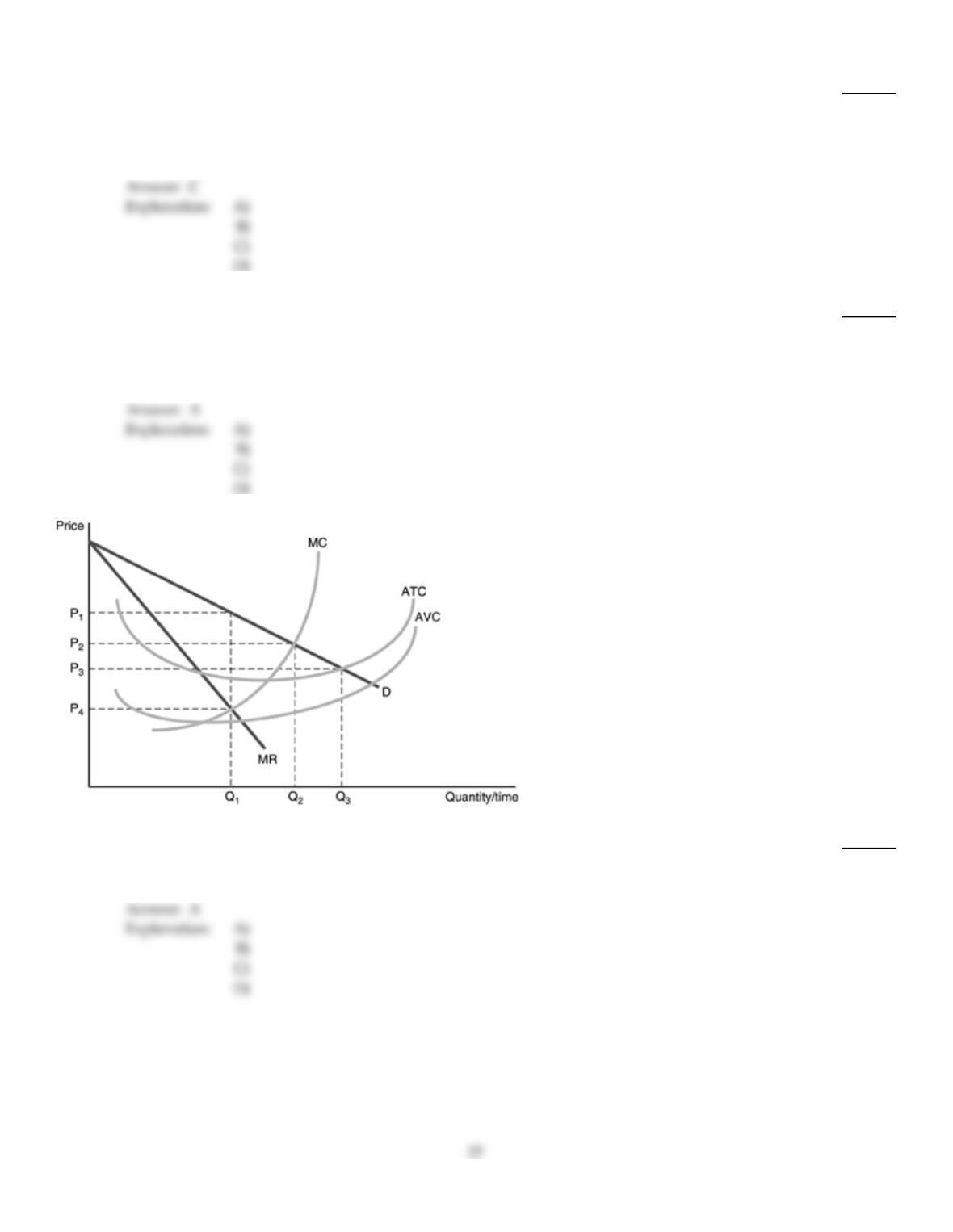
Refer to the above figure. The profit–maximizing price and output for this monopolist are
81)
A)
a price of P1 and output of Q1.
B)
a price of P2 and output of Q2.
C)
a price of P3 and output of Q3.
D)
a price of P4 and output of Q1.
82)
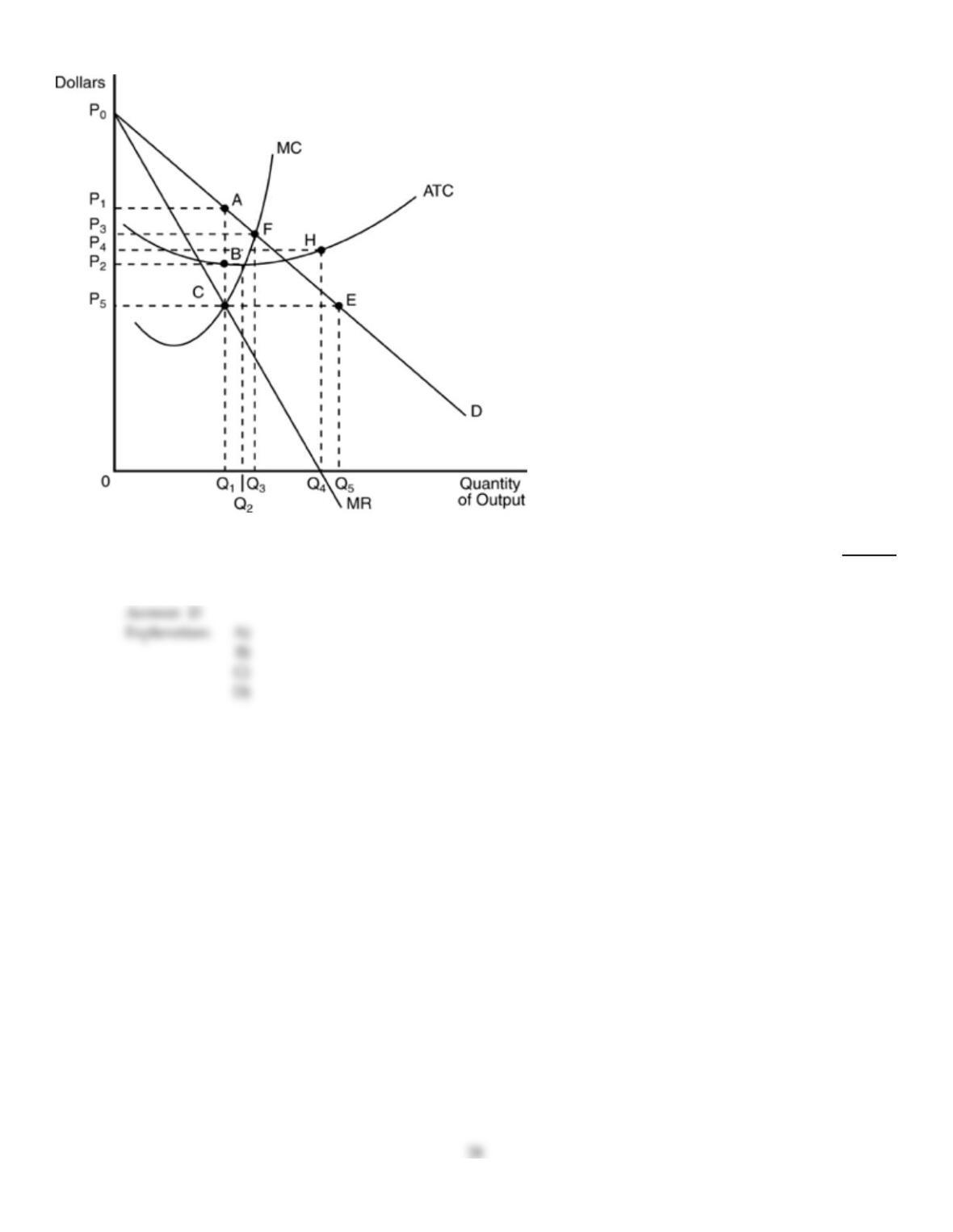
The profit–maximizing quantity of the monopolist compared to the perfectly competitive industry
in the above figure are, respectively
82)
A)
Q2 and Q3.
B)
Q1 and Q2.
C)
Q1 and Q5.
D)
Q1 and Q3.
83)
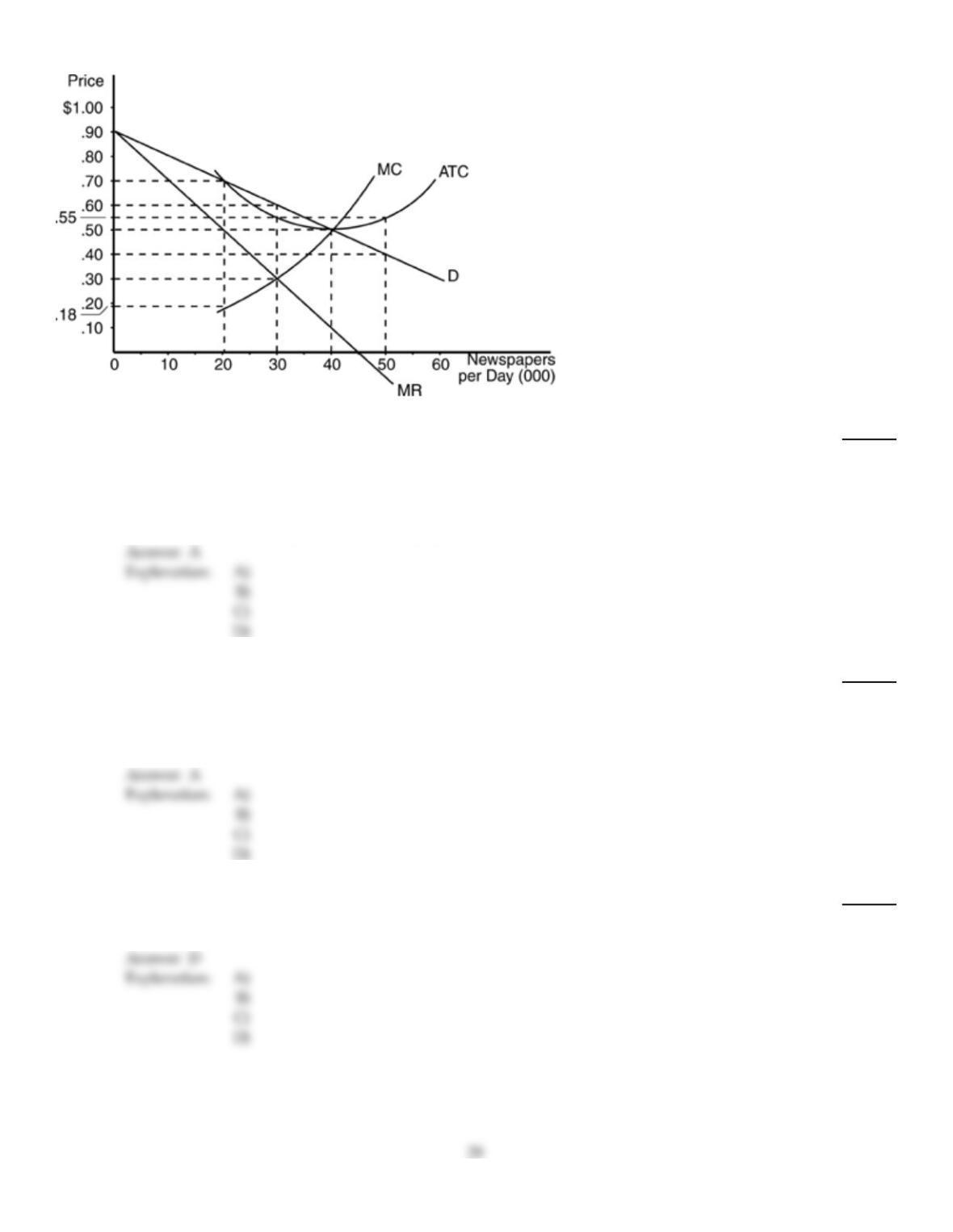
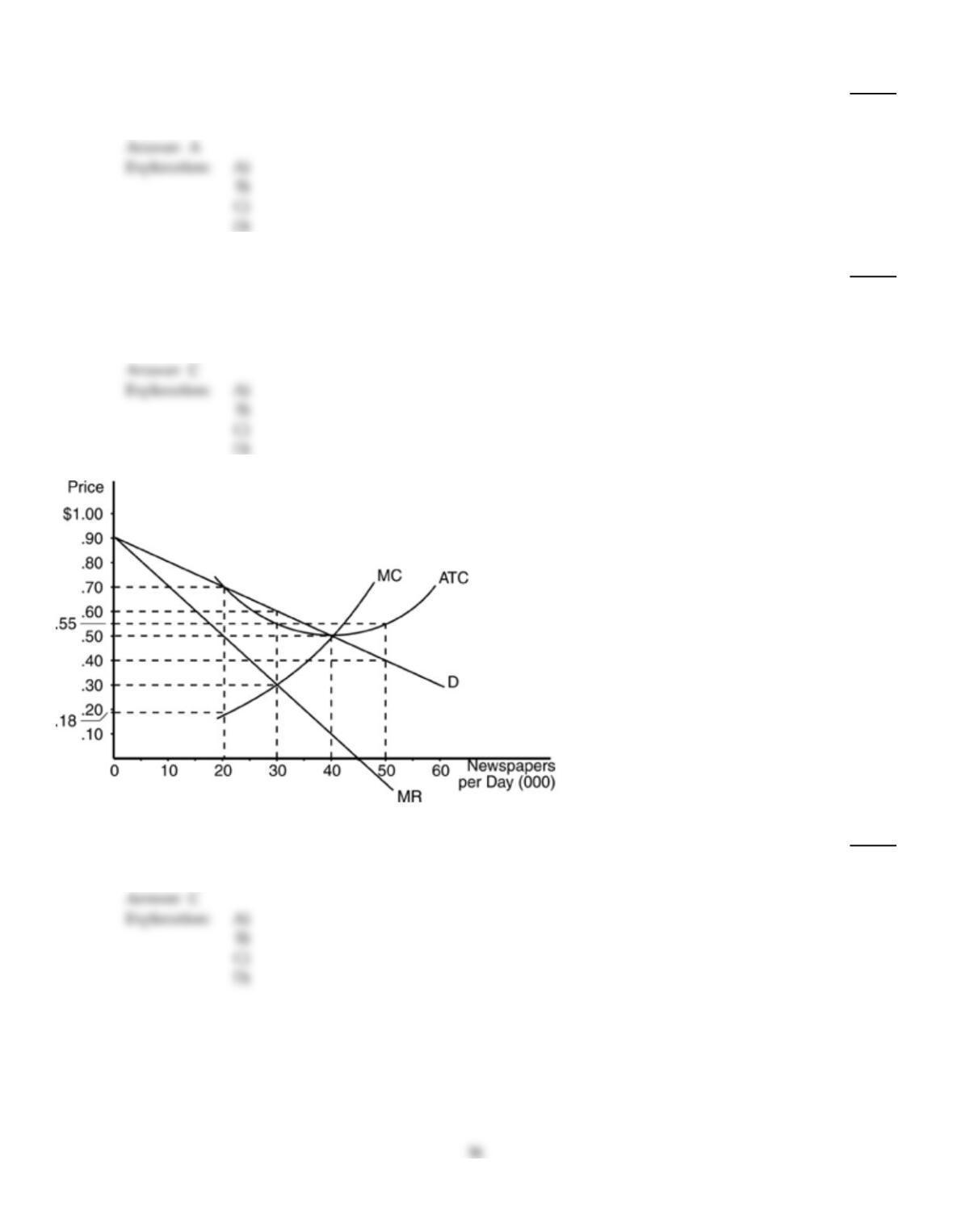
According to the above figure, the profit maximizing price–output combination for the monopolist
is a price of
83)
A)
60 cents and an output of 30,000 newspapers per day.
B)
45 cents and an output of 45,000 newspapers per day.
C)
30 cents and an output of 30,000 newspapers per day.
D)
50 cents and an output of 40,000 newspapers per day.
84)
As a price searcher, a monopoly firm
84)
A)
must determine its optimal price–output combination.
B)
must only determine the price it charges.
C)
must determine its output level and then accept the market price for its product.
D)
must determine the prices it pays for its inputs and accept the market price for its output.
85)
From the date a U.S. patent is granted to a firm, it ceases to be a potential source of monopoly
profits after
85)
A)
14 years.
B)
10 years.
C)
7 years.
D)
20 years.
86)
The portion of consumer surplus that would have existed in a perfectly competitive market but is
unobtainable by anyone in society under a monopoly is known as
86)
A)
an external cost.
B)
an unattainable surplus.
C)
a deadweight loss.
D)
monopoly profits.
87)
When a firm sells a given product at more than one price and the price difference is NOT caused by
differences in cost then there is
87)
A)
price delineation.
B)
price differentiation.
C)
price demarcation.
D)
price discrimination.
D
88)
A monopolist engages in price discrimination
88)
A)
by charging a lower price to consumers whose demand is more elastic.
B)
by charging the same price to all consumers.
C)
by charging a higher price to consumers whose demand is more elastic.
D)
by charging a higher price when marginal cost is lower.
A
89)
A deadweight loss occurs in a
89)
A)
market in which the market clearing price of a good is below the marginal cost of producing
it.
B)
perfectly competitive market.
C)
market in which the market clearing price of a good equals the marginal cost of producing it.
D)
monopoly.
D
90)
If a firm sells 20 units of output at $15 per unit and 21 units of output when price is reduced to $14,
its marginal revenue from selling the last unit is
90)
A)
–$6.
B)
$294.
C)
$21.
D)
$6.
A
C
91)
The price elasticity of demand for a monopolist’s product depends on
91)
A)
the ATC of the item it produces.
B)
the AVC of the item it produces.
C)
the number and similarity of substitutes.
D)
the MC of the item it produces.
92)
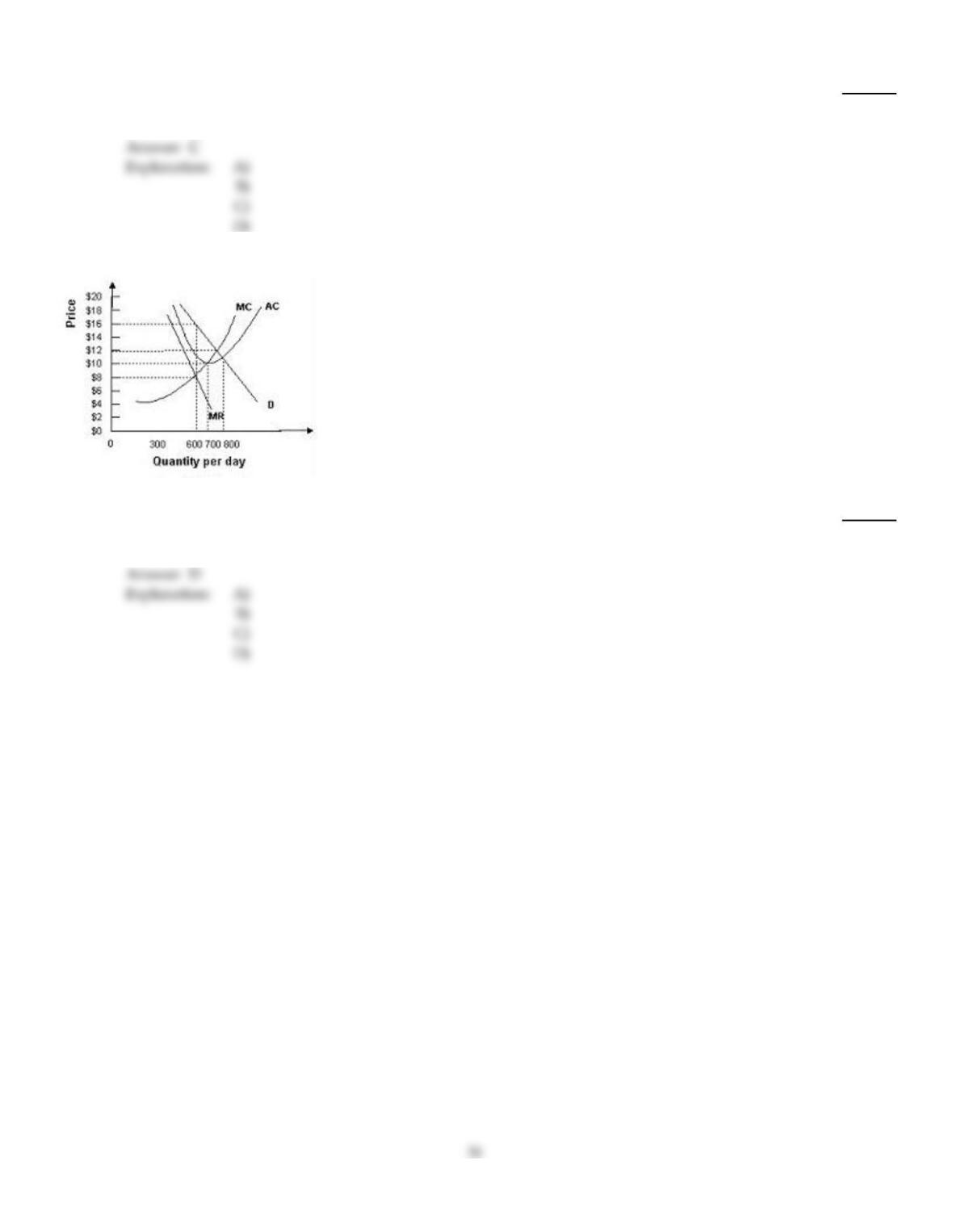
Use the above figure. The profit–maximizing output and price is
92)
A)
800 and $10, respectively.
B)
600 and $8, respectively.
C)
600 and $10, respectively.
D)
600 and $16, respectively.
93)
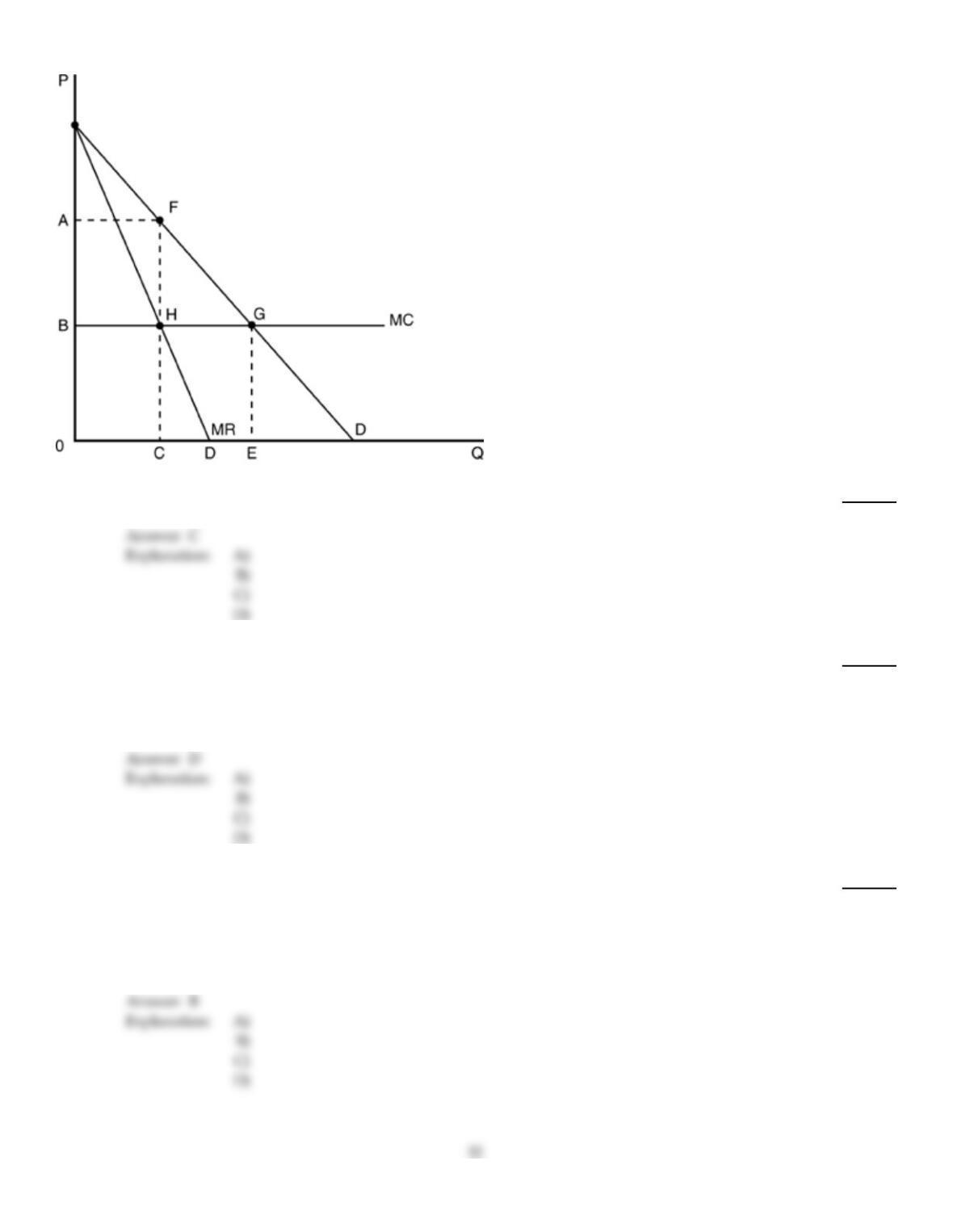
In the above figure, the monopolist’s profit–maximizing output level is
93)
A)
A.
B)
B.
C)
C.
D)
D.
94)
A monopolist engages in price discrimination
94)
A)
by charging a lower price when marginal cost is higher.
B)
by charging a lower price to consumers whose demand is more inelastic.
C)
by charging the same price to all consumers.
D)
by charging a higher price to consumers whose demand is more inelastic.
95)
When a firm experiences declining long–run average total costs as it produces more output, there
are
95)
A)
constant returns to scale.
B)
economies of scale.
C)
increasing marginal returns to variable inputs.
D)
diseconomies of scale.
96)
Which of the following statements about a monopolist is FALSE?
96)
A)
A pure monopolist is the sole supplier of one product, good, or service.
B)
The monopolist faces the industry demand curve, which is upward sloping.
C)
The monopolist faces a demand curve for the entire market for that good.
D)
A pure monopolist is not the same as a perfect competitor.
97)
A monopolistic firm will shut down if
97)
A)
P < ATC for every level of output.
B)
P > ATC for every level of output.
C)
P < AVC for every level of output.
D)
P > AVC for every level of output.
98)
When the number of substitutes increase, the demand curve for a monopolist will
98)
A)
become more elastic.
B)
not change.
C)
become more inelastic.
D)
become steeper.
99)
Which of the following is NOT a restriction the government imposes to keep potential entrants out
of a market?
99)
A)
certificate of convenience
B)
compliance with government safety regulations
C)
licensing of exclusive ownership of such a vital resources
D)
subsidizing imported goods
100)
For a monopolist, marginal revenue is always
100)
A)
equal to price.
B)
greater than price.
C)
equal to zero.
D)
less than price.
101)
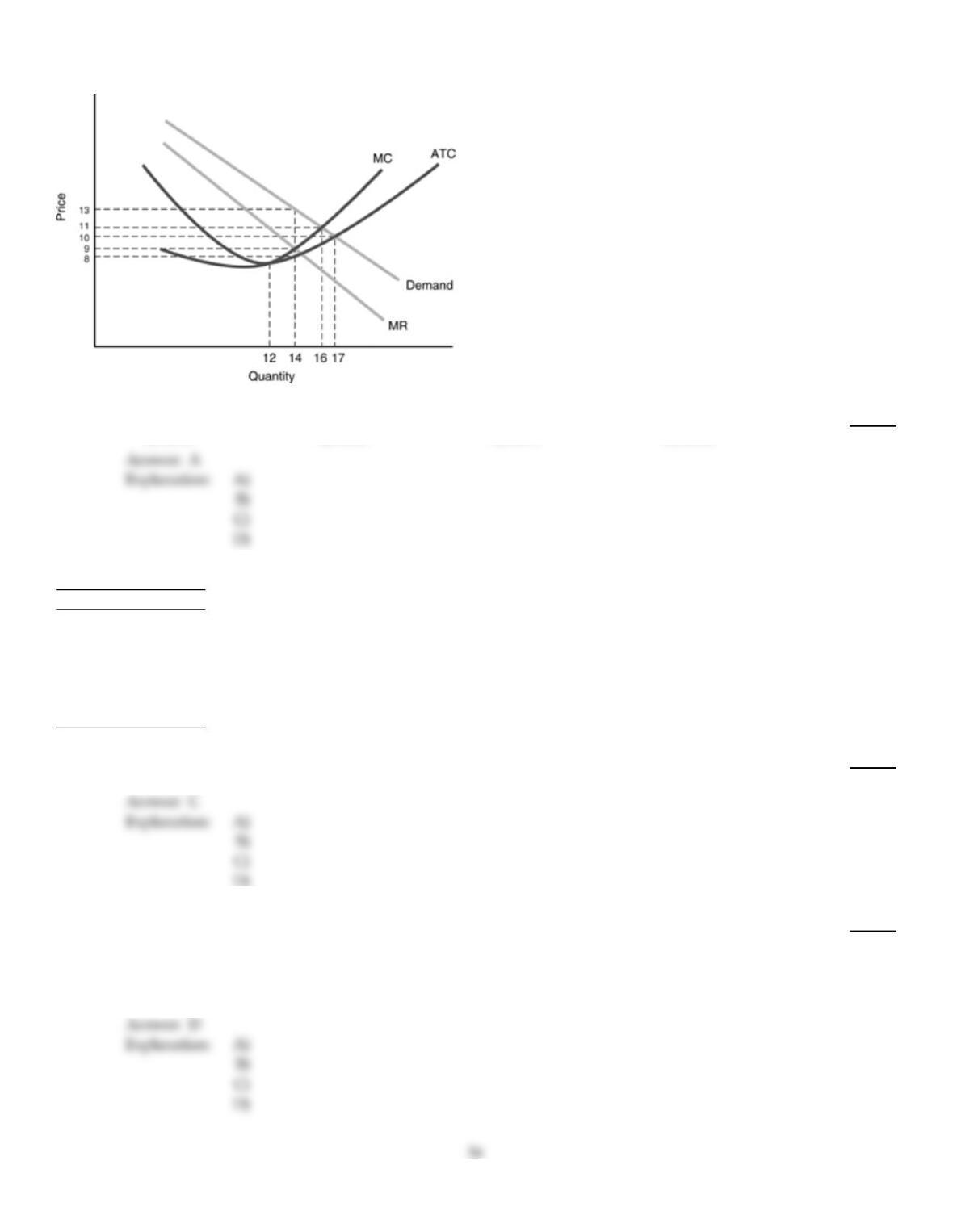
In the above figure, what is total cost at the profit–maximizing point?
101)
A)
$112
B)
$182
C)
$170
D)
$126
Price Quantity
$19 11
18 12
17 13
16 14
15 15
14 16
102)
Given the data in the above table, what is the marginal revenue when the 13th unit is sold?
102)
A)
$1.00
B)
$7.00
C)
$5.00
D)
$3.00
103)
If it is not profitable for more than one firm to be in an industry, we have an example of
103)
A)
pure competition.
B)
monopoly due to governmental entry restrictions.
C)
monopoly due to ownership of key resources.
D)
monopoly due to economies of scale.
Price Quantity
$19 11
18 12
17 13
16 14
15 15
14 16
104)
Given the data in the above table, what is the marginal revenue when the 15th unit is sold?
104)
A)
$1.00
B)
$7.00
C)
$3.00
D)
$5.00
105)
A monopolist can earn economic profits in the long run because
105)
A)
monopolies can legally force people to buy their products and to pay more for them than they
are worth.
B)
a monopoly makes the good or service better than anyone else.
C)
a monopoly is by definition large, and this gives it the ability to make large profits.
D)
barriers to entry prevent new firms from entering the industry.
106)
Which is NOT a necessary condition for price discrimination to exist?
106)
A)
The firm must face a downward sloping demand curve.
B)
The firm must be able to prevent resale of the product or service.
C)
The firm must identify buyers with different elasticities of demand.
D)
The firm must establish different prices to reflect marginal cost.
107)
Which of the following would NOT be a barrier to entry for a particular market?
107)
A)
government regulation
B)
ownership of a patent
C)
low cost of obtaining initial capital
D)
the presence of economies of scale
108)
Senior citizens can buy movie tickets at a lower price than the general public. This is an example of
108)
A)
price discrimination.
B)
age discrimination.
C)
price differentiation.
D)
demand discrimination.
109)
All of the following are considered a barrier to entry into a market EXCEPT
109)
A)
governmental restrictions on a firm’s ability enter a market.
B)
ownership of resources without close substitutes.
C)
when firms can only earn a normal rate of return in a market.
D)
economies of scale.
110)
According to the above figure, what are the profits of the firm if it produces 50,000 units?
110)
A)
–$17,500 per day
B)
–$10,000 per day
C)
–$7,500 per day
D)
–$5,000 per day
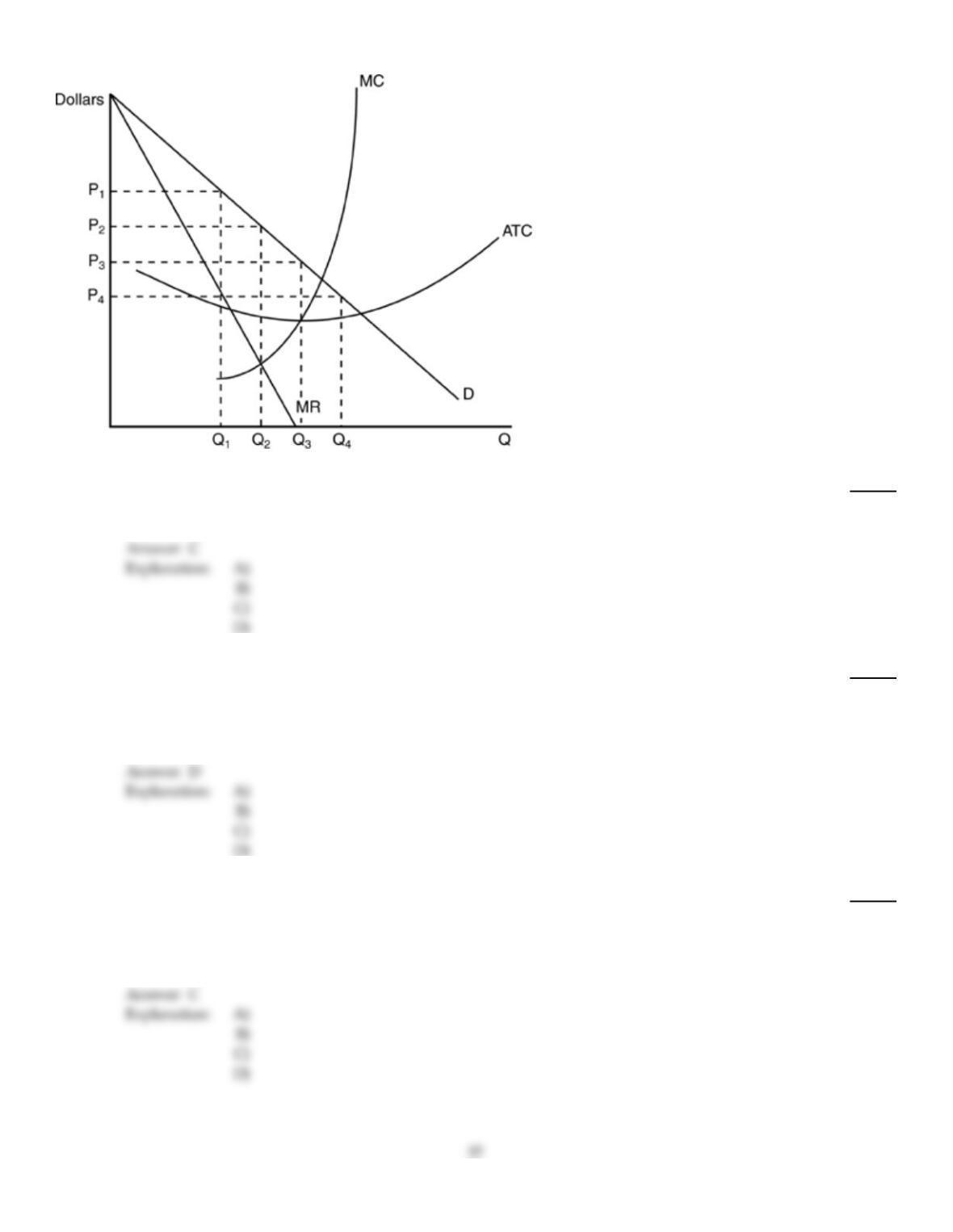
111)
In the above figure, if the firm is producing Q2 units at a price P2, it should
111)
A)
increase output and decrease price.
B)
decrease output and increase price.
C)
not change output or price.
D)
shut down.
112)
The more substitutes there are for a monopolist’s product
112)
A)
the more positively sloped the demand curve becomes.
B)
the steeper is the demand curve.
C)
the less elastic is the demand curve.
D)
the more elastic is the demand curve.
113)
Price discrimination exists when
113)
A)
each buyer is treated equally.
B)
a firm charges each buyer a price of the product in proportion to its costs.
C)
a firm charges different buyers different prices for its product but the costs are the same.
D)
sales are made below cost.
114)
Selling a product at different prices when the price difference is unrelated to costs is a practice
known as
114)
A)
price discrimination.
B)
price differentiation.
C)
price monopolization.
D)
price fixing.
115)
Which of the following is TRUE?
115)
A)
Charging all customers the same price when costs vary can actually be a case of price
discrimination.
B)
Monopoly results in a higher quantity of output being sold compared with perfect
competition.
C)
Price discrimination guarantees that the monopolist will make a profit.
D)
Price discrimination occurs when there are differences in prices that reflect differences in
marginal cost.
116)
The monopolist’s marginal revenue is less than price since
116)
A)
additional units can only be sold if the price is lowered on all units sold.
B)
average total cost is declining.
C)
average revenue is also less than price.
D)
the demand function is horizontal.
117)
Economic inefficiency exists when
117)
A)
P = MC.
B)
P > MC.
C)
P = MR.
D)
MR = MC.
118)
A natural monopoly exists when
118)
A)
economies of scale occur.
B)
the firm owns all of the raw materials needed to produce the product.
C)
there are governmental entry restrictions.
D)
the firm holds a patent.
P Q TC
$13 10 $15
$12 14 $25
$11 19 $45
$10 25 $75
$9 30 $115
$8 35 $165
119)
Refer to the above table. Given the demand and cost schedules, what is the profit maximizing
quantity for this monopolist?
119)
A)
30
B)
19
C)
14
D)
25
120)
Use the above figure. The profit–maximizing price will be
120)
A)
P1.
B)
P2.
C)
P3.
D)
P4.
121)
For a firm to become a monopoly in an industry
121)
A)
the firm must produce a faulty product.
B)
the firm will engage in unfair practices to drive all competitors out of the market.
C)
the firm must charge higher prices than its competitors.
D)
barriers to entry must exist.
122)
Which of the following conditions is not necessary for a firm to be able to engage in price
discrimination?
I. The firm must be able to produce to the point at which price equals marginal revenue.
II. The firm must easily be able to identify consumers with different demand elasticities.
III. The firm must be able to prevent resale of the item it produces and sells.
122)
A)
I only
B)
III only
C)
Both I and II only
D)
Both II and III only
D
123)
If a firm is price differentiating, then it is
123)
A)
charging different prices to different consumers based on differences in marginal costs.
B)
charging different prices based on advertising costs.
C)
charging different prices based on quality.
D)
producing a homogeneous product.
A
124)
Suppose that a perfect–maximizing monopolist operates with a horizontal marginal cost curve and
no fixed costs. Which of the following would NOT be represented as part of the area between its
demand curve and marginal cost curve?
124)
A)
total costs
B)
economic profits
C)
deadweight loss
D)
consumer surplus
A
D