College Physics: A Strategic Approach, 3e (Knight)
Chapter 24 Magnetic Fields and Forces
24.1 Conceptual Questions
1) If you were to cut a small permanent bar magnet in half,
A) one piece would be a magnetic north pole and the other piece would be a south pole.
B) neither piece would be magnetic.
C) each piece would in itself be a smaller bar magnet with both north and south poles.
D) None of these statements is true.
2) A straight bar magnet is initially 4 cm long, with the north pole on the right and the south pole
on the left. If you cut the magnet in half, the right half will
A) contain only a north pole.
B) contain a north pole on the right and a south pole on the left.
C) contain only a south pole.
D) no longer contain any poles.
3) Which one of the following statements is correct?
A) Earth’s geographic north pole is the north pole of Earth’s magnetic field.
B) Earth’s geographic south pole is the south pole of Earth’s magnetic field.
C) The north pole of a magnet points towards Earth’s geographic north pole.
D) The north pole of a magnet points towards Earth’s geographic south pole.
E) None of the above statements is correct.
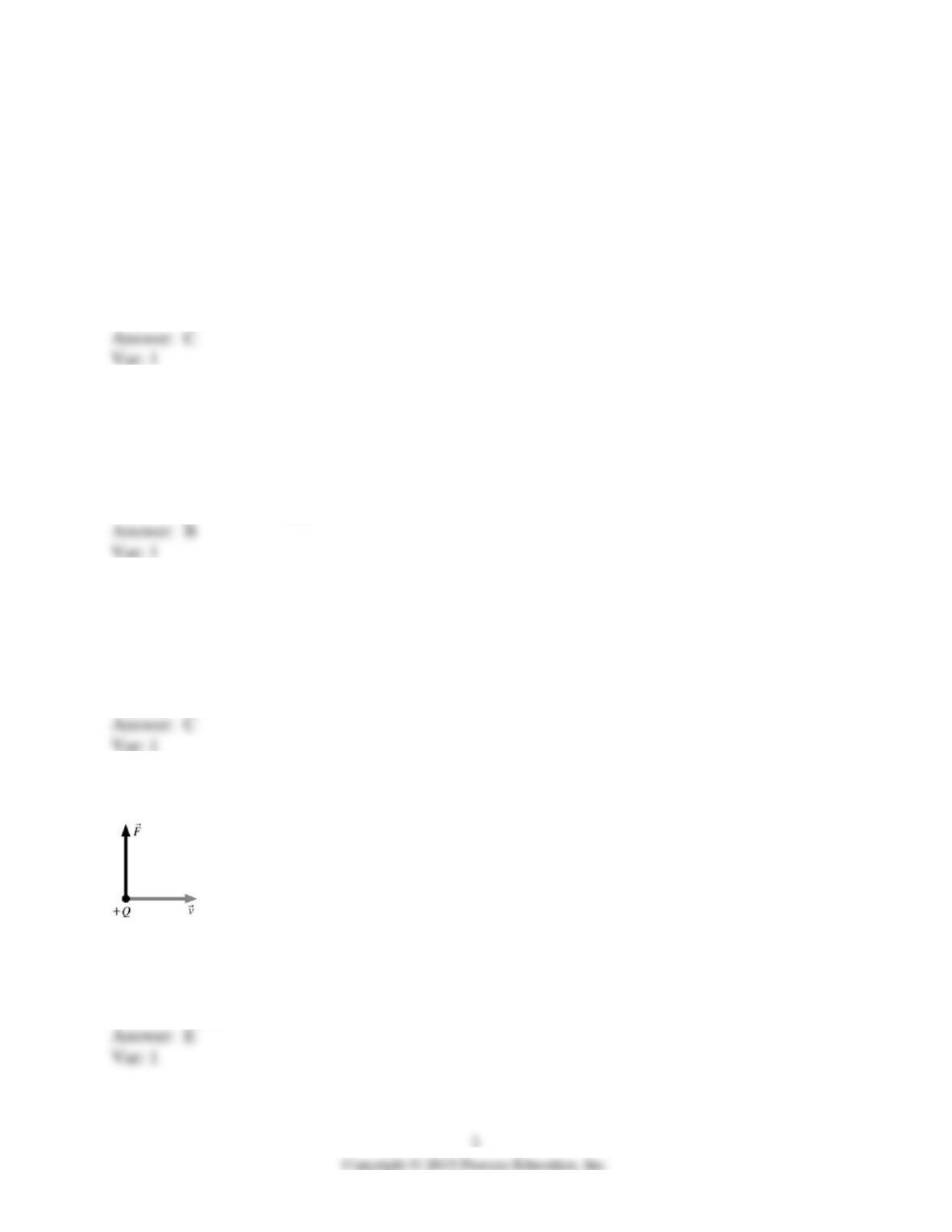
4) A positive charge is moving to the right and experiences an upward magnetic force, as shown
in the figure. In which direction must the magnetic field have a component?
A) to the right
B) to the left
C) upward
D) out of the page
E) into the page
5) A charged particle that is moving in a static uniform magnetic field
A) will always experience a magnetic force, regardless of its direction of motion.
B) may experience a magnetic force which will cause its speed to change.
C) may experience a magnetic force, but its speed will not change.
D) may experience a magnetic force, but its direction of motion will not change.
E) None of the above statements are true.
6) An electron moving along the +x-axis enters a magnetic field. If the electron experiences a
magnetic deflection in the –y direction, then the magnetic field must have a component
A) along the +z-axis
B) along the –z-axis
C) along the –x-axis
D) along the +y-axis
E) along the –y-axis
7) An electron, moving south, enters a magnetic field. Because of this field, the electron curves
upward. We may conclude that the magnetic field must have a component
A) downward.
B) towards the east.
C) upward.
D) towards the west.
E) towards the north.
8) A proton, moving north, enters a magnetic field. Because of this field, the proton curves
downward. We may conclude that the magnetic field must have a component
A) downward.
B) upward.
C) towards the east.
D) towards the west.
E) towards the north.
9) An electron, moving west, enters a magnetic field. Because of this field the electron curves
upward. We may conclude that the magnetic field must have a component
A) towards the north.
B) towards the south.
C) upward.
D) downward.
E) towards the west.
10) A proton, moving west, enters a magnetic field. Because of this magnetic field the proton
curves upward. We may conclude that the magnetic field must have a component
A) towards the west.
B) towards the east.
C) towards the south.
D) towards the north.
E) downward.
11) A proton, moving east, enters a magnetic field. Because of this magnetic field the proton
curves downward. We may conclude that the magnetic field must have a component
A) towards the south.
B) towards the north.
C) towards the west.
D) upward.
E) downward.
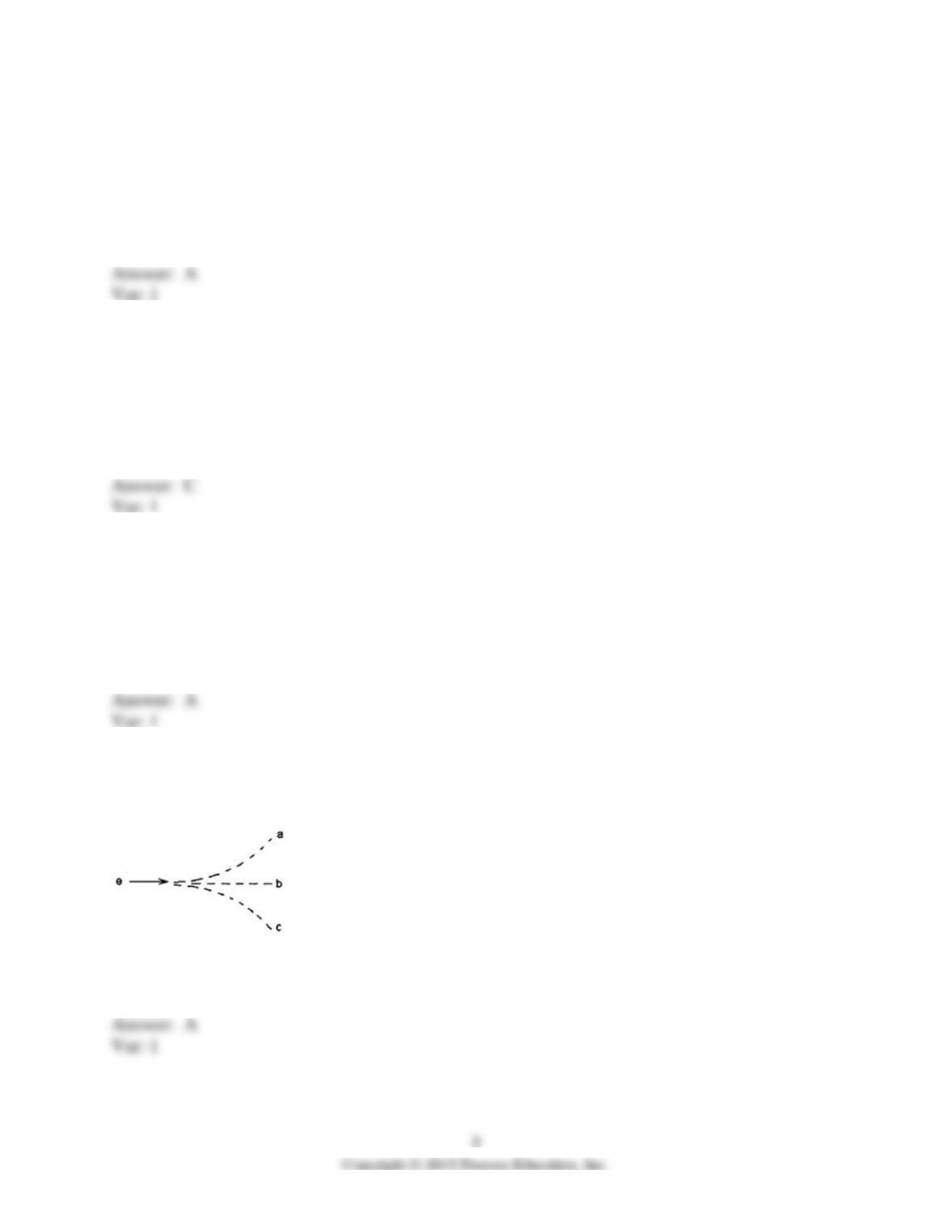
12) An electron is moving to the right, as shown in the figure. Suddenly it encounters uniform
magnetic field pointing out of the page. Which one of the three paths shown will it follow in the
field?
A) path a
B) path b
C) path c
4
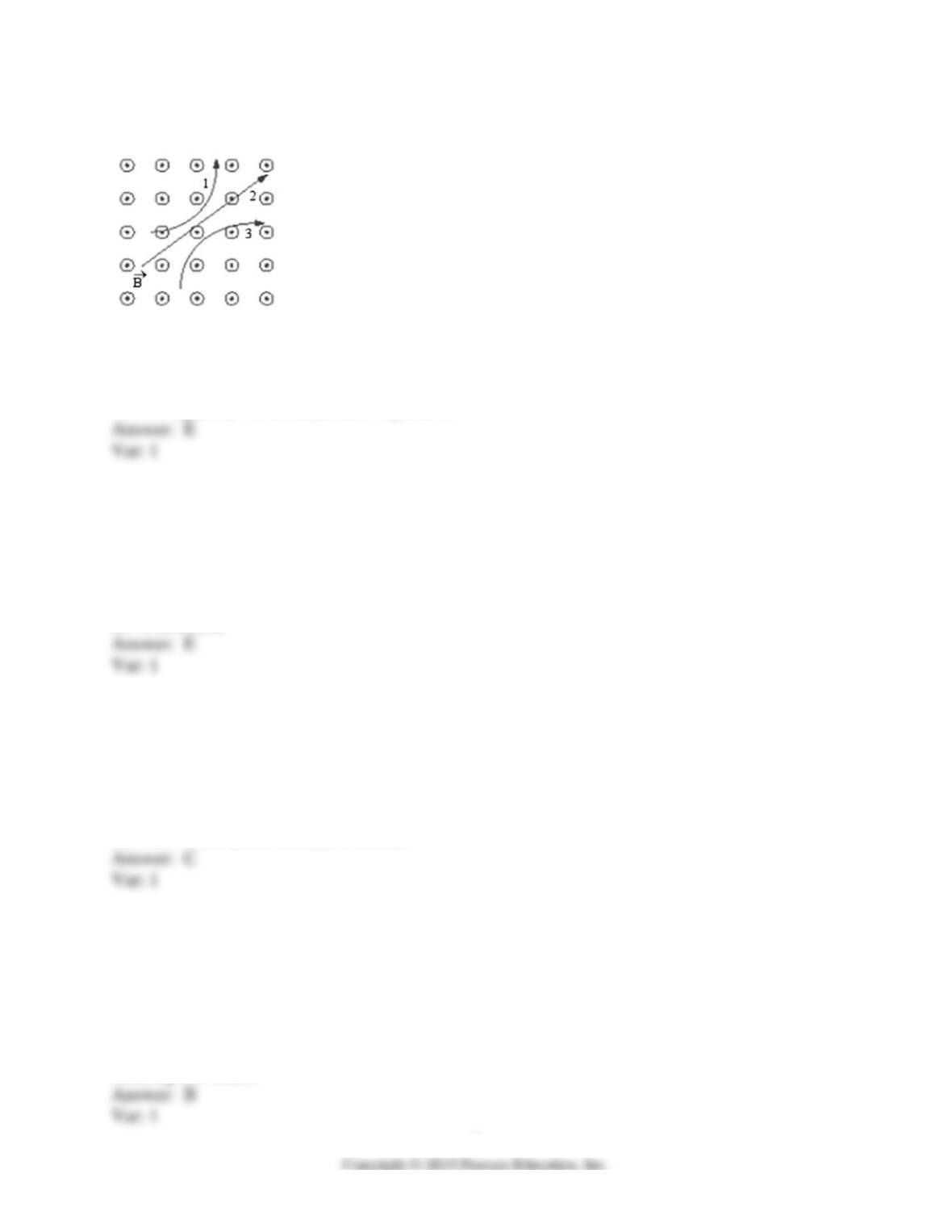
13) Three particles travel through a region of space where the magnetic field is out of the page,
as shown in the figure. What are the signs of the charges of these three particles?
A) 1 is neutral, 2 is negative, and 3 is positive.
B) 1 is neutral, 2 is positive, and 3 is negative.
C) 1 is positive, 2 is neutral, and 3 is negative.
D) 1 is positive, 2 is negative, and 3 is neutral.
E) 1 is negative, 2 is neutral, and 3 is positive.
14) An electron moving in the +y direction, at right angles to a magnetic field, experiences a
magnetic force in the –x direction. The direction of the magnetic field is in the
A) –x direction.
B) +x direction.
C) +y direction.
D) –z direction.
E) +z direction.
15) A charged particle moving along the +x-axis enters a uniform magnetic field pointing along
the +z-axis. Because of an electric field along the +y-axis, the charge particle does not change
velocity. What is the sign of this particle?
A) positive
B) negative
C) The particle could be either positive or negative.
D) None of the above choices is correct.
16) A charged particle moving along the +x-axis enters a uniform magnetic field pointing along
the +z-axis. A uniform electric field is also present. Due to the combined effect of both fields, the
particle does not change its velocity. What is the direction of the electric field?
A) along the –y-axis
B) along the +y-axis
C) along the –x-axis
D) along the +x-axis
E) along the –z-axis
17) A proton is to orbit Earth at the equator using Earth’s magnetic field to supply part of the
necessary centripetal force. In what direction should the proton move?
A) upward
B) northward
C) southward
D) eastward
E) westward
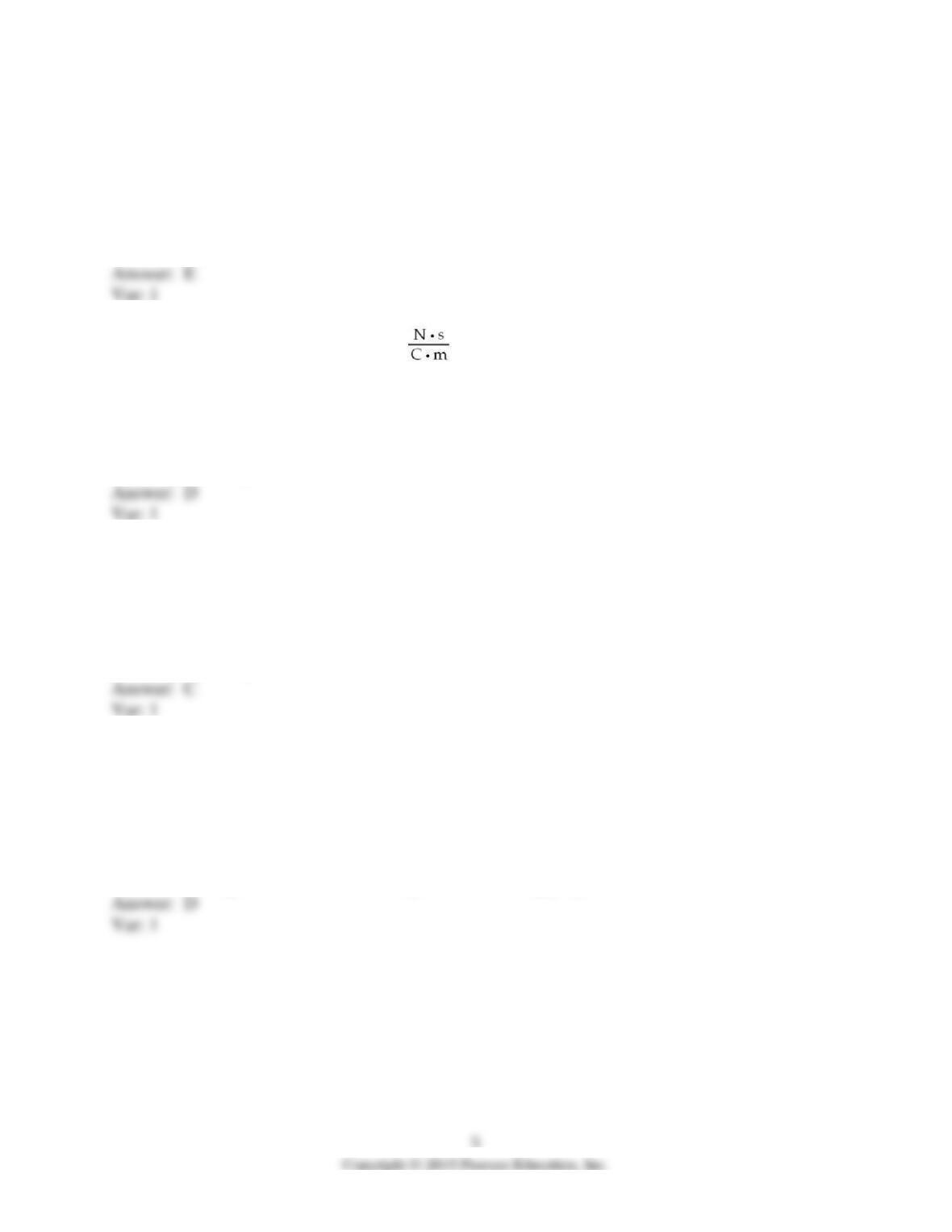
18) If a calculated quantity has units of , that quantity could be
A) an electric field.
B) an electric potential.
C) μ0.
D) a magnetic field.
E) a magnetic torque.
19) If a calculated quantity has units of T ∙ m/A, that quantity could be
A) an electric field.
B) an electric potential.
C) μ0.
D) a magnetic field.
E) a magnetic torque.
20) We observe that a moving charged particle experiences no magnetic force. From this we can
definitely conclude that
A) no magnetic field exists in that region of space.
B) the particle must be moving parallel to the magnetic field.
C) the particle is moving at right angles to the magnetic field.
D) either no magnetic field exists or the particle is moving parallel to the field.
E) either no magnetic field exists or the particle is moving perpendicular to the field.
21) A charged particle moves with a constant speed through a region where a uniform magnetic
field is present. If the magnetic field points straight upward, the magnetic force acting on this
particle will be strongest when the particle moves
A) straight upward.
B) straight downward.
C) in a plane parallel to Earth’s surface.
D) upward at an angle of 45° above the horizontal.
22) A negatively-charged particle moves across a constant uniform magnetic field that is
perpendicular to the velocity of the particle. The magnetic force on this particle
A) causes the particle to speed up.
B) causes the particle to slow down.
C) causes the particle to accelerate.
D) is in the same direction as the particle’s velocity.
E) is opposite the direction of the particle’s velocity.
23) At a particular instant, a proton moves toward the east in a uniform magnetic field that is
directed straight downward. The magnetic force that acts on it is
A) zero.
B) upward.
C) toward the north.
D) toward the south.
E) downward.
24) At a particular instant, an electron moves toward the east in a uniform magnetic field that is
directed straight downward. The magnetic force that acts on it is
A) zero.
B) upward.
C) toward the north.
D) toward the south.
E) downward.
25) An electron has an initial velocity to the south but is observed to curve upward as the result
of a magnetic field. This magnetic field must have a component
A) to the west.
B) to the east.
C) upward.
D) downward.
E) to the north.
26) A proton has an initial velocity to the south but is observed to curve upward as the result of a
magnetic field. This magnetic field must have a component
A) to the west.
B) to the east.
C) upward.
D) downward.
E) to the north.
27) After landing on an unexplored Klingon planet, Spock tests for the direction of the magnetic
field by firing a beam of electrons in various directions and by recording the following
observations:
Electrons moving upward feel a magnetic force in the northwest direction.
Electrons moving horizontally toward the north are pushed downward.
Electrons moving horizontally toward the southeast are pushed upward.
Mr. Spock therefore concludes that the magnetic field at this landing site is in which direction?
A) toward the east
B) toward the northeast
C) toward the southwest
D) toward the southeast
E) toward the west
28) A charged particle is injected into a uniform magnetic field such that its velocity vector is
perpendicular to the magnetic field lines. Ignoring the particle’s weight, the particle will
A) move in a straight line.
B) follow a spiral path.
C) move along a parabolic path.
D) follow a circular path.
29) A charged particle is observed traveling in a circular path of radius R in a uniform magnetic
field. If the particle were traveling twice as fast, the radius of the circular path would be
A) 2R.
B) 4R.
C) 8R.
D) R/2.
E) R/4.
30) A particle carrying a charge of +e travels in a circular path of radius R in a uniform magnetic
field. If instead the particle carried a charge of +2e, the radius of the circular path would have
been
A) 2R.
B) 4R.
C) 8R.
D) R/2.
E) R/4.
31) A proton, moving in a uniform magnetic field, moves in a circle perpendicular to the field
lines and takes time T for each circle. If the proton’s speed tripled, what would now be its time to
go around each circle?
A) 9T
B) 3T
C) T
D) T/3
E) T/9
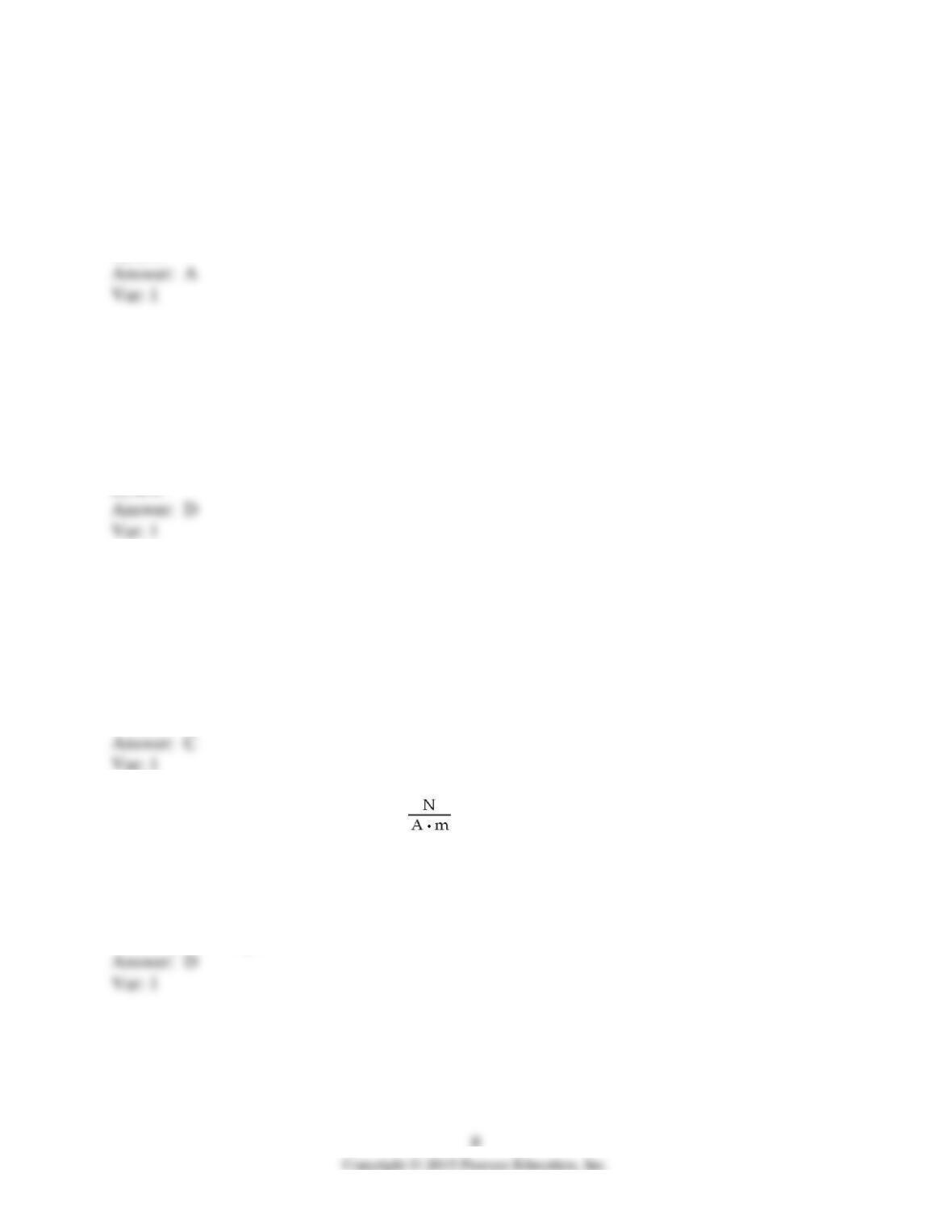
32) If a calculated quantity has units of , that quantity could be
A) an electric field.
B) an electric potential.
C) μ0.
D) a magnetic field.
E) a magnetic torque.
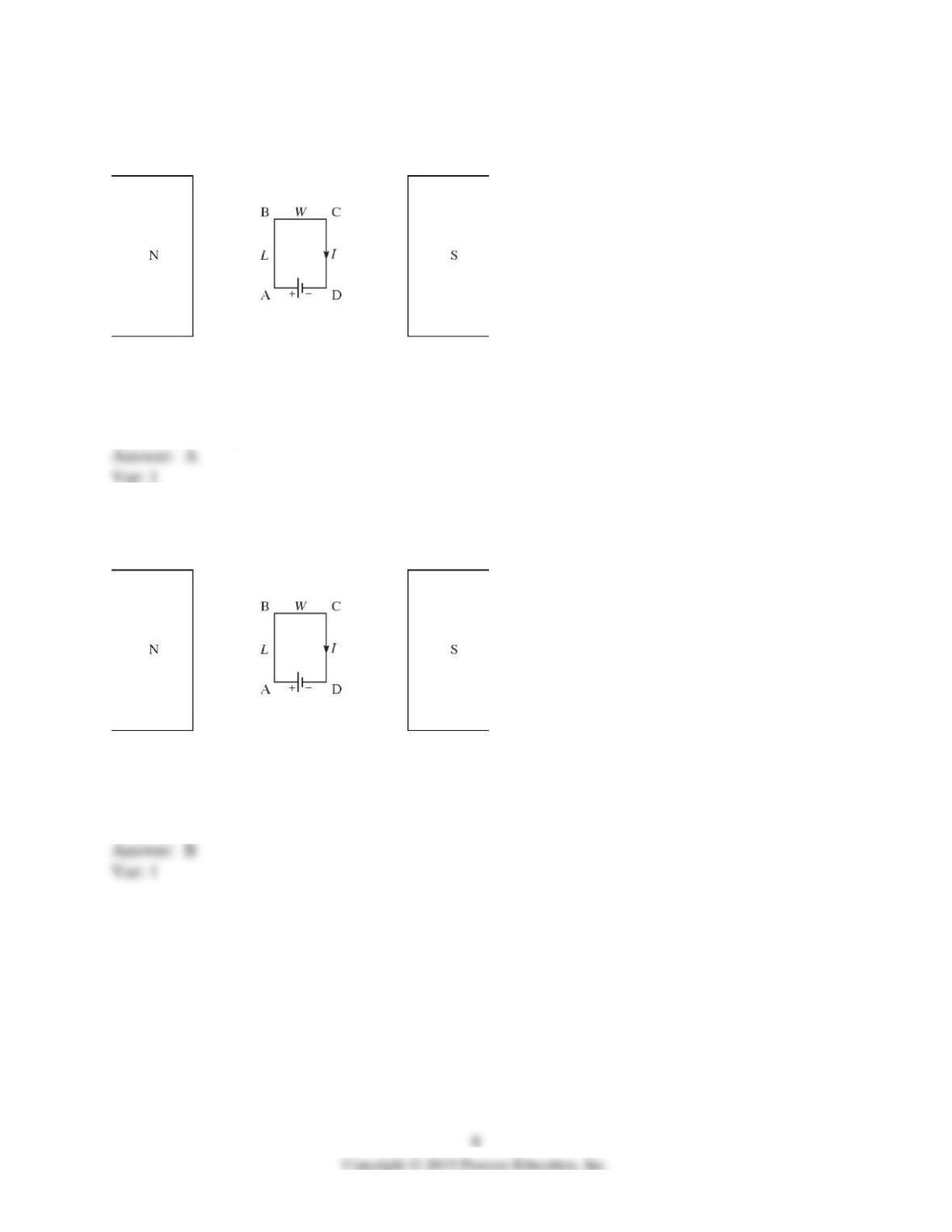
33) A rectangular coil, with corners labeled ABCD, has length L and width w. It is placed
between the poles of a magnet, as shown in the figure If there is a current I flowing through this
coil in the direction shown, what is the direction of the force acting on section AB of this coil?
A) perpendicular to and into the page
B) perpendicular to and out of the page
C) in the direction of the magnetic field
D) in the opposite direction of the magnetic field
E) The force is zero.
34) A rectangular coil, with corners labeled ABCD, has length L and width w. It is placed
between the poles of a magnet, as shown in the figure. If there is a current I flowing through this
coil in the direction shown, what is the direction of the force acting on section CD of this coil?
A) perpendicular to and into the page
B) perpendicular to and out of the page
C) in the direction of the magnetic field
D) in the opposite direction of the magnetic field
E) The force is zero.
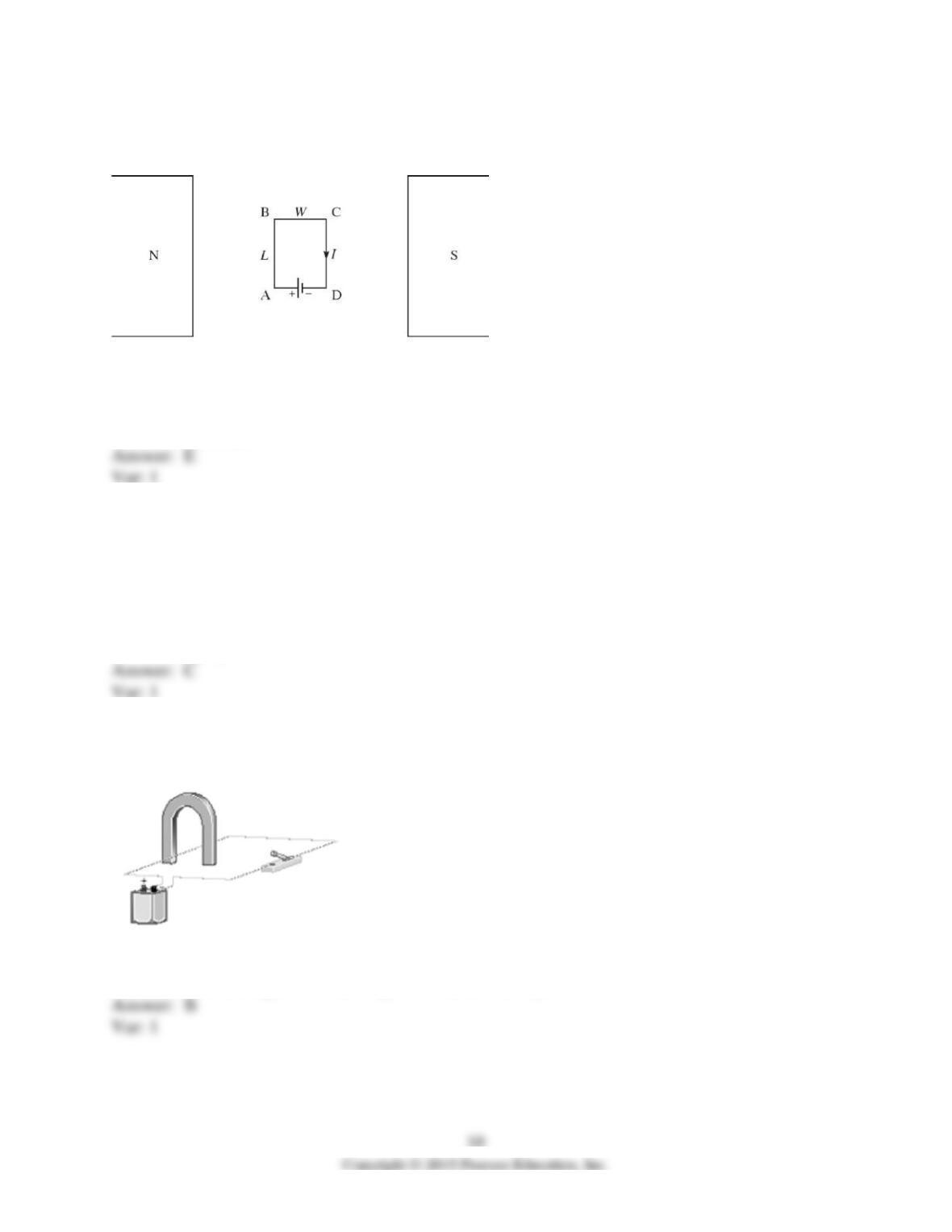
35) A rectangular coil, with corners labeled ABCD, has length L and width w. It is placed
between the poles of a magnet, as shown in the figure If there is a current I flowing through this
coil in the direction shown, what is the direction of the force acting on section BC of this coil?
A) perpendicular to and into the page
B) perpendicular to and out of the page
C) in the direction of the magnetic field
D) in the opposite direction of the magnetic field
E) The force is zero.
36) A wire is carrying current vertically downward. What is the direction of the force on this
wire due to Earth’s magnetic field?
A) horizontally towards the north
B) horizontally towards the south
C) horizontally towards the east
D) horizontally towards the west
E) vertically upward
37) When the switch is closed in the circuit shown in the figure, the wire between the poles of
the horseshoe magnet deflects upward. From this you can conclude that the left end of the
magnet is
A) a north magnetic pole.
B) a south magnetic pole.
C) There is not enough information given to answer the question.
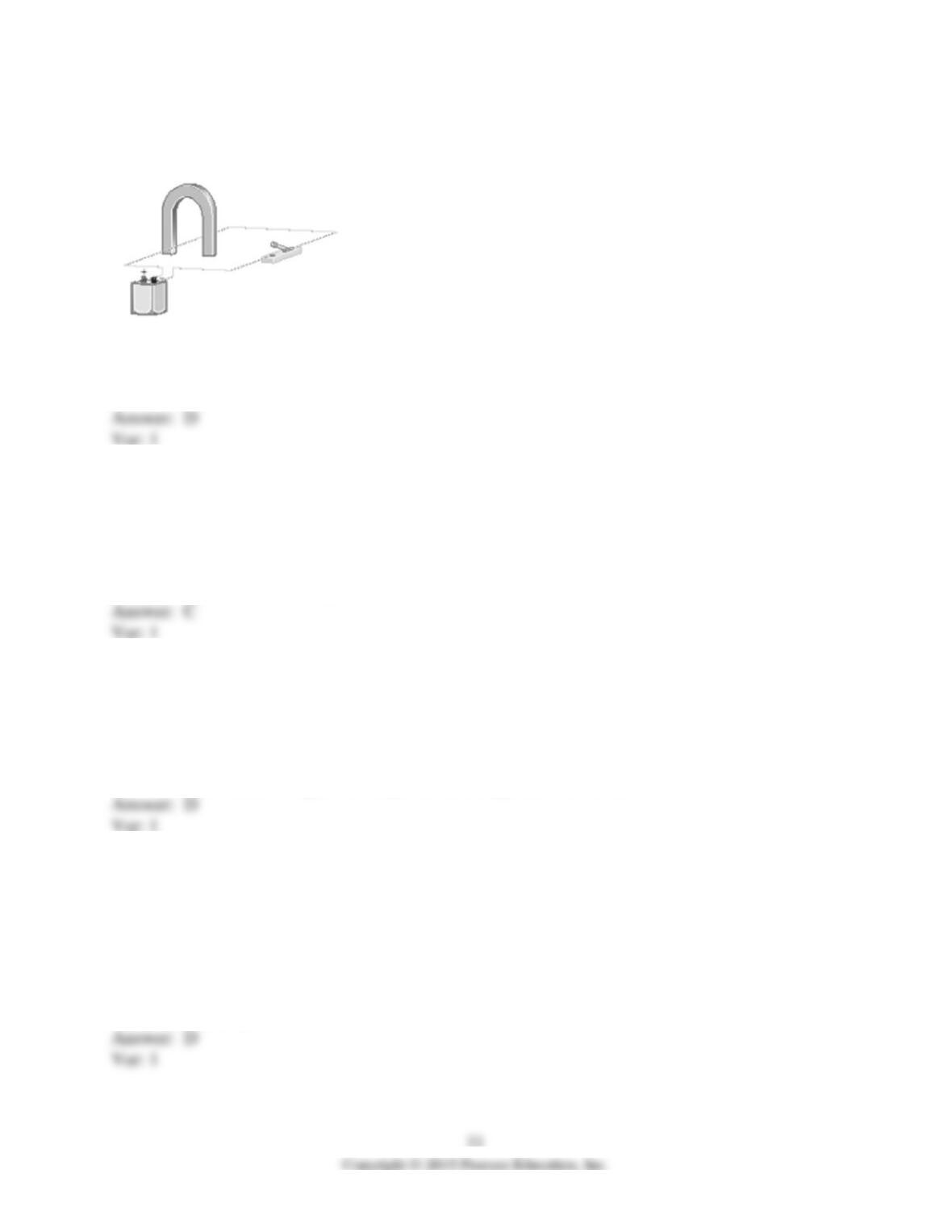
38) For the horseshoe magnet shown in the figure, the left end is a north magnetic pole and the
right end is a south magnetic pole. When the switch is closed in the circuit, which way will the
wire between the poles of the horseshoe magnet initially deflect?
A) to the right
B) to the left
C) upward
D) downward
39) The direction of the force on a current-carrying wire in a magnetic field is
A) perpendicular only to the current.
B) perpendicular only to the magnetic field.
C) perpendicular to both the current and the magnetic field.
D) in the direction opposite to the current.
E) in same direction as the current.
40) The magnetic force on a current-carrying wire in a magnetic field is the strongest when
A) the current is in the direction of the magnetic field lines.
B) the current is in the direction opposite to the magnetic field lines.
C) the current is at a 180° angle with respect to the magnetic field lines.
D) the current is perpendicular to the magnetic field lines.
E) the current is at a 0° angle with respect to the magnetic field lines.
41) A vertical wire carries a current straight up in a region where the magnetic field vector points
toward the north. What is the direction of the magnetic force on this wire?
A) downward
B) toward the north
C) toward the east
D) toward the west
E) upward
F) toward the south
42) Two long parallel wires are placed side-by-side on a horizontal table. If the wires carry
current in the same direction,
A) one wire is lifted slightly while the other wire is forced downward against the table’s surface.
B) both wires are lifted slightly.
C) the wires pull toward each other.
D) the wires push away from each other.
43) Two long parallel wires are placed side-by-side on a horizontal table. If the wires carry
current in opposite directions,
A) one wire is lifted slightly while the other wire is forced downward against the table’s surface.
B) both wires are lifted slightly.
C) the wires pull toward each other.
D) the wires push away from each other.
44) When two long parallel wires carry unequal currents, the magnitude of the magnetic force
that one wire exerts on the other is F. If the current in both wires is now doubled, what is the
magnitude of the new magnetic force on each wire?
A) 16F
B) 8F
C) 4F
D) 2F
E) F
45) Two long parallel wires are placed side-by-side on a horizontal table and carry current in the
same direction. The current in one wire is 20 A, and the current in the other wire is 5 A. If the
magnetic force on the 20-A wire has magnitude F, what is the magnitude of the magnetic force
on the 5-A wire? No external magnetic fields are present.
A) 4F
B) 2F
C) F
D) F/2
E) F/4
46) Two long, parallel wires carry currents of different magnitudes. If the current in one of the
wires is doubled and the current in the other wire is halved, what happens to the magnitude of the
magnetic force that each wire exerts on the other?
A) It is doubled.
B) It stays the same.
C) It is tripled.
D) It is quadrupled.
E) It is reduced by a factor of two.
47) Two long, parallel wires carry currents of different magnitudes. If the amount of current in
one of the wires is doubled, what happens to the magnitude of the force that each wire exerts on
the other?
A) It is increased by a factor of 8.
B) It is increased by a factor of 4.
C) It is increased by a factor of 3.
D) It is increased by a factor of 2.
E) It is increased by a factor of
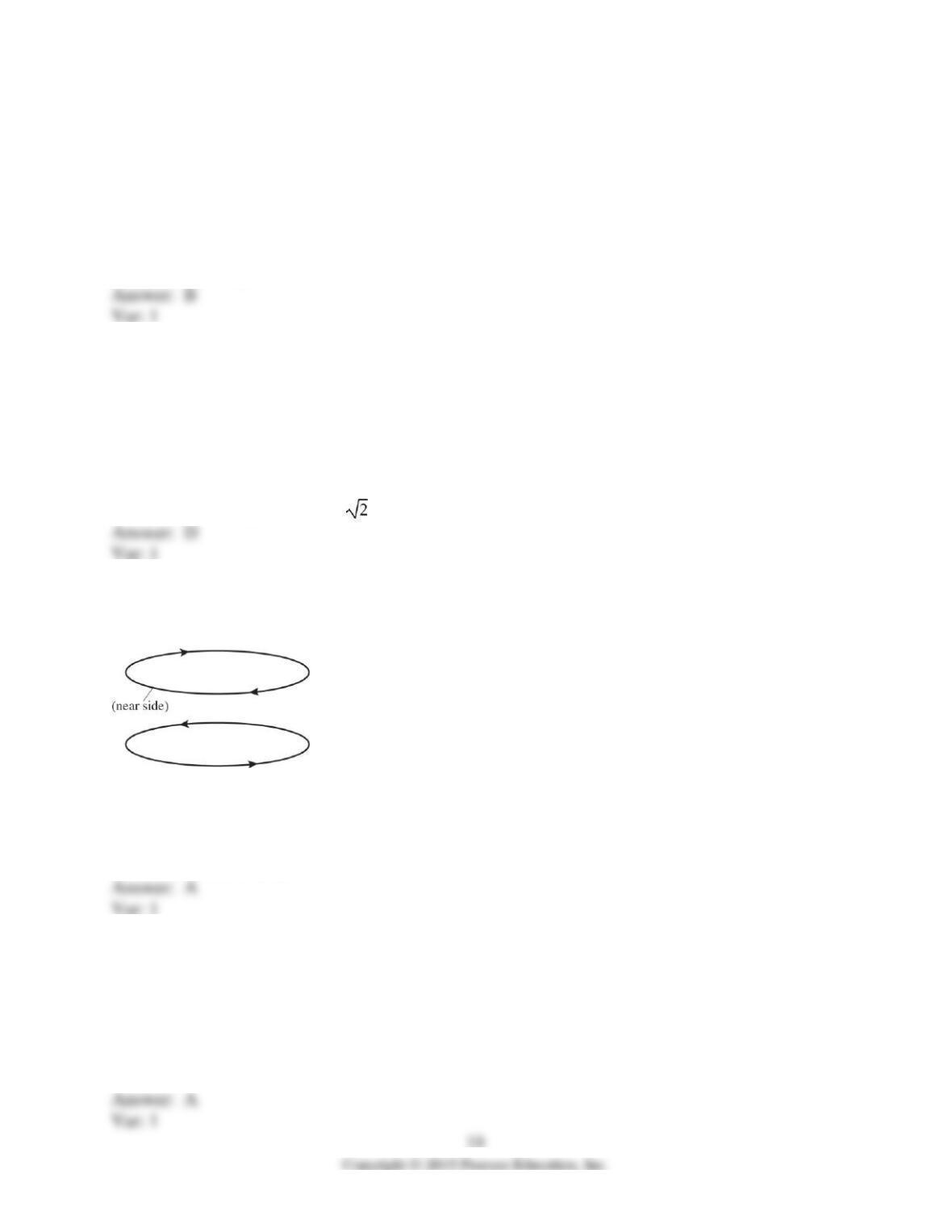
48) A ring with a clockwise current (as viewed from above the ring) is situated with its center
directly above another ring, which has a counter-clockwise current, as shown in the figure. In
what direction is the net magnetic force exerted on the top ring due to the bottom ring?
A) upward
B) downward
C) to the left
D) to the right
E) The net force is zero.
49) An object is hung using a metal spring. If now a current is passed through the spring, what
will happen to this system?
A) The spring will contract, raising the weight.
B) The spring will extend, lowering the weight.
C) The weight will not move.
D) The spring will begin to swing like a pendulum.
E) None of these are true.
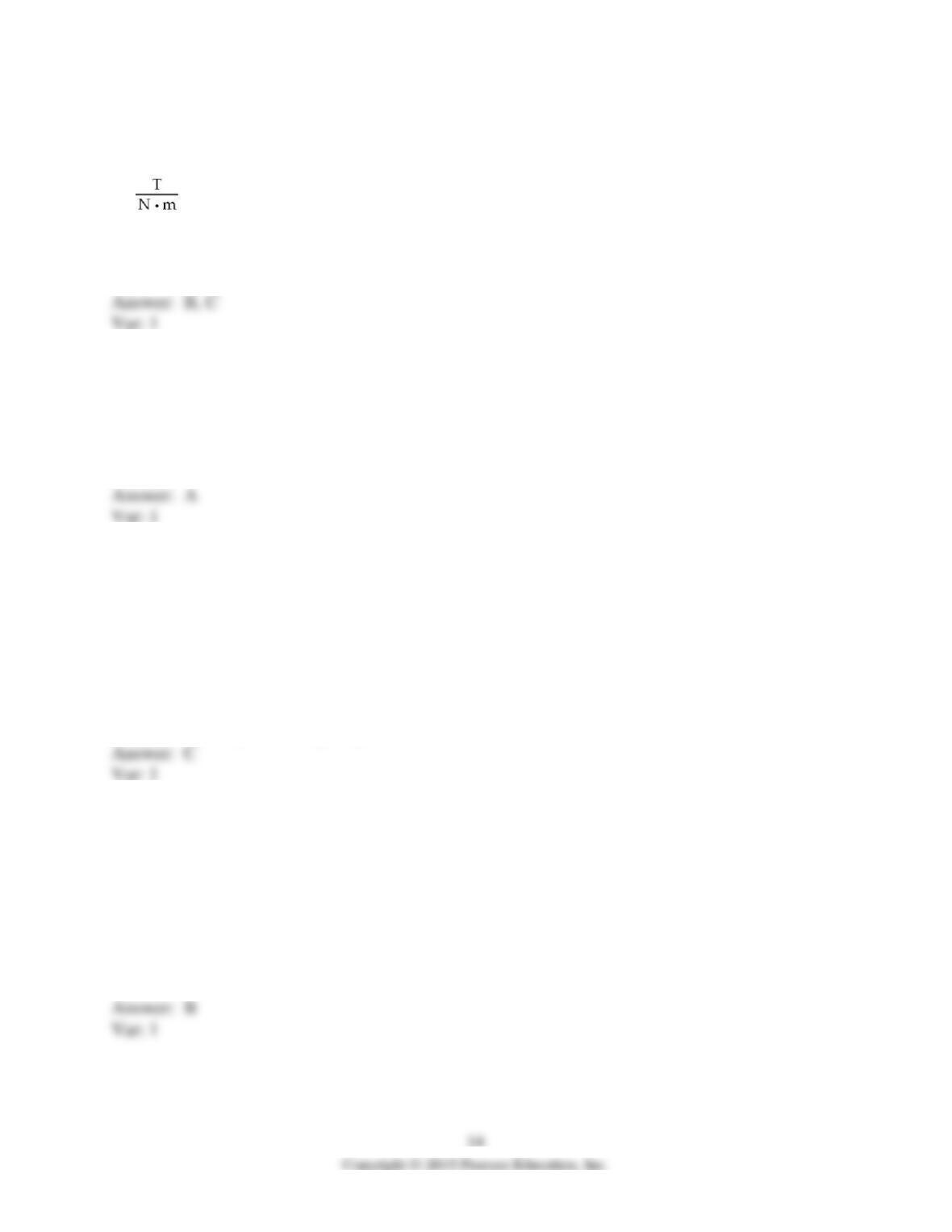
50) Which of the following are units for the magnetic moment? (There could be more than one
correct choice.)
A)
B) A ∙ m2
C) N ∙ m/T
D) T/m2
51) The maximum torque on a flat current-carrying loop occurs when the angle between the
plane of the loop’s area and the magnetic field vector is
A) 0°
B) 45°
C) 90°
D) 135°
52) A flat circular wire loop lies in a horizontal plane on a table and carries current in a
counterclockwise direction when viewed from above. At this point, the earth’s magnetic field
points to the north and dips below the horizontal. Which side of the coil tends to lift off of the
table due to the magnetic torque on the loop?
A) the north side
B) the east side
C) the south side
D) the west side
E) The entire loop lifts straight up.
53) Two long parallel wires placed side-by-side on a horizontal table carry identical size currents
in opposite directions. The wire on your right carries current directly toward you, and the wire
on your left carries current directly away from you. From your point of view, the magnetic field
at a point exactly midway between the two wires
A) points upward.
B) points downward.
C) points toward you.
D) points away from you.
E) is zero.
54) Two long parallel wires placed side-by-side on a horizontal table carry identical current
straight toward you. From your point of view, the magnetic field at a point exactly between the
two wires
A) points upward.
B) points downward.
C) points toward you.
D) points away from you.
E) is zero.
55) A long, straight, horizontal wire carries current toward the east. A proton moves toward the
east alongside and just south of the wire. What is the direction of the magnetic force on the
proton?
A) toward the north
B) toward the south
C) upward
D) downward
E) toward the east
56) A long, straight, horizontal wire carries current toward the east. An electron moves toward
the east alongside and just south of the wire. What is the direction of the magnetic force on the
electron?
A) toward the north
B) toward the south
C) upward
D) downward
E) toward the west
57) A wire lying in the plane of this page carries a current directly toward the top of the page.
What is the direction of the magnetic force this current produces on an electron that is moving
perpendicular to the page and outward from it on the left side of the wire?
A) perpendicular to the page and towards you
B) perpendicular to the page and away from you
C) toward the top of the page
D) toward the bottom of the page
E) The force is zero.
58) A long, straight wire carrying a current is placed along the y-axis. If the direction of the
current is in the +y direction, what is the direction of the magnetic field due to this wire as you
view it in such a way that the current is coming directly toward you?
A) clockwise, around the x-axis
B) counterclockwise, around the x-axis
C) counterclockwise, around the z-axis
D) counterclockwise, around the y-axis
E) clockwise, around the y-axis
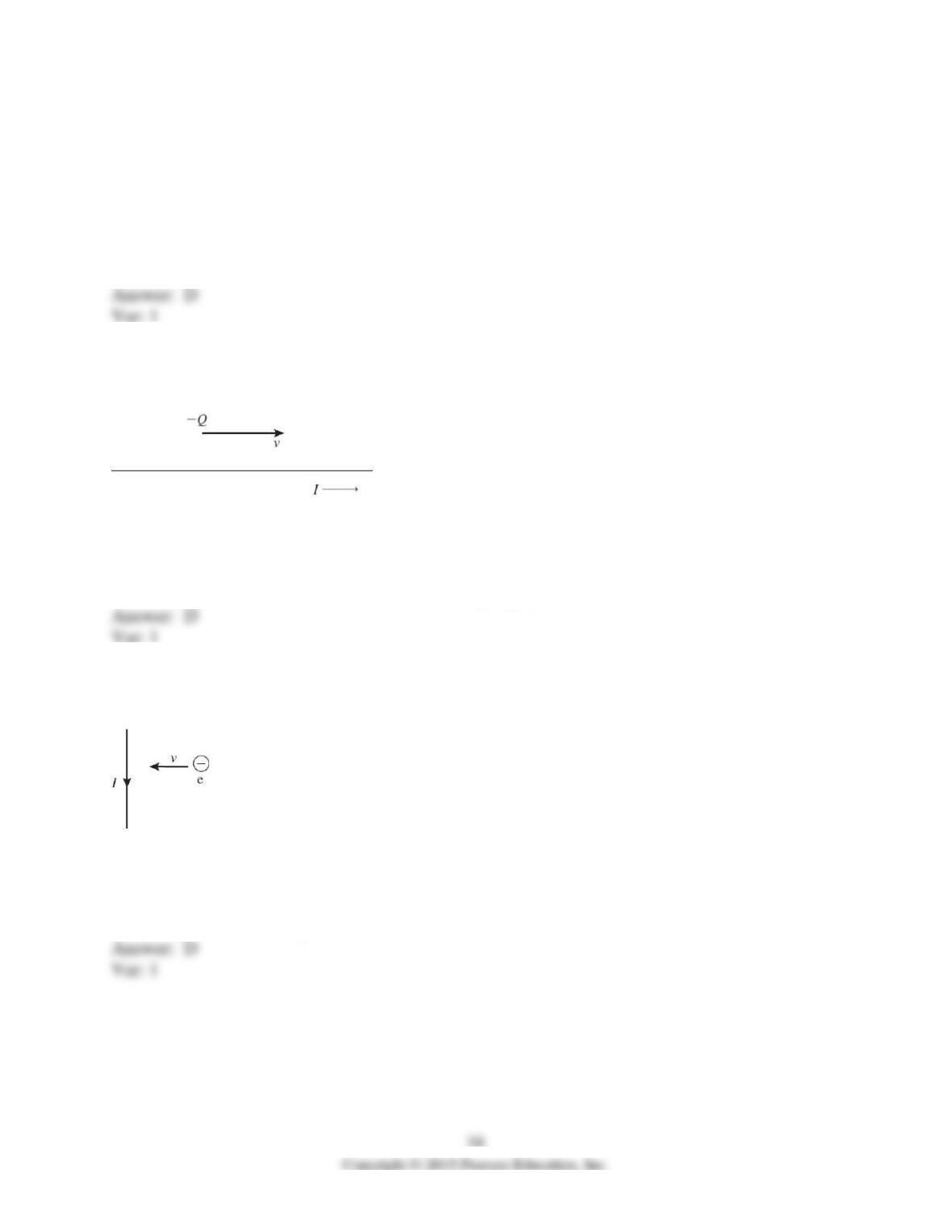
59) A negatively charged particle –Q is moving to the right, directly above a wire having a
current I flowing to the right, as shown in the figure. In what direction is the magnetic force
exerted on the particle due to the current?
A) into the page
B) out of the page
C) downward
D) upward
E) The magnetic force is zero because the velocity is parallel to the current.
60) A wire lying in the plane of the page carries a current toward the bottom of the page, as
shown in the figure. What is the direction of the magnetic force it produces on an electron that is
moving to the left directly toward the wire, as shown?
A) straight into the page
B) straight out of the page
C) directly toward the top of the page
D) directly toward the bottom of the page
E) directly to the left away from the wire
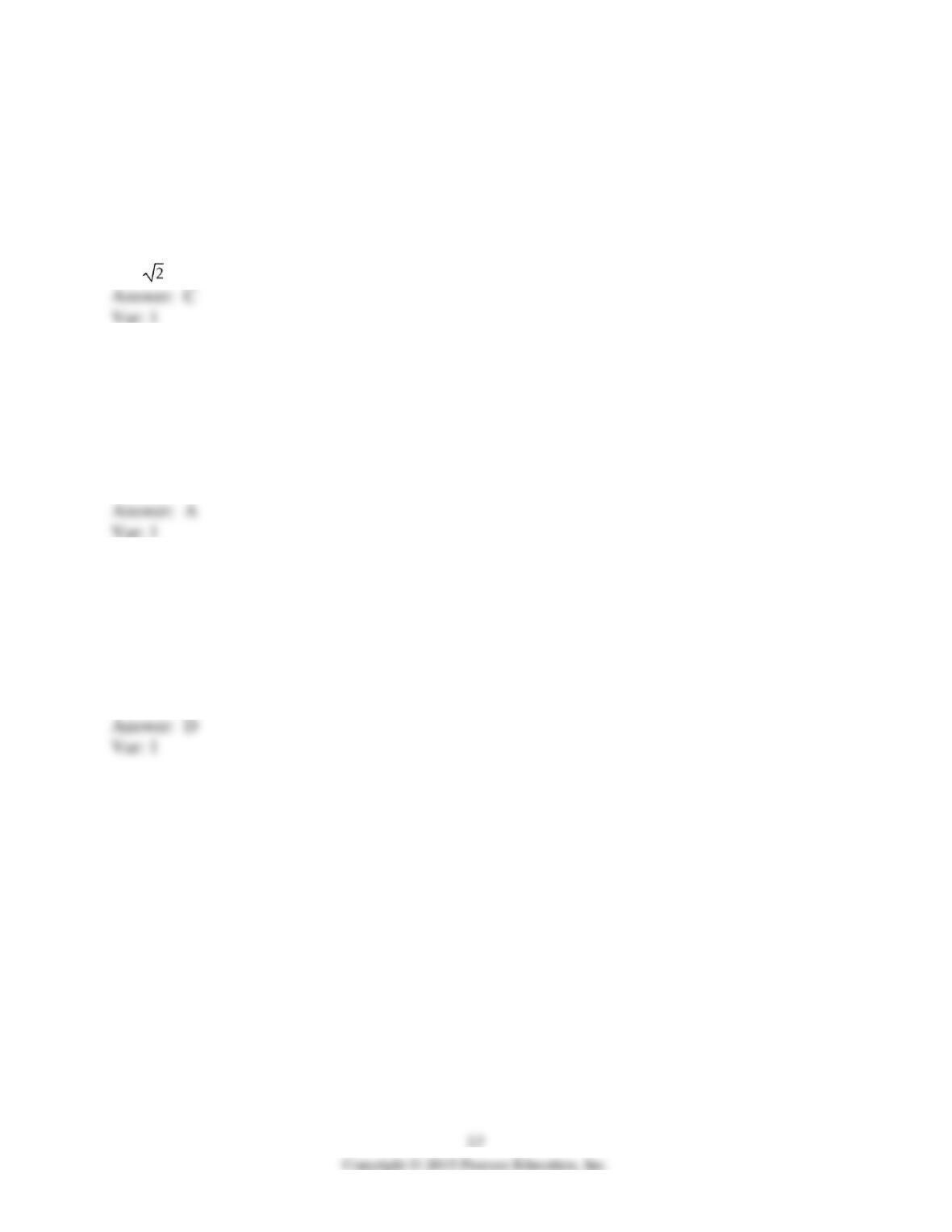
61) A very long straight current-carrying wire produces a magnetic field of 20 mT at a distance d
from the wire. To measure a field of 5 mT due to this wire, you would have to go to a distance
from the wire of
A) 16d.
B) 8d.
C) 4d.
D) 2d.
E) d
62) The magnetic field at a distance of 2 cm from a long straight current-carrying wire is 4 μT.
What is the magnetic field at a distance of 4 cm from this wire?
A) 2 μT
B) 4 μT
C) 6 μT
D) 8 μT
E) 10 μT
63) The magnetic field at a distance of 2 cm from a long straight current-carrying wire is 4 μT.
What is the magnetic field at a distance of 1 cm from this wire?
A) 2 μT
B) 4 μT
C) 6 μT
D) 8 μT
E) 10 μT
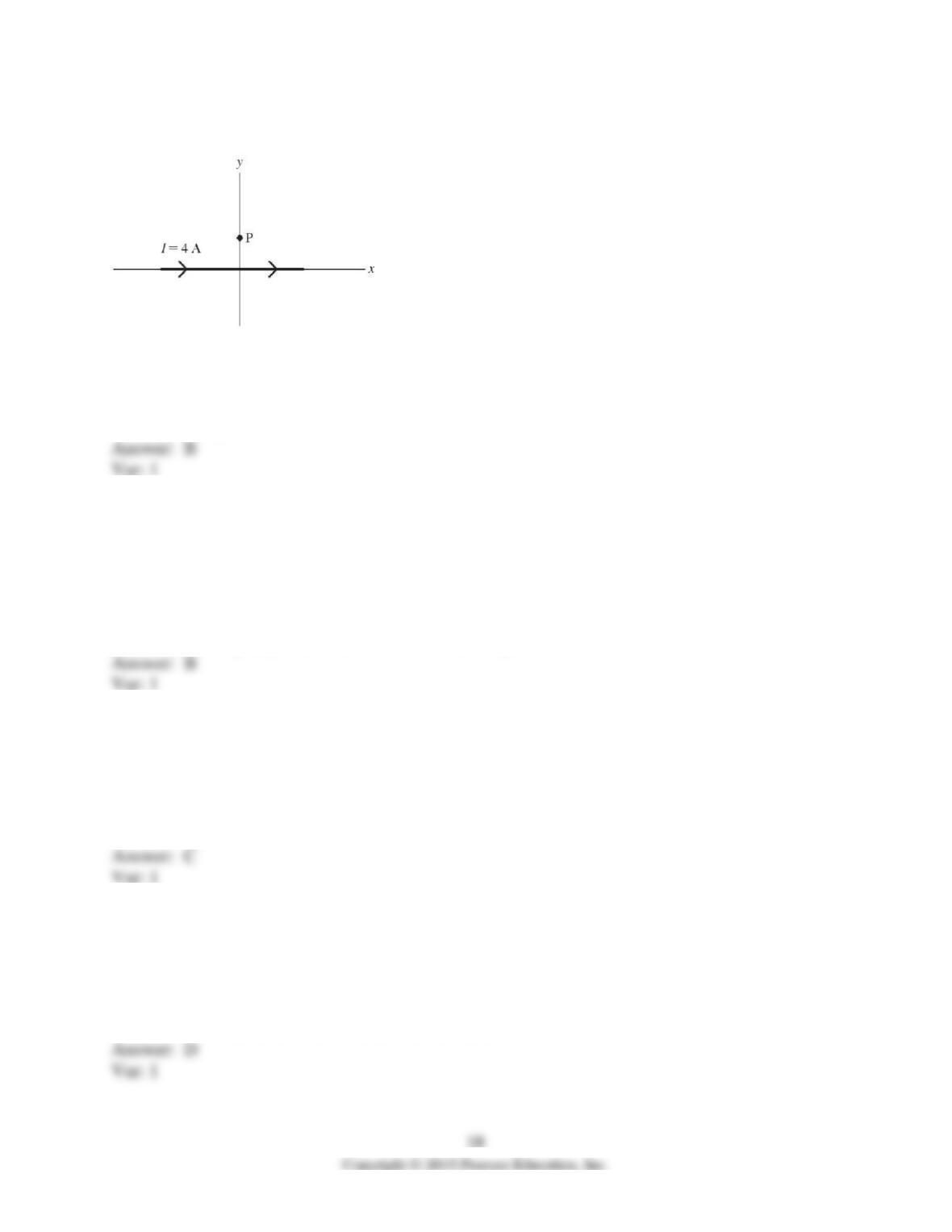
64) A long straight wire carrying a 4-A current is placed along the x-axis as shown in the figure.
What is the direction of the magnetic field at a point P due to this wire?
A) into the plane of the page
B) out of the plane of the page
C) along the –x-axis
D) along the +x-axis
E) along the +y-axis
65) Which one of the following statements is correct?
A) When a current-carrying wire is in your right hand, with your thumb in the direction of the
current, your fingers point opposite to the direction of the magnetic field lines.
B) When a current-carrying wire is in your right hand, with your thumb in the direction of the
current, your fingers point in the direction of the magnetic field lines.
C) When a current-carrying wire is in your left hand, with your thumb in the direction of the
current, your fingers point in the direction of the magnetic field lines.
66) A vertical wire carries a current vertically downward. To the east of this wire, the magnetic
field points
A) north.
B) east.
C) south.
D) down.
67) A horizontal wire carries a current straight toward you. From your point of view, the
magnetic field caused by this current
A) points directly away from you.
B) points to the left.
C) circles the wire in a clockwise direction.
D) circles the wire in a counter-clockwise direction.
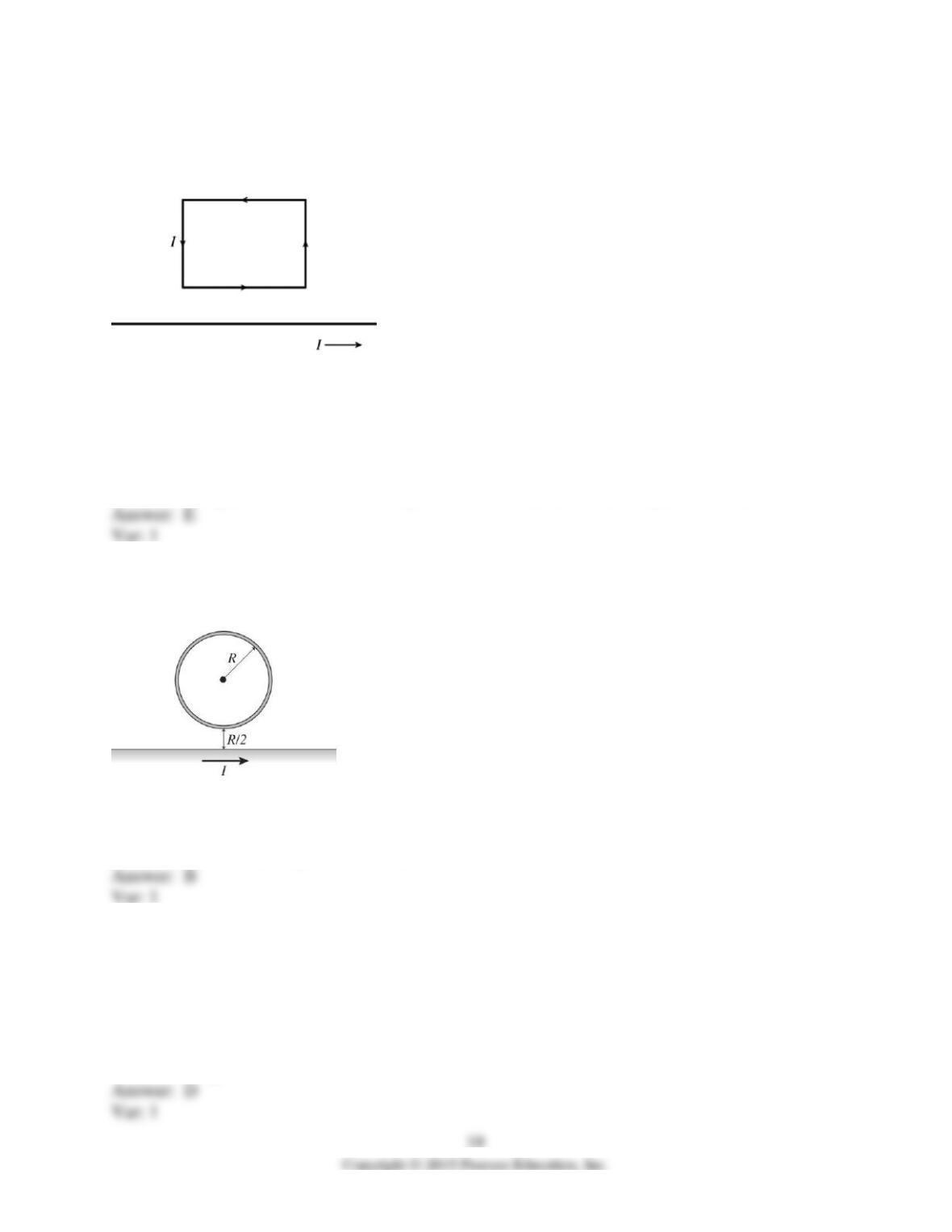
68) A long straight wire has a constant current flowing to the right. A rectangular metal loop is
situated above the wire, and also has a constant current flowing through it, as shown in the
figure. Which one of the following statements is true?
A) The net magnetic force on the rectangle is upward, and there is also a nonzero torque on the
rectangle.
B) The net magnetic force on the rectangle is zero, and the net torque on it is zero.
C) The net magnetic force on the rectangle is downward, and there is also a nonzero torque on
the rectangle.
D) The net magnetic force on the rectangle is zero, but there is a nonzero torque on the rectangle.
E) The net magnetic force on the rectangle is downward, and the net torque on it is zero.
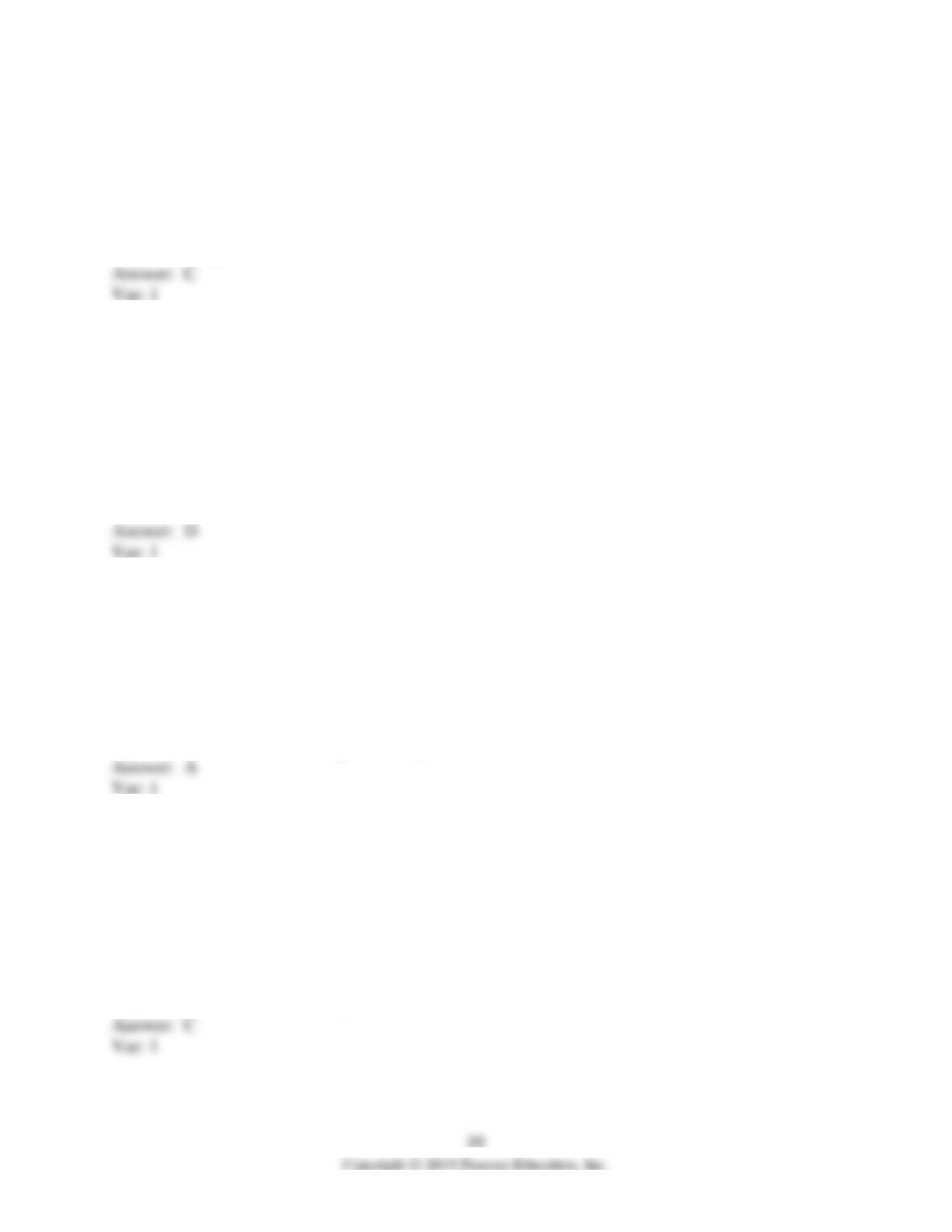
69) A single current-carrying circular loop of radius R is placed next to a long, straight wire, as
shown in the figure. The current I in the wire flows to the right. In which direction must current
flow in the loop to produce a net magnetic field of zero at its center?
A) counterclockwise
B) clockwise
C) It could be either clockwise or counterclockwise.
D) The current in the loop should be zero.
70) A current-carrying loop of wire lies flat on a horizontal tabletop. When viewed from above,
the current moves around the loop in a counterclockwise sense. For points on the tabletop
outside the loop, the magnetic field lines caused by this current
A) circle the loop in a clockwise direction.
B) circle the loop in a counterclockwise direction.
C) point straight up.
D) point straight down.
71) A current-carrying loop of wire lies flat on a horizontal tabletop. When viewed from above,
the current moves around the loop in a counterclockwise sense. For points on the tabletop inside
the loop, the magnetic field lines caused by this current
A) circle the loop in a clockwise direction.
B) circle the loop in a counterclockwise direction.
C) point straight up.
D) point straight down.
72) Consider two current-carrying circular loops. Both are made from one strand of wire and
both carry the same current, but one has twice the radius of the other. If the magnetic field
strength at the center of the smaller loop is B, what is the magnetic field strength at the center of
the larger loop?
A) 8B
B) 4B
C) 2B
D) B/2
E) B/4
73) Consider an ideal solenoid of length L, N windings, and radius b (L is much longer than b). A
current I is flowing through the wire windings. If the radius of the solenoid is doubled to 2b, but
all the other quantities remain the same, the magnetic field inside the solenoid will
A) remain the same.
B) become twice as strong as initially.
C) become one-half as strong as initially.
D) become four times as strong as initially.
E) become one-fourth as strong as initially.
74) Consider an ideal solenoid of length L, N windings, and radius b (L is much longer than b). A
current I is flowing through the wire windings. If the length of the solenoid becomes twice as
long (to 2L), but all other quantities remained the same, the magnetic field inside the solenoid
will
A) remain the same.
B) become twice as strong as initially.
C) become one-half as strong as initially.
D) become four times as strong as initially.
E) become one-fourth as strong as initially.