Exam
Name___________________________________
MULTIPLE CHOICE. Choose the one alternative that best completes the statement or answers the question.
1)
The molecule that serves as the major source of readily available fuel for neurons and blood cells is
________.
1)
A)
protein
B)
acetyl CoA
C)
glucose
D)
fat
2)
The most abundant dietary lipids are ________.
2)
A)
cholesterol
B)
fatty acids
C)
phospholipids
D)
triglycerides
3)
Which of the choices below is not a fate of carbohydrate taken into the body?
3)
A)
ATP production
B)
glycogenesis
C)
lipogenesis
D)
direct conversion to a nucleic acid
E)
amino acid synthesis
4)
Which hormone directs essentially all the events of the absorptive state?
4)
A)
epinephrine
B)
thyroid hormone
C)
insulin
D)
growth hormone
5)
When a person’s hypothalamic thermostat is set to a higher level and the actual body temperature
is below that level, the person may ________.
5)
A)
exhibit vasodilation of skin vessels
B)
pant
C)
perspire heavily
D)
shiver
6)
Which of the following is correct?
6)
A)
Each FADH2 yields about 1 1/2 ATP via oxidative phosphorylation.
B)
Most ATP from cellular respiration are produced directly in the Krebs cycle.
C)
Most of the ATP are produced by substrate–level phosphorylation.
D)
Glycolysis relies on substrate–level oxidation for the four ATP produced in this pathway.
7)
Which of the following does not occur in the mitochondria?
7)
A)
formation of malic acid from fumaric acid
B)
glycolysis
C)
Krebs cycle
D)
electron transport
8)
Which of the following is a normal consequence of the activation of the heat–promoting center?
8)
A)
vasodilation of cutaneous blood vessels
B)
sympathetic sweat gland activation
C)
increase in ADH production
D)
release of epinephrine
9)
The term basal metabolic rate reflects the ________.
9)
A)
energy the body needs to perform only its most essential activities
B)
energy needed to make all organic molecules
C)
loss of organic molecules in urine
D)
loss of energy to perspiration
10)
Which of the choices below is not a source of glucose during the postabsorptive state?
10)
A)
absorption of glucose from the GI tract
B)
lipolysis in adipose tissues and the liver
C)
catabolism of cellular protein
D)
glycogenolysis in the liver
11)
Which of the following is the major role of leptin in the body?
11)
A)
decrease appetite and food intake
B)
protect against weight loss during nutritional deprivation
C)
promote weight loss with activity
D)
shrink fat stores
B
12)
Which of the following best defines negative nitrogen balance?
12)
A)
Protein breakdown exceeds protein synthesis.
B)
A negative nitrogen balance is normal and is a way of maintaining homeostasis.
C)
It is a condition usually caused by having a diet low in fish and meat.
D)
It occurs when amino acids are broken down by liver enzymes and carried to the
bloodstream.
A
13)
Transamination is the process whereby the amine group of an amino acid is ________.
13)
A)
converted to ammonia
B)
transferred to acetyl CoA
C)
converted to urea
D)
transferred to a keto acid
D
14)
Oxidative deamination takes place in the ________.
14)
A)
liver
B)
brain
C)
muscles
D)
blood
A
A
15)
What process primes a molecule to change in a way that increases its activity, produces motion, or
does work?
15)
A)
beta oxidation
B)
phosphorylation
C)
glycolysis
D)
cellular respiration
16)
Prostaglandins play a role in ________.
16)
A)
control of blood volume
B)
noninflammatory responses
C)
skeletal muscle contraction
D)
control of blood pressure
17)
The process of breaking triglycerides down into glycerol and fatty acids is known as ________.
17)
A)
lipolysis
B)
lipogenesis
C)
gluconeogenesis
D)
fat utilization
18)
Oxidation reduction reactions ________.
18)
A)
occur via the gain of hydrogen or the loss of oxygen
B)
are rarely coupled together
C)
may involve the loss of hydrogen and electrons
D)
utilize hydrogenases
19)
Select the correct statement about proteins.
19)
A)
Proteins will be used by most cells for ATP synthesis if insufficient carbohydrates are
ingested.
B)
Strict vegetarians need not worry about adequate protein intake, as most vegetables are
almost perfect sources of amino acids.
C)
Proteins can be synthesized in the body if most of the amino acids are present.
D)
Catabolic steroids (hormones) accelerate the rate of protein synthesis.
20)
Heat–loss mechanisms do not include ________.
20)
A)
vasoconstriction of peripheral blood vessels
B)
behavior measures such as wearing light, loose clothing
C)
the evaporation of sweat
D)
reducing activity
21)
Cholesterol, though it is not an energy molecule, has importance in the body because it ________.
21)
A)
helps mobilize fats during periods of starvation
B)
enters the glycolytic pathway without being altered
C)
helps provide essential nutrients to the brain and lungs
D)
is a stabilizing component of the plasma membranes and is the parent molecule of steroid
hormones
22)
Which of the following food groups are considered good sources of complete proteins?
22)
A)
egg yolk, fish roe, and grains
B)
corn, cottonseed oil, soy oil, and wheat germ
C)
lima beans, kidney beans, nuts, and cereals
D)
eggs, milk, yogurt, meat, and fish
23)
Which food type is considered to be the most important for athletes to eat to improve performance?
23)
A)
animal proteins
B)
complex carbohydrates
C)
plant proteins
D)
simple sugars
24)
Which of the choices below is not a mechanism of heat production?
24)
A)
sweating
B)
shivering
C)
enhanced thyroxine release
D)
vasoconstriction of cutaneous blood vessels
25)
In the liver, the amine group of glutamic acid is removed as ________ in the oxidative state.
25)
A)
oxaloacetic acid
B)
glyceraldehyde
C)
pyruvic acid
D)
ammonia
D
Explanation:
26)
When ketone bodies are present in the blood and urine in large amounts, it usually indicates
increased metabolism of ________.
26)
A)
glycogen
B)
amino acids
C)
fatty acids
D)
lactic acid
C
Explanation:
27)
Catabolism would be best described as a process that ________.
27)
A)
builds up triglycerides during the postabsorptive state
B)
breaks down complex structures to simpler ones
C)
elevates glucagon levels
D)
causes a decline in circulating ketone bodies
B
Explanation:
28)
The primary reason elderly people should decrease their caloric intake is that ________.
28)
A)
their appetite begins to diminish
B)
they have a higher metabolic rate and do not need large amounts of food
C)
muscle mass and metabolism decline with age
D)
they spend most of the day at rest, and their food will quickly turn to fat
C
Explanation:
A
Explanation:
29)
Conditions that promote the oxidative deamination and energy use of amino acids include
________.
29)
A)
adequate fat calories to provide adequate ATP formation
B)
ammonia combining with oxygen to form urea
C)
adequate essential amino acids
D)
excessive amounts of protein in the diet
30)
In gluconeogenesis, during the postabsorptive state, amino acids and ________ are converted to
glucose.
30)
A)
glycogen
B)
acetyl Co A
C)
glycerol
D)
glucagon
31)
Which of the following mechanisms produces the most ATP during cellular respiration?
31)
A)
lactic acid production
B)
oxidative phosphorylation
C)
oxidation reactions
D)
substrate–level phosphorylation
32)
Which of the choices below describes the pathway of cellular respiration (the complete oxidation of
glucose)?
32)
A)
lipolysis, glycogenolysis, beta oxidation
B)
glycolysis, Krebs cycle, electron transport chain, oxidative phosphorylation
C)
gluconeogenesis, Krebs cycle, lipolysis
D)
glycogenesis, lipogenesis, electron transport chain
33)
Many factors influence BMR. What is the most critical factor?
33)
A)
the ratio of surface area to volume (weight) of the body
B)
an individual’s body weight
C)
the way an individual metabolizes fat
D)
the way skeletal muscles break down glycogen
34)
Gluconeogenesis is the process in which ________.
34)
A)
glucose is formed from noncarbohydrate precursors
B)
glycogen is broken down to release glucose
C)
glucose is converted into carbon dioxide and water
D)
glycogen is formed
Explanation:
35)
Which of the following is not an important function of the liver?
35)
A)
synthesis of vitamin K
B)
protein metabolism
C)
carbohydrate and lipid metabolism
D)
synthesis of bile salts
Explanation:
36)
As the body progresses from the absorptive to the postabsorptive state, only the ________ continues
to burn glucose while every other organ in the body mostly switches to fatty acids.
36)
A)
pancreas
B)
liver
C)
spleen
D)
brain
Explanation:
37)
Glucose can be obtained from ________.
37)
A)
glycogenolysis
B)
lipogenesis
C)
protein anabolism
D)
triglyceride anabolism
Explanation:
Explanation:
38)
Which of the following nutrients yield the highest amount of energy per gram when metabolized?
38)
A)
proteins
B)
fats
C)
vitamins and minerals
D)
foods and beverages high in caffeine
39)
Anabolism includes reactions in which ________.
39)
A)
ketone bodies are formed
B)
structural proteins are used as a potential energy source
C)
larger molecules or structures are built from smaller ones
D)
carbohydrate utilization increases
40)
Lipogenesis occurs when ________.
40)
A)
cellular ATP and glucose levels are high
B)
glucose levels drop slightly
C)
there is a shortage of fatty acids
D)
excess proteins are transported through the cell membrane
41)
The amount of ________ produced is probably the most important hormonal factor in determining
BMR.
41)
A)
ADH
B)
thyroxine
C)
norepinephrine
D)
prolactin
42)
Which of the following statements is a false or incorrect statement?
42)
A)
Fats and carbohydrates are oxidized directly to produce cellular energy.
B)
Amino acids can be used to supply energy only after being converted to a carbohydrate
intermediate.
C)
Excess carbohydrate and fat can be stored as such, whereas excess amino acids are oxidized
for energy or converted to fat or glycogen for storage.
D)
The amino acid pool is the body’s total supply of amino acids in the body’s proteins.
43)
The primary function of cellular respiration is to ________.
43)
A)
break down food molecules and generate ATP
B)
provide the body with adequate amounts of vitamins and minerals
C)
efficiently monitor the energy needs of the body
D)
determine the amount of heat needed by the human body
44)
What is the outcome of ketosis?
44)
A)
glucogenesis
B)
metabolic acidosis
C)
metabolic alkalosis
D)
water retention and edema
E)
glycogen buildup
45)
Which of the following is not true of beta oxidation?
45)
A)
It occurs in the mitochondrion.
B)
Every second carbon is reduced.
C)
Fatty acids are broken into acetic acid fragments.
D)
It involves the anabolism of fats.
46)
The ingestion of which nutrient type results in the greatest food–induced thermogenesis?
46)
A)
proteins
B)
carbohydrates
C)
lipids
D)
vitamins
47)
Which of the following is not a function of LDLs?
47)
A)
regulate cholesterol synthesis in tissue cells
B)
transport cholesterol from the peripheral tissues to the liver
C)
make cholesterol available to tissue cells for membrane or hormone synthesis
D)
assist in the storage of cholesterol when supply exceeds demand
B
48)
Minerals required by the body in moderate amounts include all but which of the following?
48)
A)
sodium and chlorine
B)
iron and selenium
C)
sulfur and potassium
D)
calcium and phosphorus
B
49)
The term metabolism is best defined as ________.
49)
A)
the length of time it takes to digest and absorb fats
B)
the sum of biochemical reactions involved in building breaking down molecules
C)
a measure of carbohydrate utilization, typically involving measurement of calories
D)
the number of calories it takes to keep from shivering on a cold day
B
50)
When proteins undergo deamination, the waste substance found in the urine is mostly ________.
50)
A)
ketone bodies
B)
ammonia
C)
acetyl CoA
D)
urea
D
A
51)
Glycolysis is best defined as a catabolic reaction based upon the ________.
51)
A)
conversion of glucose into carbon dioxide and water
B)
conversion of pyruvic acid into carbon dioxide and water
C)
formation of sugar
D)
conversion of glucose into two molecules of pyruvic acid
52)
It is important to ensure that your diet is adequately rich in vitamins because ________.
52)
A)
vitamins provide protection against the common cold
B)
all vitamins are water soluble and pass out of the body too quickly to ensure utilization
C)
most vitamins are coenzymes needed to help the body utilize essential nutrients
D)
very few foods contain vitamins
C
53)
Which of the following statements best describes complete protein?
53)
A)
derived only from legumes and other plant material
B)
must contain all the body’s amino acid requirements for maintenance and growth
C)
derived from meat and fish only
D)
meets all the minimum daily requirements for a healthy diet
B
54)
Which of the choices below is not a major route of heat exchange?
54)
A)
evaporation
B)
radiation
C)
conduction/convection
D)
shivering
D
D
55)
In the case of a person who consumes a normal, balanced diet, proteins are essential to the body for
all of the following except ________.
55)
A)
formation of functional molecules like hemoglobin and cytochromes
B)
production of energy
C)
production of some hormones
D)
production of enzymes, clotting factors, and antibodies
56)
Glycogen is formed in the liver during the ________.
56)
A)
absorptive state
B)
starvation period
C)
postabsorptive state
D)
period when the metabolic rate is lowest
57)
Which of the choices below happens during the absorptive state?
57)
A)
Only glucose metabolism occurs.
B)
Catabolic processes exceed anabolic ones.
C)
No metabolism occurs.
D)
Anabolic processes exceed catabolic ones.
SHORT ANSWER. Write the word or phrase that best completes each statement or answers the question.
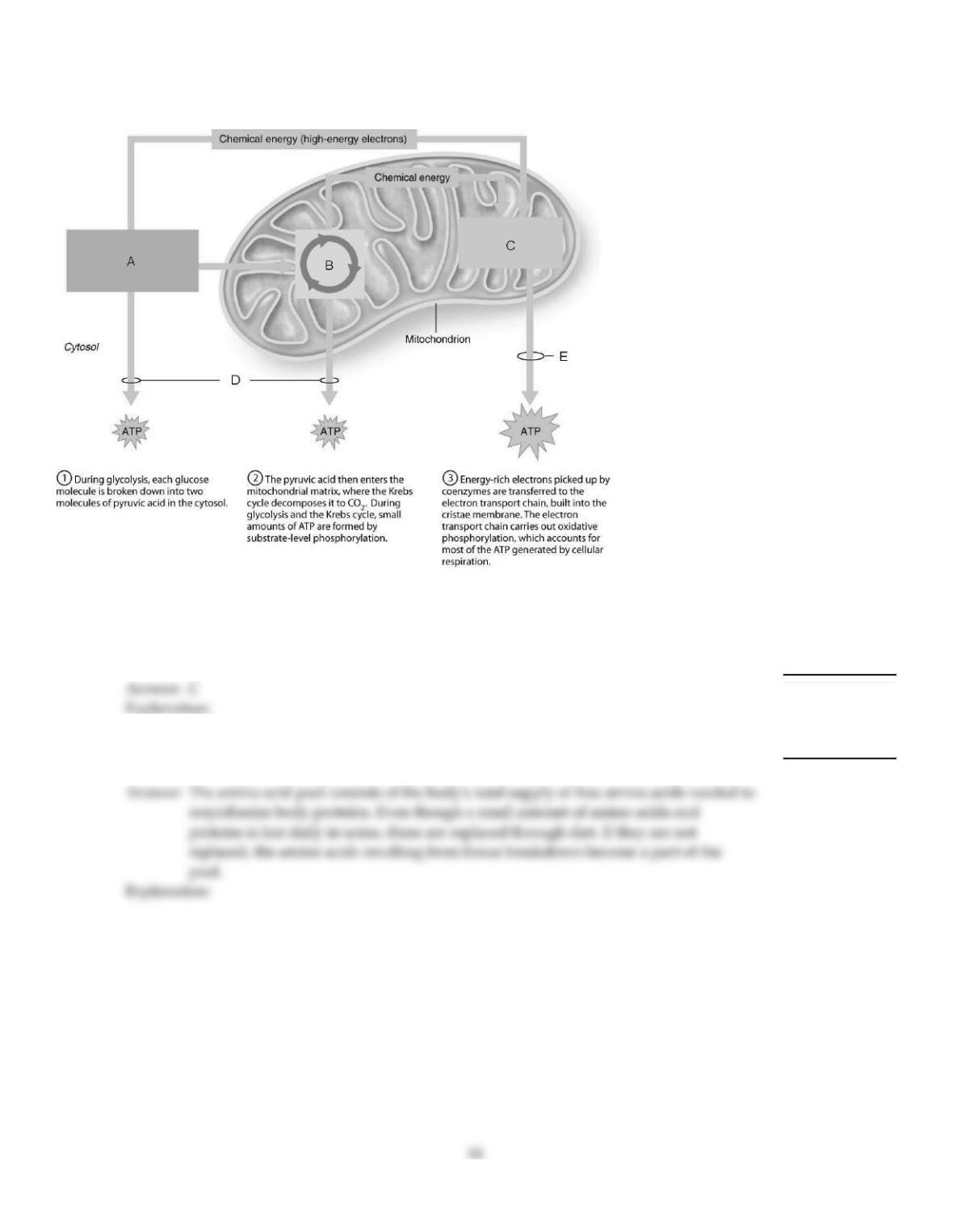
Figure 24.1
Using Figure 24.1, match the following:
58)
Contains ATP synthases, small rotary motors.
58)
59)
Define amino acid pool and explain how the pool is maintained even though we excrete
amino acids daily.
59)
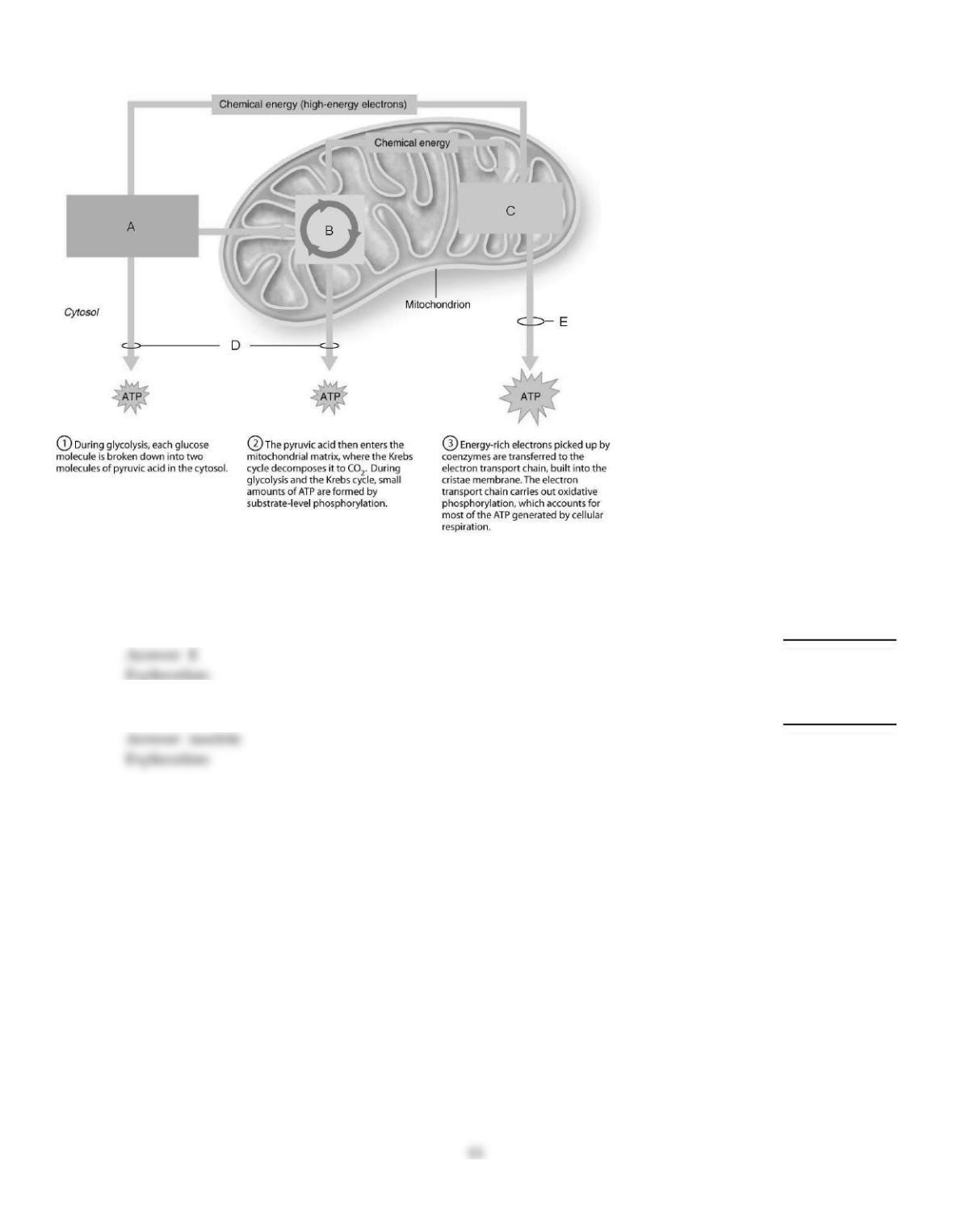
Figure 24.1
Using Figure 24.1, match the following:
60)
ATP formed by oxidative phosphorylation.
60)
61)
In the Krebs cycle, citric acid is followed by ________ acid.
61)