Exam
Name___________________________________
MULTIPLE CHOICE. Choose the one alternative that best completes the statement or answers the question.
1)
Which of the following is NOT a necessary condition for price discrimination?
1)
A)
downward sloping demand curve
B)
having a constant marginal cost
C)
preventing resale of the product
D)
separating markets for the good
2)
Which of the following is a TRUE statement about a monopoly?
2)
A)
As long as there are barriers to entry, a monopoly can always find some price–output
combination that generates positive economic profits.
B)
A monopoly does not necessarily earn positive economic profits.
C)
A monopoly must earn an above–normal profit to stay in business.
D)
As long as the demand curve slopes down, a monopoly can always find some price–output
combination that generates positive economic profits.
3)
The demand curve faced by a pure monopolist
3)
A)
is the same as its marginal revenue curve.
B)
is perfectly inelastic.
C)
is the market demand curve.
D)
lies below the marginal revenue curve.
4)
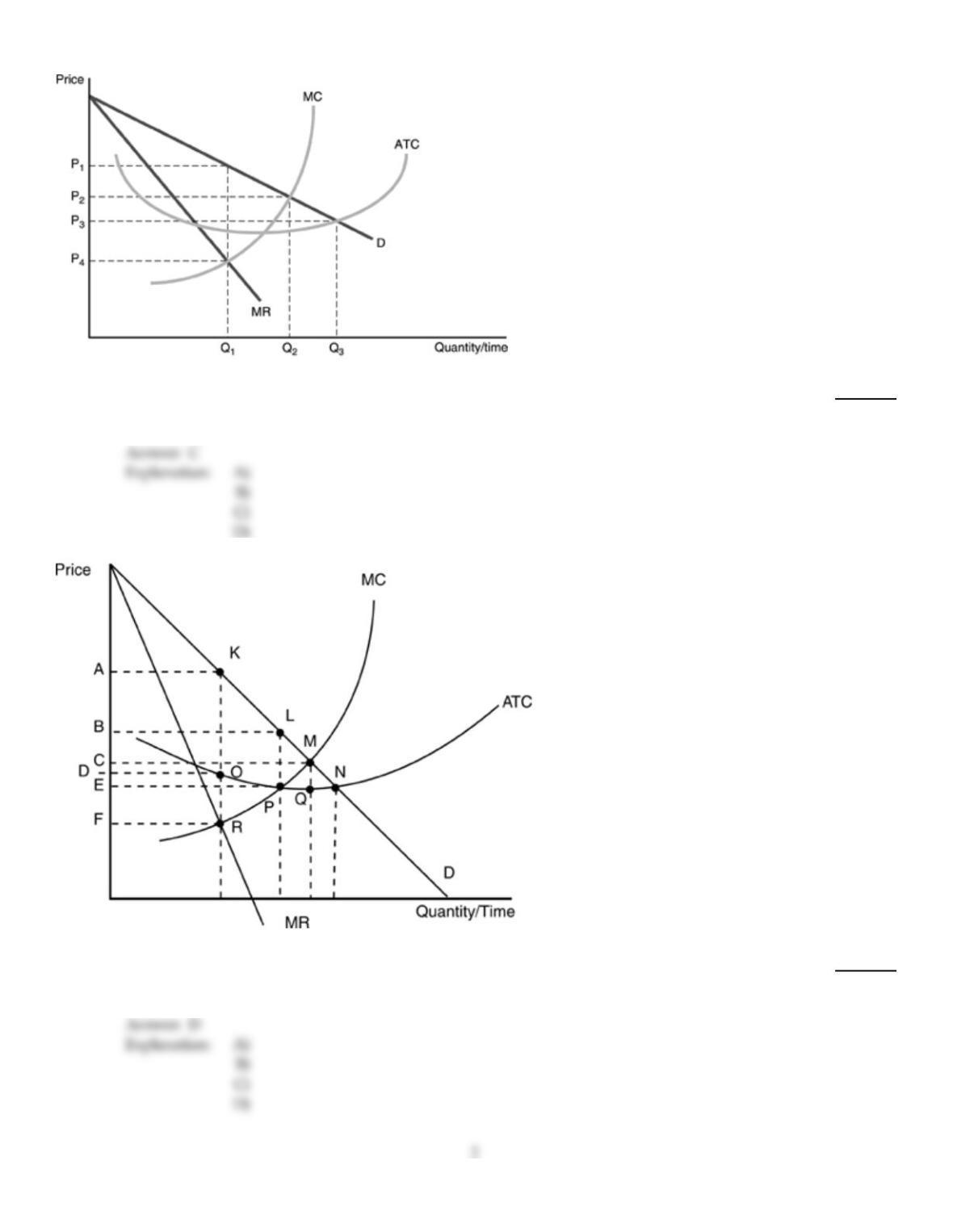
Refer to the above figure. Profits for this firm are
4)
A)
zero.
B)
negative.
C)
positive.
D)
undetermined without more information.
5)
According to the above figure, the profit–maximizing output for this monopolist is found directly
below the letter
5)
A)
M.
B)
N.
C)
P.
D)
R.
6)
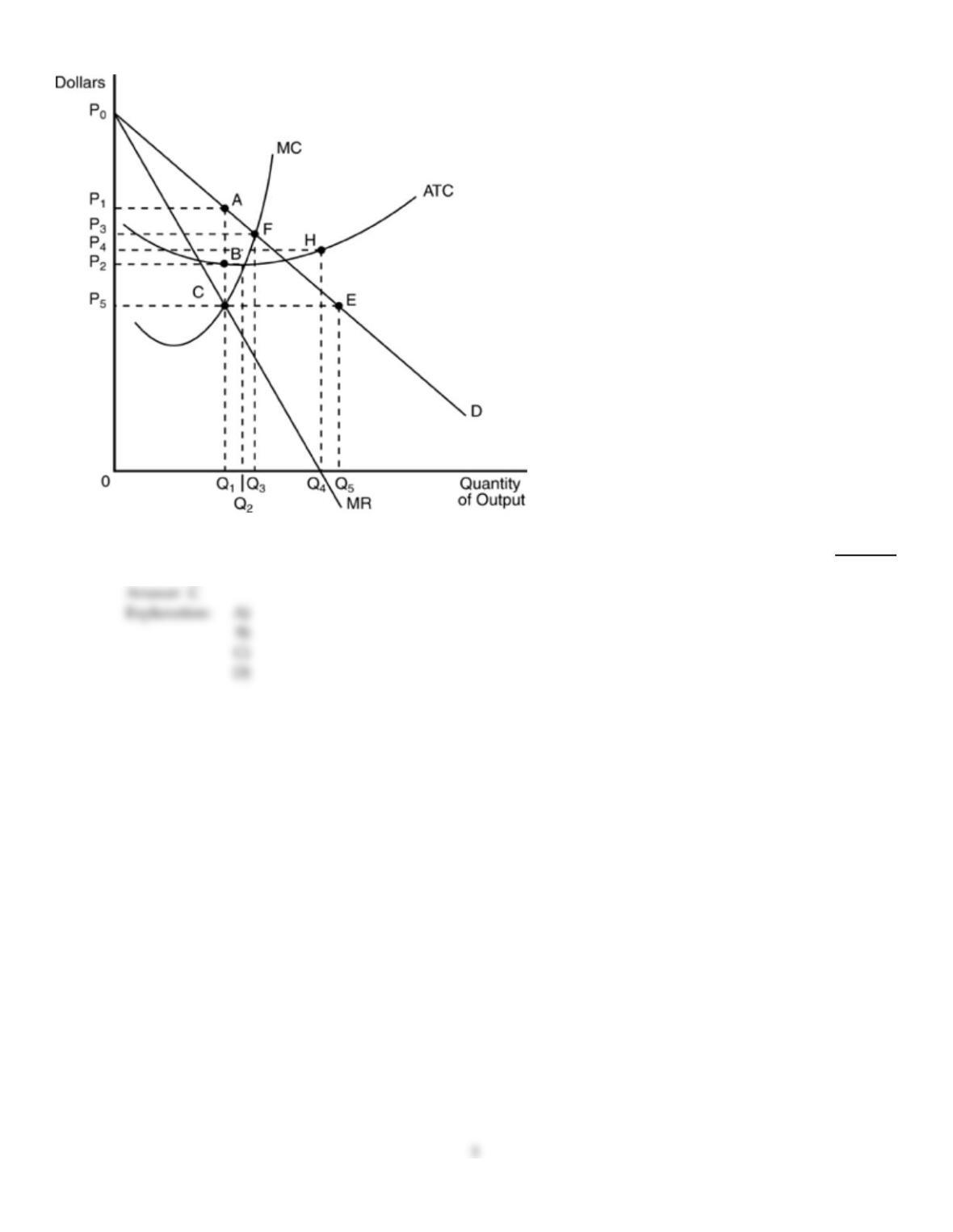
In the above figure, at the firm’s profit maximizing output, total revenue is rectangle
6)
A)
0P3FQ3.
B)
0P2BQ1.
C)
0P1AQ1.
D)
0P5EQ5.
7)
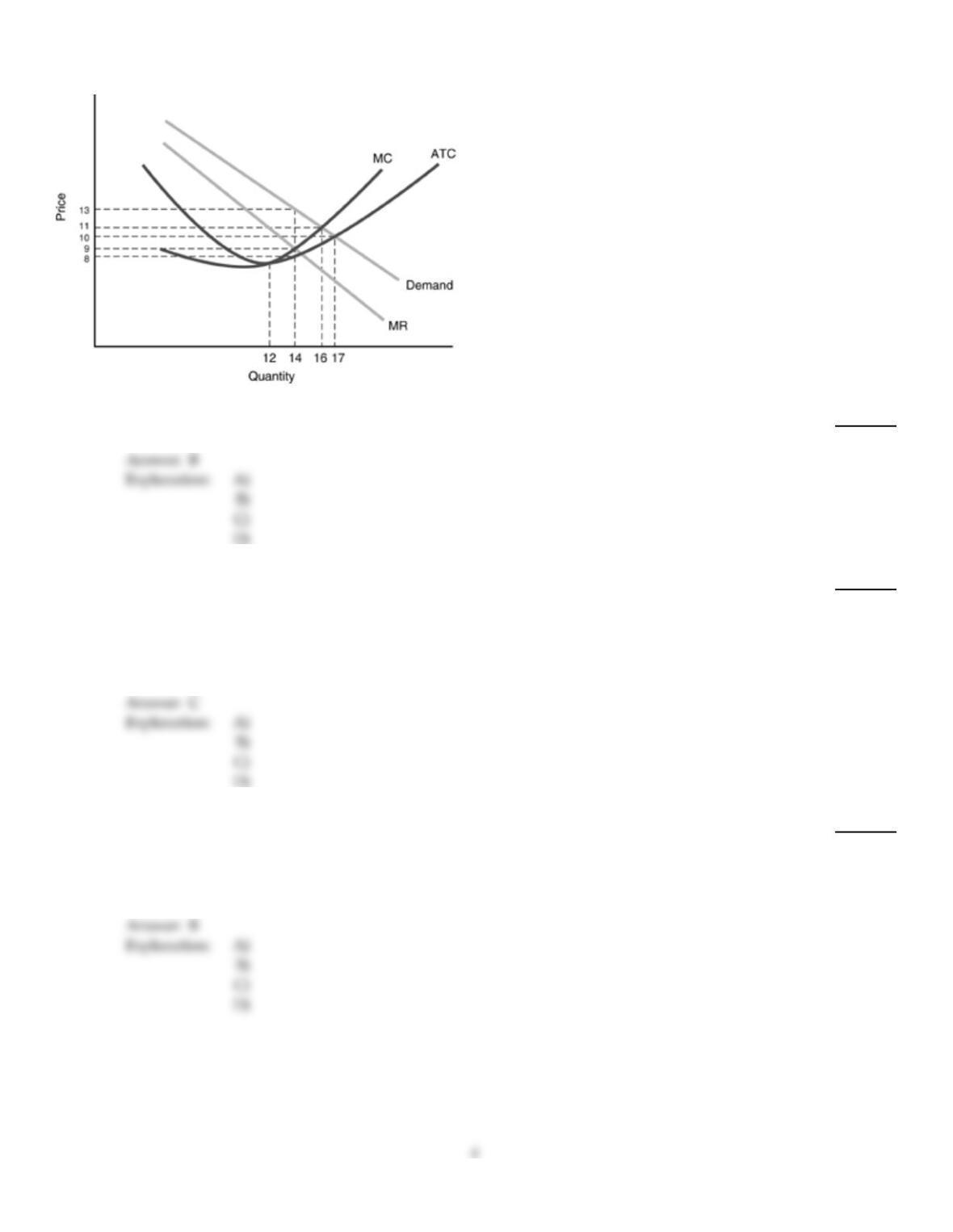
In the above figure, what is total revenue at the profit–maximizing point?
7)
A)
$126
B)
$182
C)
$176
D)
$170
8)
For a perfectly competitive market in which firms face an identical constant marginal costs, the
amount of consumer surplus increases if
8)
A)
market demand decreases.
B)
marginal cost increases.
C)
market demand increases.
D)
none of the above: insufficient information to answer.
9)
Which of the following regarding a monopolist is INCORRECT?
9)
A)
The monopolist is a single supplier of a good or service.
B)
Only expensive products are produced by monopolies.
C)
There are barriers to entry that allow monopoly.
D)
The monopolist constitutes the entire industry.
10)
If the price elasticity of demand for U.S. automobiles is higher in Europe than it is in the United
States, and transport costs are zero, a price–discriminating monopolist would charge
10)
A)
a higher price for autos in the United States than in Europe.
B)
the same price for autos in the United States as in Europe.
C)
a less profitable price for autos in the United States than in Europe.
D)
a lower price for autos in the United States than in Europe.
11)
If Japanese producers sell computer chips at a higher price in the United States than in Japan, and if
there is no cost difference in producing or transporting the chips, the Japanese producers would be
practicing
11)
A)
cartel pricing.
B)
price sampling.
C)
price discrimination.
D)
simple monopoly behavior.
12)
The use of a tariff provides monopoly protection since
12)
A)
it expands tax credits.
B)
it reduces exporters‘ profits.
C)
it reduces competition from imports by raising the import price.
D)
it allows more imports into the country.
13)
A monopolist finds the output (Q*) rate that maximizes profit. It finds the price by
13)
A)
taking the height of the demand curve at output rate Q*.
B)
setting price equal to marginal cost.
C)
taking the height of the marginal revenue curve at output rate Q*.
D)
taking the height of the marginal cost curve at output rate Q*.
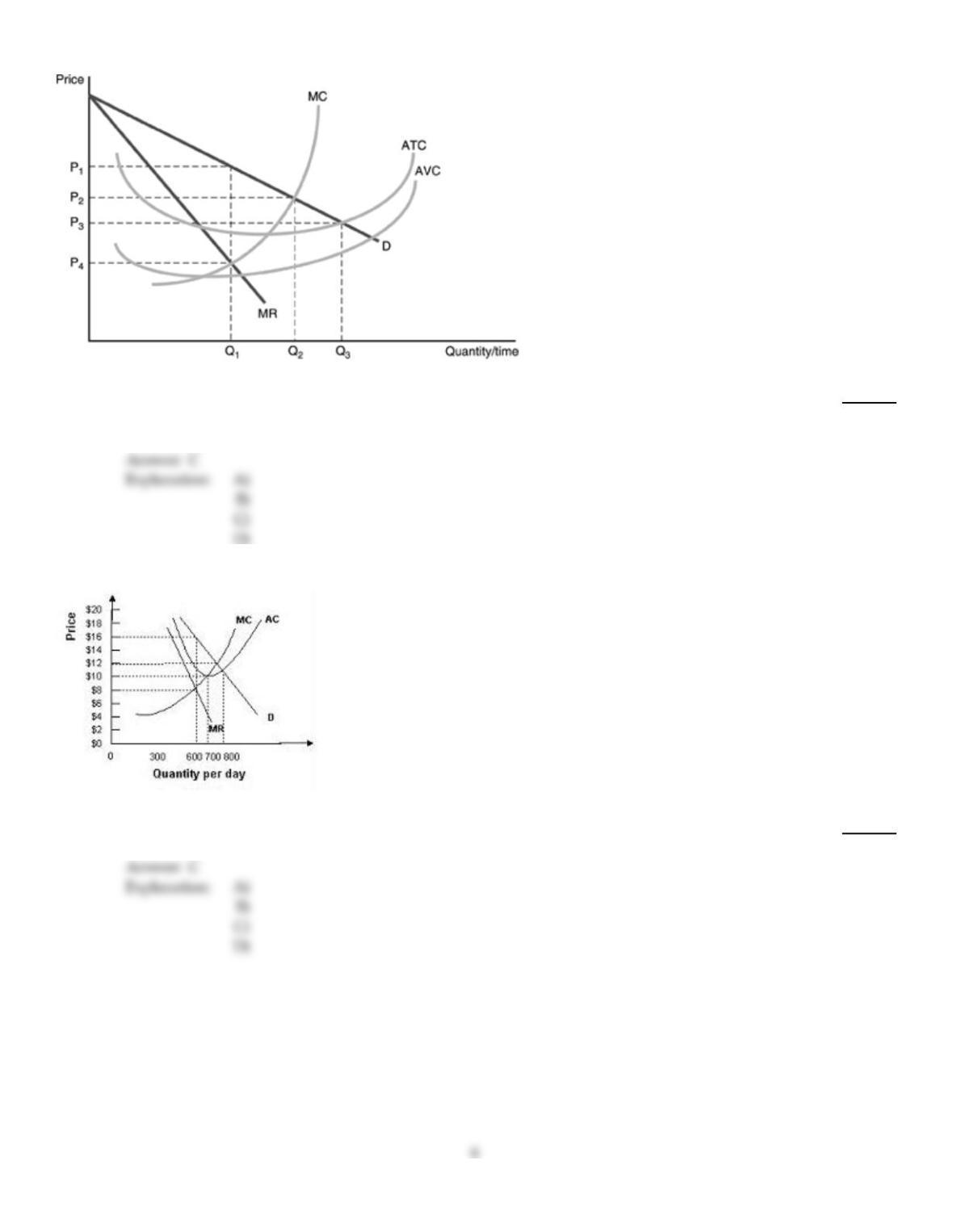
14)
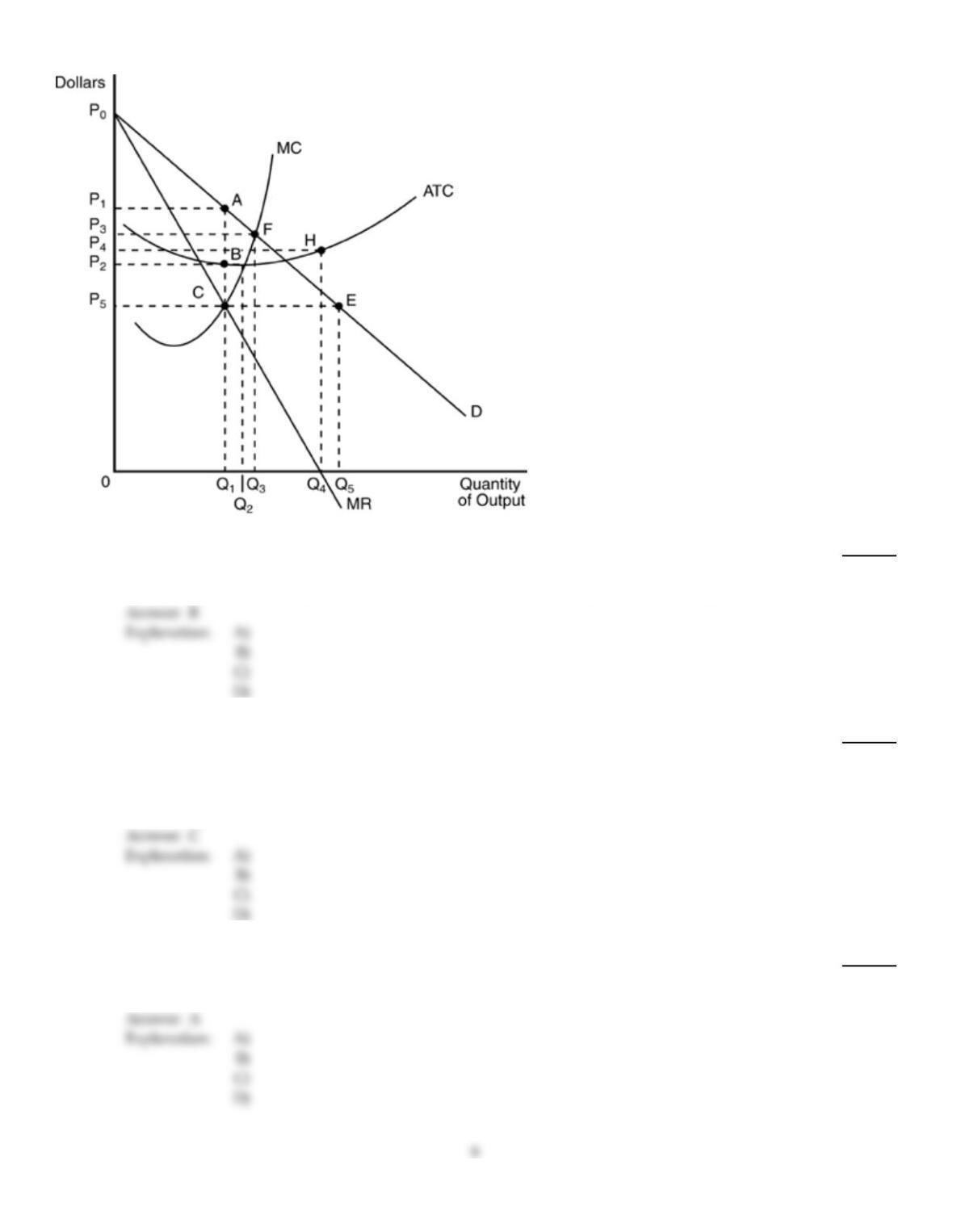
Refer to the above figure. The firm is currently producing at Q1. The firm should
14)
A)
reduce production.
B)
increase production.
C)
leave production as it is.
D)
shut down.
15)
Use the above figure. The profit this monopolist earns is closest to
15)
A)
$4,800.
B)
$1,000.
C)
$3,000.
D)
$1,600.
Explanation:
Explanation:
P Q MR MC
$7 20 $12 $2
$6 21 $14 $5
$5 22 $16 $10
$4 23 $18 $15
$3 24 $20 $20
$2 25 $22 $26
16)
Refer to the above table. Given the demand and cost schedules, what is the profit–maximizing price
for this monopolist?
16)
A)
$6
B)
$7
C)
$4
D)
$3
17)
A monopolist’s demand curve is
17)
A)
perfectly elastic.
B)
of unit elasticity throughout.
C)
the industry demand curve.
D)
perfectly inelastic.
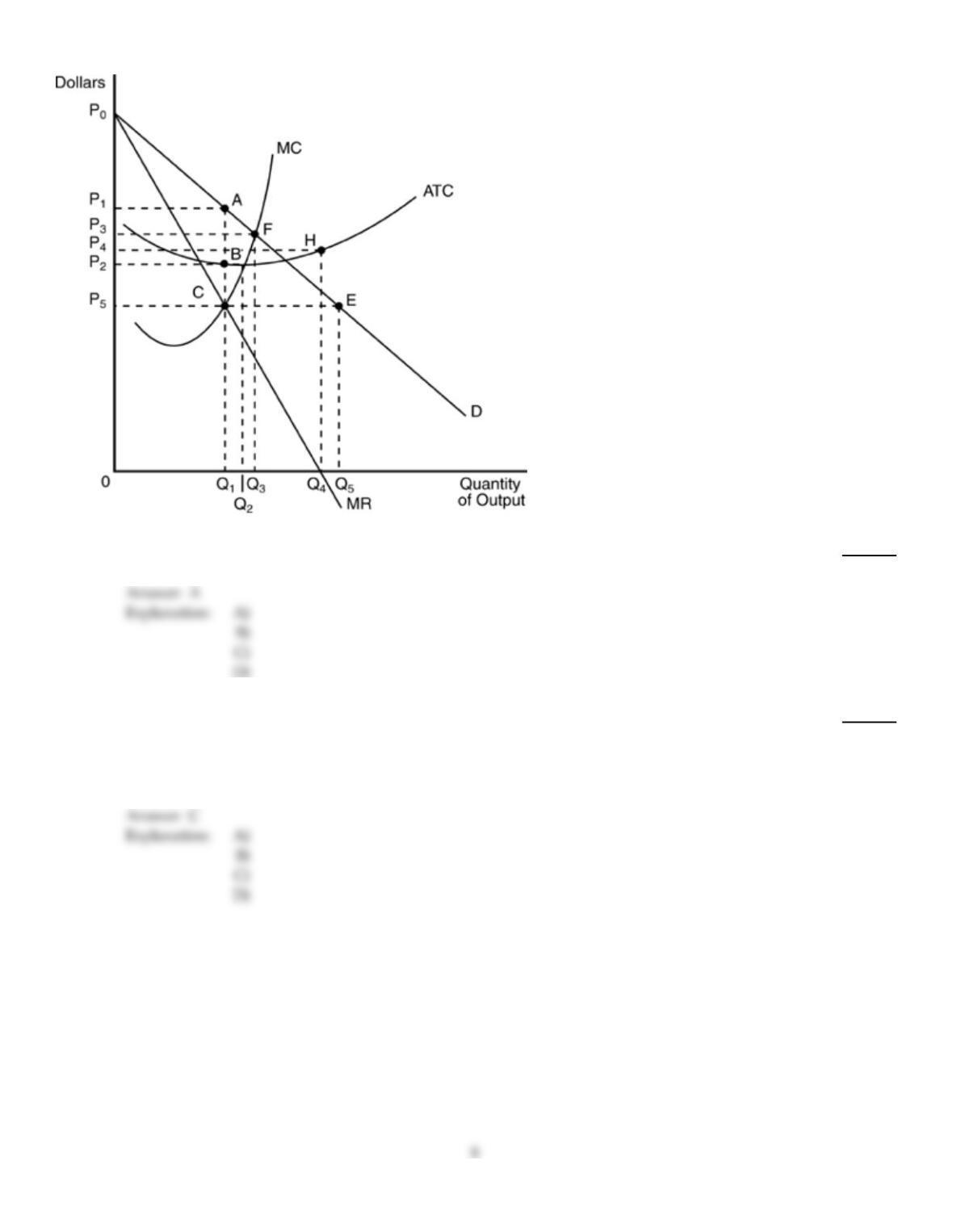
18)
In the above figure, marginal cost and marginal revenue are equal at output
18)
A)
Q1.
B)
Q2.
C)
Q3.
D)
Q5.
19)
Other things being equal, a price–discriminating firm will charge less to the customers who
19)
A)
have the lowest incomes.
B)
are the most rational in making their decisions.
C)
have the most elastic demand for the product.
D)
have the least elastic demand for its product.
20)
In the above figure, suppose the monopolist is producing at Q3. The firm should
20)
A)
shut down.
B)
decrease output and increase price.
C)
not change output or price.
D)
increase output and decrease price.
21)
Barriers to entry enable many monopolists to
21)
A)
manipulate the government into providing special favors for themselves.
B)
charge as high a price as they want.
C)
earn economic profits in the long run.
D)
make people buy more of a good than they really want.
Explanation:
22)
Unlike a perfectly competitive firm, a monopolist faces a demand curve that is
22)
A)
downward sloping.
B)
vertical.
C)
horizontal.
D)
upward sloping.
Explanation:
Explanation:
23)
When a monopolist sells the same product at different prices and the prices are related to cost
differences, we have
23)
A)
price discrimination.
B)
price differentiation.
C)
monopoly pricing.
D)
marginal cost pricing.
24)
A patent on a product gives a firm
24)
A)
excessive profits in the long run.
B)
economies of scale in producing the product.
C)
the power to impose a tariff on a competing product.
D)
protection from having the invention copied or stolen for a period of 20 years.
25)
The point of profit maximization for a monopolist is exemplified by
25)
A)
MR = MC.
B)
ATCmin.
C)
TR = TC.
D)
MR > MC.
26)
A patent provides legal protection for an invention for
26)
A)
as long as the invention is valuable.
B)
7 years.
C)
20 years.
D)
11 years.
27)
A major difference between a monopolist and a perfectly competitive firm is that
27)
A)
the monopolist’s marginal revenue curve lies below its demand curve.
B)
the monopolist engages in marginal cost pricing.
C)
the monopolist charges the highest possible price that he can.
D)
the monopolist is certain to earn economic profits.
28)
Which of the following is LEAST likely to be able to regularly engage in price discrimination?
28)
A)
a university
B)
a producer of copyrighted computer software
C)
a farmer
D)
an airline
29)
If different markets for a product produced by a monopolist can be separated and if the elasticity of
demand differs between the two markets, then the monopolist will
29)
A)
sell the product in only one of the markets with inelastic demand curves.
B)
go out of business.
C)
be able to make higher profits by using price discrimination.
D)
charge a single price in all markets.
30)
A monopolist would probably earn fewer profits if
30)
A)
the importance of specialized capital equipment in its production techniques increased.
B)
environmental regulations increased that required the purchase of special capital equipment.
C)
tariffs on competing products were lowered.
D)
the time length of patents increased.
31)
A monopolist produces in the elastic segment of its demand curve because when it lowers the price
31)
A)
the percentage change increase in quantity demanded is greater than the percentage change
decrease in price and total revenue decreases.
B)
the percentage change decrease in quantity demanded is less than the percentage change
decrease in price and total revenue increases.
C)
the percentage change increase in quantity demanded is greater than the percentage change
decrease in price and total revenue increases.
D)
the percentage change increase in quantity demanded is less than the percentage change
decrease in price and total revenue increases.
32)
A natural monopoly usually arises when
32)
A)
companies band together to form a larger company.
B)
the government allows unrestricted access to a market.
C)
there are diseconomies of scale in an industry.
D)
there are large economies of scale relative to the industry’s demand.
33)
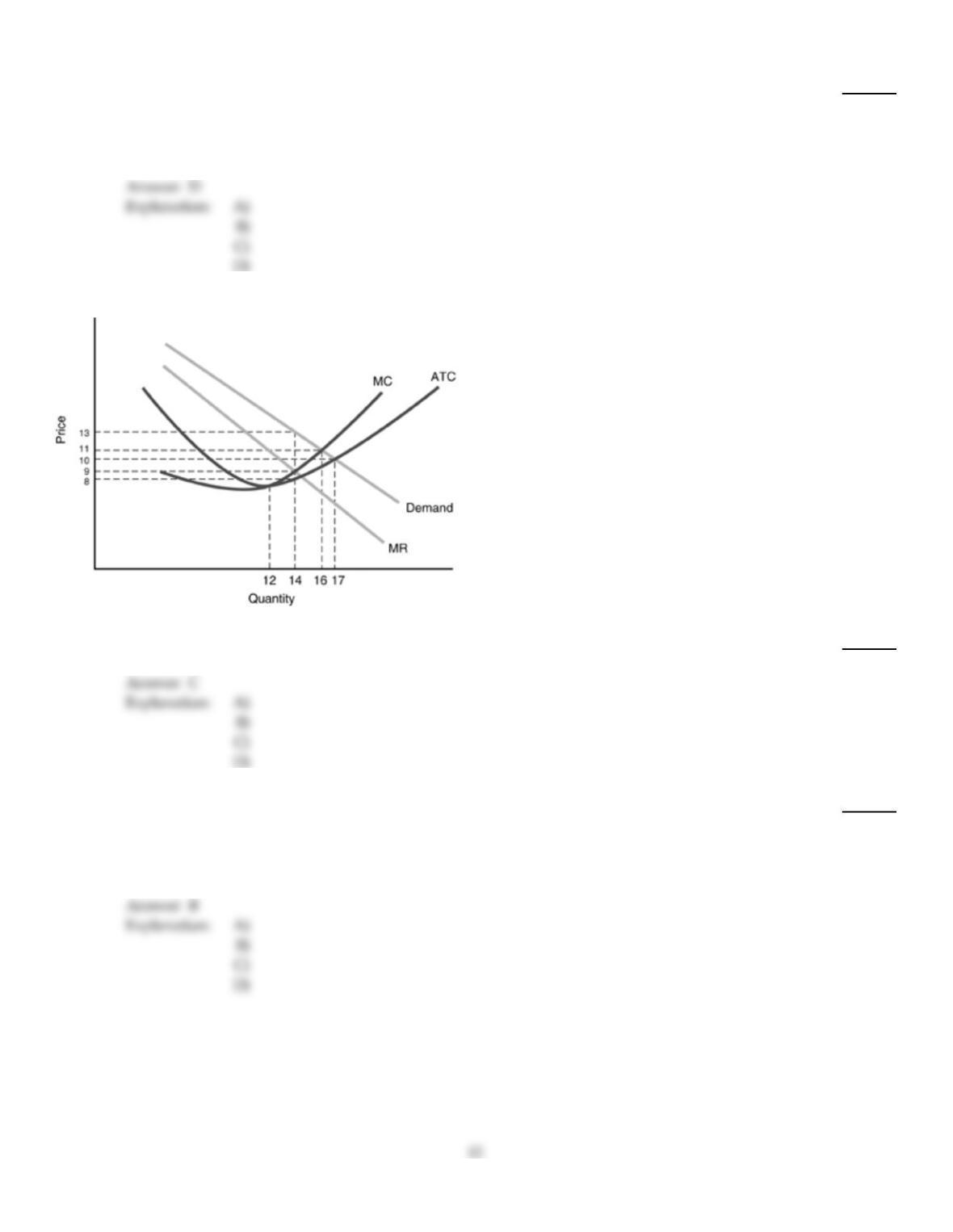
In the above figure, what is the profit–maximizing price and output?
33)
A)
$10, 17
B)
$11, 16
C)
$13, 14
D)
$9, 14
34)
A privately owned monopoly will NEVER produce along a range of output for which
34)
A)
the price elasticity of demand is greater than 1.
B)
the demand curve is inelastic.
C)
the price elasticity of supply is greater than 1.
D)
the demand curve is elastic.
35)
For a profit–maximizing monopolist
35)
A)
P = MR.
B)
P > MC.
C)
P = MC.
D)
P = ATC.
36)
If a “certificate of convenience and public necessity” protects a monopolist’s position, the barrier to
entry this firm relies on is called
36)
A)
a patent.
B)
a tariff.
C)
a government license.
D)
economies of scale.
37)
If a monopolist produces to a point at which marginal revenue is less than marginal cost then
37)
A)
the firm should increase output.
B)
the firm should reduce output.
C)
the firm is maximizing profits.
D)
we do not know if the firm should increase or reduce without more information.
38)
For a monopolist, the reason that marginal revenue is less than price is
38)
A)
because of the perfectly elastic demand curve that the monopolist faces.
B)
because the monopolist must lower the price of the good in order to sell an additional unit.
C)
because of the lack of competition in the market.
D)
because of the U–shaped average revenue curve.
39)
The effect of a tariff
39)
A)
can lead to economies of scale for firms inside the U.S.
B)
is negligible since it applies to firms outside the U.S.
C)
can lead to a monopoly advantage for firms inside the U.S. since they become the sole
suppliers inside the U.S.
D)
will be more beneficial to large firms than to small firms.
40)
The demand curve faced by the monopolist
40)
A)
is the industry demand curve.
B)
is identical to the firm’s TR curve.
C)
has a constant price elasticity.
D)
is identical to the firm’s MR curve.
41)
A tax that is imposed on an imported good is called a
41)
A)
patent.
B)
tariff.
C)
government license.
D)
quota.
B
42)
A monopolist charges a price that is ________ and produces ________ than a perfect competitor.
42)
A)
higher; more
B)
higher; less
C)
lower; more
D)
lower; less
B
43)
The owner of a patented invention
43)
A)
may or may not have a legal monopoly.
B)
will only earn a profit if average total cost is less than price.
C)
will always have demand high enough and costs low enough to ensure a profit.
D)
is guaranteed a profit since her idea cannot be copied.
B
44)
Monopoly producers face
44)
A)
at least one competitive producer of the same product.
B)
no competitive producers of the same product.
C)
many competitors producing the same product.
D)
only a few competitors producing the same product.
B
A
45)
The price elasticity of demand for a monopolist
45)
A)
increases as similar products enter the market.
B)
decreases as more competition occurs in the market.
C)
is infinite since the monopolist is the only firm in the market.
D)
is undefined due to the lack of competition.
46)
Barriers to entry might include all of the following EXCEPT
46)
A)
positive economic profits.
B)
ownership of essential resources.
C)
government franchise.
D)
patents and copyrights.
Explanation:
47)
Which of the following is NOT true about the demand curve faced by a monopolist?
47)
A)
The demand curve is perfectly elastic.
B)
The firm’s demand curve is the same as the market demand curve.
C)
The demand curve is downward sloping.
D)
The marginal revenue curve is below the market demand curve.
Explanation:
48)
Suppose that the profit maximizing level of output for the monopolist is 100 units, and ATC =
$45.00; MC = $35.00; MR = $35.00; P = $45.00. What is the monopoly’s profit?
48)
A)
$3500
B)
–$1000
C)
$4500
D)
$0
Explanation:
49)
Which of the following is NOT true about a certificate of convenience and public necessity?
49)
A)
It is a patent.
B)
It is issued by a government agency.
C)
It limits competition.
D)
It is a barrier to entry.
Explanation:
Explanation:
50)
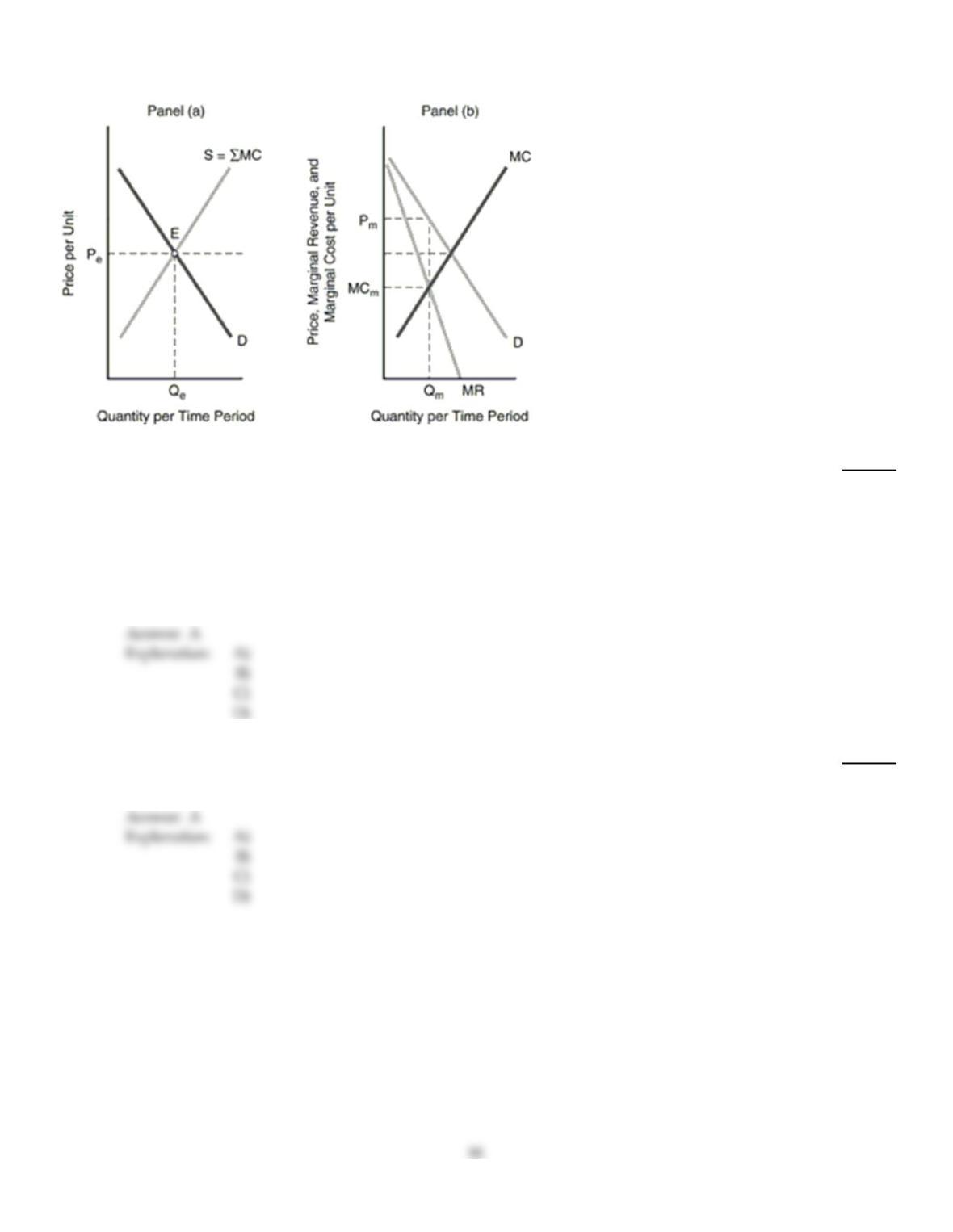
Referring to the above graphic, which of the following statements is FALSE?
50)
A)
The price the monopolist charges in panel (b) at Pm is lower than the price that the
competitive producer charges.
B)
In panel (a), a competitive situation is shown in which equilibrium is established at the
intersection of D and S at point E.
C)
In panel (a), the equilibrium price is Pe and the equilibrium quantity Qe.
D)
The monopolist produces at Qm, and charges a price ofPm, while maximizing profits at the
intersection of MC and MR.
51)
To sell one more unit of a good, a monopolist must
51)
A)
lower the price on all units.
B)
raise the prices on all goods.
C)
lower the price on the last unit only.
D)
raise the price only on the last unit sold.
A
A
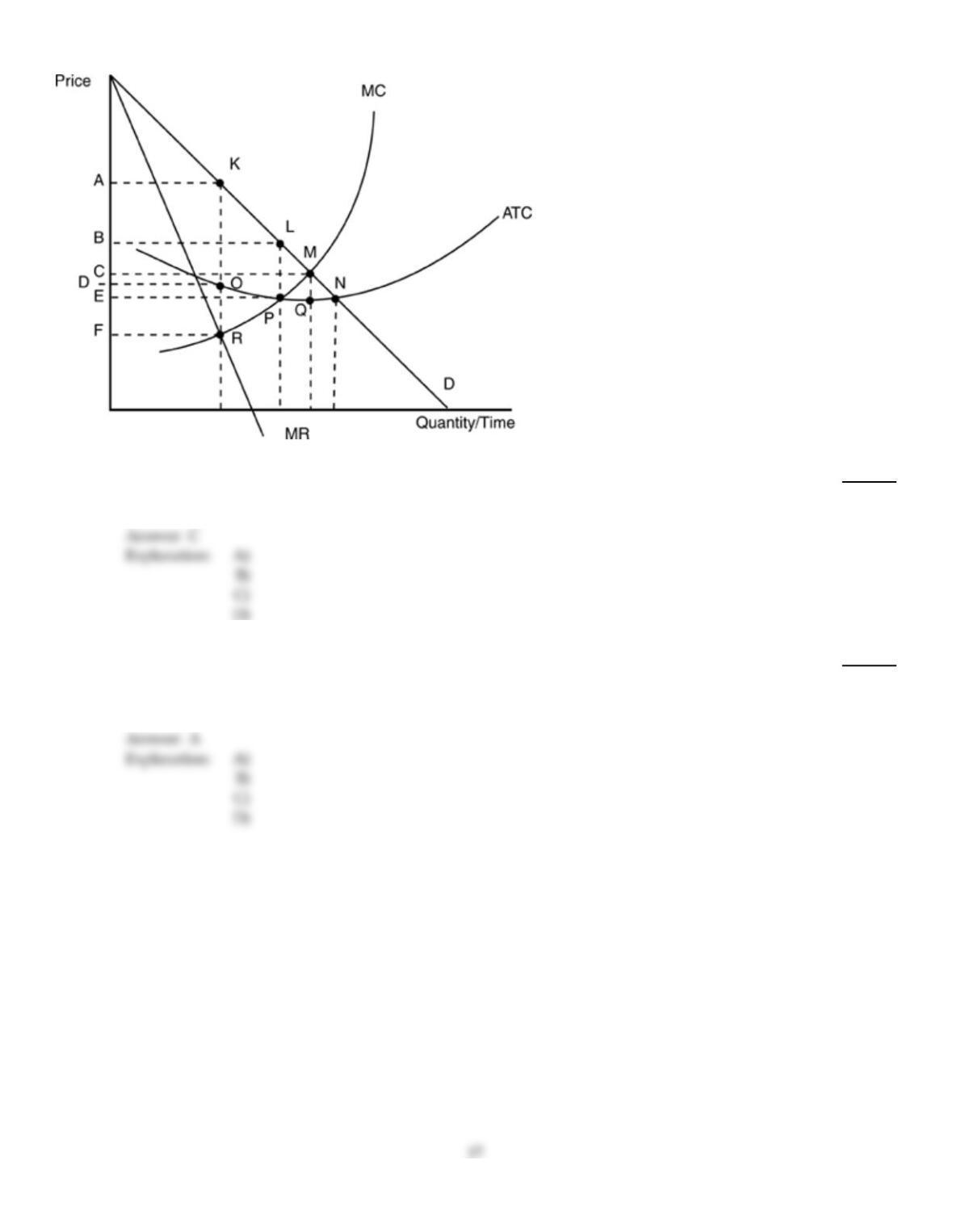
52)
According to the above figure, when the monopolist maximizes profits, its profits are equal to the
area given by
52)
A)
EPRF.
B)
BLPE.
C)
AKOD.
D)
AKMC.
53)
Establishing different prices for similar products to reflect differences in marginal cost in providing
those goods to different groups of buyers is
53)
A)
price differentiation.
B)
product differentiation.
C)
price discrimination.
D)
cost–plus pricing.
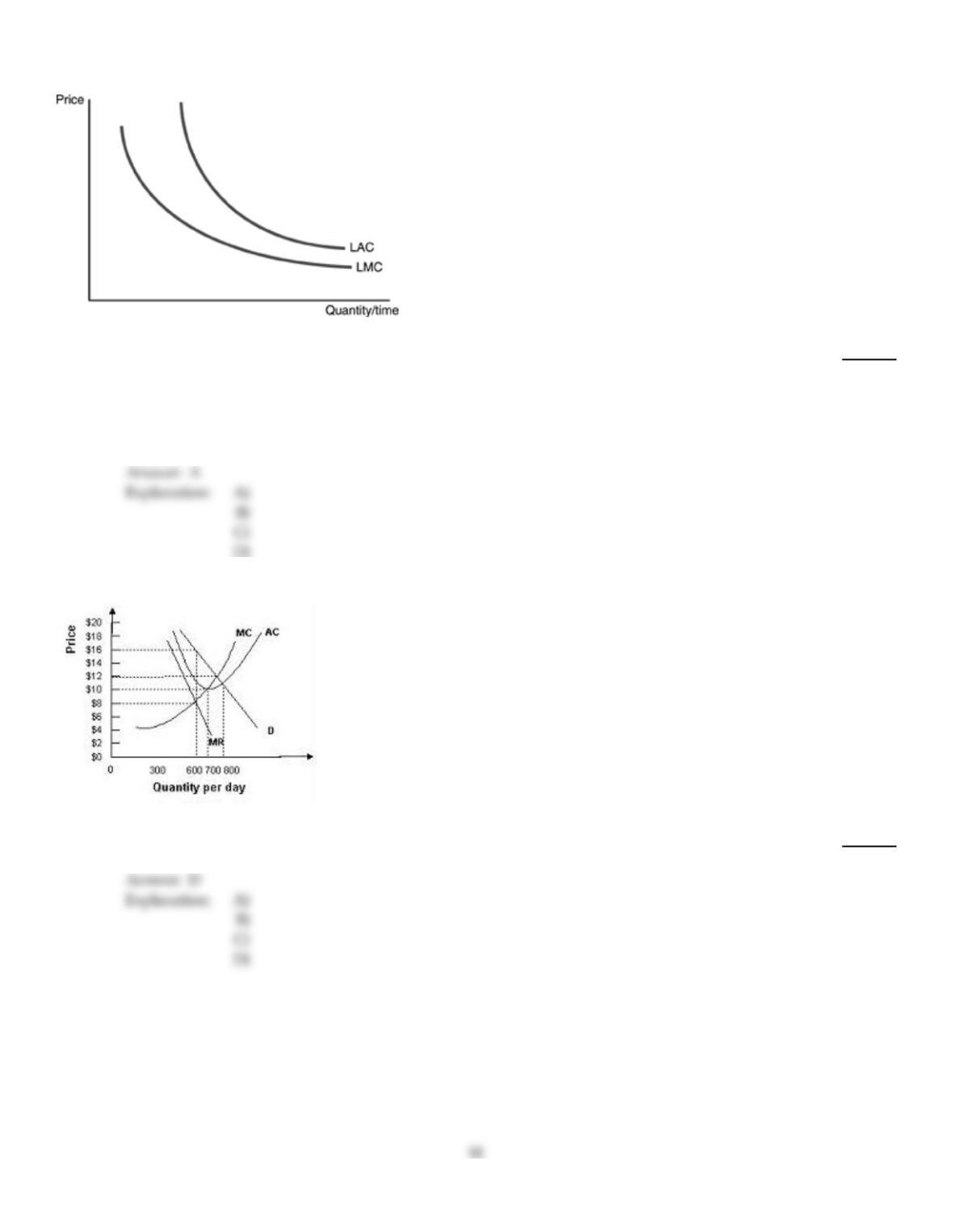
54)
Refer to the above figure. The long–run average cost curve and the long–run marginal cost curves
represent
54)
A)
the cost curves for a natural monopoly.
B)
a situation where a firm has control over the raw materials.
C)
a situation where a firm has a patent.
D)
the cost curves for a competitive firm.
55)
Use the above figure. Total cost at the profit–maximizing output is closet to
55)
A)
$8,000.
B)
$9,600.
C)
$4,800.
D)
$6,600.
56)
Which of the following statements about the elasticity of demand for a monopolist is TRUE?
56)
A)
Since every good has some substitute, even if imperfect, the demand for a good produced by
a monopolist will not have zero price elasticity.
B)
A monopolist produces a good with demand that is perfectly inelastic because people can not
do without the good.
C)
Since the demand curve of a monopolist is downward sloping, the demand for the good must
be inelastic.
D)
Since a monopolist produces a good with no close substitutes, the price elasticity of demand
for the good is zero.
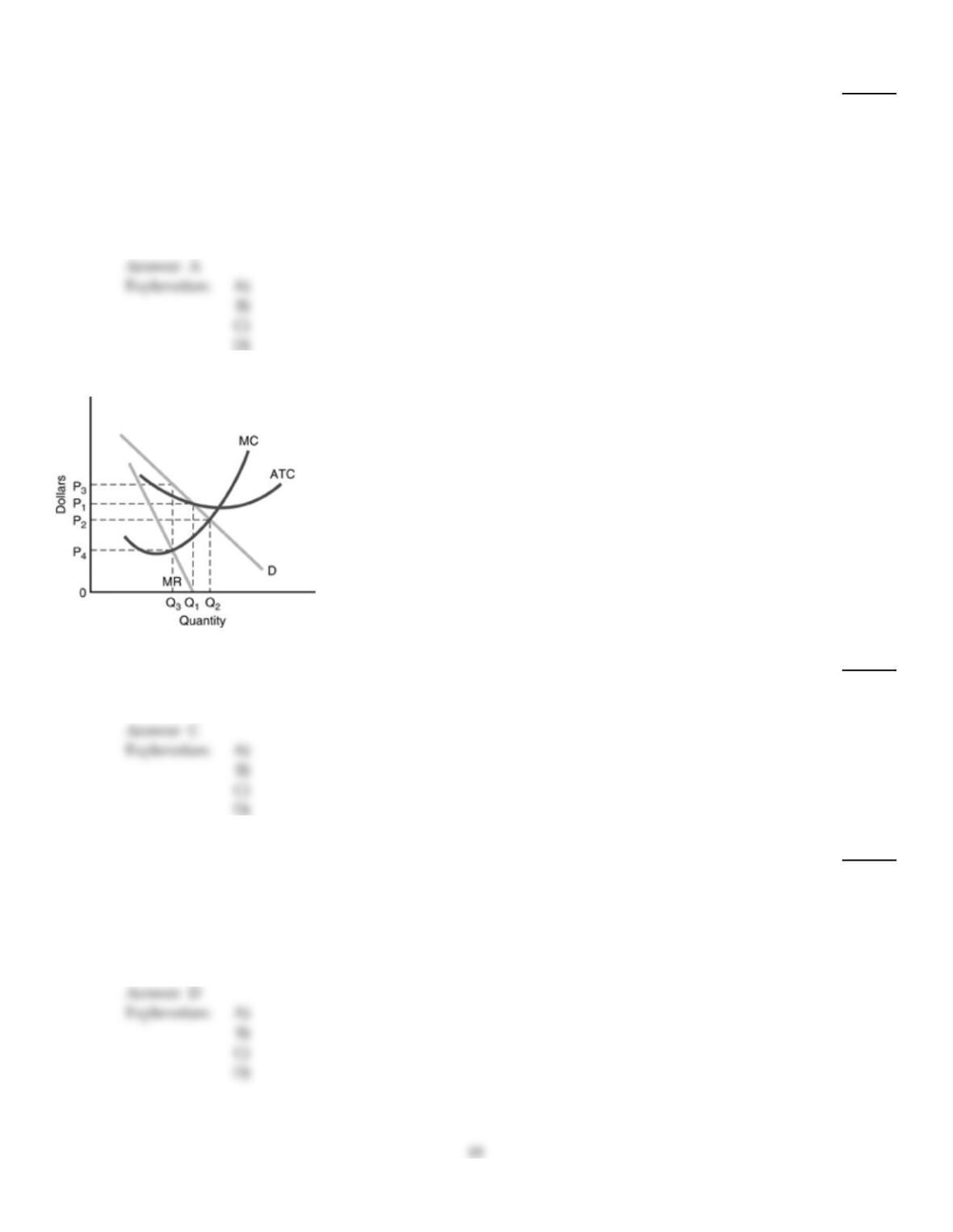
57)
Use the above figure. The profit–maximizing output will be
57)
A)
Q1.
B)
Q2.
C)
Q3.
D)
None of the above are correct.
58)
If marginal cost is constant, what happens to a market if it alters from perfect competition to
monopoly without any change in the position of the market demand curve or any variation in
costs?
58)
A)
Consumer surplus decreases, producer surplus decreases and a deadweight loss is created.
B)
Consumer surplus increases, producer surplus decreases and a deadweight loss is created.
C)
Consumer surplus increases, producer surplus increases and a deadweight loss is created.
D)
Consumer surplus decreases, producer surplus increases and a deadweight loss is created.
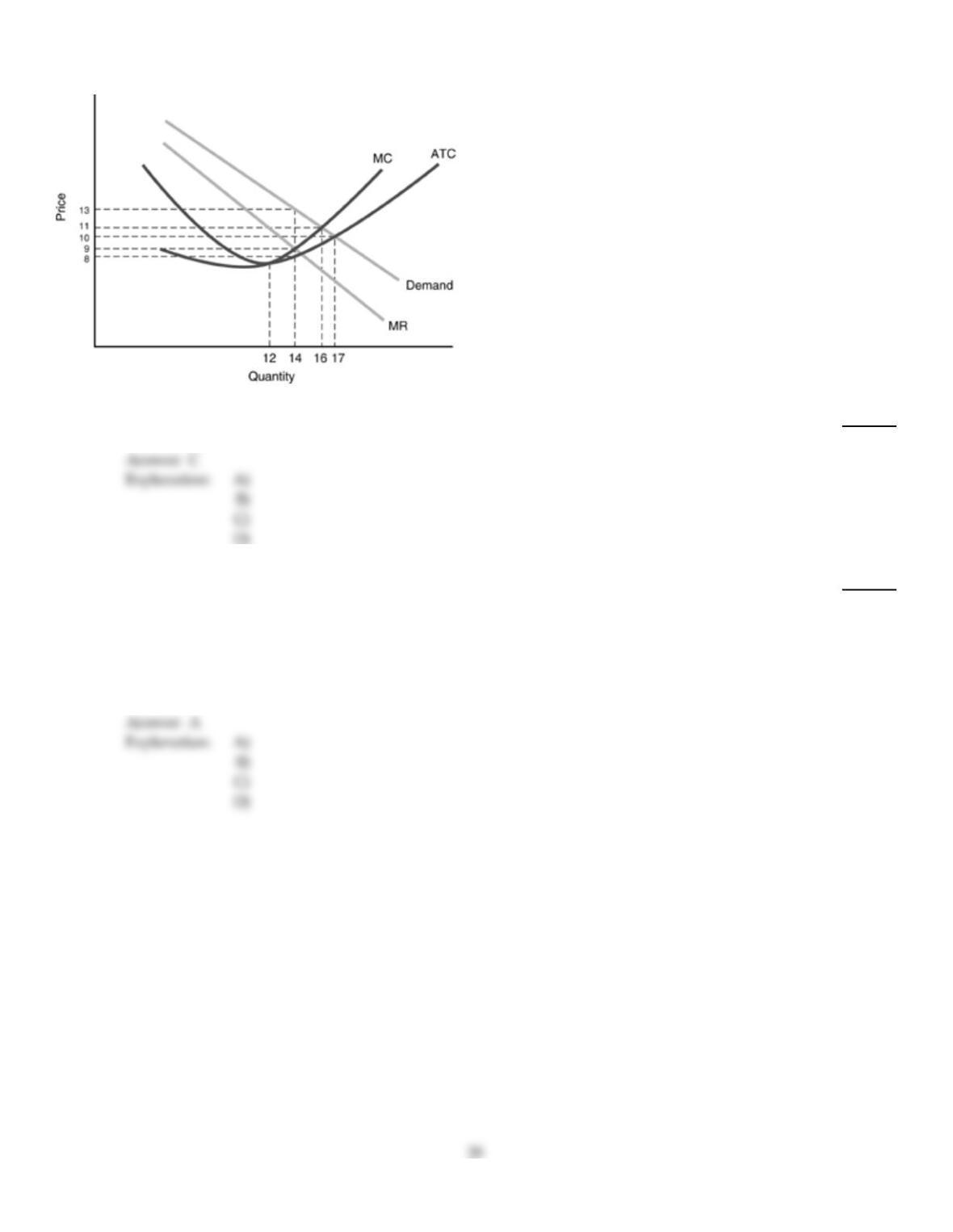
59)
In the above figure, what is total profit at the profit–maximizing point?
59)
A)
$14
B)
$56
C)
$70
D)
$42
60)
Economies of scale will lead to only one firm in the industry because
60)
A)
by increasing output a firm is able to lower the cost per unit and charge lower prices driving
smaller firms out of business.
B)
there are governmental entry restrictions.
C)
one firm has an average cost curve, which has shifted below the average cost curves of its
competitors.
D)
of government licensing.