
Financial Markets and Institutions, 6e (Mishkin/Eakins)
Chapter 24 Risk Management in Financial Institutions
24.1 Multiple Choice
1) Banks face the problem of _________ in loan markets because bad credit risks are the ones
most likely to seek bank loans.
A) adverse selection
B) moral hazard
C) moral suasion
D) intentional fraud
2) If borrowers with the most risky investment projects are more likely to seek bank loans than
borrowers with the safest investment projects, banks face the problem of
A) adverse credit risk.
B) adverse selection.
C) moral hazard.
D) conflict of interest.
3) Because borrowers, once they have a loan, are more likely to invest in high–risk investment
projects, banks face the
A) adverse selection problem.
B) lemon problem.
C) adverse credit risk problem.
D) moral hazard problem.
4) Banks’ attempts to solve adverse selection and moral hazard problems help explain loan
management principles such as
A) screening and monitoring of loan applicants.
B) collateral and compensating balances.
C) credit rationing.
D) all of the above.
E) only A and B of the above.
5) In one sense, _________ appears surprising since it means that the bank is not _________ its
portfolio of loans and thus is exposing itself to more risk.
A) specialization in lending; diversifying
B) specialization in lending; rationing
C) credit rationing; diversifying
D) screening; rationing

6) From the standpoint of _________, specialization in lending is surprising but makes perfect
sense when one considers the _________ problem.
A) moral hazard; diversification
B) diversification; moral hazard
C) adverse selection; diversification
D) diversification; adverse selection
7) Provisions in loan contracts that proscribe borrowers from engaging in specified risky
activities are called
A) proscription bonds.
B) collateral clauses.
C) restrictive covenants.
D) liens.
8) Banks attempt to screen good from bad credit risks to reduce the incidence of loan defaults.
To do this, banks
A) specialize in lending to certain industries or regions.
B) write restrictive covenants into loan contracts.
C) expend resources to acquire accurate credit histories of their potential loan customers.
D) do all of the above.
9) A bank’s commitment (for a specified future period of time) to provide a firm with loans up
to a given amount at an interest rate that is tied to a market interest rate is called
A) credit rationing.
B) a line of credit.
C) continuous dealings.
D) none of the above.
10) Lines of credit and long–term relationships between banks and their customers
A) reduce the costs of information collection.
B) make it easier for banks to screen good from bad risks.
C) enable banks to deal with moral hazard contingencies that are neither anticipated nor
specified in restrictive covenants.
D) do all of the above.
E) do only A and B of the above.

11) Compensating balances
A) are a particular form of collateral commonly required on commercial loans.
B) are a required minimum amount of funds that a borrower (i.e., a firm receiving a loan)
must keep in a checking account at the bank.
C) allow banks to monitor firms’ check payment practices which can yield information
about their borrowers’ financial conditions.
D) all of the above.
12) A bank that wants to monitor the check payment practices of its commercial borrowers, so
that moral hazard can be prevented, will require borrowers to
A) place a bank officer on their board of directors.
B) place a corporate officer on the bank’s board of directors.
C) keep compensating balances in a checking account at the bank.
D) do all of the above.
E) do only A and B of the above.
13) Of the following methods that banks might use to reduce moral hazard problems, the one
not legally permitted in the United States is the requirement that
A) firms keep compensating balances at the banks from which they obtain their loans.
B) firms place on their board of directors an officer from the bank.
C) loan contracts include restrictive covenants.
D) individuals provide detailed credit histories to bank loan officers.
14) When a lender refuses to make a loan, although borrowers are willing to pay the stated
interest rate or even a higher rate, it is said to engage in
A) constrained lending.
B) strategic refusal.
C) credit rationing.
D) collusive behavior.
15) When a lender refuses to make a loan, even though borrowers are willing to pay the stated
interest rate or even a higher rate, it is said to engage in
A) specialized lending.
B) strategic refusal.
C) diversified lending.
D) coercive behavior.
E) none of the above.

16) Credit rationing occurs when a bank
A) refuses to make a loan of any amount to a borrower, even when she is willing to pay a
higher interest rate.
B) restricts the amount of a loan to less than the borrower would like.
C) does either A or B of the above.
D) does neither A nor B of the above.
17) Because larger loans create greater incentives for borrowers to engage in undesirable
activities that make it less likely they will repay the loans, banks
A) ration credit, granting borrowers smaller loans than they have requested.
B) ration credit, charging higher interest rates to borrowers who want large loans than to
those who want small loans.
C) ration credit, charging higher fees as a percentage of the loan to borrowers who want
large loans than to those who want small loans.
D) do none of the above.
18) When banks offer borrowers smaller loans than they have requested, banks are said to
A) shave credit.
B) discount the loan.
C) raze credit.
D) ration credit.
19) Which of the following are not generally rate–sensitive assets?
A) Securities with a maturity of less than one year
B) Variable–rate mortgages
C) Fixed–rate mortgages
D) All of the above are rate–sensitive assets
E) None of the above is a rate–sensitive asset
20) Liabilities that are partially, but not fully, rate–sensitive include
A) checkable deposits.
B) federal funds.
C) non–negotiable CDs.
D) fixed–rate mortgages.
E) money market deposit accounts.

21) If a bank has more rate–sensitive liabilities than rate–sensitive assets, then a(n) _________ in
interest rates will _________ bank profits.
A) increase; increase
B) increase; reduce
C) decline; reduce
D) decline; not affect
22) If a bank has more rate–sensitive assets than rate–sensitive liabilities, then a(n) _________ in
interest rates will _________ bank profits.
A) increase; increase
B) increase; reduce
C) decline; increase
D) decline; not affect
23) If a bank has _________ rate–sensitive assets than rate–sensitive liabilities, then a(n)
_________ in interest rates will increase bank profits.
A) more; decline
B) more; increase
C) less; increase
D) both A and C
24) The difference between rate–sensitive liabilities and rate–sensitive assets is known as the
A) duration.
B) interest–sensitivity index.
C) interest–rate risk index.
D) gap.
25) Referring to Table 24.1, First National Bank has a gap of _________.
A) –30
B) +30
C) 60
D) 0
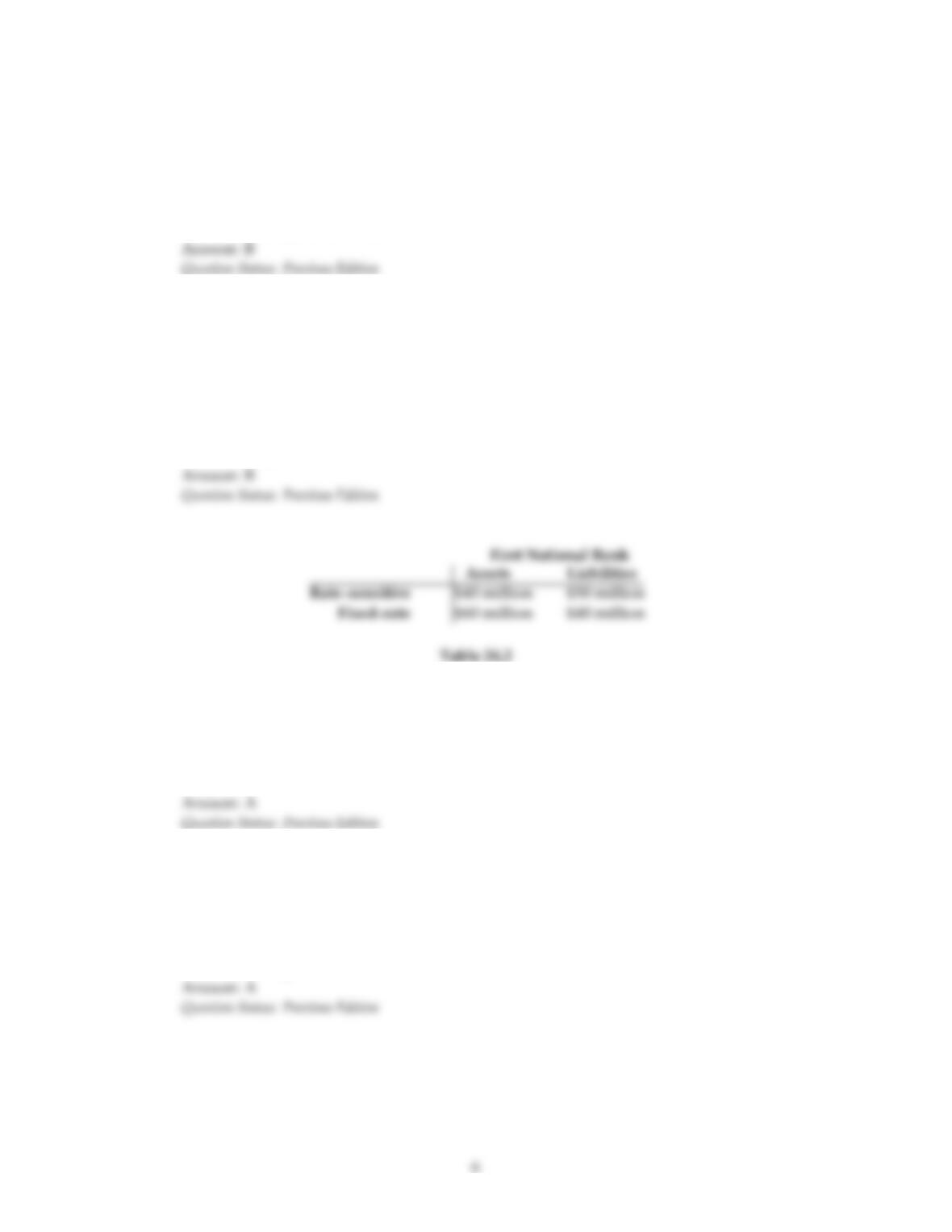
26) Referring to Table 24.1, if interest rates rise by 5 percentage points, then bank profits
(measured using gap analysis) will
A) decline by $0.5 million.
B) decline by $1.5 million.
C) decline by $2.5 million.
D) increase by $1.5 million.
27) Refer to Table 24.1. Assuming that the average duration of its assets is five years, while the
average duration of its liabilities is three years, a rise in interest rates from 5% to 10% will
cause the net worth of First National to _________ by _________ of the total original asset
value.
A) increase; 11%
B) decline; 11%
C) increase; 10%
D) decline; 5%
28) Referring to Table 24.2, First National Bank has a gap of _________.
A) –10
B) 10
C) 20
D) 0
29) Referring to Table 24.2, if interest rates rise by 5 percentage points, then bank profits
(measured using gap analysis) will
A) decline by $0.5 million.
B) decline by $1.5 million.
C) decline by $2.5 million.
D) increase by $2.0 million.

30) Refer to Table 24.2. Assuming that the average duration of the bank’s assets is four years,
while the average duration of its liabilities is three years, a rise in interest rates from 5
percent to 10 percent will cause the net worth of First National to _________ by _________ of
the total original asset value.
A) decline; 5%
B) decline; 1.3%
C) decline; 6.2%
D) increase; 5%
31) If First State Bank has a gap equal to a positive $20 million, then a 5 percentage point drop in
interest rates will cause profits to
A) increase by $10 million.
B) increase by $1.0 million.
C) decline by $10 million.
D) decline by $1.0 million.
32) If First National Bank has a gap equal to a negative $30 million, then a 5 percentage point
increase in interest rates will cause profits to
A) increase by $15 million.
B) increase by $1.5 million.
C) decline by $15 million.
D) decline by $1.5 million.
33) Measuring the sensitivity of bank profits to changes in interest rates by multiplying the gap
times the change in the interest rate is called
A) basic duration analysis.
B) basic gap analysis.
C) interest–exposure analysis.
D) gap–exposure analysis.
34) Measuring the sensitivity of bank profits to changes in interest rates by multiplying the gap
for several maturity subintervals by the change in the interest rate is called
A) basic gap analysis.
B) the segmented maturity approach to gap analysis.
C) the maturity bucket approach to gap analysis.
D) the segmented maturity approach to interest–exposure analysis.
E) none of the above.

35) Duration gap analysis
A) is a refinement of basic gap analysis that accounts for interest–rate changes over a
multiyear period.
B) is a refinement of basic gap analysis that accounts for how long a gap will last.
C) is a complement to basic gap analysis that accounts for the effect of interest rate
changes on market value.
D) is a complement to basic gap analysis that accounts for the influence of partially rate–
sensitive assets.
36) Duration analysis involves comparing the average duration of the bank’s _________ to the
average duration of its _________
A) securities portfolio; non–deposit liabilities.
B) loan portfolio; non–deposit liabilities.
C) loan portfolio; rate–sensitive liabilities.
D) rate–sensitive assets; rate–sensitive liabilities.
E) assets; liabilities.
37) To use the concept of duration to analyze the effect of changes in interest rates on the market
value of an asset, a bank manager would multiply
A) the negative of the duration of the asset by the change in the interest rate, Δi.
B) the negative of the duration of the asset by Δi /(1 + i).
C) the duration of the asset by the change in the interest rate, Δi.
D) the duration of the asset by Δi /(1 + i).
38) If a bank has a duration gap of 2 years, then a rise in interest rates from 6 percent to 9
percent will lead to
A) a rise in the market value of its net worth of 5.66 percent.
B) a rise in net interest income of 5.66 percent.
C) a fall in the market value of its net worth of 5.66 percent.
D) a fall in net interest income of 5.66 percent.
E) an unknown change.
39) If a bank has a duration gap of 2 years, then a fall in interest rates from 6 percent to 3 percent
will lead to
A) a rise in the market value of its net worth of 5.66 percent.
B) a fall in the market value of its net worth of 5.66 percent.
C) a rise in net interest income of 5.66 percent.
D) a fall in net interest income of 5.66 percent.
E) an unknown change.

40) If a decline in interest rates causes the market value of a bank’s net worth to rise, then the
bank must have a
A) negative duration gap.
B) positive duration gap.
C) negative gap.
D) positive gap.
41) If a rise in interest rates causes the market value of a bank’s net worth to rise, then the bank
must have a
A) negative duration gap.
B) positive duration gap.
C) negative gap.
D) positive gap.
42) One problem with duration gap analysis is that it
A) is calculated assuming that the yield curve is flat.
B) is calculated assuming that the yield curve does not change.
C) does not measure the sensitivity of net worth to interest rate changes.
D) does not measure the sensitivity of income to interest rate changes.
E) applies only to financial institutions.
43) One problem with basic gap analysis is that it
A) is calculated assuming interest rates on all maturities are equal.
B) is calculated assuming interest rates on all maturities change by equal amounts.
C) measures the sensitivity of net worth to interest rate changes.
D) does not measure the sensitivity of income to interest rate changes.
E) applies only to financial institutions.
44) A bank manager concerned about interest income who expects interest rates to rise and who
knows the bank currently has a positive gap should _________ rate–sensitive assets and
_________ rate–sensitive liabilities.
A) increase; increase
B) decrease; increase
C) decrease; decrease
D) increase; decrease

45) A bank manager concerned about interest income who expects interest rates to fall and who
knows the bank currently has a positive gap should _________ rate–sensitive assets and
_________ rate–sensitive liabilities.
A) increase; increase
B) decrease; increase
C) decrease; decrease
D) increase; decrease
24.2 True/False
1) If a bank has more rate–sensitive liabilities than assets, then an increase in interest rates will
reduce bank profits.
2) The difference between rate–sensitive liabilities and rate–sensitive assets is known as the
duration gap.
3) If a bank has a negative gap, then a decrease in interest rates will increase income.
4) Banks face the problem of adverse selection in loan markets because bad credit risks are the
ones most likely to seek bank loans.
5) Due–on–sale clauses in loan contracts reduce moral hazard.
6) A correspondent account is sometimes required of a borrower as a condition for a loan.
7) Credit rationing reduces adverse selection problems.
8) Credit rationing occurs when lenders charge higher interest rates on the loans they make to
riskier borrowers.
9) Developing and maintaining long–term customer relationships help to reduce banks’ costs of
screening and monitoring borrowers.
10) Measuring the sensitivity of bank profits to changes in interest rates by multiplying the gap
for several maturity subintervals by the change in the interest rate is called duration
analysis.
11) If interest rates rise by 5 percentage points, then bank profits (measured using gap analysis)
will increase regardless of the income gap.
24.3 Essay
1) What is the difference between credit risk and interest–rate risk?
2) How is credit risk related to the concepts of adverse selection and moral hazard?
3) What steps do banks take to reduce their exposure to credit risk?
4) How do the concepts of adverse selection and moral hazard explain the credit risk
management principles that banks adopt?
5) What is gap analysis and why is it important to a bank?
6) What is duration gap analysis and why is it important to a bank?
7) Explain how banks benefit from long–term customer relationships.
8) Explain how banks benefit from specialization in lending.
9) What special assumptions do income and duration gap analyses make about interest rate
changes and the yield curve?