Exam
Name___________________________________
MULTIPLE CHOICE. Choose the one alternative that best completes the statement or answers the question.
1)
A monopolist can earn economic profits in the long run because
1)
A)
a monopoly is by definition large, and this gives it the ability to make large profits.
B)
barriers to entry prevent new firms from entering the industry.
C)
a monopoly makes the good or service better than anyone else.
D)
monopolies can legally force people to buy their products and to pay more for them than they
are worth.
2)
Refer to the above table. Given the demand and cost schedules, what is the profit maximizing
quantity for this monopolist?
2)
A)
20
B)
23
C)
24
D)
21
3)
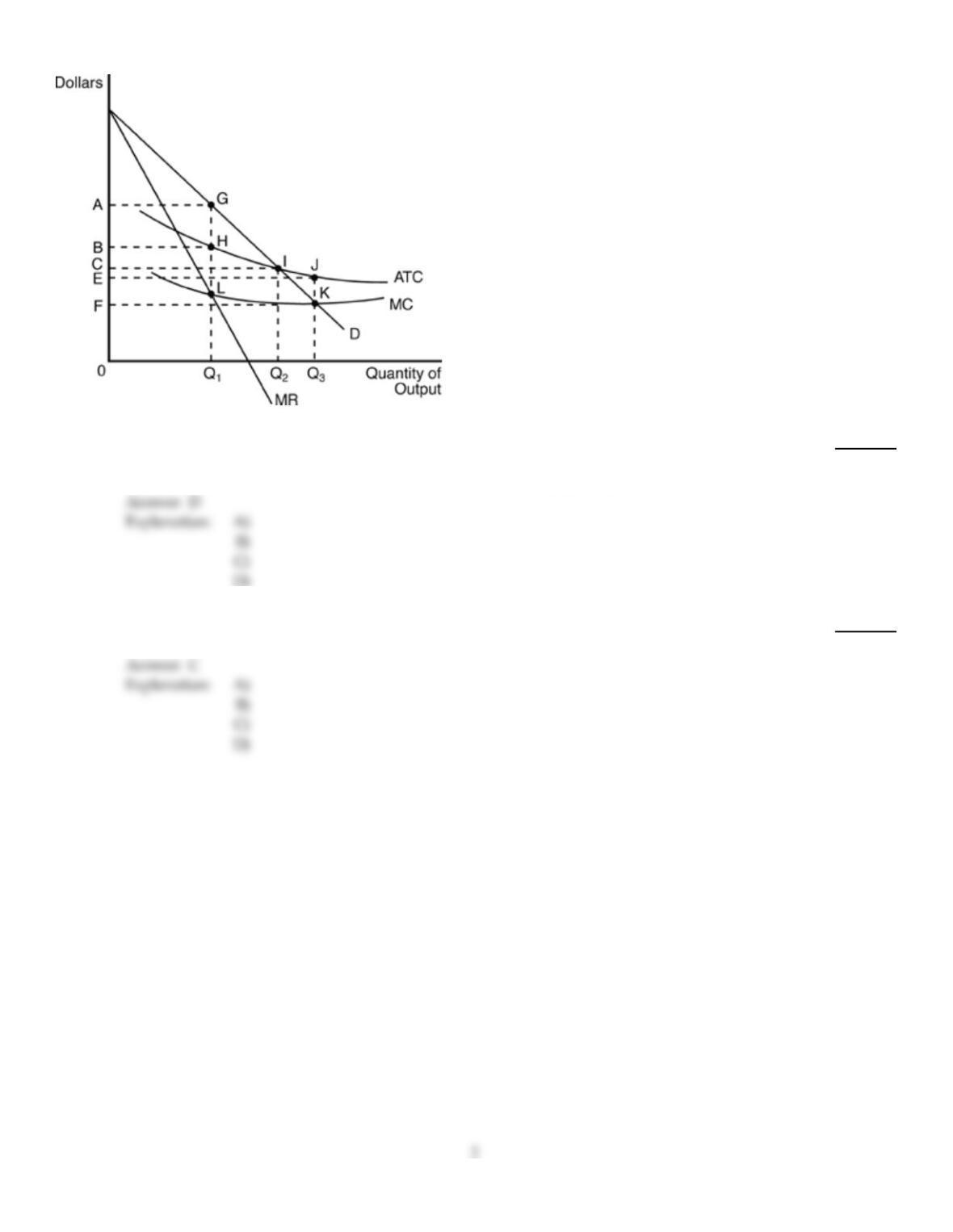
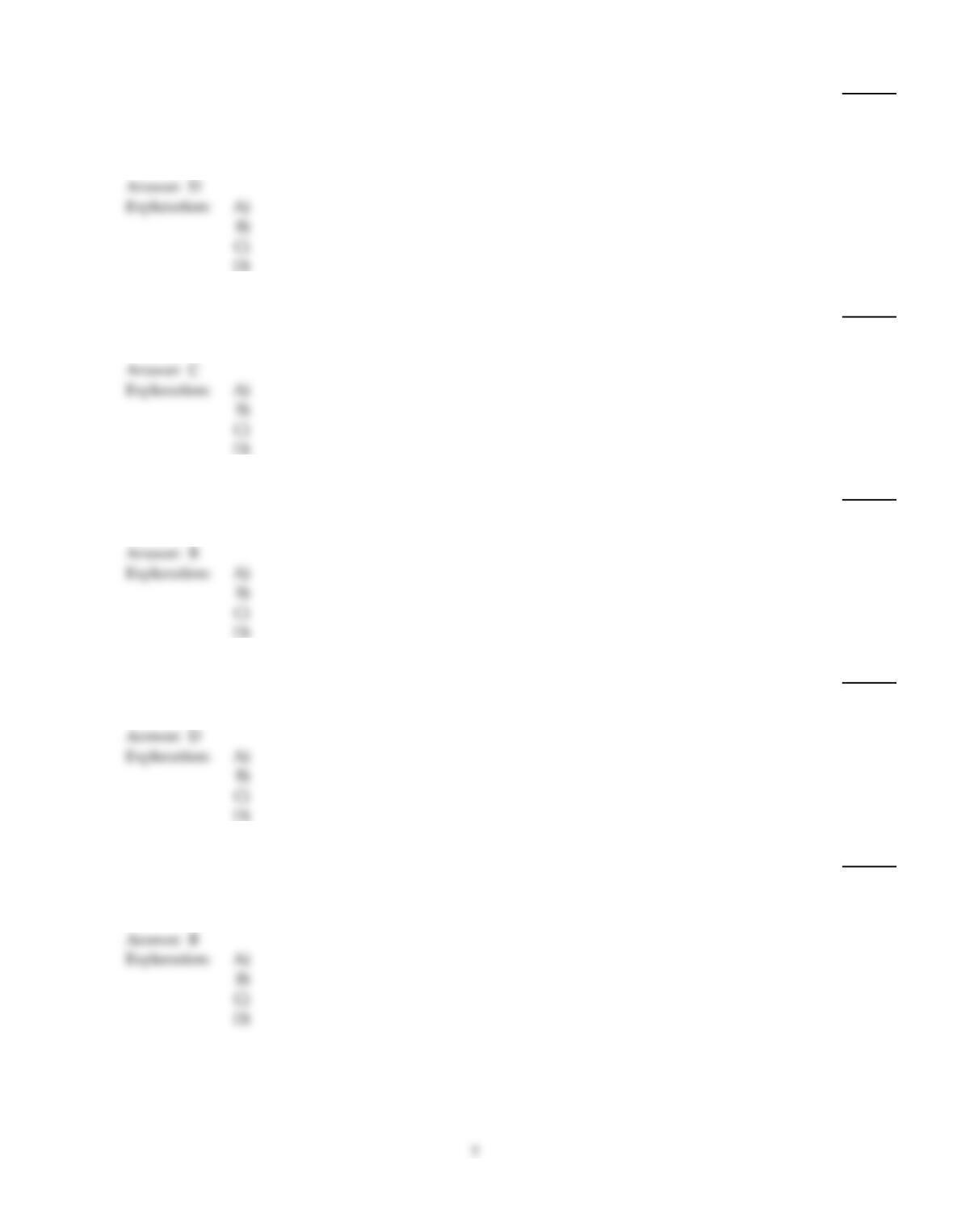
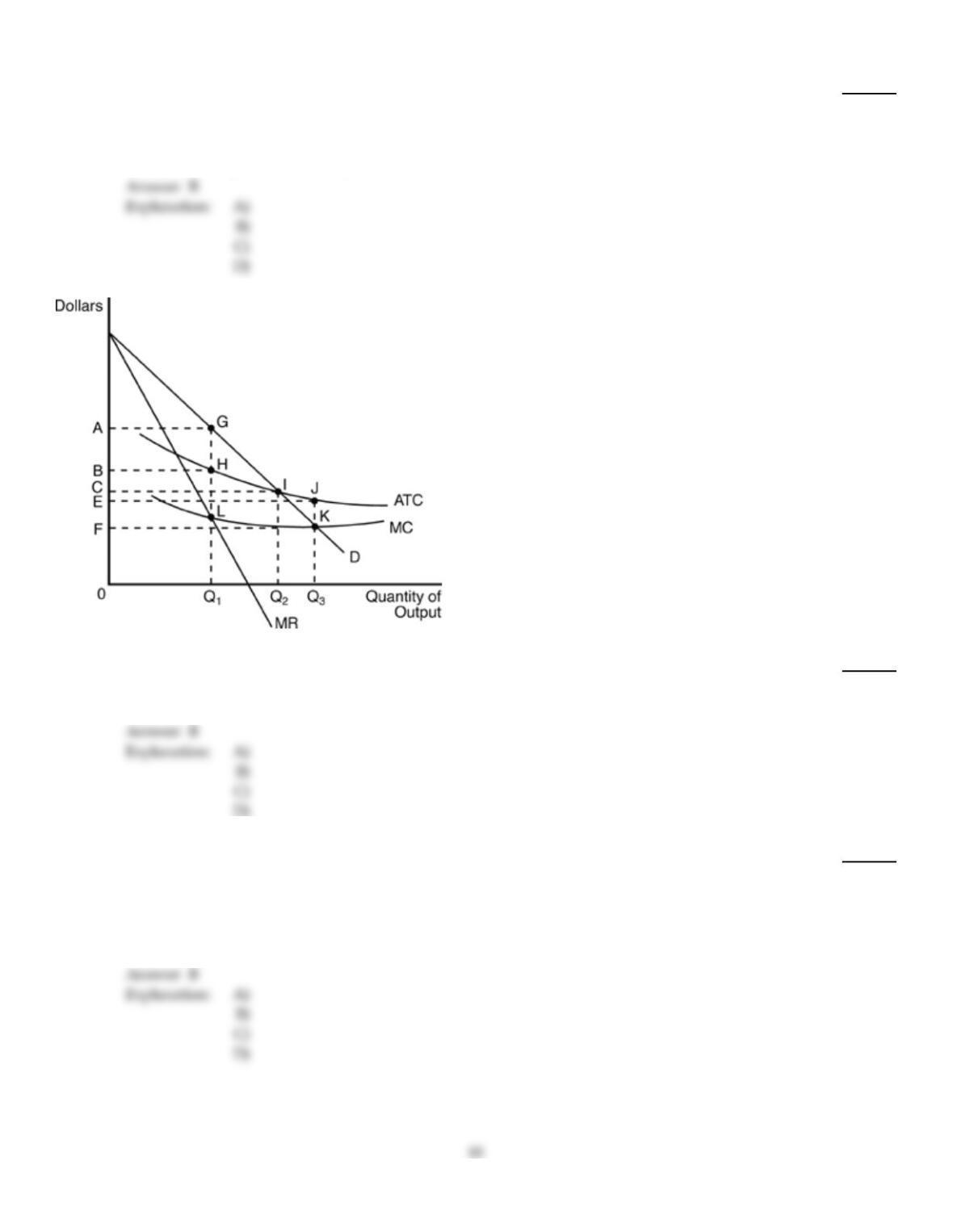
In the above figure, the distance between A and B represents this monopoly firm’s
3)
A)
total profit.
B)
average cost per unit.
C)
total revenue.
D)
average profit per unit.
4)
A monopoly will maximize profits at the level of output at which
4)
A)
MC = ATC.
B)
MC = P.
C)
MR = MC.
D)
MR = AFC.
5)
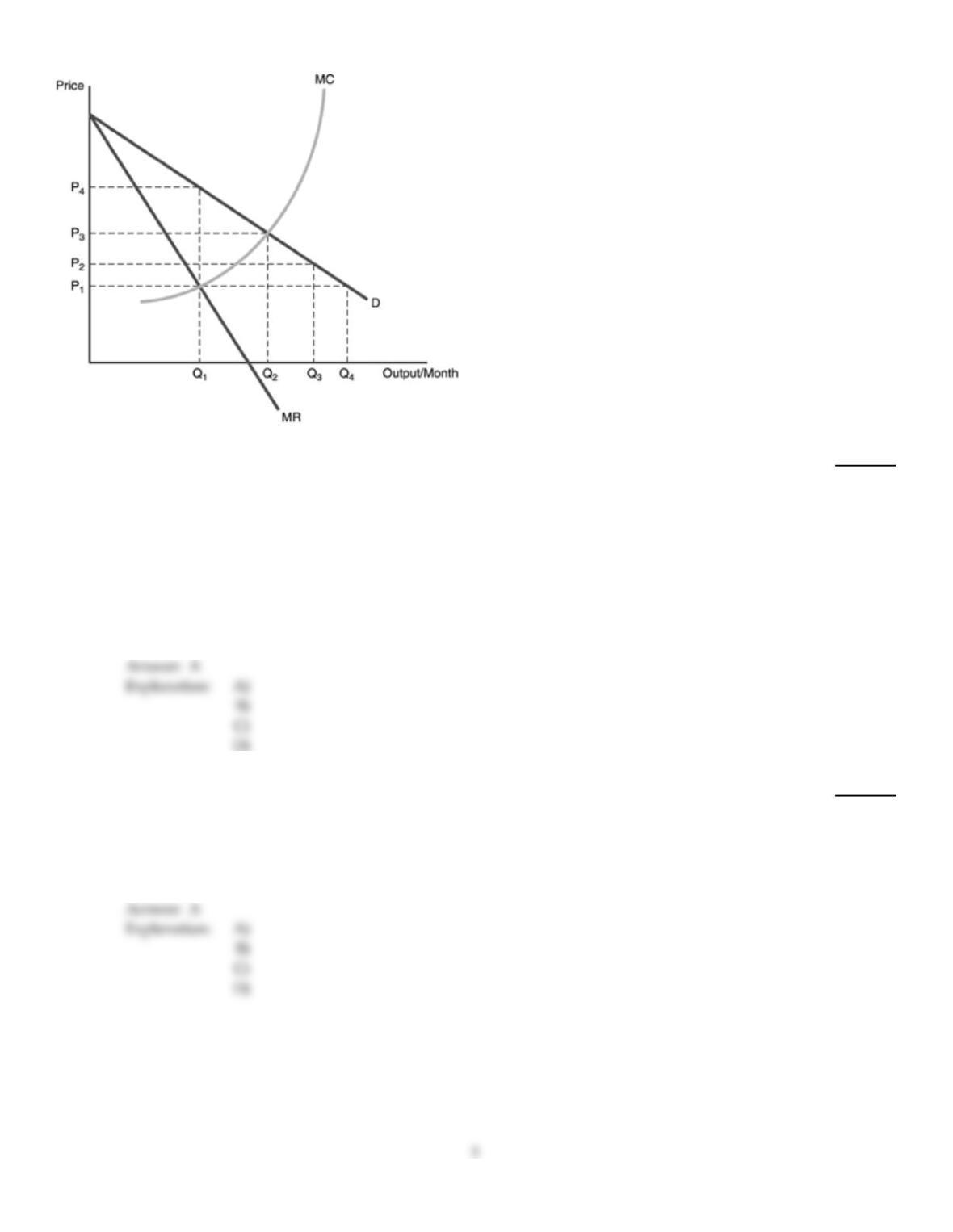
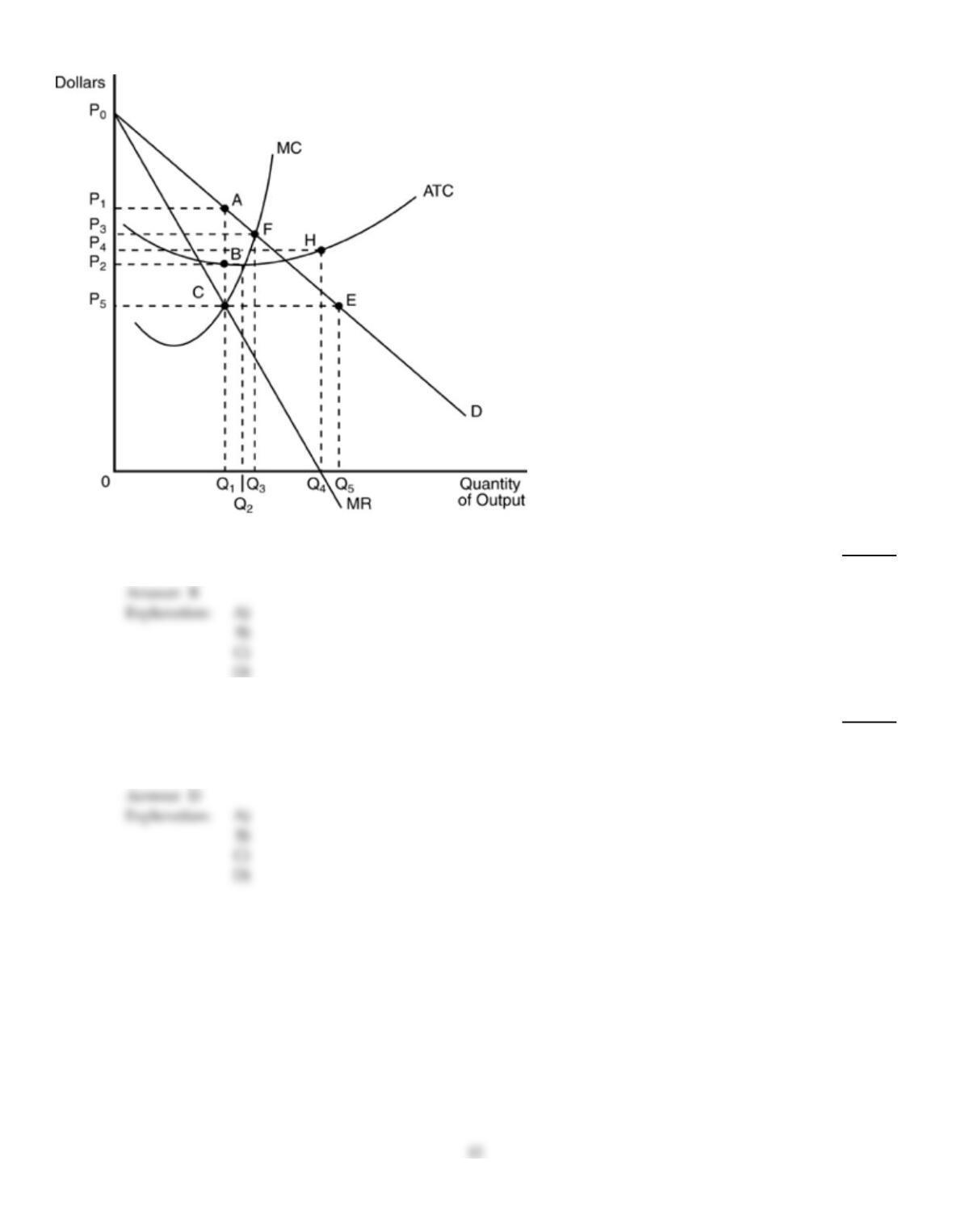
Refer to the above figure. Which of the following statements is true?
5)
A)
Under perfect competition price equals marginal cost (P3) while under monopoly price (P4) is
greater than marginal cost (P1).
B)
Under perfect competition, the efficient price is charged, which is the lowest price possible (
P1) while under monopoly output is too large (Q4) and price is too high (P4).
C)
Price equals marginal cost under both monopoly and perfect competition, but output is too
low under monopoly (Q1 instead of Q2).
D)
The rate of output is the same under both monopoly and perfect competition (Q1), but price is
higher under monopoly (P4 rather than P1).
6)
If the marginal cost curve of all identical firms in a perfectly competitive industry are horizontal at
the same per–unit cost, then the market’s consumer surplus equals the area
6)
A)
beneath the demand curve and above the marginal cost curve.
B)
above the demand curve.
C)
above the demand curve and beneath the marginal cost curve.
D)
below the marginal cost curve.
7)
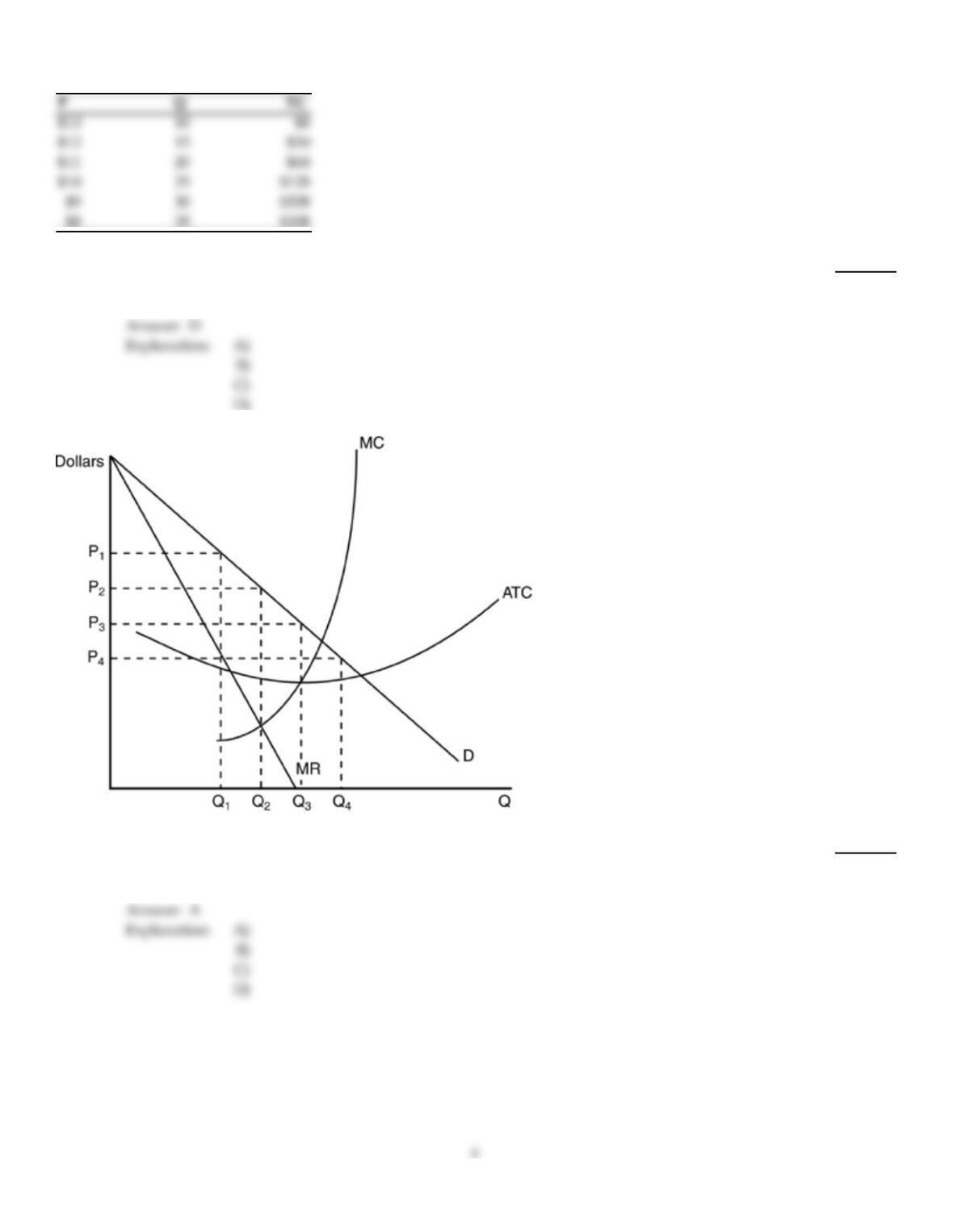
Refer to the above table. Given the demand and cost schedules, what are the maximized economic
profits for this monopolist?
7)
A)
$150
B)
$220
C)
$122
D)
$152
Explanation:
8)
In the above figure, if the firm is producing Q1 units at a price P1, the firm should
8)
A)
increase output and decrease price.
B)
shut down.
C)
not change output or price.
D)
decrease output and increase price.
Explanation:
9)
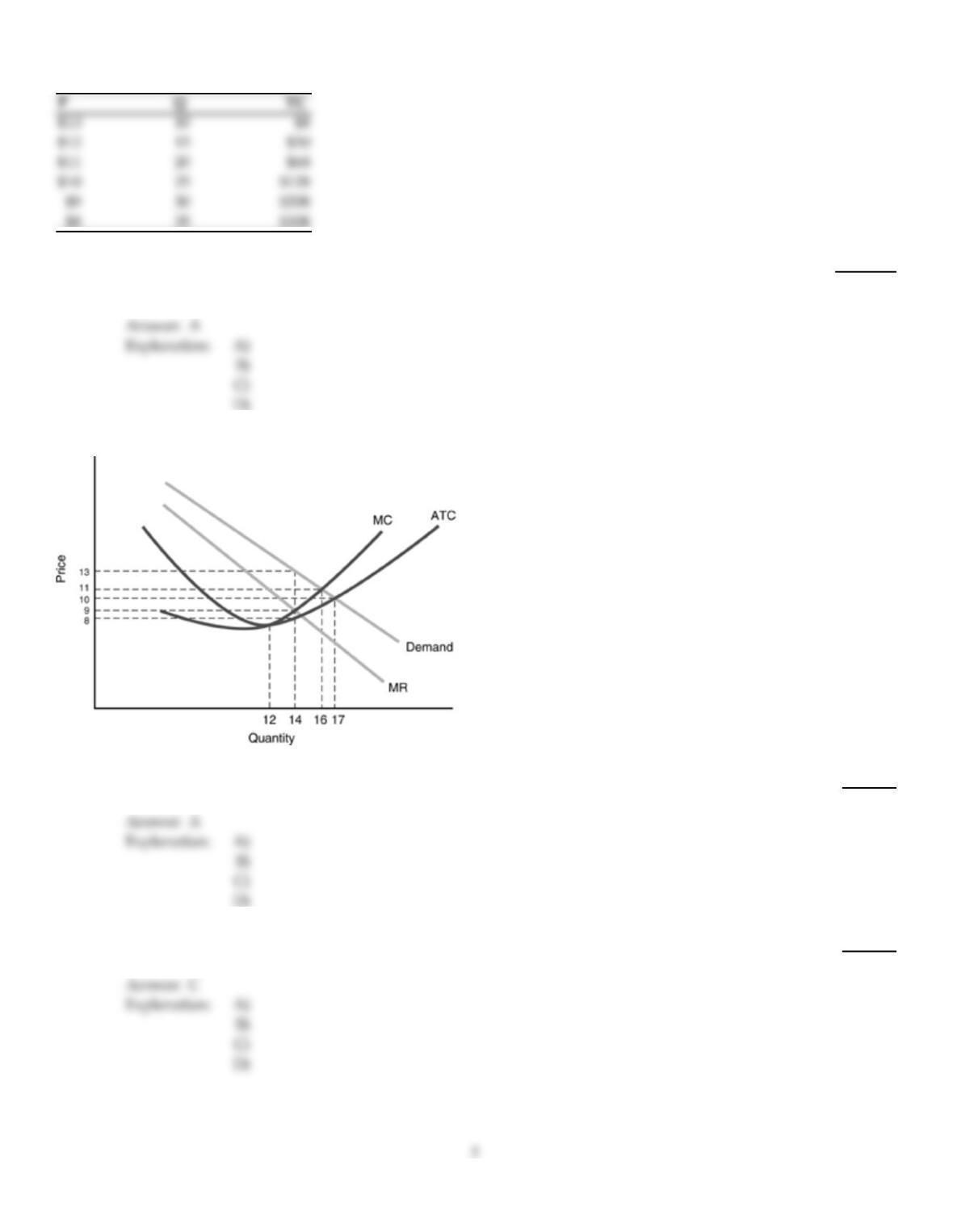
Refer to the above table. Given the demand and cost schedules, what is the profit–maximizing price
for this monopolist?
9)
A)
$11
B)
$13
C)
$10
D)
$12
10)
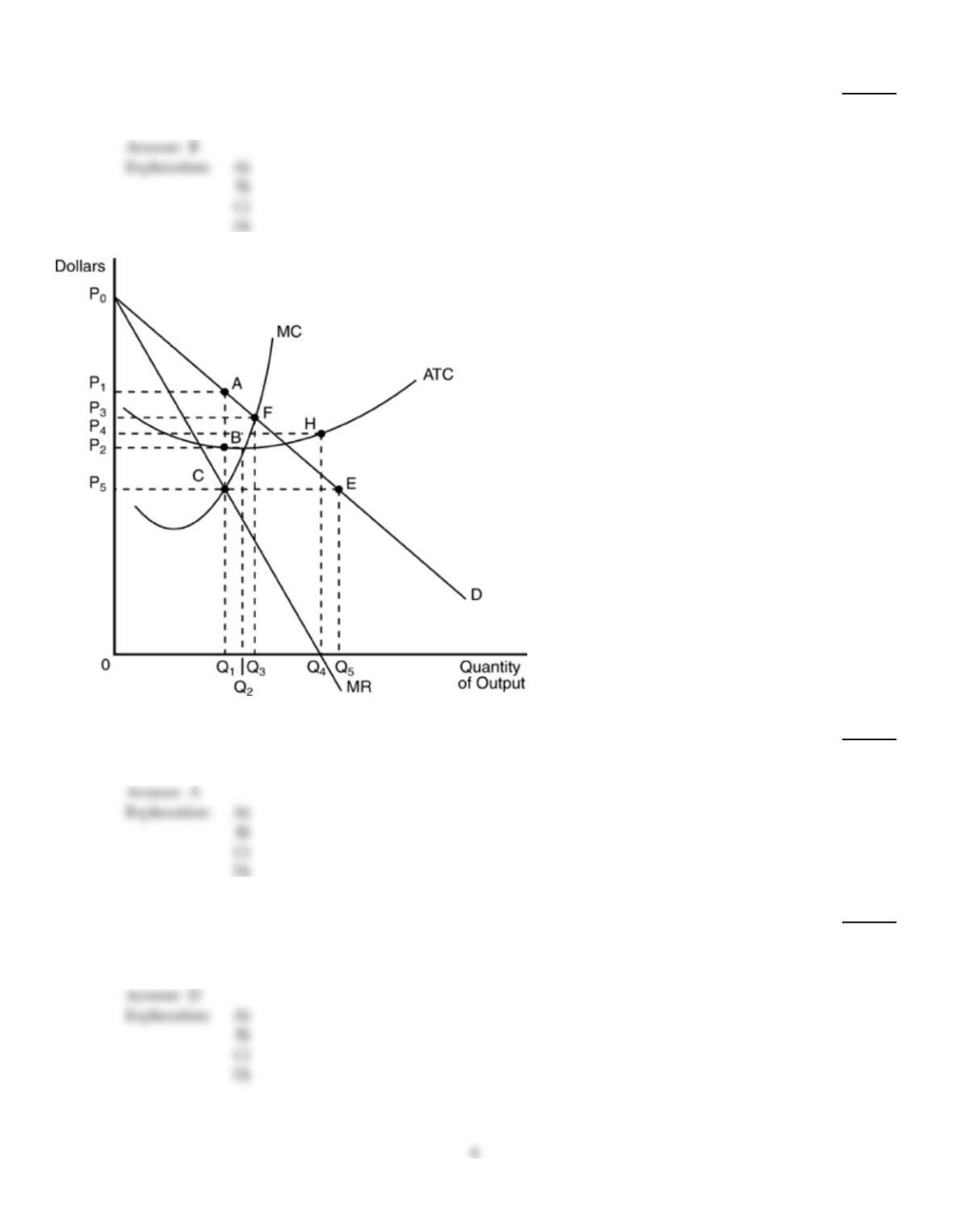
In the above figure, the break–even output and price is
10)
A)
$10 and 17.
B)
$11 and 16.
C)
$9 and 14.
D)
$13 and 14.
11)
For a profit–maximizing monopolist,
11)
A)
P = MR.
B)
P = ATC.
C)
P > MC.
D)
P = MC.
12)
Which of the following would most likely be classified as a natural monopoly?
12)
A)
Microsoft
B)
A city water district
C)
Exxon–Mobil
D)
Disneyland
13)
The profit–maximizing price and quantity of the monopolist compared to the perfectly competitive
industry in the above figure are, respectively
13)
A)
A and F.
B)
C and F.
C)
A and C.
D)
A and B.
14)
When a firm sells a given product at more than one price and the price difference is NOT caused by
differences in cost then there is
14)
A)
price delineation.
B)
price differentiation.
C)
price demarcation.
D)
price discrimination.
15)
Which of the following statements about a monopolist is TRUE?
15)
A)
Monopolies will always make a profit in the long run.
B)
Monopolies tend to allocate resources in a socially optimal manner.
C)
All monopolies are unlawful in the United States.
D)
Monopolies tend to misallocate resources.
16)
Suppose that the profit maximizing level of output for the monopolist is 10 units, and price = $50,
ATC = $35, and AVC = $25. What is the monopoly’s profit?
16)
A)
$50
B)
$250
C)
$150
D)
$500
17)
Unlike a perfectly competitive firm, a monopolist faces a demand curve that is
17)
A)
upward sloping.
B)
downward sloping.
C)
horizontal.
D)
vertical.
18)
Which of the following is NOT a necessary condition for price discrimination?
18)
A)
Separating markets for the good
B)
Preventing resale of the product
C)
Downward sloping demand curve
D)
Having a constant marginal cost
19)
A monopoly sells 5 units of output at $20. If the MR of the 6th unit is $14, then the price of the 6th
unit is
19)
A)
also $14.
B)
$19.
C)
$17.
D)
greater than $20.
20)
The demand curve faced by the monopolist
20)
A)
is identical to the firm’s MR curve.
B)
is the industry demand curve.
C)
is identical to the firm’s TR curve.
D)
has a constant price elasticity.
21)
The demand curve facing a monopolist will be more elastic
21)
A)
as the consumers’ need for the good increases.
B)
the greater is the number of substitute products.
C)
the greater is the amount of fixed costs to cover.
D)
as the number of consumers increases.
22)
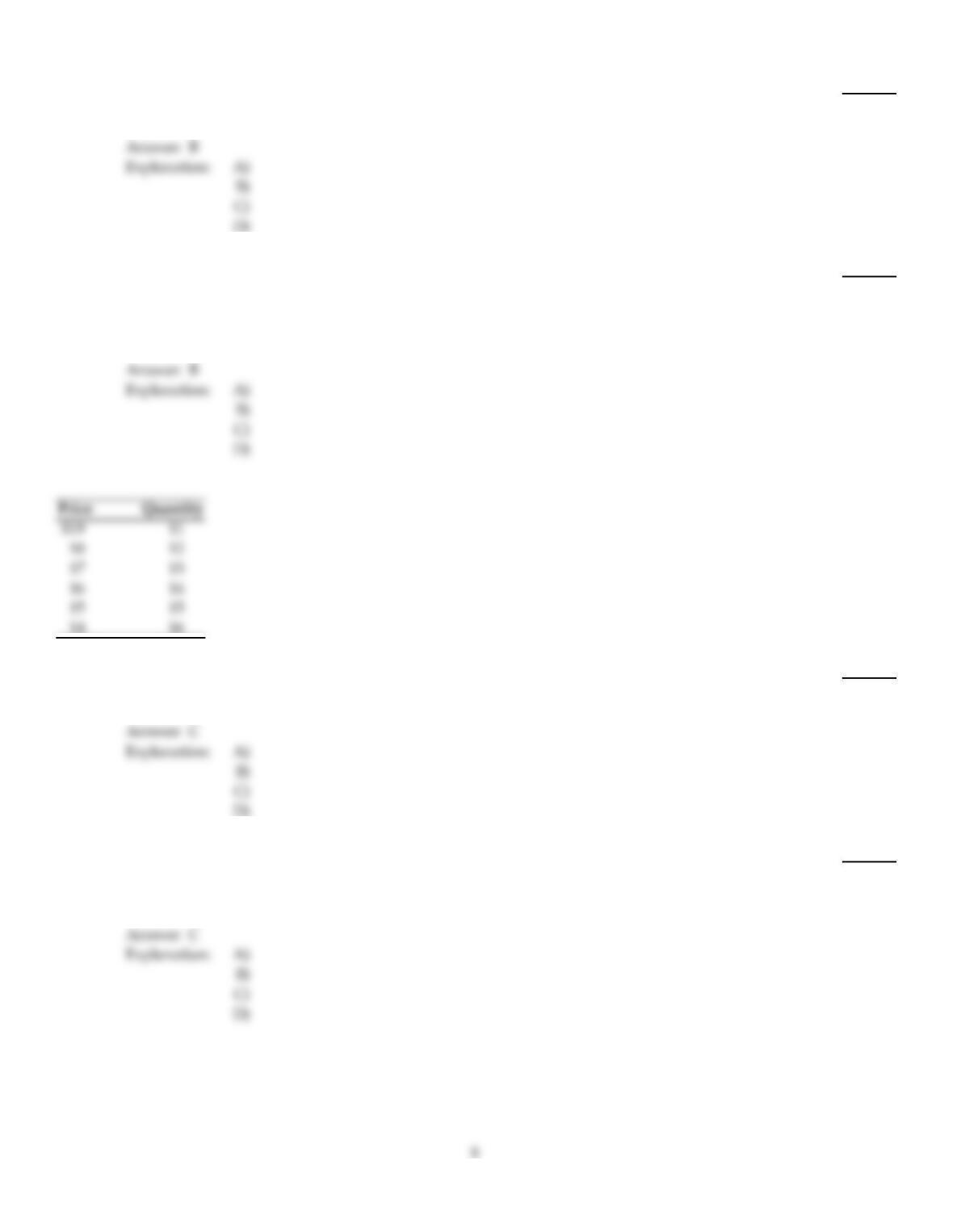
Given the data in the above table, the marginal revenue curve
22)
A)
lies above the demand curve.
B)
is equal to the demand curve.
C)
lies below the demand curve.
D)
intersects the demand curve.
23)
When a monopolist sells the same product at different prices and the prices are not related to cost
differences, we have
23)
A)
price differentiation.
B)
marginal cost pricing.
C)
price discrimination.
D)
monopoly pricing.
24)
For a firm to be able to engage in price discrimination, it must
24)
A)
have economies of scale.
B)
produce more than one product.
C)
have customers of different levels of wealth and age.
D)
face a downward sloping demand curve.
25)
A patent provides legal protection for an invention for
25)
A)
20 years.
B)
5 years.
C)
9 years.
D)
3 years.
26)
A firm that is the only seller of a good with no close substitutes is a(n)
26)
A)
oligopolist.
B)
monopolistic competitor.
C)
monopolist.
D)
perfect competitor.
27)
The monopolist will choose the price and output combination at which
27)
A)
MR equals AR.
B)
MC equals MR.
C)
MC equals AR.
D)
MC equals price.
28)
If it is not possible for a pharmaceutical drug maker to sell its generic cholesterol reducing drug
along with some name brand cholesterol reducing drugs, we have an example of
28)
A)
monopoly due to ownership of key resources.
B)
monopoly due to economies of scale.
C)
monopoly due to governmental entry restrictions.
D)
pure competition.
29)
A patent on a product gives a firm
29)
A)
the power to impose a tariff on a competing product.
B)
protection from having the invention copied or stolen for a period of 20 years.
C)
economies of scale in producing the product.
D)
excessive profits in the long run.
30)
In the above figure, a monopolist will set its level of output and price at
30)
A)
Q2 and C, respectively.
B)
Q1 and A, respectively.
C)
Q3 and F, respectively.
D)
Q1 and B, respectively.
31)
A monopoly misallocates resources when it
31)
A)
makes an above–normal profit.
B)
restricts output so that the marginal benefit of the last unit sold exceeds the marginal social
cost of producing the good.
C)
exploits scale economies.
D)
sells the same product to different groups of customers at different prices.
32)
Refer to the above table. Given the demand and cost schedules, what is the profit–maximizing price
for this monopolist?
32)
A)
$12
B)
$11
C)
$9
D)
$10
33)
Given the data in the above table, what is the marginal revenue when the 13th unit is sold?
33)
A)
$1.00
B)
$3.00
C)
$7.00
D)
$5.00
34)
The effect of a tariff
34)
A)
will be more beneficial to large firms than to small firms.
B)
can lead to a monopoly advantage for firms inside the U.S. since they become the sole
suppliers inside the U.S.
C)
can lead to economies of scale for firms inside the U.S.
D)
is negligible since it applies to firms outside the U.S.
35)
In the above figure, at the firm’s profit maximizing output, total revenue is rectangle
35)
A)
0P5EQ5.
B)
0P1AQ1.
C)
0P3FQ3.
D)
0P2BQ1.
36)
Legal or governmental restrictions that give monopolistic advantages to a firm include all of the
following EXCEPT
36)
A)
franchises.
B)
licenses.
C)
tariffs.
D)
economies of scale.
37)
The monopolist determines the price and quantity combination that maximizes short–run profits
by
37)
A)
finding the point at which marginal revenue and demand intersect. This gives the price and
quantity that maximizes profits.
B)
finding the quantity at which average revenue and average total cost are furthest apart.
C)
determining the price by finding the highest price at which sales can be made and then using
the demand curve to find the appropriate quantity.
D)
finding the quantity at which marginal cost and marginal revenue are equal and then using
the demand curve to find price.
38)
The point of profit maximization for a monopolist is exemplified by
38)
A)
ATCmin.
B)
TR = TC.
C)
MR = MC.
D)
MR > MC.
C
39)
A firm that faces a downward sloping demand curve is known as a
39)
A)
perfect competitor.
B)
utility maximizer.
C)
price searcher.
D)
price taker.
C
40)
If government regulations significantly increase the cost of operating within a particular market,
one result is that
40)
A)
a perfectly competitive market environment is encouraged.
B)
barriers to entry are nullified.
C)
new firms are encouraged to enter the market.
D)
new firms are discouraged from entering the market.
D
D
41)
The price–output combination that maximizes profits for a monopolist occurs at the point where
41)
A)
the elasticity of demand equals one.
B)
total revenues and total costs are equal.
C)
the difference between total revenues and total costs is the greatest.
D)
total revenues are the greatest.
42)
An important difference between a perfectly competitive firm and a monopolist is
42)
A)
the goals of the owners of the firms.
B)
the size of the firms.
C)
the shape of the demand curve each faces.
D)
a monopolist normally produces a service, while a perfect competitor normally produces a
good.
43)
Senior citizens can buy movie tickets at a lower price than the general public. This is an example of
43)
A)
demand discrimination.
B)
price discrimination.
C)
price differentiation.
D)
age discrimination.
44)
Which of the following is NOT a condition for price discrimination to exist?
44)
A)
identification of buyers with differing elasticities
B)
unpatented product or the service
C)
downward sloping demand curve faced by the firm
D)
ability to prevent the resale of the product or service
45)
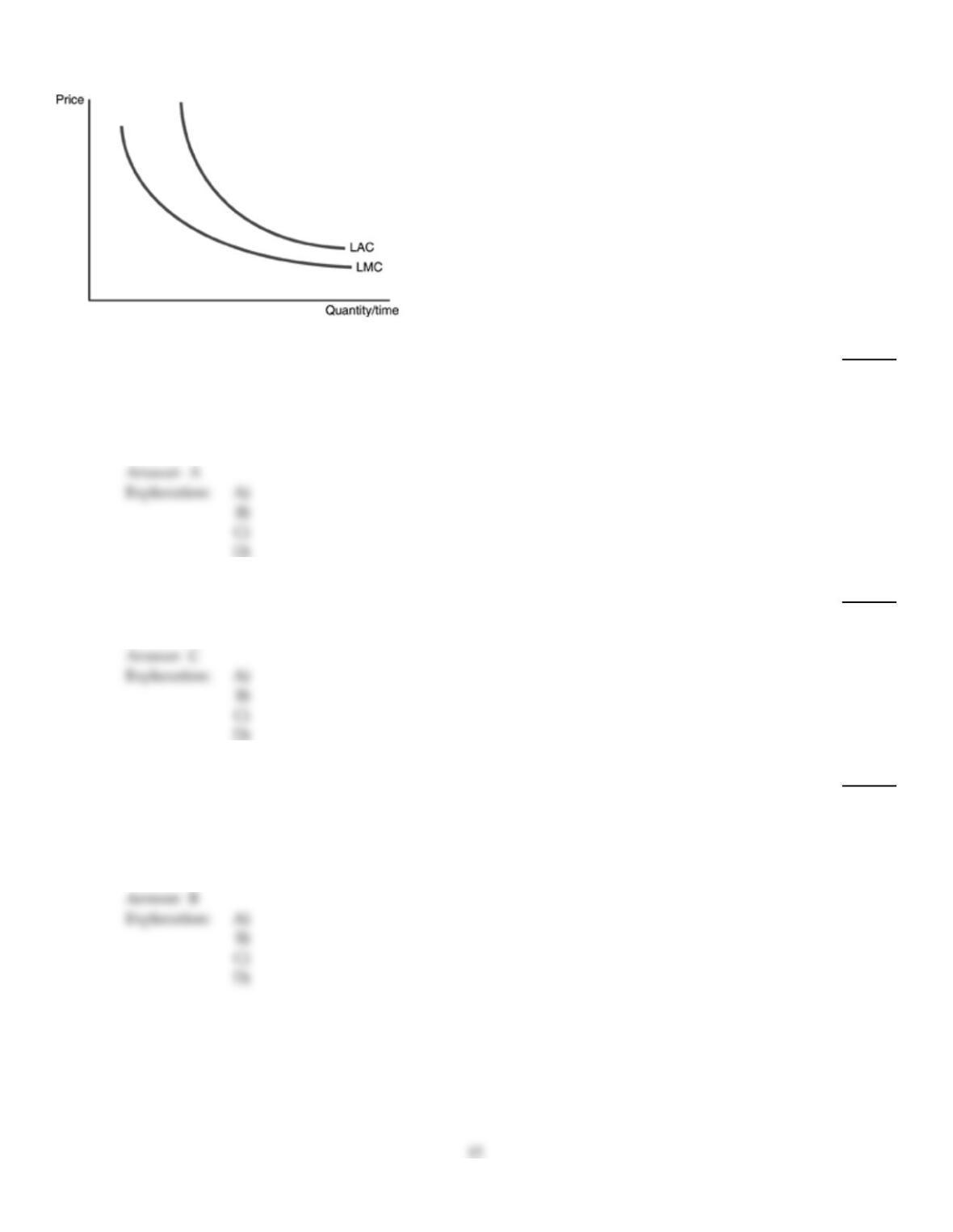
Refer to the above figure. The long–run average cost curve and the long–run marginal cost curves
represent
45)
A)
the cost curves for a natural monopoly.
B)
a situation where a firm has a patent.
C)
the cost curves for a competitive firm.
D)
a situation where a firm has control over the raw materials.
46)
A monopolist will maximize its profits by charging a higher price for customers with a price
elasticity of
46)
A)
1.
B)
1.5.
C)
0.1.
D)
10.
47)
For a monopolist, the marginal revenue gained when one more unit of output is sold is
47)
A)
negative if price is above the midpoint of the demand curve.
B)
the price at which the extra unit is sold minus the loss in revenue that results from cutting the
price on units sold previously.
C)
the average revenue created by the increased sales.
D)
equal to the price of the product.
48)
Compared to perfectly competitive firms, the demand curve for a monopolist will be
48)
A)
less elastic.
B)
as elastic.
C)
more elastic.
D)
perfectly elastic.
49)
Which of the following is not true when there are large economies of scale such that one firm can
produce at a lower average cost than can be achieved by multiple firms?
49)
A)
The long–run average cost curve of the firm will increase at a low level of output.
B)
There will only be one firm in this industry.
C)
This situation produces a natural monopoly.
D)
Proportional increases in output yield proportionally small increases in total cost.
A
50)
Considering the spectrum of market structures and moving from pure competition to pure
monopoly we can say that
50)
A)
entry becomes harder but exit becomes easier.
B)
entry barriers get lower but exit gets more difficult.
C)
entry gets harder and the number of firms dwindles.
D)
none of the above
C
51)
A price–discriminating monopolist will equate
51)
A)
marginal revenue and marginal cost in each market.
B)
average revenue and marginal revenue in each market.
C)
price and marginal cost in each market.
D)
price and marginal revenue in each market.
A
A
52)
The monopolist’s marginal revenue is less than price since
52)
A)
average revenue is also less than price.
B)
additional units can only be sold if the price is lowered on all units sold.
C)
average total cost is declining.
D)
the demand function is horizontal.
53)
If a monopolist raises its price,
53)
A)
it raises the barriers to entry.
B)
the quantity demanded decreases.
C)
the quantity demanded remains the same.
D)
the quantity demanded increases.
B
54)
If a firm is price differentiating, then it is
54)
A)
charging different prices based on advertising costs.
B)
producing a homogenous product.
C)
charging different prices to different consumers based on differences in marginal costs.
D)
charging different prices based on quality.
C
55)
For a monopolist,
55)
A)
there is no relationship between marginal revenue and price.
B)
marginal revenue is greater than price for all units being sold except for the first unit.
C)
marginal revenue is less than price for all units being sold except the first unit.
D)
marginal revenue is equal to price for all units being sold.
C
B
56)
If a monopolist wants to increase the amount it sells, it
56)
A)
must lower the cost of production.
B)
must lower the price on all units.
C)
will keep the price the same.
D)
must accept lower profits.
57)
Selling a product at different prices when the price difference is unrelated to costs is a practice
known as
57)
A)
price differentiation.
B)
price monopolization.
C)
price fixing.
D)
price discrimination.
Explanation:
58)
In equilibrium, which of the following conditions is common to both unregulated monopoly and
pure competition?
58)
A)
AR = ATC
B)
MR = MC
C)
MC = P
D)
P = MR
Explanation:
59)
One problem associated with a monopoly firm is that it
59)
A)
is just as good as a purely competitive firm in terms of output and price.
B)
produces too much output and charges too low a price.
C)
restricts output and charges a relatively higher price than a purely competitive firm.
D)
produces too little output but also charges a low price.
Explanation:
60)
In order for a firm to receive monopoly profits, there must be
60)
A)
free entry and exit to the market.
B)
barriers to market entry.
C)
mutual interdependence among firms.
D)
homogeneous products.
Explanation:
Explanation: